Donald Trump, as everyone knows, hates wind power and loves coal. Both passions are deeply irrational. Yet they are shaping policy.
Trump is doing his best to kill wind power, going so far as to order work halted on a mostly completed wind farm off the coast of Rhode Island. (Orsted, the Danish company behind the project, has sued and gotten the stop-work order lifted.)
And the administration is trying to revive coal, opening federal land for mining, removing pollution limits and providing hundreds of millions of dollars in subsidies. But why?
Administration officials would have you believe that coal mining is an economically viable industry that has been sabotaged by liberals. On Monday Chris Wright, the energy secretary, declared — in a weirdly dated culture war cliché — that coal is “out of fashion with the chardonnay set in San Francisco, Boulder, Colo., and New York City.”
The truth, however, is that coal is a dying industry for very good reasons, and anti-wokeism is unlikely to revive it.
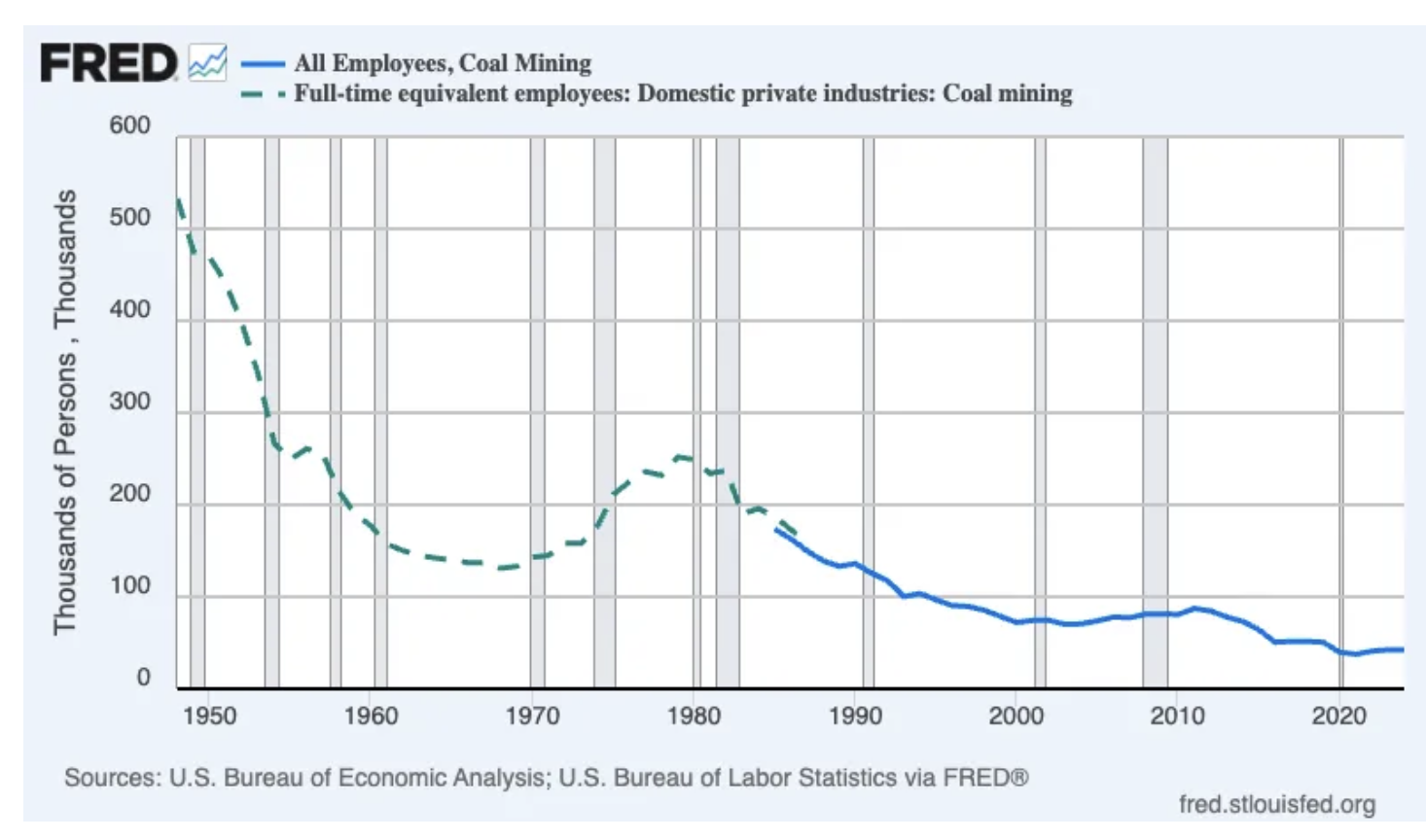
Coal stopped being a significant source of jobs decades ago:
At this point there are only around 40,000 coal miners left. In case you’re wondering, vineyards and wineries employ around 130,000 people, three times as many as the coal industry.
Where did all the coal jobs go? The answers may surprise you.
As you can see in the chart above, there was an epic decline in coal employment between 1950 and the 2000s, from half a million miners to around 80,000. But this employment decline didn’t reflect an economy turning away from coal. In fact, use of coal to generate electricity rose steadily over the whole period, peaking in 2008:
So what happened to all the coal jobs? Basically, workers were displaced first by giant power shovels (strip mining), then by explosives used to blow the tops off mountains, exposing the coal beneath. By using these techniques, in 2008 coal companies were able to produce twice as much coal as they did in 1950, while employing 80 percent fewer workers. Don’t blame renewables
Coal consumption finally did start declining after 2008. But if you look at the chart above, you can see that until recently coal was mainly replaced, not by renewable energy, but by natural gas — which became cheap and abundant thanks to the rise of fracking.
Solar and wind power have finally become important sources of energy in recent years. But the reason they have grown rapidly while coal has declined isn’t that the chardonnay set considers coal unfashionable. It’s the simple fact that coal is no longer cost-competitive, while wind and solar are.
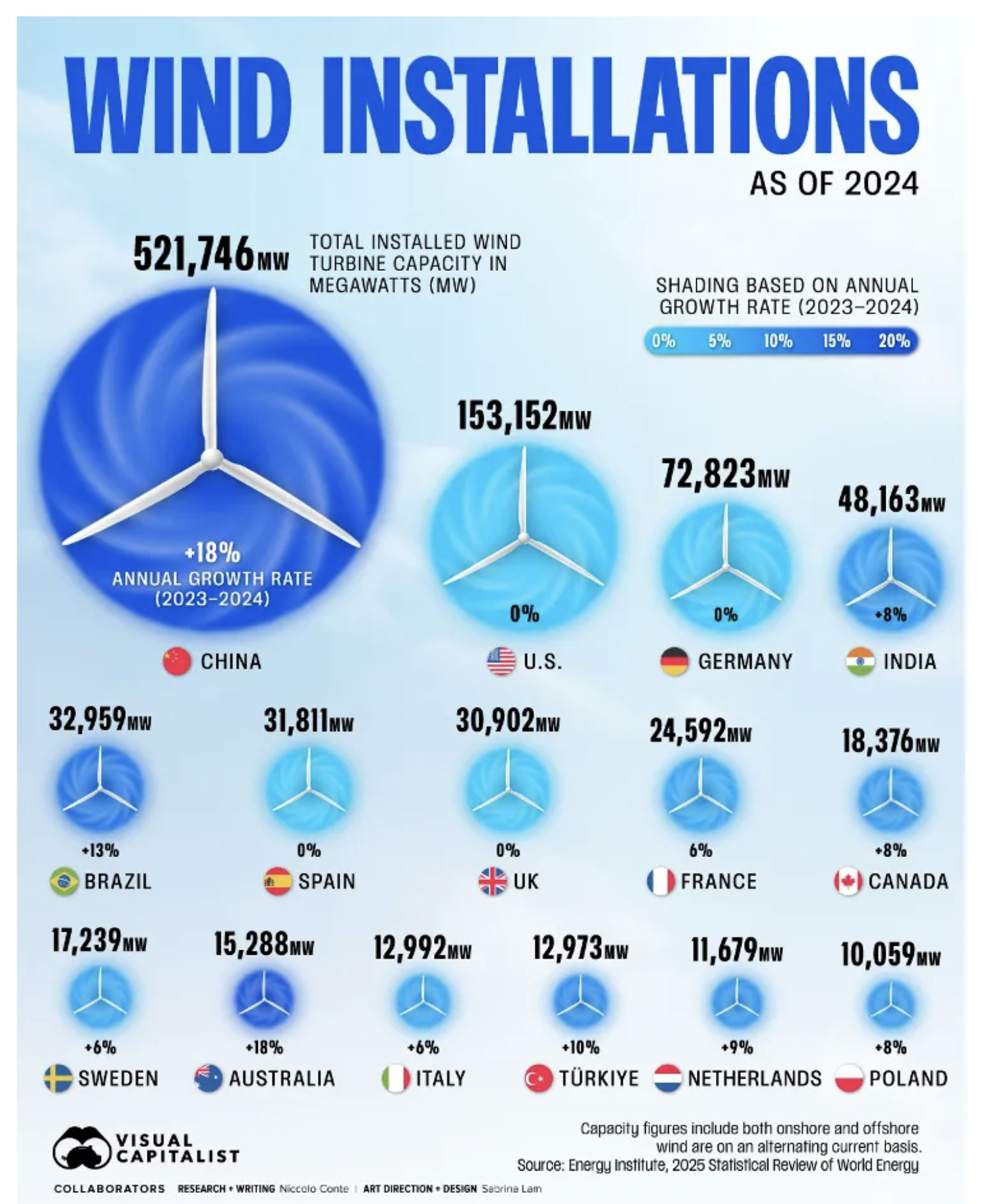
Needless to say, Trump and company aren’t going to acknowledge these facts. They may not even be aware of them. In his speech at the U.N. General Assembly, Trump declared that the Chinese sell a lot of wind turbines to the rest of the world, “but they barely use them.”
Chinese sell a lot of wind turbines to the rest of the world, “but they barely use them – Donald Trump Take a look at this chart and know the facts.
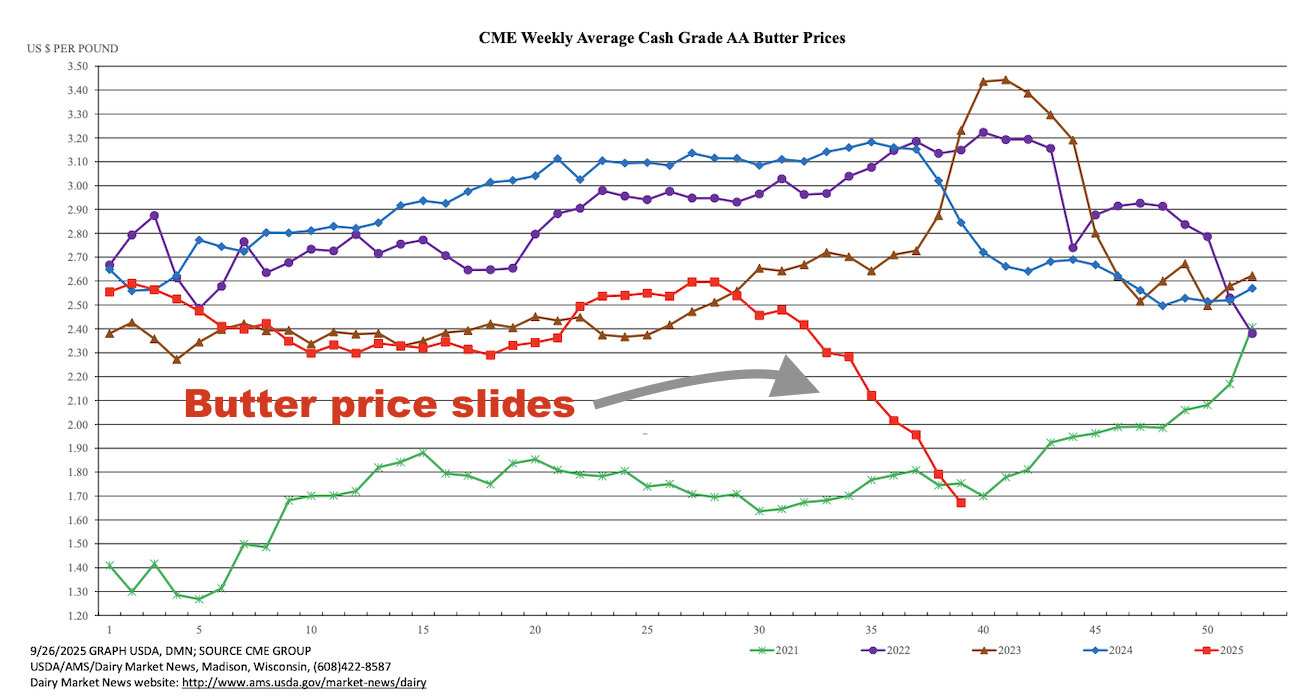
Butter prices started heading south in July this year (red on chart)
Butter prices have dropped to a multi-year low – around $1.80 a pound in September – well below the $2 historical threshold.The Daily Dairy Report notes that the $2.00-per-pound butter price compares to the annual CME butter price average of $2.8645 per pound in 2024, $2.5938 per pound in 2023, and $2.8596 per pound in 2022.
By the way, a recent government report says in 2024 farmers received 57 percent of what consumers paid for butter. Consumers typically pay around double what the farmer gets.
More cows
This last week’s Milk Producers Council newsletter writes that”Milk is absolutely gushing out of the U.S. dairy industry. Milk production reached 19.52 billion pounds in August, up 3.2% from a year ago. USDA revised its estimate of July milk output and cow numbers upward significantly. The agency now reports that dairy producers added 35,000 cows in July and another 10,000 head in August. That put the August milk-cow herd at 9.52 million head, larger thanat any time since late 1993 and up 176,000 head from a year ago.
The output is helping to reduce this fall’s milk checks for farmers. “Record-setting component levels continue to supercharge the growth in milk output. With 3.2% more milk, U.S. cows made 5% more butterfat.”
It’s not just butter but most milk-based products that are heading south.” The October Class III (think cheese) contract slumped 38ȼ to $16.80 per cwt., with similar losses and prices into early 2026. October Class IV (butter- powder) futures plummeted 60ȼ to $14.75. When October milk checks arrive in about six weeks, dairy producers who are exposed to the Class IV markets are sure to be disappointed.”
Dairy profitability depends on an average milk price at least in the high teens. In Kings County the average price in the annual crop report for milk was $26 per cwt in 2022,$19.30 in 2023,$19.10 in 2021 and $18.60 in 2020 (think Covid).
USDA has weighed in predicting the average price of milk will be about $1 lower in 2026 than this year.
Cattle Prices Set Record Highs
USDA says the August price for slaughter steers in the 5-area marketing region set a new monthly average record at $243.14 per hundredweight (cwt), which was $6 higher than July and almost $54 above August last year. In early September, weekly cattle and wholesale prices softened from the daily highs set in late August but remain historically elevated. As a result, the third-quarter price forecast for slaughter steers is raised by $2 to $240.00 per cwt and the fourth quarter is raised $4 to $244.00 per cwt. With that price strength being carried into 2026, the forecast for the annual price is raised $5 to $248.50.
Cattle prices are at record highs due to a low national cattle inventory after years of drought. Meanwhile there is strong consumer demand for beef and higher production costs. This summer shoppers are paying $6.25 per pound for ground beef.
Beef Exports down
USDA reports that U.S. beef exports in July totaled 211 million pounds, 19 percent lower than a year ago largely due to current trade disputes. Monthly exports to the top six markets were lower year over year except for South Korea, which were up 15 percent year over year. Exports to China were down 94 percent while exports to Taiwan were nearly 26 percent lower year over year. Exports to Mexico were 17 percent lower than July 2024.
California’s first solar-covered canal is now fully online
This story was originally published by Canary Media
The 1.6-MW pilot system is among a growing number of initiatives to put solar over waterways. The approach could generate gigawatts of power nationwide.
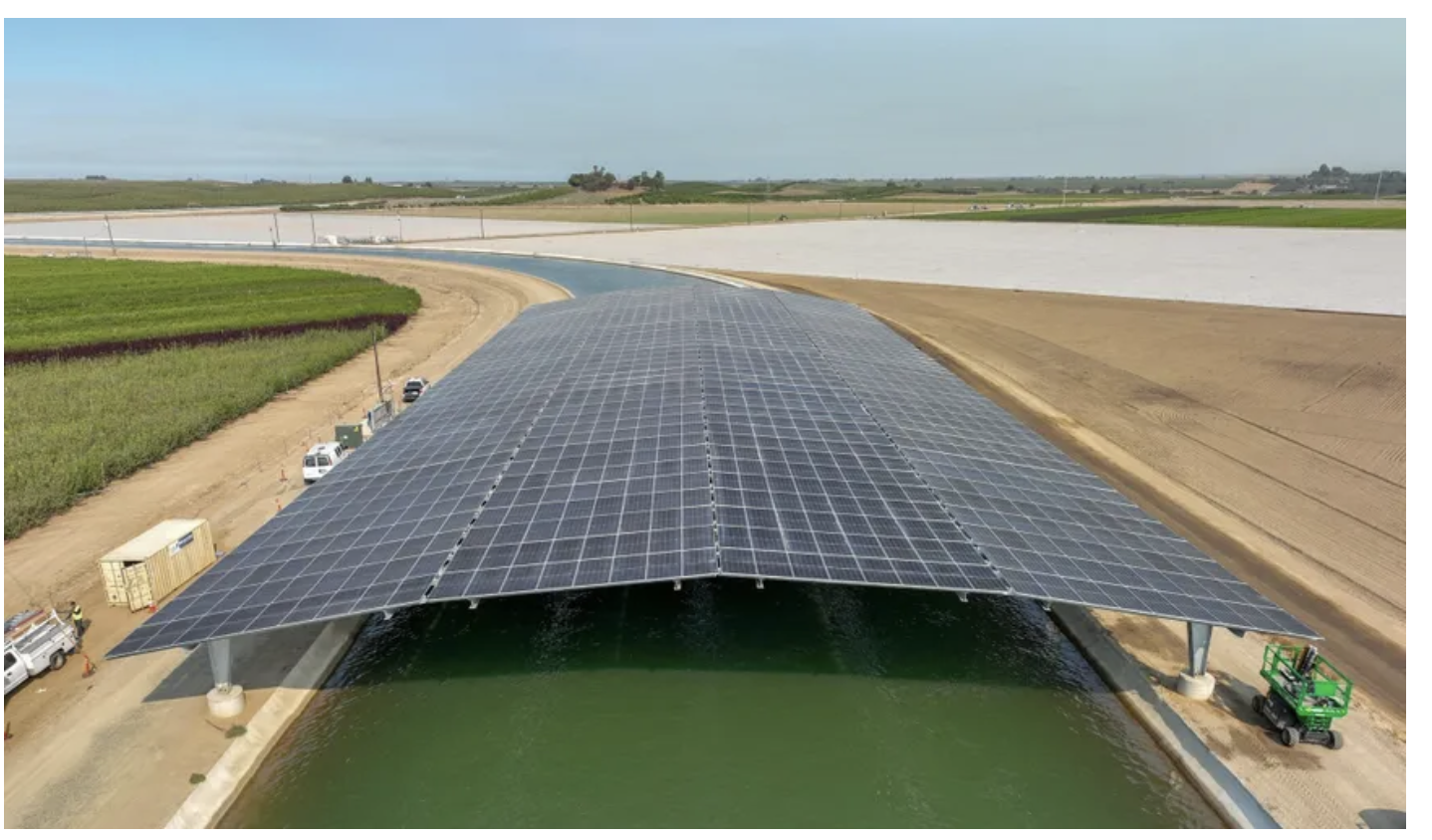
The roughly 110-foot-wide portion of the canal-top solar project near Hickman, California. (Turlock Irrigation District)
A novel solar power project just went online in California’s Central Valley, with panels that span across canals in the vast agricultural region.
The 1.6-megawatt installation, called Project Nexus, was fully completed late last month. The $20 million state-funded pilot has turned stretches of the Turlock Irrigation District’s canals into hubs of clean electricity generation in a remote area where cotton, tomatoes, almonds, and hundreds of other crops are grown.
Project Nexus is only the second canal-based solar array to operate in the United States — and one of just a handful in the world. America’s first solar-canal project started producing power in October 2024 for the Pima and Maricopa tribes, known together as the Gila River Indian Community, on their reservation near Phoenix, Arizona. Two more canal-top arrays are already in the works there.
In California, the solar-canal system was built in two phases, with a 20-foot-wide stretch completed in March and a roughly 110-foot-wide portion finished at the end of August. Researchers will study the project’s performance over time, while a new initiative led by California universities and the company Solar Aquagrid will push to fast-track the deployment of solar canals across the state.
Proponents of this emerging approach say it can provide overlapping benefits.
Early research suggests that, along with producing power in land-constrained areas, putting solar arrays above water can help keep panels cool, in turn improving their efficiency and electricity output. Shade from the panels can also prevent water loss through evaporation in drought-prone regions and can limit algae growth in waterways.
Plus, solar canals could offer a faster path to clean energy development than utility-scale solar farms, especially in rural parts of the U.S. where big renewables projects increasingly face community opposition. Placing solar panels atop existing infrastructure doesn’t require altering the landscape, and the relatively small installations can be plugged into nearby distribution lines, avoiding the cumbersome process of connecting to the higher-voltage wires required for bigger undertakings.
UC Merced says an almond orchard in Parlier provides a look into the future of farming.
Researchers at UC Merced and the University of California Agriculture and Natural Resources installed an irrigation system powered by artificial intelligence to deliver the precise amount of water needed and measure the results.
Led by computer science and engineering Professor Wan Du, the project was funded through the Fall 2023 Climate Action Seed Funds. It included a goal that’s almost as important as the work itself: spreading the word about the system and its potential.
The project includes two test beds: one irrigated via traditional methods and one served by the AI-powered system. Du is working alongside civil and environmental engineering Professor Safeeq Khan, a water resource management and soil science expert who built the soil model for the project, and computer science and engineering Professor Stefano Carpin, who developed the AI model.
“We will compare how much water each test bed will use,” Du said, “and then compare the production and result of these two fields.”
The system measures how much moisture is in the soil, then the potential for movement of water through a tree and eventually out the leaves. The data is uploaded to the internet.
“We have sprinklers under almost every tree so we can control them,” Du said. An algorithm processes the data and determines whether to open a sprinkler and how long it should run.
“We want to save as much water as we can,” Du said. “Saving water will reduce the cost to growers, and we can save the natural resource for the next generation.”
The system will be operational next spring, when the trees start to flower.
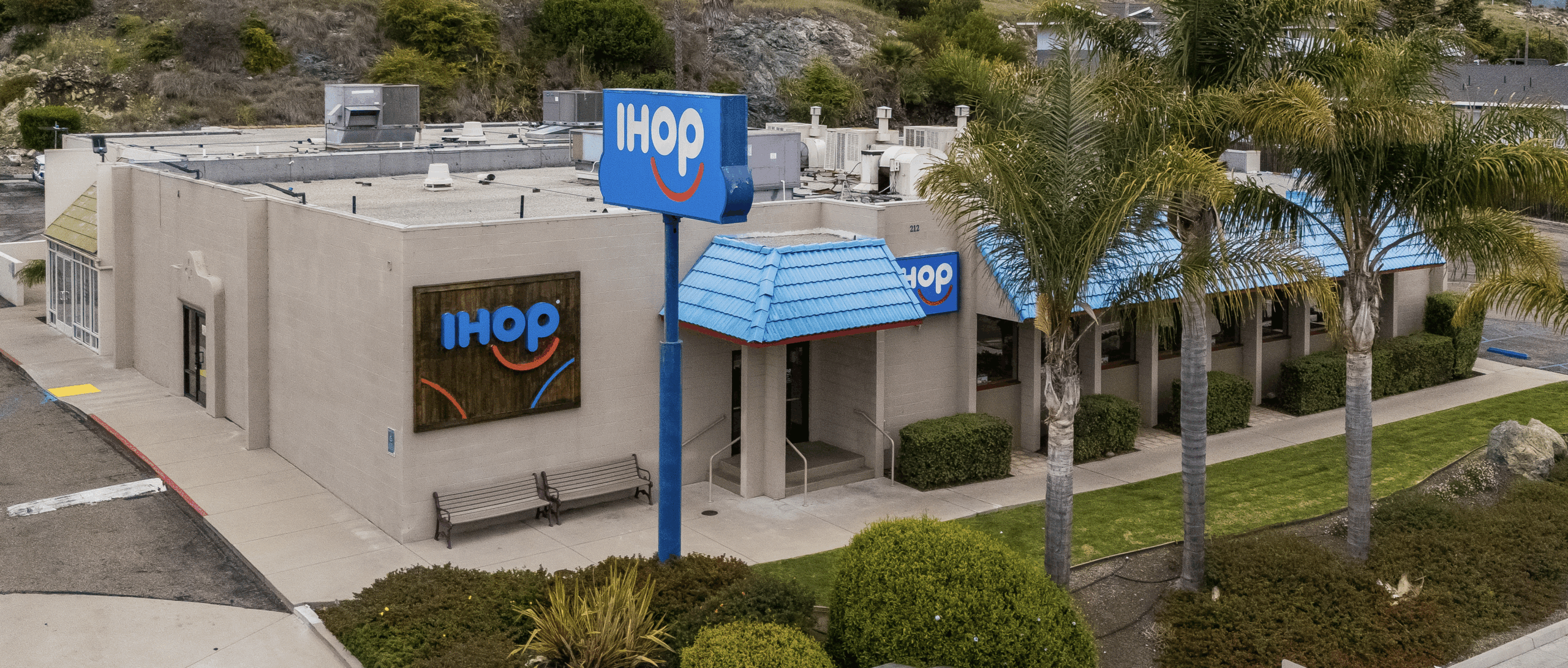
No announcement from the management, but the IHOP restaurant property on Madonna in San Luis Obispo is for lease according to a real estate company. McCarty Davis Real Estate website says the 1971 built pancake house will be available as of January 1, 2026 – just a few months from now. Unlike some IHOP restaurants, the eatery is not open for dinner, but just breakfast and lunch.Reports says IHOP closed 88 locations in 2024 and planned to close another 70 to 90 locations in 2025. There has been a struggle for customers in the casual dining and family-dining sector – sit down restaurants that are less popular these days.
Among the younger generation going out for a sit down breakfast is also out of favor. A recent study of Gen Z found they are less likely to dine out for breakfast compared to older generations. Instead they go for quick, at-home, or grab-and-go options like smoothies, granola bars, and make-ahead items.
SLO airport traffic up, LAX down
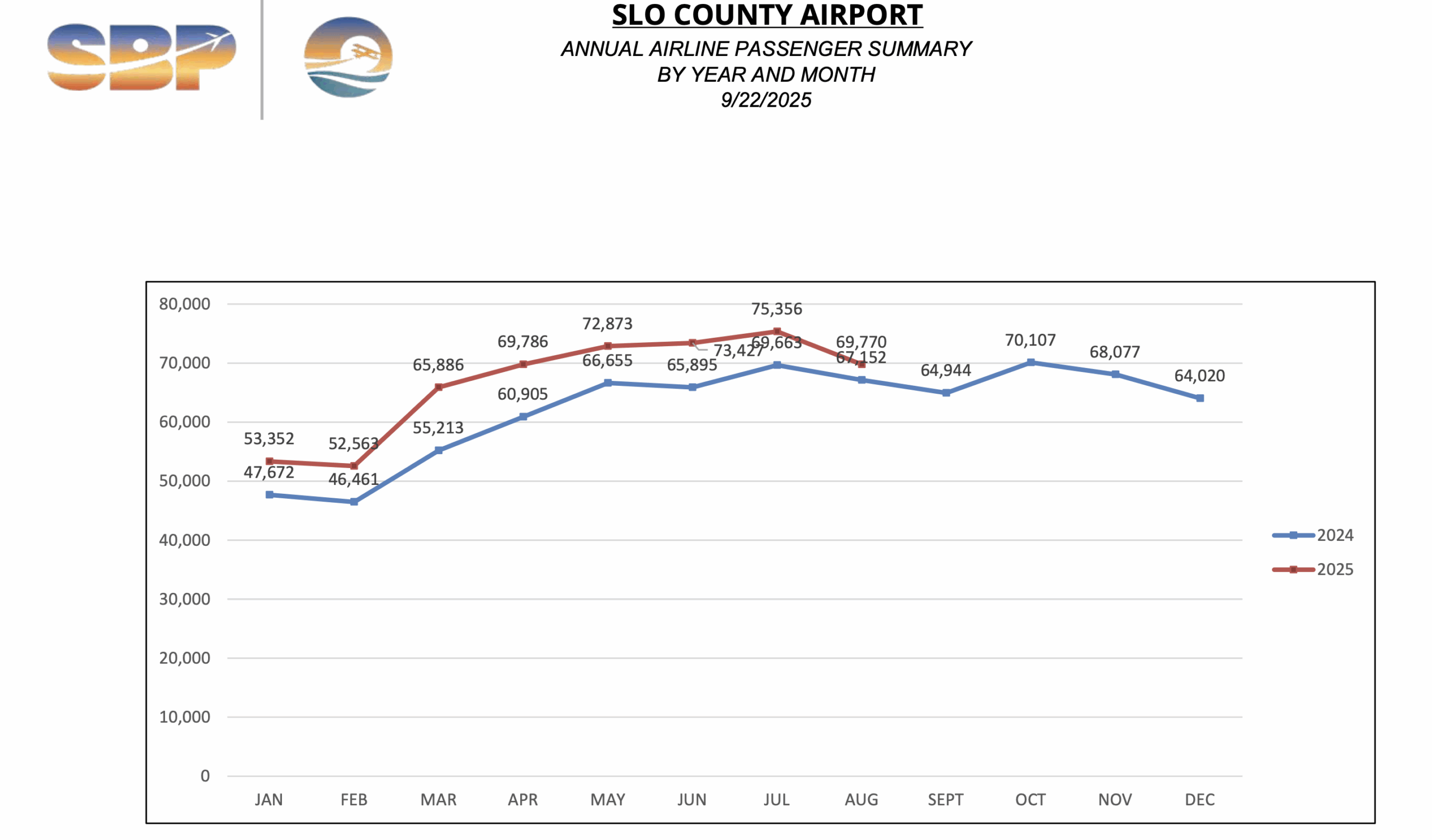
San Luis Obispo airport is seeing an uptick in passenger traffic so far this year ,up each month according to the latest statistics. (red on above chart). Meanwhile passenger numbers at LAX are down in August for both domestic travel, down 5.1% and international- down about 2%compared to Aug 2024.Year over year passenger numbers are down 4.3%.Air cargo is down 10%.
Albertsons may open drugstore at former Morro Bay Rite-Aid
Employees at the Morro Bay Albertsons says the grocer has won a round of bidding to take over the next door Rite Aid store property vacated by the bankrupt drug chain. The intention is to install an Albertsons Pharmacy in the building next year.
Chase closes one Arroyo Grande branch
JP Morgan Chase has shuttered one of their two Arroyo Grande branches on 900 Rancho Parkway according to a notice filed with the Office of the Comptroller Of the Currency. Chase’s branch at 1242 E Grand Ave remains open.
SLO County home permits up
Construction Monitor reports that 394 single-family home permits have been issued in San Luis Obispo County so far in 2025, up from 288 in the same 9 months of 2024,231 in 2023 and down from 464over the same period in 2022.
In another report, the California Association of Realtors says home sales were up in August in San Luis Obispo County.In SLO County sales of existing homes were up 3.4% year over year. August’s median price dropped from $940,000 in July to $935,000 in August 2025.Next door Santa Barbara County reported a 32.6% year over year increase in its median home price.
200 lose hope at City of Hope
City of Hope announced more than 200 employees will be laid off by December 1 confirmed in a state WARN notice.The cuts were described as part of a strategic realignment and mainly affected business support and operational roles. A spokeswoman for Duarte-based City of Hope stated that patient care would not be directly impacted.The layoffs were concentrated among business support and operations staff, spanning all levels of management The has multiple locations around the LA area.The cuts were the first workforce reduction in 25 years. Privately owned City of Hope is best known as a cancer treatment center. It has been designated a Comprehensive Cancer Center by the National Cancer Institute.
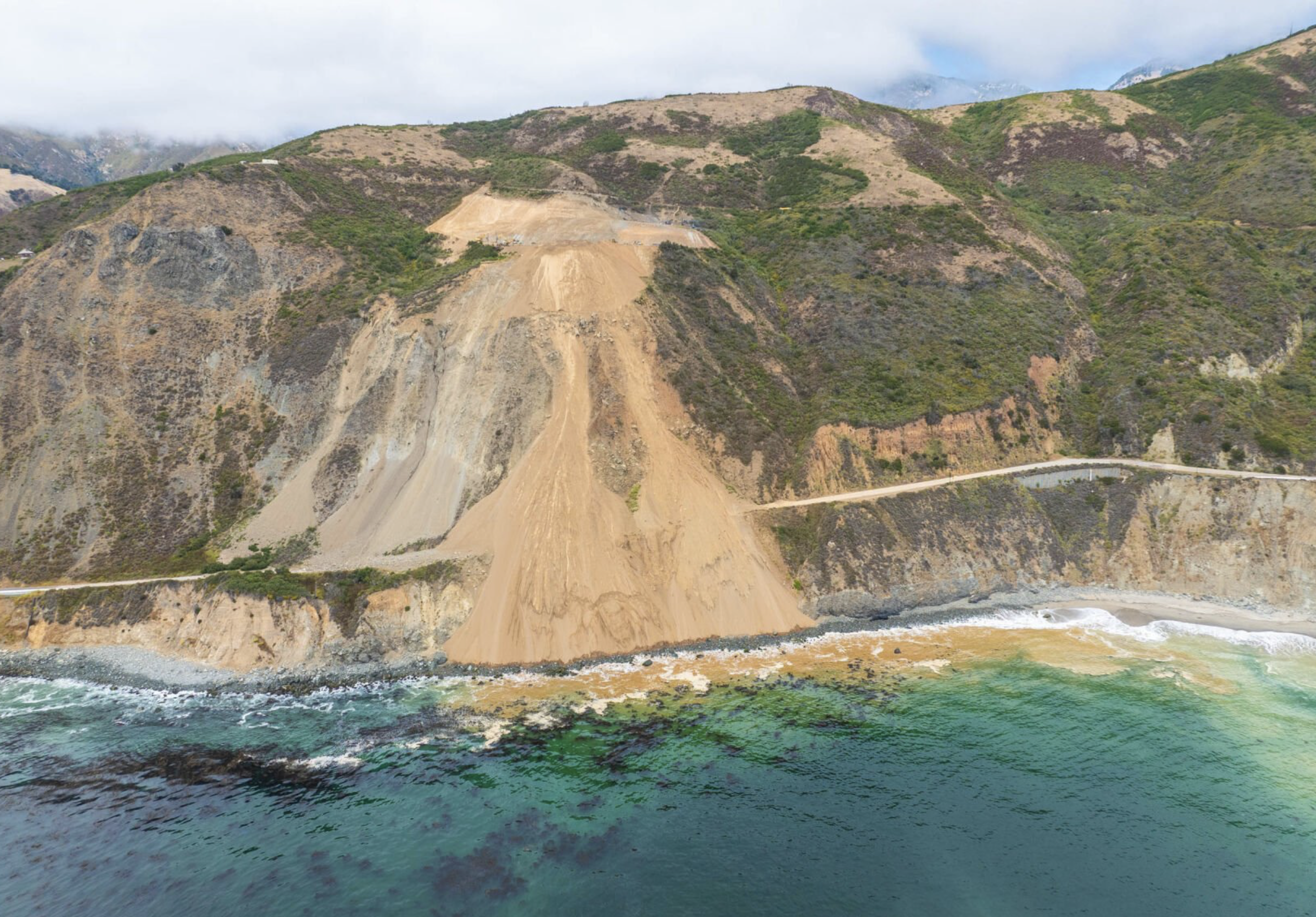
Landslides closed Highway 1 along the world famous Big Sur coast, severing the flow of travelers, and reducing the amount of economic activity, mostly tourist spending, by roughly $312 million between 2023 and 2024 says the state agency Visit California and LA-based Beacon Economics in a recently published study.
Local city and county governments have lost over $27 million in tax revenue during these two years.
Meanwhile the highway remains closed today and is causing $13 to $14 million in economic losses per month, equaling a total of $438 million since the first slide occurred in January 2023.
Late March opening date
Now Caltrans just announced repairs to the road will be complete next year allowing the highway to open for thru traffic by the end of March 2026 assuming no new winter damage in coming months. Landslides have become a money pit for the state spending hundreds of millions of dollars as vigorous wet stormsand its location on fault lines have increased periodic damage to the cliffside highway.
Landslides closed Highway 1 in 2017 but the Covid shutdown also reduced traffic in 20/21 compounding the multi-year economic impacts in recent years.
On January 14, 2023, a major landslide buried a stretch of Highway 1 in Lucia, near Big Sur, on California’s central coast. Before Caltrans could repair the damage, a second major slide occurred six miles north of the first one. As of September 2025, a 6.8 mile stretch of the road remains closed, with reconstruction still underway.
The Beacon Economics study says the small towns of San Simeon and Big Sur experienced the steepest proportional losses. Over the two years, visitor spending at San Simeon dropped 42% relative to baseline expectations.
In 2022, tourists spent roughly $27 million in San Simeon. If the road had remained open, it’s expected this number would have risen slightly to $29M. Instead, nature buried the highway under half a million cubic yards of debris, and tourist spending dropped to $17 million in 2023 and $17 million in 2024.
Near San Simeon is Hearst Castle, a vast estate built by newspaper magnate William Randolph Hearst between 1919 and 1947. Visitation at the castle—now a museum and California State Park—fell from 222,500 during the summer of 2022, to 184,000 during the summer of 2023.
For Big Sur, the road closure resulted in a total loss of $33 million in visitor spending, reflecting a decline of 20% from baseline expectations for 2023 and 2024. This was driven by their respective isolation and dependency on the Highway, and hotel managers in the area reported having to close segments of their businesses. In a news article the GM of the resort restaurant Nepenthe says they have about a third fewer customers than usual.
Monterey hard hit
In absolute terms, the City of Monterey is home to the largest tourism economy in the region, representing nearly 60% of total tourism spending annually. Similarly, the City of Monterey also endured the largest loss of visitor spending, losing $145 million over the two years as compared to baseline expectations, says the report.
Likewise in San Luis Obispo County’s Morro Bay and Cambria, visitor spending dropped about 10% from where it was expected to be without the closures, says the study.
The Utah Department of Agriculture and Food (UDAF) has confirmed highly pathogenic avian influenza (HPAI) in a commercial turkey facility in Sanpete County. HPAI is a contagious viral disease that affects domestic poultry and wild birds, often leading to high death rates in flocks.
“Commercial turkey facilities in the northern U.S. and here in Utah have been the most impacted by HPAI this falI. With migratory bird season just beginning, we may see a greater impact as the season progresses. It is imperative that poultry producers practice strong biosecurity.” said State Veterinarian Dr. Amanda Price.
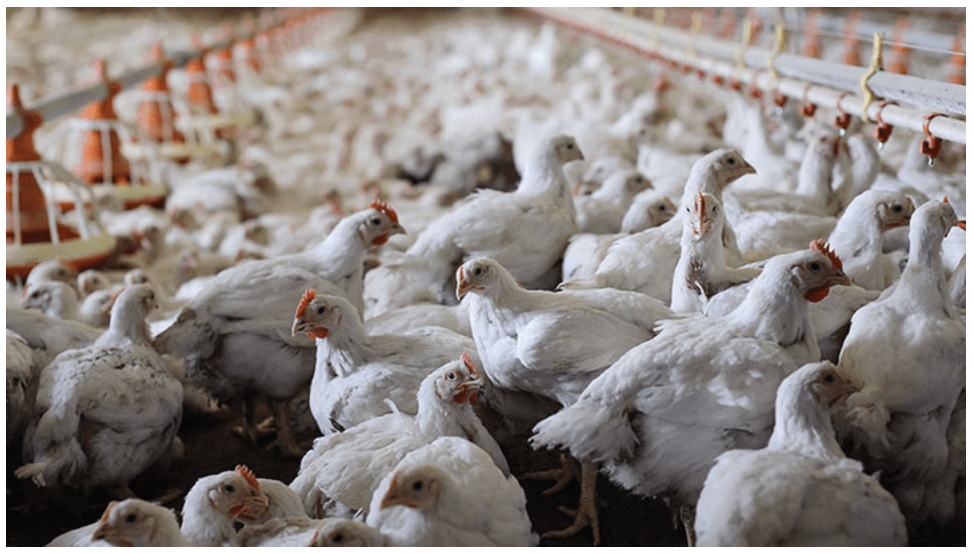
Nearly 35,000 turkeys were culled after cases of highly pathogenic avian influenza were detected at a commercial turkey facility in central Utah.
.In recent days news of the most recent northern US losses includes a flock of nearly 3.1 million laying hens in Wisconsin.
For the third year in a row avian flu is spreading across the states in the US as the annual north/south bird migration progresses.So far this fall poultry ranches in North and South Dakota, Minnesota,Wisconsin and Utah have been hit.
Watt Poultry publication says the United States has lost more than 175 million head of commercial poultry to highly pathogenic avian influenza (HPAI) since the outbreak began in 2022.
Poultry owners should vigilantly watch their flocks for signs of HPAI, which include high death loss among flocks, nasal discharge, decreased appetite or water consumption, and lack of coordination in birds.
HPAI is often spread by wild migratory waterfowl. The virus can be carried into domestic flocks through direct contact with wild birds, contaminated equipment, or people moving between flocks. Anyone involved with poultry production, from small backyard flock owners to large commercial producers, should review their biosecurity plans to ensure the safety of their birds. While HPAI is a serious disease in poultry, it does not currently present an immediate risk to public health. As a reminder, the proper handling and cooking of all poultry and eggs to an internal temperature of 165˚F is recommended as a general food safety precaution.
Central Valley growers are reaching for that sweet spot as production of the tangy mandarin citrus crop keeps climbing.
USDA has released its latest forecast for Tango and W Murcott Afourer Mandarin groves finding that this winter’s crop should reach 33 million 49-lb cartons compared to 29 million in 24/25 and 21 million cartons in 22/23.
These citrus varieties are not only sweet, but seedless in the case of Tango and easy-to-peel mandarin fruit that were developed by the University of California and planted by San Joaquin Valley gowers starting some 20 years ago. The small size fruit has a rich flavor, deep orange color, and a sweet-tart taste that makes it popular for snacking, juicing and school lunch boxes.
This year mandarin acreage has climbed from 31,000 acres in the year 23/24 to 33,000 acres in 24/25 to 35,000 in 25/26.
This year’s survey, done in July and August found that fruit set is down 24% this year although fruit diameter is up 1%. The yield this year is expected to be 943 cartons per acre compared to 879 last year and 677 cartons per acre in the year 23/24.
Look for the fruit at your grocer or farmer’s market from January through April.
More than a dozen varieties of mandarins have been planted in recent years besides these two varieties adding up to nearly 70,000 acres with the Clementine variety a widely planted mandarin and the subject of its own USDA report not out yet.
Besides seedless mandarins, Exeter-based Citrus Mutual is proposing a standard for seedless lemons that are likely to become popular in coming years.
Mandarins are a growth industry for citrus farmers who have maintained their navel orange acreage at about 109,00 acres for the past five years but shrinking from 141,000 acres in 2007/08. The latest USDA production report forecasts a navel crop of 80 million cartons, up slightly from the average for each of the past five years.
California citrus production has now far outpaced rival Florida with around 79% of the U.S. total while Florida accounts for 17%. Florida has suffered citrus greening disease, cold snaps and hurricane damage to their industry. While California produces fresh market oranges and lemons, Florida oranges are largely used to make juice. Florida’s citrus industry’s production has dropped 90% in the last 20 years.
Along with all California hospitals, particularly rural ones, Visalia’s Kaweah Health got some bad news recently with passage of the “Big Beautiful Bill”, expected to reduce revenues once Medicare and Medicaid cuts are implemented in the coming months. The new law is expected to strip up to $128 billion from CA Hospitals over the next 10 years according to the California Hospital Association.
Kaweah Health CEO Gary Herbst has said the impact on the hospital could amount to $60 million a year by the time all elements of the bill are fully implemented.
Kaweah Health’s service area in Tulare County, California, has a significant Medicaid population, with approximately 62% of its residents covered by Medi-Cal and living near or below the federal poverty level. As a large, public, non-profit hospital, Kaweah Health serves as the primary provider in the region, offering critical services to a population with a high proportion of Medicaid recipients.
This is just one factor as the area’s largest employer struggles with stubborn obstacles. The district has approximately 5,200 employees and a medical staff of about 670 professionals.
Since the arrival of COVID in March 2020, Kaweah Health has struggled to return to financial health, although some months their monthly financial statements presented to the Kaweah Board show a positive bottom line, suggesting they may have turned a corner.
Employee costs up
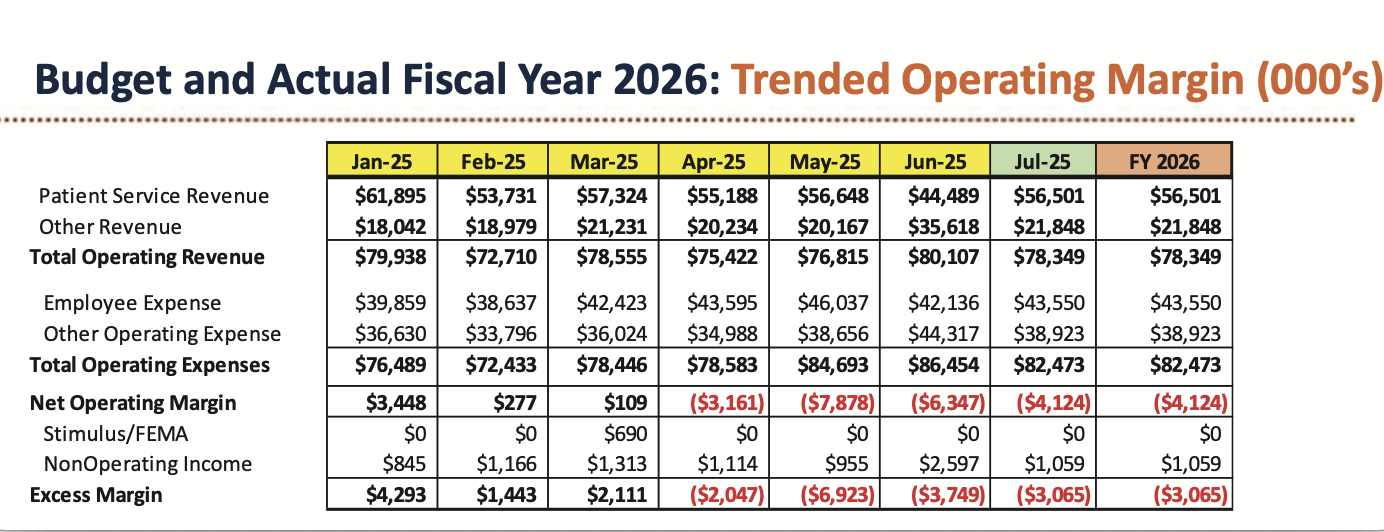
During the pandemic, the hospital was forced to hire hundreds of nurses and other care providers through contract agencies to handle the flood of patients. Since then, the hospital has been successful in cutting the number of these expensive temporary health care workers. But now the latest monthly financial snapshot shows overall employee costs are up. This year employee expenses have gone from $38.8 million in January 2025 to $43.5 million in July 2025.
In the meantime, one place the hospital earns important income is in surgery cases. But here too the number of procedures is down. In recent years, many types of care are now provided without an overnight stay including cataract surgery, hernia repairs(now done on an outpatient basis that can lead to a faster recovery). Also, Gallbladder Removal,Colonoscopies and Lumpectomiesy, all formerly done in a hospital.
Baby Bust?
Then, there’s a curious decline in the number of births at the hospital. It is a trend seen across the State and nation. In 2023, the most recent year for which the California Department of Public Health records birth data, there were 400,129 births in California. This is down almost 100,000 births from a decade ago, when there were 494,392 births. With about 70 births per 1,000 women of child-bearing age annually, Tulare County actually has one of the highest fertility rates in California.
But Tulare County is also struggling to maintain enough doctors to provide essential maternity care. Agreements between doctors and hospitals are ending and obstetricians are changing their practices and sometimes moving out of the county or out of state. Some obstetricians have decided they no longer want to deliver babies. Many OB/GYN medical practices no longer accept new patients and in the most extreme instances, hospitals no longer accept maternity patients. That is not happening here.
At Kaweah Health Medical Center, Tulare County’s largest hospital, about 400 babies are delivered each month, although the most recent numbers are down from that. One reason for this decline was the closure of the Visalia OB/GYN Medical Group back in December 2024. This Group accounted for a large number of deliveries, particularly among women with private insurance. For June 2025, Kaweah Health had budgeted for more than 400 deliveries but the actual number came in at 330. During the COVID years, there was a “baby bust” trend at Kaweah.
Outpatient trend
One long-term trend across the nation is that more procedures that were previously done in the hospital are now being done on an outpatient basis. That means the inpatient occupancy of the hospital is lower than budgeted. For example, in June 2025 the budget called for a daily census in the hospital of 440 but just 385 beds were filled. One report says in 2023, the hospital had an average census of 421 patients daily – falling to 405 in 2025.
In July the Trump administration signaled that more surgeries be done in outpatient facilities like ambulatory surgery centers, proposing a Medicare policy that could accelerate the shift away from hospital-based care, says a report from STAT.
“The administration is aiming to scrap Medicare’s list of 1,700 procedures that the program will only pay for in inpatient settings. Medicare officials unveiled their decision to eliminate the so-called inpatient only list in a proposed rule…”
Some trends up
Not that it is all bad news. Kaweah Health’s growing network of rural health clinics are seeing more and more patients around Tulare County. Other hospital-based clinics are also doing well, including its two urgent care centers, its urology clinic and other medical clinics whose patient care volumes are up year over year. The hospital- owned retail pharmacy is making money, up some $596K from budget. Revenue from operation of the Lifestyle Center is up 24%.
But the monthly bottom line number shows red ink for 4 of the 7 months of this calendar year, with the most recent months all minus as to net margin, indicating its profitability or lack of it.
This chart shows it all.
January, February and March of 2025 were all positive with a net income of $7.8 million. But, April, May, June and July were all below the predicted budget number, adding up to a minus $15.7 million, offsetting earlier numbers by double. July, the first month of the new 2026 fiscal year, is still showing more expenses than revenue. A July 2024 to July 2025 comparison shows operating revenue down 10% and employee expenses up 12%.
A memo to the Kaweah Board explained the following trends:
Salaries and Wages: The $954K unfavorable variance is due to increases in registered nurse expenses compared to budget in inpatient settings.
Physician Fees: The $765K unfavorable variance is due to payments made to contracted Radiology, Cardiology and Hospitalist groups that were higher than anticipated.
Humana Cap Expenses: The unfavorable variance of $1.7M is due to higher than anticipated third party expenses (bills paid by Kaweah Health to other non-Kaweah providers for its enrolled Humana Medicare Advantage members). People living here show up for medical care whether they have insurance or not. So, Kaweah Health has to write off, on average, $10M-$12M/year (“expected net patient payments”) in bad debt uncompensated care. The standard healthcare industry benchmark for bad debt is 2-3% of Net Patient Revenue. “We are averaging within that range.” explains a memo.
Talk of Towers
The district hospital lays out their financial reports for all to see on their website and both administrators and the Board regularly strategize and work to improve the results knowing that continued red ink could sink perhaps Tulare County’s most important institution. One trend the hospital is no longer talking about – building more patient care towers, although the seismic issue of the Mineral King wing is still unresolved. Hospitals all over the State have sought public funding through bonds, but these efforts have faced voter opposition.
On a regular basis the hospital faces both positive and negative news presented to the public including a recent lawsuit over a claimed wrongful death after an ER visit and kudos this week by U.S. News & World Report who recognized Kaweah Health in seven adult procedures and conditions as a High Performing Hospital in their 2025-2026 rankings.
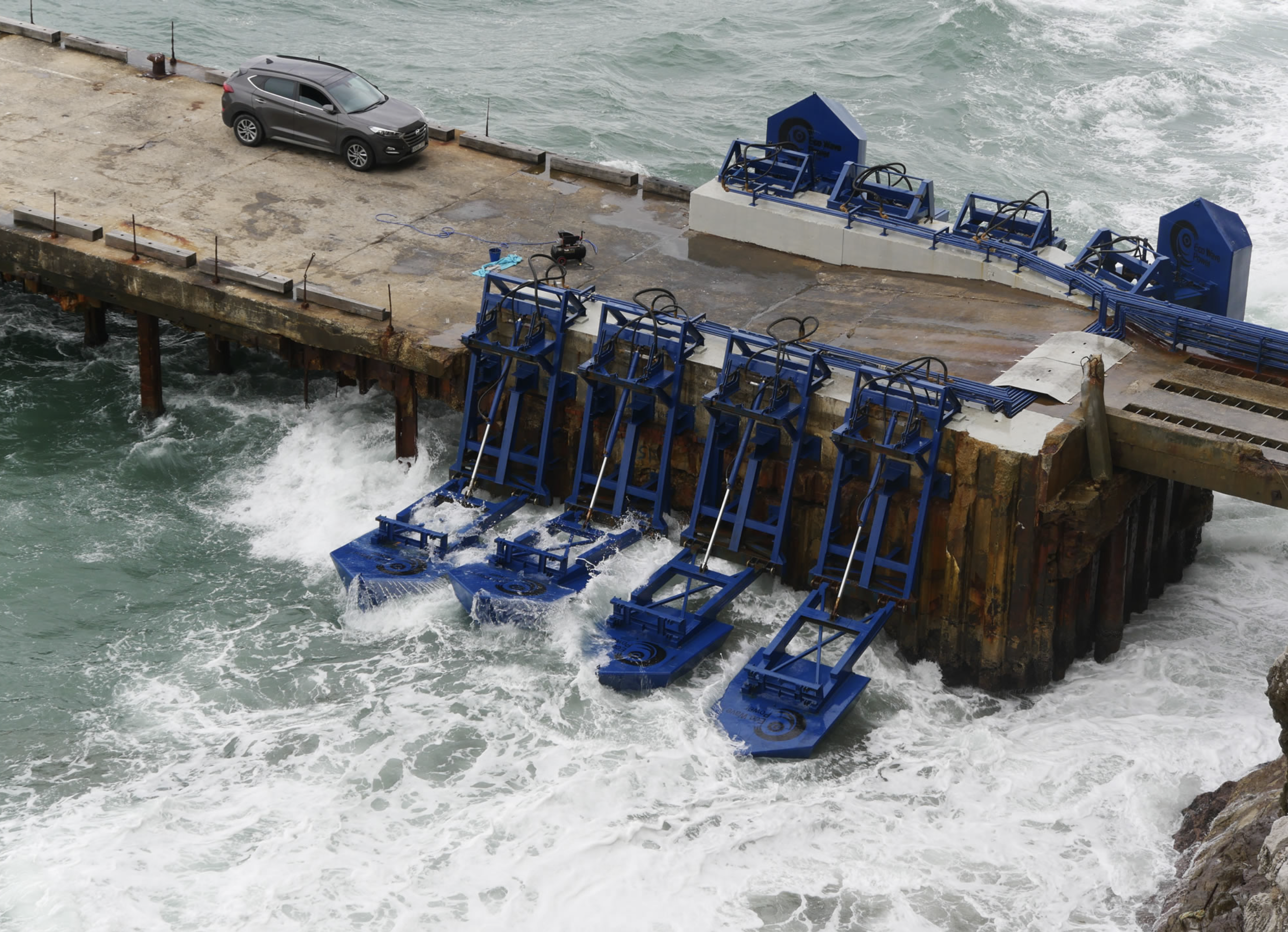
Historic Launch Showcases Scalable Technology, Supported by Government Initiatives and Strategic PartnershipsLos Angeles, California–(September 10, 2025) – Eco Wave Power (NASDAQ: WAVE), a global leader in onshore wave energy technology, has achieved a major breakthrough for renewable energy in the United States: the successful launch of its first U.S. wave energy project at the Port of Los Angeles, developed in collaboration with AltaSea and Shell Marine Renewable Energy (MRE).This historic project marks the first onshore wave energy installation in the U.S., showcasing Eco Wave Power’s patented, award-winning technology and setting the stage for large-scale wave energy deployment along America’s coastlines and worldwide.The demonstration site features floaters, which capture the motion of ocean waves to generate renewable electricity – proving the technology’s potential to deliver reliable and clean power. While still in demonstration mode, this project provides a key foundation for commercial-scale operations, positioning Eco Wave Power as the frontrunner in the emerging U.S. wave energy sector.The launch comes at a pivotal time for California, aligning with the state’s bold climate policies and Senate Bill 605, which calls for the creation of a comprehensive wave energy roadmap. Federal support is also growing, led by Congresswoman Nanette Díaz Barragán, who recently introduced the Marine Energy Technologies Acceleration Act, a $1 billion initiative to scale marine energy across the nation.Giving opening remarks, Congresswoman Nanette Díaz Barragán stated:“Eco Wave Power made history by deploying its innovative wave energy technology into U.S. waters for the very first time. This milestone shows incredible potential for wave energy to power our communities with clean, renewable electricity, while creating jobs and protecting our environment. I am proud to support Eco Wave Power and to lead the Marine Energy Technologies Acceleration Act in Congress, so we can accelerate wave energy development across the country. Congratulations to Eco Wave Power on this groundbreaking achievement!”Inna Braverman, Founder and CEO of Eco Wave Power, emphasized the importance of this moment:“California has been a pioneer for climate policy, and we are proud to see wave energy included in Senate Bill 605, calling for a full roadmap for wave energy in California. At the federal level, we applaud the leadership of Congresswoman Barragán for introducing the Marine Energy Technologies Acceleration Act, a $1 billion initiative to scale marine energy nationwide. This project shows that with the right policy, we can turn innovation into reality. And we’re just getting started.Today, I’m excited to announce that our next projects are already being prepared in Taiwan, India, and Portugal. Wave energy has enormous potential – it is predictable, reliable, and available right here on our coastlines. With projects like this, we are proving that wave energy is not just the future – it is here, now. So, let’s celebrate this milestone together. Because today, we are not just cutting a ribbon – we are opening the door to a new era of clean energy for California and for the world.”Terry Tamminen, President and CEO of AltaSea said: “AltaSea is a blue economy. We support researchers that are creating intellectual property, like Eco Wave Power, to make sure that they can scale up these technologies and make them practical and successful all over the world. Eco Wave Power is one of those exciting technologies that is ready to scale. It’s already around the world, and it’s only going to get bigger because it has solved many of the problems that other technologies has come up against, for harnessing something as challenging as wave energy. It takes a real clever technology, and I want to say genius, to be able to figure this out.”Michael J. Galvin, Director of Waterfront and Commercial Real Estate at the Port of Los Angeles, emphasized the local significance:“The San Pedro Bay Port Complex has big goals to get to zero emissions in the next decade. We can only do this with significantly scaled-up local energy generation. Projects like this are super important to get us there. We can’t do it without localized energy sources, and this project provides us the ability to get there – to make this port the cleanest it can be. That’s a critical component of the port’s goals over the next decade.We really applaud AltaSea, and we applaud Eco Wave Power’s adaptive reuse of a very old port structure that is not used for anything else and now will be used to demonstrate how energy can be generated out of the ocean. We are really happy to be using the power of the ocean to continue the efforts here and bring the technologies and solutions that we need at the Port of Los Angeles to get to zero emissions in our port complex.”Laura Richardson, Member of the Senate, 35th District, California State Legislature, presented a certificate of recognition to Inna Braverman, stating:“In honor of your Grand Opening Ceremony at AltaSea and in recognition of achieving the first wave power station in the United States, we celebrate your commitment to energy innovation and wish you continued growth and success.”Tim McOsker, Council Member, 15th District, also presented Eco Wave Power with a certificate, noting:“On behalf of the City of Los Angeles and the One-Five, congratulations on the grand opening of your first wave power station in the United States! This is a remarkable milestone – not just for your team, but for the future of clean energy. As you expand your groundbreaking technology across the globe, we look forward to seeing the powerful impact you will continue to make in shaping a brighter, greener future.”The event drew a global audience, with Eco Wave Power’s partners traveling from Taiwan, Africa, and other parts of the world, underscoring the international momentum for wave energy development.Sandra Lee, speaking on behalf of CY Huang, Chairman of I-Ke, shared details of Eco Wave Power’s upcoming project in Taiwan:“Taiwan offers a unique combination: a strong wave climate, a sophisticated marine and power-electronics manufacturing base, and one of Asia’s most ambitious net-zero policy commitments by 2050. This makes it an ideal environment for wave energy commercialization. That is why I-KE has completed a detailed feasibility study and is now preparing to launch a pilot at Suao Port, with a roadmap to grow to 400 MW in the near future.Wave energy also provides reliable, local, and sustainable power for energy-intensive industries, such as data centers, supporting the growing demand for cloud computing and AI-driven services. Just as the LA pilot turns that port into a living laboratory, Suao will become a blueprint for replication across Taiwan’s working harbors – and eventually across the region. From Los Angeles to Suao, we share the same mission: turning the energy of the ocean into dependable, scalable, and bankable power. We look forward to welcoming the EWP team to Taiwan and celebrating the commissioning of our pilot as the next step toward large-scale deployment.”Wilfred Emmanuel, CEO of Africa Great Future Development, highlighted Africa’s growing role:“Africa faces critical energy challenges. In South Africa alone, over 80% of electricity is still generated from coal-fired power plants, and communities and industries continue to experience power shortages. At the same time, our continent has tremendous untapped renewable resources. With more than 2,800 kilometers of coastline, South Africa has enormous wave energy potential to diversify the energy mix, reduce reliance on fossil fuels, and provide sustainable, reliable electricity to underserved communities and industries.That is why Africa Great Future Development is proud to partner with Eco Wave Power to conduct a feasibility study for a potential wave energy power station at the Port of Ngqura in the Eastern Cape Province. The port’s deep-water infrastructure and exposure to strong ocean waves make it an ideal location to demonstrate the value of wave energy on the African continent.To promote this vision, we have plans to expand to other ports in South Africa, and a new location in Kenya is already at an advanced stage. Our collaboration with Eco Wave Power is focused on delivering long-term, practical impact. Wave energy can play a transformative role in Africa’s renewable energy future – supporting economic growth, sustainability, and energy security. Together, we are taking the first steps toward a project that could bring measurable benefits to communities, industries, and the broader energy system.The global expansion of Eco Wave Power – from Israel to the United States, Portugal, Taiwan, and India – demonstrates that wave energy is ready to move from pilot projects to real-world solutions. Africa is next, and we are proud to be part of this journey.”The launch generated national media attention, with coverage from Good Morning America, CNN, the Los Angeles Times, and the Associated Press, all highlighting the significance of U.S.-based wave energy deployment and its potential to contribute to California’s clean energy goals.About Eco Wave Power Global AB (publ)Eco Wave Power (NASDAQ: WAVE) is a pioneering onshore wave energy company transforming ocean and sea waves into clean, cost-efficient electricity using its patented and intelligent technology.With a strong commitment to addressing climate change, the company developed and operates Israel’s first grid-connected wave energy power station-recognized as a “Pioneering Technology” by the Israeli Ministry of Energy and co-funded by EDF Renewables IL.Eco Wave Power is actively expanding its global footprint, with upcoming projects planned in the Port of Los Angeles, Portugal, Taiwan, and India-contributing to a growing project pipeline of 404.7 MW.The company has earned support and recognition from leading international organizations, including the European Union Regional Development Fund, Innovate UK, and the Horizon 2020 program, and is a proud recipient of the United Nations Global Climate Action Award.Eco Wave Power’s American Depositary Shares are listed on the Nasdaq Capital Market under the symbol “WAVE.” For more information, please visit www.ecowavepower.com.
Nuclear generation is expensive and slow to develop. Claims that past failures won’t recur have convinced politicians to socialize investments rejected by private capital markets.
Published Sept. 5, 2025
Opinion by By Amory B. Lovins
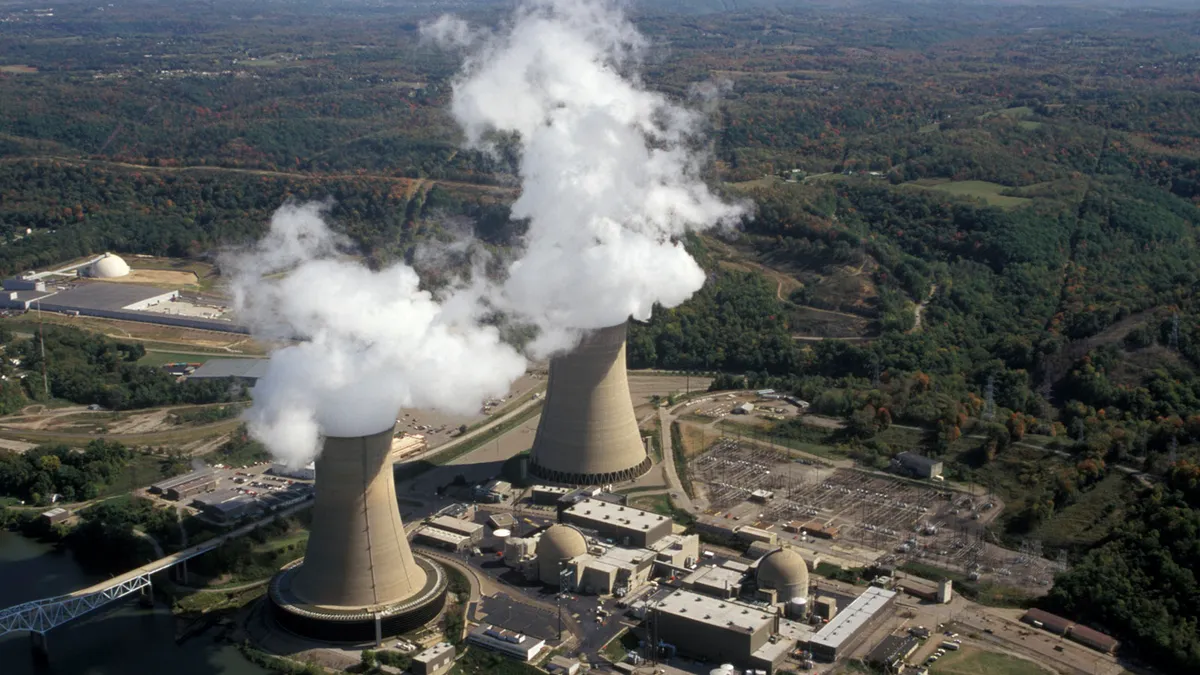
“Beaver Valley Nuclear Power Plant”. Retrieved from Wikipedia.
Amory Lovins teaches engineering at Stanford, and is cofounder and chairman emeritus of RMI.
An intensive influence campaign seeks to resurrect a “nuclear renaissance” from the industry’s slow-motion collapse documented in the independent annual World Nuclear Industry Status Report. Claims that past failures won’t recur have convinced many politicians that socializing nuclear investments rejected by private capital markets, weakening or bypassing rigorous safety regulation, suppressing market competition, and commanding military reactor and data-center projects as a national-security imperative will restore nuclear expansion and transform the economy.
This illusion neatly fits the industry’s business-model shift from selling products to harvesting subsidies.
A few awkward facts intrude. Even the most skilled firms and nations keep delivering big reactors with several times the promised cost and construction time. A swarm of startup firms that have never built a reactor are dubiously rebranding their inexperience as a winning advantage. New designs are said to be so safe they don’t need normal precautions (though not safe enough to waive nuclear energy’s unique exemption from accident liability). Political interference in nuclear licensing is eroding public confidence. Proposed smaller reactors cost more per kWh, produce more nuclear waste per kWh, and often need more-concentrated fuel directly usable for nuclear weapons.
And nuclear power faces the same fundamental challenges as fossil fuels: uncompetitive costs, runaway competitors, dwindling profits, and uncertain demand. Few if any vendors have made profits selling reactors — only fueling and fixing them. Nuclear electricity loses in open auctions, so only Congressional bailouts — $27 billion ($15 billion paid out) in 2005, $133 billion in 2021-22, tens of billions more in 2025 — saved most existing U.S. reactors from closure.
Now comes another vision: powering the glorious new world of artificial intelligence. This may be a trillion-dollar bubble, but it’s sellable until market realities intervene. The International Energy Agency expects data centers, mostly non-AI, to cause only a tenth of global electricity demand growth to 2030, doubling their share of usage — to just 3%. So AI won’t eat the grid. But IEA forecasts renewables will power data-center growth10-20 times over, while Bloomberg NEF predicts over 100. Nuclear lost the race to power the grid, so new reactors have no business case or operational need.
Keep up with the story. Subscribe to the Utility Dive free daily newsletterEmail:Sign up
Each year, nuclear adds as much net global capacity as renewables add every two days. Soaring renewables generate three times more global electricity than stagnant nuclear power, whose 9% world and 18% U.S. shares keep shrinking. In 2023-24, China added 197 times more solar and wind than nuclear capacity, at half the cost. In May, China added 93 GW of solar, or 3 GW per day.
Despite having turned nuclear power into a minor distraction, renewables are dismissed as “intermittent.” Again, facts intrude.
Military and industrial installations already prefer 100% renewables for their most critical applications, including Apple’s data centers in four states. Ten kinds of carbon-free resources can balance variable (but highly predictable) renewables, keeping the grid stable. Using a small subset, power systems with modest or no hydropower already sustain such annual renewable fractions of electricity use as Denmark 88+%, South Australia 74% (expecting 100% in two years), and Germany 54%.
And since a nuclear kWh costs several to many times more than a renewable or saved kWh — even more if nuclear load-follows to “complement” rather than curtail renewables — nuclear displaces less fossil fuel per dollar (or year), making climate change worse.
Nonetheless, nuclear power is being boosted by fierce lobbying and federal policy as essential for new AI data centers vital for prosperity and security. This case can’t withstand scrutiny. My essay “Artificial Intelligence Meets Natural Stupidity: Managing the Risks” shows:
Data centers use about 4.5-5% of U.S. and 1.5% of world electricity, and lately caused only about 5% of world electricity demand growth. Of all data-center electricity, about one-fourth in the U.S. or one-ninth globally is for AI, the rest for traditional uses.
Claims of soaring AI electricity use are projections, not realities, except in a few “hot spots” like two Virginia counties. In 2023, AI added roughly 0.04% to world and 0.1% to U.S. electricity use.
Most proposed AI data centers are speculative and unlikely to get built; many built won’t thrive. Major power-supply investments risk getting stranded.
Demand for AI services is enormously uncertain. So is their business case: AI’s proven value in narrowly specialized technical applications looks too small to repay its immense investments. Many general users don’t need or want to pay for AI.
Big Tech firms rarely sign specific nuclear power purchase agreements. Much of the hype is about vague statements of interest in buying electricity timely at an attractive price, or modest, symbolic investments. Big Tech rightly prefers renewables as faster, surer and cheaper.
The efficiency of turning electricity into AI services roughly quadruples each year, so a new data center must roughly quadruple its sales of AI services each year for decades to keep using and paying for the same amount of electricity — a tall order.
This spring, innovators showed how operating AI data centers slightly more flexibly without compromising service can power at least the next decade of U.S. AI growth with no new generators, stranding more electricity and gas investments.
The coal industry’s 1999 campaign to create panic that the Internet would falter without huge power expansions misled investors, worsening a 2000-02 bloodbath when hundreds of new power plants weren’t needed. Today’s trends, pushing an AI case for unsellable and too-late nuclear and gas projects, rhyme with that disaster.
The latest risk to the AI/nuclear case came into focus in Sparks, Nevada, in June, when Redwood Energy (a new activity of dominant battery-recycler Redwood Materials) revealed North America’s largest microgrid.
Twenty MW-DC of photovoltaics are laid flat on level ground. Water-recovering Roomba-like crawlers clean them nightly. About 800 battery packs from retired or crashed cars — the world’s largest use of second-life batteries — are wrapped in white plastic and set on cinderblocks, safely separated. They’re good for another few years, then hot-swappable. Novel power electronics and software meld those diverse batteries into 63 MWh of storage with 2-48-hour nominal duration. (Redwood Energy is already engineering similar microgrids an order of magnitude larger, enough to run most existing data centers.)
The resulting 100%-solar microgrid produces 10 MW-AC of ultrareliable 24/7/365 power that runs modular Crusoe data centers onsite, eliminating transmission costs, losses and approvals. This all-solar power is more reliable than grid power, cheaper than the utility’s 8¢/kWh retail price, and allbuiltin four months.
Thus, we needn’t guess or debate whether a particular data center will get built and flourish. Instead, we can commit to build its onsite solar power plant, perhaps by competitive procurement, only when the data center’s 1.5 to 2.5 years of construction is mostly done. Needing no grid connection, the solar microgrid needs few if any approvals — just cheap land. It’s inherently safe, silent, automatic, virtually water- and maintenance-free, based on common commodities, zero-emission, portable and durably profitable.