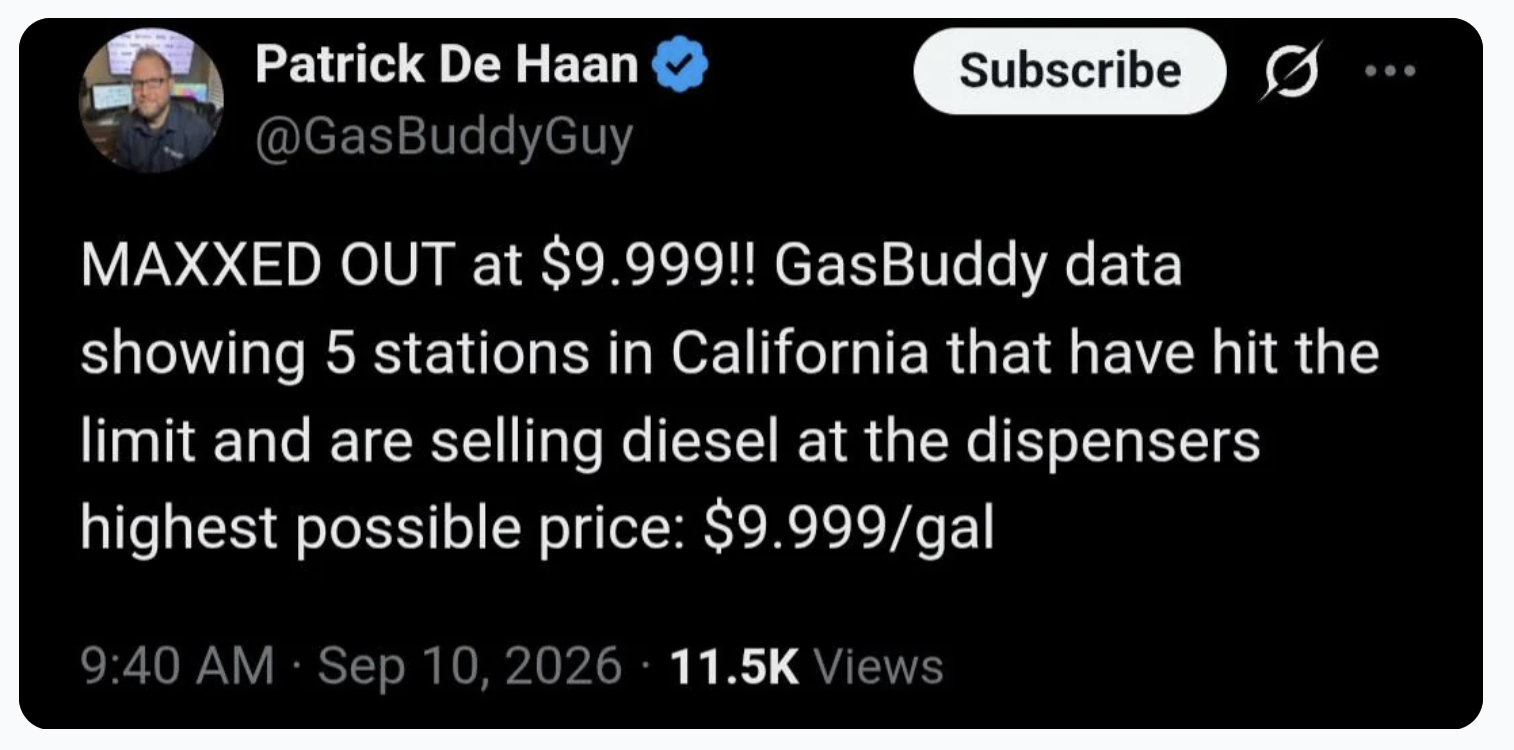
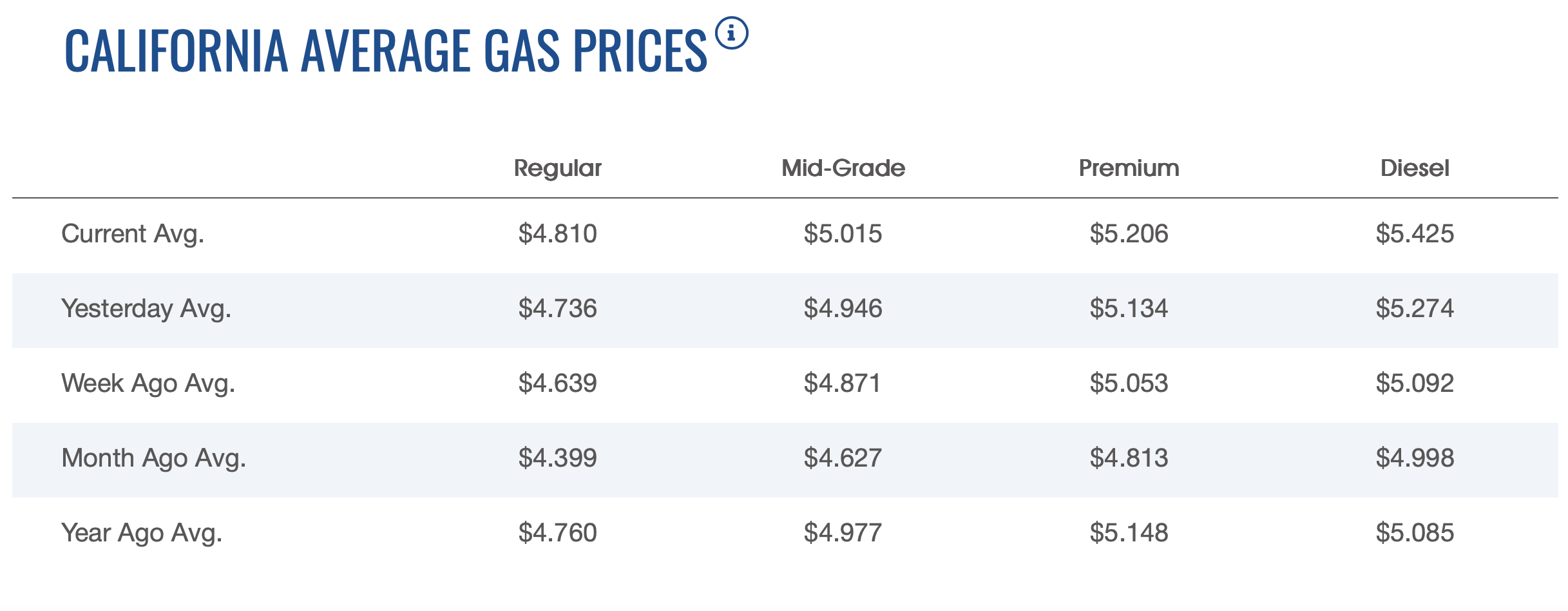
Diesel fuel cost hit a record in Tulare County on a daily basis this week, reports AAA with an average cost of $8.27 a gallon as of Sept 15, up 36 cents in a week, $1.49 over the past month and $3.11 more than a year ago. Bay Area stations have a problem with posted signs running out of room for more than $9.99.
Gasoline is up 66% in the past year while ethanol is up just 3%.That’s one more reason why California state officials look forward to January when more ethanol will begin to be blended (15%) with gasoline offering E-15 fuel instead of E-10 for most cars. This week at an industry convention, gas retailers heard they don’t have to add new equipment to offer the fuel or dig up their fuel tanks. They don’t have to shop for a different vendor and can simply use equipment that they already have. When you pull up to a pump in spring of 2027, you will likely choose the cheapest fuel option which will be E-15 with a 25 cent or more discount.
Californians just made it through the hottest August ever without any rolling power outages. In fact, the state has not issued a Flex Alert since 2022 nor implemented any rotating outages since 2020. What’s the secret – expansion of battery storage in California. The state says as of mid-2026 operating capacity surpassed 21,112 MW, a 2,500% increase since 2019 when the state had less than 700 MW online. Widespread solar battery use may not be popular in Morro Bay where some residents don’t want the technology nearby but it keeps the lights on in town anyway preventing blackouts during record summer heat waves.
The technology has expanded in tandem with solar power installations that have grown in California – now surpassing fossil fuel-based natural gas on the grid for the first time in state history. This shift was unlocked by batteries, which absorb cheap, excess afternoon solar and discharge it when the sun sets when most people are home.
Where is our power coming from?
Electricity generation “grows in line with electricity use,” the federal Energy Information Agency (EIA) said in its latest forecast. Natural gas generation is expected to grow 2% this year and another 1% in 2027, while coal generation falls 8% and 6%, respectively. “As wind and utility-scale solar capacity continues to be added to the grid, we expect solar generation to grow by 21% in 2026 and by 18% in 2027, while wind generation grows 7% in 2026 and 5% in 2027,” EIA said.
States sue government over TotalEnergies wind for fossil fuels swap deal
A coalition of seven states has brought to court the Trump administration over one of its deals with TotalEnergies (EPA:TTE) that will see the French group exit its offshore wind activities in New York and invest in oil and gas instead. California has criticized a second similar plan that would pay the company OceanWinds to withdraw from their existing lease off Morro Bay if they invest in fossil fuels instead.
Chinese investor plans new West Coast offshore wind project
Chinese wind turbine maker Ming Yang Smart Energy Group Ltd (SHA:601615) will consider investing in an offshore wind project in the Hecate Strait off British Columbia, Canada, that will add between 1.5 GW and 2 GW of installed capacity.
The Chinese firm will assess opportunities to take part in the project under a non-binding Memorandum of Understanding (MoU) with Oceanic Wind Energy Inc (NKW.H:CVE), the latter said on Thursday. The scheme related to the pact is a 50/50 partnership between Oceanic Wind Energy and Indigenous-owned company Coast Tsimshian Enterprises (CTE).
In new attack on solar, lawmakers spread myths about potato farms
Is Frito-Lay categorically refusing to buy potatoes grown on farmland that has hosted solar installations? No, the company says.
That hasn’t stopped lawmakers in Michigan and Pennsylvania from spreading the false claim about one of the biggest purchasers of potatoes in the country.
In January, Michigan Republican state Rep. Cam Cavitt posted a 51-second clip to Facebook labeled “Solar Farm SECRET.” In the segment, he claimed that farmers in his district couldn’t grow potatoes on land where solar developments were sited.
“Frito [Frito-Lay] did the same with the potato growers up by us,” fellow Michigan Republican Rep. Dave Prestin told Cavitt in the clip. “Any field that had solar panels installed on it will never be allowed to grow potatoes for human consumption due to the leaching.”
More than 1 million people viewed that video. Pennsylvania Republican Sen. Cris Dush shared it and said he wanted “cash bond guaranteeing restoration” of the soil after a solar development was removed. “When Frito Lay refuses to accept potatoes from farms that had solar arrays we should all sit up and take notice!” he wrote.
PepsiCo, which owns Frito-Lay, told Canary Media that the company “has not issued blanket guidance to growers that fields with solar installations will not be accepted.”
Nor is there any published evidence that solar farms have a negative impact on potato farming, according to experts consulted for this story. On the contrary, there is agrivoltaics research showing that potatoes — and many other crops — can benefit from growing alongside shade-making solar panels. Canary Media
Some farmers have a negative view of solar panels, thinking that solar developers are taking away productive ag land to erect miles of arrays. The truth is most PV solar goes on spent land with a perched water table – unproductive land that the farmer-owners hope can generate some income to keep their ag operations afloat.
But well known ag commentators like Edward Ring suggest “If new solar farms are destined to carpet hundreds of square miles of land, they should be dispersed throughout the state and near already existing high voltage lines. Or, they should be concentrated in California’s abundant stretches of uninhabited land such as the Mojave Desert.”
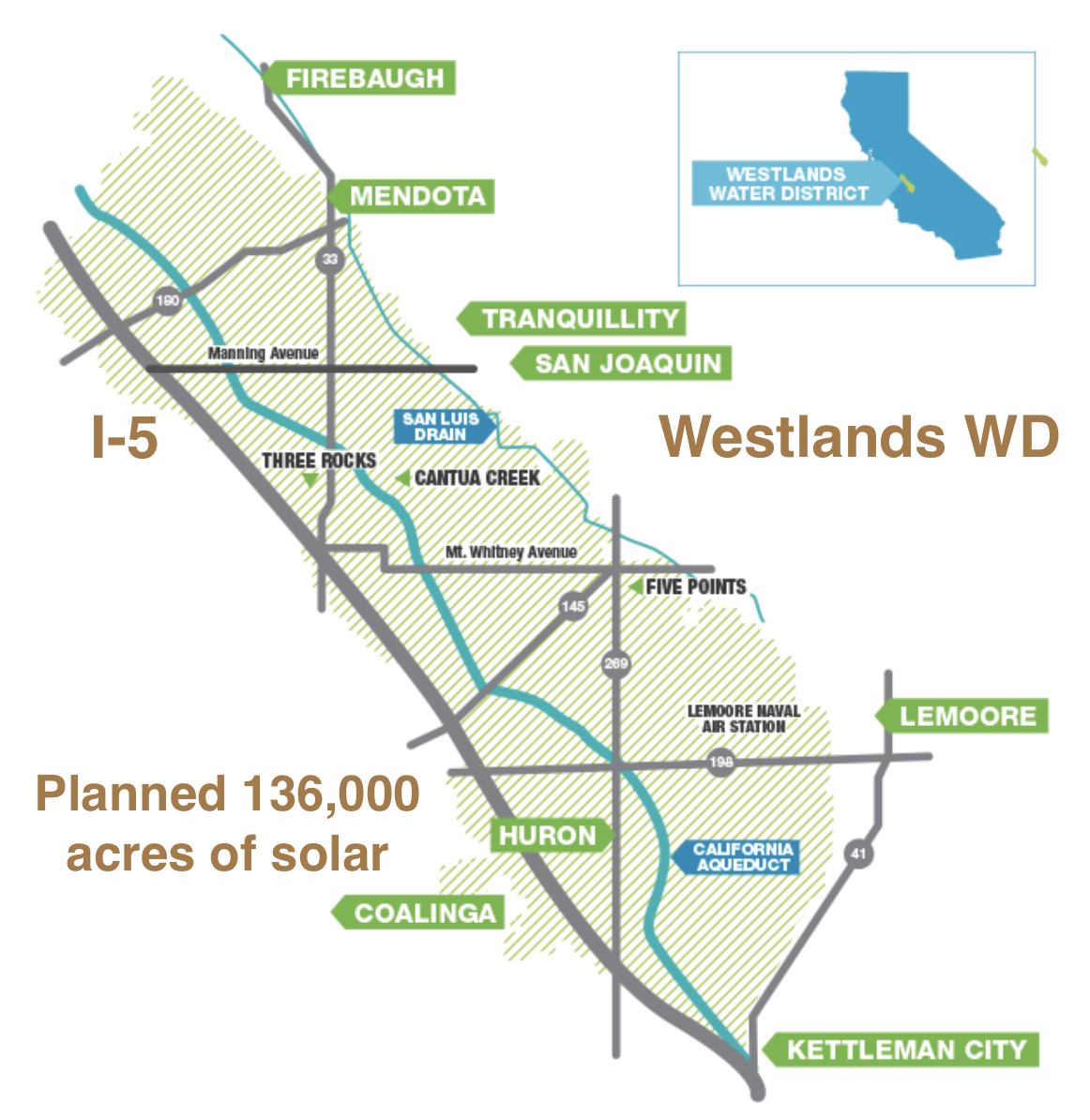
Take a drive along Highway 5 on the hot and dry Westside of the Valley and you see miles of uninhabited and idle land along side the state’s largest network of transmission lines.It is also where the Westlands Water District farmers are looking forward to construction of 136,000 acres of solar farms in the next few years with about half the income going to the district and the rest to private landowners. Not irrigating that land saves water for the farmland in the area that is still productive. Switching solar to Mojave leaves local farmers without an income source for their idle land in the valley.
Solar can also have a beneficial impact on farmer’s biggest want – more water. And independence. Farms are energy intensive and increasingly the tools on the farm from machinery, tractors, ATVs and pickup trucks are trending electric, requiring farms to have an on-site energy source that does not break the bank or depend on the Middle East for fuel.
In the past decade, the cost of solar panels has dropped by around 90%, largely thanks to a big jump in Chinese manufacturing capacity.
“Solar power is the cheapest form of energy in history,” economist Gernot Wagner from Columbia Business School told the German news agency DW. “This stuff is so cheap that Germans are installing it as garden fencing. It keeps the dog in and the car charged.”
Trouble is that President Trump is vehemently anti-renewable energy, including solar, that he calls “a big scam.”
Gee, it really is not. Instead, it is a power source that can not just light up homes but move water to where farms and communities can use it.
This past week Kern County officials dedicated a new solar farm, the Pastoria Solar Project, that will help the Department of Water Resources, to provide power for the operation of the California State Water Project, including irrigation for more than 750,000 acres of agricultural land.
Another pilot project shows that solar can do more.
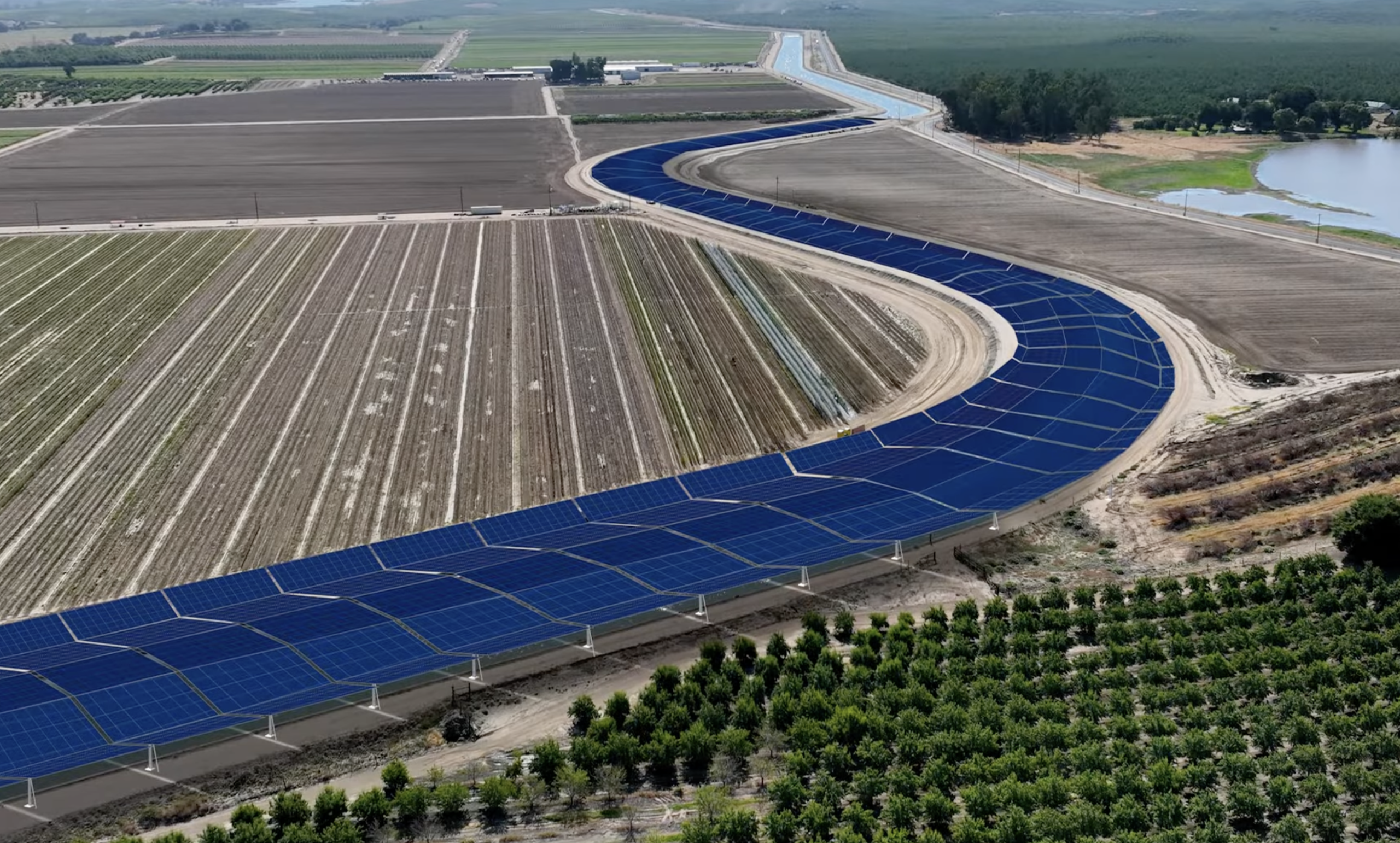
An initiative pioneered by Turlock Irrigation District set the stage for a future potential covering of California’s roughly 4,000 miles of irrigation canals with solar canopies. The panels generate electricity to move water as well as drastically reducing evaporation from the canals.
A UC study estimated that 4,000 miles of California’s open canals could save up to 63 billion gallons of water annually — enough to meet the needs of 2 million people.
Putting in the solar panels over the canals generates another positive impact by not taking any of the surrounding land out of production in order to have the benefits of solar. As is the case with Turlock Irrigation District who put solar panels over their canal – it generates an income source for the water district making it more self reliant.
So what’s keeping the idea from going beyond one large irrigation district in California? Again it’s Mr. Trump’s opposition to anything solar that seems to be a huge stumbling block. He calls solar “stupid.”
I’m sorry Mr Trump – I’m with stupid.
“We will not approve wind or farmer destroying Solar,” Trump, who has complained in the past that solar takes up too much land, posted on Truth Social. “The days of stupidity are over in the USA!!!”
Trump pulls plug on Delta Mendota solar canal project
In 2024 the Delta Mendota Water District was awarded $15 million by the Congress to do their own pilot version of the covered canal within their district. But now, two years later, no money has been released by the administration, despite farmers wanting to try the technology and Congress approving the money.
A spokesperson for the Delta Mendota District says there’s been no activity on the project because of lack of funding. No matter that farmers want to see if the technology could work as advertised.
At the time Federico Barajas, Executive Director of the San Luis & Delta-Mendota Water Authority said this funding could”improve the quality of water delivered to our contractors, and maximize the use of every drop of water in California by potentially reducing conveyance losses.”
So while farm advocates beg Trump for help with new water projects, they know any mention of solar is the kiss of death. The last thing they want to do is piss-off Mr Trump.
Meanwhile, farmers are pushing for more water in California by demanding more north to south transfers and seeking help from the Trump administration to help with their number one issue – subsidence – that limits the amount of water a canal can carry. That problem promises to get worse without billions of dollars to repair hundreds of miles of canals.That includes the 150-mile Friant Kern Canal along the eastern side of the Valley.If they are going to spend billions to redo these canals- why not allow solar to help pay for it? We know why.
By the way, while ground may be sinking in most of the Central Valley, it’s actually rising in some parts of southern Fresno County, says Westlands Water District. Land nearby has seen “measurable uplift” in and around the area between Cantua Creek and Huron of about 1.2 inches. The news offers support for efforts to cut excessive water pumping that may be showing results.
Trump has also cut any funding for farmers to erect solar on their barns,dairies and outbuildings despite the fact this can save them money on their power costs. The Associated Press has looked into this.
Department of Agriculture hasn’t awarded a dollar in rural energy grants or loan guarantees
“Within the first year of President Donald Trump’s second term, two federal programs critical to the growth of solar energy production — REAP and the clean energy tax credit — have been rolled back. To document how those policy changes are affecting farmers, The Associated Press and Grist analyzed data on both commercial-scale solar projects and small-scale rural energy development across the country. They found that, so far this fiscal year, the Department of Agriculture hasn’t awarded a dollar in rural energy grants or loan guarantees. Reporters contacted roughly a quarter of the nearly 300 developers that have proposed projects on agricultural land in the last two years and found that they are either preparing their businesses to do future projects without federal support or have already lost millions in investment because of the administration’s new tax credit policies.”
Among other moves the administration moved to deny new federal permits for wind and solar projects.Secondly,the “One Big Beautiful Bill” targeted renewable energy by restricting tax credits and threatening the 30% solar tax credit for homeowners by late 2025.Then regulations were introduced to block solar and wind projects on federal lands, aiming to prevent the use of farmland for energy production.
This month a new court ruling may provide some relief after a federal court seemed to have struck down a truckload of Trump administration moves designed to paralyze solar and wind permits.
One report says ‘U.S. District Judge Denise Casper in April enjoined a raft of actions by the Trump administration that delayed federal renewable energy permits, granting a request submitted by regional trade groups. The plaintiffs argued that tactics employed by various executive branch agencies to stall permits violated the Administrative Procedures Act. Casper — an Obama appointee — agreed in a 73-page opinion, asserting that the challenge was likely to succeed on the merits.’
Trump ‘s Dept of Interior lost on another front aiming to block offshore wind projects already under construction. Trump lost by allowing government legal challenges to offshore wind court rulings to expire. Now all five East Coast offshore projects can move forward unobstructed.
Apr 20, 2026 Advancing perovskite-silicon technology from lab breakthrough to commercial production FREMONT, Calif.–(BUSINESS WIRE)–Tandem PV, a pioneer in high-efficiency perovskite-silicon solar panels, today announced the opening of its commercial demonstration factory in Fremont, California. The facility marks a major step toward commercializing U.S.-manufactured next-generation solar panels for utility-scale projects.
As electricity demand rises, driven in part by data centers and AI workloads, utilities are moving quickly to add new capacity. Tandem PV’s Fremont factory supports efforts to reshore advanced solar manufacturing and reduce reliance on overseas supply chains. The line is designed to demonstrate that perovskite-silicon tandem panels can be manufactured reliably in the United States at scale with high power density, durability, and lower costs.
The 65,000-square-foot Fremont site is producing tandem solar panels using state-of-the-art equipment. The line has approximately 40 MW of annual nameplate capacity, and the panels are roughly 60 times larger than Tandem PV’s R&D-scale devices. The factory is intended to validate large-format production and accelerate market adoption.
“This factory marks the shift from impressive R&D results to repeatable manufacturing at a commercially meaningful scale,” said Tandem PV CEO Scott Wharton. “People have talked for years about the promise of perovskites. This is what it looks like to deliver. It is an important milestone in restoring American leadership in solar manufacturing through the kind of breakthrough engineering Silicon Valley is known for.”
Tandem PV’s proprietary technology combines a thin perovskite light-absorbing layer with a conventional silicon solar cell. By capturing more of the solar spectrum than silicon alone, tandem panels generate more electricity from the same footprint. The higher efficiency lowers overall costs, especially because labor, land, and balance of system costs account for roughly 75% of utility-scale solar deployment costs.
The Fremont opening builds on recent R&D progress that Tandem PV is now translating into production panels, including 29.7% efficiency based on internal testing. In accelerated lifetime testing, the latest-generation panels show less than 1% average annual power loss, about a tenfold improvement versus the company’s results from a year ago. Tandem PV is targeting 25+ year performance consistent with industry standards and warranty requirements for utility-scale solar projects.
“Utility-scale perovskites are here,” said Jennifer Granholm, former U.S. energy secretary. “Tandem PV is delivering an ingenious product that can help provide more clean power with a smaller footprint and meaningful cost savings as we scale deployment in the United States.”
With the Fremont site now operating, Tandem PV has begun producing initial modules, with shipments planned to support customer validation trials later this year. The company plans to sell its first commercial panels in 2026 from this facility and is targeting high-volume manufacturing in 2028.
The Trump plan is to pay $1B taxpayer money to stop wind farms if they invest in oil projects. REACT group wants to do that here
As of April 2,San Luis Obispo attorney Saro Rizzo, VP of the REACT Alliance, an anti-offshore wind group, asked the Trump administration in a letter to pursue lease refund agreements with the five companies currently holding offshore wind leases in California, three of which are off the coast of Morro Bay. A story was published in Cal Coast News.
The paper reported that in 2022, the federal government auctioned off three offshore wind energy sites located between 20 and 30 miles off the coast near Morro Bay for more than $400 million. REACT, like Mr Trump, calls offshore wind “destructive.”
“Wind is for stupid people,” the president has said.
The REACT request to the Dept of Interior looks to replicate a March 23 agreement with TotalEnergies that offered that company a refund of over $928 million to give up their two offshore wind leases and shift their investment to production of fossil fuels – oil and natural gas including off the US coast, if they “renounce” offshore wind projects
A Dept of Interior release says” TotalEnergies has committed to invest approximately $1 billion—the value of its renounced offshore wind leases—in oil and natural gas and LNG production in the United States. Following their new investment, the United States will reimburse the company dollar-for-dollar, up to the amount they paid in lease purchases …”
Cal Coast News says “In Dec. 2025, based on national security concerns, the Trump administration suspended leases of all off-shore wind farms currently under construction in the United States. Since then, many wind energy projects have stalled or ended.”
Well, not quite.
In a development that may have significant impact for the West Coast too, the Trump administration’s Department of Interior missed a final deadline-April 10- to appeal a number of court rulings that Trump lost.
Last December the Trump administration demanded that construction stop at five major wind projects off the East Coast citing national security concerns. But all five developers of the projects challenged his move in court and all 5 won – allowing work to continue. Collectively, they’ll be capable of generating enough electricity to power over 2 million homes.
A news report says the Department of Interior did not appeal the court rulings because a pending bipartisan congressional bill needed to fund public works and transportation projects that would continue to be stalled if the administration did not back off on court challenges to offshore wind. That position was outlined by Rhode Island Senator Sheldon Whitehouse, a supporter of offshore wind.
A news report quotes Whitehouse, more than willing to play hardball given he is Ranking Member of the U.S. Senate Environment and Public Works Committee, holding up a number of key bills the GOP needs to pass.
“We have paused permitting reform negotiations until the attack on clean energy ends and we can have some assurance that a solid bipartisan bill, which we were working on, would actually get implemented fairly by this administration,” Whitehouse said. “So that’s paused. And by the way, good luck with your highway bill — the other bill that needs to come through me. And good luck with the Army Corps of Engineers WRDA bill — the other bill that needs to come through me.”
Canary Media reports that The lack of appeals could be good news for future wind projects as well. A bipartisan group of senators has been debating a long-delayed “permitting reform” bill for months. The bill would speed up environmental review for critical energy projects, make it easier to build interstate transmission lines, and protect clean energy permits from federal interventions like those of the Trump administration. (It would also likely afford the same protections to oil and gas projects such as the Keystone XL pipeline, which President Joe Biden scrapped after taking office in 2021.)
Also California Attorney General Bonta in December celebrated a decision from the U.S. District Court for the District of Massachusetts invalidating the Trump Administration’s action freezing the development of wind energy and declaring that action unlawful. That decision vacates the Trump Administration’s “Day One” executive memorandum, which imposed an indefinite moratorium on offshore and onshore wind energy projects.
Not Stalled
So the projects are not stalled or ended. The West Coast offshore wind projects are very much alive as well. But REACT wants the government to use more taxpayer funds to buy out the 5 leases along the West Coast including the 3 off Morro Bay.
REACT wants to replicate the TotalEnergies formula- trade the wind projects for oil projects. That works for the president.Trump has apparently found a champion for drill-baby-drill in California from a Central Coast group that says they want to protect our environment. Trump is doing everything he can to restart oil drilling off the Santa Barbara coast right now and now apparently a citizens group is ready to help despite the fact that fossil fuels are heating up the global environment, causing havoc both on and off shore.
Does REACT support OIL? Here is the last paragraph in their letter to the Trump administration. Notice the code words “energy dominance”.
“We request the opportunity to discuss how the REACT Alliance can support the Department in securing a future for the California coast that prioritizes genuine conservation and energy dominance over the ineffective economic boondoggle known as floating offshore wind.”
One of President Donald Trump’s major priorities in his second term has been his so-called “energy dominance” agenda to boost fossil fuel production by weakening or eliminating environmental protections.
REACT says “We do not accept donations from fossil fuel companies.” But this letter makes it clear it supports Trump’s energy policies that include West Coast oil drilling both offshore and on thousands of acres of California BLM land including right here next to Los Osos Middle School. Now they support giving the same foreign-owned energy companies they complain about – millions in taxpayer monies to switch to oil.
In the past six months about a dozen huge utility-scale solar projects have launched permitting requests on thousands of acres of former farmland near I-5, the Valley’s driest region,where farmers have been hardest hit by water scarcity worries and SGMA regulation. Many are wondering how they will be able to pay their bills in the future. For more Kern,Kings and Fresno county landowners, harvesting solar energy is the most attractive answer.
More solar in Kern’s oil patch
While the current administration in Washington has downplayed the benefits of renewable energy, even calling it a scam, farmers are watching missiles fly over the Middle East where fossil fuels is what they’re fighting over. Meanwhile there are no missiles flying over I-5.Now it turns out that none other than the United Arab Emirates is investing here – not in oil but in solar.Despite loss of federal incentives it appears solar energy installation is more popular than ever across the US. Mr Trump’s Energy Information Agency(EIA) says utility-scale solar is the fastest-growing source of electricity generation in the United State with almost 70 gigawatts of new solar generating capacity projects scheduled to come online in 2026 and 2027 – a 49% increase in U.S. solar operating capacity compared with the end of 2025.The run up in fossil fuel costs this year is only adding to the momentum of developers looking to supply more solar power and critically, battery storage to the grid including along I-5 in the west side of the Valley.The big highway parallels the state’s largest transmission lines and power stations.
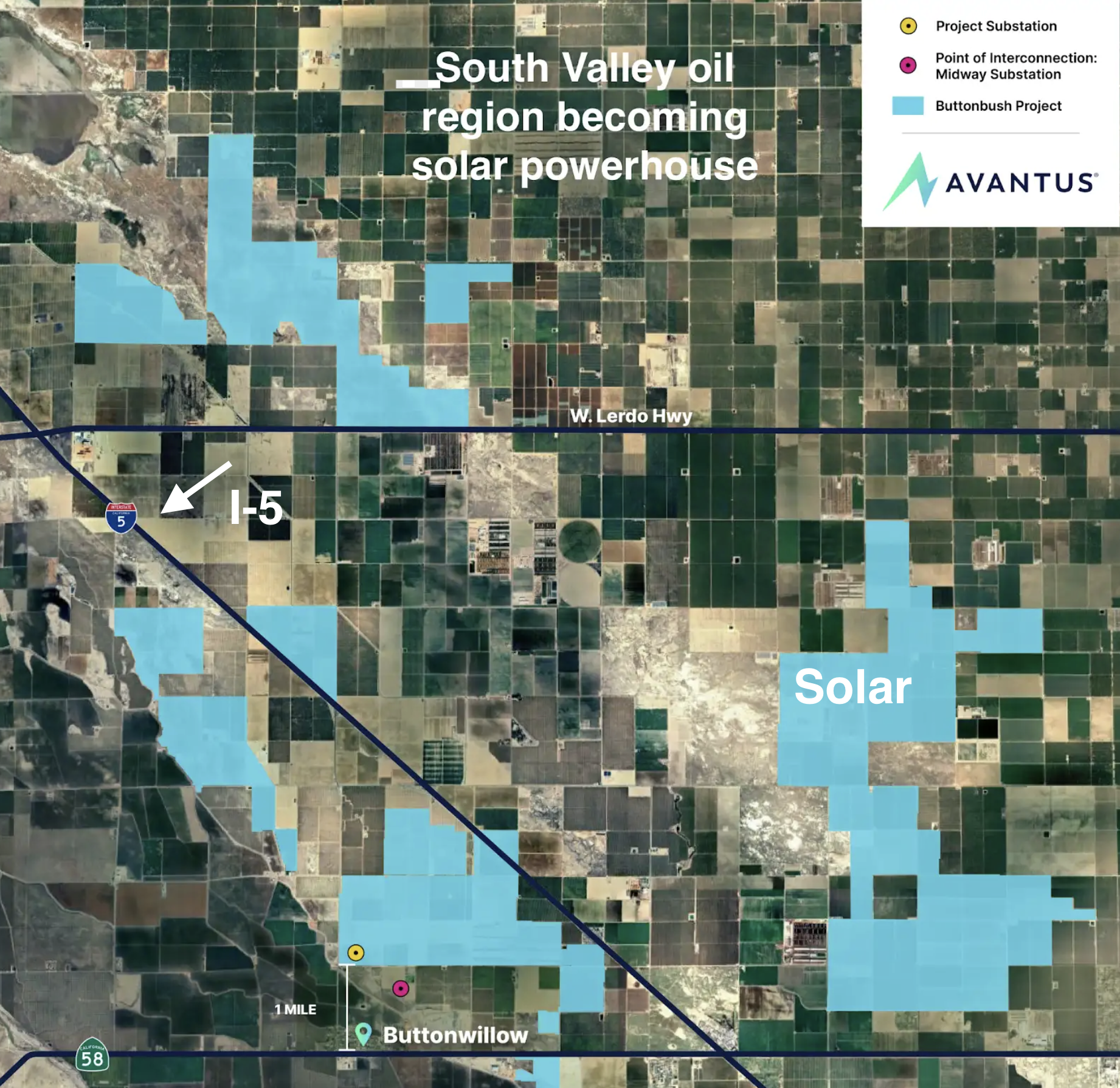
Now we are looking at a massive solar expansion along a 120 mile corridor from the Buttonwillow oil fields to the north extension of the Westlands Water District almost to Los Banos. It was here in 2016 that state regulators, developers and environmentalists mutually agreed this was the best place in the state to juice up the state’s renewable power considering this is where there are fewer disruptive conflicts found, no rare tortoises. Instead, they found thousands of acres of formerly irrigated farmland so high in salts, it could not be tilled again. A long drive on I-5 will tell you this dry and windy corridor features both few people and critters yet enjoys nearby access to the power grid. It is also equidistant between the metro areas of LA and the SF Bay.
Then there is the AI-fueled data center boom in California and the realized need discovered in the past year, for large quantities of electric power that can be installed quickly. Again the sunny west side of the San Joaquin Valley and this technology looks to be in the right place at the right time.
It is of course, ironic that Kern County is the leader of the pack to develop solar power in the Valley, since western Kern County where the California oil industry is still king. It is the home of the still potent Elk Hills oil fields, the former Navy Petroleum Reserve near Buttonwillow.Now in the past few weeks the Kern County Board of Supervisors approved a development that has been described as California’s single largest solar energy project near Buttonwillow called the Buttonbush Solar and Storage project. The sprawling solar farm spans almost 12,000 acres on both sides of Highway Five and will generate 2000 MW or enough power for about 1 million homes. The power capacity is on the scale of Diablo Canyon nuclear power plant.The developer is Avantus,majority owned by KKR.
While eastern Kern County, the Mojave region, was popular for new solar arrays in the past decade, the Bakersfield Californian reports that now “Thirty-five projects that propose to sell their power to the state grid have been approved for construction in western Kern. It remains to be seen how many of them ultimately get built.”
UAE connection
If that 12,000 acre Kern project is big,a Kings County solar application a few miles up the road filed late year is bigger – encompassing 18,300 acres called Rex Solaire Solar and Storage, LLC.This huge development is just one of a dozen mega renewable projects developed by the company Terra Gen with a portfolio of 4.2 GW of wind, solar, and battery storage projects, including 5.6 GWh of energy storage capacity owned by Abu Dhabi Future Energy Company PJSC – Masdar, the United Arab Emirates’ clean energy powerhouse, and Igneo Infrastructure Partners.Of course the United Arab Emirates has been on the receiving end of Iran’s missile barrage hitting their oil fields and hotels.
The big Kings solar farm will generate 2800 megawatts produced from solar panels and include a battery storage facility that will have a capacity of 11,200 gigawatt-hoursThe project site is located on approximately 18,381 acres of agricultural land in unincorporated southern Kings County (County), along the eastern edge of Interstate 5 at Utica Ave, 10 miles southeast of Kettleman City and 3 miles east of the California Aqueduct. Still in the draft EIR stage, their application says construction is expected to begin in 2028 with the initial 900 to 1,500 MW phase to be completed over a period of approximately 24 to 36 months.
Only a few miles away straddling the Kings/Fresno line is another big solar farm called Cornucopia Hybrid, LLC on 2,446 acres between Avenel and Coalinga west of I-5. The project will generate 300MW with construction anticipated to begin in the fourth quarter of 2026 and to last 39 months.Commercial operation expected in the fourth quarter of 2029.
Wall to wall solar in Kings County
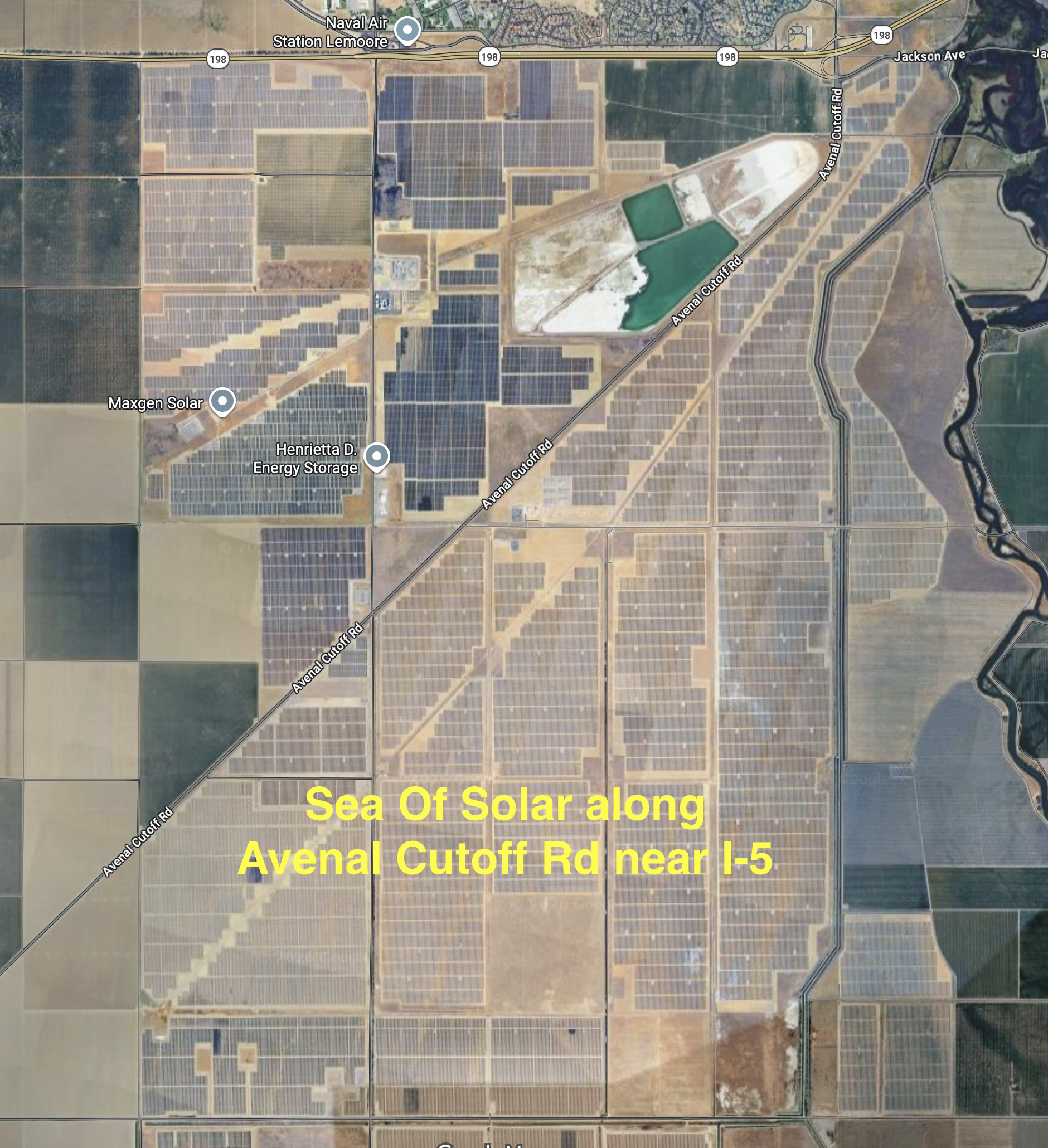
In Kings County an early adopter of the west side solar boom is Westlands Solar Park (WSP) who has been building one by one, a dozen 200MW plus solar farms in Kings County on Westlands Water District bare land just east of I-5 along the Avenal Cutoff since 2016. When the solar park is completed it is slated to spread over 20,000 acres and generate 2276MW plus battery storage.Construction is continuing on new WSP projects with a hearing at the Kings County Planning Commission this month.
Big projects in Fresno County’s westside
Just to the north where thousands of renewable megawatts are in the offing the California Energy Commission recently approved the Darden Clean Energy Project on approximately 9,500 acres in western Fresno County. The project consists of a 1,150 megawatt solar photovoltaic facility with a 4,600 megawatt-hour energy storage system, a 34.5-500 kilovolt grid step-up substation, a 15-mile 500 kV generation intertie line, and a 500 kV utility switchyard. The project would interconnect to the existing Pacific Gas and Electric Company Los Banos-Midway #2 500 kV transmission line. The development will be south of the community of Cantua Creek – just east of I-5.
To be located 5 miles south of the City of San Joaquin in Fresno County, Rosemary Solar, LLC proposes to construct a 1,172 acre, 140 megawatt project and include energy storage capacity of up to approximately 140 MWac.Further along on a construction schedule is San Luis West Solar, LLC who wants to break ground in 2026 on a 125-megawatt solar facility coupled with an estimated 30 MW Battery Energy StorageSystem.The project would be located on seven parcels that total approximately 1,400 acres.
136,000 acre Valley Clean Infrastructure Plan
Fresno County supersized solar
The granddaddy of the super-sized solar farms was just announced by Westlands Water District and their partner Golden State Clean Energy – based in LA – who are also the developers of Kings County’s Westlands Solar Park.The final EIR was approved in December. Called the Valley Clean Infrastructure Plan (VCIP), the 130,000 acre multi-year project in collaboration with Westlands Water District, plans to repurpose drainage-impaired and other agricultural lands within Westlands for solar generation, energy storage, and electric transmission facilities.At full build out, the projects developed under VCIP would generate 20 gigawatts (20,000MW), enough to provide up to one-sixth of California’s electricity requirements in 2035 and up to one-tenth of its requirements in 2050
.The project would be built ion 72,000 acres of district-owned land and 64,000 acres of privately-owned land.The project would also install dedicated transmission lines to connect to the grid.The plan is to erect an average of a 200MW solar farm every year for over 11 years.They want to start in the northern part of the district near Firebaugh and move south.
According to Westlands, over 242,000 acres were idled in 2025 due to unreliable water supplies, including 23,988 acres already repurposed for solar.That will now grow to an additional 136,000 acres so that 160,000 acres of solar will cover almost 70% of this fallowed ag land. Potential construction could begin as early as 2028.
Westland’s managers have taken this step not only because of the drought, reduced water deliveries and SGMA rules but because over the years more of this irrigated land is suffering from a perched water table when irrigation water accumulates above impermeable clay layers near the surface. The impact is that this shallow groundwater lacks natural drainage, leading to salt accumulation in the root zone, damaging crops. Drainage solutions are few and expensive.
There is still another huge challenge for this parched part of the state.The capacity of the westside’s California Aqueduct has been predicted to decline by 87% if subsidence was not corrected. The big canal that delivers water from the north is suffering from reduced capacity each year. Fixing it will cost the public billions. One bill in Congress would pay $1.68 billion dedicated to repairing existing canals, including $830 million for the Delta-Mendota Canal and $850 million for the San Luis Canal and California Aqueduct.
Westlands crops
As we have also pointed out in past articles, Westlands has retired more cropland once dedicated to processing tomatoes as technology has vastly improved yield. The district grew nearly 100,000 acres in 2000 but today earns more money from 40,00 acres of tomatoes. Today cotton suffers from low prices, but once grew on 180,000 acres in the district and now is just a 13,000 acre crop.
In 2000 Westlands grew about 10,000 acres of grapes, mostly wine grapes according to their published crop report. In 2014 that grew to 18,000 acres. As of 2024 wine grape acres were back down to 10,200 as district farmers fallowed unprofitable vines. Grape industry leaders have and still are arguing that growers need to pull acreage to reflect lower demand seen in the marketplace.In other words-market forces are the reason there are fewer grapes needed.
Today one of Westlands larger crop acreage is almonds at 73,000 acres. But even that is down as overplanting of this crop statewide has led to lower prices along with tariff issues and now Westlands almond acres are down from 103,000 acres seen in 2021- a drop of about one third. Some are looking for new drought tolerant crops like Agave.
California’s top exports to China fell by 64% in 2025
Again the tarff wars are taking their toll.California agricultural exports to China saw a 64% decline last year, with the top 13 commodities in total falling from an average of $1.55 billion to $554 million, according to new research published by the University of California Giannini Foundation of Agricultural Economics. The researchers found that California counties with large agricultural sectors experienced some of the biggest estimated annual export losses, including losses of roughly $246 million in Fresno County and $238 million in Kern County.
Nuts are a big Westlands crop but almost all are exported . The study found that export volumes dropped significantly in 2025 with almond shipments to China falling about 77%, while pistachio shipments declined roughly 84%.
The bottom line suggests it’s prudent to use some of this excess land to harvest the sun, never facing tariffs. _
NOAA has published a listing of Western US counties that experienced the warmest winter since 1895 when records were first kept. Tulare County is on the list. So were a number of other California counties from Riverside in the south to Santa Barbara on the coast. Here is the US map shown in red for the counties who recorded all-time high average temperatures for December through February this winter. The map shows the geography of the scorching temps that extended to 10 states.The map shows the heat wave reaching Oklahoma in the east, Idaho to the north and across southern California. The salmon color on the map indicates counties that were “much above” the average- so the entire western US was extremely hot.
NOAA map of counties that experienced warmest winter(25/26) in 131 years Here are the average temperature graphs for Tulare, Santa Barbara and Riverside counties.
Tulare County’s average three month winter temps according to the graph is about 5°F warmer this year than the turn of the century. Scientist, Daniel Swain says Central Valley temps this winter would’ve been warmer if it wasn’t for a heavy blanket of truly fog this winter.
Visialia to see 95F in a few days This winter’s warm temps are now extending into March with the region about to be hit with summer-like temps- 95 degrees in Visalia and in the Sierra typically snowy Grant Grove at 6500ft, is expected to reach 76 degrees in the next few days.
The warmer winters have of course negative and positive implications. Google offers the following: Agriculture & Ecosystems: Warmer temperatures can cause “false springs,” where plants bloom early only to be killed by later frosts. Many fruit trees, like apples and peaches, also struggle because they require specific “chilling hours” to produce fruit. Water Supply: Less snowfall and earlier snowmelts reduce the natural water storage provided by mountain snowpacks, leading to increased drought risks in the summer. Public Health: Warmer winters allow disease-carrying insects like ticks and mosquitoes to survive longer and expand into new territories, increasing the risk of Lyme disease and West Nile virus. Extreme Weather: Counterintuitively, a warmer atmosphere can hold more moisture, leading to more intense winter storms. Additionally, a warming Arctic can destabilize the jet stream, occasionally pushing the polar vortex south and causing brief but extreme cold waves. In Tulare County, a big negative of warmer winters for both Ag and Sierra environments is where pests are able to over winter and won’t be killed off further weakening crops and forest making them more prone to damage or wildfires.
On the plus side consider these points
Lifestyle and Economic Benefits
More Opportunities for Physical Activity People are generally more motivated and likely to exercise outdoors when the weather is pleasant. Warmer winters make year-round activities like walking, jogging, or gardening more accessible.
Lower Heating Costs Milder winters require less energy for heating homes, which can lead to significant savings on utility bills.
Reduced Wear and Tear There is less need for expensive winter gear and less damage to vehicles and infrastructure from frost, snow, and ice.
Longer Growing Seasons For some agricultural areas, warmer winters can extend the growing season, potentially benefiting plant growth, though this can be a “two-edged sword” due to increased pests and water management issues.
Easier Transportation Less snow and ice can reduce transportation delays and accidents, benefiting both individuals and shipping commerce.
KQED reports on climate scientist Daniel Swain’s view.
Daniel Swain, a climate scientist with UC Agriculture and Natural Resources, said it’s clear from the warm forecast that “there will be no Miracle March,” or when a dry winter turns into a snowy one with late-season cold storms.
“We’re going to get to April 1, and we’re going to have some scary snowpack numbers, essentially everywhere,” Swain said in his latest YouTube office hours.
Swain said the above-average heat is “not going to be a short-duration heat wave” and could last two weeks, even though it “won’t be equally hot the whole time everywhere.”
A record warm winter and a record snowless winter are the “single most obvious” signals of the effects of human-caused climate change, he added.
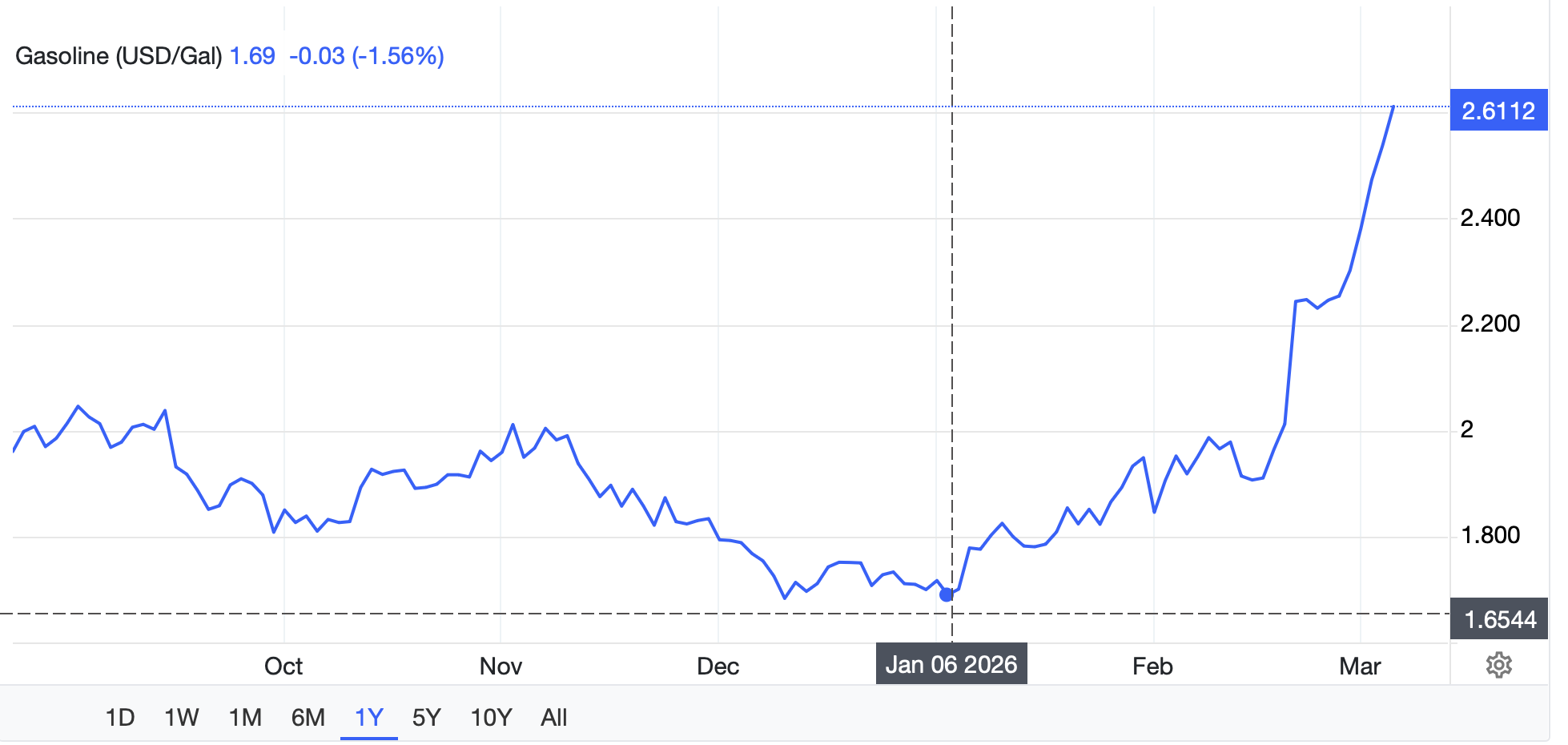
Since January 2026 wholesale gasoline prices have risen just under a dollar as of March 5, an increase of more than 40%. Of course the biggest spike has come in the past week with the war in Iran prompting a steep run up.
The price increases are hitting both jet fuel and diesel prices with jet fuel reaching $4/gallon today. California gas prices as well as diesel are up about 40 cents from a month ago says AAA.
Renewable Fuels Assn expects your pump choices will look like this in the near future You may have to wait a little longer to fill up with E15 ethanol/ gasoline blend at your local gas station.It is now approaching the fifth month after California Governor Gavin Newsom signed a bill Oct 2 allowing “immediate” sale of higher blends of ethanol in gasoline sold in the state – up to E15 (15% ethanol & 85% gasoline) instead of E10. Legislation was signed as an “urgency statute,” meaning retailers could sell E15 immediately after Newsom signed the bill. At the time ethanol industry advocates celebrated the news after a decade of seemingly futile attempts to convince CARB, the California Air Resource Board, to allow the option but then suddenly getting what looked like a green light to launch a new 650-million-gallon market for ethanol. Midwest corn growers are excited about the potential here with 40% of U.S. corn production directed toward ethanol. California is the nation’s largest fuel market and E15 is allowed everywhere else. ‘Right now it is down to just one hiccup” says Renewable Fuels Assn representative Robert White.That last step is approval by the fire marshall that the vapor recovery mechanism in the fuel pumps works as certified by the manufacturer. Only Underwriters Lab can do this according to the regulations although White is requesting help from the governor to cut what he considers to be red tape blocking the rollout of the fuel across the state.”CARB was accepting what the manufacturer promised.” Once this issue is resolved, sales can move forward “very quickly” , suggests White, with no need to dig up underground tanks or change the dispensers to offer E15. At retail, all stations need are new labels. The blending of ethanol by percentage happens at dozens of locations across the state including two terminals in the Central Valley in Fresno in Stockton and the move to a higher blend is a simple computer program.No holdup here. In our reading area, the company Calgren, based in Pixley supplies ethanol to the regional market. At the gas station, Renewable Fuels Assn believes motorists will see the familiar three choices that vary by octane level and price. Most will choose the budget friendly E15 blend with 87 octane level although E15- octane 89- and E10 octane 91- will be available as well (see pic). In approving the new blend, Newsom has said the availability of E15 could help bring down the cost of gasoline in California. A study conducted by the University of California, Berkeley and the United States Naval Academy, showed E15 could lower gasoline prices by up to $0.20 per gallon and save Californians as much as $2.7 billion annually. Another study at the University of California, Riverside found that increasing ethanol blending in gasoline would not affect NOx emissions and would reduce particulate emissions.
Besides offering a cheaper option for motorists, the approval of E15 could also benefit the state’s fuel supply that will be expanded, even as refiners in California are making less gasoline, notes White. One refinery in the Bay Area has closed and one in Wilmington (LA) owned by Phillips 66 just announced it would layoff 277 employees as it winds down operations and is slated to be closed later in the year. Critics of California policies say the state is making it too tough for businesses including refiners and as a result of the closures, gas prices will skyrocket. Part of the reason California gas prices are high is that the market is isolated with no connecting pipelines to the east. It looks like that will change with the competitive race to complete a petroleum pipeline that will connect the Midwest and Texas over the Rockies to California and Arizona.Phillips 66 who is closing a refinery here, is one of the pipeline builders. But skeptics of E15 make several arguments downplaying its significance.I it’s worth remembering that the oil industry has always opposed more blending of corn ethanol in America’s fuel supply for the simple reason that they don’t make the product. It is worth remembering that the oil industry has always opposed more blending of ethanol into our fuel supply because they don’t make it. Oil company manufactured MTBE was phased out because, although the octane booster was added in the 1990s to help fuel burn cleaner, it was found to be a possible carcinogen and contaminated groundwater. Some skeptics Some say E15 won’t be widely adopted,noting that it is not that popular in the rest of the nation. Fears continue that it could harm some older engnes.Others note that the mileage filling up with E15 could fall. Adoption of the new standard- a three-option pump choice by major gas retailers like Costco (140 warehouses in the state), the big truck stops- Love’s,TA and Pilot and the 37 tribal stations could bring the rest of the retail sector with them if motorists vote with their credit cards lured by a 20-25 cent break at the pumps. Still, 80% of all gasoline purchased in the U.S. is sold at convenience stores and here is where we should watch what happens. One political note: This February President Donald Trump called for allowing the year-round sale of E15 petroleum.
New bird flu find in Sonoma County USDA reports that highly pathogenic avian influenza (HPAI) was confirmed on February 9 in a commercial broiler flock in Sonoma California. The bird flu find required the destruction of 84,000 birds. Commercial poultry were decimated in California in 2024/2025. This is the first commercial flock impacted in 2026 although a game bird flock in Butte County was hit in January with 36,000 birds.USDA says 53 flocks in the past 30 days across the nation have been been impacted by bird flu .
Fewer foreign visitors There was a 6 percent drop in foreign visitors to the US last year, according to industry body the World Travel & Tourism Council, amid tensions between the Trump administration and other countries, including Mexico and Canada.
Floating Wind powers up in Japan / Trump U.S. ban struck down
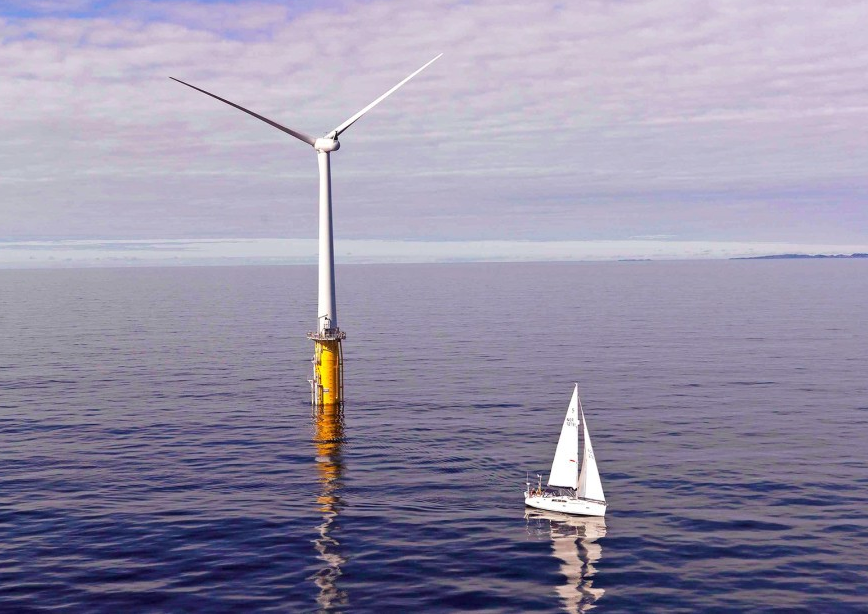
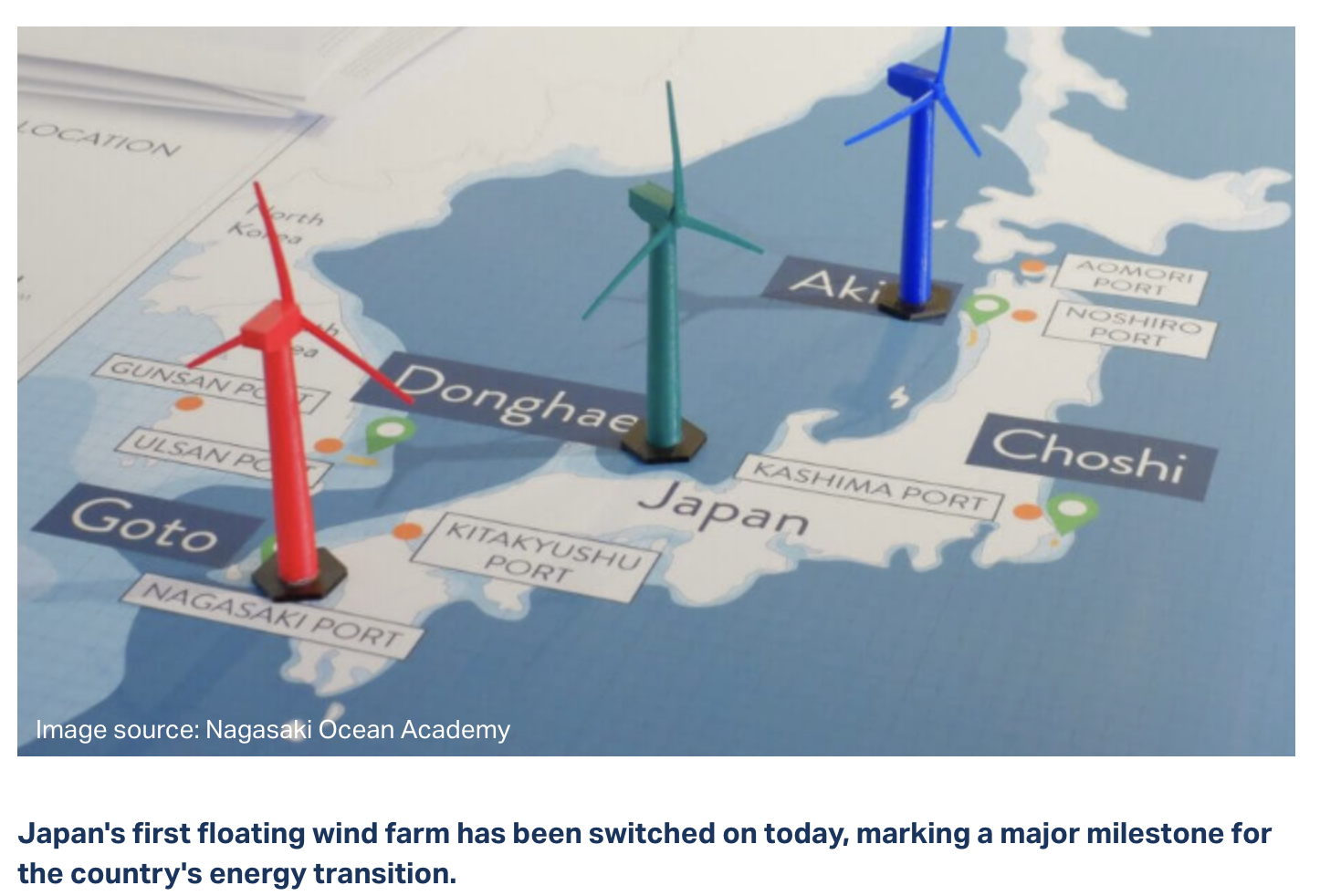
News reports say that off the coast of Japan the Goto Floating Wind Farm that employs floating technology under consideration on the U.S. West Coast, announced the start of commercial operations this week, pumping nearly 17 megawatts of power onto the Japanese grid. Japanese officials last year raised the country’s goal for installed capacity of offshore wind to 10 gigawatts by 2030 and 45 gigawatts by 2040. Last month US Groups that promote offshore wind power are hopeful that a big win in court will convince the federal government to consider permitting new projects.
In December a federal judge struck down President Donald Trump’s day-one executive order that halted all offshore wind approvals and argued that the Biden administration unfairly favored renewable energy over oil and gas.
“Now each individual project is still going to have to continue the route it’s on,” said Benjamin Collings, offshore wind advisor for the nonprofit Elected Officials to Protect America. “For example, projects like in the Port of Humboldt, they can continue without being permanently stopped, which the White House was trying to do.”
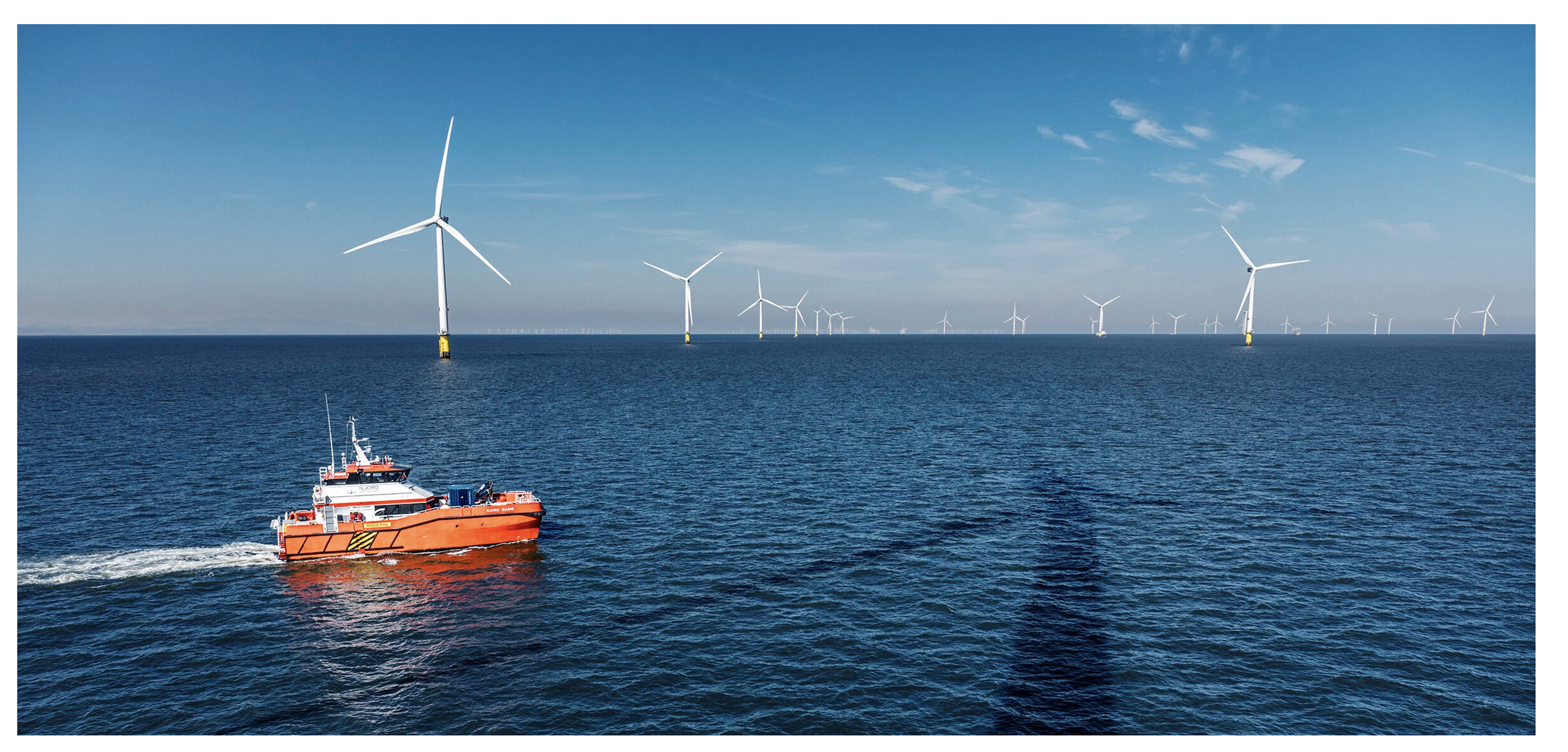
California has five offshore wind projects in development: two off of Humboldt Bay and three off the coast of Morro Bay. Companies are doing environmental studies as they prepare to apply for state permits.
US manufacturing contracted in December 10th month in a row
The Institute for Supply Management reported this week that the Manufacturing PMI® registered 47.9 percent in December, a 0.3-percentage point decrease compared to the reading of 48.2 percent in November and the lowest reading of 2025. The overall economy continued in expansion for the 68th month after one month of contraction in April 2020. (A Manufacturing PMI® above 42.3 percent, over a period of time, generally indicates an expansion of the overall economy.)
The New Orders Index contracted for a fourth straight month in December following one month of growth; the figure of 47.7 percent is 0.3 percentage point higher than the 47.4 percent recorded in November.
EIA: Crude oil prices fell in 2025 amid oversupply
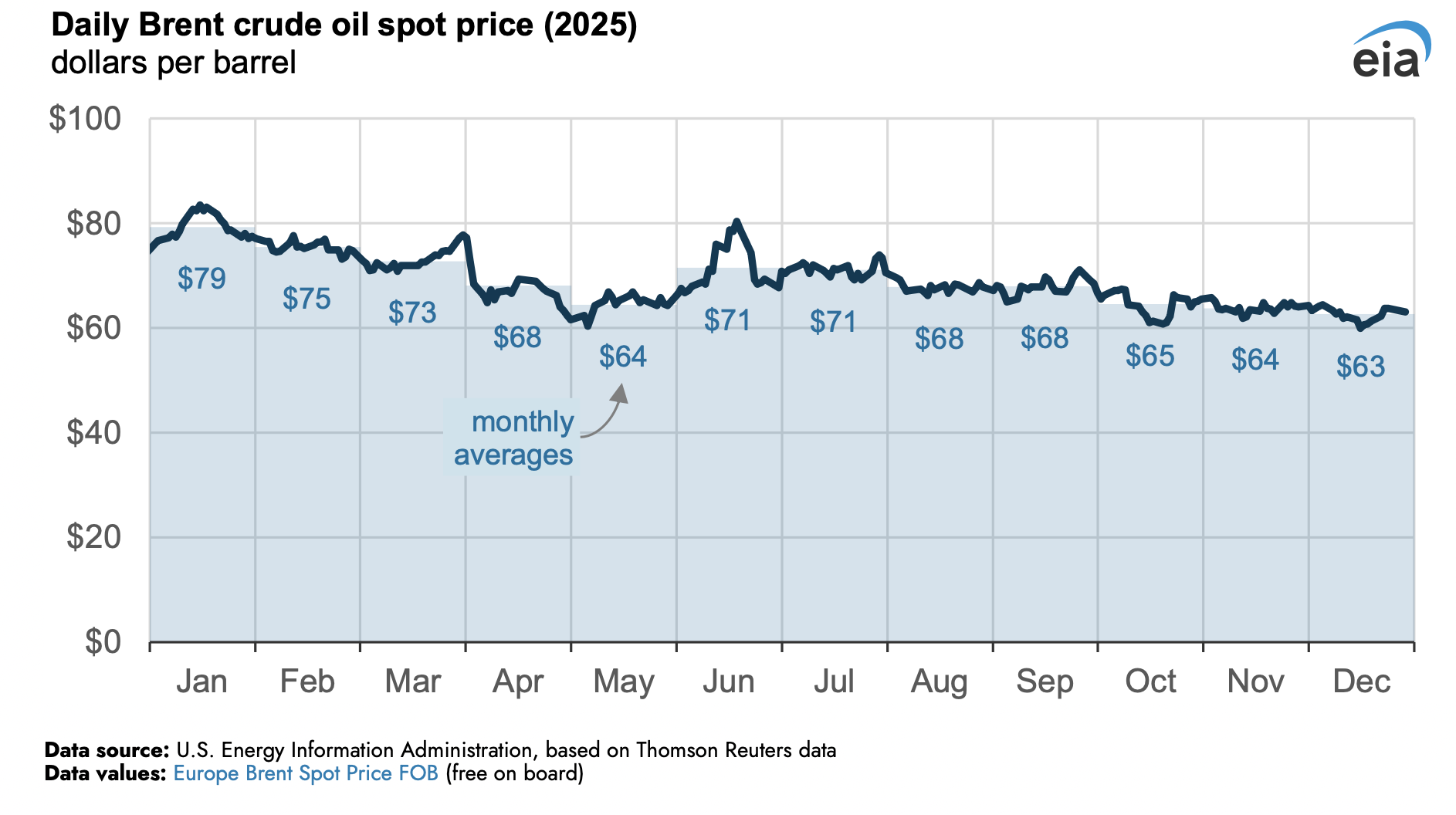
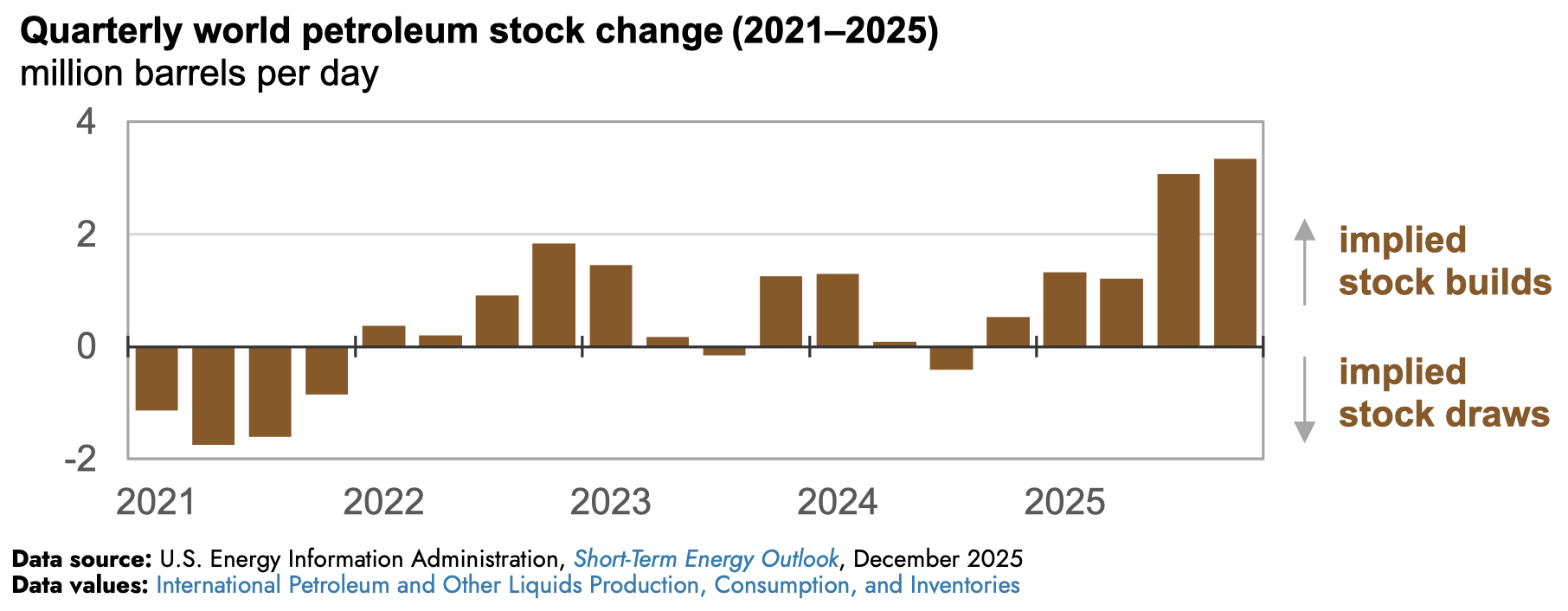
Crude oil prices generally declined in 2025 with supplies in the global crude oil market exceeding demand. Crude oil inventory builds in China muted some of the price decline. Events such as Israel’s June 13 strikes on Iran and attacks between Russia and Ukraine targeting oil infrastructure periodically supported prices.
On a monthly average basis, the price of Brent crude oil declined from a high of $79 per barrel (b) in January to a low of $63/b in December, which was the lowest monthly average price since early 2021. The annual average price was $69/b, the lowest since 2020, even when adjusting for inflation.
World supply of oil continues to build in 2026. EIA forecasts that global crude oil production will increase by 0.8 million barrels per day (b/d) in 2026, with supply from Brazil, Guyana (next to Venezuela), and Argentina accounting for 0.4 million b/d of the expected global growth forecast in our December Short-Term Energy Outlook (STEO). Global crude oil production growth since 2023 has been driven by countries outside of OPEC+.
The price drop bodes poorly for reviving Venezuela’s oil industry in the wake of the U.S. raid on Caracas and arrest of the South American country’s President Nicolás Maduro. At such low levels, investments in new infrastructure may be difficult to justify. say some analysts.