New Kings Co Solar Projects Total 336MW

Four solar projects on non-prime ag land in Kings County are expected to move forward late this year totaling a hefty 336 megawatts. All are believed to hold power purchase agreements with a utility, a key milestone to toward actual construction.

The filings come as an environmental group urged earlier this year approval of solar projects on marginal or spent ag land in the Central Valley.

The Kings County Community Development Agency has invited public review and comment on the environmental documents listed below.
The public review period, for all four documents, begins on Wednesday, June 13, 2012, and ends on Friday, July 13, 2012.

INITIAL STUDIES PROPOSED AS NEGATIVE DECLARATIONS OR MITIGATED NEGATIVE DECLARATIONS:

1. Conditional Use Permit No. 11-03 (River West Investments, Inc.) The applicant proposes to construct a 136 Megawatt
solar photovoltaic energy facility located at 17515 20th Avenue. Lemoore, CA. The 670 acre project is near Hanford and is being proposed by a firm from Sacramento headed by former homebuilder Brian Vail. SunPower is the developer. It is also labeled the Henrietta Solar project

2. Conditional Use Permit No. 11-09 (RE Mustang LLC) The applicant proposes to establish a 160 Megawatt solar photovoltaic energy facility located at 15866 25th Avenue, Lemoore, CA. The big project  is one of several being proposed by SF based Recurrent energy owned by Sharp, a Japanese firm. The site is near the NAS Lemoore base. Recurrent also a a plan to build a 500MW solar farm near Tranquility in Fresno County.
3.Conditional Use Permit No. 12-01 (RE Orion LLC) – The applicant proposes to establish a 20 Megawatt solar photovoltaic
energy facility located at 16480 25th Avenue, Lemoore, CA.Orion is based in Oakland but Recurrent is the developer.
4. Conditional Use Permit No. 12-02 (RE Kent South LLC) – The applicant proposes to establish a 20 Megawatt solar
photovoltaic energy facility located at 17264 25th Avenue, Lemoore, CA. Recurrent is the developer

The Kings County Planning Commission will hold public hearings to consider the environmental documents for the proposed project Aug 6  7PM,at the BOS chambers.

109 South Valley Projects

A February 2012 report from the Defenders Of Wildlife says there are 59 solar PV projects in the permitting  stage within the five southern San Joaquin counties that if built would generate 2,780 MW of power.This is in addition to 45 projects in those same counties that have already been approved that would generate 1,648 MW.That’s 109 solar projects pending in the south Central Valley that add up to  4,428MW, more than double 2 Diablo Canyon nuclear power plants.

Two large projects in the Westlands Water District that spans Fresno and Kings counties are in the permitting stage says the February report. One is Mustang in Kings County on 1400 acres being proposed by Recurrent mentioned earlier.The second in Fresno County is a a 1890 acre project near Mendota being  proposed by SunPower that could generate 200MW.

Defenders Of  Wildlife argue that such projects on “degraded” and “impaired” ag lands will help avoid farmland of higher quality as well as avoiding sites that are more sensitive environmentally with wildlife impacts for example – think some desert site proposals pending.

To help this area the group urges the PUC to upgrade electricity infrastructure in the area

Green Energy Fuels Update

E85 Ethanol Flowing Again in Tulare: Corn-based E85 ethanol fuel for owners of flexfuel vehicles is available once again in the Tulare area at Stanley’s Food Mart on Cartmill Ave. at “M” Street.  The Tulare E85 station was the third to open in California, beginning sales in February 2008 during the World Ag Expo.  There are about 60 E85 stations in California today according to US Department of Energy websites.  The nearest is in Modesto, with dozens in the Sacramento, Bay and LA . The gas station was idled for about a year sold recently by Nella Oil to the Vohra brothers who have 10 stations in the Fresno area.The station opened in the past week carrying a Chevron brand name.

Speaking of corn, Pacific Ethanol, Inc. announced this week it
will install corn oil separation technology at the Pacific Ethanol Magic Valley plant with the intention to further implement corn oil separation at the other 3 Pacific Ethanol Plants by the end of the first quarter of 2013,that appears to include currently idled Madera.  The Magic Valley plant is expected to produce approximately 12 million pounds of corn oil per year, which at current prices would contribute as much as $4.5 million, or seven cents per gallon, of operating income annually.” Corn oil ise used as a food grade vegetable oil or as  feedstock used for biodiesel. Pixley-based Calgren added corn oil extraction as part of its ethanol making process.

In Visalia EdenIQ will hold its pilot plant ribbon cutting  Tuesday, June 26 in Visalia from 10 AM to 3PM. The ceremony includes  an industry presentation  to be attended by   government officials, venture capitalists and industry analysts on the state of the biofuels industry as well as the future of sustainable fuels. . The Pilot Plant converts cellulosic feedstock (non-food plant material) into ethanol and is located at Edeniq’s headquarters in Visalia, California.

Also the following presentations are planned.

The State of The BioFuels Industry: Insights and analysis of the current successes, challenges, bright spots and trends within the biofuels/bio chemical sector by Mackinnon Lawrence, Pike Research
The Future of Sustainable Fuels: A panel discussion with Brian Thome, CEO of Edeniq, CEC Deputy Director Pat Perez, Glenda Humiston Director of the USDA’s State Rural Development office, and John Rockwell from the Venture Capital community to discuss the partnership needed between funding, public and private sectors to get to a successful biofuel future.Moderated by Heather Youngs, Analyst with Energy Biosciences Institute at UC Berkeley.
________
CEC Funds Green Fuels Program Will Add 101 New E85 Stations & Much More
The California Energy Commission approved funding of $35,031,310 to projects that will accelerate the development of green fuels and technology in California. These investments reduce the state’s dependence on foreign oil, improve the environment and help California attain its climate change policies.
These investments provide vital support to emerging fuels and vehicle technologies by funding the differential cost of their development and deployment. Additionally, many of these projects leverage outside funding to attract additional investment in clean energy jobs and technology.
The award recipients are:
CALSTART, Inc., will receive $14,469,304 to demonstrate medium- and heavy-duty vehicles using advanced technology and alternative fuels. Altogether, 29 vehicles of nine different types will be used and evaluated, ranging from all-electric battery vehicles to hybrid diesel-electric work trucks, shuttle buses, and construction equipment. In addition to reducing greenhouse gas emissions, as these projects become commercial they have the potential to create more than 600 jobs by 2015. CALSTART is based in Pasadena.
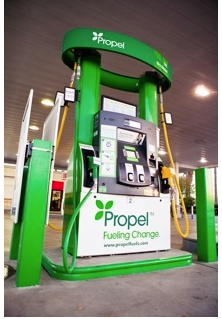
Propel Biofuels, Inc., will receive $10.1 million as a share of the cost to install 101 new E85 (ethanol) fueling facilities at existing gas fueling stations statewide. As there are currently just 51 publicly accessible E85 fueling stations in the state, this project will greatly enlarge the network of stations that can serve the approximately 500,000 flex fuel vehicles in California. Propel Biofuels is based in Redwood City. 
SacPort Biofuels Corp. will receive $5 million to develop, build and test a pilot facility to demonstrate an innovative gasification process to produce renewable biomass diesel from local municipal solid waste, including green refuse, railroad ties, construction and demolition waste, and plastics that typically wind up in landfills. Because landfills are a major contributor of greenhouse gas emissions, reducing their size reduces emissions. Annually, the facility is slated to eventually produce 365,000 gallons of renewable diesel fuel that will be blended with conventional diesel. The project, located at the Port of West Sacramento, is expected to create 20 permanent jobs and an additional 30 during construction. 
Gas Technology Institute, a nonprofit energy research and development organization, will receive $4,562,532 for two projects: a demonstration of three plug-in hybrid trucks, in partnership with US Hybrid Corp.; and a demonstration of a natural gas version of the heavy-duty Navistar MaxxForce 13 diesel engine, in partnership with Clean Air Power.
Springboard Biodiesel, LLC, will receive $758,200 to develop and build a pilot biodiesel production facility in Chico, where Springboard is based. The facility is expected to provide low-cost biodiesel in rural Northern California, which currently lacks such fuel options. Used cooking oil and other waste material will be diverted from landfills and used to produce up to 1,000 gallons a day of biodiesel to be used locally. This project is expected to create 12 permanent jobs. 
Whole Energy Pacifica LLC will receive $125,274 to design, build and install a fuel-blending system at an existing biodiesel terminal in Richmond. The new system will provide accurate, uniform blending of diesel and biodiesel. The biodiesel at this facility is predominantly made from used cooking oils. 
Reynolds Buick-GMC will receive a buy-down incentive of $16,000 for two natural gas-fueled medium-duty vehicles of 8,501 to 14,000 pounds gross vehicle weight. Such incentives are designed to help pay the difference between the cost of conventional gas- or diesel-powered vehicles and new ones that use propane or natural gas. To receive an incentive, purchasers must agree to register the vehicles in California and operate them in the state for three years using the designated alternative fuel at least 90 percent of the time.

Kern’s Big $4 Billion Hydrogen Project To Capture CO2

The California Energy Commission has scheduled a July 12 site tour and information hearing for the HECA hydrogen power and fertilizer plant  near Bakersfield. Reservations for the 5 p.m. site tour are due by July 6 and may be made by contacting the commission’s public affairs office: 916-654-4489 or 800-822-6228, or by email: publicadviser@energy.ca.gov.
The session will  serve as a scoping meeting for the U.S. Department of Energy’s National Environmental Policy Act’s  review of the $4 billion, 453-acre project.
According to the the project website, the key goals are to generate low-carbon hydrogen power and fertilizer to meet California’s increasing demands while capturing carbon dioxide (CO2) and storing it permanently in nearby oil fields.
In doing this, the project will create jobs, supply needed power, address climate change concerns, enhance US energy security, and boost domestic oil production.
The project is a response to the leadership shown by California in tackling the issue of climate change and in taking steps towards a hydrogen based economy.
The expected multi-billion-dollar power project, which will create more than 2,000 construction jobs over three years, will generate 300 megawatts of low-carbon electricity and enough power to support 160,000 homes. It will recapture at least 90 percent of its carbon emissions, demonstrating how groundbreaking environmental progress goes hand-in-hand with job-creation and economic growth.
When completed, the 400MW Hydrogen Energy California project (HECA) will produce low-carbon electricity to help meet the growing demand in Southern California and contribute to meeting California’s increasing power demand while minimizing greenhouse gas emissions.
The project will also produce approximately 1.3 million tons of locally manufactured, 90% carbon-free fertilizer per year, enhancing the local agricultural economy and reducing foreign imports of a critical farming supply.
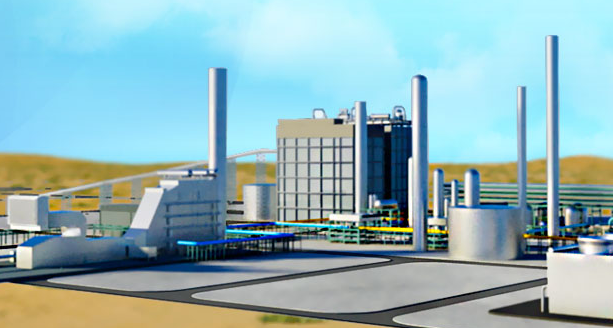
At the heart of the project is a gasification unit and carbon capture facility where a blend of California produced petroleum coke (a waste product currently exported) and western coal is transformed into hydrogen and CO2. This process is designed to capture approximately 90% of the CO2 from the fuel source and transport it by pipeline for enhanced oil recovery in local oil fields for permanent and secure storage in deep geological formations.
Hydrogen Energy California is being development by SCS Energy, one of the nation’s leading independent developers of clean power.