
New projects in Kern,Kings & Fresno Counties
In the past six months about a dozen huge utility-scale solar projects have launched permitting requests on thousands of acres of former farmland near I-5, the Valley’s driest region,where farmers have been hardest hit by water scarcity worries and SGMA regulation. Many are wondering how they will be able to pay their bills in the future. For more Kern,Kings and Fresno county landowners, harvesting solar energy is the most attractive answer.
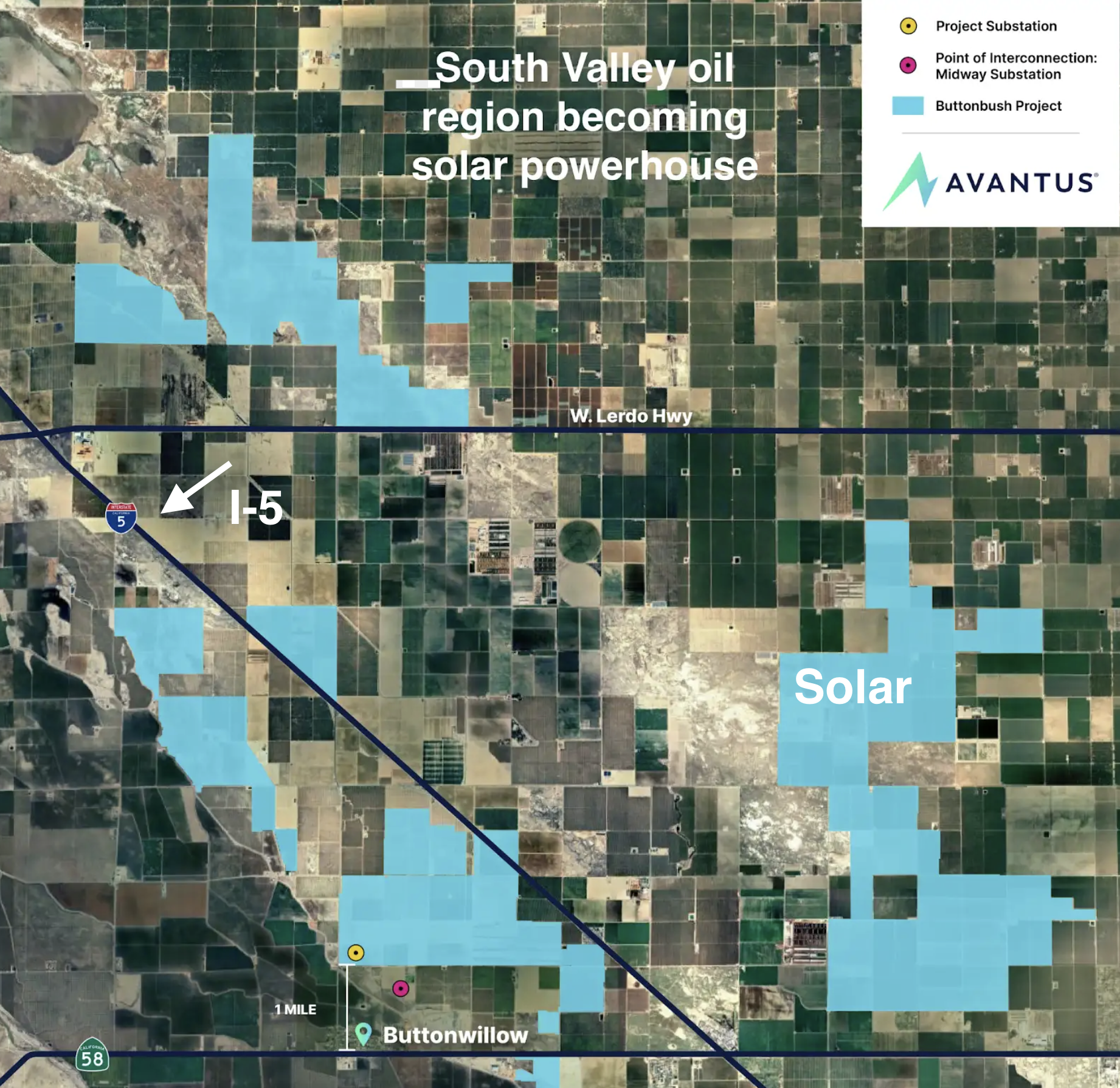
More solar in Kern’s oil patch
While the current administration in Washington has downplayed the benefits of renewable energy, even calling it a scam, farmers are watching missiles fly over the Middle East where fossil fuels is what they’re fighting over. Meanwhile there are no missiles flying over I-5.Now it turns out that none other than the United Arab Emirates is investing here – not in oil but in solar.Despite loss of federal incentives it appears solar energy installation is more popular than ever across the US. Mr Trump’s Energy Information Agency(EIA) says utility-scale solar is the fastest-growing source of electricity generation in the United State with almost 70 gigawatts of new solar generating capacity projects scheduled to come online in 2026 and 2027 – a 49% increase in U.S. solar operating capacity compared with the end of 2025.The run up in fossil fuel costs this year is only adding to the momentum of developers looking to supply more solar power and critically, battery storage to the grid including along I-5 in the west side of the Valley.The big highway parallels the state’s largest transmission lines and power stations.
Now we are looking at a massive solar expansion along a 120 mile corridor from the Buttonwillow oil fields to the north extension of the Westlands Water District almost to Los Banos. It was here in 2016 that state regulators, developers and environmentalists mutually agreed this was the best place in the state to juice up the state’s renewable power considering this is where there are fewer disruptive conflicts found, no rare tortoises. Instead, they found thousands of acres of formerly irrigated farmland so high in salts, it could not be tilled again. A long drive on I-5 will tell you this dry and windy corridor features both few people and critters yet enjoys nearby access to the power grid. It is also equidistant between the metro areas of LA and the SF Bay.
Then there is the AI-fueled data center boom in California and the realized need discovered in the past year, for large quantities of electric power that can be installed quickly. Again the sunny west side of the San Joaquin Valley and this technology looks to be in the right place at the right time.
It is of course, ironic that Kern County is the leader of the pack to develop solar power in the Valley, since western Kern County where the California oil industry is still king. It is the home of the still potent Elk Hills oil fields, the former Navy Petroleum Reserve near Buttonwillow.Now in the past few weeks the Kern County Board of Supervisors approved a development that has been described as California’s single largest solar energy project near Buttonwillow called the Buttonbush Solar and Storage project. The sprawling solar farm spans almost 12,000 acres on both sides of Highway Five and will generate 2000 MW or enough power for about 1 million homes. The power capacity is on the scale of Diablo Canyon nuclear power plant.The developer is Avantus,majority owned by KKR.
While eastern Kern County, the Mojave region, was popular for new solar arrays in the past decade, the Bakersfield Californian reports that now “Thirty-five projects that propose to sell their power to the state grid have been approved for construction in western Kern. It remains to be seen how many of them ultimately get built.”
UAE connection
If that 12,000 acre Kern project is big,a Kings County solar application a few miles up the road filed late year is bigger – encompassing 18,300 acres called Rex Solaire Solar and Storage, LLC.This huge development is just one of a dozen mega renewable projects developed by the company Terra Gen with a portfolio of 4.2 GW of wind, solar, and battery storage projects, including 5.6 GWh of energy storage capacity owned by Abu Dhabi Future Energy Company PJSC – Masdar, the United Arab Emirates’ clean energy powerhouse, and Igneo Infrastructure Partners.Of course the United Arab Emirates has been on the receiving end of Iran’s missile barrage hitting their oil fields and hotels.
The big Kings solar farm will generate 2800 megawatts produced from solar panels and include a battery storage facility that will have a capacity of 11,200 gigawatt-hoursThe project site is located on approximately 18,381 acres of agricultural land in unincorporated southern Kings County (County), along the eastern edge of Interstate 5 at Utica Ave, 10 miles southeast of Kettleman City and 3 miles east of the California Aqueduct. Still in the draft EIR stage, their application says construction is expected to begin in 2028 with the initial 900 to 1,500 MW phase to be completed over a period of approximately 24 to 36 months.
Only a few miles away straddling the Kings/Fresno line is another big solar farm called Cornucopia Hybrid, LLC on 2,446 acres between Avenel and Coalinga west of I-5. The project will generate 300MW with construction anticipated to begin in the fourth quarter of 2026 and to last 39 months.Commercial operation expected in the fourth quarter of 2029.
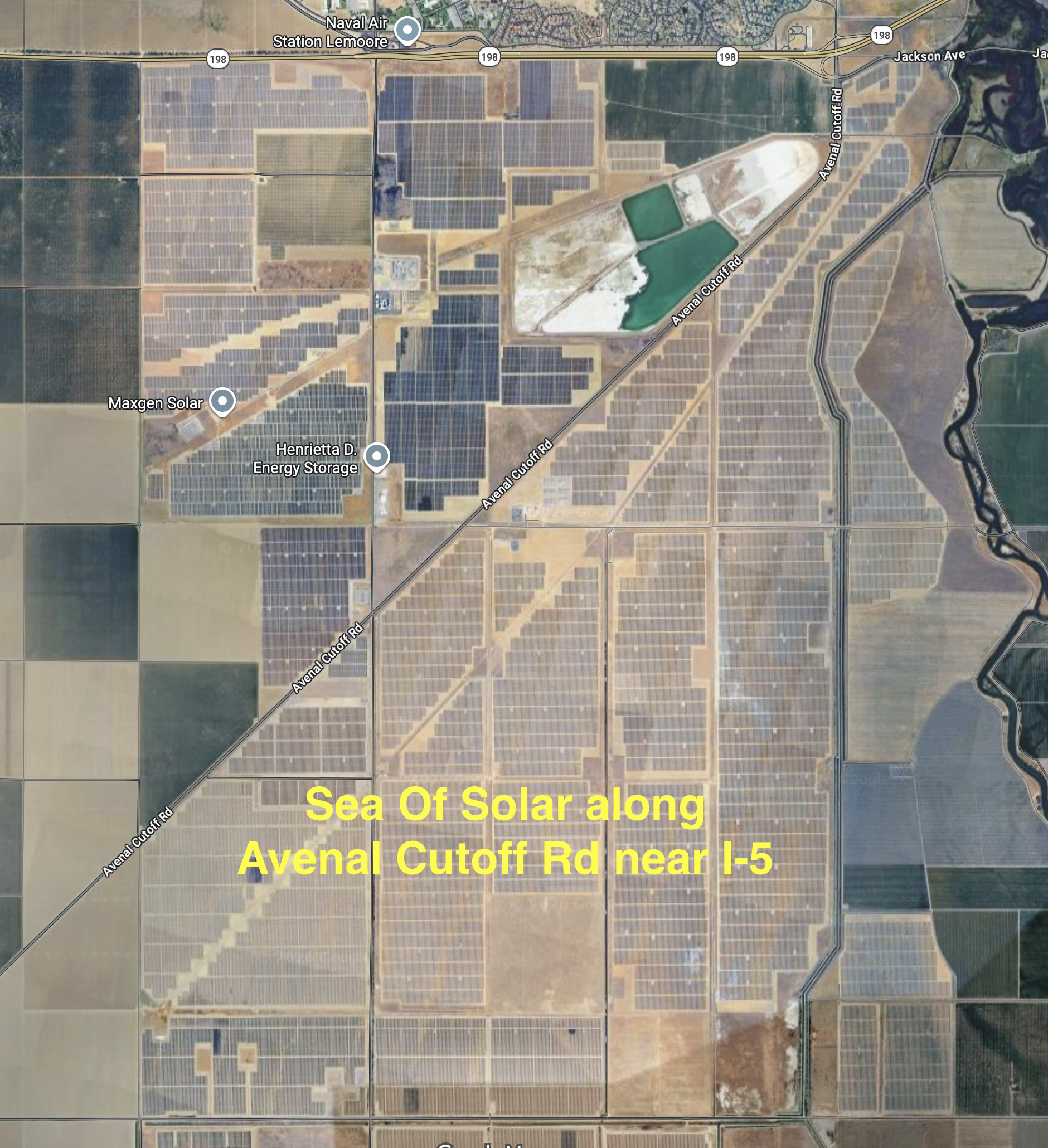
Wall to wall solar in Kings County
In Kings County an early adopter of the west side solar boom is Westlands Solar Park (WSP) who has been building one by one, a dozen 200MW plus solar farms in Kings County on Westlands Water District bare land just east of I-5 along the Avenal Cutoff since 2016. When the solar park is completed it is slated to spread over 20,000 acres and generate 2276MW plus battery storage.Construction is continuing on new WSP projects with a hearing at the Kings County Planning Commission this month.
Big projects in Fresno County’s westside
Just to the north where thousands of renewable megawatts are in the offing the California Energy Commission recently approved the Darden Clean Energy Project on approximately 9,500 acres in western Fresno County. The project consists of a 1,150 megawatt solar photovoltaic facility with a 4,600 megawatt-hour energy storage system, a 34.5-500 kilovolt grid step-up substation, a 15-mile 500 kV generation intertie line, and a 500 kV utility switchyard. The project would interconnect to the existing Pacific Gas and Electric Company Los Banos-Midway #2 500 kV transmission line. The development will be south of the community of Cantua Creek – just east of I-5.
To be located 5 miles south of the City of San Joaquin in Fresno County, Rosemary Solar, LLC proposes to construct a 1,172 acre, 140 megawatt project and include energy storage capacity of up to approximately 140 MWac.Further along on a construction schedule is San Luis West Solar, LLC who wants to break ground in 2026 on a 125-megawatt solar facility coupled with an estimated 30 MW Battery Energy StorageSystem.The project would be located on seven parcels that total approximately 1,400 acres.
136,000 acre Valley Clean Infrastructure Plan
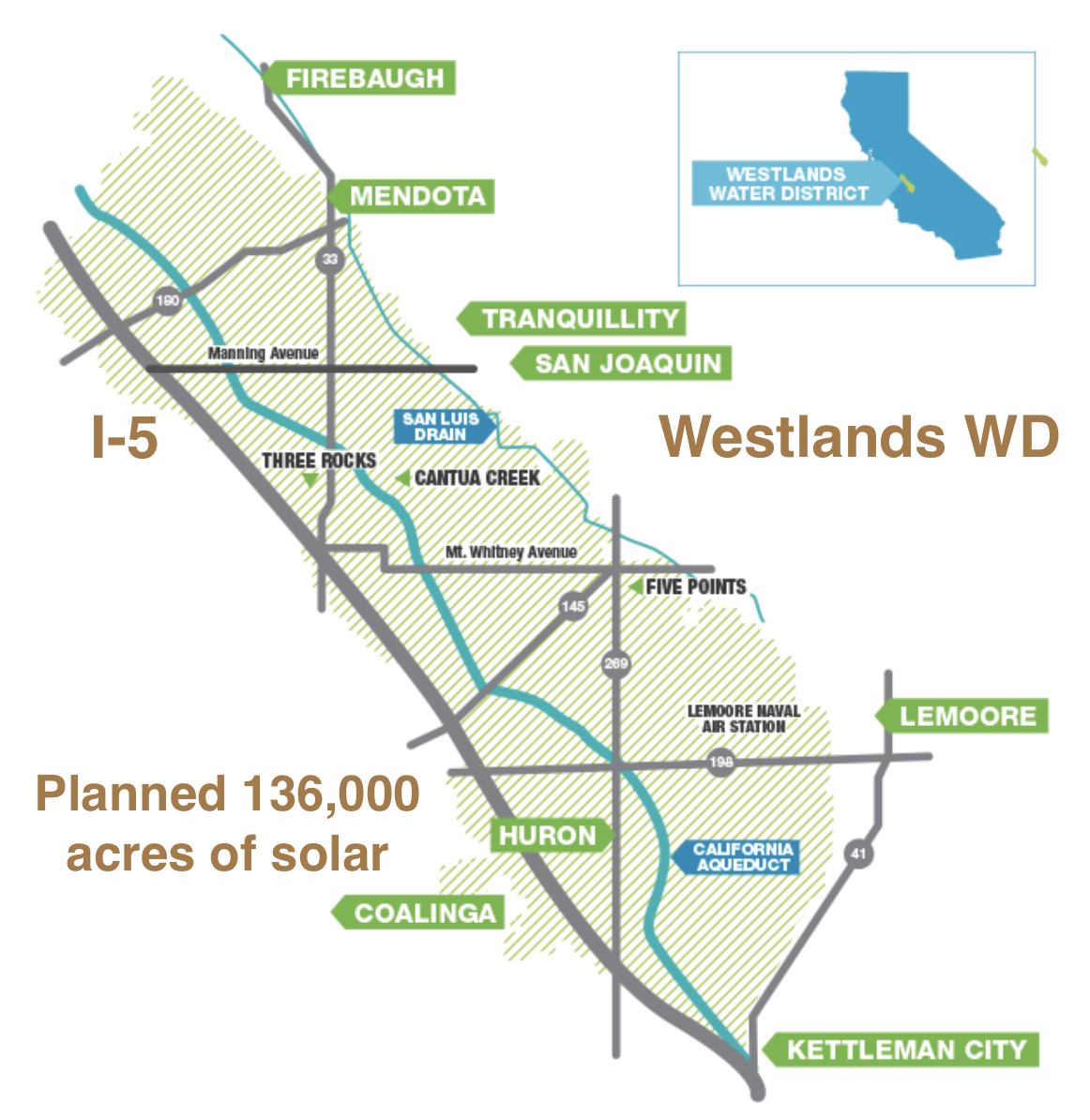
Fresno County supersized solar
The granddaddy of the super-sized solar farms was just announced by Westlands Water District and their partner Golden State Clean Energy – based in LA – who are also the developers of Kings County’s Westlands Solar Park.The final EIR was approved in December. Called the Valley Clean Infrastructure Plan (VCIP), the 130,000 acre multi-year project in collaboration with Westlands Water District, plans to repurpose drainage-impaired and other agricultural lands within Westlands for solar generation, energy storage, and electric transmission facilities.At full build out, the projects developed under VCIP would generate 20 gigawatts (20,000MW), enough to provide up to one-sixth of California’s electricity requirements in 2035 and up to one-tenth of its requirements in 2050
.The project would be built ion 72,000 acres of district-owned land and 64,000 acres of privately-owned land.The project would also install dedicated transmission lines to connect to the grid.The plan is to erect an average of a 200MW solar farm every year for over 11 years.They want to start in the northern part of the district near Firebaugh and move south.
According to Westlands, over 242,000 acres were idled in 2025 due to unreliable water supplies, including 23,988 acres already repurposed for solar.That will now grow to an additional 136,000 acres so that 160,000 acres of solar will cover almost 70% of this fallowed ag land. Potential construction could begin as early as 2028.
Westland’s managers have taken this step not only because of the drought, reduced water deliveries and SGMA rules but because over the years more of this irrigated land is suffering from a perched water table when irrigation water accumulates above impermeable clay layers near the surface. The impact is that this shallow groundwater lacks natural drainage, leading to salt accumulation in the root zone, damaging crops. Drainage solutions are few and expensive.
There is still another huge challenge for this parched part of the state.The capacity of the westside’s California Aqueduct has been predicted to decline by 87% if subsidence was not corrected. The big canal that delivers water from the north is suffering from reduced capacity each year. Fixing it will cost the public billions. One bill in Congress would pay $1.68 billion dedicated to repairing existing canals, including $830 million for the Delta-Mendota Canal and $850 million for the San Luis Canal and California Aqueduct.
Westlands crops
As we have also pointed out in past articles, Westlands has retired more cropland once dedicated to processing tomatoes as technology has vastly improved yield. The district grew nearly 100,000 acres in 2000 but today earns more money from 40,00 acres of tomatoes. Today cotton suffers from low prices, but once grew on 180,000 acres in the district and now is just a 13,000 acre crop.
In 2000 Westlands grew about 10,000 acres of grapes, mostly wine grapes according to their published crop report. In 2014 that grew to 18,000 acres. As of 2024 wine grape acres were back down to 10,200 as district farmers fallowed unprofitable vines. Grape industry leaders have and still are arguing that growers need to pull acreage to reflect lower demand seen in the marketplace.In other words-market forces are the reason there are fewer grapes needed.
Today one of Westlands larger crop acreage is almonds at 73,000 acres. But even that is down as overplanting of this crop statewide has led to lower prices along with tariff issues and now Westlands almond acres are down from 103,000 acres seen in 2021- a drop of about one third. Some are looking for new drought tolerant crops like Agave.
California’s top exports to China fell by 64% in 2025
Again the tarff wars are taking their toll.California agricultural exports to China saw a 64% decline last year, with the top 13 commodities in total falling from an average of $1.55 billion to $554 million, according to new research published by the University of California Giannini Foundation of Agricultural Economics. The researchers found that California counties with large agricultural sectors experienced some of the biggest estimated annual export losses, including losses of roughly $246 million in Fresno County and $238 million in Kern County.
Nuts are a big Westlands crop but almost all are exported . The study found that export volumes dropped significantly in 2025 with almond shipments to China falling about 77%, while pistachio shipments declined roughly 84%.
The bottom line suggests it’s prudent to use some of this excess land to harvest the sun, never facing tariffs.
_