

Along with all California hospitals, particularly rural ones, Visalia’s Kaweah Health got some bad news recently with passage of the “Big Beautiful Bill”, expected to reduce revenues once Medicare and Medicaid cuts are implemented in the coming months. The new law is expected to strip up to $128 billion from CA Hospitals over the next 10 years according to the California Hospital Association.
Kaweah Health CEO Gary Herbst has said the impact on the hospital could amount to $60 million a year by the time all elements of the bill are fully implemented.
Kaweah Health’s service area in Tulare County, California, has a significant Medicaid population, with approximately 62% of its residents covered by Medi-Cal and living near or below the federal poverty level. As a large, public, non-profit hospital, Kaweah Health serves as the primary provider in the region, offering critical services to a population with a high proportion of Medicaid recipients.
This is just one factor as the area’s largest employer struggles with stubborn obstacles. The district has approximately 5,200 employees and a medical staff of about 670 professionals.
Since the arrival of COVID in March 2020, Kaweah Health has struggled to return to financial health, although some months their monthly financial statements presented to the Kaweah Board show a positive bottom line, suggesting they may have turned a corner.
Employee costs up
During the pandemic, the hospital was forced to hire hundreds of nurses and other care providers through contract agencies to handle the flood of patients. Since then, the hospital has been successful in cutting the number of these expensive temporary health care workers. But now the latest monthly financial snapshot shows overall employee costs are up. This year employee expenses have gone from $38.8 million in January 2025 to $43.5 million in July 2025.
In the meantime, one place the hospital earns important income is in surgery cases. But here too the number of procedures is down. In recent years, many types of care are now provided without an overnight stay including cataract surgery, hernia repairs(now done on an outpatient basis that can lead to a faster recovery). Also, Gallbladder Removal,Colonoscopies and Lumpectomiesy, all formerly done in a hospital.
Baby Bust?
Then, there’s a curious decline in the number of births at the hospital. It is a trend seen across the State and nation. In 2023, the most recent year for which the California Department of Public Health records birth data, there were 400,129 births in California. This is down almost 100,000 births from a decade ago, when there were 494,392 births.
With about 70 births per 1,000 women of child-bearing age annually, Tulare County actually has one of the highest fertility rates in California.
But Tulare County is also struggling to maintain enough doctors to provide essential maternity care. Agreements between doctors and hospitals are ending and obstetricians are changing their practices and sometimes moving out of the county or out of state. Some obstetricians have decided they no longer want to deliver babies. Many OB/GYN medical practices no longer accept new patients and in the most extreme instances, hospitals no longer accept maternity patients. That is not happening here.
At Kaweah Health Medical Center, Tulare County’s largest hospital, about 400 babies are delivered each month, although the most recent numbers are down from that. One reason for this decline was the closure of the Visalia OB/GYN Medical Group back in December 2024. This Group accounted for a large number of deliveries, particularly among women with private insurance. For June 2025, Kaweah Health had budgeted for more than 400 deliveries but the actual number came in at 330. During the COVID years, there was a “baby bust” trend at Kaweah.
Outpatient trend
One long-term trend across the nation is that more procedures that were previously done in the hospital are now being done on an outpatient basis. That means the inpatient occupancy of the hospital is lower than budgeted. For example, in June 2025 the budget called for a daily census in the hospital of 440 but just 385 beds were filled. One report says in 2023, the hospital had an average census of 421 patients daily – falling to 405 in 2025.
In July the Trump administration signaled that more surgeries be done in outpatient facilities like ambulatory surgery centers, proposing a Medicare policy that could accelerate the shift away from hospital-based care, says a report from STAT.
“The administration is aiming to scrap Medicare’s list of 1,700 procedures that the program will only pay for in inpatient settings. Medicare officials unveiled their decision to eliminate the so-called inpatient only list in a proposed rule…”
Some trends up
Not that it is all bad news. Kaweah Health’s growing network of rural health clinics are seeing more and more patients around Tulare County. Other hospital-based clinics are also doing well, including its two urgent care centers, its urology clinic and other medical clinics whose patient care volumes are up year over year. The hospital- owned retail pharmacy is making money, up some $596K from budget. Revenue from operation of the Lifestyle Center is up 24%.
But the monthly bottom line number shows red ink for 4 of the 7 months of this calendar year, with the most recent months all minus as to net margin, indicating its profitability or lack of it.
This chart shows it all.
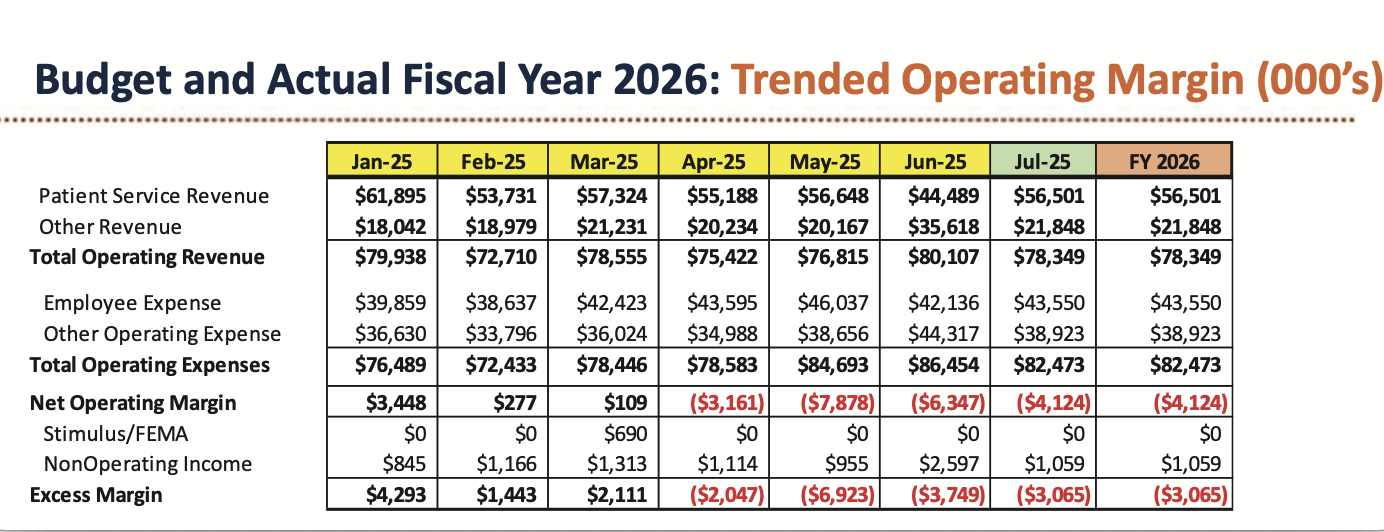
January, February and March of 2025 were all positive with a net income of $7.8 million. But, April, May, June and July were all below the predicted budget number, adding up to a minus $15.7 million, offsetting earlier numbers by double. July, the first month of the new 2026 fiscal year, is still showing more expenses than revenue. A July 2024 to July 2025 comparison shows operating revenue down 10% and employee expenses up 12%.
A memo to the Kaweah Board explained the following trends:
- Salaries and Wages: The $954K unfavorable variance is due to increases in registered nurse expenses compared to budget in inpatient settings.
- Physician Fees: The $765K unfavorable variance is due to payments made to contracted Radiology, Cardiology and Hospitalist groups that were higher than anticipated.
- Humana Cap Expenses: The unfavorable variance of $1.7M is due to higher than anticipated third party expenses (bills paid by Kaweah Health to other non-Kaweah providers for its enrolled Humana Medicare Advantage members).
People living here show up for medical care whether they have insurance or not. So, Kaweah Health has to write off, on average, $10M-$12M/year (“expected net patient payments”) in bad debt uncompensated care. The standard healthcare industry benchmark for bad debt is 2-3% of Net Patient Revenue. “We are averaging within that range.” explains a memo.
Talk of Towers
The district hospital lays out their financial reports for all to see on their website and both administrators and the Board regularly strategize and work to improve the results knowing that continued red ink could sink perhaps Tulare County’s most important institution. One trend the hospital is no longer talking about – building more patient care towers, although the seismic issue of the Mineral King wing is still unresolved. Hospitals all over the State have sought public funding through bonds, but these efforts have faced voter opposition.
On a regular basis the hospital faces both positive and negative news presented to the public including a recent lawsuit over a claimed wrongful death after an ER visit and kudos this week by U.S. News & World Report who recognized Kaweah Health in seven adult procedures and conditions as a High Performing Hospital in their 2025-2026 rankings.
use this chart showing red ink recently