
California’s first solar-covered canal is now fully online
This story was originally published by Canary Media
The 1.6-MW pilot system is among a growing number of initiatives to put solar over waterways. The approach could generate gigawatts of power nationwide.
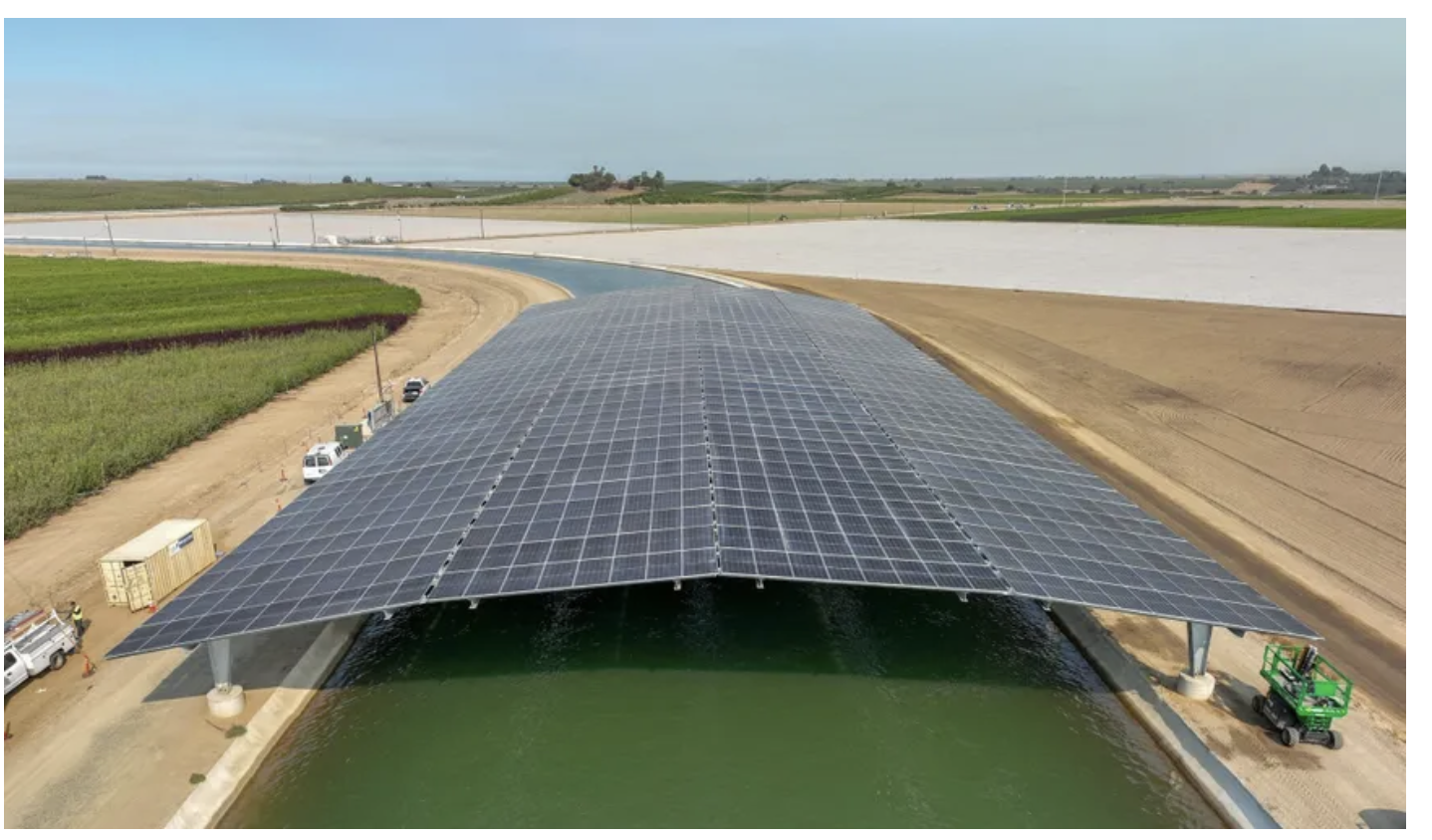
The roughly 110-foot-wide portion of the canal-top solar project near Hickman, California. (Turlock Irrigation District)
A novel solar power project just went online in California’s Central Valley, with panels that span across canals in the vast agricultural region.
The 1.6-megawatt installation, called Project Nexus, was fully completed late last month. The $20 million state-funded pilot has turned stretches of the Turlock Irrigation District’s canals into hubs of clean electricity generation in a remote area where cotton, tomatoes, almonds, and hundreds of other crops are grown.
Project Nexus is only the second canal-based solar array to operate in the United States — and one of just a handful in the world. America’s first solar-canal project started producing power in October 2024 for the Pima and Maricopa tribes, known together as the Gila River Indian Community, on their reservation near Phoenix, Arizona. Two more canal-top arrays are already in the works there.
In California, the solar-canal system was built in two phases, with a 20-foot-wide stretch completed in March and a roughly 110-foot-wide portion finished at the end of August. Researchers will study the project’s performance over time, while a new initiative led by California universities and the company Solar Aquagrid will push to fast-track the deployment of solar canals across the state.
Proponents of this emerging approach say it can provide overlapping benefits.
Early research suggests that, along with producing power in land-constrained areas, putting solar arrays above water can help keep panels cool, in turn improving their efficiency and electricity output. Shade from the panels can also prevent water loss through evaporation in drought-prone regions and can limit algae growth in waterways.
Plus, solar canals could offer a faster path to clean energy development than utility-scale solar farms, especially in rural parts of the U.S. where big renewables projects increasingly face community opposition. Placing solar panels atop existing infrastructure doesn’t require altering the landscape, and the relatively small installations can be plugged into nearby distribution lines, avoiding the cumbersome process of connecting to the higher-voltage wires required for bigger undertakings.
UC Merced says an almond orchard in Parlier provides a look into the future of farming.
Researchers at UC Merced and the University of California Agriculture and Natural Resources installed an irrigation system powered by artificial intelligence to deliver the precise amount of water needed and measure the results.
Led by computer science and engineering Professor Wan Du, the project was funded through the Fall 2023 Climate Action Seed Funds. It included a goal that’s almost as important as the work itself: spreading the word about the system and its potential.
The project includes two test beds: one irrigated via traditional methods and one served by the AI-powered system. Du is working alongside civil and environmental engineering Professor Safeeq Khan, a water resource management and soil science expert who built the soil model for the project, and computer science and engineering Professor Stefano Carpin, who developed the AI model.
“We will compare how much water each test bed will use,” Du said, “and then compare the production and result of these two fields.”
The system measures how much moisture is in the soil, then the potential for movement of water through a tree and eventually out the leaves. The data is uploaded to the internet.
“We have sprinklers under almost every tree so we can control them,” Du said. An algorithm processes the data and determines whether to open a sprinkler and how long it should run.
“We want to save as much water as we can,” Du said. “Saving water will reduce the cost to growers, and we can save the natural resource for the next generation.”
The system will be operational next spring, when the trees start to flower.