BIZ BEAT… car sales,home sales,industry,Kern renewables

Toyota Prius – California’s top selling car in 2012

California Vehicle Sales Climbed 25% In 2012

The new vehicle market in California continued its winning streak
at the end of 2012, with new registrations increasing 22 percent in
the Fourth Quarter versus a year earlier. It was the 15th consecutive
year-over-year quarterly increase. Last year’s annual total exceeded
1.6 million units, a 25.3 percent increase from 2011.

“The release of pent up demand, easing credit conditions, and strong
trade in values helped the market last year and should continue to
support sales in 2013” says the California New Car Dealer Assn newsletter. “ Auto Outlook is predicting a smaller 8.2
percent improvement this year, but registrations are expected to
reach approximately 1.75 million units.”

Other key trends in the state market:
• Among the top 15 selling brands in the state, Kia had the largest
percentage increase last year, up 53.3 percent.
• Korean, Japanese, European, and Detroit Three brand registrations
each increased by more than 17 percent last year.
• Passenger car share increased 2.4 share points. SUVs were
down two points.
• The state market was up 25.3 percent last year, well above the
national 13.4 percent increase.
• Hybrid vehicle market share increased by two market share
points last year. Electric vehicle share fell to just 0.2 percent.

Prius was the top selling car in2012 ,edging out Honda Civic.For F Series held a 34% market share in full size trucks, ahead of Chevy.

Western US Home Sales Up
The National Association of Realtors reports today that existing-home sales in the West rose 5.1 percent to a pace of 1.23 million in December and are 8.8 percent higher than a year ago. The median price in the West was $239,900, which is 17.3 percent above December 2011.

Kern County Biz News

Kern County helped dedicate the new $50 million, 46 acre Caterpillar parts distribution facility at the foot of the Grapevine this month. The 400,000 sf facility employs 150.

Also in recent months Paramount Agricultural Company,owned by Stewart Resnick  expanded Shafter’s International Trade and Transportation Center by 362 acres taking over ownership and marketing of the industrial park from the Allen Group. The sprawling complex is already home to Target distribution center.The move puts Mr Resnick as a major player not only in ag industries but now in industrial real estate.


Iberdrola – the second largest operator in the US renewables sector  has dedicated the the Manzana wind power complex  – one of the company’s largest wind farm facilities in the world, with an installed capacity of 189MW. It is located in Kern County, close to the towns of Rosamond and Tehachapi and comprises 126 GE 1.5MW turbines.

Earlier this month  two Californian wind energy projects have reached completion, bringing 300MW of new capacity onto the state’s grid, developer MidAmerican wind said.
The 168MW Pinyon Pines Wind I and 132 MW Pinyon Pines II projects, located near Tehachapi, interconnected to Southern California Edison’s Tehachapi Renewable Transmission Project, which connects wind capacity in the Tehachapi area to the wider transmission system.
Southern California Edison will purchase electricity from each of the projects under long-term power purchase agreements (PPAs).

Also in January MidAmerican Solar announced the acquisition from SunPower of the 579-megawatt Antelope Valley Solar Projects (AVSP), two co-located projects in Kern and Los Angeles Counties in Calif. Together, the two combined projects will form the largest permitted solar photovoltaic power development in the world and will create an estimated 650 jobs during construction.

After Wet December – Dry Winter Looms

Tale Of Two Winters & Two Californias

It poured in Northern California in December as rainfall totals were over 200% of normal for the water year starting October 1 and going into the New Year.

Even today – three weeks later – the state DWR says  the Northern California  Water Index stands at 142% of normal for this date with 33 inches of precipitation so far. The agency says in an average water year (ending after April) we can expect around 50 inches in the bucket.

For the 5-station San Joaquin Valley Index – more indicative of our neck of the woods – the index is at 109% of normal for the date having already received about half the 40 inches we can expect by the end of April in a “normal “ year.

But if this football game’s first half has been full of stormy excitement – the second half – January and now likely February seem like a much different team has showed up on the field and they are a quiet and  literally – cold bunch.

“February like January looks on the dry side” says Alan Fox of Fox Weather who predicted the record breaking storms in late November and December characterized by what NOAA called “ atmospheric rivers “ of tropical moisture that funneled into California. Some places along the Feather River  got over 2 inches an hour one of those events.

At that time Fox saw a a wet winter ahead but changes in sea temperatures to the cool side along the equator have changed the ballgame. The El Nino pattern is gone.

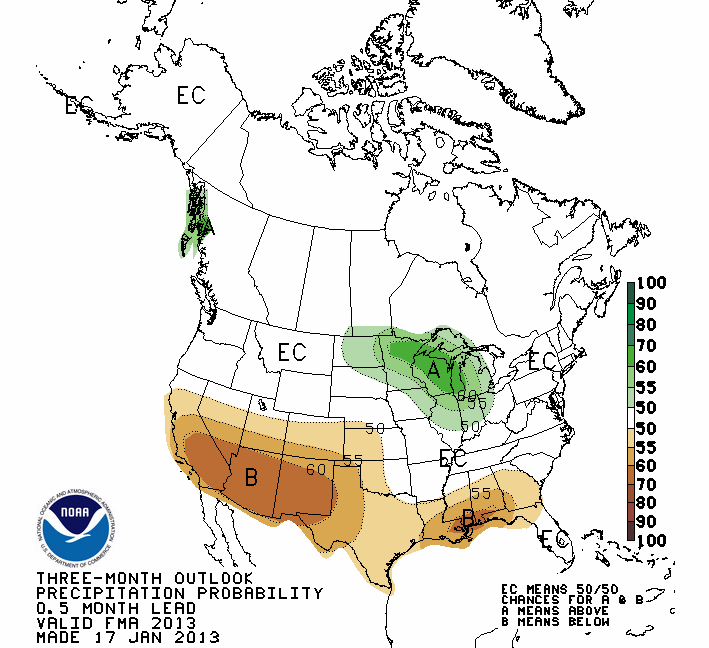
NOAA’s Climate Prediction Center has recently (Jan 17) published this three month map with big brown spot signaling dry weather over central and southern California the rest of this winter.

Not only is this bad news for central California but for drought stricken states in parts of the Midwest who desperately need rain this coming Spring to avoid another bad corn and soybean crop year

Tale Of Two Winters

After flowing freely in December the spigot seemed to be shut on “off” as of January. At the key northern reservoir at Shasta Dam that had seen 31 inches of rain in November and December –  the rain gauge measured just 0.08 inches over the first 21 days of this month.

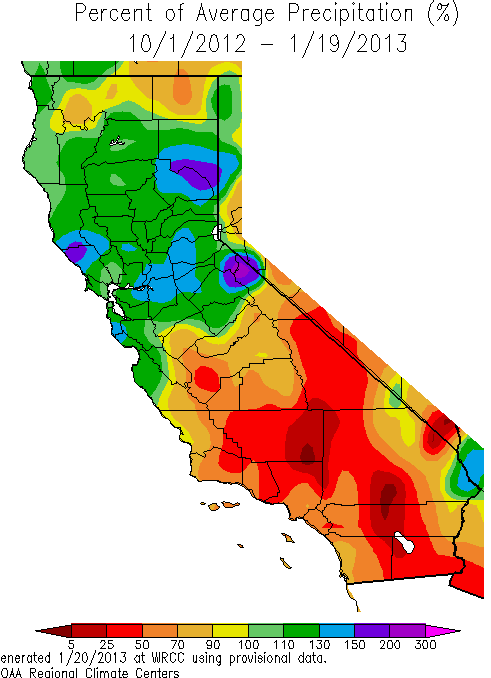
click to enlarge- TWO CALIFORNIAS

If it as a tale of two winters it is also a tale of two Californias so far this water year. This map tells the story showing the percent of average rainfall from Oct 1 through Jan 20 with part of northern California at 200%( purple) and parts of southern California at 25% of average( brown).

More dry cold weather is in the offing Fox says.

Still, forecaster Fox says he is “not giving up on February” and expects a few storms to come into the state over the month coming up.

“January 24,25 ,26 could see a small amount of rain and Feb 5,6 should see a storm that will drop snow in the Sierra “ he says.

Central Coast forecaster John Lindsey says today to expect unsettled weather for this region starting Wednesday and more promising – ”rain showers forecast on Saturday into Sunday.”

But those big rain events of December are long gone.

New Pomogranate Processor For Tulare County

A start-up pomegranate processing facility in Tulare County is under construction and expected to open by the end of February at 220 South Main Street in Pixley. M&A Foods based in Mountain View Ca, will employ around 20 to start says founder Dr. Aamir A. Farooqui.

The new company will pack high quality pomegranates for the fresh market, ready-to-eat naturally fresh arils – the pulp, make pomegranate gourmet jam, jelly, syrup, and preserves and produce fresh salad pack for fresh market. The jams and jellys are expected to provide” 35-40% revenue of M&A Foods.”

Dr Farooqui says “marketing of pomegranate arils in a way that makes them easy to eat is a way to promote consumption of the fruit. Currently, there are only two competitors – POM Wonderful and Young’s Town, both, unable to meet the market demands,” he believes.

M&A Foods plans to first extract the Arils by hand and once they have enough orders, plan to purchase automatic deseeding plant from Israel. Farooqui, a UC Davis computer scientist and inventor by training – plans a 100,000 sf facility eventually. He has pomegranate trees in the Alpaugh area.

There are about 4500 acres of pomegranates in Tulare County and some 30,000 acres Valleywide.In 1980 there were only 2500 acres before the health benefits of  the ancient fruit were widely known.

As an aside, a battle has been joined in the past year between industry leader Pom Wonderful, owned by Stewart Resnick,and the US government over health claims. A few days ago the  Federal Trade Commission upheld a judge’s finding that the owners of POM Wonderful pomegranate juice made false claims about the health benefits of their products  – an assertion that Pom Wonderful rejected.

The M&A company’s website explains both the draw and obstacles involved with consuming pomegranates.

“Pomegranate is a natural bounty fruit. Many studies have demonstrated the nutritional and medicinal properties of this fruit. However, it is difficult to peel and extract the edible parts (called Arils) and this reduces its acceptance by the consumer in favor of other fruits that are easier to prepare. Marketing of pomegranate arils in a way that makes them easy to eat is a way to promote consumption of the fruit.
In order to solve this problem M&A Foods plans to produce ready-to-eat naturally fresh arils, free of internal membranes or skin and other unwanted material hygienically packed. The market developed by POM Wonderful is mature enough to accept this product. The aril removal on commercial scale is a very sophisticated process and requires extra care in the de-seeding and packaging steps. Currently, there are only two competitors namely POM Wonderful and Young’s Town, both, are unable to meet the market demands.
During the off-season when no Pomegranate is available, M&A Foods plan to produce fresh cut fruit salad. The market demand and the availability of the fruits will decide this segment.”
Resumes Of Key Players:
Dr. Aamir A. Farooqui, has a successful carrier of building Hi-Tech companies from ground-zero. He is a technical leader and entrepreneur who can turn around technology into business. He completed his Ph.D in Computer and Electrical Engineering in a record period of two years from the University of California, Davis. He worked at multi-national companies and owns several key patents in the field of Computer architecture and Video processing. One of his key ventures is Bluesteel networks, which was sold to Broadcom in 1999. For the past few years he is focusing his efforts on the sustainable farming practices and developing business around farm produce. In this respect he also launched an ecommerce marketplace www.myhomeproduce.com that enables farmers and small cottage food industries to sell their products to millions of consumers throughout US.
Marka Nakata – CEO: Expert in Sales and Marketing and Farm advisor. Accomplished and agile Market Strategy Executive with proven experience in identifying, analyzing and exploiting market  opportunities. Creative and multi-disciplinary executive with conservative approach. Strong supporter of Natural and Healthy Foods. Proven leader with outstanding relationship building skills, strong communication abilities and exceptional emotional intelligence that excels in matrix and hierarchical structures.

Dr Farooqui says Tulare County has been very supportive of the project – BEST County to do Business – and notes their facility is in the Economic Development Zone, which will reduce taxes. The location is in close proximity to pomegranate farms but just three hours drive to Northern or Southern CA markets.

For the county’s new economic development office – led by Mike Washam – the news is especially sweet – considering the firm discovered Tulare County through the county’s new economic  development website and was guided through all the approvals by the county office.

Tulare County Business Briefs

The Board of Directors of Sierra View District Hospital in Porterville have fired their CEO Joseph Stewart.”Joe Stewart will no longer serve  as the chief executive officer effective January 16,2013”, says a hospital press release. The board voted 3 to 2 to oust Mr Stewart who has held his position for a yeas and later this week named Donna Hefner as interim CEO. She was director of risk management for the hospital and a 20 year veteran employee. In the public session Mr Stewart acknowledged financial problems at the district hospital.

As the housing market recovers across the state – Tulare County’s numbers are improving as well. In December 2012 the median home  price in Tulare County was  $144,440 – up 13.1%% from a year ago when it stood at $127,660. Time on the market has dropped from 35 days a year ago to 25 days in December 2012. But the volume of sales is down from a year ago by 23.4%.

The unemployment rate in Tulare County was 15.7 percent in December 2012, up from a revised 14.5 percent in November 2012, and below the year-ago estimate of 16.5 percent. This compares with an unadjusted unemployment rate of 9.7 percent for California and 7.6 percent for the nation during the same period. A closer look reveals that farm jobs year-over-year in Tulare County are down 3800 while non-farm jobs are up by 1200, the later a hopeful sign.

Tulare County Ag Installing More Solar

A solar farm at Limoneira in Ducor helps run a pump that irrigates the citrus orchard

Strathmore’s Villa Park orange packing house along Hwy 65 is installing a 5 acre solar farm next door that is expected to cover 80% of the power needs for the big Sunkist packing house and cold storage says manager Jammie Logan.The $3.2 million system is going on line at the end of February.

Add Tipton’s Pitigliano Farms to the local ag enterprises taking advantage of solar technology to cut their costs. Mike Pitigliano says a solar farm is being built on their ranch by March that promises to cut  85% of their current electricity costs for some of their ranches. The permit is valued at near $500,000  with the units being put in by Korea-based Hanwha Solar.

Citrus Losses May Be Minimal From Freezing Nights

January 16, 2013
By Cecilia Parsons

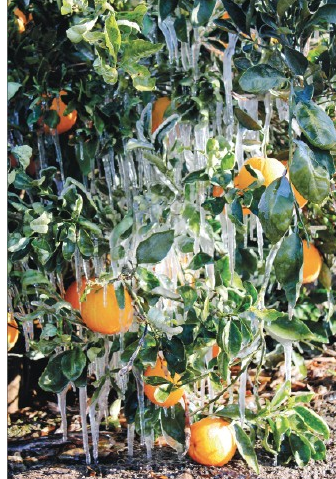
Oranges in Tulare County’s citrus belt are covered with ice. Growers turn on their sprinklers and the ice that forms protects the fruit from internal damage.
Photo/Cecilia Parsons

After five long, freezing nights spent turning on water and wind machines to protect their crops, San Joaquin Valley citrus growers are hoping they have dodged widespread frost damage.
Sunday night recorded the lowest temperatures in the valley citrus belt to date and California Citrus Mutual is reporting the seedless mandarin crop has likely sustained moderate damage due to the low temperatures and their duration. Navel oranges, especially those on edges of groves in the coldest areas, sustained minor damage. Extent of the damage will not be known for several days. Citrus growing areas in Riverside, Ventura and Imperial counties experienced lows in the 30s.
Lows Monday morning were in the lower 20s in many areas, with Ducor recording 22 degrees.
On Monday morning, Joel Nelsen of California Citrus Mutual reported some freeze damage is expected in lemon and mandarin crops, but navel orange damage is not expected to be extensive. The extended cold spell, which began Jan. 10, has been expensive for California citrus growers who have spent $17.5 million on frost protection last week.
Seventy-five percent of the valley’s navel orange harvest remains in the field. Harvest for the Murcott and Tango mandarin varieties harvest begins this month. Only 30 percent of the Valley lemons have been harvested.
“(Sunday) night, the cold began earlier and it stayed cold,” said Nelsen. There was little cloud cover to provide much of an inversion layer that makes wind machines more effective.
Mandarin growers were running their wind machines at least 13 hours in the coldest areas. Navel growers started about 1:30 a.m. Many growers began running water in their groves earlier in the day to warm the ground.
On previous nights, there was enough of an inversion layer that made wind machines more effective in drawing down warmer air aloft. By Saturday night, skies were clear with little cloud cover, extending the duration of low temperatures. Low temperatures in the mid-20s were recorded throughout the citrus belt with lows reaching 25 degrees in a few areas.
Nelsen said duration of cold temperatures is the critical factor. Even though temperatures dropped lower and for longer periods of time during Saturday night, Nelsen said it was not significant enough to cause widespread fruit damage. Fruit on edges of groves farthest from wind machines are expected to incur some damage. Ice crystals forming inside the juice sacs will cause them to burst and the fruit will dry out. The mandarin crop is most likely to see frost damage due to the thinner skin of the seedless fruit, he said.
At this point in the season, navel oranges have reached a higher sugar content and are better able to withstand freezing temperatures for longer periods of time.
Cold temperatures averaging in the low 30s hit citrus production areas in Ventura, Riverside and Imperial counties where fruit has a higher sensitivity to cold due to overall higher temperatures. No damage has been reported where frost protection was provided.
While the freeze event may have shifted grower priorities last week, the Asian citrus psyllid is still a chilling factor in this year’s citrus harvest.
This pest, which can carry the deadly citrus disease Huanglongbing, or citrus greening, was trapped in two San Joaquin Valley sites in October and November—the first time the pest has been found in the state’s prime citrus growing area. The single adults are believed to be hitchhikers into the area and not a signal of an established breeding population of ACP.
Trapping and visual surveys around the two sites have failed to find additional ACP.
In Tulare County, 163 square miles—a five-mile radius around two sites where ACP were trapped late last year—are restricted areas. Citrus nursery stock cannot be moved outside the area unless it was grown inside an insect-proof structure. Citrus harvested inside the restricted areas must either be packed inside the area or be cleaned of stems and leaves before it is moved outside.
On Dec. 31, CDFA announced another option. Growers with citrus inside the two restricted movement areas in Tulare County can opt for chemical treatment prior to harvest to minimize spread of ACP.
This treatment option is much less expensive and favored by growers, said Tulare County Agricultural Commissioner Marilyn Kinoshita. The option had to first be approved by CDFA and updated compliance agreements are required. Growers can choose from a list of approved products, time the application prior to harvest and treat. Kinoshita said they have seven days after treatment to complete harvest. Cost of the treatment option is half of the $10- to $15-per-bin cost of running fruit through a packing line.
Porterville lemon grower John Konda, who grows citrus inside the Terra Bella restricted area, said the chemical treatment is a much better option cost-wise in spite of the extra paperwork required.
Growers outside the restricted areas have not been impacted by the ACP requirements. Leonard Massey of B&Z Nursery said the restricted zones, which are smaller than the normal 20-mile quarantine zones, do not include any large commercial nurseries.
Even with the recent freeze, University of California researcher Beth Grafton-Cardwell said she isn’t convinced the ACP threat is gone in the valley. The pest doesn’t move much in cold weather, but when temperatures warm up, they could still be found, she said.
Citrus growers hoping that the freeze wiped out any ACP lingering in the San Joaquin Valley should know that is not the case, said Shirley Batchman, director of governmental affairs for CCM. On a trip to Florida, Batchman said she visited an ACP research laboratory where she was shown a container with frozen ACP.
“When they began to thaw, they started moving,” Batchman said. “It can’t get cold enough to kill them, so don’t count on that.”
The ACP trapping program in Southern California counties continues to find the pest, Grafton-Cardwell noted. Researchers are also working on a better ACP trap. Grafton-Cardwell said the pest is attracted to color and volatile oils—both found on citrus leaves and the yellow sticky traps currently in use—don’t specifically attract ACP.
(Cecilia Parsons is a reporter in Ducor. She may be contacted at ceciliaparsons8@gmail.com.)

CFB contributed

Tulare County: More Groundwater Basins In The Works

Could Handle Flood Flows & Recharge The Aquifer –

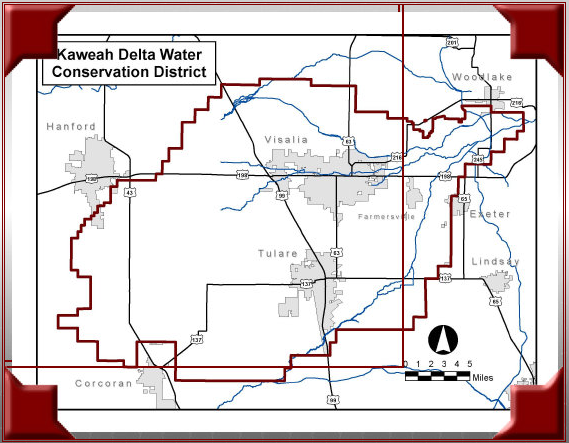
Kaweah Delta Water Conservation District already has some 25 groundwater recharge basins in the greater Kaweah Delta fan and is working hard to design and build 5 more in the near future says district engineer Larry Dotson.

Besides the district, others own recharge basins as well and there around 40 in total covering 5000 acres.

“These basins complement the reason we were founded” says Dotson back in 1925, both “to conserve our water and protect surrounding  land from floods.”

Case in point is work planned for February to construct the 34 acre Curtis Basin near Woodlake being designed by KDWCD to both lay off flood water on about a section of land if need be – as well as recharge the groundwater when surplus water is available,he says. The basin should be ready before Spring,he expects.

The new basin is about 2 miles south of Bravo Lake on district land close to one of those irrigation canals that criss-cross this part of Tulare County.

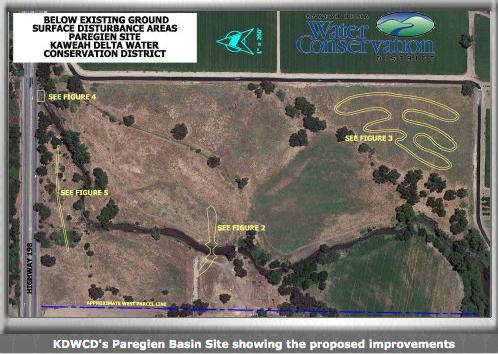
Another new basin being designed is just south of Kaweah Oaks on the  78 acre Paregien parcel. This basin will enhance storm floodwater control for the City of Farmersville that gets flooded in some wet years. This basin will also feature habitat restoration like they do at next door’s Kaweah Oaks.

Another planned site is just west of Mooney Grove.

Using these basins to recharge water comes only in some years when  contracted districts are able to get Class 2 water from the Friant Kern shipped in and /or when Kaweah flows are heavy.

One of the major importers of water is Tulare Irrigation District(TID)  who when they run water toward their district passes through the Kaweah Delta area between Woodlake and Visalia in earthen canals recharging the aquifer below as the water flows.

TID importation of water comes from both the Kaweah off Terminus Dam and its Bureau of Reclamation allotment delivered through the the Friant Kern. The total water amount varies widely by year. The year 2010 was wet and TID imported 340,000 acre ft adding both Kaweah water and water originating on the upper San Joaquin River, source for the Friant Kern Canal. The following year – in 2011 – less than 30,000 acre ft flowed in and farmers suffered.

But when it does come in the districts will be ready to use that water beneficially adds Dotson, “banking” the water so farms and cities can tap it in another dry year.

The City of Visalia has several partnerships to build basins as well, just upstream from the city limits.

Only this fall the city announced they would get a grant to build a new basin on the east side of town that will help protect the Downtown.

Another partnership under study would exchange TID water with the City of Visalia for highly treated wastewater from the city sewer farm  in coming years. There is a pending Fresno State study of the effect of using such water to grow crops.

All this effort has helped raise the groundwater levels by about 25 ft  in the past 2 years in some parts of TID although they”had to spend around $6.5 million in additional funds in the past two years to help make this happen” says a TID report – constructing new basins and  doing water exchanges.

Kaweah Delta’s own figures show in 2010 the district  experienced a wet year of 135% of normal and between river and canal water importation – using 30 basins they recharged 159,853 acre ft of water. In addition, the water flowing west in the canal percolated another 148,000 acre ft –  all figures estimated. That helped bring the area groundwater level up about 12 ft.

Tulare Council Sells Land For Cheese Plant

Targeting Asia Market

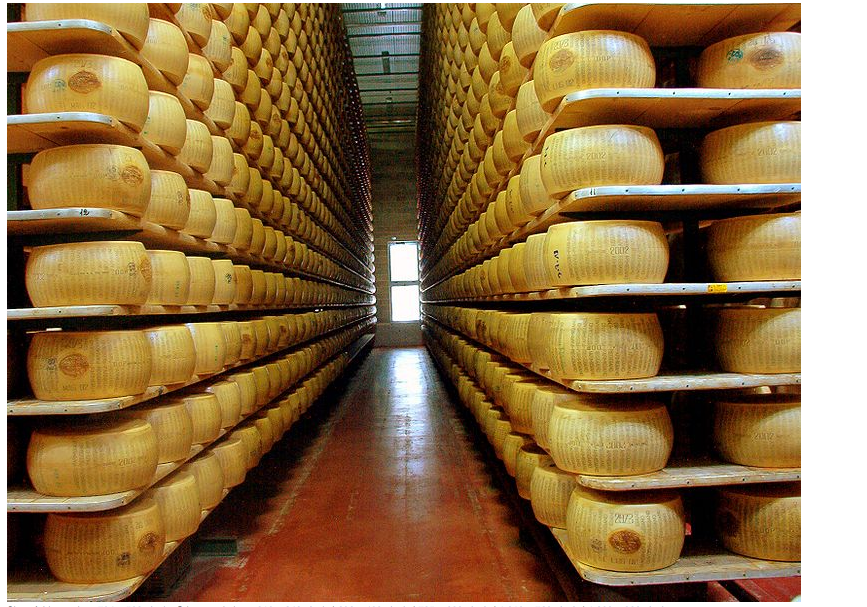
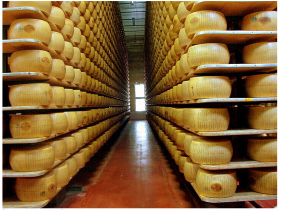
The Tulare City Council approved the sale of 59 plus acres this week to CaliCheese Company LLC, to build a 300,000 sf cheese plant on city-owned land next to the wastewater treatment plant.

The deal calls for just over $2 million for the land with the money changing hands between June 30, 2013 and the end of the year.

According to the company’s business plan the start-up cheese plant will to employ 220 producing both cheddar cheese and whey protein -both big sellers in the export market in Asia. They put the value of the project at $250 million and say it would produce 4 million lbs of milk a day to start.

The company plan says they expect to close financing by June 30, 2013, and begin operation in early 2015. Council was told this week that the plant was already designed and the milk supply would be secured with talks ongoing with two large milk coo-ops.

The sale of the property at 2600 W. Paige comes after a year of negotiations with the firm says a city staff report. The company expects the purchase to include “full entitlements” to the land to build a plant based the approved EIR at the same site for Western Pacific Meat packing a few years ago.  That meat packer never bought the land but the cheese project is similar enough that it can be used, it is assumed.

The city staff report asks the city council “Approve and authorize the Mayor to execute a Purchase and Sale Agreement (PSA) between the City of Tulare and Cali-Cheese LLC for 59+ acre parcel of property located adjacent to the Wastewater Treatment Plant, to be used for a cheese processing facility…”

Project Development Manager of CaliCheese Co is Jeffrery F. Lee Mr Lee is also affiliated with Manhattan Beach based California Ethanol  and Power.California Ethanol & Power, LLC focuses on production of renewable energy from sugarcane and on developing, financing, installing, and operating sugarcane-to-ethanol-and-electricity production plants in California. The company says it is in the permitting stage to build a plant in Imperial Valley by 2015.
CaliCheese Co lists Mr Lee as the former Division Counsel for a $1 billion-plus Bechtel Power Corporation operating division and a Senior Development Manager with Bechtel Enterprises, where he led or participated in a number of project developments and financings for industrial processing facilities.  Mr. Lee also wrote the business plan that provided the foundation for Southwest Cheese Company in Clovis New Mexico founded in 2006.  He holds a BA in Economics with honors from the University of Michigan, and a Juris Doctorate from Michigan Law School.
The company lists Chief Operating Officer Daryl D. Boddicker  – a 30-year Kraft Foods veteran and recipient of the Kraft Merit Award. Mr. Boddicker had responsibility for all Kraft North American plant operations, and also for all Kraft Research & Development activities worldwide.

CaliCheese Co. mission statement says the huge project requires them to raise up to $350 million in financing to fund the $250 million facility. The statement  says the plant” will generate cash flow that is more than sufficient to provide adequate debt service coverage, a fair market return to the project finance equity provider(s), and robust returns to the CCC ownership interests, particularly once the senior debt is retired.”

Their project is huge by any standard. At $250 million – the project would be the largest in Tulare County in recent memory. The largest project underway in the county now is the new Porterville courthouse valued at $91 million.Visalia’s largest commercial projects in recent memory was the VWR warehouse valued at $22 million or the KD hospital wing in 2009 valued at $143 million. The Leprino cheese plant – built almost a decade ago in Lemoore – was valued at $300 million and has expanded since – processing some 12 million lbs of milk a day into mostly mozzarella cheese.

The CaliCheese Co(CCC) statement says their business plan calls for expansion of the 4 million lbs a day production by 50% putting its planned capacity at 6 million lbs a day.

Asia Market

Regarding the market opportunity the company’s statement says “Asia’s growing appetite for cheese and whey-derived products has caused wholesale cheddar cheese prices to increase more than 50 percent, and whey-derived products prices almost 100%, over the past year.  CCC expects to enter into long-term contracts for the sale of a majority of its cheese and the totality of its whey-derived products to a major industry player at pricing indexed to market prices. “

“The U.S. shipped more than twice as much cheese to Asia in 2011 than in 2010, and the demand for whey-derived products is growing even faster, also driven in large part by the increasing demand for protein from Asia. “
The US Dairy Export Council recently stated that ”through the first 10 months of 2012, the volume of major products increased a combined 5.5 percent to more than 2.8 billion lbs. Although growth had softened in recent months, U.S. cheese and whey protein concentrate were poised to shatter volume records, and nonfat dry milk/skim milk powder was tracking at or near record levels.
For the second consecutive year, U.S. export volume accounted for more than 13 percent of total milk solids produced in the United States. “

Must Perform

The Tulare city agreement with CaliCheese Company has provisions that include;

A six month feasibility period for the developer to approve the site
A $10,000 non-refundable deposit
A 12 month period for the developer to obtain project financing
A six-month period after the close of escrow for developer to initiate the project, failure to comply would result in a reversion of the property to the City.

Tulare officials wanted the last provision to be in the agreement keep a developer from buying the land and just siting on it or flipping it. This is a sensitive issue in this community where two large projects, a meat packing plant and a huge race track project were near final approval but in the end failed to get financing. The projects, instead of producing jobs, actually cost the city lots of time and grief and money as well as the jobs of several politicos.

Tulare is already home to many of the worlds’ largest diary product producers  and the largest cluster of dairy firms in the US West. They include names like Land O Lakes employing nearly 600, Saputo (now with three plants and 400 workers), Haagen Dazs(Nestle) with some 300, and Kraft employing 120. Scores of supply firms for the industry are based here as well with employment of hundreds more. Tulare County is the largest milk producing county in the world with $2 billion in milk sales annually.

Despite the size of the California dairy industry producers have complained they feel they are being paid too little for their milk particularly from the private cheese plants who suck up about half the milk produced in the state. Cheese makers – particularly the smaller ones – say it is they who are in danger of being driven out of business.

Caught in the middle is CDFA ag secretary Karen Ross who is expected to make a price adjustment upward for some dairy products later this month (by Jan 22) that could translate into higher costs for cheese manufacturers here. One other new cost – paying for greenhouse gas emissions in California now.

Welcoming More Competition

“Producers would favor a new processor” in the area says Tom Barcellos – a Porterville dairyman and president of the Western United Dairymen. ”We need more competition for our milk” he adds.


Southland Closes 2012 With Higher Sales and Prices

January 15, 2013
La Jolla, CA—Southern California’s housing market ended 2012 with the highest December home sales in three years, the result of robust investment activity, a record level of cash buyers and more sales gains in move-up markets. The median sale price jumped nearly 20 percent from a year ago, pushed higher by greater demand and the market’s shift away from foreclosure resales and toward more mid- to high-end deals, a real estate information service reported.
A total of 20,274 new and resale houses and condos sold in Los Angeles, Riverside, San Diego, Ventura, San Bernardino and Orange counties last month. That was up 5.1 percent from 19,285 sales in November, and up 5.3 percent from 19,247 sales in December 2011, according to San Diego-based DataQuick.
A rise in sales from November to December is normal for the season. Last month’s sales were the highest for the month of December since 22,328 homes sold in December 2009, though they were 17.2 percent below the December average of 24,488 sales since 1988, when DataQuick’s statistics begin. The low for December sales was 13,240 in 2007, while the high was 36,865 in 2003.
The median price paid for a home in the six-county Southland was $323,000 last month, up 0.6 percent from $321,000 in November and up 19.6 percent from $270,000 in December 2011. For the past four consecutive months the median has been the highest since it was $330,000 in August 2008. The Southland median has risen or held steady month-to-month for 11 consecutive months and has increased year-over-year for nine consecutive months.
“The housing market had more to offer in 2012 than many anticipated. A lot of markets not only found a price bottom as foreclosures waned but they started to see their first meaningful gains in nearly two years. Buyers on the fence were drawn back into the housing game by amazingly low mortgage rates, a brighter jobs outlook and, in some cases, a renewed sense of urgency,” said John Walsh, DataQuick president.
“Last year should also be remembered as the year the move-up market awoke. If these upward trends hold, which requires a sustained economic recovery, we should eventually see more inventory hit the market. More would-be sellers will be satisfied with what their homes can fetch, and fewer people will owe more than their homes are worth, freeing them up to move. The rise in inventory would at least tame price appreciation.”
Sales rose sharply again in many mid- to-higher-cost markets in December. Home sales between $300,000 and $800,000 – a range that would include many move-up buyers – increased 31.4 percent year-over-year. December sales over $500,000 shot up 40.0 percent year-over-year, while sales over $800,000 jumped 36.3 percent compared with December 2011.
Last month 24.7 percent of all Southland home sales were for $500,000 or more, which ties the November level for the highest for any month since July 2008, when 26.1 percent of sales were for $500,000-plus. In December 2011 18.4 percent of sales crossed the $500,000 threshold.
Lower-cost areas again posted the weakest sales compared with last year. The number of homes that sold below $200,000 fell 28.1 percent year-over-year, while sales below $300,000 dipped 18.2 percent. Sales in the more affordable markets have been hampered by the slowdown in foreclosure activity, which results in fewer foreclosed properties listed for sale. Also, lower-cost markets typically have a relatively high percentage of homeowners who owe more than their homes are worth, meaning they can’t afford to sell.
While inventory and sales have declined in many of these lower-cost areas, higher demand has pushed prices up. In December, the median price paid per square foot in the lowest-cost third of Southern California’s housing stock rose 21.1 percent year-over-year, while that measure increased 11.4 percent in the middle and 13.0 percent in the top third of the market.
Last month foreclosure resales – properties foreclosed on in the prior 12 months – accounted for 14.8 percent of the Southland resale market. That was down from 15.4 percent the month before and 32.4 percent a year earlier. Last month’s level was the lowest since foreclosure resales were 13.6 percent of the resale market in September 2007. In the current cycle, foreclosure resales hit a high of 56.7 percent in February 2009.
Short sales – transactions where the sale price fell short of what was owed on the property – made up an estimated 25.6 percent of Southland resales last month. That was down slightly from an estimated 26.5 percent the month before and 26.0 percent a year earlier. However, the number (rather than percentage) of short sales last month was up 7.4 percent from December 2011.
Last month investor and cash buying was at or near record levels.
Absentee buyers – mostly investors and some second-home purchasers – bought 29.1 percent of the Southland homes sold in December. That was up from 28.6 percent the prior month and 26.8 percent a year earlier. Last month’s figure was the highest since the absentee share of sales was a record 29.9 percent last February. The monthly average since 2000 is 17.7 percent. Last month’s absentee buyers paid a median $252,750, up 24.8 percent from a year earlier.
Buyers paying with cash accounted for a record 33.8 percent of last month’s home sales, tying a revised 33.8 percent the month before and up from 29.8 percent a year earlier. The prior peak for cash purchases was 33.7 percent of all sales last February, and since 2000 the monthly average is 17.3 percent. Cash buyers paid a median $265,000 last month, up 26.2 percent from a year ago.
The number of Southland homes cash buyers bought for $500,000 or more has hovered near record levels in recent months, reflecting difficulties many face in qualifying for larger loans as well as some people’s desire to park cash in real estate amid today’s low-interest-rate savings environment.
In December, cash buyers bought 1,309 homes priced $500,000 or more, up 49.6 percent from a year earlier. Last month’s $500,000-plus cash purchases represented more than one quarter of all homes sold at that price level. About 40 percent of the people who paid $500,000-plus in cash for a home were absentee buyers last month, which typically means they are investors or second-home buyers.
Meantime, credit conditions showed modest signs of improvement.
Jumbo loans, mortgages above the old conforming limit of $417,000, accounted for 22.3 percent of last month’s Southland purchase lending, up from 21.2 percent the prior month and up from 15.3 percent a year earlier. Last month’s figure was the highest since September 2007, when jumbos made up 26.9 percent of the purchase loan market. In the months leading up to the credit crunch that struck in August 2007, jumbos made up close to 40 percent of the market.
With rates on fixed 30-year loans so low, and aversion to risk in the marketplace high, the use of adjustable-rate mortgages (ARMs) remains very low in an historical context. Last month 5.9 percent of Southland home purchase loans were ARMs, compared with 5.6 percent in November and 6.4 percent a year earlier. Since 2000, a monthly average of about 33 percent of Southland purchase loans were ARMs.
Government-insured FHA loans, a popular low-down-payment choice among first-time buyers, accounted for 23.2 percent of all purchase mortgages last month. That was down from 24.6 percent in November and down from 30.5 percent a year earlier. In recent months the FHA share has been the lowest since summer 2008. The decline reflects tighter FHA qualifying standards implemented in recent years as well as the difficulties first-time buyers are having competing with investors in the housing market.
The most active lenders to Southland home buyers last month were Wells Fargo with 8.9 percent of the market, Prospect Mortgage with 2.6 percent and IMortgage.com with 2.4 percent.
DataQuick monitors real estate activity nationwide and provides information to consumers, educational institutions, public agencies, lending institutions, title companies and industry analysts.
The typical monthly mortgage payment Southland buyers committed themselves to paying last month was $1,152, up from a revised $1,132 the month before and up from $1,026 a year earlier. Adjusted for inflation, last month’s typical payment was 51.2 percent below the typical payment in the spring of 1989, the peak of the prior real estate cycle. It was 60.0 percent below the current cycle’s peak in July 2007.
Indicators of market distress continue to move in different directions. Foreclosure activity, while above long-term averages, continues to drop and is far below peak levels. Financing with multiple mortgages is very low, and down payment sizes are stable, DataQuick reported.

For Central Valley … Really Big Projects Pending In January

January is supposed to be a quiet month for business activity but some  important and even multi-billion dollar decisions could be made. Here is a roundup of few to watch.

Fresno County

Central Valley High Speed Rail construction begins later this year with the construction bids on first 28 mile segment from Fresno north to Merced due on January 18. Five companies have pre qualified to bid. Jeffrey Morales, CHSRA CEO expects to award a contract by June. This fall, property acquisition and initial construction work will begin, assuming there are no successful legal challenges.State Public Works Board is expected to approve the rail agency request to purchase 356 parcels on the route at their meeting this week.

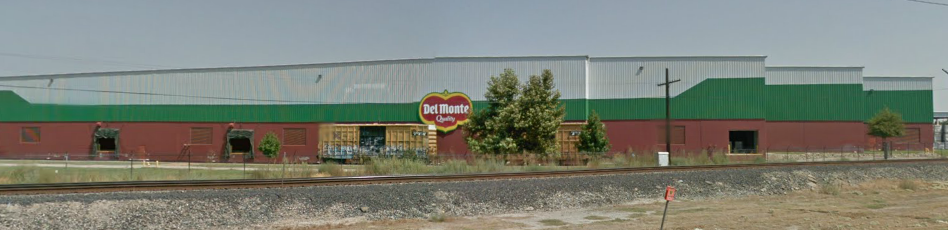
Kingsburg: Manufacturer Could Bring 200 Jobs To Town: So says Kingsburg City manager Don Pauley. An unnamed company is working with the city and Del Monte to buy the now vacant 100,000 sf warehouse from Del Monte to convert it to a manufacturing facility.Pauley says the company may start work to remodel the building as soon as February but that the deal is not yet done. Del Monte closed all their operations in Kingsburg last year. Several other pieces of the Del Monte empire in town are for sale as well including the 14 acre processing plant and the former Silgan can manufacturing building.

Kings County:

Navy is expected to release their draft EIR for the Joint Strike Fighter this month that will spell out if the plane will based in Lemoore or alternatively in San Diego County. This is a $500,000 million impact annually on Kings County. If the draft decides against Lemoore, the local base and its economic impact here, would shrink dramatically.

Long awaited 19th Ave interchange over Hwy 198 will break ground  soon in Lemoore.The $21 million half clover-leaf project will require 2 years to build with a contract awarded to Granite Construction. The interchange  will be the only one on Hwy 198 and ties the rest of the city to its industrial area. The project has been on the drawing board  for decades.The intersection has the second largest accident history in town say city planner Holly Smyth.

Avenal: Avenal Energy has got approval on a 4 to 0 vote from the California Energy Commission this month to move forward on their 600MW natural gas power plant in the works since 2009 despite objections from environmental groups.

Avenal: NRG plans to expand their solar farm to the southeast of their current project in the county and is applying to the county for a permit.

Tulare County

Tulare:  $250 Million cheese plant could bring 220 jobs to town CaliCheese is negotiating with  the City of Tulare to buy acreage at 2600 W Paige in west Tulare to build a new cheese plant.The city lists the item on  its January 15 agenda to sell it for $2 million.The property is the same city-owned land that was the subject of a lengthy and court tested EIR for a meat packing plant. It is expected the cheese plant would qualify as a similar type user and could use the EIR.The cheese plant is valued at $250 million.

Tulare has scheduled a Jan 15 city council meeting to pass a resolution of necessity to acquire right of way to begin construction of the new  Cartmill /99 interchange. City engineer Mike Whitlock says the city has agreements with about half the property owners that hold the necessary land and it may require some property be taken by eminent domaine.

Separately, the city is expecting to break ground on the new Bardsley Ave overcrossing with all funds  and the contractor in place. The crossing will make it  safer and faster to go east-west in Tulare.

Visalia

Growth Issue Returns/Salomon Offers Plan

Visalia City Council and Planning Commission are expected to take up the 2030 General Plan Update January 22 and we should see a lively debate over growth projections.

A citizen committee and their consultant have projected faster growth than several recent studies and as a a result their plan requires more land than may be needed to accommodate population growth between now and then says one council member. Councilman Greg Collins expects we can handle city growth “within the current city limits” with enough room, he says, to add another 40,000 to 50,000 residents.

City manager Steve Salomon is recommending the council adopt a policy that estimates a 10 year average for growth – currently 872 new homes built a year –  even though growth rates have slowed in the past few years to 250 in 2012. Mr Salomon’s staff report says there is an inventory of some 9359 units within the city limits or just under a 11 year supply using the 872 unit year average.

The staff suggested policy being proposed would allow annexation of non city limits, Tier 1 residential units, once the inventory got below the 10 year average of  8720 units or about 650 lower than we have today. County islands add 473 new units that would bulk up the current inventory. Salomon argues the ten year average would change allowing for market flexibility.

Salomon’s report suggests allowing immediate development of 572 acres of new industrial land along Riggin and 82 acres south of Goshen  to help bring in more employers.

On the hot button issue of new commercial land Salomon would add new land options immediately on South Moooney –  126 acres of new regional commercial land south of the Visalia Parkway – past Target. But any new Caldwell /99 commercial shopping center land would be pushed off to some future time. “I think it is clear that commercial developers want to be on Mooney Blvd and we are close to being filled up.”

Technical School To Expand In Visalia: The Visalia Unified School District plans to expand and modernize the current VTEC that currently leases a portion of the College of Sequoias Visalia Campus. The VUSD plans to purchase the entire 26.29 acre property from the COS. the project consists of modifications to current buildings with the addition of 2 standard modular classrooms. The future Master Plan Capacity will be 621 students in grades 10-12. Parking will be relocated on site; the new classrooms will occupy current parking places. No changes to the existing ingress/egress are proposed. The existing house and garage on the property will be demolished as the first phase of construction.