
State Home Sales Surge

California’s housing market continued to improve in May, with home prices posting solid gains for the third straight month and home sales well above last year’s pace, the CALIFORNIA ASSOCIATION OF REALTORS® (C.A.R.) said this week.
“California home sales were strong in May, continuing the gradual recovery of the California housing market,” said C.A.R. President LeFrancis Arnold.  “First-time buyers are recognizing that the housing market has hit bottom and are now seeing a sense of urgency to take advantage of ultra-low interest rates and advantageous home prices.  Additionally, trade-up buyers are returning to the market after sitting it out for the past few years to get in on favorable home prices.”
Closed escrow sales of existing, single-family detached homes in California climbed 3.4 percent from April’s revised 553,670 to a seasonally adjusted annualized rate of 572,260 in May, according to information collected by C.A.R. from more than 90 local REALTOR® associations and MLSs statewide.
Sales Up 21.5%
May sales surged 21.5 percent from May 2011’s revised 470,910 pace, marking the highest year-over-year sales increase since May 2009.   The statewide sales figure represents what would be the total number of homes sold during 2012 if sales maintained the May pace throughout the year and is adjusted to account for seasonal factors that typically influence home sales.
The May 2012 sales pace was the highest since February 2009, when 598,770 homes were sold at a seasonally adjusted annualized rate.
Home prices appear to be stabilizing, with the median home price posting both month-over-month and year-over-year gains for the third consecutive month. The statewide median price of an existing, single-family detached home was $312,110 in May, the highest since September 2010.
May’s price was up 1 percent from a revised $309,050 in April and 6.6 percent from a revised $292,850 recorded in May 2011. The May 2012 figure was 27.3 percent higher than the cyclical bottom of $245,230 reached in February 2009.  The median price has posted above the $300,000 level for the second straight month after remaining below that mark for 15 months.
The increase in the median price can be attributed to the strong sales increase in the higher-priced coastal regions, particularly in the San Francisco Bay Area, where job growth is strong and the economy is growing faster than other areas of the state.

San Luis Obispo home sales in May were up 42.8% year over year and 31.5% higher than just one month earlier. The median price climbed to $382,470, up 6% for the month but just 0.3% higher year over year. Homes are selling faster in SLO County,an average of 42 days compared to 59.6 days in May 2011.
Valley Contrast
By contrast sales in the Central Valley are showing only some improvement with sales actually declining 10.9% in Tulare County and up 3% in Fresno year over year, The median price climbed 4% year over year in Tulare  County to $123,190 and up 3.5% in Fresno County.Time on the market in Tulare County in May 2012 was just 25 days in Tulare County and 28 days in Fresno indicating keen buyer demand. A year ago the market took nearly 40 days in Fresno County.
California’s housing inventory sank lower in May, with the Unsold Inventory Index for existing, single-family detached homes dropping to 3.5 months in May, down from 4.2 months in April.  May’s housing inventory was down from a revised 5.7 months in May 2011.  The index indicates the number of months needed to sell the supply of homes on the market at the current sales rate.  A 7-month supply is considered normal.
“Low housing inventory continues to be the critical issue in the California market,” said C.A.R. Vice President and Chief Economist Leslie Appleton-Young. “Inventory levels have not been this low since December 2005, when the supply matched the current level. The Bay Area has the greatest shortage of homes for sale, with inventory levels in the two- to three-month range for Santa Clara, San Mateo, Alameda, and Contra Costa counties.”
Interest rates continued their downward trend in May, with 30-year fixed-mortgage interest rates averaging 3.80 percent, down from 3.91 percent in April and 4.64 percent in May 2011, according to Freddie Mac.  Adjustable-mortgage interest rates averaged 2.74 percent in May, down from 2.78 in April and 3.13 percent in May 2011.
Homes are moving faster on the market with the median number of days it takes to sell a single-family home dropping to 46.6 days in May, down from a revised 48.9 days in April and 52.0 days in May 2011.

SLO Adds Jobs

SLO Unemployment Down Again

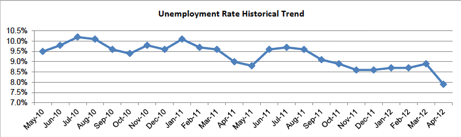
EDD reported that unemployment in San Luis Obispo County in May fell to a multi year low of 7.8%  compared to 7.9% in April and 8.8% a year earlier.

The SLO economy added a robust 2000 jobs in all sectors in the past month including 1500 non-farm jobs.Some 800 of those jobs were in the hospitality industry(700 of those added in the past year) as tourism has rebounded.

In the farm sector there were 4500 jobs in May 2012 compared to 4400 in May 2011.

There were 500 more construction jobs in May 2012 compared to May 2011 likely due to the solar projects in eastern SLO county.

The EDD reports show a larger labor force in May 2012 at 142,300 – 2.1% higher than year ago – as more people are looking for work.But there are more jobs with employment up 3.2% year over year.

California’s unemployment rate in May dropped to 10.4% compared to 10.5% in April and 11.4% in May 2011.

THE FUTURE OF JOBS IN SLO

SAN LUIS OBISPO, CA – A public workshop is planned to review a draft of the City’s Economic Development Strategy. At this workshop, participants will review a draft of the Plan and provide feedback on the proposed strategies and prioritization of the City’s future work efforts in support of the Plan.

The public workshop will be held on Thursday, June 21 at 6:30-8:30 p.m. in the City-County Library Community Room. Audience participation will be encouraged via a survey tool that collects responses from text messages and web browsers. In order to participate, attendees should bring their mobile devices.

Previously, three public workshops were held to gather input from residents and the business community. At these workshops, residents and representatives from the business community, Cal Poly and non-profit organizations provided robust feedback on a variety of topics associated with creating quality jobs. This public input was a significant source of information used to identify key issues and develop the Strategic Plan.

As part of the 2011-13 Financial Plan, the City Council approved Economic Development as a Major City Goal, with the objective to:
Increase focus on economic development.
Support creation of head of household jobs through developing strategies for infrastructure, focusing on promising growth sectors, and expediting desired economic activity.
Expand collaboration with Cal Poly, Cuesta, business community, and responsible agencies.

More information about the workshops can be found at http://www.slocity.org/economicdevelopment/strategicplan/plan.asp.

For more information, visit the City’s website at www.slocity.org. For questions, please contact Michael Codron, Assistant City Manager (mcodron@slocity.org) or Claire Clark, Economic Development Manager.

Ag Updates

Tree Fruit Growers See Improvement
Overcoming challenges from the economy and Mother Nature, California tree fruit growers say their harvest is off to a solid start. Springtime hailstorms destroyed some peaches, plums and nectarines in the Central Valley, but farmers who have fruit to sell say their crops look good and consumer demand has been strong. Tree fruit growers say they’re starting to recover from a tough 2011 and the closure of some fruit packing and shipping facilities in 2009.
Strawberry Crop May Set Records
Just about halfway through their harvest, strawberry farmers and marketers say they could be headed toward record production. The harvest avoided severe trouble from springtime rain, which reduced last year’s final crop. California farmers have also increased strawberry acreage about 3 percent. Strawberry harvest will be concentrated along the Central California coast now as the Southern California harvest winds down.

Environmentally Efficient Cows

In 2006, a United Nations report entitled “Livestock’s Long Shadow” claimed that the livestock sector is a major player in climate change, “responsible for 18 percent of greenhouse gas emissions … a higher share than transport.”  Appeals for reducing meat consumption to prevent climate change filled the public media, and they continue today (see this recent opinion blog from the New York Times).

At Alltech’s recent Symposium, UC Davis Associate Professor and Air Quality Specialist Dr. Frank Mitloehner explained why this greenhouse gas (GHG) statistic is misleading.  His examination of the issue is detailed in a 2009 study entitled “Clearing the Air: Livestock’s Contributions to Climate Change,” which was co-authored by Pitesky and Stackhouse.

At the Symposium, Mitloehner explained that livestock in developed countries actually make a fairly small contribution to greenhouse gas emissions: in the United States, livestock contribute only about 3 percent of anthropogenic emissions, as compared to 26 percent by transportation and 31 percent by electricity.  The 18 percent cited in the UN report is an international statistic, influenced by emissions percentages in developing countries.  In these countries, livestock make a greater contribution to total GHG production because the countries have smaller transportation and energy sectors.

Percentages of GHG production in developing countries are also influenced by land-use changes related to livestock production, such as deforestation. Many developing countries are converting land to pasture and cropland in an attempt to develop their economies, just as developed countries have already done.  According to Mitloehner, GHG emissions due to deforestation and other land-use change patterns inflate the worldwide, livestock-associated GHG production percentage by as much as one-third.

Mitloehner emphasized the importance of reducing GHG production by improving efficiency and productivity of livestock in developing countries, rather than decreasing milk and meat consumption.  The more productive the animal (for example, the more milk produced per cow), the lower the GHG emissions are for a particular amount of product.  Improving productivity can be achieved by improving fertility, health, and genetics of the animal, as well as by increasing digestibility of feed.  According to Mitloehner, the efficient nature of livestock production in the U.S. makes it a useful model for developing countries.

In the coming years, developing countries should focus on improving digestibility and developed countries should focus on waste management.  With the need to feed a world population expected to reach 9 billion by 2050, increased productivity and efficiency, not decreased meat and milk consumption, is the key to reduced GHG production.

Big Tomato Growers/UFW To Sign Contracts

Celebrating their 50th anniversary last month in Bakersfield the United Farmworkers Union with barely 27,000 workers under contract- half of what they had- the UFW is not the union powerhouse once feared by California produce growers. But don’t count them out yet.
With some backing from the California government and a perceived worker shortage in the state the UFW is expected to sign the first major contract with large Central Valley tomato growers in coming weeks.
This week the UFW and tomato producer Pacific Triple E of Tracy are signing their first union contract during a ceremony in Stockton covering 800 workers
UFW President Arturo S. Rodriguez will join the union’s negotiating committee and Pacific Triple E Operating Partner Jon Esformes in signing the agreement that comes after decades of battle and litigation.
In a news release Esformes said” When the UFW approached us last fall we found that we held many common ideals which allowed us to quickly establish a line of communication that was honorable, transparent and non-confrontational.”
“Working with the UFW will allow us to continue to enhance the level of mutual respect we have enjoyed for many years”he said.
The contract is said to provide wage increases of 12 to 57.4 % over the life of the agreement for hourly and daily rate employees. Other highlights of the contract include a pension plan, grievance procedure, seniority and job security.
Also expected to be signed soon is a contract with Manteca-based ACE Tomatoes. As with Tripe E, the UFW won an election years ago (1989) at Ace but but never got a union contract because the  farm company never came to the table, the union charges.
The UFW has charged growers with bad faith after elections are won dragging their feet for years to stall any contract. Last year they got  Governor Brown and the state to agree to new rules that gives them some new clout in talks with farmers.
Senate Bill 126, by Senate President Pro Tem Darrell Steinberg, now gives farmworkers greater protections in organizing disputes with growers, including allowing the state’s Agricultural Labor Relations Board to certify a union when it determines grower misconduct affected an election’s outcome. Brown signed the bill last summer.
Despite the kind words from Triple E’s spokesman the company and UFW have been going at it since 1975 when the union first won an election at the ranch that involves workers from several counties. The matter of the election was litigated by the company all the way to the state supreme court who found in the company’s favor.
The union won again in a state sponsored election in 1989 but it took until 1994 before Triple E and UFW began negotiations.
Now 18 years later, the workers will get that contract with UFW’s president Arturo Rodriguez asserting that it will make them the best paid tomato pickers in the nation.
California produces around 90% of all US tomato production.
On a roll, the UFW is pressing Governor Brown this summer to back overtime pay for farmworkers.

2011 Crop Report: Monterey County Ag Values Fall 3.8%

Wine Grapes Down 18:
Monterey County agriculture maintained its economic clout in 2011 with crop production values that exceeded $3.85 billion, Agricultural Commissioner Eric Lauritzen announced this week as he released the annual crop report.
While gross crop values declined slightly from 2010 – about $153 million, or 3.8 percent – agricultural production remained higher than any year prior to 2009. “We expect some fluctuations in production from year to year, based on market, price, weather and other factors,” said Lauritzen. “At the same time, agriculture’s consistent standing as the number one business in Monterey County underscores its importance to our economy.”
The 2011 Monterey County Crop Report calculated total crop values of $3,853,004,200. Leaf lettuce took over the number one spot with a value of $777.4 million (a 7 percent increase), compared to $713.9 million for strawberries (down 5 percent). Other top crops included head lettuce at $454.2 million (down 11 percent), broccoli at $297.3 million (no change), and nursery production at $260.7 million (down 2 percent).
Wine grapes fell 18%, following an even larger decline the previous year. But Rhonda Motil, Executive Director of the Vintners and Growers Association, expects a turnaround in 2012, saying, “The weather was perfect, early cluster counts are up and inventories are down, which indicate a much better year ahead.”
While public attention often focuses on the county’s number one crop, Lauritzen said the top ten crops are worth more than $100 million each and together generate more than $3 billion in production. “These dollars multiply as they spread into the rest of our local economy. An economic analysis released by my office this spring shows that all of our high-value, labor-intensive crops create many jobs in the field and throughout the community,” Lauritzen said.
“The resilience of Monterey County’s agricultural sector is noteworthy,” said Jeff Langholz, who co- authored the economic study. “Even with the recent dip in production value, the overall story for the past decade is one of impressive growth.”

Kern’s Big $4 Billion Hydrogen Project To Capture CO2

The California Energy Commission has scheduled a July 12 site tour and information hearing for the HECA hydrogen power and fertilizer plant  near Bakersfield. Reservations for the 5 p.m. site tour are due by July 6 and may be made by contacting the commission’s public affairs office: 916-654-4489 or 800-822-6228, or by email: publicadviser@energy.ca.gov.
The session will  serve as a scoping meeting for the U.S. Department of Energy’s National Environmental Policy Act’s  review of the $4 billion, 453-acre project.
According to the the project website, the key goals are to generate low-carbon hydrogen power and fertilizer to meet California’s increasing demands while capturing carbon dioxide (CO2) and storing it permanently in nearby oil fields.
In doing this, the project will create jobs, supply needed power, address climate change concerns, enhance US energy security, and boost domestic oil production.
The project is a response to the leadership shown by California in tackling the issue of climate change and in taking steps towards a hydrogen based economy.
The expected multi-billion-dollar power project, which will create more than 2,000 construction jobs over three years, will generate 300 megawatts of low-carbon electricity and enough power to support 160,000 homes. It will recapture at least 90 percent of its carbon emissions, demonstrating how groundbreaking environmental progress goes hand-in-hand with job-creation and economic growth.
When completed, the 400MW Hydrogen Energy California project (HECA) will produce low-carbon electricity to help meet the growing demand in Southern California and contribute to meeting California’s increasing power demand while minimizing greenhouse gas emissions.
The project will also produce approximately 1.3 million tons of locally manufactured, 90% carbon-free fertilizer per year, enhancing the local agricultural economy and reducing foreign imports of a critical farming supply.
At the heart of the project is a gasification unit and carbon capture facility where a blend of California produced petroleum coke (a waste product currently exported) and western coal is transformed into hydrogen and CO2. This process is designed to capture approximately 90% of the CO2 from the fuel source and transport it by pipeline for enhanced oil recovery in local oil fields for permanent and secure storage in deep geological formations.
Hydrogen Energy California is being development by SCS Energy, one of the nation’s leading independent developers of clean power.


Buck Rock Lookout Expected To Reopen July 4

Landmark WPA fire lookout – Buck Rock Lookout will be undergoing a rehabilitation during the Summer of 2012. Work is scheduled to begin the first week of June, with the replacement of a section of the 1942 era stairway. Access along the stairway and to the lookout cab will be closed to visitors during the month of June, when the majority of the rehabilitation is expected to take place. However, docents will be on hand as often as possible to provide information and updates about the project and nearby recreation opportunities.
Buck Rock is located in Sequoia National Forest off the General’s Highway that spans Sequoia and Kings Canyon Nation Parks. Take the Big Meadow Rd.
Visitors are welcome to come by and watch the progress of the project from below. The lookout is expected to re-open for July 4th. Please call the Hume Lake Ranger District Office (559-338-2251 for update.)
Meanwhile a second fire lookout -Needles, off of Highway 190 near  Ponderosa that burned down last year, the Sequoia National Forest(SQF) has committed to beginning the process  to rebuild the Needles Lookout and its tower. Through the National Environmental Policy Act (NEPA) the Forest is determining if there are any “significant issues” for natural and cultural resources, and/or social concerns that may need to be address prior to or during reconstruction. They are also beginning to follow up on the outpouring of public interest and offers to help rebuild the lookout, so we can determine how best to plan and organize the rebuild.
Through coordination and cooperation with the Buck Rock Foundation, Sierra Club, and Giant Sequoia Monument Association over the next few months we hope to have in place conduits for accepting donations of money, expertise, and determining how to integrate volunteer labor.  

Over the next six months we hope to begin developing blue prints, materials lists, equipment, and labor needs, and a signed NEPA decision. Please contact the Buck Rock Foundation, P.O. Box 540, Squaw Valley, CA 93675 or email: buckrock@inreach.com

What’s Cooking At Svenhard’s?

Exeter Bakery To Open This Summer

They have owned the former Dixie Yarns manufacturing plant in Exeter since 1992 but have waited 20 years to make their own products here. No longer spinning any yarn, to figure out what’s cooking – soon all you will have to do is follow your nose.

We are talking about national sweet roll baker Svenhard’s Swedish Bakery who now says they will begin hiring by July and test baking by late August preparing for a single line of production to begin by September/October in Exeter.

The recession has slowed Svenhard’s plans. “It has taken a little longer than we thought to begin operations in this tough financial market. We had some lender problems but that’s all behind us now” says the company’s chief operating officer David Kunkel.

Kunkel says the first line to begin production will be a 16 and 32 roll variety pack sent daily to over 600 Sam’s Club locations around the nation and baked right here. Varieties will range from big packages of their famous bear claws, to raisin snails to cinnamon rolls.

“We will do all our bulk item baking and distribution from Exeter” says Kunkel, adding that this first phase will require 40 new employees in addition to the 20 people working there now. The numbers would increase to about 120 more by this time next year when all bulk lines will be in production.

The sprawling 40 acre property on Industrial Ave has not registered much on the local radar screen for most of two decades because the company has delayed any plan to relocate all operations from their Oakland facility, their only bakery.

But several years ago the concept changed to maintain two plants in California – one for single baked items, Oakland and the new bulk item plant in Exeter. They began talking to the city and other agencies about permits to move forward.

Kunkel says an extensive remodel of the manufacturing area has been underway for the past year, a new roof as well as electrical and plumbing work along with the addition of automated manufacturing equipment, mixers and packaging machines. An oven was installed some time ago.

Kunkel himself says he will have an office in Exeter and will hire a plant manager soon to oversee operations. ”I love Exeter and look forward to working there“ says Kunkel, noting Svenhard’s family members still live in the area and Kunkel’s nephew John Kunkel was formerly the police chief in town.

“The state EDD will handle all our hiring” says Kunkel suggesting people interested in jobs contact EDD by the end of June.

Look for a formal ribbon cutting in September he adds.

Farm Employment Adds 7,300 Jobs In May For Fresno County

The unemployment rate in the Fresno County was 14.9 percent in May 2012, down from a
revised 15.8 percent in April 2012, and below the year-ago estimate of 16.0 percent. This
compares with an unadjusted unemployment rate of 10.4 percent for California and 7.9 percent
for the nation during the same period.


SLO Biz…Wine,Taxes & Power

Paso Robles May Get 225 Room Resort

The City of Paso Robles is studying a plan for a new 225 room resort  hotel off Highway 46 and east of 101. The Ayers Resort Hotel project is the subject of a formal environmental review and is located on 20 acres at the northeast corner of Buena Vista Dr and Experimental Station Rd. The city began the review in February. The negative declaration ends June 22 ,suggesting their are few issues.

New Winery Planned

Doug Thomsen is seeking a county permit to build a 6340 sf winery on Vineyard Dr near Paso Robles on a 36 acre parcel. Thomsen owns Orchard Hill Farm Bed and Breakfast nearby.

Dynegy: No NPDES Permit For Morro Bay

The owner of the Morro Bay Power Plant has informed the state California Energy Commission that it wishes to eliminate any more phases to modernize the aging power plant now – after removal of the old tank farm. In letters received May 22 and June 11,2012, Dynegy clarified  that it  would not seek a un updated National Pollution Discharge Elimination System(NPDES) permit required to continue operations on a long term basis.

The letter appears to confirm Dynegy’s plan to shutter the plant. In a May 30 press release, Dynegy said “ Until recently, output from the facility was under contract to a local utility. That contract was cancelled in mid-May and the cancellation will likely result in a shift of earnings and cash flows between periods. Dynegy is actively seeking other commercial arrangements for the facility and has been offering the facility’s output in the day-ahead market administered by the California Independent System Operator since May 19, 2012”

Seeking a new NPDES permit would require the company to offer a long range plan to quit use of the practice of once through cooling, banned by the state in 2010 with a deadline of 2015. The Morro Bay plant is one of 19 coastal power plants that rely on ocean water as a coolant.

Still,the Houston_based company continues an optimistic tone in their news release saying that”Dynegy has no plans to retire the facility at this time, and as long as the plant is economically viable, Dynegy will continue to operate it.”

But not without a new permit.

City Sales Tax Receipts Up 13%

San Luis Obispo city sales tax revenues received in May 2012 for sales occurring from October through December 2011 were up by 11.7% compared with the same quarter last year. This follows a 9.1%
increase last quarter. Total tax receipts were up 13%. This is the 7th consecutive quarter of recovery following 11 quarters of decline.

Statewide,retail sales in the final quarter of 2011 were up 7.8% compared to the same period in 2010. Strong 4th quarter sales brought statewide calendar year 2011 within 7.25% of the pre-recession peak reached in 2006. At their 2009 low point, retail sales were 18.6% below their 2006 highs.

The city’s tax newsletter says retail sales have risen on strong demand for new autos, increased consumer spending, significant use tax receipts from alternative energy projects and federal stimulus funded
infrastructure projects. However, rising fuel costs and continued
economic uncertainties are expected to slow the rate of growth in the
second half of this year.

More Sales OnLine

Retailers downsizing is creating new opportunities and challenges.
A recent survey concluded that 53% of the U.S. population has
made an online purchase and that 7% of all retail sales are now done
over the Internet. With mobile and tablet shopping capabilities making online purchases ever easier, Internet market share is expected to hit 9% by 2016.

The ease of online research has sharpened price competition and
brick and mortar retailers are racing to accommodate the new consumer patterns by focusing on enhancing the shopping experience. This includes the development of more intimate shopping environments, use of social media to reach buyers, higher levels of customer service, specialized merchandise that cannot be purchased elsewhere and expanding the selection of goods offered with in-store kiosks supplemented with timely deliveries.

To cut overhead and compete on price, more retailers are going to
the “endless aisle” concept of selling items not actually in the store.
This allows the retailer to increase product variety in a smaller space.
Almost every major retailer has plans for either downsizing the
footprint of new stores or subleasing space in existing stores.
On the plus side, this trend allows entrance into retail markets too
small for large format stores to be feasible. Less populous communities could find their retail bases growing with new compact stores offering the same or more merchandise as their larger counterparts.

Communities with substantial existing retail could see new challenges in filling vacated space while also keeping up with the need for more inviting shopping environments says the newsletter.