
 Good news on the gasoline front with 9 Visalia stations including Costco selling gas for $3.69 this week(June 21). Statewide there has been a 50 cent price drop in the past month. Now you can spend that extra jingle elsewhere instead of burning it. “The drop is great news for July Fourth travelers and may encourage even more trips than AAA’s projected 5 percent increase in holiday travel compared to 2011 says AAA’s Jeffery Spring.”This makes three weeks of double-digit declines” down 13 cents in the past week the “first time since the financial meltdown of 2008.”

Slow Growth Projections For Central Valley
 ( from April 2012 – Update: Neither the city or county have yet to address their general plan updates as of July 1)
Both the City of Visalia and Tulare County are updating their general plans this year using 5 year old demographic estimates that may now need a re-write.
A new demographic forecast for the San Joaquin Valley’s eight county-wide Metropolitan Planning Organizations was published March 27 as part of the San Joaquin Valley Regional Blueprint process. Fresno COG coordinated the study that includes Tulare County Association of Governments(TCAG) who, like others, will utilize the forecast to model their long term community plans going forward.
Unlike state Department of Finance demographic studies done in 2007 the 2012 report suggests that the Valley’s population growth that has crawled along in recent recession years will continue at a slow pace over coming decades impacting plans that cities and counties have to add subdivision land,make infrastructure capital improvements, build schools and plan their budgets.
Not only local governments but private sector players alike home builders,developers and retailers will be paying close attention to the trends that are likely to impact their bottom lines.
What is the bottom line? Past studies may have strongly overstated how fast we can expect to grow in the Valley.One factor is an expected exodus of the white population out of the region(see other story).
The new projections are upending the assumptions currently in use.
Case in point is Tulare County who had a population of around 449,000 as of 2010. Projections done by Tulare County Association of Governments using 2007 DOF numbers have predicted future growth of 2.5% resulting in a population of 599,000 by 2020 and 743,000 by 2030. Note that the 2010 number for Tulare County was too high as well,before Census numbers were known. Later numbers have compounded the overestimate.
But now comes the new Blueprint estimate for 2030 that suggests closer to 1 percent annual growth and a 2030 population in Tulare County of only 570,000. That’s less than TCAG had estimated for 2020 in the previous study and 173,000 people too high for 2030, a huge difference.
The old
numbers
The outdated projections have been used for recently adopted plans like the 2010 Housing Element of the Visalia General Plan. All the county’s cities rely on the TCAG numbers as well. The County’s new General Plan to be adopted by the supervisors next month uses the old numbers.
Also, the same dated formula has been used for the City of Visalia’s new General Plan Update that has just being adopted that says Visalia can expect to grow to 165,000 by 2020, a 2.9% increase over 2010 numbers (125,000) and an anticipated 211,000 residents by 2030.
But if the Blueprint is right, Tulare County’s’ population growth is likely to be much closer to 1%. At that rate Visalia would add about 13,000 new residents by 2020 and some 27,000 by 2030. The population in Visalia by 2030 would not be 211,000 as modeled, but more like 152,000!
What’s the difference? First, it is up to every general plan study to consider all the information before setting a policy. More importantly perhaps, Visalia may not need an extra 34,700 homes to accommodate that 211,000 population they expected. That’s hundreds of new subdivisions we may not fill,a glut that could further reduce existing home values as it did with the overbuilding in 2006.
Looked at it another way, the current number of homes in Visalia is now around 44,000. But there is a 6.5% vacancy rate meaning there are 3000 empty homes. Once more people come in – we can accommodate perhaps 9000 more residents figuring 3 persons per house.
In addition the General Plan Update (GPU) says there are about 7000 homes in the “existing pipeline”, already zoned and approved to be built without paving over any new farm land.
So added together Visalia sports an inventory of 10,000 residential units that could accommodate 30,000 more people in town than it has today.
That would allow the city to grow to 154,000 residents – about the population the new 8 county Blueprint might expect for Visalia using their estimate of 1% growth.
Builders Know The Score
How fast are builders pulling permits for new homes in 2012? The slowest in 2 decades – on pace to build around 150 new homes this year in Visalia compared to 269 in 2011,329 in 2010,397 in 2009, 496 in 2008,869 in 2007,1317 in 2006 and 1450 in the year 2005.
Do you kind of notice a trend here?
But because of inflated estimates the GPU plan calls for adding new subdivisions right away,several million square feet of new retail space and immediately adding new acreage for development so we don’t fall behind, we are told.
The preferred plan put forward by the GPU committee calls for around 1800 new acres of ag land along 198 to be developed mostly as new residential land under the plan as soon as the gavel drops and it is adopted, now set for December of 2012.
The issue of phasing of development might be the key. If the proponents of development believe there is demand – why not let the single family building permits be our metric? Let the market be our guide.
If the pace of home building picks up in Visalia it should be a signal that we are starting to fill our substantial inventory of subdivision land.
But even if the pace doubled from 2012 to 300 new home permits a year – that translates to 3000 units built in ten years – with no danger of running out of acres.
Visalia is gonna’ grow in the next 20 years But will it add 80,000 new residents or more like 30,000? The school district wants to know too. Do they plan for nearly 30 new schools as they are preparing to do? What will happen to growth after this extended recession is over ? Time will tell.
The upshot: set a trigger of opening new lands based on several years of building permits trending higher but not before. The new Blueprint report screams ‘slow down’.
The Blueprint study suggests Valley housing wont be strong in coming years saying “significant factors will likely continue to push the rate of home ownership downwards, and hence, increase the rentership rate. The factors include wages and incomes, housing finance, and demographics.”
“The decrease in home owner equity means that fewer households will be able to fund the down payment to purchase another house using their current equity.”

Battle Over Avenal Power Plant Continues
 (from March 2012)
The four year battle over a Kings County gas-fired power plant continues this month.
Facing what it fears could be several years of protracted litigation and caught in the middle over an EPA approval of their operating permit, Avenal Power Center this week petitioned the California Energy Commission to OK a plan to begin construction and operate under rules as minor source of air emissions resulting in less than 100 tons per year.
Avenal Power wants to start construction on a 600 MW natural gas fired power plant just east of Highway 5 in the City of Avenal and says it has already waited four years to clear legal hurdles as it is.
Waiting longer for resolution of lawsuits against the EPA would mean they would lose their place in a long term queue to connect to the power grid and start approvals all over argues their petition to the CEC.
No Harm?
The petition says “None of the changes requested in the Amendment) in this petition) would change the scope of the Project as licensed by the(CEC) Decision. Furthermore, the Amendment would create no new adverse environmental impacts. Finally and as discussed in Section III(G) below, the Project will remain in compliance with all applicable laws, ordinances, regulations and standards (“LORS”) including the federal hourly NO2 and SO2 standards adopted after the date of the Decision).
Ironically, it was environmental groups’ contention that the Avenal project had been grandfathered by EPA and as result did not have to meet the new 1 Hr rule – a rule Avenal says they are in compliance with in any case.
The petition argues that “It took over three and a half years to obtain a final PSD Permit from the EPA. Furthermore, the PSD Permit is now being litigated in the Ninth Circuit Court of Appeals. Due to the uncertainties of litigation, Avenal Power cannot predict when the ongoing appeals to the Project’s PSD Permit will ultimately be resolved. Therefore, Avenal Power respectfully requests the Commission to extend the deadline to commence construction on the Project until five years after the Commission decision on the amendments contained in this Petition.”
“In early November 2011, three lawsuits were filed against the Project’s PSD Permit in the Ninth Circuit Court of Appeals. Although one of these Ninth Circuit appeals was dismissed as untimely, the remaining two appeals are still in the early stages of litigation. At this time it is unclear when these appeals will be resolved.”
Here is some recent history.
On May 26, 2011, U.S. District Court Judge Richard Leon ordered the USEPA to make a final permit decision, which the agency did the following day. Construction of the power plant could begin after a 60-day administrative appeal period.
Paul Cort of Earthjustice was quoted in a news story as saying that an administrative appeal would be filed, and if that is unsuccessful, the organization would appeal to the federal court.[10] In June 2011, both People for Clean Air and Water and the Sierra Club filed petitions for review with the USEPA’s environmental appeals board. The Center for Biological Diversity joined the Sierra Club’s petition. Their petition alleged that the proposed plant would emit excessive nitrogen oxides and is being wrongfully grandfathered in under old clean air rules.
On August 18, 2011, the USEPA’s environmental appeals board denied the petition. Bradley Angel renewed his vow to continue the fight in court. A news story quoted him as saying: “Basically the fix was in when EPA boss Lisa Jackson broke her commitment to environmental justice and illegally approved the permit. We’re going to continue to challenge it. It’s going to court.” On November 3, 2011, The Sierra Club, the Center for Biological Diversity and Greenaction filed suit with the Ninth Circuit Court of Appeals challenging the EPA permit.
Avenal Power says this legal battle could go on a long time.
”We note for comparison purposes that another recent NinthCircuit case challenging an EPA decision under the Clean Air Act took over three years from the time the lawsuit was filed until the time the court’s judgment went into effect.”
In addition, the Project’s Interconnection Agreement with the California Independent System Operator (“CAISO”) would be put in jeopardy, placing the Project at risk of starting over in the CAISO interconnection process that also takes several years to complete they say.
The CEC is expected to take several months to approve the request,but that approval was likely.

Travel/Tourism Watch
 No More Bakersfield Jokes! Not known for its scenery,Bakersfield nevertheless continues to attract plenty of visitors leading the state in May 2012 in the percent increase in rooms sold vs 2011- up 13% and up 11% in occupancy as well. Bako’s closely watched RevPAR was up 16.2%.
Statewide California was up 3.9% on rooms sold in May while Tulare/Visalia metro improved from April (when it was down-3.4%) with a 5.7% increase in rooms sold and 4.2% increase in RevPAR .
Over on the Coast, SLO County showed a 4.8% increase in rooms sold and 5.5% RevPAR jump.
The research done by Smith Travel shows RevPAR’s highest increase was around airport area hotels – up nearly 12% from May 2011.
Back in Kern County other signs of a resurgent economy are evident like this news item.“Among California metro areas, Kern County had the fourth highest rate of five year growth in median household income. In an analysis released Monday of U.S. Census Bureau estimates, the Sacramento Business Journal identified 25 metro areas in the state with the largest percentage gains in median household income from 2005 to 2010.During those five years, Kern’s median household income grew by 13.2 percent, rising $5,300 to $45,524.”
Got to like those gasoline prices ,falling every day, that may help boost summer travel in the Golden State in coming months.The nation’s airlines jet fuel index as measured by their industry group -is down 15% from a year ago and 11.5% lower than just one month ago. Hey,pass some that down!
But there should be more savings at the retail pump for that July 4 trip on tap. Why? Gasoline providers are getting wholesale gas(CARBOB/LA) at 90 cents cheaper per gallon as of June 20 than they got as of May 15 while the retail price of gas to you and me has dropped 40 to 50 cents. California Energy Commission website reports a spike in margins in the past few weeks as they slooooolwly meter out the savings on lower oil costs.

Citrus Update,Labor & Pests
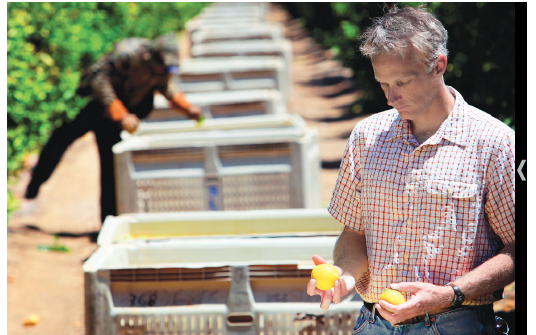
Photo/Steve Osman
Facing unusual difficulty in hiring enough harvest help, lemon growers in Ventura County say they are finding ways to get the job done by sharing resources.
“Like everywhere else in California, we are having a labor shortage. We are getting by, but it is taking us a little longer than normal to harvest,” said Gus Gunderson, director of farming for southern operations for Limoneira in Santa Paula.
Ventura County lemon grower Josh Pinkerton said the difficulty in finding enough people for the harvest relates directly to the current situation on the California-Mexico border, where a combination of enforcement by U.S. Customs and Border Protection officers and drug-related violence on the Mexican side of the border has discouraged people from entering the U.S.
“Our labor contractors are juggling everything and that is creating a stumbling block,” he said. “When compared to last summer when my labor contractor may have had 60 to 80 people on his crew, this summer he has about 40.
“We are picking a particular part of the ranch right now, and because of the labor shortage our farm labor contractor had to pull his crew out a few days early to go to another ranch to meet the needs of another farmer. That isn’t an optimal situation for us, but due to the labor shortage that is happening all over Ventura County,” Pinkerton said.
Another Ventura County grower, David Schwabauer, said he faces a similar situation.
“The big challenge has been the very tight labor situation. The picking crews are smaller than they normally would be at this time of year, and it is taking longer to harvest,” he said.
Another area of concern for citrus growers in California is the Asian citrus psyllid and the deadly, bacterial tree disease called huanglongbing, also known as citrus greening disease, that the insect can carry to citrus trees. HLB, which is widespread on the southeastern United States, is responsible for killing 200,000 acres of Florida citrus groves.
The psyllid showed up in a California Department of Food and Agriculture trap in San Diego County in 2008 and has since been found in several Southern California counties. Only one incident of HLB has been detected, in a suburban citrus tree in the Los Angeles suburb of Hacienda Heights, and that tree was removed.
Bob Blakely, director of industry relations for California Citrus Mutual, said HLB is the most serious disease known to citrus because there is no known cure.
“In Florida, they didn’t recognize the danger caused by the psyllid until it was widespread and after about five years the disease started showing up. It was like a domino effect,” he said. “We learned that lesson and benefited from their problems, and when the psyllid showed up in Tijuana and San Diego in 2008 we immediately began a program of treating wherever it was found.
“We haven’t been able to eradicate it in the inner Los Angeles metropolitan area, but we have been able to push it back and keep it from spreading out into the commercial citrus areas. To date, we have no commercial groves that are infested with the Asian citrus psyllid,” he said.
Lemon acreage in Ventura County, which is the state’s leading county for lemon production, is slowly declining. Pinkerton called concern about HLB a driving force behind the shift from lemons to other crops.
“We are seeing quite a bit of lemons being removed throughout Ventura County. Avocado acreage continues to rise, but then we are also seeing people pulling out lemons and going to row crops such as strawberries, celery, raspberries and so on,” he said.
Another citrus crop, tangerines, is gaining in popularity. Ventura County grower Emily Thacher-Ayala, who produces 16 varieties of tangerines for both the wholesale trade and farmers markets, said this year’s fruit had “outstanding flavor,” but that the crop size was down from average.
“This year was a little bit odd with the tangerines because of the freeze in the Central Valley that caused a shortage. We put our prices really high and kept them high, and we sold out early,” she said.
Harvest has wrapped up for mandarins, which are grown primarily in the Central Valley, Blakely said. Clementines, which are harvested from October through Christmas, enjoyed a very good season with excellent quality, ideal size and good flavor, he said, but W. Murcott mandarins did not fare as well.
“Clementines had probably one of their best seasons since that sector has come into existence over the last eight to 10 years. The Murcotts on the other hand were caught by that cold weather in December-January and they struggled,” Blakely said.
Harvest of California’s biggest citrus crop—navel oranges—is just ending. Overall, this year’s crop will be smaller than last year, but about the same amount of fruit was shipped because of better utilization, Blakely said.
California supplies up to 85 percent of the fresh citrus consumed in the United States, and exports, depending on crop size, anywhere from 25 percent to 30 percent. Major export markets include Korea, Southeast Asia, China and Japan.
Navel acreage has remained fairly steady with slight increases in recent years. Acreage of valencia oranges, though, has declined the last 10 years. Valencias compete with other summer tree fruit and with grapes—as well as with navel oranges coming into the United States from Southern Hemisphere countries such as Chile, South Africa and Australia.
“The valencia acreage has been replaced in large part by the mandarins, which have had phenomenal growth over the past 12 to 15 years and have now pretty much surpassed valencias as the No. 2 variety in terms of acreage,” Blakely said.
California Farm Bureau Federation

Discovery May Lead To Tomatoes With Vintage Taste
A new discovery could make more tomatoes taste like heirlooms, reports an international research team headed by a University of California, Davis, plant scientist.
The finding, which will be reported in the June 29 issue of the journal Science, has significant implications for the U.S. tomato industry, which annually harvests more than 15 million tons of the fruit for processing and fresh-market sales.
“This information about the gene responsible for the trait in wild and traditional varieties provides a strategy to recapture quality characteristics that had been unknowingly bred out of modern cultivated tomatoes,” said Ann Powell, a biochemist in UC Davis’ Department of Plant Sciences and one of the lead authors of the study
“Now that we know that some of the qualities that people value in heirloom tomatoes can be made available in other types of tomatoes, farmers can have access to more varieties of tomatoes that produce well and also have desirable color and flavor traits,” she said.
For decades, plant breeders in the tomato industry have selected varieties that are uniformly light green before they ripen, in order to produce tomatoes that can be harvested at the same time.
However, this characteristic is accompanied by an unintended reduction in sugars that compromises the flavor of the fresh fruit and its desirability for processing.
Powell’s UC Davis research team began studying the genes influencing tomato fruit development and ripening after spending two summers screening tomato plants for transcription factors that might play a role in both fruit color and quality. Transcription factors are proteins that regulate genes, or turn them on and off. These factors themselves are manufactured or expressed by genes.
The UC Davis researchers were particularly interested in tomatoes they observed in the field that were unusually dark green before they ripened.
Partnering with researchers at Cornell University and in Spain, who were mapping regions of the tomato genome, the scientists discovered two transcription factors, called GLK1 and GLK2, that control the development of chloroplasts. Chloroplasts are the structures in the plant cells that enable plants to photosynthesize, converting the energy of sunlight into sugars and other compounds that influence flavor and color.
The researchers scoured a collection of mutant and wild species of tomatoes at UC Davis established at UC Davis by the late Professor Charles Rick beginning in the 1950s. They discovered that dark green tomatoes that naturally express GLK2 produced ripe fruit with increased levels of sugars or soluble solids, important for processing tomatoes, as well as higher levels of the health-promoting compound lycopene.
“Nature presents numerous important genes and their variants, like uniform ripening, that breeders employ to facilitate the needs of growers, processors and consumers,” said Jim Giovannoni, a USDA plant molecular biologist with the Boyce Thompson Institute at Cornell University. “Understanding the genes responsible for these characteristics facilitates the challenging process of breeding crops that meet the needs of all components of the food-supply chain.”
Cuong Nguyen, a Cornell graduate student in Giovannoni’s laboratory co-authored the paper with Powell. Other members of the research team included: Theresa Hill, KaLai Lam Cheng, Rosa Figueroa-Balderas, Hakan Aktas, Hamid Ashrafi, Ariel Vicente, Javier Lopez-Baltazar, Roger Chetelat, Allen Van Deynze and Alan Bennett, all of UC Davis; Yongsheng Liu and Cornelius Barry of Cornell University and the Boyce Thompson Institute of the USDA; Clara Pons and Antonio Granell, of the Universidad Politécnica de Valencia, Spain; Rafael Fernández-Muñoz of the Universidad de Málaga, Spain.
Funding for the study was provided by The University of California Discovery program, the U.S. Department of Agriculture-Agricultural Research Service, the National Science Foundation, the Viet Nam Education Foundation, the Fundación Genoma España, and the Ministerio de Ciencia y Tecnología and the Instituto Tecnólogico de Costa Rica.
UC Davis is an international leader in agricultural research and is ranked as the most frequently cited university in the world in the area of plant and animal sciences, according to ISI Essential Science Indicators. The university’s Department of Plant Sciences is internationally known for its Plant Breeding Academy, which provides professional training for plant breeders around the world.

New Kings Co Solar Projects Total 336MW
 Four solar projects on non-prime ag land in Kings County are expected to move forward late this year totaling a hefty 336 megawatts. All are believed to hold power purchase agreements with a utility, a key milestone to toward actual construction.
The filings come as an environmental group urged earlier this year approval of solar projects on marginal or spent ag land in the Central Valley.
The Kings County Community Development Agency has invited public review and comment on the environmental documents listed below.
The public review period, for all four documents, begins on Wednesday, June 13, 2012, and ends on Friday, July 13, 2012.
INITIAL STUDIES PROPOSED AS NEGATIVE DECLARATIONS OR MITIGATED NEGATIVE DECLARATIONS:
1. Conditional Use Permit No. 11-03 (River West Investments, Inc.) The applicant proposes to construct a 136 Megawatt
solar photovoltaic energy facility located at 17515 20th Avenue. Lemoore, CA. The 670 acre project is near Hanford and is being proposed by a firm from Sacramento headed by former homebuilder Brian Vail. SunPower is the developer. It is also labeled the Henrietta Solar project
2. Conditional Use Permit No. 11-09 (RE Mustang LLC) The applicant proposes to establish a 160 Megawatt solar photovoltaic energy facility located at 15866 25th Avenue, Lemoore, CA. The big project is one of several being proposed by SF based Recurrent energy owned by Sharp, a Japanese firm. The site is near the NAS Lemoore base. Recurrent also a a plan to build a 500MW solar farm near Tranquility in Fresno County.
3.Conditional Use Permit No. 12-01 (RE Orion LLC) – The applicant proposes to establish a 20 Megawatt solar photovoltaic
energy facility located at 16480 25th Avenue, Lemoore, CA.Orion is based in Oakland but Recurrent is the developer.
4. Conditional Use Permit No. 12-02 (RE Kent South LLC) – The applicant proposes to establish a 20 Megawatt solar
photovoltaic energy facility located at 17264 25th Avenue, Lemoore, CA. Recurrent is the developer
The Kings County Planning Commission will hold public hearings to consider the environmental documents for the proposed project Aug 6 7PM,at the BOS chambers.
109 South Valley Projects
A February 2012 report from the Defenders Of Wildlife says there are 59 solar PV projects in the permitting stage within the five southern San Joaquin counties that if built would generate 2,780 MW of power.This is in addition to 45 projects in those same counties that have already been approved that would generate 1,648 MW.That’s 109 solar projects pending in the south Central Valley that add up to 4,428MW, more than double 2 Diablo Canyon nuclear power plants.
Two large projects in the Westlands Water District that spans Fresno and Kings counties are in the permitting stage says the February report. One is Mustang in Kings County on 1400 acres being proposed by Recurrent mentioned earlier.The second in Fresno County is a a 1890 acre project near Mendota being proposed by SunPower that could generate 200MW.
Defenders Of Wildlife argue that such projects on “degraded” and “impaired” ag lands will help avoid farmland of higher quality as well as avoiding sites that are more sensitive environmentally with wildlife impacts for example – think some desert site proposals pending.
To help this area the group urges the PUC to upgrade electricity infrastructure in the area

Walmart Plans New Visalia Grocery Store
 ICE Builders of Ventura and others are accepting bids for a new 40,000 sf “Neighborhood Walmart Grocery Store” at Demaree and Houston in Visalia. The bids are due June 25 on the $4 million project. The bidding instructions available at the Tulare/Kings Builders Exchange indicate work will start right away and all work needs to be completed December 10.
Walmart spokesperson Delia Garcia said she could not comment on the news but “you should stay tuned over the next week or two” indicating an announcement is pending.The proposed store even carries its official Walmart store number#5635-00. But Walmart likes to do its new store development under the radar, the likely reason why the company has filed for its building permit and submitted store plans with the city without disclosing who they are.
The project has been rumored for many months but this week city building official Greg Adams says “the permit is very close to being issued” and that the plans carry the name WD Partners.WD Partners works with Walmart on projects.
“It’s pretty unusual the plans don’t show who they are” offers Adams.
Third Walmart In Visalia
This would be the first smaller-format Walmart grocery store built in the South Valley and the third in Visalia that will now sell groceries.
That’s because before this year the only Walmart location in town on Noble did not sell groceries although there are plans to expand the space to sell groceries that have been filed. In May, Walmart opened a second store in Visalia on south Mooney in the former Costco location that is “superstore” – selling general merchandise as well as a full line of groceries.
The east Visalia Noble Ave Walmart expansion is being litigated in Tulare County Superior Court right now but eventually the court is expected to allow Walmart to expand this store – becoming the second Walmart in town Visalia to sell groceries.
Now with a smaller format store to open north of 198 around the end of year – that makes it three Walmart outlets that will sell groceries in Visalia, fairly well covering the town, geographically.
To date, Visalia’s supermarket scene has been dominated by Modesto- based Save Mart, a union store, with five locations in town including their warehouse store. Unlike most cities, Visalia does not have a the complement of national chains like Von’s, Albertson’s or Ralph’s. The rest of the competition here have only single locations in town.
Arguably, the surge by Walmart into groceries in Visalia hurts Save Mart the most,already struggling this summer with their union contract and a threat of a strike.
Both Save Mart and the grocery union have made it no secret they consider the entrance of nonunion Walmart into their turf as a big problem.It was Save Mart employees that spoke against the expansion of the Noble store at the Visalia public hearing approved by the city council and now subject of a lawsuit by a group that does not name who they are.
Save Mart has just closed a store in Elk Grove in recent days citing the economy and tough competition. Perhaps not by coincident Walmart is expected to open a ‘Neighborhood’ store in the same town later this year.

Taxable Sales/Fuel Sales In California Signal Economic Growth
 2011 First Quarter Increased 9.0%; 2012 First Quarter Estimate Up 9.3%
Sacramento – In the first quarter of 2011, taxable sales in California rose 9.0 percent compared to the previous year, signaling economic growth, said Jerome E. Horton, Chairman of the California State Board of Equalization (BOE).
The growth rate of 9.0 percent was nearly twice as fast as two years ago in 2010 when the average growth was 4.6 percent.
An estimate of this year’s first quarter projects taxable sales of 9.3 percent, a pace similar to that of 2011. The 2012 figures are being compared to a similar period in 2011. The 2012 figures are an estimate subject to revisions, while the 2011 figures have been confirmed by BOE data.
“Taxable sales fuel the engine of economic growth and job creation that moves California forward,” said Chairman Horton. “Moving forward, we will continue to help our small businesses and will seek out new ways to help our companies grow by leveling the playing field and forging strong working relationships between government and private enterprise.”
Soaring gasoline prices, which rose 20.0 percent in the first quarter of 2011, required consumers to pay more at the pump and likely prompted many households to begin replacing aging vehicles. As a result, taxable sales made by gasoline stations increased 22.4 percent and those made by motor vehicle dealers increased 17.4 percent.
Statewide taxable sales by type of business for retail and food services rose 8.8 percent compared to all other nonretail businesses such as business equipment, construction materials, utilities, transportation, finance, insurance, real estate, entertainment, recreation, accommodation, and other services, which rose 9.5 percent, consistent with the national trend in the first quarter of 2011.
In related report thr state reported late last month for the first time in a year, gasoline consumption rose—2.1 percent—despite a hefty 12.6 percent increase in California gasoline prices, according to a report released today by Chairman Jerome E. Horton of the California State Board of Equalization (BOE). Gasoline prices jumped 12.6% to an average of $4.03 a gallon in February 2012, while consumption increased 2.1% compared to a year ago.
“Californians used more gasoline,” said Horton. “This could be a sign that economic activity is picking up and California’s economy is improving. In fact, in addition to the gasoline indicators, non-agricultural and manufacturing employment has increased over the same period last year and the unemployment rate is decreasing, as well as the average number of weeks of claimed unemployment benefits.
California Taxable Sales increased at a growth rate 2.3 percent faster than California Personal Income in the first quarter of 2011, the largest positive gap since 2005 (see chart)

Green Energy Fuels Update
 E85 Ethanol Flowing Again in Tulare: Corn-based E85 ethanol fuel for owners of flexfuel vehicles is available once again in the Tulare area at Stanley’s Food Mart on Cartmill Ave. at “M” Street. The Tulare E85 station was the third to open in California, beginning sales in February 2008 during the World Ag Expo. There are about 60 E85 stations in California today according to US Department of Energy websites. The nearest is in Modesto, with dozens in the Sacramento, Bay and LA . The gas station was idled for about a year sold recently by Nella Oil to the Vohra brothers who have 10 stations in the Fresno area.The station opened in the past week carrying a Chevron brand name.
Speaking of corn, Pacific Ethanol, Inc. announced this week it
will install corn oil separation technology at the Pacific Ethanol Magic Valley plant with the intention to further implement corn oil separation at the other 3 Pacific Ethanol Plants by the end of the first quarter of 2013,that appears to include currently idled Madera. The Magic Valley plant is expected to produce approximately 12 million pounds of corn oil per year, which at current prices would contribute as much as $4.5 million, or seven cents per gallon, of operating income annually.” Corn oil ise used as a food grade vegetable oil or as feedstock used for biodiesel. Pixley-based Calgren added corn oil extraction as part of its ethanol making process.
In Visalia EdenIQ will hold its pilot plant ribbon cutting Tuesday, June 26 in Visalia from 10 AM to 3PM. The ceremony includes an industry presentation to be attended by government officials, venture capitalists and industry analysts on the state of the biofuels industry as well as the future of sustainable fuels. . The Pilot Plant converts cellulosic feedstock (non-food plant material) into ethanol and is located at Edeniq’s headquarters in Visalia, California.
Also the following presentations are planned.
The State of The BioFuels Industry: Insights and analysis of the current successes, challenges, bright spots and trends within the biofuels/bio chemical sector by Mackinnon Lawrence, Pike Research
The Future of Sustainable Fuels: A panel discussion with Brian Thome, CEO of Edeniq, CEC Deputy Director Pat Perez, Glenda Humiston Director of the USDA’s State Rural Development office, and John Rockwell from the Venture Capital community to discuss the partnership needed between funding, public and private sectors to get to a successful biofuel future.Moderated by Heather Youngs, Analyst with Energy Biosciences Institute at UC Berkeley.
________
CEC Funds Green Fuels Program Will Add 101 New E85 Stations & Much More
The California Energy Commission approved funding of $35,031,310 to projects that will accelerate the development of green fuels and technology in California. These investments reduce the state’s dependence on foreign oil, improve the environment and help California attain its climate change policies.
These investments provide vital support to emerging fuels and vehicle technologies by funding the differential cost of their development and deployment. Additionally, many of these projects leverage outside funding to attract additional investment in clean energy jobs and technology.
The award recipients are:
CALSTART, Inc., will receive $14,469,304 to demonstrate medium- and heavy-duty vehicles using advanced technology and alternative fuels. Altogether, 29 vehicles of nine different types will be used and evaluated, ranging from all-electric battery vehicles to hybrid diesel-electric work trucks, shuttle buses, and construction equipment. In addition to reducing greenhouse gas emissions, as these projects become commercial they have the potential to create more than 600 jobs by 2015. CALSTART is based in Pasadena.
Propel Biofuels, Inc., will receive $10.1 million as a share of the cost to install 101 new E85 (ethanol) fueling facilities at existing gas fueling stations statewide. As there are currently just 51 publicly accessible E85 fueling stations in the state, this project will greatly enlarge the network of stations that can serve the approximately 500,000 flex fuel vehicles in California. Propel Biofuels is based in Redwood City.
SacPort Biofuels Corp. will receive $5 million to develop, build and test a pilot facility to demonstrate an innovative gasification process to produce renewable biomass diesel from local municipal solid waste, including green refuse, railroad ties, construction and demolition waste, and plastics that typically wind up in landfills. Because landfills are a major contributor of greenhouse gas emissions, reducing their size reduces emissions. Annually, the facility is slated to eventually produce 365,000 gallons of renewable diesel fuel that will be blended with conventional diesel. The project, located at the Port of West Sacramento, is expected to create 20 permanent jobs and an additional 30 during construction.
Gas Technology Institute, a nonprofit energy research and development organization, will receive $4,562,532 for two projects: a demonstration of three plug-in hybrid trucks, in partnership with US Hybrid Corp.; and a demonstration of a natural gas version of the heavy-duty Navistar MaxxForce 13 diesel engine, in partnership with Clean Air Power.
Springboard Biodiesel, LLC, will receive $758,200 to develop and build a pilot biodiesel production facility in Chico, where Springboard is based. The facility is expected to provide low-cost biodiesel in rural Northern California, which currently lacks such fuel options. Used cooking oil and other waste material will be diverted from landfills and used to produce up to 1,000 gallons a day of biodiesel to be used locally. This project is expected to create 12 permanent jobs.
Whole Energy Pacifica LLC will receive $125,274 to design, build and install a fuel-blending system at an existing biodiesel terminal in Richmond. The new system will provide accurate, uniform blending of diesel and biodiesel. The biodiesel at this facility is predominantly made from used cooking oils.
Reynolds Buick-GMC will receive a buy-down incentive of $16,000 for two natural gas-fueled medium-duty vehicles of 8,501 to 14,000 pounds gross vehicle weight. Such incentives are designed to help pay the difference between the cost of conventional gas- or diesel-powered vehicles and new ones that use propane or natural gas. To receive an incentive, purchasers must agree to register the vehicles in California and operate them in the state for three years using the designated alternative fuel at least 90 percent of the time.