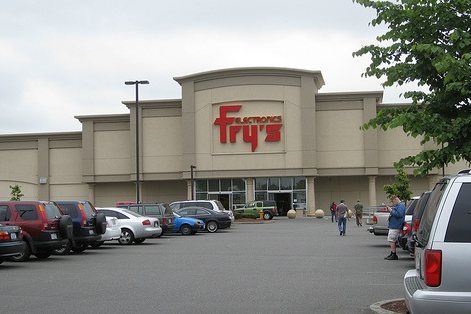
Fry’s Electronics Warehouse Coming To Hanford?

Big box retailer reportedly seeks warehouse center in Hanford

Some 180 New Jobs On Tap

Kings County officials confirm that a major retail company will be relocating its warehouse and central repair depot operations to Hanford within the next few months. They are starting a recruitment drive to fill approximately 180 positions. The unnamed firm is locating in the vacant 175,000 sf International Paper Corrugated Box Plant in the Kings Industrial Park at 10555 Iona Avenue. Local officials say they cannot release their name.
However,when anyone Googles that address in Hanford – San Jose-based Fry’s Electronics comes up.The company has been rumored by industrial real estate brokers to be interested in a Hanford warehouse, mid-point between their Northern and Southern California retail stores.Hanford would be a logical overnight shipping location for their California stores.
Fry’s is a privately owned top big-box retailer of computers, consumer electronics, and appliances with some 34 stores in about 10 states.The popular store has no Valley locations but a big presence in LA and the Bay Area.On the retail front they compete with Best Buy and WalMart.They had $2 billion in sales in 2011 and 14,000 employees.
Fry’s Electronics, Inc. was founded in 1985 in Sunnyvale, California in a 20,000 square-foot location by the three Fry brothers, John, Randy, and Dave; and Kathy Kolder. Fry’s is a closely-held private company, and all of the founders are actively involved in the daily operation of the business.
Spawned from Silicon Valley’s passion for retail electronics, the store provides a one-stop-shopping environment for the Hi-Tech Professional. Fry’s says they continues to keep hi-tech professionals supplied with products representing the latest technological trends and advances in the personal computer marketplace. Fry’s retails over 50,000 electronic items within each store, now totaling 34. There are currently 8 stores in Northern California, 9 stores in Southern California, 8 stores in Texas, 2 stores in Arizona, 2 stores in Georgia, and 1 store each in Illinois, Indiana, Nevada, Oregon and Washington. The stores range in size from 50,000 to over 180,000 square feet. Fry’s also provides customers with added shopping opportunities via its online center at Fry’s.com.

Pesticides, Water Quality and Alfalfa Production

January 24, 2013

There is no question that managing pests in alfalfa is a challenge. But it’s even more of a challenge considering that we need to consider how our chemical tools impact our environment. Why is this is important?  Two reasons: 1) no grower wants to pollute our natural waterways or wells, 2) ultimately unwanted environmental impacts will cause the loss of these pesticide tools over time.  This became evident last year when the detection of the herbicide Velpar (hexazinone) in wells caused DPR to threaten to pull the registration.  After hearings with members of the California Alfalfa & Forage Association and scientists in Sacramento, ultimately growers were able to keep Velpar, but it should have been a wake-up call about the potential for water impacts of chemicals used in alfalfa.

Pesticide water quality issues continue to be a concern for alfalfa fields that drain into natural waterways. The products used in alfalfa that are most troublesome include the herbicide diuron (Karmex or Direx), Velpar, and the insecticide chlorpyrifos (Lorsban, Lock-On, Cobalt, Stallion). Diuron is used for winter weed control in alfalfa (primarily as a pre-emergence material) while chlorpyrifos is used for weevil control. Velpar is very important for controlling groundsel in alfalfa. All of these  pesticides move with water (irrigation and storm water runoff) after they are applied to fields.

The Water Quality Coalition groups have reported detections of chlorpyrifos and diuron in several of the alfalfa growing areas of the Sacramento and San Joaquin Valleys.

Diuron is relatively persistent in the environment. It has a low tendency to attach to soil particles, has a high aquatic toxicity, and the field dissipation half-life is 90 days. This herbicide is also a groundwater issue in some areas of our state. Chlorpyrifos has a moderate tendency to attach to soil particles, but is very highly toxic to aquatic invertebrates (in parts per trillion) with a half-life of 43 days.

Numerous exceedances have occurred in waterways for both diuron and chlorpyrifos, requiring the implementation of management plans to reduce the concentration of these pesticides to levels that are not toxic to aquatic test species. The development of these management plans, as required by the Regional Water Quality Control Board, are very expensive and time consuming to implement. They require huge amounts of staff time to write reports and additional monitoring requirements.

UCCE is conducting field studies in collaboration with growers and CA DPR and UC Davis to better understand how to minimize offsite movement of these products into surface waters. Current guidelines include the following:

  • If you are managing large alfalfa acreage, consider using multiple pesticide chemistries on different fields to reduce the cumulative effect of any one active ingredient.
  • Study your water systems and look for ways to recirculate water back onto agricultural fields and to prevent drainage water from entering natural waterways.
  • Use alternative products that have less water impacts on those fields where drainage is difficult to prevent – lists by crop and pest are available on the UC IPM guidelines at: http://ipm.ucdavis.edu/PMG/selectnewpest.alfalfa-hay.html
  • Use extreme caution during applications. Eliminate drift and overspray, especially near ditches (supply and drainage).
  • Do not apply to saturated soils where the danger of off-site movement is greater.
  • Do not apply just prior to a runoff event or irrigation.
  • Several approaches such as alternative products on field perimeters have been shown to reduce the off-site movement of the more problematic chemicals.

New Lawsuit Filed Over Fracking In California –

Vineyard Owners On Central Coast Weigh In

click to enlarge

A new lawsuit says state regulators have allowed hydraulic fracturing, or fracking, to expand in California without legally required oversight.
The lawsuit, filed last week in Alameda County Superior Court by the Center for Biological Diversity, seeks to compel regulators to enforce existing state law that protects people and the environment from underground injections carried out by the oil and gas industry.
In a news release, the Center for Biological Diversity said the state has yet to regulate or even monitor the controversial practice of fracking, which involves injecting water and industrial chemicals, mixed with sand, at high pressure into shale formations to release previously inaccessible stores of natural gas or oil. The water-intensive and controversial process has expanded in many areas of the country, raising concerns about impacts on drinking water supplies.
“A looming fracking boom threatens to transform California, creating serious pollution risks to our air, water and climate,” said the center’s Vera Pardee said the release. “Existing rules clearly cover fracking, but state officials don’t regulate or even track this dangerous way of extracting oil and gas. The state needs to stop ignoring the law and start protecting our environment.”
According to the center, more than 600 wells in at least nine California counties were fracked in 2011 alone. Recent advances in fracking techniques are driving a growing interest in the Monterey Shale, a geological formation holding an estimated 15 billion barrels of oil.
California’s existing oil and gas regulations cover all forms of underground injection and clearly apply to fracking, the center said in its release. While fracking was exempted from the federal Safe Drinking Water Act in 2005, no such exemption exists in California law, the center said.
On the central Coast vineyard owners have increasing concern about fracking near their water source. The Wine Spectator has published an article this month suggesting a looming controversy.
Central Coast
“Oilers are intensely exploring the Central Coast. In December, mineral rights leases to 17,000 acres on federal lands near vineyards in southern Monterey County were sold, and another auction is scheduled for May 2013. Vintners are starting to wonder what fracking might mean for them. “We understand that energy is an issue, just as our water is an issue,” said Paula Getzelman, who grows 5 acres of Syrah, Grenache and Mourvèdre with her husband at Tre Gatti Vineyards in the Lockwood Valley of southern Monterey County, less than five miles from a recent federal lease sale. “What we’re saying is, if something spoils our water, we’re all done out here.”
Paul Johnson, president of the Monterey County Vintners and Growers Association, agreed. “Oil companies are buying [mineral rights] up, and if oil companies are buying it, they are obviously planning on doing fracking,” said Johnson, who manages various Central Coast properties under his family’s Johnson Vineyard Com.”
The California Division of Oil, Gas, and Geothermal Resources (DOGGR) released a “discussion draft” of regulations for fracking in December and has said a more formal rulemaking process will begin in 2013. Information on the discussion draft is available here.
According to the Center for Biological Diversity, compliance with California’s existing oil and gas regulations would require disclosure of all fracking chemicals, as well as engineering studies and tests to evaluate the potential for underground migration of fracking fluids. State regulators would also need to ensure that fracking is conducted in a way that prevented, as far as possible, damage to life, health, property, and California’s water and other natural resources.

Contributed by Lisa Lien-Mager – ACWA News

Home Prices Extend Gains

New York, January 29, 2013 – Data through November 2012, released today by S&P Dow Jones Indices forits S&P/Case-Shiller1 Home Price Indices, the leading measure of U.S. home prices, showed home prices rose 4.5% for the 10-City Composite and 5.5% for the 20-City Composite in the 12 months ending in November 2012.
In the 12 months ended in November, prices rose in 19 of the 20 cities and fell in New York. In 19 cities prices rose faster in the 12 months to November than in the 12 months to October; Cleveland prices rose at the same pace in both time periods. Phoenix led with the fastest price rise – up 22.8% in 12 months as it posted its seventh consecutive month of double-digit annual returns.

“The November monthly figures were stronger than October, with 10 cities seeing rising prices versus seven the month before.” says David M. Blitzer, Chairman of the Index Committee at S&P Dow Jones Indices.

“Phoenix and San Francisco were both up 1.4% in November followed by Minneapolis up 1.0%. On the down side, Chicago was again amongst the weakest with a drop of 1.3% for November.
“Winter is usually a weak period for housing which explains why we now see about half the cities with falling month-to-month prices compared to 20 out of 20 seeing rising prices last summer. The better annual price changes also point to seasonal weakness rather than a reversal in the housing market. Further evidence that the weakness is seasonal is seen in the seasonally adjusted figures: only New York saw prices fall on a seasonally adjusted basis while Cleveland was flat.

Regional patterns are shifting as well. The Southwest – Las Vegas and Phoenix – are staging a strong comeback with the Southeast — Miami and Tampa close behind. The sunbelt, which bore the brunt of the housing collapse, is back in a leadership position. California is also doing well while the northeast and industrial Midwest is lagging somewhat.

“Housing is clearly recovering. Prices are rising as are both new and existing home sales. Existing home sales in November were 5.0 million, highest since November 2009. New Home sales at 398,000 were the highest since June 2010. These figures confirm that housing is contributing to economic growth.

Atlanta, Denver, Las Vegas, Los Angeles, Miami, Minneapolis, Phoenix, San Diego, San Francisco and Seattle were the ten MSAs that were higher.
Year over year Los Angeles was up 7.7%  San Francisco up 12.7%,San Diego up 8% and Las Vegas up 10%.

Central Valley Irrigation Intensifies Rainfall, Storms Across Southwest

Irvine, Calif., Jan. 28, 2013 – Agricultural irrigation in California’s Central Valley doubles the amount of water vapor pumped into the atmosphere, ratcheting up rainfall and powerful monsoons across the interior Southwest, according to a new study by UC Irvine scientists.
Moisture on the vast farm fields evaporates, is blown over the Sierra Nevada and dumps 15 percent more than average summer rain in numerous other states. Runoff to the Colorado River increases by 28 percent, and the Four Corners region experiences a 56 percent boost in runoff. While the additional water supply can be a good thing, the transport pattern also accelerates the severity of monsoons and other potentially destructive seasonal weather events.
“If we stop irrigating in the Valley, we’ll see a decrease in stream flow in the Colorado River basin,” said climate hydrologist Jay Famiglietti, senior author on the paper, which will be published online Tuesday, Jan. 29, in the journal Geophysical Research Letters. The basin provides water for about 35 million people, including those in Los Angeles, Las Vegas and Phoenix. But the extra water vapor also accelerates normal atmospheric circulation, he said, “firing up” the annual storm cycle and drawing in more water vapor from the Gulf of Mexico as well as the Central Valley.
When the additional waves of moisture bump into developing monsoons, Famiglietti said, “it’s like throwing fuel on a fire.”
Famiglietti, an Earth system science professor in the School of Physical Sciences, and colleague Min-Hui Lo, a postdoctoral researcher at the University of California Center for Hydrologic Modeling who is now at National Taiwan University, painstakingly entered regional irrigation levels into global rainfall and weather models and traced the patterns.
“All percent differences in the paper are the differences between applying irrigation to the Central Valley and not applying it,” Famiglietti said. “That’s the point of the study – and the beauty of using computer models. You can isolate the phenomenon that you wish to explore, in this case, irrigation versus no irrigation.”
Famiglietti’s team plans to increase the scope of the work to track how major human water usage elsewhere in the world affects neighboring areas too. A better understanding of irrigation’s impact on the changing climate and water availability could improve resource management in parched or flooded areas.

Port San Luis Plans Huge New Campground / New Fish Growing Pens Studied

Harbor Terrace is an approximately 50-acre site above San Luis Bay, the site of a former mobile home park. The entrance to the new facility will be just east of the access road to Diablo Canyon.Once constructed, the proposed campground will help meet the need for lower cost accommodations in the region by providing a mix of tent camping, tent cabins, and RV sites serving up to 300 visitors at a time.

The developer, Bay Area-based GMB Realty Partners says “Our vision for Harbor Terrace is to create a truly unique Coastal Camping Resort where every view is a coastal view.”

The resort offering will include 102 RV locations,50 tent camp sites,25 tent cabins, a main lodge, a restaurant ,market-deli, boat and trailer spaces and other harbor uses.

Harbor manager Steve McGrath of Port San Luis says the hillside project will boost tourism, be a “significant source of  revenue” for the district and  offer storage facilities for fishermen,a big draw to the area.Clearly it will help other Avila Bay businesses, including port concessions as well.

The California Coastal Conservancy a state agency established in 1976 to enhance coastal resources and access has reviewed the plan is expected to approve a memorandum of understanding with Port San Luis on the project in February. “In return for the Conservancy carrying out the entitlement activities, the District will agree to provide the Conservancy with a portion of any revenue it may receive from the leasing of the site to a private entity for the construction and eventual operation of the campground “says minutes of a December joint meeting. The conservancy will approve a $400,000 grant to help to establish the campground there.

The Port San Luis dsirct has been in the planning phases for Harbor Terrace for over 10 years.GMB has estimate the cost of the project at $15 million. Once all approvals are in place the project will take 15 to 18 months to build, says the developer.

Port San Luis ,located in Avila Bay on on a south-facing beach with the prevailing winds and swell from the north offers a sheltered cove and some of the greatest weather on the entire Central Coast.

The Coastal Conservancy notes that Harbor Terrace could be attractive to moderate to lower income visitors.” Out of more than 1,600 hotels, RV parks and campgrounds in California’s coastal counties, fewer than 10% offer accommodations under $100 per night” says a Conservancy report on the project.

“All of these improvements will be designed and sited to minimize impacts to the area’s natural and scenic resources and to meet today’s energy efficiency standards. “ says a Conservancy report.

sea bass

Growing Pens For Sea Bass Planned At Port San Luis

Central Coast sea bass fishing could get better once growing pens to add to their local population get growing this year.Port San Luis Harbor manager Steve McGrath says the pilot project is modeled after sea bass growing pens in southern California where they have successfully boosted the fishery there.”We will see how it works in these colder waters” says McGarth.

The growing pens were used at Port San Luis on Avila Bay to grow salmon and sturgeon but were discontinued after it was determined by  California DF&G that the practice could be harmful to the wild salmon  population. But there is no such problem with sea bass.

The district filed a negative declaration this  month and will now go to the California Coastal Commission and State Lands Commission for their blessing.
McGrath says the project could start this summer. The hatchery fish will be pend in the ocean at Port San Luis and feed for 2 to 3 months before being released. McGrath says before the fish are a year old they can be caught.

A Cut For Enterprise Zones – Good News Bad News For Tulare County

The Good News
The State of California has approved a long awaited proposal to expand the Sequoia Enterprise Zone in Tulare County this month effective immediately. The expansion will add acreage in several parts of the county where businesses are located or want to locate who can now take advantage of the tax incentives the zone offers. County Economic Development Manager Mike Washam say he expects several businesses to expand as a result.  But if the state is offering in one hand they appear to be taking back with the other.
The Bad News
A new state plan to cut the size and tighten the rules for enterprise zones that offer tax incentives for business expansion in California has Valley officials worried they will result in job losses in the future. The new draft rules announced January 11 will impact the 40 zones in the state including Fresno,Tulare and Kings counties.

The zone benefits are targeted to economically depressed parts of the state to attract new companies and retain those looking to relocate out of the state of California.The Enterprise Zones (EZ) are a series of geographic areas in California where companies receive special tax breaks.

Right now many businesses in Tulare County,considered distressed   because of its persistent high unemployment, can hire a new employee from any part of the county and potentially receive a tax credit.
But all that would change under the new rules.

“As we understand it, about 30 of 72 census tracts in the county would no longer be eligible for hiring credits” says Michael Washam.

If the employee lived in most neighborhoods in Visalia or Tulare for example, that have a higher income level than most of the county,that person would not be eligible for the tax incentives once these new regulations are in effect. The department that runs the program, Housing & Community Development, says they will take comment on the new plan until February 28, 2013.

Fresno County would be hard hit by the proposed regulations says Victor Bribiesca, manager of the local program for the Fresno EDC.”They would cut the number of eligible census tracts by about half” he says. ”That translates into employees who won’t qualify for jobs. I would call this plan devastating to Fresno County.” Kingsburg City Manager Don Pauley says the proposed cuts would hurt job psopects for Kingsburg residents whowould no longer qaulfy for employer tax incentives.

Coast Biz Beat/ Outdoor Amphiteatre / New Cinema / SLO Airport

Edward Cinema Coming To Santa Maria

Edwards Theatre is building a $ 8.6 million 14-screen movie theater in the Santa Maria Town Center complex. The new cineplex replaces the former Gottschalks building and is expected to open late this year.

SLO Airport Traffic Down 4.7%

San Luis Obispo Regional Airport recorded a down year in 2012 accommodating 259,505 passengers compared to 272,429 in 2011 – a 4.7% decline. The numbers are down from the years 2002 to 2008  when the airport saw an average more than 300,000 passengers fly here.Airport management says demand is there but the number of seats in the market available  though the 2 airlines based here are down compared to earlier this decade.

3000 seat outdoor amphitheater set to open this summer

Outdoor Amphitheater In Wine Country

Paso Robles, CA. – San Francisco based Prescient Entertainment, in partnership with AEG Live, has been selected as the exclusive promoter to book the inaugural concert season at the 3,300 seat VinaRobles Amphitheatre, which is set to open in summer 2013.

The new state-of-the art boutique amphitheatre is located adjacent to Vina Robles Winery’s existingHospitality Center in the heart of Paso Robles wine country. The amphitheatre, nestled on a picturesque oak-dotted hillside, will feature a combination of tiered reserved seats, VIP boxes, and general admission lawn seating; offering a variety of ticket pricing options for concert-goers. VIP and Season ticket holders will be able to immerse themselves in the full concert experience with access to luxury services including valet parking, VIP/artist reception area, and first-class pre show dining options.

The venue is scheduled to host 15 to 20 events a year between April and October beginning in midsummer of 2013. Opening day has not yet been scheduled. “I am excited to partner with AEG Live and Vina Robles Winery to book our first of many seasons at this incredible new venue.” says Lee Smith, President of Prescient Entertainment. “The addition of booking the Vina Robles Amphitheatre was a natural fit for us because we already produce concerts in similar venues in both Northern and Southern California. Vina Robles will allow us to bring these same artists to Paso Robles as they travel between cities.”

General Manager, Tim Reed who has overseen the development of the project says, “This facility represents a new high-water mark for entertainment on the Central Coast and will forever change the local concert-going experience. We look forward to working with Lee and his team to bring first class concerts to Paso Robles. The Vina Robles Amphitheatre will become the premier outdoor entertainment destination between Santa Barbara and the Bay Area.”

Oner Hans Nef describes the winery’s plan”.We craft wines that represent a stylistic bridge between the Old and New worlds, capturing the finesse associated with European wines while celebrating the bold natural flavors of our estate vineyards in Paso Robles. Here, proprietor Hans Nef and managing partner Hans – R. Michel bring their Swiss heritage to California’s Central Coast, where they aim to unite the
best of both experiences. We specialize in varieties that excel in the complex soils and nuanced microclimates of Paso Robles, and we also embrace unconventional blends as an opportunity to create wines of distinctive quality and character.”

High-Speed Rail Authority Selects Team To Manage Central Valley Construction

Brown Praises Effort/ Bid Contractors Announced


SACRAMENTO, Calif. – Following a competitive bidding process, the California High-Speed Rail Authority (Authority) Board of Directors has selected PGH Wong Engineering, Inc., and Harris & Associates to provide additional oversight and management of contractors who will build the initial 30-mile stretch of high-speed rail from Madera to Fresno. Thirty percent of the work will be done by small businesses and over 50 percent of those will be located in the Central Valley.

“We’re proud to say both companies that won the Project and Construction Management (PCM) contract are California-based firms with extensive experience in transit delivery and design-build programs in California and around the nation,” said Jeff Morales, CEO of the California High-Speed Rail Authority. “They have also achieved the Authority’s goal of having 30 percent Small Business participation and of the Small Businesses that will provide PCM services over 50 percent are located in the Central Valley.”

Also this week the names of five bidding teams offering to build the first leg of the system were made public. The bids of the contractors will be examined in the next few weeks before a decision is announced. The contractor groups are:

* California Backbone Builders, a consortium of two Spanish construction firms — Ferrovial Agroman and Acciona.
* California High-Speed Rail Partners, composed of Fluor Corp. of Texas, Swedish-based Skanska, and PCL Constructors of Canada.
* California High-Speed Ventures, made up of Kiewit Corp. of Nebraska, Granite Construction of Watsonville, and Comsa EMTE of Spain.
* A joint venture of Dragados SA of Spain, Denver-based Flatiron Construction Corp., and Shimmick Construction of Oakland.
* Tutor Perini Corp. of Sylmar, Zachry Construction of Texas and Pasadena-based Parsons Corp.

Wong-Harris will work with the Authority to oversee the contractors that will be selected to design and construct the backbone of the high-speed rail project, an initial 30-mile stretch that runs from Madera to Fresno. Wong-Harris will provide extra oversight of inspection and testing, construction safety and security, technical and environmental compliance, document control and public outreach. The purpose of this oversight is to ensure that construction is managed properly and that taxpayers are getting a good value for their investment.

This week Governor Jerry Brown praised the effort to build the huge rail system in his State of the State speech.

“ In the years following World War II, California embarked on a vast program to build highway, bridges and roads.
Today, California’s highways are asked to accommodate more vehicle traffic than any other state in the nation. Most were constructed before we knew about climate change and the lethal effects of dirty air. We now expect more.
I have directed our Transportation Agency to review thoroughly our current priorities and explore long-term funding options.
Last year, you authorized another big project: High Speed Rail. Yes, it is bold but so is everything else about California.
Electrified trains are part of the future. China already has 5000 miles of high speed rail and intends to double that. Spain has 1600 miles and is building more. More than a dozen other countries have their own successful high speed rail systems. Even Morocco is building one.
The first phase will get us from Madera to Bakersfield. Then we will take it through the Tehachapi Mountains to Palmdale, constructing 30 miles of tunnels and bridges. The first rail line through those mountains was built in 1874 and its top speed over the crest is still 24 miles an hour. Then we will build another 33 miles of tunnels and bridges before we get the train to its destination at Union Station in the heart of Los Angeles.
It has taken great perseverance to get us this far. I signed the original high speed rail Authority in 1982—over 30 years ago. In 2013, we will finally break ground and start construction.”

PGH Wong Engineering, Inc. is a full-service engineering firm that specializes in construction management, project management, and design of rail transit projects which include heavy rail, light rail, commuter rail, freight railroad, and high-speed rail. Wong’s extensive experience includes project and construction management of major transit projects including BART Silicon Valley Berryessa Extension, Central Phoenix/East Valley Light Rail Transit System, Sonoma-Marin Area Rail Transit Project, San Francisco International Airport AirTrain System, and San Francisco BART Extension to the San Francisco International Airport on behalf of the Airport.

Harris & Associates provides expertise from project conception through occupancy in project and construction management, program management, engineering services, and municipal services. Harris has also provided services to Caltrans starting with the first
consultant contract for Construction Engineering in 1986 for District 6, headquartered in Fresno. Harris was a key part of a team to provide oversight for both the design-build of the SR-22 Widening and the current design-build of the I-405 projects.

The PCM will be located at the Central Valley construction site with the Design-Build Contractor. Under the contract, Wong-Harris could receive up to $34.9 million based on actual work performed.

PGH Wong Engineering, Inc. is headquartered in San Francisco and Harris & Associates is based out of Concord, California.

Dairy Exports To China Could Double By 2017

U.S. Dairy Export Council / Updated: 01/22/2013
US & China Resolve Export Issue

Chinese and U.S. regulators approved a dairy certificate ensuring that the flow of U.S. dairy goods into the largest dairy importer in the world continues unabated.
“U.S. dairy exports to China are on pace to clear $400 million in 2012,” says Tom Suber, president, U.S. Dairy Export Council (USDEC). Primarily funded by U.S. dairy farmers through their checkoff investment, USDEC leads industry efforts in resolving overseas dairy regulatory affairs issues and developing export markets. USDEC staff worked closely with Chinese officials and a U.S. inter-agency regulatory team to secure this particular deal.
“With the certificate question settled, we expect U.S. dairy export value to China could more than double by 2017,” he says. “Some or all of those sales could have been lost had it gone unresolved.”
The issue dates back to early 2010 when China revised its dairy certificate as part of sweeping efforts to upgrade domestic food safety.
“Credit goes to China for keeping its market open throughout the certificate negotiation and review process,” says Matt McKnight, senior vice president, market access, regulatory and industry affairs, USDEC. “It is not always the case that a country is so willing to work with a major supplier to find mutually satisfactory ways to get the regulatory assurances it requires. They said, in essence, as long as good faith negotiations were moving forward, the market would stay open. If the United States became nonresponsive or if talks fell apart, China could have closed its doors.”
The process was ongoing and USDEC was involved from the start. Staff visited one-on-one with Chinese food safety and ag authorities to understand the assurances they were seeking and collaborated closely with U.S. regulators to develop and revise sample certificate language.
“Special appreciation is due to USDA [U.S. Department of Agriculture] and the rest of the inter-agency team that worked dedicatedly with China to find a way to address their concerns,” says McKnight.
At the same time, although there never was a market closure, the unresolved certificate issue and threat of closure loomed over U.S.-China dairy trade. That perceived risk made some buyers hesitate, opting to source some or all of their product from U.S. competitors.
USDEC estimates the uncertainty of the certificate situation depressed U.S. dairy ingredient sales by 5-10 percent and cheese sales by as much as 50 percent. The impact was considerably greater in the case of cheese given the foodservice industry’s need for consistent supply and more limited interchangeability of cheeses.