Tahoe’s Kirkwood expects a “fire hose” of moisture next weekend
Middle California should get some nice precipitation in what could be a wet period for a week in some areas. Next weekend will likely bring potentially heavy Sierra snowfall say multiple weather forecasters.
Accuweather’s Ken Clark on November 23 said ”this easily could be the wettest period there has been so far this season.” He sets up this way.
”A cold, upper level low develops over the east-central Pacific next week and sends into California and the Northwest a series of storms. The first comes inland on Wednesday. Rain is likely in northern California down to at least part of Central California Wednesday spreading to central areas probably later in the day and night. Much of this rain may not make it into southern California though a little is possible Wednesday night or Thursday morning.” This storm is said to be more tropical in nature.
SLO forecaster John Lindsey continues that “A stronger and much wetter Gulf of Alaska storm system is forecast to move southwestward over San Luis Obispo County late Friday into next Saturday. This system is expected to produce fresh gale to possibly strong gale (39- to 54-mph) southeasterly winds along the coastline and moderate to heavy rain throughout San Luis Obispo County. Snow levels should remain above 6,000 feet.
NWS Hanford says rain is is likely at least Saturday with other days chances at 50% with the path of the storms in some flux.
The 10 day weather forecast for Sacramento has rain likely from Wednesday into the next week including Tuesday.
Tahoe’s Kirkwood ski report says to expect a” fire hose of moisture toward NorCal. The first of several mild, moist waves will ride in on this jet across NorCal starting late Thursday and continue through at least Sunday before there is a significant let up. The snow level will be high though with this nearly “Pineapple Express-like” pattern, peaking around 8000ft on Saturday. Eventually the offshore trough will push inland and bring with it some colder air to help drop the snow level to at least 6000ft if not lower Sunday into Monday. There should still be plenty of moisture available on Sunday to help dump a foot of more snow around the lake. Up the that point though Friday & Saturday we’re looking at mainly rain below 7000-7500ft, and lots of it. In the meantime though, the upper elevations, SW’ern facing Sierra slopes should receive several feet of wet/heavy snow (great for a base) before at least a couple more feet of lighter, more fluffy snow falls on top of it on Sunday.”
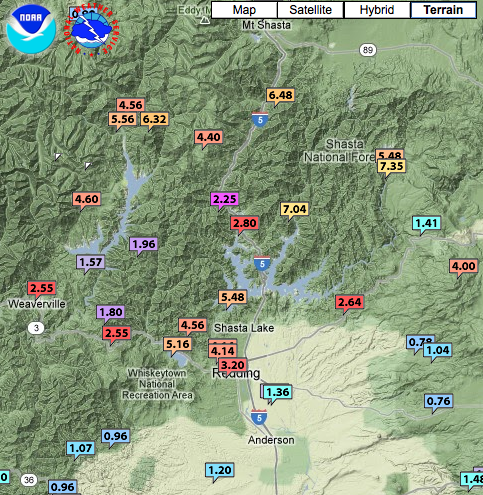
So far, California is on track for an average to under-average rainfall year as of November 21 at 8 AM. But it’s been a great 48 hours in the Shasta region north of Redding where rainfall totals include 6 to 7 inches in some foothill and mountain locations (see map). The great thing about heavy rain here – Shasta reservoir collects the stuff to store and send south when the rest of the state needs it.
Shasta Dam rain went from zero precipitation a month ago to nearly 11 inches total in this water year as of today.Shasta is the headwater for the federal CVP hydraulic empire. The state’s top reservoir is Oroville that went from zero rain Oct 21 to 5 inches today, a nice start.
The state says snow water equivalents today stand at just 66% of normal for this time of year. Sacramento is expecting light rain today but no new storm until November 30.
San Luis Obispo’s County’s hotel business is on the upswing this year with the latest numbers from SmithTravel Research for October continuing strong. Compared to October 2011, hotel occupancy was up 4.8% to 68% and RevPAR was up 9.6% with 7% more rooms sold.
Bed tax numbers from the City of SLO also show revenues for the month of September 2012 are up by 3.7% from the same month last year and up 6.8% year to date. Currently this report covers 38 establishments representing 2127 rooms, including the addition in May of 84 rooms at the Hampton Inn. The number will increase with the October report due to the opening of the 17 room Hotel Granada.
Not as good news from the SLO airport for October with passenger traffic down 6.9% in October compared to the same month a year ago.For the year – traffic is down 3.8%.
The Conoco Phillips,now Phillips 66 refinery in Arroyo Grande is seeking a permit to increase their crude oil production by 10% increasing the daily limit from 44,500 barrels to 48,950. Last Spring, Conoco Phillips spun off Phillips 66 as a separate business traded on the NYSE under ticker symbol PSX. Phillips owns 11 refineries in the US,3 in Europe and 1 in Asia. The county Planning Commission will take up the request December 13.California oil production has been going down about 2% a year but new techniques promise to access deeper reservoirs of oil in the state.
California Polytechnic State University in San Luis Obispo will receive $94,924 from the California Energy Commission to develop a low-cost Nitrous Oxide (NOx) control method. The project will demonstrate a new and potentially low-cost method for reducing NOx emissions from small scale generators and boilers that use biogas.
aquatic weed is choking intake structures on the Friant Kern Canal
Water districts up and down the Central Valley will participate in a massive dewatering of the 152 mile Friant Kern Canal beginning this month to allow for chemical treatment on a 23 mile segment to fight Western watermilfoil, an aquatic weed that can grow 10 ft long that is clogging canals,water meters and micro irrigation sprinklers alike.
“It’s a huge problem” says Scott Edwards of Lindsay Strathmore Irrigation District who says the invasive weed “grows like kelp – forming huge mats of vegetation that are impeding water flow from Orange Cove all the way to Bakersfield.”
To make matters worse – when the canal water – filled with weed fragments – is pumped to irrigation spigots and micro-irrigation emitters, the small weed particles are covering tiny filters that protect the devices. “I’ve got 1000 meters out there in the district that need to be cleaned by hand and in this summer, they needed to be cleaned again a few hours later” adds Edwards.
The aquatic weed was first noticed in the Valley’s most important canal in 1998 near Hwy 180 and since has spread at least 23 miles south,well into Tulare County, says Eric Quinley maintenance manager for the 28 district Friant Kern. How did it get there? One story suggest somebody may have dumped their aquarium in the canal.”Nobody really knows” adds Quinley.
The problems has been getting worse particularly where the canal is earthen instead of concrete, says Quinley, through the Orange Cove and Stone Corral water districts.The earth allows the weed to plant itself and reproduce – to take root although this tough customer can attach itself in any crack in the concrete too.
The upshot is that the capacity of the vital canal that irrigates one million acres is increasingly compromised says Quinley. But it gets worse at the canal turnouts where each district takes water,requiring that maintenance staff clear the intake systems regularly right when water is most needed.
Floating Nightmare
The plant fragments and spreads rapidly in a nightmare scenario, the fragments grow roots,stems and leaves as they float along on the current.So the water carries the debris of this invasion with it – creating havoc wherever it flows. And it will be back next year – the plant is perennial.
“This plant poses a problem from the district all the way to the end user – the grower in the field” notes Quinley. In recent years growers have dramatically cut back on water use adopting micro irrigation technology that is now vulnerable to clogging from the plant’s voracious growth.
The Delano area on the canal route was hit hard this summer as this communication to growers explains.
”While it has had a presence in the Friant Kern canal for a number of years, 2012 was the first year that it became a major problem for Delano Earlimart ID. Milfoil has caused a number of operational problems for the District and its growers alike, from plugging pump intakes to clogging filter screens and emitters. The problem became so acute that at one point in August, the entire District shut down for a short period of time when milfoil completely clogged the trash screens within the Friant Kern, preventing water from entering the District’s mainlines. The milfoil has be-come so invasive and present in such massive quantities within the Friant Kern that it has taken the combined efforts” to tackle the problem.
The newsletter explains their staff is required to” keep the district’s intakes clean, requiring milfoil removal by hand twice a day, seven days a week just to keep water flowing …”
Quinley,who is in charge of doing battle with this dragon-like pest, doesn’t have a sword to slay the monster but does have a budget and a plan. So far, the Friant Water Authority has had to budget more than $1 million to handle this weed invasion but has high hopes this winter’s pre-emergent application will make headway in reducing the scale of the problems.
With work underway this month to begin the dewatering of the entire 152 mile canal for a 3 month period there are operational issues that must be tackled including the fact that municipal and ag contractors along the route will not have access to any water from the canal until March1, sooner if it can be managed.
A Drinking Problem
That‘s a problem in Orange Cove where 12,000 customers depend on the water for drinking along with irrigation customers who often don’t have much groundwater.
In Orange Cove the city council has had to spend $750,000 for a temporary supply of well water brought into the city. Improvements are required to convey the well water purchased from land owners through the Orange Cove irrigation District to the City water treatment system.Treatment is necessary due to the high level of nitrates found in the well water says a city staff report.
Canal water is used for drinking in Lindsay,Strathmore and Terra Bella too,all places with little groundwater and high nitrates too.
Lindsay Strathmore ID has municipal customers and supplies them from an alternative well source on the Kaweah River, not high in nitrates.
Quinley says in the past, the district has tried to remove the fast growing plant that grows underwater by hand,using mechanical devices and even treating small areas with chemicals but all attempts have fallen well short.
Now with the consultation of USDA and UC Davis the Friant district will go to war with the weed using several pre-emergent chemicals after the canal is dewatered and the silt is removed. The treatment with the chemicals should kill the emerging plant chutes next spring, everyone hopes.
To insure the chemicals applied do not hurt drinking water, Friant has been working with the state Dept of Public Health,Dept of Pesticide Regulation and the manufacturers to insure no harmful residues remain once the trillions of gallons of water refills the canal in March.The two chemicals- fluridone and imazamox are certified by EPA for use to treat drinking water. Of course the water will be tested before it enters the muni systems next spring.
A Choke Hold
Despite their best efforts this water loving weed like most weeds “may be with us forever” shrugs Edwards.
Farmers may not be big global warming believers but they do believe they that got a plant that was not here a few years ago with choke hold on their hydraulic empire that seems to like the heat.The NWS says we had 23 days of 100F or over in August in the Valley and across the US, September was the 16th straight month of higher than average temps in a row.
The consequence: farmers will have to do battle with this green monster from now on.
The discovery of a second find of a single Asian citrus psyllid in a Tulare County citrus grove insect trap near Strathmore is expected to spur CDFA and USDA to establish a 20 mile quarantine on any citrus plant material movement soon. So says Tulare County Agricultural Commissioner Marilyn Kinoshita who expects a formal announcement by CDFA tomorrow, November 20 after she was briefed today.
Kinoshita says this latest pest find dates from October but several tests were needed on the insect by USDA labs resulting in the announcement this weekend, weeks later, of the find by Kinoshita’s office.
“Since it’s the second find this year it looks CDFA will recommend to USDA the 20 mile quarantine zone be established.”
Kinoshita says a map of the zone will be made available on the ag commissioner’s web site but its rough boundaries would go from Woodlake, south to Ducor and the City of Tulare on the west, a large swath of Tulare County’s big citrus growing region along the eastern foothills.
The dreaded pest can carry citrus greening disease that has devastated other citrus growing regions in the world including Florida in the US. The disease kills the trees after just a few years of being infected by the bacteria even as it stunts growth and production (see pic).
citrus tree with greening disease
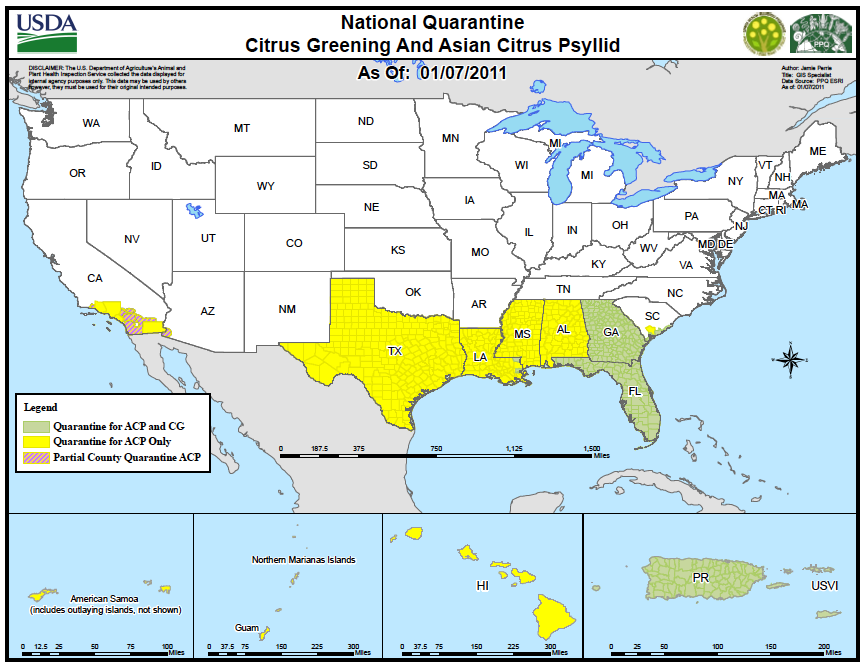
Kinsoshita says USDA will be testing trees near the find to see if they show any signs of the disease although there is a year long period before symptoms are seen. So far the tiny pest has been found in southern California as far north as Ventura County but not the dreaded disease. The first find of the insect in California came in 2008
The first find of a phyllid in Tulare County came in February 2012 and was found east of Lindsay. After the find, a dense quantity of pest traps were set up in citrus groves to determine if the insect was an isolated ”hitchhiker” from southern California or if the find signaled a potential infestation.
This time around CDFA seem to be worried about an infestation.
The citrus industry is the county’s number two crop after milk,valued at over $600 million annually with about 120,000 acres of citrus trees vulnerable to the voracious pest.
Kinsoshita says impact of the quarantine will hit growers who will now have to run all citrus fruit on rollers to remove any leaves or debris,nurseries who will face restrictions on plant movement unless the nursery trees are being grown under a screen and juice plants who will have to take extra precaution when they bring fruit in and out of the quarantine zone.
current quarantine area in US
Kinoshita also says a citrus grower meeting to discuss the new quarantine zone will be held November 27 at a location to be announced.
Just what if any – impact on citrus exports to foreign countries will be remains to be seen depending on what those governments want to do.
One thing for certain.”Famers lives just got more complicated ”adds Kinoshita.
The University of California Agriculture and Natural Resources will soon be hiring a UC Cooperative Extension term area advisor specializing in table grapes in Tulare, Kern and Kings counties. Thanks to an $840,000 gift from the California Table Grape Commission, the advisor position will be funded for six years by the $1.4 billion annual table grape industry.
“The UC Cooperative Extension farm advisor system is an integral part of the growth story of the table grape industry in California,” said Kathleen Nave, president of the California Table Grape Commission. “Continuing that growth is critical to the industry but also to the rural communities in which table grapes are grown. With this gift, the University will be able to expand its ability to help growers cope with challenges such as pests, diseases, water quality and quantity, and a host of known and unknown issues that could negatively impact the industry’s ability to compete in a worldwide marketplace.”
The California Table Grape Commission-funded position will be headquartered in Tulare. UC ANR will also be hiring a UC Cooperative Extension area viticulture advisor who will be based in Kern County.
“This generous gift by the California Table Grape Commission will enable UC ANR to begin recruitment immediately,” said Barbara Allen-Diaz, University of California vice president for Agriculture and Natural Resources. “As state funding has dramatically decreased in recent years, private-sector support is becoming a critical component of funding important positions essential to the long-term health of agriculture throughout California.”
This new funding model will enable UC ANR to hire outstanding academics to continue to conduct research and deliver new knowledge that is critical to the sustainability of farmers and to California’s future.
Mortgage Rates Dip To New Record Lows
MCLEAN, Va., Nov. 15, 2012 Freddie Mac released the results of its latest survey, showing fixed mortgage rates dipping to new all-time record lows amid indicators of higher consumer confidence and lower wholesale prices. The previous record low for the 30-year fixed was set the week of October 4, when it averaged 3.36 percent, and the 15-year fixed was set the week of October 18, when it averaged 2.66 percent.
30-year fixed-rate mortgage (FRM) averaged 3.34 percent with an average 0.7 point for the week ending November 15, 2012, down from last week when it averaged 3.40 percent. Last year at this time, the 30-year FRM averaged 4.00 percent.
15-year FRM this week averaged 2.65 percent with an average 0.7 point, down from last week when it averaged 2.69 percent. A year ago at this time, the 15-year FRM averaged 3.31 percent.
5-year Treasury-indexed hybrid adjustable-rate mortgage (ARM) averaged 2.74 percent this week with an average 0.6 point, up from last week when it averaged 2.73 percent. A year ago, the 5-year ARM averaged 2.97 percent.
1-year Treasury-indexed ARM averaged 2.55 percent this week with an average 0.3 point, down from last week when it averaged 2.59 percent. At this time last year, the 1-year ARM averaged 2.98 percent.
Bankrate 1 year mortgage rates
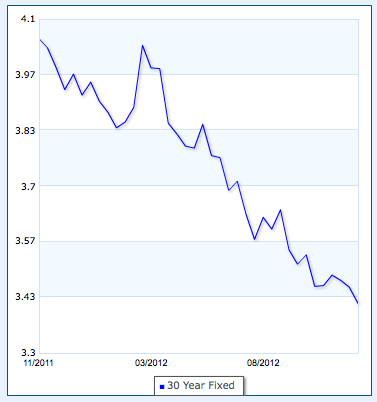
The average single family home mortgage rate is down from 4% a year ago to 3.41% (compared to 3.34% in Freddie Mac survey) this week says Bankrate (see chart).
October Home Sales In S2S Region
California’s central region saw an increase in median prices from year ago in October and sales volume was mixed according to DQ News.
In San Luis Obispo County sales of resale homes were up 23% year over year and the median price increased 5.6%. Santa Barbara County showed an even more remarkable turnaround with sales up 17.6% and the median up 42%. SLO County showed a recovery in the condo market with sales up 34.5% and a 50% jump in median prices to $300,000 from $200,000 in October 2011.
In the Valley, Fresno saw a sales increase of 12.5% and median was up 3.9%. In Tulare County sales were down 4.9% and the median was up 14.4% to $133,000.
Tenant improvements for the new San Luis Obispo Chamber Of Commerce office at 895 Monterey St Downtown are underway this month.
Early next year, the Chamber will move from its current location at the corner of Chorro and Higuera street. Permits for $157,000 in tenant improvements were issued this month to be carried out by contractor Maino Construction. It is the first move by the group in over 4 decades.
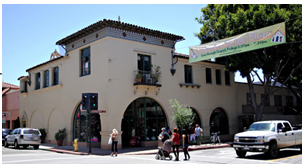
The Chamber’s newsletter says the move to to 895 Monterey St., on the corner of Monterey and Morro streets, will be in the historic Paiarola building, which formerly housed Ann’s Clothing store and Luna Rustica.
The newsletter says the following about the plans.
Triggered by a seismic retrofit scheduled for the Chorro Street location in 2013, the Chamber Board of Directors initiated a process last year to analyze the needs and priorities of the Chamber’s administrative offices and Visitors Center.
“The seismic retrofit prompted us to look at how we could improve visibility for the Visitors Center to benefit the tourism industry and at the same time see whether we could improve the accessibility and efficiency of our administrative offices,” said Russ Levanway, Chamber Board Chair and CEO of TekTegrity. “We are confident that we have found a new location that meets all of the goals set by the Board and will provide the Chamber with all the best of our existing space with some much-needed improvements.”
Levanway said the new space, which will be fully accessible, will provide for greater visibility of the Visitors Center to benefit members and tourists, as well as provide a larger meeting room for Chamber members. “The location in the downtown core maintains the Chamber presence close to the Mission and city and county government offices,’’ Levanway said.
Commissioned in 1932 by Caterina Paiarola, the grandmother of current owner Howard Carroll, the building was built by Maino Construction. It is one of the first reinforced concrete structures in downtown and was built in a Mediterranean-style with expansive arches that border the streets.
“The new location in the Paiarola building represents the Chamber’s ongoing support for the revitalization of our downtown and a commitment to the future vitality of the city’s core,” said Chamber Board member and facilities task force member Pierre Rademaker of Pierre Rademaker Design.
The Chamber Board voted unanimously to make a permanent move following an analysis by a special facilities task force, which looked at several options, including keeping the Visitors Center at its current space and moving the administrative offices out of the downtown core.
“We found a space that seemed to be the perfect fit,” said Clint Pearce, president of Madonna Enterprises and facilities task force member. “The space is the right size and has the features that will help the Chamber fulfill its mission and strategic initiatives. The task force and board were unanimous that the Monterey Street space will be the best long-term home for the Chamber, and we can hardly wait to see it finished.”
“Our current location and landlord have served us well for over four decades,” said Chamber President and CEO Ermina Karim. “Now, given the availability of 895 Monterey, we have the opportunity to serve visitors better, as well as to provide more services to our members. We look forward to creating new memories, build on our brand and, most importantly, enhance service for our members and visitors.”
Sacramento Superior Court Judge Tomothy Frawley denied a request for a preliminary injunction to halt work on construction of the Central Valley segment of the high speed rail line late today says a source answering the phone at Judge Frawley’s courtroom. The injunction sought by plaintiffs,including farm groups,would have prevented the rail authority from buying land along the proposed route and other work needed to move the huge project forward. The ruling is a key victory for the builders of the project.
“We welcome the Court’s ruling,” said Dan Richard, Chair of the California High-Speed Rail Authority Board of Directors. “Both the voters and the Legislature have spoken on High-Speed Rail. And since the Governor signed the bill modernizing the state’s transit system in July, we’ve made significant progress on many aspects of the program. The Judge’s decision ensures that we can continue to move forward with our preparatory work to build the first segment of high-speed rail in the Central Valley, with a plan to break ground next summer.”
SANTA MONICA, Calif., Nov. 15, 2012 /PRNewswire via COMTEX/ — In a letter today, Consumer Watchdog called on California State Attorney General Kamala Harris to launch a criminal investigation into the conduct of oil companies in the state based on new information that oil refiners were running refineries and building inventories even when they said that they were performing maintenance.
Research done by McCullough Research released at a Sacramento hearing this week suggests refiners used their dominant market power to raise prices in October when gas prices in California spiked 50 cents even as their inventory of gasoline built up (see chart). The refiners claimed prices spiked because of refinery outages. ” In May 2012, seven companies made 94% of all sales. The seven companies are all vertically integrated with both retail sales and refinery operations” says a paper released.Based on the research,Consumer Wathdog filed the complaint with the Attorney General.
inventory of gasoline spikes even as price spikes.Where’s the shortage”?
The full letter follows below.
“It appears that California’s oil refineries falsified public information to drive up the price of gasoline, an allegation that, if true, is criminal conduct and reminiscent of the Enron-like manipulation of the California energy market,” Consumer Watchdog’s president Jamie Court and Energy Project Director Liza Tucker wrote to Attorney General Harris. “This unprecedented information demands a criminal investigation.”
Consumer Watchdog reiterated its call for the AG to block the merger of Tesoro and BP, pointing out that if Tesoro takes over BP’s refinery in Carson, that will leave two companies-Tesoro and Chevron-controlling 54 percent of California’s already overly concentrated gasoline market and exacting a heavy price from consumers.
“Information we learned today only reinforces our call for blocking the merger. McCullough Research reports today that refineries in the state were making gasoline while telling the public that they weren’t because of outages or maintenance. McCullough Research analyzed thousands of pages of documents and discovered refineries were operating during supposed outages and maintenance shutdowns.
“McCullough says that in May, when Royal Dutch Shell’s Martinez plant was supposedly down for two weeks for maintenance, it was making gasoline at least half the time. State air monitors showed nitrogen oxide emissions associated with making gasoline returned to normal at that location a whole week before the refinery reported coming back on line.
“At Chevron’s Richmond refinery, emissions reports suggest that the refinery never shut down, though it reported being down for two weeks in May. Supplies were actually growing in May when consumers here paid at least 50 cents more per gallon than the national average, the group said. October’s huge price hike that pushed gasoline up 50 cents a gallon in the space of a week was partly blamed on Chevron’s Richmond fire in August. But McCullough says that Chevron’s supplies at the time were only growing.
“When the state only has ten to thirteen days of gasoline supply on hand, misinformation about a week’s worth of gasoline can cost the consumer $1 per gallon or more at the pump. False information can set the commodities markets on fire. Oil companies know this well and their profits are dependent on misaligned expectation in the commodities market. We urge you take action immediately to prevent California consumers from being gouged by the same type of artificial manipulation of the energy markets that occurred during electricity deregulation.”
Consumer Watchdog is a nonprofit, nonpartisan consumer advocacy organization with offices in Santa Monica, CA and Washington, DC. Find us online at www.consumerwatchdog.org .