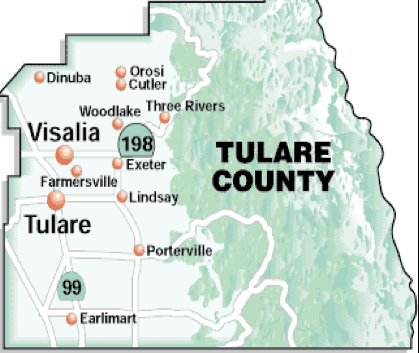
Former city manager Darrel Pyle snagged a job in Coalinga after leaving Tulare in 2010 but now has been hired to run the city in Hanford,a little closer to his Visalia home. So the big news in Hanford is that the city is going to get a Costco. ”We expect them to be open by spring 2014” figures Plye, noting the EIR on the shopping center at Hwys 198 and 43 will take a year to complete. Pyle says another biggie for Hanford is the proposed route and station site for high speed rail.”I got a call from the head of the California High Speed Rail Authority and he told me the train is going to come,either to the east of Hanford or to the west.” Pyle adds “entrepreneurs are already out there making property acquisitions” and that he suspects the CHSRA will select the eastside alignment. That would put the station about a mile from the new Costco.
Adohr Cow Statue -the Adohr Milkmaid and Cow was a series of statues commissioned to advertise Adohr Farms Creameries. Tulare’s located on the grounds of Morningstar Foods, is the only remaining sculpture of its kind in the United States.
Saputo Inc. announced this week that it has signed a definitive agreement to acquire Morningstar Foods, a subsidiary of Dean Foods Company. The acquisition includes the Tulare plant. Canada-based Saputo already has three plants in Tulare. Morningstar produces a variety of dairy and non-dairy extended shelf-life products, including creams and creamers, ice cream mixes, whipping cream, aerosol whipped toppings, iced coffee, half and half, value-added milks, as well as cultured products such as sour cream and cottage cheese. Saputo purchased the company for $1.45 billion. Morningstar has ten plants and some 2000 employees.The deal is set to close this month. Sources says they believe the Tulare operation will be unaffected.
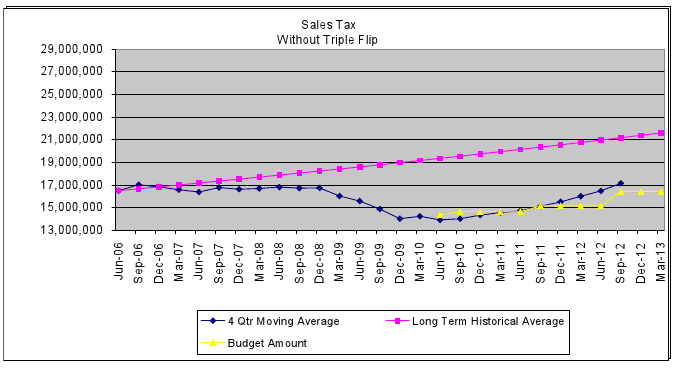
When it comes to the fiscal health of the City of Visalia the major issue is the local economy mayor Amy Shuklian reported in the State of The City presentation this fall. ”The major issue facing Visalia is the general economic contraction. To put into context the severity of the recession, consider that in the past 30 years, sales tax has not had a major decline until 2008.” But in the past several years ” this decline is dramatic and severe. Economic activity dropped, unemployment went to double digits and businesses retrenched.” Shuklian summed up.
Now comes the latest sale tax revenue number that for the first time in four years – offers what looks very much like a rebound.
City finance chief Eric Frost says based on the most recent quarter cash receipts for the April/May/June quarter, the city received $4.9 million. That compares to $4.2 million for the same quarter in 2012, $3.8m for the same time period in 2011, $3.75m in 2010 and $4.46m for the quarter in 2009, just as the recession was kicking in.
If the latest quarter is a sign of an upward trend, the city will average $5 million a quarter that would add up to $20 million a year. The interesting part is that our frugal and conservative city has budgeted about $16.4 million for this fiscal year that runs July to June says Frost.
“This latest $4.9 million quarter is the largest on record” adds Frost.
Is Frost celebrating? Not yet, but he is dusting off the party favors.
“I will be able to tell you a lot more after our next report comes at the end of December” says Frost, for the period July through September. ”As you can see we have had some nice increases lately which hit or may exceed our budgeted sales tax. All good news compared to what we have had for the last 4 years.”
Council member Warren Gubler who opposed a plan to raise the sales tax percentage in Visalia this summer, a decision put on hold, says the latest numbers ” sound like at least we are heading in a promising trend.” Gubler, who when we talked, says he just returned from an upbeat Downtown realtor’s conference and saw a record crowd a few days ago at the Christmas parade. ”I think people seem more positive and ready to open their wallets for the Holidays” suggests Gubler.
“Mooney’s on the Move” adds the State of The City report pointing to the big shopping strips new players. And car sales are up as well.
Visalia’s general fund gets money from sales tax and property tax that is also finally heading higher.The median price of a home in town is up about $25,000 since April says real estate website Trulia. However, ”there is long lag-time on property tax revenues” says Frost. In 2010- the city budgeted $18 million from property taxes and for 2012-13 the budget is anticipating $18.4 million.
One more related issue – the big pharmaceutical distributor VWR, now open in Visalia ,was the Bay Area City of Brisbane’s largest sales tax generator but has indicated to the City of Visalia it would not report sales from here even though this is now their West Coast headquarters. Using our town as their point of sale would give Visalia a big boost. How about it guys – since we were dragged into your union dispute and had to defend in court!
Statewide, sales tax collections are also improving. The State Board of Equalization collected $1.86 billion in general fund sales and use tax revenue in October, surpassing the state’s $1.74 billion budget estimate.
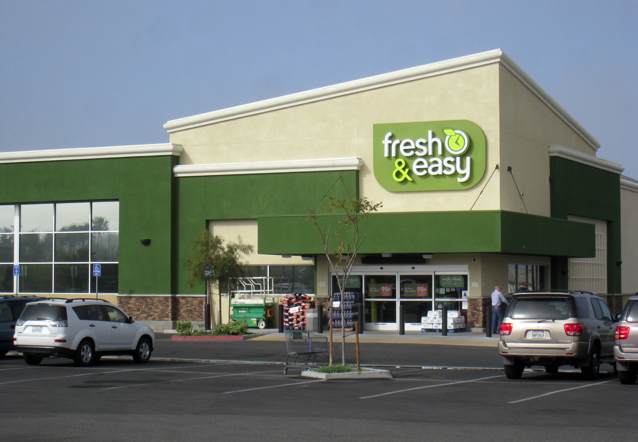
Decision taken to conduct strategic review of Fresh & Easy; all options under consideration; Tim Mason, CEO of Fresh & Easy, to leave Tesco
British grocer Tesco announced this week that they would put the US market chain up for sale after several years of struggling to turn profit.
The small format stores compared to Trader Joe’s by some, never garnered a strong following.
The company has 199 stores in the US including several in the Central California region in the S2S reading area. They include one in Santa Mara, one in San Luis Obispo and in the Valley, six locations in Fresno County, one in Lemoore in Kings County, and six locations in Kern County. Stores had been announced in Tulare and Visalia but never seemed to happen.
The company made this announcement.
“In October, we announced that new capital investment in Fresh & Easy was to be tightly constrained whilst the business focused on reducing costs and improving the profitability of its existing stores.
It is now clear that Fresh & Easy will not deliver acceptable shareholder returns on an appropriate timeframe in its current form.
We have therefore appointed Greenhill to assist with the review of options. In recent months, we have had a number of approaches from parties interested in acquiring either all or part of Fresh & Easy, or in partnering with us to develop the Fresh & Easy business. We will communicate progress on this process when we present our full year results for the current financial year in April 2013.
We are also announcing that Tim Mason is to leave Tesco after 30 years’ service with the company.”
Philip Clarke, Chief Executive said:
“I have been clear since my appointment as CEO was announced that my role is to deliver long-term value for shareholders. Following a year in which my priority for Fresh & Easy was to improve its performance, I have now made a fully-informed assessment of its longer term potential.
“Whilst the business has many positives, its journey to scale and acceptable returns will take too long relative to other opportunities. I have therefore decided to conduct a strategic review of Fresh & Easy, with all options under consideration.
“Tim Mason, who leaves Tesco today, has played an important part in our success over a 30 year career with the company, and he leaves with my thanks and good wishes.”
atmospheric river of moisture streams into California
Just days after a soaking winter storm hit the state NOAA announced that its scientists and colleagues are installing the first of four long-term “atmospheric river observatories” in coastal California this month to better monitor and predict the impacts of landfalling atmospheric rivers. These powerful winter systems, sometimes called “pineapple express” storms, can be beneficial, in that they help to fill the state’s reservoirs, but they can also cause destructive floods and debris flows.
The coastal observatories, which are arrays of custom instruments, are being installed in
collaboration with the California Department of Water Resources and Scripps Institution of
Oceanography, University of California San Diego. The observatories will give weather
forecasters, emergency managers and water resource experts detailed information about
incoming storms such as winds and water content.
“California needs to know how and where it might rain or snow, when and where to
expect flooding,” said Michael Anderson, Ph.D., state climatologist with the California
Department of Water Resources. “The observatories will also help state officials and scientists
monitor changes in atmospheric rivers associated with climate change.”
This month’s installation of an atmospheric river observatory in Bodega Bay, Calif., will
be followed by installations at Eureka, Point Sur and Goleta. The move to set up the four
observatories and other weather instruments throughout the state came after NOAA
researchers and academic scientists spent several winters testing and selecting the most
effective arrays of instruments for collecting useful information for decision makers. Installation
of all four observatories is expected to be completed by early 2014.
“With satellites, we can see the tell-tale water vapor signature of an incoming
atmospheric river over the ocean. However, NOAA’s offshore observing systems do not
measure another key factor—strong low-altitude winds,” said Martin Ralph, Ph.D., a research
meteorologist and branch chief in NOAA’s Earth System Research Laboratory in Boulder, Colo.
“With our new sensors, we’ll be able to measure those winds and more, to understand just how
much moisture is moving in, which largely controls how extreme the precipitation inland will
become. This information will ensure that meteorologists and emergency managers have
additional information to keep the public informed about these potentially destructive storms.”
One storm event doesn’t make a water year….or does it?
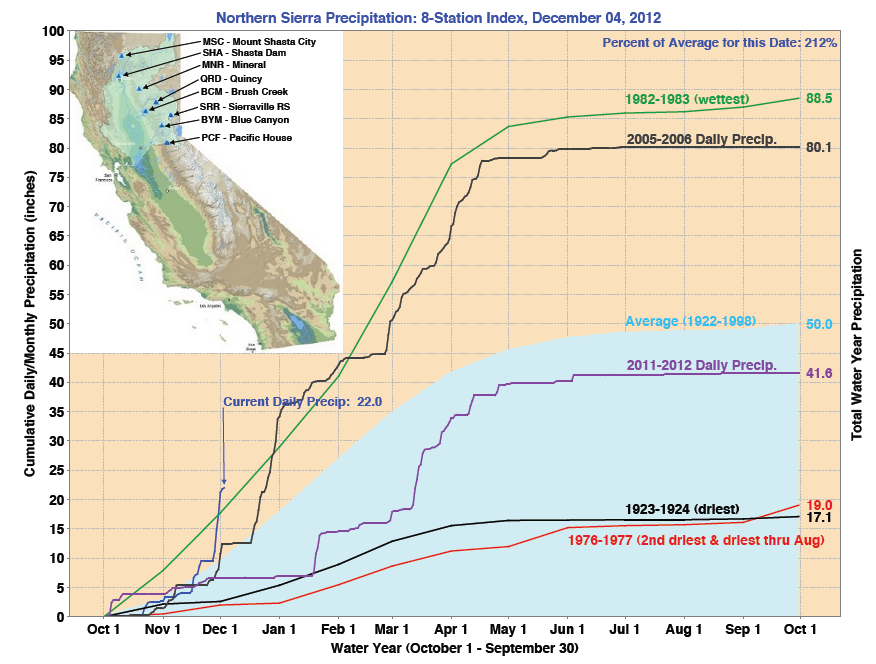
Several California Dept Of Water Resources indexes published this week after a 5 day sequence of storms pounded northern California showed these storms had consequences. A jump in the Northern Sierra Precipitation Index of 8 stations shows rainfall so far this water year is now ahead of the 1982-83 year – the wettest on record.The index which sat at only 5 inches of rain as of late November jumped to 22 inches as of December 3.The index includes Shasta dam that saw 15 inches of rain.
Index sits at 212% of normal
The index is 212% of average for this date for the water year that runs Oct 1 thru Sept 30,2013.
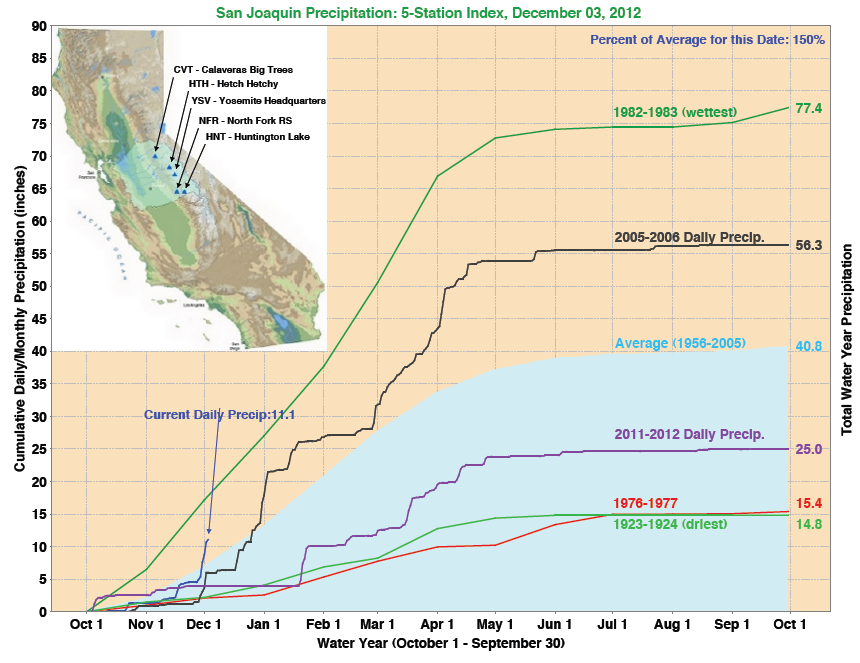
Further south, the 6 station San Joaquin Valley index which includes Huntington Lake on the San Joaquin River, now sits at 150% of normal for this date after a pulse of 6 inches blew into the central Sierra from the 5 day event. This index is also ahead of the 82-83 year.
All in all – a nice start for year where expected rainfall was anyone’s guess.
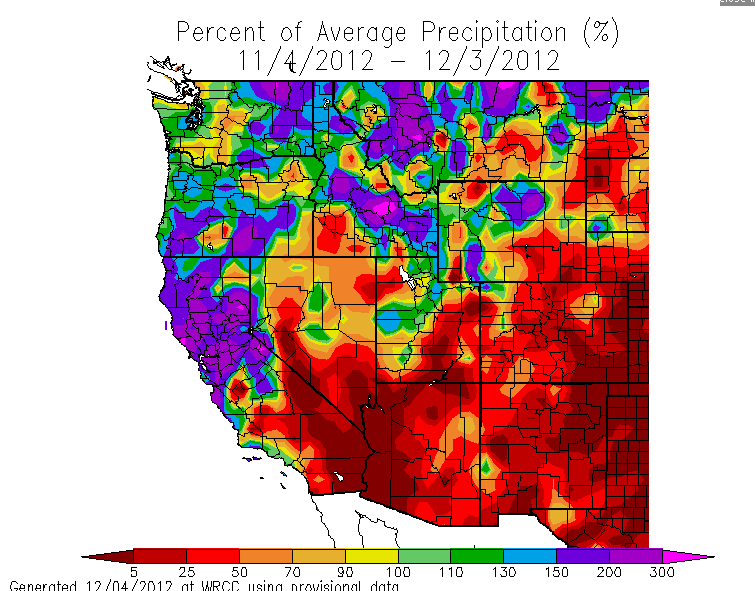
Wet California from Tulare County north Click to enlarge
The Assoc of California Water Agencies website posted a story this week as follows:
The rains that have pounded parts of California in recent days have boosted water levels in state reservoirs, raising water storage in Oroville Reservoir—the State Water Project’s primary reservoir – by more than 300,000 acre feet, according to a statement released Dec. 3 by the State Water Contractors.
“This weekend’s storms gave a needed boost to California’s water conditions – storage is up in key reservoirs, which will help us get through potential dry spells in 2013,” Terry Erlewine, general manager of the State Water Contractors, said in a statement. “We are by no means out of the woods, but the hope is that we will get enough precipitation throughout the winter to bring State Water Project allocations up to a reasonable amount.”
Last week, the California Department of Water Resources announced that the initial allocation for State Water Project supplies is 30%. Initial allocation estimates are typically conservative and state officials expect the allocation to increase as the winter season progresses. In 2012, State Water Project contractors received 65% of their contracted amount of water.
Water data compiled by DWR and listed here reveal higher than average water storage levels in reservoirs across the state. Reservoirs have shown large increases in storage in recent days due to the series of storms. For instance, Folsom reservoir has increased by more than 100,000 acre feet from Nov. 29 to midnight Dec. 2. It is at 50% of capacity and 104% of its average capacity, according to DWR data available at the California Data Exchange.
SAN FRANCISCO, December 4, 2012 – Trulia today released the latest findings from the Trulia Price Monitor and the Trulia Rent Monitor, the earliest leading indicators available of trends in home prices and rents. Based on the for-sale homes and rentals listed on Trulia, these monitors take into account changes in the mix of listed homes and reflect trends in prices and rents for similar homes in similar neighborhoods through November 30, 2012.
Asking Prices Up 3.8 Percent Year-over-Year Nationally In November, asking home prices rose 0.8 percent month-over-month (M-o-M), seasonally adjusted–which implies an annualized growth rate of 10 percent. Year-over-year (Y-o-Y) prices increased 3.8 percent, which was also the largest yearly increase to date. Quarter-over-quarter (Q-o-Q) prices rose 2.2 percent, seasonally adjusted, another post-crisis high; in fact, prices rose 0.8 percent Q-o-Q without adjusting for seasonality, even though prices typically decline after summer.
Home Prices in Hard-Hit Atlanta, Sacramento, and the Inland Empire Now Bouncing Back For the first time since the housing crisis began, Atlanta and two inland California metros—Riverside-San Bernardino and Sacramento—all experienced significantly large Q-o-Q asking home price gains. Unlike other hard-hit metros such as Phoenix, Las Vegas, and Miami, prices in these metros have been slower to bounce back, declining in February and making smaller gains in August and May.
Other metros experiencing large quarterly increases in November include Salt Lake City and Wilmington, DE, both of which surpassed 7 percent, along with, Cape Coral – Fort Myers, FL, San Jose, Portland, OR, and Denver.
Rents Rose 5.6 Percent Year-over-Year, But Prices Catching Up in Largest Markets
Nationally, rents rose 5.6 percent Y-o-Y, outpacing the national price gain of 3.8 percent. However, asking prices in 14 of the 25 largest rental markets actually rose faster than rents as the price recovery picks up. In fact, prices have zoomed ahead of fast-rising rents in Denver, Seattle, and San Francisco, which rank among the top 10 metros where rents rose most in November.
USDA and Tulare County are announcing a scaled back version of a proposed 20 mile quarantine after three recent finds of an Asian Citrus Psyllid in traps in Tulare County’s orange belt production area.
Dept. Ag commissioner Gavin Iacone says the new restrictions will go into effect soon to limit the movement of citrus plant material to a five mile radius of the finds. One zone is near Strathmore ( where there were two finds) that would take in the Lindsay/Strathmore packing houses and the other find – near Terra Bella – would cover packing houses in the Ducor /Terra Bella area.
The finds last month of the feared pest pushed ag authorities to consider a larger 20 mile quarantine that would have covered much of the citrus belt in the county except for the northern area – Woodlake to Dinuba
The restrictions would not hinder the movement of fruit itself but packinghouses and nurseries will have to ensure no plant material, leaves for example, left the zone.
Growers will have to roll their fruit within the zones to remove leaves and nurseries could ship only trees that have been grown under screen. A number of the nurseries in the Exeter area will be spared as well the big Tipton juice plant and the Ventura Coastal plant north of Visalia.
“We consider the plan to be more restrictive than the 20 mile plan” says Iacone,rather than moving plant around within a larger area. No finding of the disease called citrus greening or HLB carried by the pest has been found in the county. The pests have been spreading from Mexico north and now southern California all the way now into Santa Barbara county with a find recently near Santa Maria.But there has bern only one find of the disease in a tree in backyard inLA.
Florida has been particularly hard hit by the citrus pest and citrus greening disease that has cost them an estimated $3.6 billion and the loss of 6600 jobs according to the University Of Florida study. First detected in Florida in 2005 grower costs are as much as 40% higher with the disease that kills the trees within five years
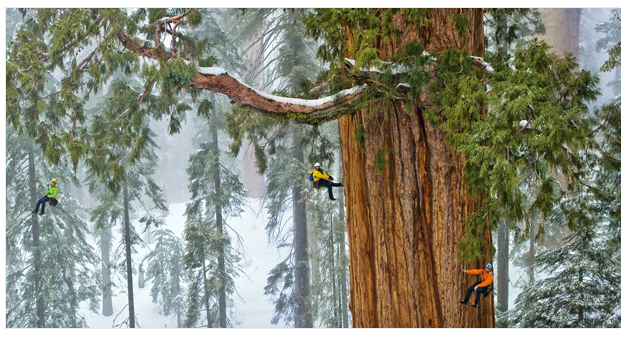
Climbing a sequoia from National Geographic story.Photo by Michael Nichols
The latest issue of the National Geographic Magazine (December) features a cover story on climbing Sequoia National Park’s Big Trees to study and measure them. One recent study led by researcher Steve Sillett reports that a new measure finds the 3200 year old President Tree is ranked number 2 largest sequoia behind the Sherman Tree. Both these trees are within walking distance to each other in Giant Forest. The new measurement moves the Grant Tree in Kings Canyon to number 3.
The article’s author David Quammen sums up the piece.” A tree-climbing scientist and his team have learned surprising new facts about giant sequoias by measuring them inch by inch.”
Quammen points to the longevity of these trees noting that man has made his mark, at first in a negative way. “Another factor that can end the lives of big trees, of course, is logging. Many giant sequoias fell to the ax during the late 19th and early 20th centuries. But the wood of the old giants was so brittle that trunks often shattered when they hit the ground, and what remained had little value as lumber. It went into shingles, fence posts, grape stakes, and other scrappy products. Given the difficulties of dealing with logs 20 feet thick, broken or unbroken, the trees were hardly worth cutting. Sequoia National Park was established in 1890, and automobile tourism soon showed that giant sequoias were worth more alive.”
The photos in the article are done by Michael Nichols.
What has been describes as a mammoth winter storm fed by a river of atmospheric moisture served up several doses of a tropical deluge into Northern and Central California from November 27 to December 2. From a line north of Modesto in the Valley and SLO on the Coast – precipitation totals were impressive particularly in foothill and mountain areas.
South of that line it was more spotty with Valley floor cities like Visalia and Fresno receiving around an inch.
Hardest hit was Northern California where the state’s extensive hydraulic system originates and flows south to supply 23 million people,billions of dollars worth of farms and a thirsty ecosystem.
The headwater of this Central Valley Project is at Shasta reservoir that received nearly 15 inches of rain from December 27 through December 2. Mt Shasta snowfall may have set a record ( the numbers are not in yet). All this will flow south to supply next summer’s irrigation,drinking and habitat water.
The NWS Hanford says the 3-day rainfall totals through Dec 2 for Friant Dam reached 1.80 in,nearly 6 in at Mariposa, 5.4 in at North Fork, 3.62 in at Trimmer near Pine Flat, 8.6 in at Wawona in Yosemite, 6.7 in at Kaiser Point above Huntington,5.3 in at Tamarack and 3.68 in at Huntington Lake.
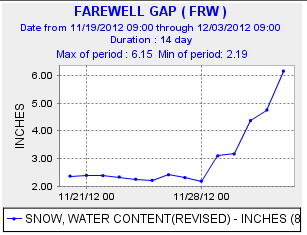
On the Kaweah, 3.37in were received at Lake Kaweah, Hockett Meadow got 3.50 in and a five day total at Farewell Gap shows 4 in of water content. South of there. it was very light with a 3-day total at Quaking Aspen shows they got just 0.17
On the Coast the Santa Lucia mountain range was in the eye of the storm receiving 21 in of rain at the 4600 ft level above Big Sur. SLO forecaster John Lindsey reports today on five-day totals for Wednesday through Sunday of 3.37 inches in San Luis Obispo, 8.54 in at a very wet Rocky Butte and 3.68 in at Santa Margarita. Morro Bay got 1.22 in and Los Osos 1.5 in.
Forecaster Alan Fox who predicted these big storms, says despite a drying off period and smaller rain events in the next few days the storm doors are wide open in California and look for another round of wet weather from around December 17 through Christmas. Fox says California will experience a wet winter through most of the state. In an August 2012 Citrograph article, Fox predicted December and January would be rainy.
If it was rainy it was a warm rain and snow did not fall below 8000 ft in many locations over this weekend. Ski resort China Peak,above Fresno is not open Dec 3 despite getting ” 2 to 3 feet” at their higher elevations because of a lack of snow at their base.
Fresno broke a record December 1 when the minimum temp recorded was 56 degrees that night says NWS.