California’s unemployment rate decreased to 9.8 percent in November, and nonfarm payroll jobs decreased by 3,800 during the month for a total gain of 564,100 jobs since the recovery began in February 2010, according to data released today by the California Employment Development Department (EDD) from two separate surveys.
The U.S. unemployment rate decreased in November to 7.7 percent.
In October, the state’s unemployment rate was 10.1 percent, and in November 2011, the unemployment rate was 11.3 percent. The unemployment rate is derived from a federal survey of 5,500 California households.
Nonfarm jobs in California totaled 14,406,400 in November, a decrease of 3,800 jobs over the month, according to a survey of businesses that is larger and less variable statistically. The survey of 42,000 California businesses measures jobs in the economy. The year-over-year change (November 2011 to November 2012) shows an increase of 268,600 jobs (up 1.9 percent).
EMPLOYMENT AND UNEMPLOYMENT IN CALIFORNIA
The federal survey of households, done with a smaller sample than the survey of employers, shows an increase in the number of employed people. It estimates the number of Californians holding jobs in November was 16,589,000, an increase of 78,000 from October, and up 223,000 from the employment total in November of last
SLO & Valley Counties
The unemployment rate in the San Luis Obispo County was 7.3 percent in November 2012, unchanged from a revised 7.3 percent in October 2012, and below the year-ago estimate of 8.6 percent.
The unemployment rate in the Tulare County was 14.5 percent in November 2012, up from a revised 14.4
percent in October 2012, and below the year-ago estimate of 15.4 percent.
The unemployment rate in the Fresno County was 14.4 percent in November 2012, up from a
revised 13.8 percent in October 2012, and below the year-ago estimate of 15.8 percent. This
compares with an unadjusted unemployment rate of 9.6 percent for California and 7.4 percent
for the nation during the same period.
Between October 2012 and November 2012, total wage and salary employment in Fresno decreased by 5,900 jobs (down 1.8 percent) to total 328,200. Farm employment dropped by 5,700 jobs (down 12.6 percent) and nonfarm employment declined by 200 jobs (down 0.1 percent).
• Farm employment posted the largest month-over decline by a drop of 5,700.
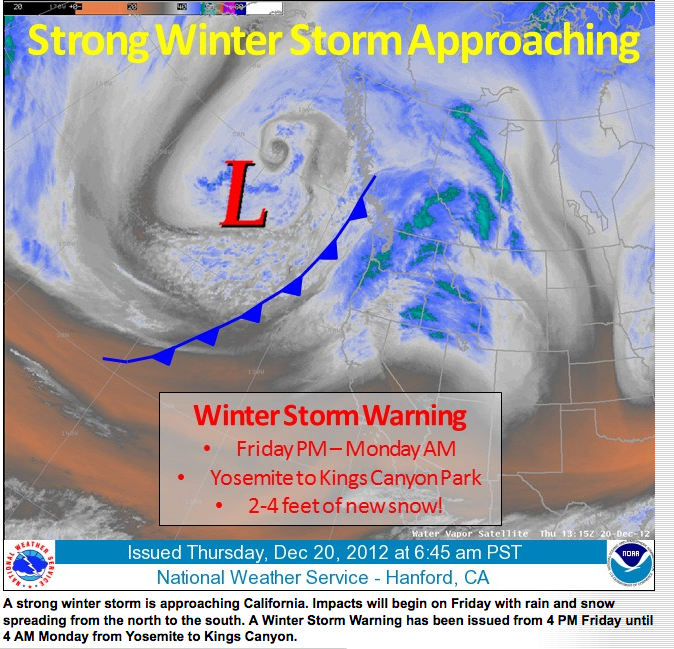
MODELS HAVE COME INTO STRONG AGREEMENT REGARDING THE EVOLUTION OF A STRONG WINTER STORM OVER THE UPCOMING WEEKEND. WHILE THERE
CONTINUES TO BE SOME MINOR TIMING DIFFERENCES, IT IS CLEAR THAT
THERE WILL BE A THREAT OF VERY HEAVY SNOW IN THE SOUTHERN SIERRA. IN AGREEMENT WITH NWS SACRAMENTO AND RENO, WE HAVE UPGRADED THE WINTER STORM WATCH TO A WARNING. HAVE ALSO EXTENDED THE WARNING THROUGH SUNDAY NIGHT. WHILE THE FIRST WAVE OF PRECIPITATION WILL HAVE THE POTENTIAL TO BE PLENTY STRONG IN THE SOUTHERN SIERRA…THE SECONDARY TROUGH COMES IN NEGATIVELY TILTED LATE SUNDAY AND LOOKS TO BRING A SHORT BUT INTENSE PERIOD OF PRECIPITATION WITH A SIGNIFICANT ASSOCIATED MOISTURE FETCH.
WINDS WILL BECOME GUSTY ON SATURDAY IN THE VALLEY AND A WIND ADVISORY MAY BE NEEDED…ESPECIALLY ALONG THE I-5 CORRIDOR. WINDS WILL PICK UP IN THE KERN COUNTY MOUNTAINS AND DESERT SUNDAY NIGHT AND INTO MONDAY AS THE TROUGH FINALLY PUSHES THROUGH.
On the Coast, John Lindsey reports rain likely from Friday thru Monday in the SLO area.
Here is his report showing a series of storms lining up:
A vigorous weather system is now crossing into far Northern
California this morning with 50+ mph southerly winds and periods
of heavy rain.
This cold front will decrease in intensity and continue to move
southeastward towards the Central Coast. This cold front will
produce increasing clouds, southerly winds and warmer overnight
low temperatures by Friday morning. Scattered rain showers are
forecast to start on Friday evening as the cold front approaches
San Luis Obispo County. Rain showers will turn to study rain
Friday night into Saturday morning with the frontal passage.
A 1,005 millibar low pressure system will follow the cold front
on Saturday afternoon and produce strong to gale force (24- to 38-
mph) southwesterly winds and rain showers. The southwesterly
winds will decrease and shift out of the west and the rain
showers will end by Saturday night. Heavy Sierra snow will
develop on Friday and continue through Saturday. Snow levels
will begin low tonight and will gradually rise to about 3,000
and 5,000 feet north to south by Saturday.
Another weather system will cross San Luis Obispo County on
Sunday afternoon into early Monday morning with potentially
heavy rain and gusty southerly winds.
Dry weather will return Christmas Day. However, another
low-pressure system may produce increasing southerly winds
and moderate to heavy rain on Wednesday afternoon into next
Thursday morning. At this time, unsettled weather is forecast
to continue into next weekend.
Gas prices are at $2.99 a gallon at six stations in the Lodi /Turlock area today.
Tulare County Board of Supervisors rejected a call to slap a moratorium on new solar projects this week noting that the solar projects could create $12.7 million in economic benefit to the county in fees alone.
Corn futures fell to $ 6.94 a bushel Dec 20 declining over $1 from September and down from $8.20 in August. The price spiked this summer because of the Midwest drought. Corn price s this time last year were $5.50. Livestock owners and ethanol makers have been hard hit by the price rise that should ease once a new crop comes in.
Milk Hearing Friday.CDFA will hold a dairy marketing hearing in Sacramento to hear proposals to raise milk component prices for six months in an effort to help struggling California dairymen.
Monterrey County leads the state in the value of all organic food production at $170 million worth of farm products on 20,000 acres. Fresno is number two at $131 million produced on 41,000 acres. Humboldt is third with $44 million on 70,000 acres.
The City of Tulare is processing the largest new home subdivision in years proposed by Central Valley Land Co on the city’s north side. Called the KCOK Ranch ,the 110 acre tract would have 343 residential units. The company is a partnership led by by Harvey May’s Paloma Development. The project that has been revised from an earlier hearing is east of Mooney and north of Seminole Ave. The plan will be the subject of a city EIR committee review December 21.
Kings County planning department is processing a General Plan Amendment and zone change for a 151 acre parcel on I-5 at Utica Ave. – five miles south of Kettleman City. The plan calls for allowing highway commercial uses with services like truck stop, hotels and restaurants similar to what is offered in Kettleman City. The highway commercial uses would be on 38 acres with the remainder zoned for light industrial uses.The land is now planted to an orchard on 120 acres. The proposal is by land owner Don Jackson.
Central Valley Community Bancorp (NASDAQ: CVCY), a bank holding company headquartered in Fresno, California, and Visalia Community Bank (OTCBB: VSMU), headquartered in Visalia, California, jointly announced today that a definitive merger agreement has been signed by both parties. Under the terms of the agreement, Visalia Community Bank, with four branches in Visalia and one branch in Exeter, will merge with Central Valley Community Bancorp’s subsidiary, Central Valley Community Bank. The transaction is subject to customary closing conditions, including regulatory approvals and approval by Visalia Community Bank’s shareholders. The Central Valley Community Bancorp and Visalia Community Bank boards of directors have unanimously approved the transaction, which is expected to close in the second quarter of 2013.
The transaction is initially valued at approximately $22.1 million or $52.00 per share to Visalia Community Bank shareholders. The purchase price is to be paid half in cash and half in Central Valley Community Bancorp common stock. Based on a value of $8.75 per share of Central Valley Community Bancorp common stock, using the 30-day volume weighted average trading price at the time when the principal terms of the agreement were being established, in the aggregate approximately 1.263 million shares of Central Valley Community Bancorp common stock would be issued and $11,050,000 would be paid in cash. As a result, Visalia Community Bank shareholders would be entitled to receive approximately $26.00 and 2.97 shares of Central Valley Community Bancorp common stock per share. The total purchase price is subject to adjustments and closing conditions, including potential adjustments if the volume weighted average trading price of Central Valley Community Bancorp common shares rises or falls beyond certain levels prior to closing.
The Central Valley Community Bancorp and Central Valley Community Bank directors and management team, led by Daniel J. Doyle, president and CEO, will continue to lead the combined team of professional bankers. F. T. “Tommy” Elliott IV, chairman of the board of directors of Visalia Community Bank, will join Central Valley Community Bancorp’s board of directors upon completion of the acquisition. This merger with Visalia Community Bank will become the third acquisition for Central Valley Community Bancorp, which acquired Service 1st Bancorp and its subsidiary Service 1st Bank on November 12, 2008, and Bank of Madera County on January 1, 2005.
As of September 30, 2012, on a pro forma consolidated basis with Visalia Community Bank, Central Valley Community Bancorp would have had approximately $1.078 billion in total assets, with 23 branches throughout California’s San Joaquin Valley.
“Both banking institutions are well known for their excellent customer service and community advocacy, which will not change as a result of the merger. Once approved, the merger will complete another step in our long-term strategy to increase our presence throughout California’s San Joaquin Valley by adding offices in Tulare County, complementing our 17 existing offices in the northern Valley counties of Fresno, Madera, Merced, Stanislaus, Sacramento and San Joaquin. This growth allows Central Valley Community Bank to further accommodate an increasing customer base in the communities of Visalia and Exeter. We believe that the expansion into Tulare County will provide long-term opportunities for businesses, customers, employees, the community, and our Bank,” stated Daniel J. Doyle, president and CEO of Central Valley Community Bancorp and Central Valley Community Bank.
“Additionally, the merger will provide Visalia Community Bank customers with more convenient locations throughout the San Joaquin Valley, as well as offer new advancement and geographic opportunities for their employees. We are pleased to have Visalia Community Bank employees join our team of professional community bankers who are focused on providing a full array of competitive financial services to meet the needs of businesses, professionals, agribusiness and consumers for the communities we serve,” concluded Doyle.
“Visalia Community Bank’s quality service standards, philosophies and corporate culture are consistent with those of Central Valley Community Bank. While the nation has seen a continuing
trend in bank consolidations through mergers and acquisitions in recent years, few of these ‘bank marriages’ promise a better fit than the marriage between Visalia Community Bank and Central Valley Community Bancorp,” stated Tom Beene, president and CEO of Visalia Community Bank.
“Over the past 35 years, Visalia Community Bank has provided exceptional community banking service of the highest caliber to residents and businesses, allowing successful growth in Tulare County. Central Valley Community Bank has likewise effectively and profitably grown throughout the San Joaquin Valley through branch expansion and the enhancement of banking products and services to fulfill customer demands,” Beene said.
Central Valley Community Bancorp trades on the NASDAQ stock exchange under the symbol CVCY and as of September 30, 2012 reported assets of $887,000,000. Central Valley Community Bank, headquartered in Fresno, California, was founded in 1979 and is the sole subsidiary of Central Valley Community Bancorp. Central Valley Community Bank currently operates 17 full service offices in Clovis, Fresno, Kerman, Lodi, Madera, Merced, Modesto, Oakhurst, Prather, Sacramento, Stockton, and Tracy, California. Additionally, the Bank operates Commercial Real Estate Lending, SBA Lending and Agribusiness Lending Departments. Investment services are provided by Investment Centers of America and insurance services are offered through Central Valley Community Insurance Services LLC. Members of Central Valley Community Bancorp’s and the Bank’s Board of Directors are: Daniel N. Cunningham (Chairman), Sidney B. Cox, Edwin S. Darden, Jr., Daniel J. Doyle, Steven D. McDonald, Louis McMurray, William S. Smittcamp, Joseph B. Weirick and Wanda L. Rogers (Director Emeritus). More information about Central Valley Community Bancorp and Central Valley Community Bank can be found at www.cvcb.com, Facebook and Twitter.
Visalia Community Bank, headquartered in Visalia, California, reported assets as of September 30, 2012 of $200,373,000. Visalia Community Bank was founded in 1977 and operates five full service branch offices in Visalia and Exeter. Additional information about Visalia Community Bank can be found at www.vcb.com.
Central Valley Community Bancorp received a fairness opinion from Sandler O’ Neill + Partners, LP, and Downey Brand LLP served as legal advisor. Visalia Community Bank received advisory service and a fairness opinion from FIG Partners, LLC, and its legal counsel was King, Holmes, Paterno & Berliner.
Wow! Gas prices have fallen to $2.89 a gallon at one Costco station in Lodi area – as the average price of regular in California continues to drop.
The average price in the state has declined from $4.66 on 10/07/12 to $3.51 today according to Gas Buddy. The trend continues to suggest lower prices,a a gift to the motorists after the run up in September by 50 cents in just a few days. The low price in the S2S reading area is $3.24 in Fresno, $3.33 at Costco Visalia, $3.25 in Tulare,$3.35 inHanford and $3.51 at the Costco in San Luis Obispo.
C.A.R. reports that California’s existing homes continued to sell at a faster pace in November, with the median number of days it took to sell a single-family home falling to 37.5 days in November 2012 from 38 days in October and down from a revised 56.6 days for the same period a year ago.
Median time on the market in November is 48 days in SLO – down from 64 days a year ago, down to 26 days from 36 days in the Fresno market and down in Tulare County from 42 days to 24 days.Kings County time on the market improved from 45 days a year ago to 43.
Meanwhile regards the median sales price SLO county now has a $391,000 median compared to $354,000 a year ago.Tulare County median is $138,000 vs $126,000 a year ago.
The statewide median price of an existing, single-family detached home increased 2.3 percent from October’s $341,370 median price to $349,300 in November. November’s price was up 24.8 percent from a revised $279,910 recorded in November 2011, marking the ninth consecutive month of annual price increases and the fifth consecutive month of double-digit annual gains. The year-to-year percentage increase was the largest since June 2004.
The following came from the NORTH AMERICAN MEAT ASSOCIATION Lean Trimmings Newsletter and is an important read for North Coast producers doing direct marketing.
TOP 2013 RESTAURANT MENU TRENDS
The National Restaurant Association (NRA) released its “What’s Hot” culinary forecast of menu trends for 2013. The NRA surveyed more than 1,800 professional chefs, members of the American Culinary Federation (ACF), to find that children’s nutrition and local sourcing will continue to be the hottest trends on restaurant menus for the upcoming year.
The top 10 menu trends for 2013 include:
1. Locally-sourced meats and seafood
2. Locally-grown produce
3. Healthful kids’ meals
4. Environmental sustainability as a culinary theme
5. Children’s nutrition as a culinary theme
6. New cuts of meat (e.g., Denver steak, pork flat iron, teres major)
7. Hyper-local sourcing (e.g., restaurant gardens)
8. Gluten-free cuisine
9. Sustainable seafood
10. Whole grain items in kids’ meals
Not making the top 10 but in the top 13 was Farm/Ranch/Estate branding.
Also included in the surveys were questions about other restaurant trends. More than half (55 percent) of the chefs surveyed said they always make efforts to adjust dishes and recipes to be more healthful, while 37 percent said they cook with nutrition in mind, but that not all recipes are easily adjusted. When asked how to best handle the increasing cost of ingredients, 32 percent of the chefs said changing menus, 25 percent said adjusting plate composition, and 24 percent said exploring new sourcing options. Only four percent said that raising menu prices is the best strategy. The survey can be viewed at http://www.restaurant.org/pdfs/research/WhatsHotFood2013.pdf.
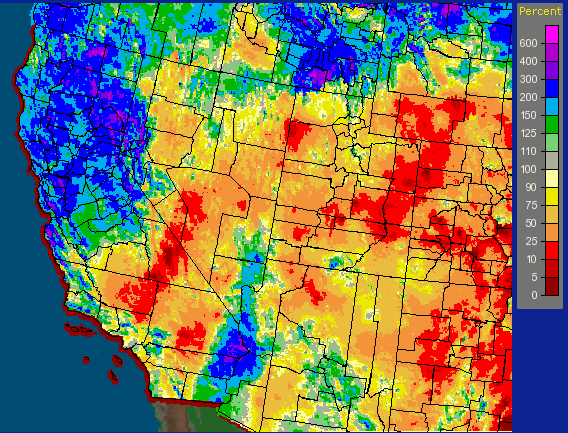
(click to enlarge) Percent of normal rainfall in past 30days – dark blue is more than 200%
California rainfall totals have varied widely in the state for the past 30 days.Beneficial rain has soaked Northern California helping to fill the state’s big reservoirs that help feed the more arid part of the state. Those totals exceed 200% in some areas.
Meanwhile in the Sierra2thesea reading area rainfall totals are below normal with Tulare County at around 75%( orange on map) and Kern below that( red). Still the storm door appears to be open for the rest of December with snowpack expected to build in the Central Valley portions of the Sierra.
San Luis Obispo County appears to be mostly ahead of normal.
The foothill town of Three Rivers will get a new 12ft by 8ft gateway monument sign saying ‘Welcome To Three Rivers’ soon with plans to build the sign going to the Tulare County Board of Supervisors this week.
The project is being carried forward by the Three Rivers Foundation. The sign will be just north of the Horse Creek bridge on CalTrans property along Hwy 198 and could be erected as soon as next month.
Tom Sparks of the Foundation says a group of vocational students from Visalia under the direction of David King will both make and erect the new entrance sign. The project has been in the works for 2.5 years say Sparks.”It’s been a bit arduous but the people from CalTrans have been just great.”
The old entrance sign was further down 198 near Lemon Cove. That sign got moved some time ago to the Slick Rock area.But now this sign will be relocated next to the TR Historical Society further up 198.The group is acquiring 2.5 acres that they will expand their museum/visitor complex operation on.
Arguably the gateway entrance to Sequoia National Park the town’s name comes from its location near the junction of the North, Middle, and South Forks of the Kaweah River.
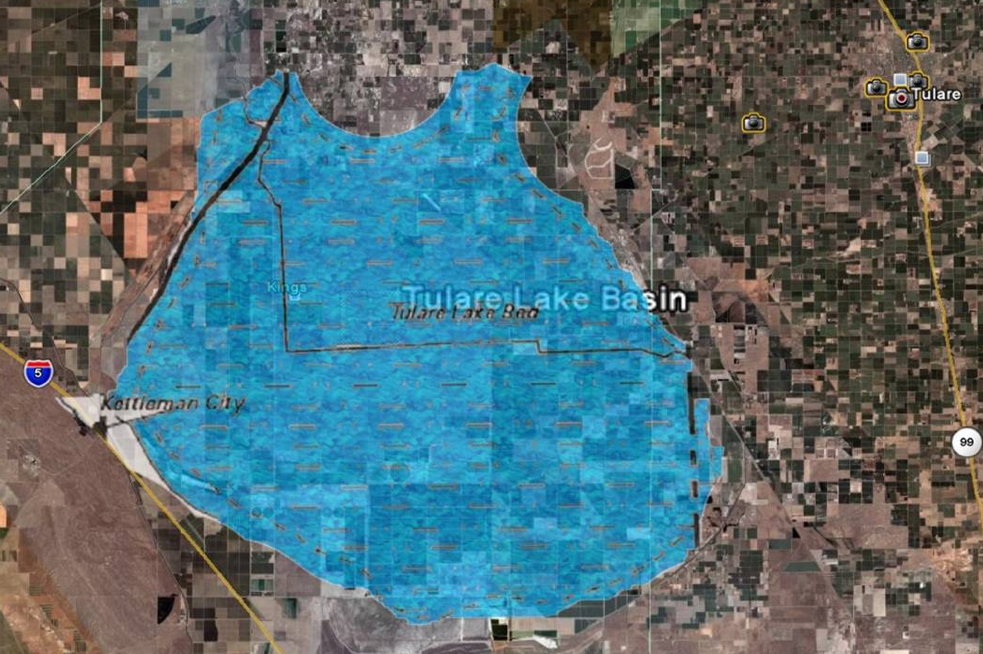
Kings and Tulare Counties’ mostly dry Tulare Lake bed – once the largest body of water west of the Mississippi – is now sporting fields of solar panels by the thousands with more to come.
Tulare lakebed covers much of Kings County and SW Tulare County(click for larger view)
This past week two new solar project applications were received by the Kings County planning department including a 155 acre, 20 megawatt solar project on farm land owned by JG Boswell, the largest farmer on the old lakebed or anywhere else.
Historically,while the lakebed was often filled in winter with water -flooding in 1938 and 1955 prompted the construction of the Terminus and Success Dams on the Kaweah and Tule Rivers in Tulare County and Pine Flat Dam on the Kings River in Fresno County, rivers that all drain here. The lakebed’s outline can still be seen from the air covering a large part of Kings County and a portion of western Tulare County.
While the farmland here grows crops there are large fallow sections with high salinity soils – impaired farmland now considered ripe for solar development.
Tulare Lake drains key Central Valley rivers
According to the application, the Boswell solar farm would be developed by Solar Project Solutions(SPS) – a joint venture that includes Samsung Green Repower, LLC and Solar Managers, LLC. The group develops, finances and operates utility scale photovoltaic projects, power sold to the grid.
Like many others in these two counties the solar arrays would be installed on land with a Williamson Act contract. Kings and Tulare counties have supported solar use on farmland that is non-prime ag land but now there is push back as we will discuss.
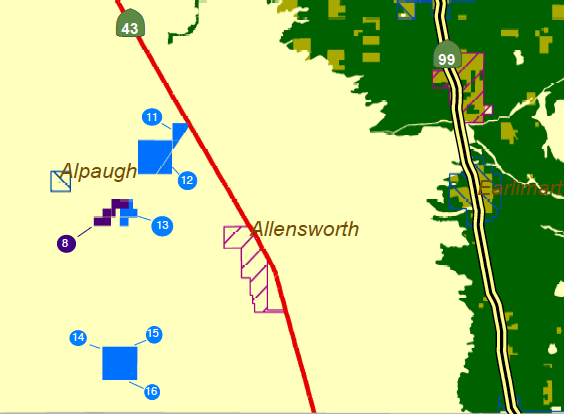
Korean-based SPS is familiar with the vast treeless old lakebed with a portfolio of 130 MW,over 1200 acres near Alpaugh and Allensworth on the edge of lakebed in Tulare County with several projects nearing completion. Most of that acreage had been fallow due to inadequate access to water.
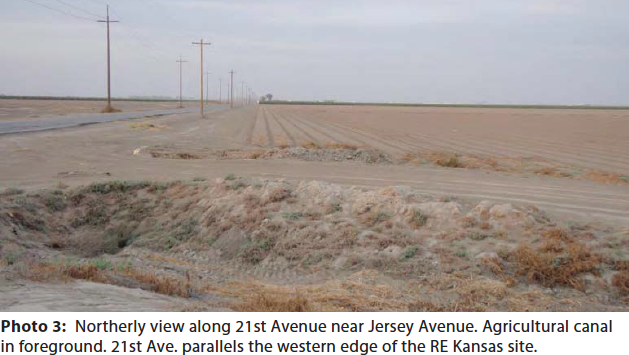
look ma, no trees in an old lakebed – Kansas South project
Also in the old Tulare lakebed but in Kings County near Kettleman City, Westlake Farms is proposing to lease 220 acres to EE Kettleman Land LLC, a San Diego firm who pioneers new solar farms around the state. This would be the third utility-size solar project on Westlake Farms vast acreage in Kings County that sprawls along miles of Highway 41 between Stratford and Kettleman City. One of those projects is Kansas South – under construction now and being developed by Recurrent Energy of San Francisco.
Nearby in Corcoran ,there are 2 new solar farms that are approaching the construction phase says a city report this week .” The first project is located on the 140 +/- acres at the City Well Fields North of town on Nevada Ave. This is supposed to be a 12 MW solar project being put together by EDF Renewable Energy – formerly enXco. They are currently in the permit process having already worked out a purchase contract with PG&E for renewable energy.
At this time they are telling us that their project, which is being built in
conjunction with a second project 20 MW project located on CID property just East of our property, is moving along very quickly for projects of this type.“
SPS also has a 60 megawatt project just outside the Corcoran city limits in conjunction with Corcoran ID, also in Kings County.
And there is more to come. Pacific Gas and Electric Co. agreed to buy electricity from a 100-megawatt solar power plant SunPower Corp. plans to build near NAS Lemoore on the edge of the lake.The Henrietta Solar Project, expected to be b approved by the California Public Utilities Commission would start construction in 2015 SunPower announced recently.
Tulare County lakebed projects
A few miles south in Tulare County, planner Mike Washam says a large share of the 270 MW of power approved by the county Board of Supervisors on farmland to date has been approved in the lakebed near Alpaugh including another new 20 MW project to be submitted soon that would add up to nearly 200 MW in Tulare County’s arid western edge.
Moratorium?
Not that everyone likes the idea of solar generation on farmland. In Tulare County the Board of Supervisors this week is considering a possible “moratorium” on new solar projects in county. But an alternative proposal expected to have majority support would lay out areas in the county were solar units on farmland would be generally supported including all of the old lakebed area in the se portion of the county.
The new policy would prohibit solar in the 127,000 acre citrus belt, on prime farmland that is not in a city urban boundary(where it is likely to be developed for city uses) as well as Class 1 soils. That would add up to around 870,000 acres in the county that would be off limits to these projects. There are 333,000 acres of trees and vines planted in the county,considered unsuitable for solar, and about 700,000 acres of ‘pasture”.
As of now – there are about 3000 acres of solar projects in the county either built or in the pipeline.
A second stipulation could be added that the proponent must show that the land where the project is proposed lacks an adequate water supply.
Criticism came from the Tulare County Farm Bureau of current policy was heard in this letter submitted this fall.
“Before any further permits are reviewed for solar installations, Farm Bureau would request that Tulare County develops a clear policy on solar installations with regards to prime farm land in Tulare County. We are concerned that the non-prime “case by case” approach is not yet clearly defined for prime farm lands, and we strongly discourage the county from permitting any solar development on lands that can support viable agriculture production.
Farm Bureau does not support the conversion of prime farmland to non-agricultural uses, and we view solar as a development that will displace the agricultural capability of this land and impair its future productivity. We object to solar projects being sited on prime farmland and believe that other marginal or impaired lands exist in the County that is more suitable for this use. If Williamson Act parcels on marginal or impaired grounds do exist and are most preferable for development, we would also ask the county to strongly consider enacting SB 618 law, and place solar easements on those parcels where applicable.“
Westlake Farms owner Ceil Howe doesn’t think much of Farm Bureau’s restrictions proposed both on the statewide level and by county.”The bottom line is that it’s my property and I’ll do with it what I want.” As a practical matter, he says ,”water is pretty tight on the Westside” and “solar projects may be the best return a guy can get. ” His farm alone has 12,000 acres fallowed this year.
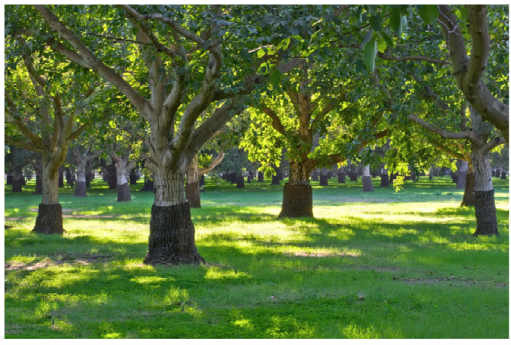
This years walnut crop is selling faster than last year at this time with exports up 6.58% and domestic sales up about 0.6% says the California Walnut Commission.
While some parts so the world are taking in fewer California walnuts, the Middle East for example is down 18% and Europe is down a whopping 70% – Asia is up 56% this year to date with China up 102%. In-shell tonnage shipped to China stands at 30 million pounds compared to 22 million lbs this time last year.
This year’s crop is larger than last year estimated to be 470,000 short tons compared to 461,000 tons – the second largest crop on record. That will be confirmed in February 2013.
Walnuts are now the fourth largest state ag export and big in Central California.Walnuts were a $140 million crop in Tulare County last year.
Helping the state’s 4000 walnut growers sell more overseas is a declining dollar vs the Chinese currency. The yuan is already up about 1.2 percent against the dollar this year following a 4.7 percent advance in 2011. A Bloomberg news survey estimated it will climb another 1.3 percent by the end of 2013, according to the median estimate of 26 analysts.
That adds up to nearly a 7.5% advantage for US products being sold to China by the end of next year vs 2011 with the state’s big 3 nut crops enjoying another good year.
This week US ag secretary Tom Vilsack pointed to the health benefits of eating California nuts. ”Vilsack’s great-aunt in Iowa had a thing for almonds. “She believed that if she consumed seven almonds a day, she would avoid cancer,” the nation’s agriculture secretary said in a phone interview Wednesday. “She lived to be 93.” says a Bee report.
The Bee continues -“I think the best export days are ahead for this industry,” Vilsack said. “There’s just a tremendous opportunity.”
U.S. exports of almonds and other tree nuts will hit a record $7 billion next year, the U.S. Department of Agriculture projected last month. That would double the figure for 2009.
Almost all of those nuts will come from California, where almonds were the top farm export in 2010 at $2.4 billion, according to state figures. Walnuts and pistachios made the top six.”

 California’s unemployment rate decreased to 9.8 percent in November, and nonfarm payroll jobs decreased by 3,800 during the month for a total gain of 564,100 jobs since the recovery began in February 2010, according to data released today by the California Employment Development Department (EDD) from two separate surveys.