California-Grown Sorghum Used In Ethanol Production

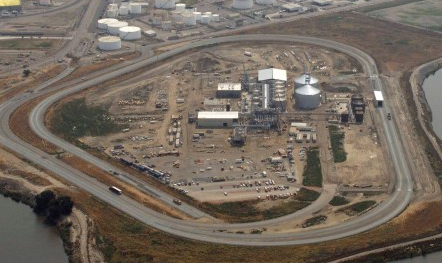
Pacific Ethanol Stockton

(December 3, 2012) Stockton, CA – Chromatin Inc., a privately held provider of innovative crop breeding technology, sorghum seed products and feedstocks, announced it has generated the first crop of sorghum that has been grown and used for ethanol production by a California ethanol company, Pacific Ethanol, Inc. (NASDAQ: PEIX). This achievement paves the way for future opportunities to use locally grown sorghum as a versatile and resilient crop that is a more energy efficient and lower cost alternative to corn.
Using sorghum seed provided by Chicago-based Chromatin, Inc., L and R Mussi Farms of Stockton, CA produced 40 acres of sorghum that were harvested and delivered to Pacific Ethanol’s ethanol production plant in Stockton, CA.
“We were pleasantly surprised by sorghum’s flexibility. It’s a high-yielding, easy to grow crop regardless of environmental conditions, and it uses less fertilizer and less water than corn,” said Rudy Mussi co-owner of Mussi Farms. Daphne Preuss, Chromatin’s CEO commented “We were pleased to see that growers were able to plant and produce high quality sorghum with minimal modifications to their current practices and that ethanol plants encountered no difficulties in substituting sorghum for corn. In addition, Chromatin has shown that the residue left over after the harvest of sorghum grain can be used as high quality animal feed, further enhancing the output from the land used in production of this crop.”
Ethanol plants in California have been seeking alternative crops for corn to reduce feedstock costs, improve carbon footprint, and to source feedstock from locally grown energy-efficient crops. While sorghum imported from other regions has been used in California ethanol plants in the past, Chromatin’s program is the first instance of supplying locally grown grain to the Pacific Ethanol plant in Stockton, CA, resulting in greater cost efficiency and an improved carbon footprint. Consequently, by using sorghum grain, ethanol producers may qualify as Advanced Bio-fuel Producers and become eligible for financial incentives.
Neil Koehler, Pacific Ethanol’s CEO, stated, “During the third quarter, Pacific Ethanol used sorghum for approximately 30 percent of the feedstock at our Stockton plant. Blended with corn, sorghum has similar conversion properties to corn and produces even lower carbon ethanol.”
Chromatin is exploring other opportunities to grow sorghum grain in California and expects to expand its production in 2013.
A Tulare County ethanol plant Calgren Renewables is also planning to use local sorghum to make the biofuel.

First Mountain Snowpack Survey for 2013 Reveals “Well Above Average” Water Content

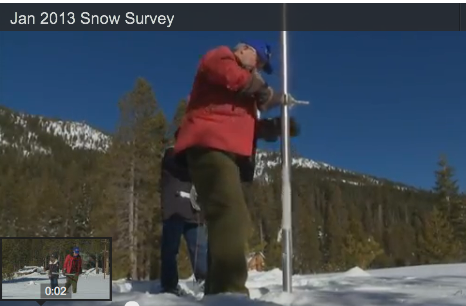
SACRAMENTO — The first mountain snowpack readings taken Jan. 2 by snow surveyors with the Department of Water Resources (DWR) and other agencies reveal water content “well above average for the date,” DWR officials stated Jan. 2 in a press release.
Manual and electronic readings recorded Jan. 2 show the California’s snowpack water content hovering at about 134% of average for this time of year. That is 49% of the average April 1 measurement, when the snowpack is typically at its peak before the spring melt.
“We are off to a good water supply start for the new year, but we have to remember that we have seen wet conditions suddenly turn dry more than once,” Ted Thomas, a spokesman for DWR said in a statement. “We know from experience that California is a drought-prone state, and that we must always practice conservation.”
Snowpack normally provides about a third of the water for California’s homes, farms and industries as it slowly melts into streams, reservoirs and aquifers in the spring and early summer.
Results of today’s manual readings of snowpack by DWR off Highway 50 near Echo Summit are as follows: Alpha location at 7,600 feet showed 56 inches of snow depth, 16 inches of water content and 122% of long term average; Phillips Station at 6,800 feet showed 48.6 inches of snow depth, 12.1 inches of water content and 101% of long term average; Lyons Creek at 6,700 feet showed 55.7 inches of snow depth, 12.9 inches of water content and 109% of long-term average. Tamarack Flat readings were not available.
Electronic readings indicate that water content in the northern mountains is 133% of normal for the date and 50% of the April 1 seasonal average. Electronic readings for the central Sierra also show 133% of normal for the date and half of the April 1 Average. The Southern Sierra revealed 131% of average for the date and 44% of the April 1 average.
DWR and cooperating agencies conduct snow surveys around the first of each month from January to May. Manual measurements supplement and check the accuracy of real-time readings from sensors throughout the state.
DWR currently estimates it will deliver 40% of the roughly 4 million acre-feet of State Water Project (SWP) water requested for this calendar year by the 29 public agencies that receive water from the project. That delivery estimate is expected to increase as more winter storms develop. The SWP final allocation was 80% in 2011, 50 % in 2010, 40% in 2009, 35% in 2008 and 60% in 2007.
In addition to above average water content in the snowpack, early winter storms have replenished California’s reservoirs. Lake Oroville in Butte County, the SWP’s principal reservoir ,is at 71% of capacity and 113% of average for this date.
Electronic reservoir level readings are available online here.
Electronic snowpack readings are available online here.

Weather Looks Dry & Cold Till End Of January

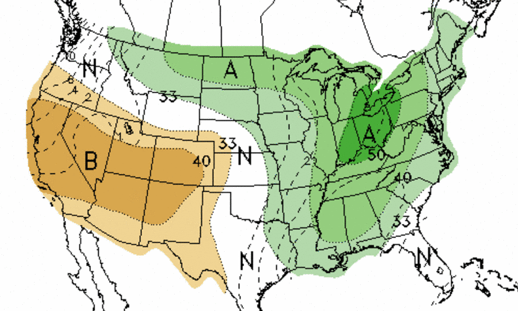
dry weather expected – Climate Prediction Center forecast Jan 10-16

The spigot that appeared to be stuck on “on” for December but abruptly shut off before New Years now looks like it will stay off with predictions of relatively dry weather over much of California until the last week of January. So says LA forecaster Alan Fox who predicted the very wet storm pattern we got from late November through much of December.

As of January 1 California precipitation in northern California is 182% of average for the date says the state DWR and in the San Joaquin Valley the index stands at 145% of average. Snowpack averages are a little lower with the upper San Joaquin River index at 137% of average for January 1. Farewell Gap on the Kaweah already 48% of April 1 average with 3 months to go.Skiers are celebrating with China Peak saying they have 142 in. of snow on some parts of the mountain.

The drier weather in January could lead to some damaging freezes in Tulare County from around the 11-13 and 15-17 Fox says, a worry for the Valley’s citrus industry.

“Lucky we have received as much rain as we did“to bring on more fog that covers the sky like a blanket on cold nights.Fox says there could be some dry clear nights where the danger of low 20s temperatures could damage trees.

“Sea surface temps in the Pacific have changed since December but this is not unusual to have a dry period after a wetter than normal month.”

The US Climate Prediction Center is forecasting a dry month as well(see map).

Fox says he does see the storm door re-opening by the last week in January when he expects a return to wet weather. California’s Mediterranean  climate gets most of its moisture by April annually,much of it stored in the snowpack.

New Year’s Update… fiscal cliff tax bill

GOP congressman Nunes votes’ No” on averting “Fiscal Cliff”

How Central California Congress members voted. While the US Senate voted overwhelmingly 89 – 8 in a bipartisan way to avoid the “fiscal cliff” the House of Representatives remains a house divided. The House voted 257-167, in favor but delegates from the center of  California offered a split decision on the tax measure.

One hundred fifty-one Republicans joined 16 Democrats to vote against the deal, while 172 Democrats voted yes along with 85 Republicans.

Voting against the Senate-backed proposal were GOP House members Devin Nunes and Kevin McCarthy joining the Tea Party wing led by Number 2 GOP leader Eric Cantor while fellow GOP members Denham and Gallegy voted yes along with their GOP majority leader, Mr Boehner. On the Demo side – Jim Costa and Lois Capps voted aye.

Rep. Jim Costa, D-Fresno said after the vote “Far too many of those serving in this institution lack the will to put the country first and partisan interests last.”

The legislation also includes a one-year extension of the Farm Bill.

Latest Tax Measure Bolsters Renewable Energy

The last minute tax bill approved over New Years include several measures to bolster renewable energy, critical in Central California. These measures include:

Extension of wind energy tax credits, part of the bill to avert the “fiscal cliff” that now moves to President Obama for his expected signature.The version included in the deal would cover all wind projects that start construction in 2013. Companies that manufacture wind turbines and install them sought that definition to allow for the 18-24 months it takes to develop a new wind farms.
Kern County, whose wind energy industry rivals its oil industry has a huge stake in the issue.”The Kern County wind industry is committed to making increased wind generation here a reality,” wrote wind energy representatives Linda Parker and Peter Kelley in the October issue of the Kern Business Journal. “The power of wind is too important to Kern County’s economy, job creation and our own independence to let this opportunity pass by.”
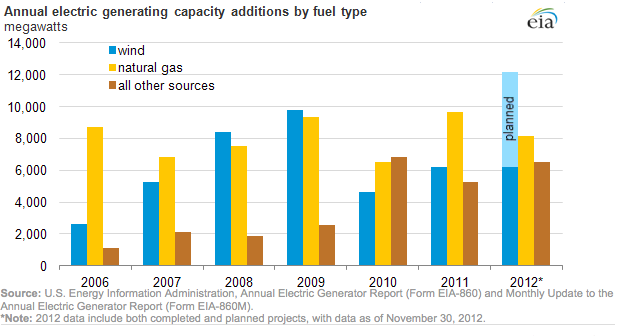
Wind set a new record in 2012 by installing 44 percent of all new electrical generating capacity in America, according to the Energy Information Administration, leading the electric sector compared with 30 percent for natural gas, and lesser amounts for coal and other sources.
However, America’s wind energy workers have been living under threat of the PTC’s expiration for over a year and layoffs had already begun, as companies idled factories because of a lack of orders for 2013. Uncertain federal policies have caused a “boom-bust” cycle in U.S. wind energy development for over a decade.
Half the American jobs in wind energy – 37,000 out of 75,000 – and hundreds of U.S. factories in the supply chain would have been at stake had the PTC been allowed to expire, according to a study by Navigant Consulting.
Biofuels production gets a a boost as well.

Cellulosic biofuels producer tax credit.  Under current law, facilities producing cellulosic biofuel can claim a $1.01 per gallon production tax credit on fuel produced before the end of 2012.  This provision was created in the 2008 Farm Bill.  The provision would extend this production tax credit for one additional year, for cellulosic biofuel produced through 2013.  The proposal also expands the definition of qualified cellulosic biofuel production to include algae-based fuel. This provision is estimated to cost $59 million over ten years.
Incentives for biodiesel and renewable diesel.  The bill extends for two years, through 2013, the $1.00 per gallon tax credit for biodiesel, as well as the small agri-biodiesel producer credit of 10 cents per gallon.  The bill also extends through 2013 the $1.00 per gallon tax credit for diesel fuel created from biomass. This provision is estimated to cost $2.181 billion over ten years.
The biodiesel tax incentive expired on Dec. 31, 2011. A recent study found that the industry would have produced an additional 300 million gallons this year with the tax incentive in place. That would have supported some 19,213 additional jobs, for a total of 83,258 jobs supported by the industry nationwide, according to the study, conducted by Cardno ENTRIX, an international economics consulting firm.
Cellulosic biofuels bonus depreciation.  Under current law, facilities producing cellulosic biofuel can expense 50 percent of their eligible capital costs in the first year for facilities placed-in-service by the end of 2012.  This provision was created in the 2008 Farm Bill.  The provision would extend this bonus depreciation for one additional year for facilities placed-in-service before the end of 2013.  The proposal also expands the definition of qualified cellulosic biofuel production to include algae-based fuel. This provision is estimated to cost less than $500,000 over ten years.
Agricultural Programs. Section 701 of the Bill extended all provisions of the 2008 Farm Bill through September 30, 2012 – including funding levels for mandatory programs.

Planned Wind Turbine Additions Rise In Advance Of Scheduled Expiration Of Wind Tax Credit

Many wind projects are planning to come on line before the end of 2012, in advance of the possible expiration of a federal incentive, the wind production tax credit (PTC). It appears that wind developers are pushing to complete projects in 2012 to qualify for the PTC. Under current law, projects that begin operating prior to the end of 2012 are eligible to receive a 2.2-cent PTC for each kilowatthour of generation over a 10-year period.EIA collects monthly updates on modifications, retirements, and additions to the nation’s fleet of power plants, including the planned date of commercial operation for new generators.
Wind plant developers reported increasing amounts of new capacity scheduled to enter commercial operation in 2012 as the year progressed. Even as completed projects accumulated during 2012 , the amount of capacity expected to come on line before the end of the year continued to increase.
As of November 30, 2012, the wind capacity planned to come on line by the end of December would account for approximately half of the total 2012 wind capacity additions.
Wind generators accounted for a significant portion of capacity additions since 2007 ( click chart below), and were the largest source for generating capacity additions in 2008 and 2009.

US will see an addition of 12,000mw of power this year due to tax credit

If all planned wind generators for 2012 come on line, as reported by industry participants, wind capacity additions could top 12,000 MW for this year. This would account for 45% of total additions and exceed capacity additions from any other fuel source, including natural gas, which was the leading fuel source for electric generating capacity additions in 2010 and 2011.

Source: U.S. Energy Information Administration, Annual Electric Generator Report (Form EIA-860) and Monthly Update to the Annual Electric Generator Report (Form EIA-860M).

Three Rivers Museum Expanding


Three Rivers Museum with Paul Bunyan statue

Three Rivers Historical Museum will be expanding now that it has acquired another 2.5 acres next to their museum/visitor center on Hwy 198 (Sierra Dr). Museum spokesman Tom Marshall says the museum recently acquired title to the property that includes the Bequette house through efforts of community-minded supporters to make it happen.”We want to thank Chan and Elizabeth Wilcox” for buying the property out of foreclosure and selling it the museum “for a very good price.” In addition Marshall says local realtor Dave Learned helped put the paperwork together. Community donations from the local Lions Club and Women’s Club help keep the doors open.

Marshall says the 1926-built Bequette house was the headquarters for Judge Walter Fry,the first superintendent for Sequoia National Park. ”We’ve been told that family members are donating some of the original furnishings from that time” to use in the building. Marshall says after some rehabbing around the house they plan to use one large room for a conference room for the museum as well as make it available for meetings.

Besides the building the extra 2.5 acres graced with oaks and sycamores, might be used for outdoor events from time to time.

In addition the property will be the new home of the famous 1950s Three Rivers metal sign done by sculptor Carroll Barnes when it is relocated from Slick Rock soon. Barnes carved the famed 1941 Paul Bunyan wooden statue in front of the current museum (see picture) as well as the redwood Giant statue in front of COS in Visalia.

This sign will be relocated in part because CalTrans requires there be only one welcome sign and the Three Rivers Foundation is erecting a new entrance sign for the community north of Horse Creek bridge as soon as next month. That 12’ by 8’  metal sign proclaims ‘Welcome to Three Rivers – Gateway to Sequoia National Park.’

Marshall says the all volunteer museum in Three Rivers – open every day of the week – gets good visitation particularly in the busy summer months when as many as 1000 visitors stop on the way into the park.

A bit more history. The Kaweah Commonwealth newspaper has written  “The Three Rivers Historical Museum evolved from Bequette’s Gift Shop that Jessie operated from 1953 to 1967. The shop later housed Mountain Arts for nearly 20 years, then for a short time was an art gallery before being acquired by the historical society in 1997.”

For those who would like to donate to the museum contact Tom Marshall and the Three Rivers Historical Museum, email:history@3rmuseum.org,website:www.3rmuseum.org
42268 Sierra Dr., P.O. Box 162, Three Rivers, CA 93271
559-561-2707.

Large Scale Marijuana Farmers Poison Sierra Rodents

Author: Anne Lombardo
December 18, 2012

There is a new predator in the forest these days. It has arisen quietly over the years. Any wildlife feeling hungry when they come upon it in the Sierra is vulnerable. This predator is amazingly small for the scope of its damage; it can’t run fast or climb high.

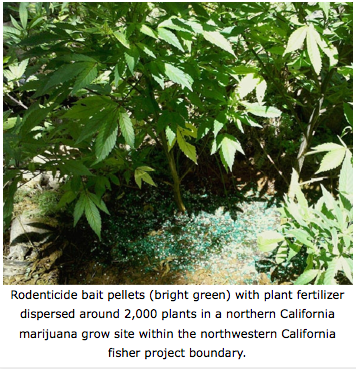
Rodenticide bait pellets (bright green) with plant fertilizer dispersed around 2,000 plants in a northern California marijuana grow site within the northwestern California fisher project boundary.
This new predator is rodenticide in pellet form, used in violation of all safe-use regulations in our national forests by large-scale marijuana growers. Rodenticides are being used to protect young and tasty marijuana seedlings from wildlife roaming through the forest looking for a meal. Chemicals never meant to be used more than 50 feet from homes are now scattered across forest hillsides. Piles of poisons are left around hundreds of plants even though only a few pellets can be lethal. Miles of water pipe are lined with these pellets to protect the stolen water source. Camps are circled with pellets to protect human food sources and sleeping areas.

University of California scientists originally became aware of this problem when Rick Sweitzer, associate professor in the Department of Environmental Science, Policy and Management at UC Berkeley, and his wildlife research team retrieved a radio-collared fisher whose cause of death was unclear. Sweitzer and his team are researching are studying the fate Pacific fishers as part of the Sierra Nevada Adaptive Management Project (SNAMP).
Necropsy (an autopsy for animals) of the fisher carcass by Mourad Gabriel of UC Davis and the Integral Ecology Research Center found rodenticide poisoning to be the cause. With these new findings, the livers from previous fisher mortalities in the SNAMP study were reexamined for evidence of rodenticide exposure. They discovered that more than 80 percent of dead fishers examined had been exposed to rodenticide. These toxicants can persist in animal tissues or the environment for potentially hundreds of days. At least five dead fishers found by researchers in SNAMP and a second fisher study in northern California have been confirmed to have died of rodenticide poisoning, the scientists reported in the science journal PlusOne.
Considering the hundreds of marijuana grow sites found every year on public lands, the scale of the damage to California’s natural resources may be unprecedented. Grow sites are also found containing massive amounts of fertilizers, herbicides and pesticides, all of which are being used without concern for run off or aquatic species nearby. Marijuana plants are removed from these plots when found, but these chemicals are often left behind.
Although this problem might seem overwhelming, there are efforts to address it. The non-profit Environmental Reclamation Team has cleaned up hundreds of grow sites since 2005. They remove and document all of the poisons found along with the miles of plastic irrigation line and piles of trash. More efforts like this are needed if we are to maintain rare animals like the Pacific fisher as well as all the other species who have the potential of coming in contact with these poisons.

Sprouts To Open Natural Foods Market In North Fresno In New Year


With a name like Sprouts, it is not surprising this natural foods supermarket chain is on the grow. Arizona-based Sprouts Farmers Market – an organic and natural foods supermarket who competes with Whole Foods – will open a new 35,000 sf store in North Fresno by May.

Sprouts has nearly 150 locations and 11,000 employees in the West and earlier this year acquired the 36-store Sunflower Farmers Market chain.
Interviewed this week company CEO Doug Sanders says the currently vacant Fresno property at 7477 N Blackstone will be leased.The new store will employ around 85. An employment fair will be announced. All their stores are non-union.

More To Come?

“We will see how it goes but I would not be surprised if we added another store in this marketplace” down the line.
Besides Fresno, Sanders confirms there is interest in locating a store in Visalia as well. ”We’ve looked in Visalia.” About half the chain’s stores are located in California with most in southern California.The company distribution center is in Riverside.

Sprouts was founded by the Henry Boney Family who also launched Henry’s Markets in LA – now part of Sprouts. Sunflower, acquired in March, had a similar marketing approach that emphasizes fresh produce says Sanders.
“Unlike most grocery stores our produce section is in the middle of the store. It’s the Farmer’s Market approach” and “it’s what we hang our hat on.”

Asked about Sprout’s comparison to Whole Foods – Sanders says Sprouts aims to compete with traditional grocery stores on produce prices that are typically “20 to 25% less expensive than a “ Vons or Ralphs, he claims.”We are more value added than Whole Foods, says Sanders, “appealing to a broader group.”

On-line some have done an item-by-item shopping comparison for typical products and Sprouts appears to cheaper – on 1/2 gallon of Silk Soy Milk for example, for $3.69 vs $4.29 at an LA Whole Foods location.
Sanders says Whole Foods does more food service items than Sprouts.

Broadening The Market

The company CEO says the organic grocery marketplace has come a long way in the past ten years  – now with “more affordable products along with better quality.” Some former unknown brand names are now household favorites like like Kashi,Organic Farms and Annies. These companies have helped increase the quality of food items as well as providing the scale and competition to lower prices.

The shopper too has changed,he adds, from a small cadre of true believers who demand organic to a wide variety of shoppers who want to have a healthier diet. A large group these days are “trial buyers” who are experimenting, he suggests.

A major stakeholder in the private company is publicly traded Apollo Global Management who also has equity interest in Smart and Final,Ralphs,CKE Restaurants and Claire’s Stores – among others.The Henry Boney Family remains active in the management of Sprouts.

Around Tulare County

Milk,Movies & Mill Creek On Tap

Minnesota-based Milk Specialties Global plans to open a Visalia operation in the existing Provisions Foods plant on Divisadero, the former Kraft plant. The plant is equipped with drying and evaporating capabilities and Milk Specialties will install a proprietary membrane filtration system to process whey proteins. Provisions Foods will reportedly continue to produce cultured dairy products. Milk Specialties Global has published a request to hire an HR manager in recent days who would be in charge of overseeing up to 60 employees the notice says. A company spokesman said a news release would follow.

The company offers value-added whey protein isolates, hydrolysates and concentrates including  science-based nutrition products for the sport nutrition and healthy lifestyle industries as well as Milk Specialties Global Animal Nutrition is a leading supplier of functional fats, proteins and carbohydrates for livestock producers worldwide.

Milk Specialties has hired Jim Ford as its manager, the former plant manager at Mozzarella-Fresca in Tipton. That cheese plant is rumored to be closing in the new year with production shifted to Idaho although the company has refused to comment.

Provisions opened in 2007 when Kraft closed their cottage cheese plant there. Provisions manufacture blue cheese, cream cheese and yogurt from two family-owned farms – the DeGraaf families in the Pixley area.

Visalia shopping center owner DBO Development is in advanced discussions with three movie theater chains to open a multi-screen theater just east of Mooney at Cameron on the south end of town to anchor the next phase of their Packwood Creek Shopping Center. “We expect to have a commitment from one of the chains by February” says Patrick Orosco of DBO.

Orosco has been marketing the next phase of Packwood Creek – Visalia’s largest retail complex – called The Grove at Packwood Creek, a 25 acre,278,300 sf center on both sides of Cameron Ave with the help of Fresno-based Commercial Retail Associates. On the south side of Cameron,Orosco hope to land big box national tenants facing Costco and on the north side they hope to bring in a large cinema complex. Orosco confirms they are talking to Regal Cinemas who already operates both movie theaters in Visalia.

Orosco says while discussions with movie theater operators are well along none of the other potential retailers or eateries listed in the marketing materials are signed up yet and some are already likely to locate elsewhere if they come to town.

That includes Pollo Loco who recently filed a plan to locate on south Mooney next to BevMo. “This is like a wish list of prospects who might be interested incoming to town.” They include the fast food hamburger chain Five Guys,an East Coast favorite who is expanding in California.

The marketing materials,done in August for the ICSC trade show, also include Burlington Coat Factory who is now expected to locate next to the new Walmart (the former Costco) on South Mooney,not a part of the Packwood Creek center.
Orosco says the key anchor for The Grove will be the megaplex – well suited for the site offering acreage for the hundreds of cars need to park at one time. He maintains that Visalia is losing out to the Tulare’s Galaxy Theatre next to the outlet mall in Tulare because it is far newer than the Sequoia Mall 12plex, a 40,000 sf divided theater inside the mall with no visibility,no other nearby nightspot ( Borders closed in 2011) and very small theater sizes.

Dollar General
stores has signed a letter of intent to lease the former Harbor Freight store (9500 sf) on mid-Mooney Blvd and will move in the next few months.Broker Doug Burr adds that Harbor Freight relocated down the block to the former JoAnn’s Fabrics location, a larger 14,000 sf space.Dollar General has plans for large grocery type stores in Farmersville, Woodlake and Tulare. Also this week,Orosi joins the dollar store boom with the construction of a Family Dollar store at 12835 Ave 416.

Napa Auto Parts is working on a lease for 940 E Main,a long vacant 14,500 sf building owned by S.Pete Salerno. Pete says the building was originally the Toyota franchise showroom and has had plenty of users since. But it has been empty for long stretches  from 1993 to 2000 and again form 2009 till now. The last occupant was an auto parts store that went out of business all over California.But now another investor bought  the assets and hopes to re-open at this location and elsewhere under the Napa name.

City Council member Greg Collins says he is satisfied with the idea that Kaweah Delta board of directors presented to the council the other day that would mean that Mill Creek would need to be culverted west of Acequia for 2 blocks for a major building expansion if the hospital agrees to open the creek on the west end of their property near Johnson and Mineral King. The hospital might agree to removing a small parking lot to daylight the creek. ”It makes more sense to improve the area closer to Miki City Park where the creek is already opened up” agrees board member Jody Graves.The creek is mostly open as it travels west from here.

Plans for 350 Oil Wells Near Pismo

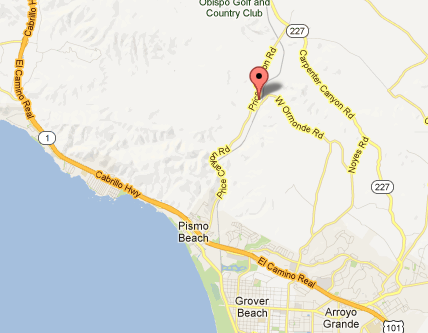
Plains Exploration and Production Co (PXP) has filed a preliminary notice with San Luis Obispo County that it will seek to expand its oil field in Price Canyon near Pismo Beach from 100 oil wells currently to 350. The drilling is planned on hillsides on both sides of the highway and include 11 new pads. A new pipe will cross Pismo Creek that also runs at the base of the canyon.

County planner John McKenzie says the company has been asked to respond to questions regarding any potential use of the controversial practice of fracking at the site but has indicated it will be doing more of the traditional steam injection to coax heavy oil out of the ground.

McKenzie says the environmental review of the big project could take a year or longer and of course, include public hearings.

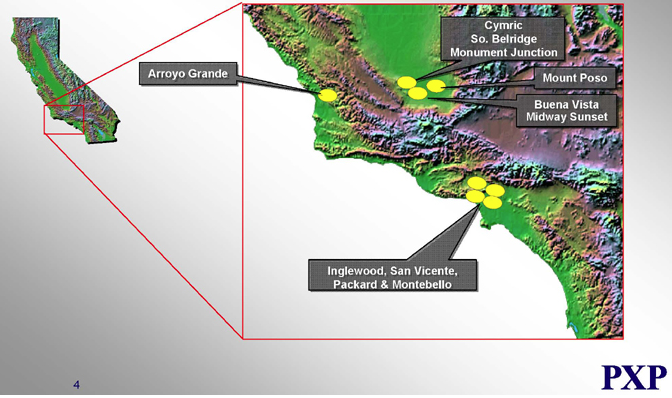
The oil field is the largest in SLO county. A 2010 PXP release refers to the multi-phase Price Canyon project said  “PXP holds a 100% working interest in the Arroyo Grande Field located in the Santa Maria Basin in San Luis Obispo County, California. This is a long-lived field that has heavier oil (12 to 16 degree API gravity), well depths averaging 1,700 feet and requires continuous steam injection. In 2009, PXP spent $4 million on capital projects in this field and drilled 7 wells.”

Fast forward to 2012 and you see a major increase in activity on the project. Plains Exploration is the largest commercial building applicant in San Luis Obispo County this year after the two huge solar projects on the Carrizo Plain. Already this year,PXP has submitted applications for about 100 permits for improvements in the Price Canyon area valued at over $40 million. With plans for more than 3X the wells – it’s clear these guys are planning to spend lots more money and believe there is plenty more oil in Price Canyon.

The county notice calls the expansion Phase V of their project . The field is said to be 320-acres which is within the larger 1,480-acre Price Canyon Unit as defined by the California Division of Oil, Gas & Geothermal Resources (DOGGR).

project location

In 2011 PXP got approval to build a water recycling operation in Price Canyon that discharges back into Pismo Creek. PXP needed the facility to have enough water to boost production of the heavy crude oil by what is expected to be thousands of barrels a day – up from around 1300 a day now. The water facility will be ready for operation next year.

If they are planning more oil rigs,not far away there could also be more houses too. Price Canyon has been in the news recently because of a development plan adjacent the City of Pismo Beach that would roughly double the number of residential units in town if it moves forward.Better get used to living near oil rigs down the block.
   
Mining Giant Buys PXP
The big got bigger this month. Earlier in December it was announced that the mining giant Freeport-McMoran was buying Houston-based Plains Explorations and Production for approximately $6.9 billion in cash and stock. Beside holdings in Price Canyon called the Arroyo Grande Oilfield,PXP also has extensive oil holdings elsewhere in southern California and the San Joaquin Valley. The company is also drilling off the coast near Vandenberg. They are said to be the fourth largest oil company in the state.
Locally PXP has a regional office in San Maria. In California, PXP says they have 430 personnel and on average over 400 contract personnel.
On the fracking issue, the worries about the use of some chemicals in injected water to extract petroleum products has heated up and now the Brown administration has signaled interest in getting involved on the state level. A draft proposal requires the oil industry to disclose where in the state they are using hydraulic fracturing, commonly referred to as “fracking. Brown’s proposal comes  as a critical new movie on the practice called Promise Land is set to be released in theaters December 28.
Also NRDC says in October – “Plains Exploration and Production Company (PXP) released a long-awaited study on the oil drilling company’s hydraulic fracturing operations at the Inglewood Oil Field in the Baldwin Hills area of south Los Angeles. While it took a year to compile the study, this report actually was years in the making as it comprised one of a host of new requirements imposed on PXP through a July 2011 settlement that resolved a lawsuit brought by NRDC and three other plaintiffs in 2008.
The study appears to have found that two test frack jobs at the Inglewood field did not result in adverse impacts to groundwater or community health, nor did they cause additional ground movement or subsidence. We are reserving judgment until we’ve had a chance to carefully review all of the study’s findings, as well as the hundreds of pages of dense, technical information the author has offered to support those findings.”