Three multi-million dollar waste-fed biomass digesters are in the works in Tulare County that will turn trash to cash, mostly into energy related products.
Largest and nearest at hand is Colony Energy’s $20 million,4 million gallon anaerobic digester/cogeneration complex on ten acres of City-owned land located at 2450 W. Paige Ave.The firm will lease the land from the city next to the wastewater treatment plant. VP for project development Matt Schmitt says the project has now received all environmental approvals and will break ground in the first quarter of next year. ” WM Lyles will build our project that should be operation in mid-2014.”
Schmitt says the plan is to accept about 25 loads a day of mostly food waste,about 20% cow manure and the rest ag waste to produce approximately 700,000 cubic feet per day of biogas,essentially CNG.”We will connect to the SoCal pipeline and the gas will go out to customers.” Some will be converted to LNG he says.
The project also features a combined heat and power plant to create electricity and heat in the form of steam or hot water.The steam/hot water has the potential for being used by the City at its wastewater treatment plant to heat the existing digesters and thereby improve efficiency.
Colony Energy is counting on increased demand for renewable biogas in California and has plans to duplicate the project at several other locations in the state says Schmitt. The Tulare project should generate over 30 jobs.
Anaerobic digestion uses naturally occurring microorganisms to break down organic materials and produce biogas, a mixture of methane and carbon dioxide. The biogas can be combusted to produce renewable electricity, cleaned to pipeline natural gas standards, or further processed into compressed natural gas (CNG) fuel. Through anaerobic digestion, many goals can be accomplished:
Divert organic materials from landfills and incinerators
Generate clean, distributed, renewable energy
Restore and maintain healthy soils using compost products
Displace chemical fertilizers
Create green jobs
Also near Tulare,Harvest Power, who owns Tulare County Compost on Lovers Lane has plans for building a new anerobic digester that will turn organic waste into fertilizer and energy. Harvest Power,based in Washington, recently secured $110 million from venture capital investors including Kleiner Perkins to build facilities at multiple locations The unit will break down food scraps and yard clippings in a closed vessel, producing both fertilizer and biogas that can be used to produce electricity or be processed into compressed natural gas for transportation fuel. Harvest Power is working on a full EIR with the county confirm county officials.The company refused comment.
Another closed vessel digester is going to be built at Calgren Renewable Fuels plant in Pixley taking piped-in cow manure and converting it to biogas to power its ethanol making operation.The $10 million project on Highway 99 faces hurdles in the form of opposition from neighbors that has stalled their mitigated negative declaration- based application to the county.The Pixley Biogas project received a $4.7 million grant from the California Energy Commission but despite a redesign to meet concerns of California Dairies with a plant nearby,the project has been stalled until now.
This week president of Calgren,Lyle Schlyer said the company will now go through a formal EIR to get the project built.The EIR is expected to take about 6 months.
The latest survey, which was conducted during the last week of August and the first week of September, included the following commodities: Oranges, Navel – California’s initial 2012-13 Navel orange forecast is 93.0 million 40.0-pound cartons, up 6 percent from the previous year.,but the same as 2010. Of the total forecast, 90.0 million cartons are estimated to be in the Central Valley.The forecast is based on the Navel Orange Objective Measurement Survey conducted in the Central Valley.Survey data indicated an average fruit set of 345 oranges per tree, with a diameter of 2.25 inches as of September 1, the five year average. Fruit set is above the five year average.
Tulare county groves had the smallest set pre tree in the Valley at 309 compared to 435 in Kern County. Walnuts – The 2012 California walnut production is forecast at 470 thousand tons, up 2 percent from the 2011 production of 461 thousand tons. Bearing acreage is unchanged from 2011 at 245 thousand acres, resulting in a yield of 1.92 tons per acre. The forecast is based on the Walnut Objective Measurement Survey conducted duringAugust. Survey data indicated an average nut set of 1,375 per tree, down 1 percent from the 2011 average of 1,388. The San Joaquin Valley set is 1,120, up slightly from last year, and the Sacramento Valley set is 1,582,down 1 percent from last year. The percentage of sound kernels in-shell was 98.0 percent statewide. Cotton – Upland cotton production in California is forecast at 495 thousand bales, down 11 percent from the 2011 crop, and up 5 percent from the August 1 forecast. Harvested acreage is estimated at 141 thousand acres, down 5 percent from the previous forecast. Yield is forecast at 1,685 pounds per acre, slightly down from last month. The forecast for American Pima cotton production was 630 thousand bales, up 1 percent from last month’s production and down 20 percent from the 2011 crop. Harvested acreage is forecasted at 224 thousand acres. Yield is forecast at 1,350 pounds per acre. Rice – All rice production in California for 2012 is forecast at 47.3 million cwt., up 2 percent from the previous year. The yield forecast is 8,400 pounds per acre, unchanged from both last month and year. Planted and harvested acreages are forecasted at 568 thousand and 563 thousand acres, respectively. As of September 1, nearly all of the rice acres had headed. Corn – Corn for grain production in California for 2012 is forecast at 958 thousand tons, up 23 percent from last year’s crop and unchanged from the August forecast. With harvested acreage forecasted at 180 thousand acres, the yield is 5.32 tons per acre. Compared with the 2011 crop year, harvested acreage is up 20 percent and the yield is unchanged.
California ethanol producing plants from Tulare County to Sacramento are working hard to wean themselves from high priced Midwest corn, company officials recently told a committee of the California Energy Commission.
Speaking to a fuels committee of the state agency, Pixley-based Calgren Renewable Fuels president Lyle Schlyer said they hope to encourage local farmers to grow grain sorghum(milo) in enough quantities to replace as much as 20% of the Midwest corn they import by the trainload now. Using milo requires few modifications to the plant to make ethanol and other co-products.
Midwest corn has been hit hard by a 60-year drought that has sent the price sky high for users including biofuel plants, food companies and livestock owners alike. The later two blame ethanol plant owners instead of Mother Nature.
“We’re all losing money right now”Schlyer admits for the state’s handful of ethanol producers. Corn prices have jumped from around $5 earlier this summer to near $8 a bushel, squeezing margins.
Understandably, the plants are looking to alternative feedstock to keep making ethanol that is blended across the US as a oxygenate in our gasoline.
Move to Help Dairy industry
Schlyer says “grain sorghum is not an ideal feedstock for dairy and …we think we can convert it into a good feedstock, so we won’t be competing with them for corn.” Some of most vocal criticism of the corn ethanol industry has come from California dairy producers.
“But we still need to find(milo) growers. So what we’re going to do in our current program is go out and see what we can do to incentivize growers, essentially contract for acreage.”
The diversification goes beyond feedstock. Schlyer says they are also seeking permit modifications to install a biodiesel production facility at their Pixley plant. “Using our extracted vegetable oil as feedstock, we believe we can produce some of the lowest carbon intensity biodiesel in California and not have to ship that stuff back to Illinois, to find a processor who is well suited to use it.” He adds the investment could be in the $5 to $10 million dollar range.
Their Ship Comes In
Port of Stockton
Well known player Pacific Ethanol based in Sacramento, says they too are bringing in milo instead of Midwest corn by the unit-train load,100 cars each, confirms company spokesman Paul Koehler.
CEO of Pacific Ethanol Neil Koehler told the same CEC committee August 1 they hope to bring in a vessel-load of sorghum from Argentina that could replace up to 5% of the Midwest corn they need to buy currently. This week, Paul Koehler confirmed the shipment “is likely to come into the Port of Stockton” where they have an ethanol plant – this fall. “I looks like it will happen.”
Pacific Ethanol like others, is adding corn oil extraction at 4 plants in the West that will give them another high value co-product to sell as did Calgren in Tulare County last year,helping them to move to profitability.
Energy Tubers in Fresno County
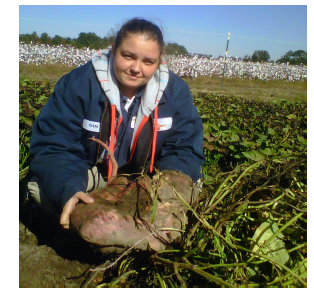
Even more more ambitious, owners of the Keyes, California biofuel plant Aemetis CEO Eric McAfee told the committee about their code name energy tubers. ”We went on a worldwide search over the course of half a decade and we came up with a product that the USDA believes is the highest yield in ethanol per acre, even in excess of Brazilian sugarcane. It happens to be a Peruvian product that the Chinese used a lot during the Mao Tse Tung revolution because they sent the intellectuals out to the farms and they were starving, and they wanted the fastest growing, highest yielding biological transformation of solar energy to starch that was possible, and they developed a product called CX1.” The code name refers to a large energy tuber, a casaba-like root plant (see picture).
“Over 15 years, the USDA commercialized it and we are the first company in the Western United States to actually take it into commercial production. Last year, we planted a field in Fresno County and we produced more than 1,900 gallons per acre of ethanol if you take the starch, convert to sugar, multiply it out, you end up with 1,900 gallons an acre of ethanol. This is between 10 and 20 percent more than you would get if you would have grown sugarcane in Fresno. And it’s almost four times the production of Ethanol from corn. If you can get four times the amount of fuel and so you have a lower cost biofuel at the pump.”
Mcafee says they are harvesting a crop in Fresno County this October.Mcafee continued that “within 48 months, we could be entirely weaned off of Midwestern feedstock and weaned off of corn if we continue to make just moderate investments and scaled up CX1 as a feedstock in the Central Valley. We would no longer import feedstock from the Midwest.”
“ I was just in Canada about a month ago and was with a grain company that scaled up a canola product to a million acres over the course of about five years, and had extensive discussions around the resource constraints to get us from zero to 30,000 acres, and I think it’s a very very achievable goal; we’re not going to have to do the million acres the Canadians did in order to have an impact.”
If Aemetis were to fund the scale-up,“we’d probably be at five percent weaned off(corn)next year, 20 percent the year after that, 60 percent the year after that, and 100 percent the year after that. The scale-up is pretty rapid.”
Aemetis recently designed, built and began to operate a corn oil extraction unit at Keyes that will produce about 2 million gallons per year of extracted oil for biodiesel or animal feed and reduce the carbon footprint of the facility that will be important over the next few years to comply with the state Low Carbon Fuel Standard. The LCFS mandates a cut of our fuel’s carbon emissions by 10% to reduce global warming.
Likewise at Pacific Ethanol with both near term and long focus is to reduce Midwest corn imports.
grain sorghum-milo
Says Neil Koehler, “Our goal” is to use“ locally produced corn and milo, and we would hope that that would be 25 to 40 percent over the next one to two years. We have programs in place that we’re looking for some support on to put in a five million gallon cellulose increment into our existing facilities.. in the range of 10 percent additional, with “the majority of our feedstock being both locally grown and new feedstocks over the next three to four year period.”
To accomplish that, Pacific Ethanol is working with Visalia-based EdenIQ to do a “bolt on” cellulosic plant to an existing corn ethanol facility that will work with a variety of feedstock.Paul Koehler says talks with EdenIQ “are mature” to launch the project. Similar work is underway at Aemetis with federal incentives in place to make cellulosic biofuel.
All the state’s plants including EdenIQ continue to lobby the California Energy Commission to help them financially move in the new direction agreeing to a compromise with critics recently over future state corn ethanol subsides. Late last month Governor Jerry Brown signed AB 523 by Assemblyman David G. Valadao into law. AB 523 eliminates all future state funding for the production of ethanol derived from corn after July 2013,less than a year from now.
Currently, approximately $6 million dollars is provided and AB 523 would redirect that money away from corn ethanol and towards other forms of renewable energy, including ethanol not derived from corn.”Over a year ago, we brought together our friends in Agriculture and many from the environmental community to oppose further state funding for the production of corn ethanol,says Valadao.
With red ink at these plants, the issue is one of survival near term. They say they hope to see the CEC support continue at least until July 2013noting that Midwest states continue to help their plants.
September 11, 2012 – LOS ANGELES, CALIFORNIA – California’s export trade faced headwinds in July, but beneath the headline numbers were reasons to remain cautiously upbeat about the growth in international trade, according to an analysis by Beacon Economics of foreign trade data released this morning by the U.S. Commerce Department.
The value of goods shipped abroad by California businesses in the year’s seventh month totaled $13.09 billion, a nominal decrease of 0.5% from the $13.15 billion recorded in July 2011. Adjusted for inflation, the real fall-off was 2.3%. However, growth in the 3-month moving average of exports, a less volatile measure, came in above 5% on a year-over-year basis. This is indeed slower than the double-digit growth rates experienced in 2011, but shows that July’s showing is not a cause for panic.
“With much of Europe in recession and with slowing economic growth in even such relatively healthy foreign markets as China and Mexico, July’s numbers come as no surprise” said Jock O’Connell, Beacon Economics’ International Trade Adviser.
California’s exports of manufactured goods edged up by 0.8% from $8.51 billion last July to $8.58 billion this July. Non-manufactured exports (chiefly raw materials and agricultural products) declined by 5.2% from $1.53 billion to $1.45 billion, while re-exports shrank by 1.9% from $3.11 billion to $3.05 billion.
So far this year, however, California’s exporters continue to exceed (by 3.9%) the inflation-adjusted pace they set in 2008, the peak pre-recession year for the state’s merchandise export trade.
“Serial policy fumbling in Europe lies at the root of the current worldwide march toward malaise,” O’Connell said. “Ever since the eruption of Greece’s sovereign debt crisis three years ago, the inability of European Union leaders to craft a decisive solution to the EU’s fiscal woes has led Europe into recession, roiled financial markets worldwide, and denied vital export opportunities to traders globally.”
“The impact is now being manifested throughout much of the world as an ebbing tide of demand for goods and services is lowering all boats,” O’Connell said. “Even Mexico, California’s single largest export market, has lately seen its economy slowing after several quarters of robust growth.”
Arguably, one piece of good news for the state’s exporters is that the dollar has backed off from its midsummer peak by about 5%, making U.S. products generally less expensive for foreigners to import.
Visalia has been the poster-child for the nationwide housing crunch, caught up in the speculative run-up in prices and expansive overbuilding by a flotilla of national and area builders that led to the bleak economic picture we have all seen, the banking and Wall Street collapse,our economies shrinking and the rest.
The nationwide economic downturn has been well on display in Visalia where the average house has lost more than half its value, a sea of foreclosures and resulted in the departure of most of the homebuilders from the market.
Last year was a decade-low year for homebuilding with the city permitting only 181 single family homes – down from the height of the building frenzy when Visalia permitted 1450 new homes in 2005.
That’s why this August home permits just tabulated by the city, look impressive. The city permitted 55 new single family homes in August bringing this years’ total so far to 181, the same number permitted for all of last year.
“We’ve seen several builders say business has picked up” says Greg Adams, Visalia’s chief building official.”It’s a steady pace and it is all around town.”
“We understand Pulte Homes is bringing in permits for about 20 more in September” adds Adams.
“I think the difference is that the homebuilders are no longer building on spec. These are pre-sold homes.”
Among the busiest builders is national builder Lennar Homes who is now number one in sales in the Central Valley.
While the inventory of existing homes continues to fall – the price of homes has been going up across the nation – up 3.8% in July CoreLogic reported this week.
“It’s been six years since the housing market last experienced the gains that we saw in July, with indications the summer will finish up on a strong note,” said Anand Nallathambi, president and CEO of CoreLogic. “Although we expect some slowing in price gains over the balance of 2012, we are clearly seeing the light at the end of a very long tunnel.”
Record low mortgage rates are not hurting either and a recent rate rise may have people finally getting off the fence. Lennar says there are other factors. Pent up demand from crowded households are leading to new customers. In their second quarter 2012 report Lennar says their backlog of 3,970 homes is up 61% from Q2 2011 and their revenues of $930.2 million is up 22% from Q2 2011.
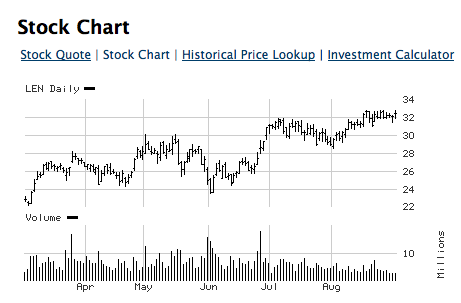
Florida-based Lennar’s stock value has improved this year rising by a third since earlier this year.
Lennar has three subdivisions in Visalia with prices starting as low as $189,000. The average new home inVisalia is being permitted at around $200,000. Attractive mortgage rates right now show paying a $180,000 mortgage for 30 years is around $860 per month, about the same as renting.
Helping the new home market has been a decline in existing home inventory seen across the state. A recent Redfin survey found homeowners holding off putting their houses up for sale figuring it will fetch more later. Instead, they are renting out their house. “We believe the main problem is not, as conventional wisdom would have it, that people can’t sell because they’re underwater on their mortgage. The problem with sales volume is that most homeowners just don’t want to sell.” says Redfin CEO Glenn Kelman.
For buyers facing fewer used home choices on the market – why not go for new home?
Local home builder Gary Smee agrees that demand has improved. “Our traffic has picked up” says Smee who has subdivisions in Porterville and Goshen. “With the low inventory out there people are willing to pay more but the appraisals are behind.That’s what is holding things up.”
Smee says he believes it will take some time for the appraisals to reach what buyers are willing to pay for.
Smee says in Porterville he is only builder left doing new homes in any number with Woodard Homes gone and Ennis doing only a few after their bankruptcy.
A tastier California navel orange will hit the market this season, thanks to seven years of
consumer research that has resulted in the all‐new California StandardTM. The California StandardTM is the new standard by which all California navels will be measured, in an effort to ensure a better navel orange eating experience and better sales results. Previously, California navels were required to meet a ratio measurement, which the industry has now shown to be an ineffective predictor of eating quality.
The new California StandardTM instead measures the balance between brix (sweetness) and acidity, which is a superior indicator of sweetness and taste. Through field testing, it is anticipated that The California StandardTM will significantly improve eating quality and sales, without impacting availability.
“We realized that we needed to strengthen our position in the marketplace and pay as much attention to the inside of the fruit as we have to the outside,” noted Joel Nelsen, president of California Citrus Mutual. “We, as an industry, took it upon ourselves to do the research, and find a solution that will benefit the grower and the consumer. The California StandardTM is that solution.” The California StandardTM is the result of consumer research conducted by California Citrus Mutual, the California Citrus Research Board, the University of California and USDA/Agricultural Research Service. The taste studies concluded that Brix minus Acid is a better predictor of flavor than the previous sugar‐to‐acid ratios. The new Standard was recommended by the California Citrus Mutual, supported by the citrus industry and ultimately adopted into regulation by the California Department of Food and Agriculture.
For California Citrus Mutual board chairman Tom Wollenman, The California StandardTM means that “consumers will receive a product early in the season that has a higher level of flavor acceptability. A better indicator of good flavor is the essence of the Standard.”
Consumer‐based research documented several key points that led to the development and adoption of The California StandardTM.
• Competition in the produce aisle has increased and fresh orange consumption has dropped
• Early season navels tend to have low customer satisfaction • A positive eating experience would cause 65% of consumers to eat more navelsTM
• The California Standard replaces 35% of less‐tasty fruit with fruit that meets onsumer expectations
• The California StandardTM exhibits a 90%+ accuracy in determining purchase intent. “With The California StandardTM we can deliver good fruit at the first delivery, to shorten he repurchase cycle and improve sales,” Nelsen concluded. “It’s all about better fruit at the right time.”
A desire to reduce fuel and water use is leading some farmers in the Central Valley to operate in new, more sustainable ways, reported Alice Daniel on KQED’s The California Report this morning.
For the five-minute story, Daniel interviewed Jeff Mitchell, UC Cooperative Extension specialist in the Department of Plant Sciences at UC Davis, and Dino Giacomazzi, a Hanford dairy farmer. These new farming systems, they said, aren’t straight forward and require a steep learning curve.
Sometimes they find themselves wondering, “What is happening out here?” Mitchell says. “And all your built-up experience base flies out the window.”
In the last seven years, Giacomazzi has dramatically changed the way he grows cattle feed. He has reduced the number of times he tills the field from 14 to just 2 times a year. Despite documented savings in fuel and reduction in dust emission, conservation agriculture has not been implemented widely in the Central Valley. Farmers like innovation, Giacomazzi notes, but many are reluctant to take the risk associated with changing long-held farming practices.
“It’s very difficult to make money farming,” Giacomazzi said. “You’re only going to get one shot each year to make it.”
Those interested in learning more about conservation agriculture systems are invited to the annual Twilight Conservation Agriculture field day, 4 p.m. Sept. 13 at the UC West Side Research and Extension Center. For more information, see the meeting announcement. Register for the free event here: http://ucanr.edu/TwilightReservation
The City of San Luis Obispo’s sales tax revenue in the first quarter of 2012 – January through March 2012 – was up by 9.2% compared with the same quarter last year. This follows an 11.7% increase last quarter. This is the eighth consecutive quarter of recovery following 11 quarters of decline but still below the peak in 2006-07.
The city’s sales tax newsletter adds that by area in town- Los Osos Valley Rd was up 1.8%, south Higuera was down 6.6%,Madonna Rd down 4.6% but Downtown was up 12.5%. By category the report says auto sales, fuel and restaurants – up 20%- all were higher. Lumber and building materials seemed to come to life – up 40%.
The report compares the City of SLO with the county and state. Taxable sales countywide were up 14.25% while the state was up 8.4%.
Nationwide,retailers are reporting strong back to school sales through August despite escalating worries about the slow pace of economic recovery. SLO Real Estate Market..New Day?
Real estate agent,Collette Kutil of Paterson Realty wrote the following in August in her blog, reflecting a new optimism in the marketplace.
“Last year I worked with a few frustrated sellers, their homes would hang out on the market for a while and receive low ball offers. Plus, buyers would nitpick the properties apart and ask for a ton of concessions. The agents (myself) would communicate and assure our sellers that we’re doing our best to promote and sell their homes for the best price. Contrast that with today’s market, sellers are receiving multiples offers with in hours of the property going live on the Multiple Listing Service – MLS. As an example, today my client toured a home in Arroyo Grande that has been on the market for 2 days. This home was previously listed last year for 9 months with no sale. Today I called the listing agent and was informed that there are already four offers….hurry…. if I want my offer to be reviewed. I know this house well, I showed it last year multiple times to clients that didn’t want to pay the asking price of $299K. Today the property is listed for $40K more and the seller is going to get their price. I hope my client gets a chance for consideration with our offer, including consideration on the forthcoming multiple counter offer. Like I said, it’s a new market!!!”
Mortgage Rates Stay Low
Aug. 30, 2012,Freddie Mac released the results of its Primary Mortgage Market Survey® , showing fixed mortgage rates pulling back and following bond yields lower after gradually moving higher over the past month.
30-year fixed-rate mortgage (FRM) averaged 3.59 percent with an average 0.6 point for the week ending August 30, 2012, down from last week when it averaged 3.66 percent. Last year at this time, the 30-year FRM averaged 4.22 percent.
More Labor Day Travelers
Labor Day travel in Southern California is expected to increase by 3.4 percent over last year, with 2.35 million Southland residents projected to take trips over the holiday weekend, according to the Automobile Club of Southern California.
More than 1.85 million Southern Californians are expected to drive to their destinations, an increase of 3.6 percent over the 1.79 million who traveled by car last year. Many will head to the Central Coast where good weather is expected.
The number of Southland travelers by plane is expected to increase by 4.1 percent to 306,000, compared to 294,000 last year. The number of travelers by all other modes – including bus, train, RV and cruise ship – is expected to stay about the same as last year at 190,000.
“Travel interest and bookings have seen improvement compared with 2011,” said Filomena Andre, the Auto Club’s vice president for travel products and services. “Although gas prices are expected to be higher this holiday weekend than during other Labor Day weekends, we anticipate this to have very little impact on holiday travel, because most people have planned their trips and made reservations before the dramatic rise in gas prices. And fuel costs typically represent a fairly small percentage of the overall trip budget.”
Statewide, 3.79 million travelers are expected to get away this holiday weekend – a 3.4 percent increase over last year’s 3.66 million. Of those, 2.99 million will drive, which is a 3.6 percent increase from last year, and 492,000 will fly, which is a 4.1 percent increase. About 306,000 are expected to go by other modes of travel.
LA/U.S.Tourism
In related news, the LA Tourism and Convention Board said last week that July tourism set a record with 83.9% of hotel rooms occupied in July,a 25 year record.This is the seventh straight month of a rebound from the 2011 downturn.
Also, the U.S. hotel industry experienced positive results in the three key performance metrics during the week of 12-18 August 2012, according to data from Smith Travel. In year-over-year comparisons, occupancy ended the week with a 3.6-percent increase to 69.6 percent, average daily rate was up 4.4 percent to US$106.58 and revenue per available room ended the week with an increase of 8.1 percent to US$74.21. Among the Top 25 Markets, St. Louis, Missouri-Illinois, reported the largest occupancy increase, rising 12.5 percent to 66.3 percent. Houston, Texas, followed with an 11.0-percent increase to 64.1 percent. Boston, Massachusetts, fell 2.9 percent in occupancy to 81.8 percent, posting the largest decrease in that metric. Three markets experienced double-digit ADR gains for the week: Oahu Island, Hawaii (+17.8 percent to US$207.82); San Francisco/San Mateo, California (+11.2 percent to US$171.80); and San Diego, California (+10.1 percent to US$145.03).
Fresno County Planning Commission will meet September 13 and is expected to approve construction plans for a pilot “Beet Energy” plant near Five Points. The long awaited project will break ground in October and will be up and running by June says proponent and area farmer John Diener.
“We’re going to do it” exclaims Diener, known as an ag innovator who will house the pilot facility on his Red Rock Ranch where the beets will be grown.
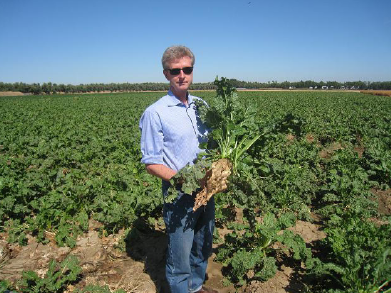
Sugar beets – once a major crop in Fresno County – is no longer grown for sugar because there is no processing plant anymore. Now, the California Energy Commission(CEC) is eager to explore ways to produce low-carbon motor fuels from plants and is funding this pilot facility that could lead to a much larger $200 million privately-funded biofuel production plant in Mendota.
In the planning stage since 2009, the integrated project includes the Mendota Advanced Bioenergy Beet Cooperative who together with Diener have been awarded $5 million by the CEC to build the model plant expected to produce 1 million gallons of ethanol processed from 250 acres of energy beets. The beets – larger than common sugar beet -would be harvested all year round. The project had already received a $1.5 million matching grant to examine the feasibility of the idea and now has the green light to move forward.
Sugar beets, that once covered over 300,000 acres statewide has now dwindled to 70,000 acres,all in Imperial County. The Central Valley once had 100,000 acres of sugar beets before Spreckels Sugar closed its doors after a 100 year run leaving farmers high and dry. California that once had 11 sugar mills is now down to one in the south state.
But now, a number of former Spreckels growers – members of the beet cooperative – hope the crop makes a comeback added to the growing number of plant materials harvested for low carbon fuels to help cut greenhouse gases.
Cut to Corn Ethanol Support
While the State of California appears to be backing away from full support for more ethanol made from corn,interest in cellulosic ethanol projects is gaining support. This week Gov. Jerry Brown signed AB 523 by Assemblyman David G. Valadao into law. AB 523 eliminates all future state funding for the production of ethanol derived from corn after July 2013. Currently, approximately $6 million is provided to a very small group of corn ethanol producers. AB 523 would redirect that money away from corn ethanol and towards other forms of renewable energy, including ethanol not derived from corn.
Beet Energy’s project consultant Jim Tischer of Fresno State says the benefits of turning beets into biofuel are attractive.”We’re talking about a much higher BTU content with three times the ethanol production per acre compared to corn.” The result is this biofuel would be much “greener’ than corn-based ethanol – lower carbon content than Brazilian ethanol as well he says. This will be important is meet the state’s low carbon fuel standard as it kicks in in coming years.
The integration that helps make the fuel “greener” includes four different technologies in one facility to produce ethanol, renewable biomethane, compost and fertilizer, and green electricity. The primary feedstocks will be sugar beets and almond orchard prunings. This integrated biorefinery combines the following renewable technologies: advanced ethanol production, anaerobic digestion, biomass gasification, water recycling, and wastewater treatment.
If the pilot proves successful Tischer says investors and lenders are in the wings that could be eager to build the full-scale production plant that would covert both ag waste and beets into ethanol and other fuel, green electricity and other green products.
beet growers would ship to Mendota
Multiple Green Products
The plant to be build in Mendota by 2016 would convert 840,000 tons of beets and 80,000 tons of almond clippings each year into 33.5 million gallons of ethanol; 1.6 million standard cubic feet of biomethane for making compressed natural gas; 6.3 megawatts of certified green electricity; and high-nutrient compost and liquid fertilizer.
For waste water treatment the processes could add 400 acre ft of treated water for irrigation of crop land.
The project could create approximately 250 direct and 50 indirect construction jobs in the Fresno County agricultural community of Mendota, along with 50 long-term jobs at the biorefinery and an additional 50 jobs for feedstock operations.
Help For Western Fresno County
“We estimate that the plant would mean about $110 million a year in economic activity to the area” says Tischer.The Mendota area has been particularly hard hit by years of recession and drought and would welcome some positive news that could provide both steady work and help clean the air too.
A key factor in the feasibility is whether the plan to grow beets year round on 35,000 acres within a 60 mile radius of Mendota works out. “Our pilot project should determine if we can prove out year-round harvest” suggests Diener. To compete with corn that can be stored,beet growers contracted with the plant would need to keep feeding the plant with about 4000 tons a day.Winter months are typically when beets grow in the Valley. Beets grown too far away would face high transportation costs making the facility less efficient.
Already the beets that will be used in the pilot refinery have been planted.The whole beet plant can be processed.
California is not the only place where the experiments with beets for biofuel is going forward. A mothballed corn ethanol plant in North Dakota is being converted this year to accept 12,000 acres of beets near Fargo.
Other Valley companies are experimenting with varied crops to make biofuel including sorghum, switchgrass and South American root crops by Aemetis Inc who own a 60 million gallon ethanol facility in Keyes and say one root crop could generate 2000 gallons per acre of ethanol according to a study.
An international cheese company is expected to announce a decision of where they will build a new 220 job cheese plant with two of the finalists said to be in the Central Valley and a location in Eastern New Mexico also in the running. The company’s consultants who first surfaced here in March have told local officials the two nearby locations are the City of Sanger and the City of Tulare.”We’ve heard we are one of the finalists” confirms Sanger economic development manager Dan Spears. Locals have been told the unnamed manufacturer would make a decision after September 1. While the cost of milk in California may be less than in New Mexico,attractive to a processor – the cost of doing business here is higher. We still have but the advantage of the largest milk supply, a cluster of supply firms and proximity to export markets. Tulare County is the US’s number one dairy county.New Mexico’s drought conditions have been worse this past year than California but the state’s fast growing dairy industry enjoys a shipping advantage to send product to the East Coast.
Expansion of Enterprise Zone Awaits State OK
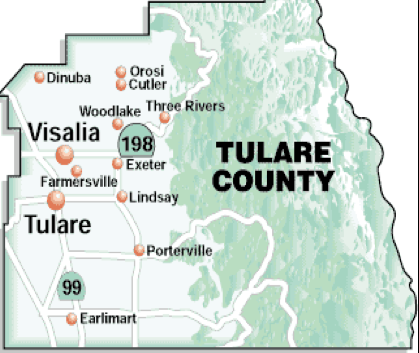
Tulare County has applied to the state early in August to expand the designated state Enterprise Zone about 10% or 5,084 acres (4,457.80 industrial, 626.28 commercial) and includes properties in the Cities of Exeter, Lindsay, Porterville, Tulare, Visalia and the unincorporated communities/areas of Cutler, Dinuba (area), Earlimart, North Delano, Exeter (area), Farmersville (area), Goshen, Pixley, Tipton, Richgrove, Terra Bella, Traver and Tulare (area) says Tulare County EDC chief Paul Saldana.
“The EDC, as the Enterprise Zone Administrator, coordinated the expansion application with all of the incorporated cities and the County, which are all required to approve the expansion and all have.”
State officials say they typically turn around an application in about 30 days meaning a decision should be coming soon.
Tulare County economic development official Mike Washam says several ag-related companies have advised him they want to expand or build new if the designation on the additional lands comes through.The zone offers tax breaks to companies who plan to add equipment and/or employees.The current zone was only just approved January 1.
Shippers To Comment on Rail Sale /Work On Exeter Rail To Start
Rail firm Genesee & Wyoming Inc’s deal to buy rival RailAmerica Inc for $1.39 billion would create the biggest short-line railroad operator in the United States. Now local shippers as well as local government wants to comment to a federal board who has to approve the merger to try to leverage better service and lower costs here. A three-county group who use the San Joaquin Valley Railroad line in the Valley,owned by RailAmerica,huddled in Tulare this week with a Washington attorney to go over their strategy.TCAG rail committee member Tom Sparks who attended the meeting,says both the shippers and public entities will offer their comments .”Hopefully,the new company can grow the business rather than just add fees that reduce the use of the rail line” says Sparks.
In related news, Sparks says work to repair the aging Exeter to Dinuba rail segment on the SJVRR line should start in October funded by public monies designated through the Valley Air District to help clean the air.The $1.5 million in repairs to the track would speed up freight traffic from 3 mph in some spots to 15mph with a 5-year plan in place to upgrade further to accommodate 40 mph speeds. The idea is to reduce truck traffic pollution.
Almond & Pistachio Sales Stay Strong,Walnuts Lag
Continued strong export demand for California nut crops this year.Year to date almond sales through July are up nearly 14% while pistachio shipments have jumped 25%.But walnut shipments are down around 11% year to date as a result of a smaller crop.
Porterville Packing House Adds Solar
Magnolia Citrus packing house has added about 3 &1/2 acres of solar panels next to their packing house near Porterville this summer.” Construction should be complete by September 15” says general manager Nick Arcure. The nearly $1 million project will offset 93% of their current electricity load, says Arcure. ”With a 28% increase in our power bill last year from SCE, we thought it was time to do this.”
Visalia Lays Off Economic Development Staffer/Gets New Job
Reflecting what is happening at municipalities across the state as a result of the loss of redevelopment,Ricard Noguera has left the employ of the City of Visalia as of August 13. Noguera headed up the city’s effort to recruit new retail and industrial business to Visalia and had been with the city for five years. Calls are now directed to city assistant city manager Mike Olmos. Good news for Noguera however – he has been hired to run the city of Tacoma Washington’s community and economic development department in the past few weeks.

 Three multi-million dollar waste-fed biomass digesters are in the works in Tulare County that will turn trash to cash, mostly into energy related products.