
California ethanol producing plants from Tulare County to Sacramento are working hard to wean themselves from high priced Midwest corn, company officials recently told a committee of the California Energy Commission.
Speaking to a fuels committee of the state agency, Pixley-based Calgren Renewable Fuels president Lyle Schlyer said they hope to encourage local farmers to grow grain sorghum(milo) in enough quantities to replace as much as 20% of the Midwest corn they import by the trainload now. Using milo requires few modifications to the plant to make ethanol and other co-products.
Midwest corn has been hit hard by a 60-year drought that has sent the price sky high for users including biofuel plants, food companies and livestock owners alike. The later two blame ethanol plant owners instead of Mother Nature.
“We’re all losing money right now”Schlyer admits for the state’s handful of ethanol producers. Corn prices have jumped from around $5 earlier this summer to near $8 a bushel, squeezing margins.
Understandably, the plants are looking to alternative feedstock to keep making ethanol that is blended across the US as a oxygenate in our gasoline.
Move to Help Dairy industry
Schlyer says “grain sorghum is not an ideal feedstock for dairy and …we think we can convert it into a good feedstock, so we won’t be competing with them for corn.” Some of most vocal criticism of the corn ethanol industry has come from California dairy producers.
“But we still need to find(milo) growers. So what we’re going to do in our current program is go out and see what we can do to incentivize growers, essentially contract for acreage.”
The diversification goes beyond feedstock. Schlyer says they are also seeking permit modifications to install a biodiesel production facility at their Pixley plant. “Using our extracted vegetable oil as feedstock, we believe we can produce some of the lowest carbon intensity biodiesel in California and not have to ship that stuff back to Illinois, to find a processor who is well suited to use it.” He adds the investment could be in the $5 to $10 million dollar range.
Their Ship Comes In

Well known player Pacific Ethanol based in Sacramento, says they too are bringing in milo instead of Midwest corn by the unit-train load,100 cars each, confirms company spokesman Paul Koehler.
CEO of Pacific Ethanol Neil Koehler told the same CEC committee August 1 they hope to bring in a vessel-load of sorghum from Argentina that could replace up to 5% of the Midwest corn they need to buy currently. This week, Paul Koehler confirmed the shipment “is likely to come into the Port of Stockton” where they have an ethanol plant – this fall. “I looks like it will happen.”
Pacific Ethanol like others, is adding corn oil extraction at 4 plants in the West that will give them another high value co-product to sell as did Calgren in Tulare County last year,helping them to move to profitability.
Energy Tubers in Fresno County
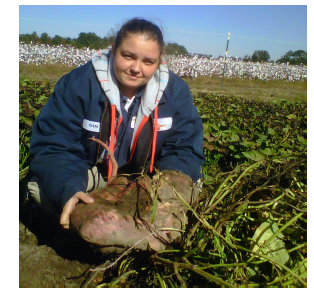
Even more more ambitious, owners of the Keyes, California biofuel plant Aemetis CEO Eric McAfee told the committee about their code name energy tubers. ”We went on a worldwide search over the course of half a decade and we came up with a product that the USDA believes is the highest yield in ethanol per acre, even in excess of Brazilian sugarcane. It happens to be a Peruvian product that the Chinese used a lot during the Mao Tse Tung revolution because they sent the intellectuals out to the farms and they were starving, and they wanted the fastest growing, highest yielding biological transformation of solar energy to starch that was possible, and they developed a product called CX1.” The code name refers to a large energy tuber, a casaba-like root plant (see picture).
“Over 15 years, the USDA commercialized it and we are the first company in the Western United States to actually take it into commercial production. Last year, we planted a field in Fresno County and we produced more than 1,900 gallons per acre of ethanol if you take the starch, convert to sugar, multiply it out, you end up with 1,900 gallons an acre of ethanol. This is between 10 and 20 percent more than you would get if you would have grown sugarcane in Fresno. And it’s almost four times the production of Ethanol from corn. If you can get four times the amount of fuel and so you have a lower cost biofuel at the pump.”
Mcafee says they are harvesting a crop in Fresno County this October.Mcafee continued that “within 48 months, we could be entirely weaned off of Midwestern feedstock and weaned off of corn if we continue to make just moderate investments and scaled up CX1 as a feedstock in the Central Valley. We would no longer import feedstock from the Midwest.”
“ I was just in Canada about a month ago and was with a grain company that scaled up a canola product to a million acres over the course of about five years, and had extensive discussions around the resource constraints to get us from zero to 30,000 acres, and I think it’s a very very achievable goal; we’re not going to have to do the million acres the Canadians did in order to have an impact.”
If Aemetis were to fund the scale-up,“we’d probably be at five percent weaned off(corn)next year, 20 percent the year after that, 60 percent the year after that, and 100 percent the year after that. The scale-up is pretty rapid.”
Aemetis recently designed, built and began to operate a corn oil extraction unit at Keyes that will produce about 2 million gallons per year of extracted oil for biodiesel or animal feed and reduce the carbon footprint of the facility that will be important over the next few years to comply with the state Low Carbon Fuel Standard. The LCFS mandates a cut of our fuel’s carbon emissions by 10% to reduce global warming.
Likewise at Pacific Ethanol with both near term and long focus is to reduce Midwest corn imports.

Says Neil Koehler, “Our goal” is to use“ locally produced corn and milo, and we would hope that that would be 25 to 40 percent over the next one to two years. We have programs in place that we’re looking for some support on to put in a five million gallon cellulose increment into our existing facilities.. in the range of 10 percent additional, with “the majority of our feedstock being both locally grown and new feedstocks over the next three to four year period.”
To accomplish that, Pacific Ethanol is working with Visalia-based EdenIQ to do a “bolt on” cellulosic plant to an existing corn ethanol facility that will work with a variety of feedstock.Paul Koehler says talks with EdenIQ “are mature” to launch the project. Similar work is underway at Aemetis with federal incentives in place to make cellulosic biofuel.
All the state’s plants including EdenIQ continue to lobby the California Energy Commission to help them financially move in the new direction agreeing to a compromise with critics recently over future state corn ethanol subsides. Late last month Governor Jerry Brown signed AB 523 by Assemblyman David G. Valadao into law. AB 523 eliminates all future state funding for the production of ethanol derived from corn after July 2013,less than a year from now.
Currently, approximately $6 million dollars is provided and AB 523 would redirect that money away from corn ethanol and towards other forms of renewable energy, including ethanol not derived from corn.”Over a year ago, we brought together our friends in Agriculture and many from the environmental community to oppose further state funding for the production of corn ethanol,says Valadao.
With red ink at these plants, the issue is one of survival near term. They say they hope to see the CEC support continue at least until July 2013noting that Midwest states continue to help their plants.