Valley News Nuggets.The Heat / High Speed Rail Station/ Birds Cost $1.5 Mil Delay

Extreme heat gradually subsided in the West says the latest USDA crop report Aug 29 noting the Midwest finally got some drought busting rain too late for most summer crops. But closer to home  Lancaster, CA, recorded 23 consecutive days (July 29 – August 20) of triple-digit heat, eclipsing the mark originally set from July 11-31, 2009. Lancaster also set a record with 20 days of 100-degree heat in August (previously, 19 days in 2001). Elsewhere in California, Fresno narrowly missed breaking a record for consecutive triple-digit days. Fresno’s streak of 100-degree readings lasted 19 days, from August 6-24, tied for third all time.

Tulare County still hopes to convince the California High Speed Rail Authority to run the bullet train to the east of Hanford aligning with Hwy 198 near 7th Ave instead of to the west of Hanford around Ave 13 – a six mile difference.That would make any roundtrip from Hwy 99 some 12 miles further,not good for ticket sales from the most populated part of the region – east of 99.One calculation is that Kings County is likely to sue CHSRA whichever choice they make although the Authority has not fully committed to a station in Kings County.

Nesting Swainson’s hawks with chicks on the construction route of Hwy 198 Expressway between Hanford and Visalia delayed construction of the big project for a number of weeks costing an extra $1.5 million says a Cal Trans communication to the Kings County Association Of Governments.The delay triggered a clause to pay the contractor in the event of such a delay.The paving where the nest was has now resumed as the baby birds developed, and all construction work is expected to be complete in November.KCOG director Terri King says federal and state funds paid for the delay.

Santa Maria Farmers & Farmworkers Assist In UC Pesticide-Exposure Research

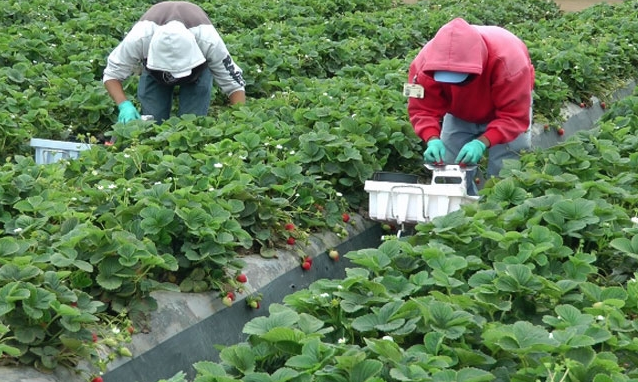
A group of Santa Maria farmworkers has volunteered to participate in a UC study to determine whether they are exposed to hazardous pesticide residues when harvesting strawberries.

The study is led by Robert Krieger, UC Cooperative Extension specialist in the Department of Entomology at UC Riverside. Krieger is an expert in environmental and occupational toxicology.
This summer, Krieger and a team of researchers spent nearly three weeks in Santa Maria with workers at DB Specialty Farms. The workers wear gloves as they pick strawberries. Before each break, their gloves are collected and frozen for later lab analysis.
“We’ve found that pesticides are transferred to the gloves during normal work and we’re measuring the amounts that are transferred in hopes that we can use it to measure total exposure,” Krieger said. “The real question is how much exposure occurs, how much is OK, and how little occurs under normal conditions of use.”
The team is also collecting samples of strawberries harvested by the workers and samples of leaves.
In order to understand uptake and excretion, the workers are asked to collect urine for 24-hour periods after working in sprayed fields. To be certain any sign of pesticides in the urine came from work exposure, the researchers have also collected 24-hour urine samples from spouses or roommates of the field workers to assess dietary or home exposure.
“The levels of exposure are determined by how much is applied, how much remains on the crop and how much is transferred to people. We’ve independently measured those and came up with an assessment of how much a person is exposed to during their normal work,” Krieger said.
The research focuses on two pesticides: the organophosphate malathion and the pyrethroid fenpropathrin. After the pesticides are applied, there is a three-day waiting period before harvest gets under way. In the project, as soon as the workers are back in the field, the monitoring begins.
Studies that Krieger has conducted over the past 18 years show that low, safe levels of pesticide are absorbed and rapidly excreted by harvesters. Breakdown products of the pesticides – parts of the pesticide molecule that are not toxic – can be measured in the urine, but it is not known whether the pesticide broke down on the plant, before the workers were exposed, or if the workers’ metabolism broke down the pesticides.
“Those breakdown products are not toxic, but if they are absorbed, they will appear in the urine and we can’t tell whether a plant made it or a person made it and that complicates our analysis and that’s one of the new areas that we’re investigating in 2012,” Krieger said.
By comparing the gloves, fruit, leaves and urine and using sophisticated metabolic chemistry in the laboratory analyses, the researchers will be able to reconstruct how much exposure there was during the work day.
If the research concludes that analyzing gloves is a useful way to measure worker exposure, gloves could become an important tool for farmers and regulators. Another probable area of impact from the study is in verifying the levels of exposure, which the researchers are finding to be very low.
“These workers have very low levels of pesticide exposure. And in fact, they’re the best-studied workers with respect to pesticide exposure in agriculture,” Krieger said. “That gives us confidence that the exposure is not having a health impact.”
Definitive results from the August study are expected in about six months.
The research program has been sponsored by strawberry growers of the California Strawberry Commission and the Personal Chemical Exposure Program, UC Riverside. The current Santa Maria research is possible by the involvement of DB Specialty Farms and Safari Farms of Santa Maria, and PrimusLabs.
The research was approved by the Institutional Review Board of UC Riverside and the California Environmental Protection Agency. All the participation is voluntary and the farmworkers and their spouses or roommates are compensated for the inconvenience of urine collection. They receive $25 for each 24-hour collection and a $100 bonus for completing all 10 urine collections.
In addition to the extra pay, the study volunteers benefit by helping improve pesticide safety for themselves and their colleagues.
“These workers are doing a service to other workers by allowing us to measure the amount of exposure that occurs during normal work,” Krieger said.

Feinstein to FTC: Investigate Spikes in California Gas Prices

Senator Dianne Feinstein (D-Calif.) today sent a letter to Jon Leibowitz, chairman of the Federal Trade Commission, calling for an investigation into recent spikes in the price of gasoline in California.
“The recent price spike began on August 6th, when a refinery fire at Chevron’s Richmond Refinery reduced refining capacity at the state’s third largest refinery,” Senator Feinstein wrote. “However, this dangerous incident has not resulted in a reduction of gasoline supply that would explain the recent rapid price increase.”
The letter continues: “Since August 6th, gasoline prices have risen 30 cents per gallon, reaching $4.21. As a result, California has the highest gas prices in the continental United States. The increase is more than double the increase in the national average over the same period.”
Text of the letter follows:
August 28, 2012
The Honorable Jon Leibowitz
Chairman
Federal Trade Commission
600 Pennsylvania Avenue, NW
Washington, DC 20580
Dear Chairman Leibowitz:
I am writing to request that the Federal Trade Commission immediately open an investigation into recent spikes in the price of gasoline in California that appear to be unjustified by supply and demand fundamentals. The Federal Trade Commission has unique authority to investigate and prevent any manipulative or deceptive device or contrivance that could be resulting in unjustifiably high gasoline prices.
Californians filling up at the pump this month have been greeted by rapid price increases. Since August 6th, gasoline prices have risen 30 cents per gallon, reaching $4.21. As a result, California has the highest gas prices in the continental United States. The increase is more than double the increase in the national average over the same period.
The recent price spike began on August 6th, when a refinery fire at Chevron’s Richmond Refinery reduced refining capacity at the state’s third largest refinery.
However, this dangerous incident has not resulted in a reduction of gasoline supply that would explain the recent rapid price increase. The California Energy Commission’s statistics show that just before the Chevron fire, the state’s refineries were producing about 6 million barrels of gasoline per week. The previous month, they were churning out 7 million barrels per week.
In fact, the state’s refineries churned out more gasoline the week after the fire than they did the week before the fire, not less. Production of California-grade gasoline jumped 12.4 percent, nearing 6.8 million barrels for the week after the fire, according to the California Energy Commission, as other refineries saw an opportunity to increase sales. The Richmond fire, therefore, never led to a shortage – a point emphasized by Chevron’s own spokeswoman Heather Kulp, who said “There is an excess of gas on the West Coast.” If the spike in California’s gasoline prices cannot be explained by supply and demand fundamentals, I believe it is vitally important that the Federal Trade Commission look into this matter expeditiously.
I also believe the that Federal Trade Commission should investigate why California gasoline prices consistently exceed prices in neighboring states, despite dramatic shifts in California’s fuel market in recent years. Gasoline sales in California have fallen from 8.5 million gallons per day in 2006 to 4.9 million gallons per day this year, as drivers switch to more-fuel-efficient cars and elect to utilize public transit. California refiners have been exporting fuel, and have been operating well below their capacity.
Despite this drop in demand, and a clear excess in capacity, Californians have continued to endure unusually high gasoline prices when compared to their neighbors to which fuel refined in California is being exported. Department of Energy statistics show that the average price of California gasoline was 14 cents higher than other western states in 2006, when high demand in California pushed refineries to their limits. Data this year shows that the price of gasoline in California has averaged 26 cents per gallon higher than other western states.
These statistics suggest other forces are at play. In 2009, the Government Accountability Office (GAO) published a thorough econometric analysis of gasoline markets nationwide which showed that highly concentrated markets – including San Francisco, San Diego and Los Angeles – were associated with higher wholesale gasoline prices, exceeding the prices in unconcentrated markets by an estimated 18 cents per gallon. This study suggests that refineries and fuel marketers in California have accumulated the market power necessary to move prices and maximize profits at the expense of California’s consumers.
The FTC’s Prohibition on Market Manipulation Rule (16 C.F.R. Part 317) specifically prohibits a single actor or a few collusive actors from setting the market price. Given the unusually high prices in California and the GAO’s conclusions, I ask that the FTC thoroughly investigate whether the use of market power is inflating gasoline prices in California.
High gasoline prices are contributing to significant economic pain for consumers and businesses in California and are jeopardizing our fragile economic recovery. A report by the University of Southern California’s Marshall School of Business estimated that for every penny increase in a gallon of gas, as much as a billion dollars is pulled from the U.S. economy each year. Californians could be spending these dollars to keep up with mortgage payments, paying college tuition, or investing in their local communities.
It is important that the Commission use its statutory authority aggressively to pursue and remedy any market schemes or other market distorting activities that have led to either the August spike in California gas prices or the longer term trend of higher gas prices in California.
Thank you very much for your consideration of this matter. If you have any questions or concerns, please do not hesitate to contact me in my Washington, DC office. I look forward to your timely response.
Sincerely,
Dianne Feinstein
United States Senator

Big SLO County Solar Projects To Energize

The two sprawling utility-scale solar projects in eastern San Luis Obispo county are approaching their second season of construction this fall and both are targeting energizing – hooking the panels up to PGE –  in coming months.

“We’re working on the third of six phases now” says First Solar on-site spokesperson Dawn Legg ”with well over 400 people working.” Ms Legg addressed the county Board of Supervisors this week to give them a progress report on the 550MW Topaz project being built by First Solar but owned by MidAmerican Solar. Legg says the workforce is mostly local and includes plenty of  stories of people glad to be working near home including returning veterans.

“We are on target to energize 48MW by the end of this year” says Legg – noting the complexity of coordinating all the moving parts including construction of a new substation and working with PG&E.

At the second large solar project in the Carrizo Plain – California Valley Solar Ranch –  being built by SunPower and Bechtel and owned by NRG – the 250MW project is a few months ahead of the other on their construction schedule and according to county planner John Mckenzie “energizing is likely in the next few weeks” – some 21 MW that will go out on the grid. About 400 people are working on this project as well.

“People who take a drive out here say when they approach the site – it is pretty impressive. There is no doubt about it – we are building a big power plant “adds Legg that will make sure the light stay on as the state moves to 33% renewables.” The Topaz project has been estimated at $417 million including property and sales tax revenues for the County, wages from direct and indirect employment, induced spending and supply chain revenues.The Sunpower project has been estimated to be valued at $ 315 million in a Cal Poly study.

It will be another two years before both projects are completed.

SCE Plans Central Valley Smart Meter Rollout In October

Southern California Edison officials are making the rounds in local city halls and county board rooms to get the word out that installation of new smart meter technology in Central Valley homes and businesses is near.

SCE regional manager Brian Thoburn is meeting with the Kings County Board of Supervisors and the city councils of Exeter, Farmersville and Woodlake among others to go over the program with installation starting in October to begin connecting around 200,000 meters in the Valley.

Already some 4.6 million smart meters have been installed in Southern California.

“What we are talking about is customer empowerment” says Thoburn who works out of the Tulare SCE office.”The new meters will give you access to information to help you manage your electricity usage and save money.”

For many people this will mean added convenience instead of waiting a month to see your bill, you can go online and see how much electricity you used yesterday.” This allows people to better budget as well.

“We think these meters will be more convenient  adding increased reliability to their service and even offering remote on and off services.

Industrywide, statistics show power users hooked to smart meter are better able to conserve, says Thoburn a key goal of both the utilities and the State of California. In the event of a power outage the meters will help Edison to more quickly respond.

Smart meters are not only the standard in the electricity business but in water service and soon natural gas expects Thoburn.

Regarding SCE’s experience in Southern California where installations of  the meters has been going on since 2009 “customers seem to have few issues with it.”

Thoburn emphasizes that customers will have a choice to” opt out” of the Edison Smart/Connect meter at a small monthly charge.

Thobrun concludes that  the new meters will help customers monitor and manage their energy use online and if they want,get information via in home internet displays or even cell phones.

Installation of the meters should go smoothly with little disruption expects SCE with the work done by  contractor Corix Utilities  in yellow vests identifying themselves at your home or business.

Around Tulare County: Kings Canyon / Talking Trash / Visalia Airport

Kings Canyon Entrance Station To Open:

Kings Canyon National Park’s new entrance station at Big Stump on Highway 180 will open in the next few days.- targeting September 1.The new  check-in station was  was made necessary because of fear that a large Giant Sequoia nearby would fall near the site of the former station. The station services more than 600,000 visitors a year.The new station,in the works since 2004 is located 2.5 miles east of the former station.


Talking Trash: County To Raise Tipping Fees,Close Refuse Facilities & Mandate In-County Disposal.

Facing a $5.1 million budget shortfall the Tulare County Board Of Supervisors are poised to take various measures to raise revenue and cut costs. The actions include raising the tipping fee from $31 a ton to $34.

Further, they plan to close trash transfer stations in rural areas in  Earlimart, Balance Rock, Badger, and Kennedy Meadows Transfer Stations, effective October 1, 2012. Also they will authorize a reduction in days of operation for the Teapot Dome Landfill to Thursdays (7:00 a.m. to 4:00 p.m.) through Saturdays (8:00 a.m. to 4:00 p.m.), effective October 1, 2012.

In addition the county wants to require Licensed Refuse Haulers to deliver waste material collected within their Service Area, excluding recyclables or residuals, to a County operated Solid Waste Facility, effective October 1, 2012 instead of allowing the option to take trash out of county.

Avenal landfill a favored location according to a county report that says Avenal landfill receives 520,000 tons annually compared to 270,00 tons delivered to the Tulare County landfills.

The report says the county is losing revenue in part because 141,000 tons of solid waste is being diverted to landfills outside the county.Most of that to Avenal.

Despite the fact that the Avenal dump has a posted price of $40 a ton contract prices are much lower says Tulare Public Works Director Lew Nelson.”They may be as low as $7” he has heard. Nelson says the city hauls their own trash to the county landfill and will have to bear the higher expense of raising the tipping fee almost 10%.

Some of Visalia’s trash apparently goes to Avenal too,something the county would like to change.”When you add the cost of diesel and hauling the trash across to the other side of the Valley, Avenal’s disposal fee has to be lots cheaper than Tulare county.”says Nelson.

The county estimates that about 43,000 tons of solid waste is being diverted to out-of-county landfills by county licensed haulers and if all was recovered it would generate an addition $1.3 million to the county. The county says they have the power to order such “flow control” and that other counties also make such a requirement.

Avenal disposal is owned by the city of Avenal and operated by Waste Connections based inTexas. The company recently relocated its corporate office from California.

Along with raising revenue and other cuts, the remainder of the county deficit has been covered by measures staff put in place in the past few months, which included eliminating seven full time vacant positions, postponing equipment purchases, and reducing service contracts. Those measures saved $800,000.

Tulare County Administrative Officer Jean Rousseau said the operating
deficit to the Solid Waste Enterprise Fund can be attributed to dated
landfill fees, a reduction in material received, low interest rates, and
a reduction in reserves that earn interest.

“Enterprise funds are used for services provided to the public
through user charges, which should cover 100 percent of the cost through no subsidy from the County,” Rousseau said. “Staff has made cuts, but it wasn’t enough. The proposed recommendations should help significantly reduce the deficit. We will need to monitor the impacts of these changes to the Solid Waste Fund to determine if additional changes are necessary.”

The Solid Waste Enterprise Fund has been operating at an average
deficit of $4 million for several years. Solid Waste Enterprise Fund
reserves, typically used for landfill expansion and equipment purchases, had been used to cover the deficit.

Visalia Selects Great Lakes Airline in Completion

The Visalia City Council has agreed with the recommendation of a city committee favoring an application from Great Lakes Airline to continue to serve the city’s airport with regular flights under the federal Essential Air Service program.Great Lakes proposal was picked over SeaPort Airlines of Portland, Ore. says airport administrator  Administrator Mario Cifuentez and the recommendation forwarded to FAA earlier this month.Now the FAA will make the final  determination  says Cifuentez and a new contract period will begin October 1. The city hopes to get more flights to LAX daily.

$56 Mil Projects Offer Tulare Big Boost

Who says stimulus is a bad word?

If it were not for local taxpayer-funded Measure R and the Tulare County Association of Governments (TCAG) the City of Tulare would likely just have to wait some more to begin building two large transportation projects with a construction spending impact of $56 million that are key to the town’s business future.

The long awaited projects, the $18.5 million Bardsley railroad crossing  underpass and the $37.7 million Cartmill freeway interchange off Hwy 99 each face a “funding gap” says city manager Don Dorman in two early August letters to the TCAG board.

Each project could move forward this fall with construction next year  now that a request was approved at TCAG’s Aug 20 meeting.

The interchange project alone could spur millions of dollars in new office,residential and retail projects that are already approved beyond the $56 million in construction work.

Bardsley Project

Regards the Bardsely grade separation,Dorman says while the city has secured $7.1 million from the California Transportation Commission, has a commitment from Union Pacific railroad to pay $1.6 million and has spent $1.4 in Measure R funds, the local match is still short $6.5 million.

The city requested TCAG approve the $6.5 million to meet a state deadline to award a construction contract by November of this year.

The project should safely speed commerce in this town divided by a busy freight rail line. The city recently completed a second rail crossing at Cartmill. Both grade separations should help the city’s Downtown.

TCAG’s staff report suggests approval of the funds amounts to juggling of monies from future budget years and adding expected $2.2 million in project cost savings, they would borrow in a short term loan from the Tulare County treasurer – resulting in funding that “would not affect any other Measure R project.”

Measure R, a one-half cent sales tax approved by Tulare County voters in 2006, provides a 50% local match to state funds to “leverage additional state funding” says TCAG director Ted Smalley, also allowing flexibility to move projects up to take advantage of state funding availability.

This month’s TCAG agenda also included news that the Measure R funds has enjoyed a 12% increase in revenues vs last year on improved sales tax returns around the county.

The second – even larger project – the reconstruction of the Cartmill interchange – in the works since 2005 – promises to stimulate regional retail commercial and business activity along the freeway and at all four quadrants leading to an increase in sales tax and property tax revenues from expected development projects.

Dorman – in his letter – asks the TCAG board to decide “whether the city of Tulare should proceed with the right-of-way acquisition” using $5.1 million already budgeted by TCAG using Measure R funds now budgeted for the 12/13 and 13/14 fiscal years.

Without funds for the ROW the chance to receive state funds for construction any time soon is reduced, says Dorman.

Dorman points to an additional $5 million in “savings” from current Hwy 99 widening projects and other possible funding that still leaves a$4.5 million “funding gap’”based on the engineer estimate for the big project at $37.7 million.

The state is sharing the cost savings that have been coming in for the past several years on highway projects from hungry contractors and Tulare hopes to garner $5 million from CalTrans at some point.

Deadlines Loom For Cartmill Project

With some deadlines bearing down, Dorman says he plans to seek city council approval to move the project to construction based on TCAG’s decision at a Tulare City Council meeting to be held  September 4.

CalTrans plans to certify the EIR on the project August 29.

City Engineer Mike Whitlock says the schedule calls for advertising the project for bidding in January 2013 with construction set to start in April. The city needs to acquire about 30 acres on all four corners of the freeway interchange to do the reconstruction work. Offers to buy the property are going out now according to the project schedule.

Still, the city will need to come to an agreement with property owners who met July 31 with the city.”We are optimistic we will come to an agreement with the property owners” states Whitlock.

Tulare also seeks assurances from TCAG that if the project is delayed   for an extended time the city should not be found in default because of a project interruption.

According to the project schedule the interchange reconstruction would be complete by February 2014. Being built at the same time will be the Bardsley underpass  that could start construction in early 2013 on an 18 month construction pace.

Put them together and you have a nice shot in the arm to Tulare starting early next year and there after. Several major projects are approved to move forward near the Cartmill interchange that have been waiting for some certainty of better access that are expected to get the green light now.

Those include a major shopping center planned by the Lagomarsino group, a new bank headquarters who recently purchased land and a large retirement living complex.The nearby outlet mall should also expand.


ASSEMBLY TO VOTE ON COMMUNITY SOLAR BILL

From Rewire

If you’d like to use electricity from rooftop solar but you don’t own a rooftop to put it on, the California Assembly will soon be deciding whether or not to help you. On Monday, August 27 the Assembly is scheduled to vote on SB 843, which would allow renters, low-income Californians and others who can’t install solar panels on their own property to buy shares in offsite solar facilities of up to 20 megawatts in size, and share in the proceeds from power sales to utilities.

SB 843, if enacted, would create the Community-Based Renewable Energy Self-Generation Program in which retail utility customers could offset up to 100% of their utility bills by buying shares in a shared facility — often referred to as a “solar garden.” The state’s Senate passed the bill in 2011. Its author is State Senator Lois Wolk; the bill was introduced in the Assembly by Members Huffman and Skinner.

Upfront costs for buying into a solar garden and the amount of credit a participant receives per kilowatt-hour generated would largely be up to the facility operator. As there’s an intermediary involved, the financial return per kilowatt of generating capacity a participant buys in a solar garden will be less than if that person sold the power to the utility directly. Then again, the same is true of solar leasing programs for homeowners, and those haven’t suffered as a result.

The state’s three major investor-owned utilities are split in their views on SB 843. San Diego Gas and Electric supports the bill, while Southern California Edison and Pacific Gas and Electric oppose it. The bill is not without its environmentalist critics either, including many clean energy advocates. An analysis of the bill by the San Francisco Bay Area group Local Clean Energy Alliance (LCEA) charges that the 20-megawatt cap is far too large to truly encourage the development of community-based solar gardens. (A 20-megawatt PV installation would cover about 160 acres of land.)

The bill also requires only that the solar facility be in the service area of the utility serving the customer, which means a PG&E customer in Oakland could buy power from a solar facility in the Mojave Desert — better than coal fired power, but not exactly a source of community development. LCEA is advocating the bill be amended to lower the capacity ceiling to encourage more development of solar facilities of 1 megawatt or less. The group also advocates a “local generation only” amendment to the bill, as well as provisions to ensure facilities are sited responsibly, on disturbed or developed lands including polluted “brownfields.”

Amended or not, if the bill passes the Assembly on Monday it will undoubtedly be signed by the governor, given his unnuanced support of all things solar.


Foreign Olives Still A Problem For California Growers

The Olive Growers Council of California  announced reaching agreement this past week with the major black ripe olive processors for prices to be paid to table olive growers for their 2012 olive crop.
Following several weeks of negotiations with OGC, Bell Carter Olive Company, Corning and Musco Family Olive Company, Tracy both agreed to the following price schedule that mirrors what growers received for the short crop of 26,566 tons harvested in 2011. The current industry estimate for the 2012 crop ranges from 85,000 to 95,000 tons.
“Although the growers had hoped for improved prices for medium, large and extra-large Manzanillo olives because of minimum inventories, the industry has an imbalance of both small olives and canning size Sevillano variety,” said Adin Hester, President of the Olive Growers Council. “In the final analysis, we are pleased the processors recognize the importance of providing a positive vision of California’s table olive future by maintaining stable prices for growers as we deal with a market that is being greatly impacted by imported sliced olives for food service along with government aid programs that encourage foreign countries to produce and sell olives in the U.S.”
The 2012 price schedule represents some of the highest paid in industry history at $1250 for Extra Large Manzanillo olives.
Unfortunately, for growers to survive financially, they need to produce good yields per acre on a consistent basis which has not been the case. Within the last six years, growers have had two successful crops and four failures thanks to weather related issues….frost damage to buds, hot weather during bloom and rain during pollination.
Of the two table olive districts, Northern California and the Central Valley, there is a strong crop in the north and modest crop in the south. As the industry approaches harvest in September, there is currently concern that adequate labor will be available to hand harvest the 2012 table olive crop.
The latest USDA Olive report shows food service sales of California olives is up 15.66%.

Ag Update: Meatpacker Shut Down / More California Corn / Letuce Recall / More

California Farmers Plant 20% More Corn
USDA says California’s 2012 corn for grain production forecast is 958 thousand tons, 23 percent above 2011.With the Midwest drought the state’s farmers are expected to reap record prices with the harvest to come this fall.
The harvested acreage is expected to total 180 thousand acres, 20 percent above a year earlier. The forecast yields, at 5.32 tons per acre, are 3 percent above a year earlier.
The U.S. corn for grain production is forecast at 302 million tons, 13 percent below 2011. Widespread drought and extreme temperatures during June and July have had an adverse effect on the 2012 corn crop. Based on conditions as of August 1, yields are expected to average 3.45 tons per acre, down 16 percent from last year. If realized, this will be the lowest average yield since 1995. Growers expect to harvest 87.4 million acres of corn for grain, down 2 percent from the June forecast, but up 4 percent from last year.

Recall Of Romaine Lettuce

Salinas-based Tanimura & Antle Inc. has voluntarily recalled a single lot of romaine lettuce because it may be contaminated with Escherichia coli O157:H7 bacteria (E. Coli O157:H7).
The affected product is limited to Tanimura & Antle Field Fresh Wrapped Single Head Romaine. This product is packed in a plastic bag with the UPC number 0-27918-20314-9 and may have a Best Buy date of “08 19 12″. The product was available at retail locations Aug. 2 – Aug. 19, 2012. A total of 2,095 cases of potentially affected product were distributed throughout the US and Canada starting on August 2.

Feds Close Hanford Calif. Slaughterhouse After Abuse Video

The AP reports that” Federal regulators have shut down a Central California slaughterhouse after receiving undercover video showing dairy cows – some unable to walk – being repeatedly shocked and shot before being slaughtered.
Officials with the U.S. Department of Agriculture, which inspects meat facilities, suspended operations Monday at Central Valley Meat Co. in Hanford, Calif., which slaughters cows when they lose their value as milk producers.
The USDA received hours of videotape Friday from Compassion Over Killing, an animal welfare group, which said its undercover investigator was employed by the slaughterhouse and made the video over a two-week period in June.
“USDA considers inhumane treatment of animals at slaughter facilities to be unacceptable and is conducting a thorough investigation into these allegations,” said Justin DeJong, spokesman for the Food Safety Inspection Service.”
On Wednesday Aug 22 it was reported that USDA believes there was no tainted meat from ‘downer animals” that entered the food supply. The meat packer supplies the USDA school lunch program. In another development, the fast food chain InN’Out said they would withdraw a contract with Central Valley Meat to supply them.
Local ag officials said the company appeared to be assumed guilty before the investigation was complete.But USDA said the video showed a full investigation was warranted before the plant is allowed to use their stamp of approval.
One ag official allowed that no one condones mistreatment of animals  but notes that the group that shot the video is committed to convince consumers to stop eating meat.
The issue was further clouded by the fact that two USDA inspectors were stationed at the plant who did not report the mistreatment.
Animal care expert, Dave Daley, PhD, Associate Dean for the College of Agriculture at California State University and an active member of the cattle community issued the following statement.
“The vast majority of cattlemen stand firm in adhering to the absolute best animal care and handling guidelines established by veterinarians and other experts. We do not condone any mishandling of livestock on the farm or ranch or in the packing facility. In fact, we firmly believe that those knowingly and willfully committing any abuse to animals should not be in the business – period. The actions depicted in these videos are disgraceful and not representative of the cattle community.”
The closure of the packing plant further complicates the life of stressed out dairymen who have been forced to cull their cows in increasing numbers due to high feed prices. “Dairy operators who cant afford to feed their animals are being put in a tough position” say Kings ag commissioner Tim Niswander. ”Maybe they need to let them out to pasture.” He says slaughterhouses bid at auction on lots of cows and since Central Valley Meat is not bidding now – that lowers the price of cows sold at the auction.The Kings County closure leaves only one packer in Fresno open nearby in the heart of dairy country- home to 1.6 million cows.

UC’s First Center Pivot Irrigation System
In a clear sign of changing times in California agriculture, the University of California dedicates its first full-sized center pivot overhead irrigation system at the UC West Side Research and Extension Center during the Twilight Conservation Agriculture field day at 4 p.m. on Sept. 13. The center is at 17353 W. Oakland Avenue in Five Points.
.
Overhead irrigation systems, such as center pivot systems, are the most prevalent form of irrigation nationwide; however, they have not been widely adopted in California to date. Recent technological advances in overhead irrigation – which allows integration of irrigation with global positioning systems (GPS) and management of vast acreage from a computer or smart phone – have boosted farmers’ interest in converting from gravity-fed surface irrigation systems, which are still used on 5 million acres of California farmland.
“We see tremendous possibilities for overhead irrigation in cotton, alfalfa, corn, onions and wheat production,” said Jeff Mitchell, UC Cooperative Extension specialist in the Department of Plant Sciences at UC Davis. “There is also great potential for overhead irrigation in California’s $5 billion dairy industry for more efficiently producing feed crops like alfalfa, corn and sorghum.”
The new system at the West Side Research and Extension Center, valued at about $100,000, was donated by Reinke Manufacturing of Hastings, Neb. Reinke will also sponsor the installation of its OnTrac irrigation monitoring system, which will give farmers and the public a real-time, online window of observation on crops growing and being irrigated by the new center pivot.
To begin with, the center pivot will irrigate an 8-acre half-circle of alfalfa and an 8-acre half-circle of cotton. All aspects of production – including irrigation system performance, weed control, fertilization, soil salinity and economic viability – will be monitored by a diverse team of researchers from UC Cooperative Extension, Fresno State University and UC Davis, plus farmer cooperators and industry members.

Crop Updates: Wine Grape Crop Up 9%
Apples – California’s 2012 apple production is forecast at 140
thousand tons, unchanged from the 2011 crop.
Grapes – The California 2012 all grape forecast is 6.60 million
tons, down slightly from last year’s crop. California’s wine-type
grape production is forecast at 3.70 million tons, and
represents 56 percent of California’s total grape crop. It is up 9
percent from the 2011 crop. California’s raisin-type grape
production is forecast at 1.90 million tons, 29 percent of
California’s total grape crop. The raisin-type grape forecast is
down 13 percent from last year. California’s table-type grape
production is forecast at 1.00 million tons, down 3 percent from
the previous year. California vineyards saw warm and dry
growing conditions this spring. Mildew and European
Grapevine Moth pressure have been low this year. Bunch
counts for the Thompson grape variety were down significantly
from 2011.
Pears – The 2012 California Bartlett pear crop forecast is 170
thousand tons, down 13 percent from the 2011 crop. Bartlett
harvest began in the Sacramento Valley by mid-July. Quality
and sizing were reported to be good with no unusual pest or
disease pressure reported. The forecast for other pear types is
50.0 thousand tons, down 12 percent from the 2011 crop.