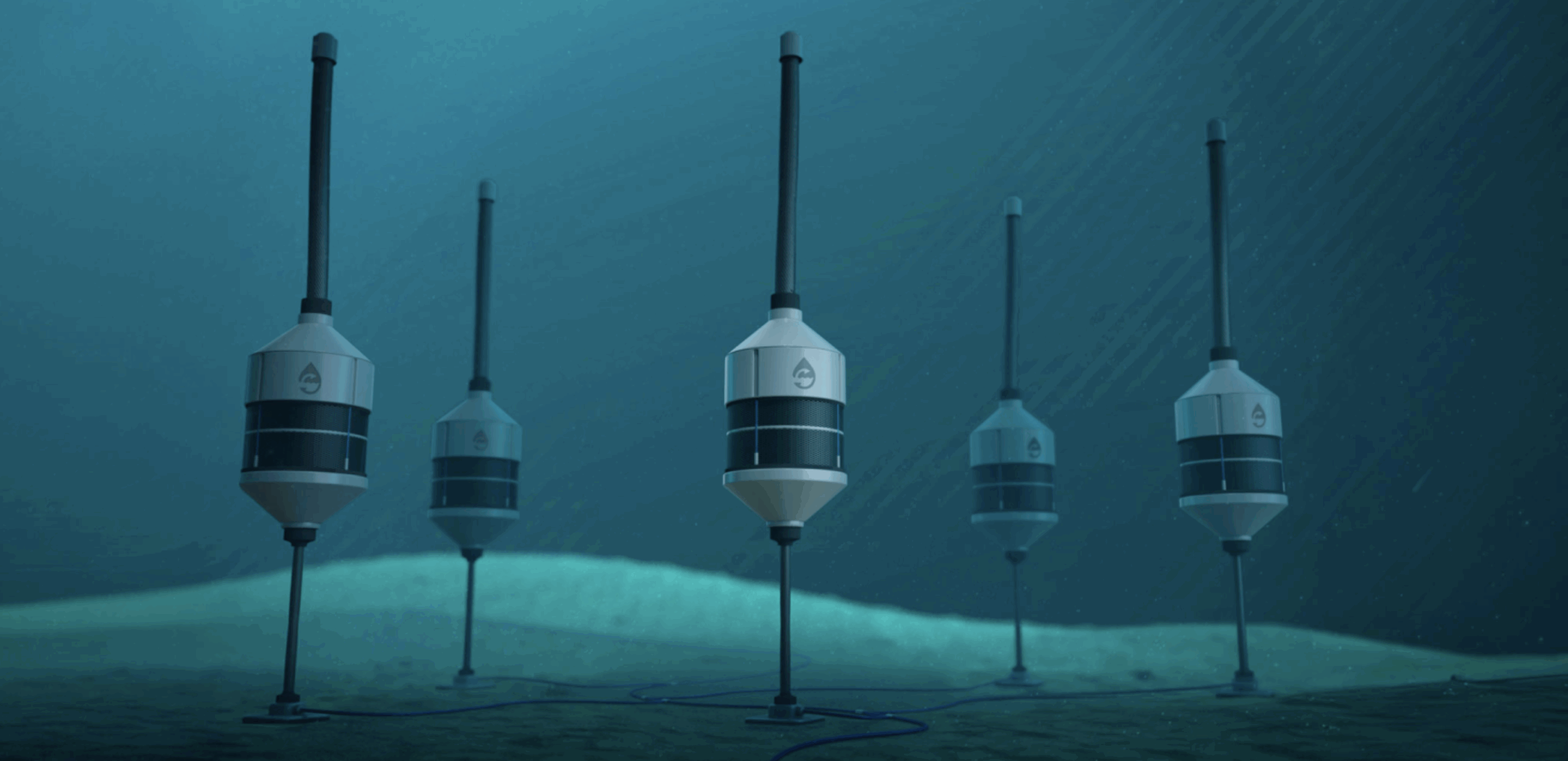
The world is running out of fresh water and now companies are using the high pressure of the ocean depths to push seawater through a membrane leaving salt behind.This month Scientific American reports a breakthrough in strategy of how to apply reverse osmosis without huge energy costs or negative environmental issues by allowing it to” happen naturally” – using technology that harnesses pressure hundreds of meters underwater.
“Reverse osmosis pods are submerged to depths of around 400 to 500 meters (1,600 feet) where immense hydrostatic pressure does the heavy lifting of separating water from salt. Purified water is then pumped back to shore. Far-fetched as it may sound, there are multiple prototypes already at work; the companies behind them aim to take cheap, large-scale desalination from pipe dream to reality.”
One such company with big but achievable pipe dreams for the California Coast is SF-based OceanWell who announced a pioneer project called Water Farm1 (WF-1) with six LA area water agencies this month. The desalination project would pump 60 million gallons per day to drought-prone Southern California by 2030. That would be about 66,000 acre-feet annually, enough to supply some 15 cities the size of San Luis Obispo. The desal pods would be anchored 4.5 miles off the coast of Malibu in Santa Monica Bay.
“California, like much of the world, urgently needs a new source of water to replace dwindling supplies,” said Robert Bergstrom, CEO of OceanWell. “Water Farm 1 shows how we can responsibly and economically harvest fresh water from the ocean by building infrastructure to withstand rapidly melting snowpack, increasing drought, more extreme atmospheric rivers, sea water intrusion, and overdrawn groundwater. Water Farm 1 is a critical milestone toward OceanWell’s goal of adding one million acre-feet of new potable water to the global supply within a decade.”
This spring OceanWell demonstrated the pods in Las Virgenes Reservoir near Calabasa to high acclaim of the water agency leaders gathered there. Las Virgenes manages water for 70,000 SoCal residents.
Looking past the Malibu water farm, OceanWell is close to testing the technology in six north-to-south locations offshore from Cayucos in San Luis Obispo County to around Pt Arguello and down to Pt Hueneme and south to Dana Point and then off Carlsbad under a permit being issued by the EPA. OceanWell has said it is aiming at 15 water farms in California and elsewhere.So far Oceanwell supported by a working group of 25 thirsty California water agencies.
The complaints against current and past desalination projects include high energy consumption, environmental impacts like brine discharge as well as marine life disruption and high costs.Importantly, the Coastal Commission has opposed on-land desal projects. Lack of scale and low volume also haunt existing projects. For example, problems with the Santa Barbara 1990s desal operation include limited capacity of just 3,125 acre-feet per year (20x smaller than the WF-1) requiring 13.8 million kilowatt hours of electricity per year, or 4,416 kilowatt hours per acre foot. This is 42 percent more electricity than it takes to import water from the State Water Project (3,100 kWh/AF).
Land infrastructure can’t deliver
The State Water Project ships water over 700 miles from northern California along the Central Coast to San Luis Obispo County and Morro Bay, Santa Maria, Santa Barbara and south to LA and beyond – all told 29 public agencies and local water districts from Plumas County in the north to San Diego County in the south. But that supply is in jeopardy due to climate change, suggest a number of studies.California is expected to lose 10% of its water supply by 2040 due to climate change, and the State Water Project could lose up to 46% of its delivery capability as land subsidence threatens canal infrastructure. Now a new study this week says if no action is taken, it could fall up to 87% by 2043 affecting 21 million Californians, says DWR.
If there is trouble to the north, LA also has problems importing water from the east – big time.
Los Angeles is dependent on imported water from the Colorado River- the source of about one-third of Southern California’s water supply. Again climate change is impacting rainfall in the Southwest as well as California with Lake Mead predicted to reach the lowest level ever in the next two years. Published research has found that” the Colorado River Basin’s current “megadrought” is the worst dry spell the region has experienced in at least 1,200 years. “ “WF-1 offers a new model that reduces pressure on strained systems like California’s Bay-Delta system and the Colorado River and unsustainable aquifer extraction, helping secure a more resilient, climate-aligned water future,” OceanWell observes.
Collaboration key
Water policy expert Tim Quinn, who knows everyone in the California water world, spent 40 years in the business including ten years as the executive director of the Association of California Water Agencies and more than twenty years as the Deputy General Manager of the Metropolitan Water District of Southern California. Over the course of that career, he was at the center of every major water management issue facing the state of California, including the state’s use of Colorado River water, management of the Bay-Delta, and sustainable groundwater management. After retiring from ACWA, Mr. Quinn became a Landreth Visiting Fellow at Stanford University, where he wrote a white paper titled Forty Years of California Water Policy. Quinn says a”valuable general lesson from that 40-year career is that collaboration works and conflict doesn’t. I learned this by reaching across silo boundaries hundreds of times during my career.”
Bringing his work history up to date, Quinn says as result of publishing that paper he got a call from Robert Bergstrom – currently CEO of OceanWell. “Now I am an employee of OceanWell” says Quinn, adding that he believes this technology is the “most promising water development since the California Aqueduct.”
Construction of the aqueduct launched in the late 1950s delivers water to 27 million people and irrigates some 750,000 acres of farms. It is a key conveyance for the State Water Project that delivers water derived from Northern California snow melt through the Delta to much drier SoCal.
Look West
Quinn remarks that in the past, Southern California “has looked north and east for a water supply and now it’s time to look west” to the ocean for the future.
If some of these land-based water sources are drying up, California’s technological future may be dependent on the rollout of new power and water sources to accommodate the growth of AI-inspired data centers.
Without a new source of both water and electricity both the Southwest and California face tremendous hurdles. Data centers are significant water consumers, primarily for cooling IT equipment and indirectly through electricity generation.Large data centers can consume millions of gallons of water daily, comparable to the usage of a small town.This water consumption is particularly concerning in regions already facing water scarcity and getting drier.
PG&E has recently announced that there are scores of new proposed data centers on the drawing board in their service area to be built in the next few years. We need water not just to exist but for California to prosper. The state has a big trade advantage positioned next to the Pacific Ocean and connected to Asia. Now we can tap that “location-location-location” advantage with a solution to water scarcity not affected by climate change.
Central Coast future?
Is there a future for this technology to help the Central Coast communities north of Malibu? Quinn says talks have been held with water agency officials in the San Luis Obispo region where the County is leading a municipal task force to hammer out an adopted “desal plan” including selecting a site and preferred technology as early as the summer of next year to bring water to this parched region.
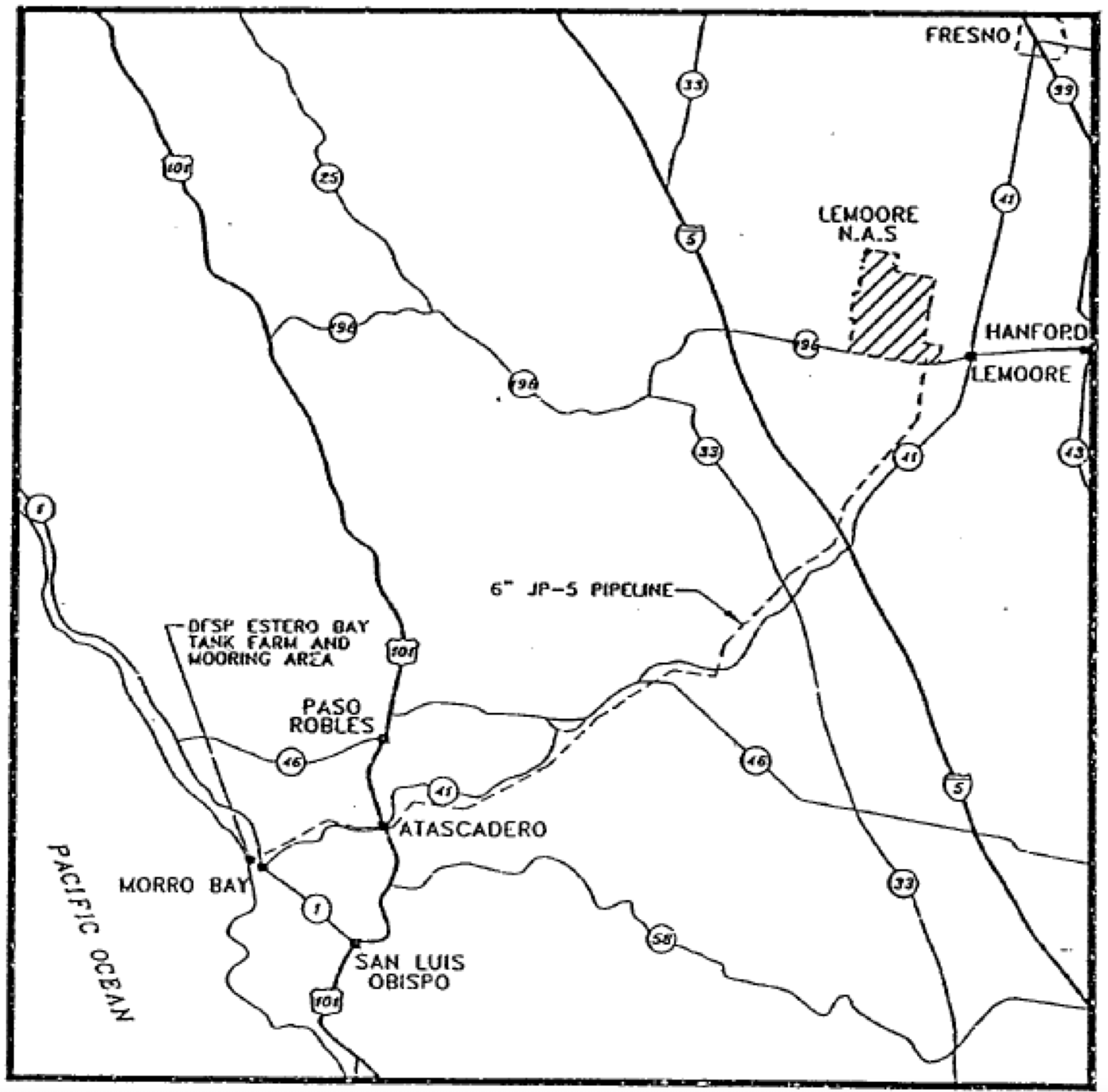
Intriguingly, there are existing pipeline opportunities in Central California from offshore oil rigs that connect to the shore that could carry water instead of oil if the deep sea OceanWell pods were in place nearby.There is also an old 50 mile pipeline that connects seaside Morro Bay to NAS Lemoore and the San Joaquin Valley that used to ship tanker oil to the Navy that is still in place. I know some thirsty Westside farms that would likely spring for that, as would the US Navy.
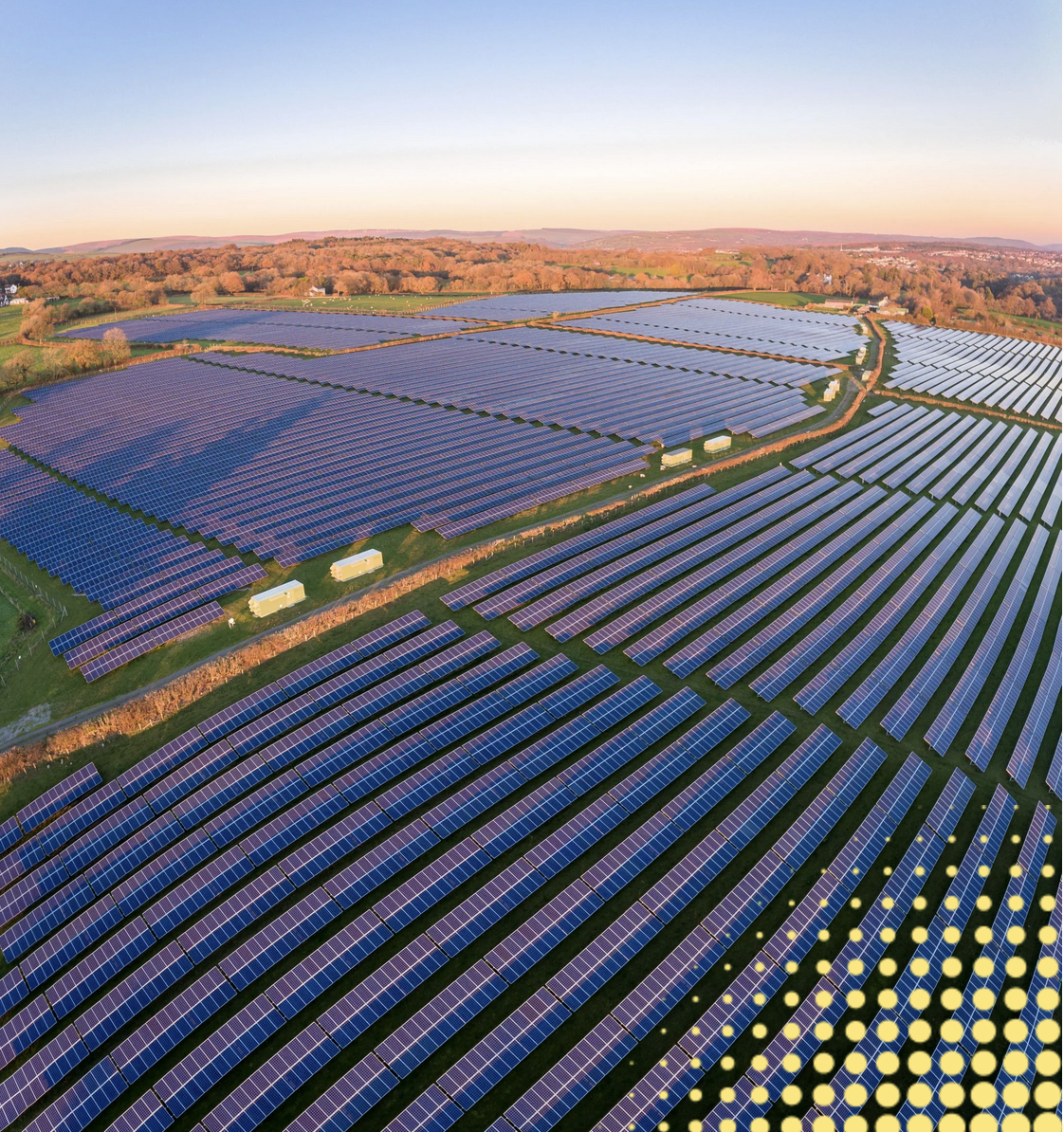
While President Trump is trashing solar power, the County of Santa Barbara is planning to make it easier to permit utility scale solar power in the unincorporated areas of the county.
CNBC reports that Trump said in a social media post Wednesday that states that rely on wind or solar power are seeing increased energy prices, and that it’s “the scam of the century.” He added that “We will not approve wind or farmer destroying solar. The days of stupidity are over in the USA!!!”
That has led investors in companies that work to provide solar and wind energy like Sunrun and First Solar to sell shares this week.
But in sunny Santa Barbara County planners are looking to make it easier to build utility-scale solar projects that generate electricity for sale, to be built in the rural environs of the county
The plan will get a hearing October 3 at 5 PM. Critics complain that the current rule makes it more difficult to generate solar power for sale in all zoning areas of the county.It would also streamline permitting for smaller solar energy systems in the unincorporated County. The Utility‐Scale Solar Amendments Project would update multiple County land use plans and zoning ordinances to facilitate the development of utility‐scale and community‐scale solar energy facilities and streamline the permitting of smaller rooftop and ground‐ mounted systems. It would remove the current 600‐acre utility‐scale overlay restriction, and clarify the permitting allowances for battery energy storage systems.instead it would allow utility-scale solar projects with Conditional Use Permits (CUPs) on various zoned lands throughout the unincorporated county. California like Santa Barbara remains a champion of solar power where it has attracted
billions in local investment. California has over 49,000 MW of installed capacity and solar supplies more than 31 percent of California’s electricity today, but it must play a bigger role if the state is to reach climate and energy goals.
Farmers in the Northwest report that this year’s cherry season went poorly, despite a large crop with high quality. Capital Press reports that a labor shortage early in the season was followed by high retail prices derailing demand for the fruit. Cherry growers said they had a large crop of beautiful fruit but the season was a “bloodbath” or “trainwreck” due to labor and market challenges. At the start of the season, immigrant workers’ fears of federal raids resulted in a labor shortage for some farms, said Ian Chandler, chairman of the Oregon Sweet Cherry Commission. That was followed by high retail prices derailing demand. “When the cherry returns are less than what it takes to pick, pack and grow the crop, you are losing money big-time,” grower Mike Omeg said. Dane Klindt,who grows 600 acres of cherries, said immigrant workers were hesitant to come up from California at the start of the season due to worries about Immigration and Customs Enforcement sweeps. Nearly 20 of his H-2A program workers also were held up at the border for three weeks. “I’ve been using the H-2A program for three years now and I’ve never had this happen,” Klindt said. “We were able to harvest most of our cherries. There were a few that I left on trees, but that was due to the market, not labor,” he added. Omeg said this season raised questions about the future of the cherry industry, including whether growers were producing too much fruit. Lesley Tamura, Columbia Gorge Fruit Growers board chairwoman, said farmers would need to take a hard look at their bottom lines and figure out how to make cuts. Some growers have both cherries and pears, and there’s general anxiety about pears this season due to the closure of canneries and a bigger crop. Pear orchards in the mid-Columbia region aren’t as reliant on migrant labor as cherries, however, growers said. “We are very reliant on our domestic labor force and our H-2A labor force rather than migrant workers coming out of California,” said Tamura, a pear grower. Chandler anticipated growers will walk away from cherry orchard leases in the future, especially if the acreage is marginally productive due to age, water restrictions, weather or other factors. He said it was three bad years in a row for cherries. “My wife and I are both looking for off-farm jobs,” he added. Chandler’s family farm also will take on more debt and he wondered if “little guys” can afford to keep growing cherries. Klindt expects to see more consolidation as smaller farms exit agriculture.
UCSB study: “There is an abundant, zero emissions source of heat right beneath our feet”
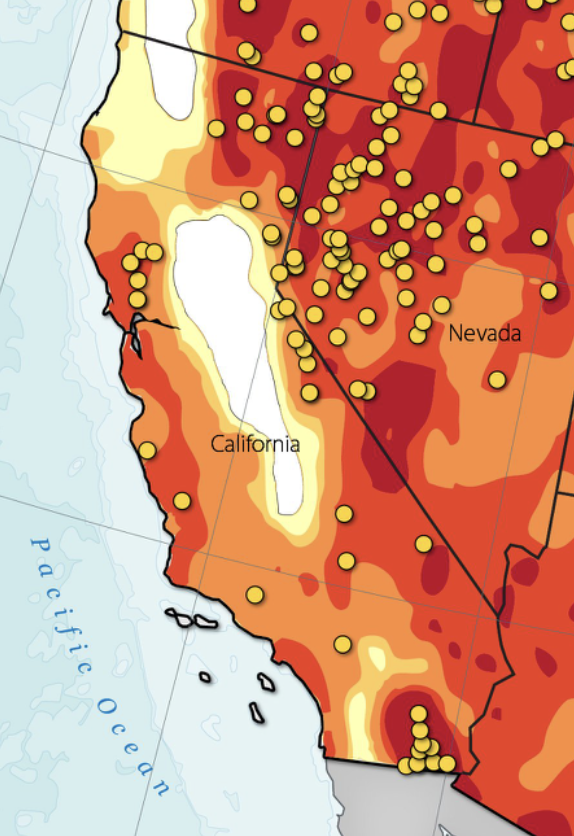
Map: High geothermal potential along the Central Coast (dark red)
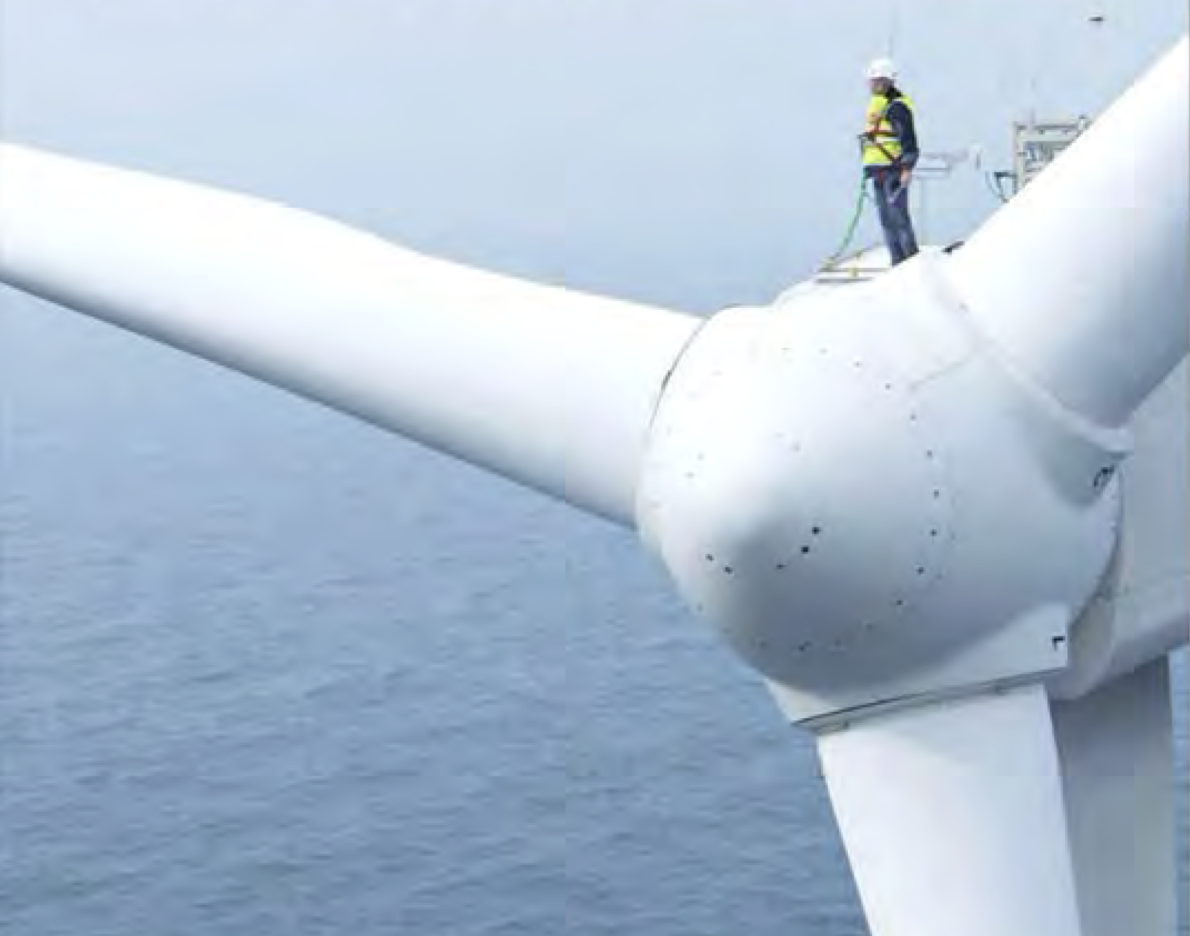
President Trump hates not just offshore wind but all wind projects going way back claiming that noise from turbines causes cancer. As a result, big plans across the US to permit more of this natural resource are in trouble even as the country looks for new energy projects to power hundreds of kilowatt-loving proposed data centers. Some call it “Trump’s war on wind.”
Back in January when Trump took office, he made a proclamation that imposed a moratorium on Federal activities associated with offshore (and onshore) wind energy projects including the issuing of federal permits (NOAA, USCG, US F&W, USACE, etc.), federal easements and ROWs, and federal purchases of electric power. This moratorium is still in effect and most believe, will not be lifted. Additionally the White House in the past few days ordered The Bureau of Ocean Energy Management (BOEM) to rescind all designated wind energy areas in federal waters, announcing last Wednesday an end to setting aside large areas for “speculative wind development.
The AP reports that” offshore wind lease sales were anticipated off the coasts of Texas, Louisiana, Maine, New York, California and Oregon, as well as in the central Atlantic. The Biden administration last year had announced a five-year schedule to lease federal offshore tracts for wind energy production. Trump began reversing the country’s energy policies after taking office in January. A series of executive orders took aim at increasing oil, gas and coal production.”
Now the NY Times reports that “The Interior Department also signaled that it would review wind projects that have already been approved by the federal government but are being sued by opponents, and consider rescinding their permits, a step that could halt projects already under construction.” Where does that leave California’s offshore wind projects like the three approved off Morro Bay?
As you might remember, five global companies paid $757 million to the US Treasury to develop wind farms in 376 square miles of federal waters including three that are 20 miles off SLO County’s north coast in a December 2022 BOEM managed auction. They already have given the government three quarters of a billion dollars in anticipation of being in operation in five years and spending millions more on the plans. Once developed, advocates say the wind farms could produce up to 6 gigawatts of clean, renewable energy — enough to power around 3.5 million homes. The state has been planning huge infrastructure upgrades to carry the power to California homes. Now poof…. it’s all gone!
The state and the big wind companies are fighting even bigger political winds as the Trump administration does everything they can to make sure it does not happen. The mostly foreign-based companies have a big target on their back. You have to wonder if their only recourse now is to ask for their money back after securing a legal, sanctioned auction amounting to a contract to move forward.
This week, the BOEM website says “the Department of the Interior and BOEM are implementing President Trump’s memorandum temporarily halting offshore wind leasing on the Outer Continental Shelf.” The memorandum also pauses new or renewed approvals, rights-of-way, permits, leases, or loans for offshore wind projects pending a review of federal wind leasing and permitting practices.”
Planned virtual public meetings on the BOEM’s draft plan for Potential Mitigation of Future Development of Wind Lease Areas Offshore California have now been postponed. The postponement amounts to another way to halt any progress for these companies, not able to secure an incidental ‘takes’ of – say a whale or birds- because the Trump administration won’t allow them to move a feather. The upshot:offshore wind in federal waters may be dead in the water as investors, too get the clear message.
A new July 15 directive by the Dept of Interior announced a new lengthy review of solar and wind projects prompting an outcry from the renewables industry including the American Clean Power Assn.
“The Secretary of the Interior will apparently now be personally reviewing thousands of documents and permit applications for everything from the location and types of fences to the grading of access roads on construction sites across the country. This intentional effort to slow energy production comes at the worst possible moment. U.S. electricity demand is projected to surge 35-50% by 2040, with data centers alone requiring over 100 GW of new capacity. To meet this demand, America needs a true ‘all of the above’ strategy, which includes additional natural gas and intense efforts to accelerate geothermal and advanced nuclear technologies.”
The group points out that “clean energy represented 93% of new capacity added to the grid last year because these sources are the best way to meet demand right now. It’s basic economics that cutting off the fastest and most affordable energy available to the grid just as demand surges will constrain our energy supply and lead to significant cost increases.”
Vandenberg and Humboldt projects
There is one California offshore wind project planned in the 3-mile boundary of state waters off of Vandenberg that could still move forward, considering California is more receptive to offshore wind.
The CADEMO Floating Wind Demonstration Project 2.5 miles offshore from Vandenberg Space Force Base in Santa Barbara County lies entirely within California’s jurisdiction.CADEMO plans to install four floating wind turbines, each capable of generating 15 megawatts, for a total output of around 60 megawatts. Developers have finalized a mitigation agreement with the U.S. Department of Defense to ensure compatibility with Space Force operations. The project was expected to begin delivering power by late 2027.
But a closer look tells you that CADEMO is in the same leaky boat as the larger projects in federal waters are. The problem is that the buyer of the power for this Vandenberg project is Vandenberg itself, a federal entity that as a result of the January 2025 Trump proclamation cannot buy the wind energy they need from this project.
The proclamation imposed a moratorium on Federal activities associated with offshore (and onshore) wind energy projects including the issuing of federal permits (NOAA, USCG, US F&W, USACE, etc.), federal easements and ROWs, and federal purchases of electric power from wind generation.This moratorium is still in effect and effectively blocks Vandenberg from working with the CADEMO offshore wind energy project developers, Cierco Energy.
CADEMO also has a time sensitive interconnection queue position with PG&E requiring a substantial deposit to secure and maintain.Now CADEMO will get some help from a northern California ally – Humboldt-based Redwood Coast Energy Authority(RCEA),one of many nonprofit California Community Choice Aggregators (CCAs) who would like to have a demonstration wind project – out of Trump’s reach – in state waters in their area.
Redwood has two wind developers that have paid BOEM to lease in federal waters that now are likely thwarted. On July 24 the Board of Redwood Coast threw CADEMO a life preserver with approval of a $1,100,500 loan” for the PG&E Second Interconnection Facilities Security Posting for the CADEMO Offshore Project in central California”.
Unlike CADEMO’s project off Vandenberg, CADEMO would also build a wind farm off Humboldt with the power sold to Redwood – not a federal entity like Vandenberg- but a nonprofit Community Energy Authority. The loan is said to be refundable and temporary and according to a Redwood staff report ” due to RCEA prior December 12, 2025, when an additional deposit for the Network Upgrades Financial Security would be due to PG&E. Between now and December the CADEMO team would need to secure public or private financial support that could repay RCEA and post the additional deposit. If this cannot be secured, RCEA would be refunded, and the project would lose their interconnection position.” It sounds like a “hail mary” for this wind farm developer and perhaps RCEA to keep California’s first offshore wind project and hope for renewable energy alive. “The CADEMO project is viewed as the only opportunity to demonstrate floating offshore at this scale in the US within the next 10 years.” summarizes a Redwood staff report.
Concerns over fires
This week Diablo curtailed their generation as a precaution and at press time, Diablo Unit 2 is only operating at 47% according to the Nuclear Regulatory Commission (NRC) website
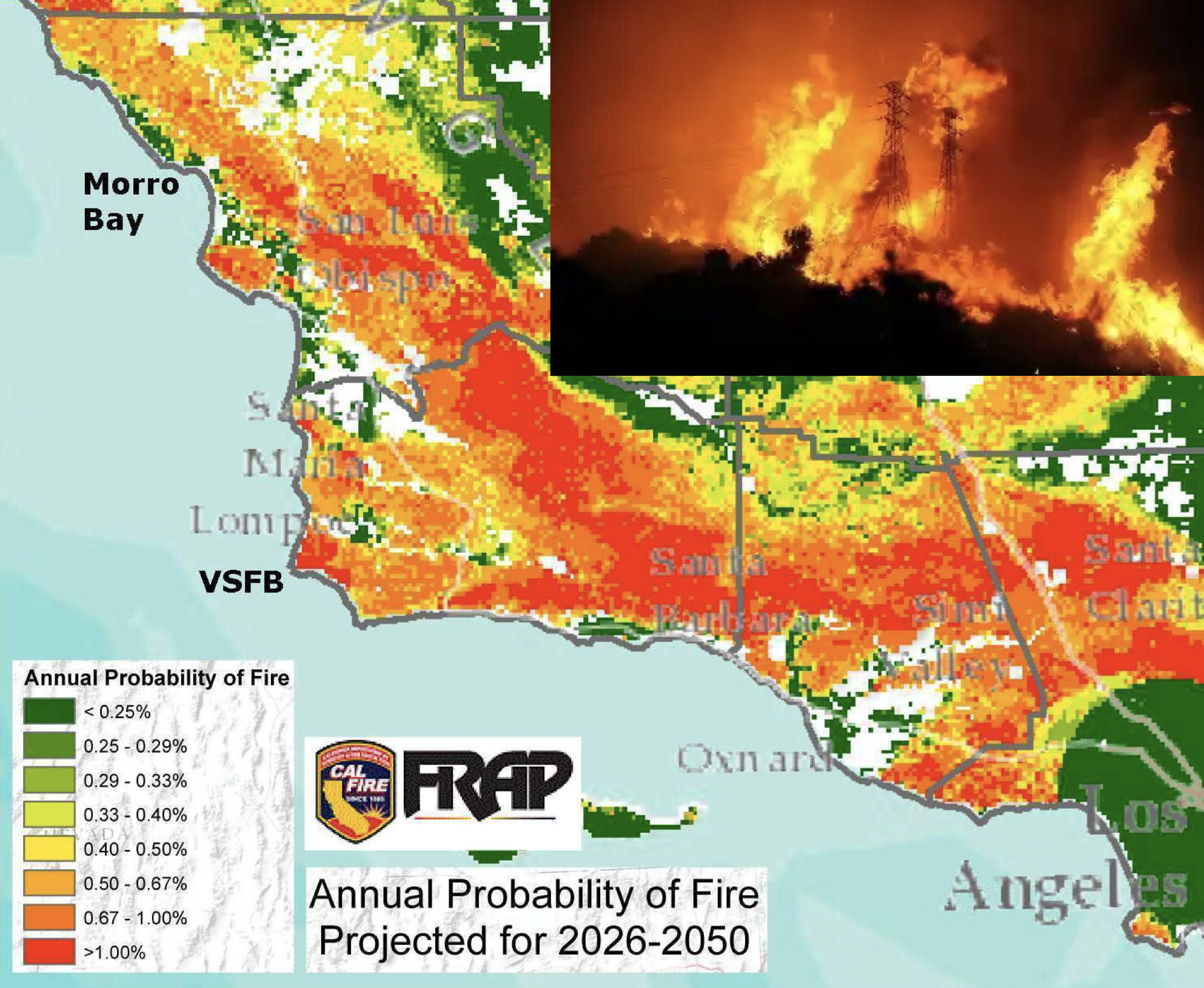
Vandenberg has a long term goal of becoming less dependent on outside sources for their electric power to carry on its critical defense activities. The base depends on PG&E for power in the evenings and at night when their solar panels don’t generate electricity. A big fire could shut down Diablo Canyon, such as the current situation with the growing Gifford Fire east of Santa Maria,now over 110,000 acres, that threaten the transmission lines that head east to the San Joaquin Valley connecting to the state grid.This week Diablo curtailed their generation as a precaution and at press time, Diablo Unit 2 is only operating at 47% according to the Nuclear Regulatory Commission (NRC) website.
High probability of fires around Vandenberg
The base must have power 24/7 to carry on with their military mission, not only to launch satellites, but defend against incoming attack with interceptor missiles. Here is a map that shows the base’s vulnerability in case of fire, more likely today with climate warming, despite Trump’s war on NASA climate monitoring.NPR recently reported Trump’s NASA now plans to end at least two major satellite missions specifically designed to monitor global carbon dioxide.
Vandenberg has a plan to put in 16 MW of battery power to store the solar power at night that is expected to be installed in the next year. But the base still needs a new source of power, with offshore wind is out- may now look to tap abundant heat underground, a source found up and down California including the Central Coast. Here is a map showing good potential along the West Coast.
Not only is geothermal energy technically available, importantly it may escape Trump’s campaign against renewable energy. In a word, Trump, who values a good soaking in a hot tub, doesn’t hate geothermal.media reports note that geothermal energy was spared in President Donald Trump’s sweeping tax and spending law,The Big Beautiful Bill that made deep cuts to incentives for other forms of clean energy.
It’s not just defense installations that are in the market for a new source of electric power. California as a whole and particularly Silicon Valley are hungry for new”clean” power generation, as Trump crushes other options.
Across the US, companies are announcing plans for new data centers.Now California’s largest utility is getting into the game.
PG&E announcement
PG&E has announced this past week that there has been a surge in demand for power with a recent uptick in new planned California data centers on the drawing board near Silicon Valley. As just about everyone knows the artificial intelligence boom and cloud technology across the nation. is boosting demand for electricity.
PG&E says it is working to serve 10 gigawatts (GW) of new electricity demand from data center projects over the next ten years—that’s enough energy to power approximately 7.5 million homes simultaneously.The 10 GW in PG&E’s data center project pipeline reflects a significant increase from the 8.7 GW of data center demand PG&E reported in May and the 5.5 GW the company reported in February. Just 1 gigawatt can power around 750,000 homes says PG&E.
PG&E estimates the 10 GW of anticipated data center load growth could lead to lower customer electric bills by 10 percent or more by spreading fixed costs across more energy usage; create 50,000 construction jobs and 115,000 associated support jobs; add 5,000 permanent tech jobs and 28,500 permanent support roles; generate $1.25 billion to $1.75 billion in increased property tax revenue; and contribute $2.5 billion to $3 billion in additional sales tax revenue.
The PG&E news release says “Of the 10 GW, 17 data center projects totaling approximately 1.5 GW are in the final engineering phase (the last step before project construction starts) and projected to begin operations between 2026 and 2030. Most of these are in San Jose, Silicon Valley and the greater San Francisco Bay Area, but some are also in the Central Valley and Sacramento.”
Growth in data center demand is good news for all PG&E customers, the utility claims.PG&E estimates for every 1,000 MW (or 1 GW) of new electric demand from data centers it serves, PG&E electric customers may save between 1-2% on their monthly bill in the long term, while serving those customers with some of the cleanest electricity in the United States.”
So where are we going to get this “clean” power from?
Keep in mind the Trump administration’s war on wind includes another renewable source – solar- a huge industry in California. EPA just announced plans to eliminate $7 billion in spending on grants for solar energy, California’s most important renewable energy source.
Where is there opportunity that Trump won’t ban?
Hot Rocks to the rescue?
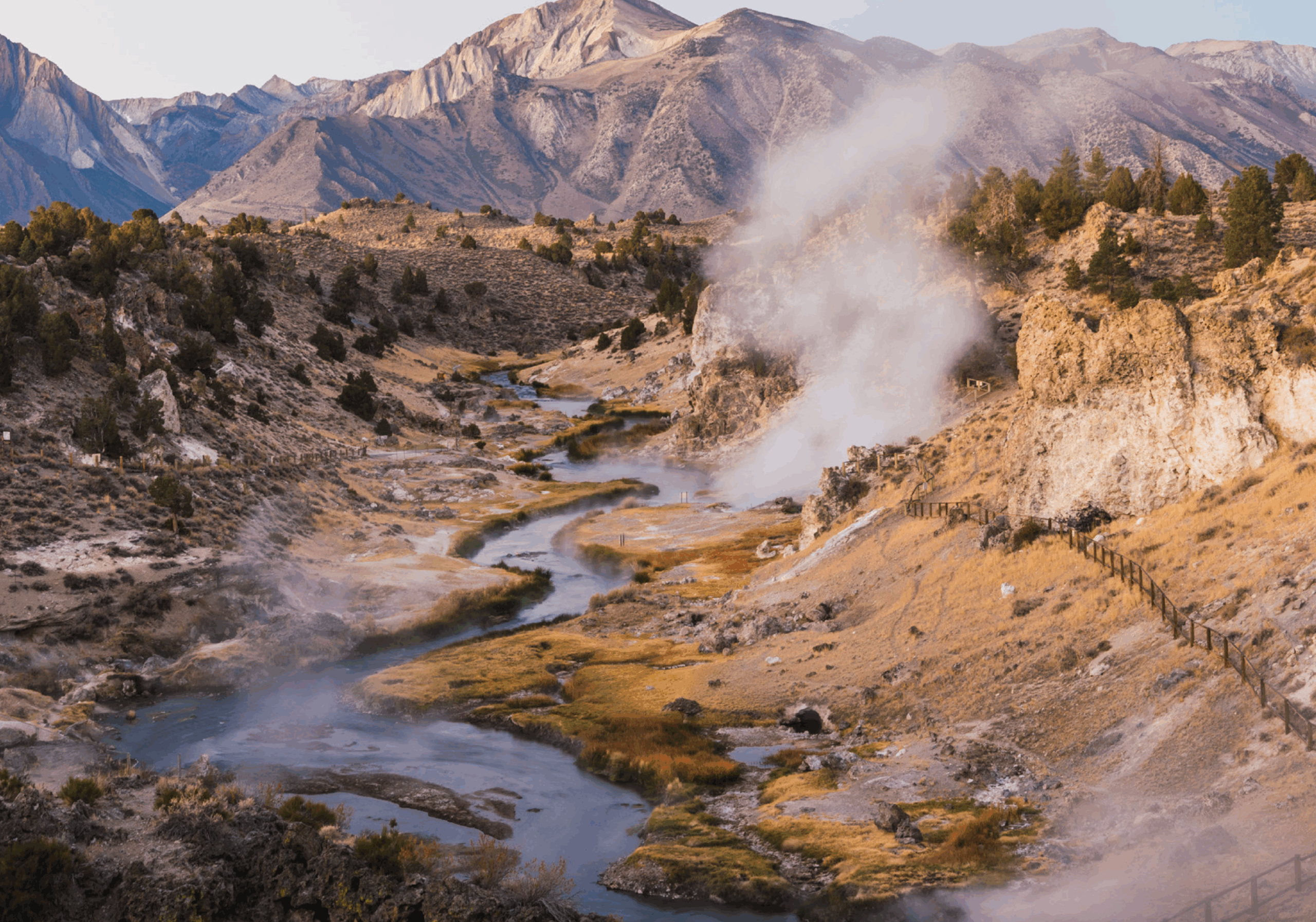
Hot springs near Mammoth Lakes
A new report published by in June by the Clean Air Task Force called “Unlocking California’s Geothermal Potential: A Strategic Opportunity for Clean, Firm Power” says” Next-generation geothermal energy, which uses the earth’s naturally occurring heat to produce power, is well-positioned to play an important role in California’s clean energy mix. It offers zero-carbon, always-available electricity that supports reliability and reduces dependence on fossil fuels during periods when solar and wind are unavailable.”
“”Recent innovations have enabled the emergence and growth of next-generation geothermal. Rather than harnessing pre-existing pockets of hot underground water, next-generation geothermal involves circulating water from aboveground through the subsurface, gathering heat from the rock that is then turned into electricity, and then re-circulating the fluid through the system as a part of a continuous cycle. This new form of geothermal energy can be harnessed in far more locations than traditional geothermal because it only requires access to underground heat – eliminating the need for naturally occurring pockets of hot water. This breakthrough expands the potential for clean, reliable energy almost anywhere on Earth. According to the International Energy Agency, next-generation geothermal techniques could elevate the global market share of geothermal from <1% to more than 8% by 2050.”
Black Gold or Hot Water
Californians may be familiar with the geysers near Sonoma and Lake counties, geothermal near the Salton Sea and Eastern Sierra, all nodes of volcanic activity. But the Central Coast has its own significant resource just below our feet, familiar after 100-plus years of drilling for oil around here. Pioneer drillers were searching for black gold but struck hot water.
Avila Hot Springs were discovered in 1907 by oil drillers who were initially seeking oil but instead found a natural artesian mineral hot spring.In 1886, another group of prospectors drilling for oil also discovered hot mineral water at what is now Sycamore Mineral Springs Resort right off 101 in San Luis Obispo County.
Back to the report – “California is the number one producer of geothermal energy of all U.S. states, and has enormous untapped geothermal potential. Clean Air Task Force’s (CATF) first-of-a-kind modeling estimates that utilizing just 1% of California’s resource potential of superhotock geothermal, the highest-temperature subset of next-generation geothermal, has the potential to generate about 380 GW of electricity – 13 times California’s 2023 electricity consumption.”
A UCSB study says next-generation geothermal systems can unlock an abundant source of clean, renewable energy.In its recent Future of Geothermal report, the International Energy Agency(IEA) found that there is enough geothermal energy to power the world 140 times over.
The IEA projects that by 2035, geothermal will be cheaper than nuclear and competitive with solar photovoltaics (PV) and wind when each is paired with battery storage. Meanwhile, a recent economic analysis put the cost of next-generation geothermal electricity at $64 per MWh, which would be competitive with other renewables before accounting for the cost of battery storage associated with intermittent power sources.
He likes it
Unlike some other clean technologies, next-generation geothermal projects appear poised to receive continued policy support in 2025 and beyond. Multiple recent Executive Orders include geothermal as a solution to improving U.S. energy security, while Trump’s Energy Secretary Wright has hailed geothermal’s benefits.
Department of Defense interest in geothermal predates the Trump administration with the United States Air Force (Department of the Air Force / DAF) announcing an open solicitation call for novel approaches to generate electricity at its installations using geothermal energy as of 3 January 2025.As a result ,the Air Force has published the list of US companies that have been deemed “Awardable” for geothermal projects in all US Department of Defense branches and facilities worldwide.
In the past few days the White House has issued new executive orders that also boost geothermal power
In the past few days the White House has issued new executive orders that also boost geothermal power. The order would ease federal regulatory burdens for AI data centers and supporting infrastructure, including power generation and transmission facilities.In more specific terms, “geothermal power equipment” is included in the order’s “Covered Components” or the materials, products, and infrastructure that are required to build data center projects. Covered Component Projects” under the EO include:Involving an incremental electric load addition of greater than 100 MW;A project that protects national security;A project for which the Project Sponsor has committed at least $500 million in capital expendituresA project that has been designated as “Qualifying Project” by the Secretary of Defense, the Secretary of the Interior, the Secretary of Commerce, or the Secretary of EnergySeveral planned data center projects in the US and around the world are already being developed under agreements to be supplied with geothermal power, including projects planned by Meta in New Mexico, and by Google in Taiwan.
On a county level, this month the expansion of the Dogwood geothermal project in Imperial County California was approved.
Advantages of Geothermal Heat
-Geothermal systems can make steam and hot water without pollution, since they don’t rely on combustion to generate heat. Next-generation geothermal has several advantages that make it a particularly useful technology for the decarbonizing of industry.
-Clean, Around-the-Clock Heat
-Geothermal systems do not produce emissions
-Geothermal resources have no fuel costs
Department of Defense Interest: The Department of the Air Force, in partnership with the Defense Innovation Unit, is exploring the use of advanced and enhanced geothermal technologies for installation energy resilience across multiple Air Force bases, including potentially Vandenberg Space Force. The UCSB report notes geothermal projects can face significant delays due to permitting hurdles. In some cases, a single geothermal project may trigger multiple National Environmental Policy Act (NEPA) reviews. In 2019, the DOE GeoVision report estimated project timelines at 8 to 10 years for geothermal systems.In contrast, oil and gas developers often receive categorical exclusions that exempt them from certain reviews, despite having much more severe environmental impacts than geothermal projects.
Granting the same exclusions to geothermal could accelerate timelines by 2–6 years. Trumps’ Bureau of Land Management has already finalized exclusions for geothermal resource confirmation and is considering further streamlining for indirect evidence of geothermal resources.
Study at Vandenberg may lead to some test wells to be drilled to gauge the potential for geothermal.The hot rocks, perhaps 600 degrees F, may be 10,000 ft down. The base is located near Tranquillon Mountain composed of volcanic and volcaniclastic sedimentary rocks formed through a combination of eruptions and subsequent uplift, akin to our Seven Sisters in SLO County.
Water use
Next-generation geothermal systems use water during reservoir stimulation to create hydraulic fractures underground. Some water is also used during drilling to cool the equipment. Once a well is operational, the circulating geothermal fluid is re-injected into the ground. This means that after drilling, the geothermal system does not actually consume groundwater. Additionally, geothermal doesn’t require freshwater – these systems can make use of “degraded” water sources such as brackish water, treated wastewater, or saline aquifers.
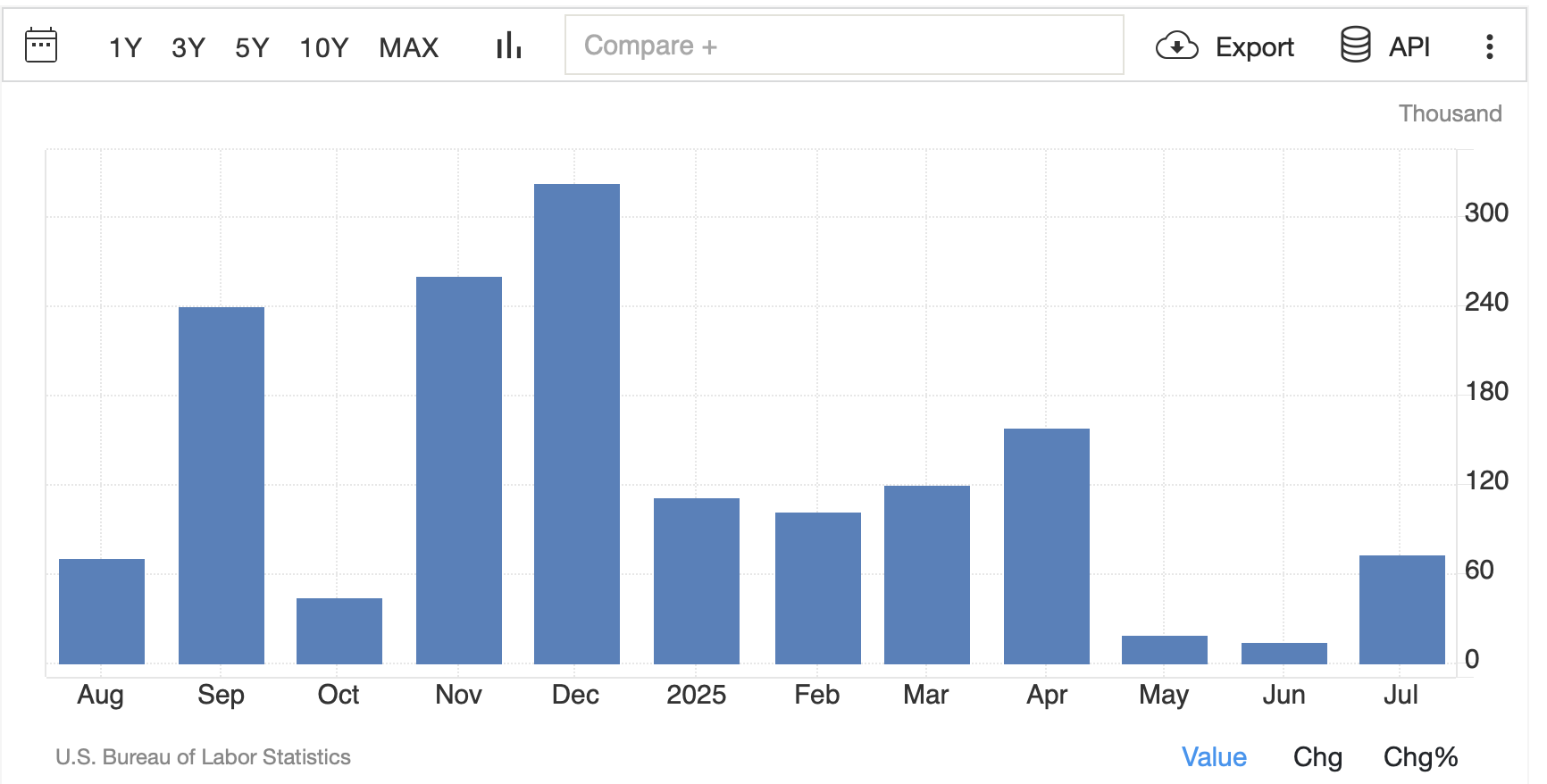
-US nonfarm payrolls rose by 73K in July 2025, well below expectations of 110K. The June figure was sharply revised down from an initial 147K to just 14K, while May’s reading was also cut by 125K. Taken together, these revisions show that employment in May and June was 258K lower than previously reported—suggesting the labor market may be cooling more rapidly than initially anticipated. US nonfarm payrolls rose by 73K in July 2025, well below expectations of 110K. The June figure was sharply revised down from an initial 147K to just 14K, while May’s reading was also cut by 125K. Taken together, these revisions show that employment in May and June was 258K lower than previously reported—suggesting the labor market may be cooling more rapidly than initially anticipated.
-Trading Economics
Visalia Industrial Park companies are feeling the chill with UPS recently reporting a 3% decline in revenue on deliveries in the current quarter.The company stock is down 30% year to date on tariffs impacts.
–Amazon ,one of Visalia’s largest employers, recently told their staff that AI “would likely lead to a smaller workforce.” reports the WSJ following other companies like Union Pacific and Verizon who are cheering about it.
-More signs of weakness comes from the Inland Empire who also has a big warehouse employment base like Visalia. One report says that area’s overall vacancy rate climbed to 4.8%, up 20 bps quarter-over-quarter (QOQ) and 70 bps YOY, the highest level seen in the past decade.
Mooney losing another retail outlet
The shopping center anchored by Dick’s Sporting Goods in Visalia will be losing a tenant with the closing of Mattress Firm in the center. Mattress Firm is one of 15 mattress stores operating under that name or Mattress Land or Sleep Fit that are closing due to bankruptcy filing.
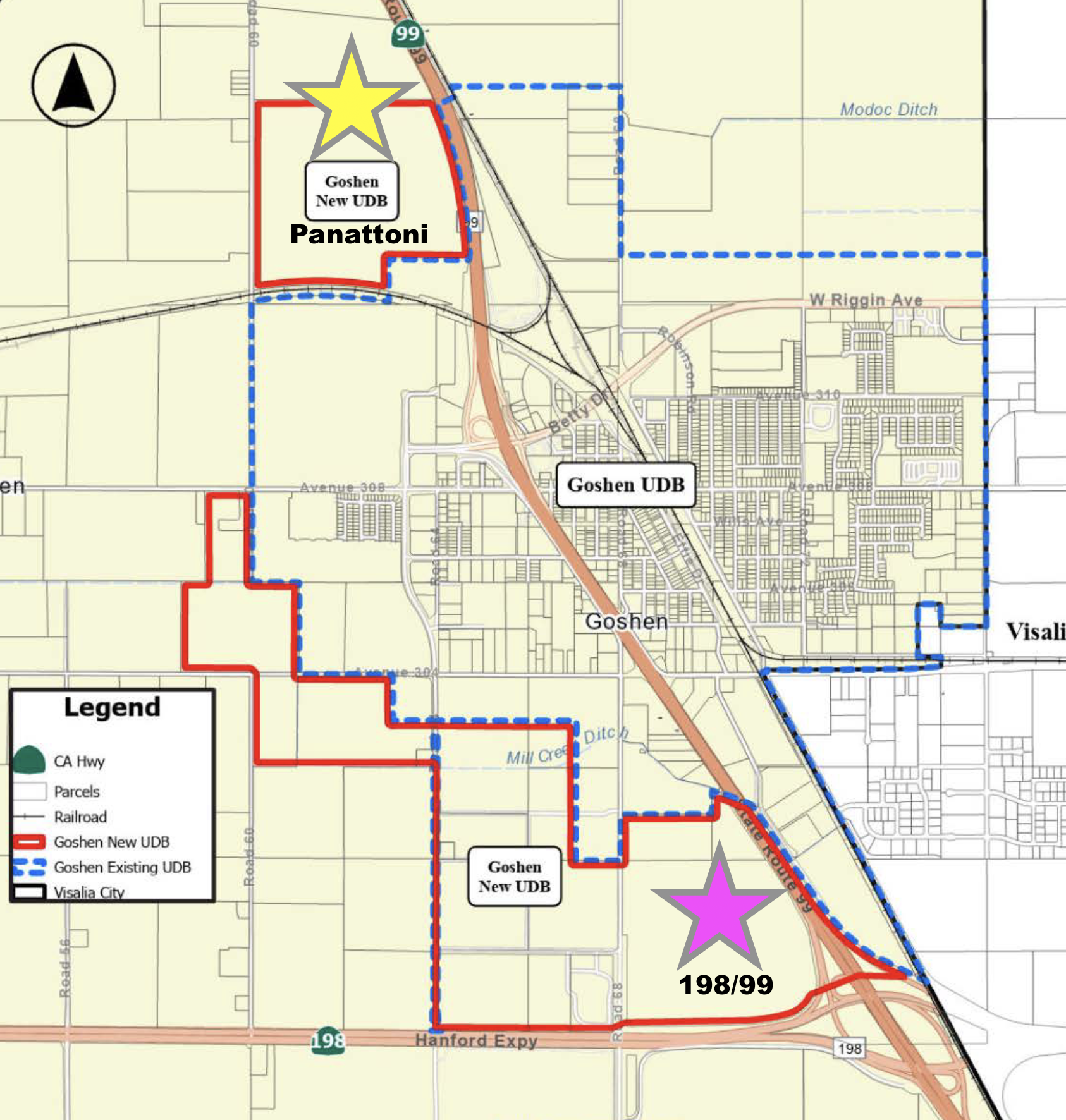
The Tulare County Board of Supervisors have approved a plan to rezone 718 acres of farmland West and north of Goshen to accommodate both industry and more housing in the future. Specifically the board approved in initiation of a general plan amendment July 22 that would allow development of these lands in the next few years once all environmental studies are complete.The new zoning designation would be “mixed use.”
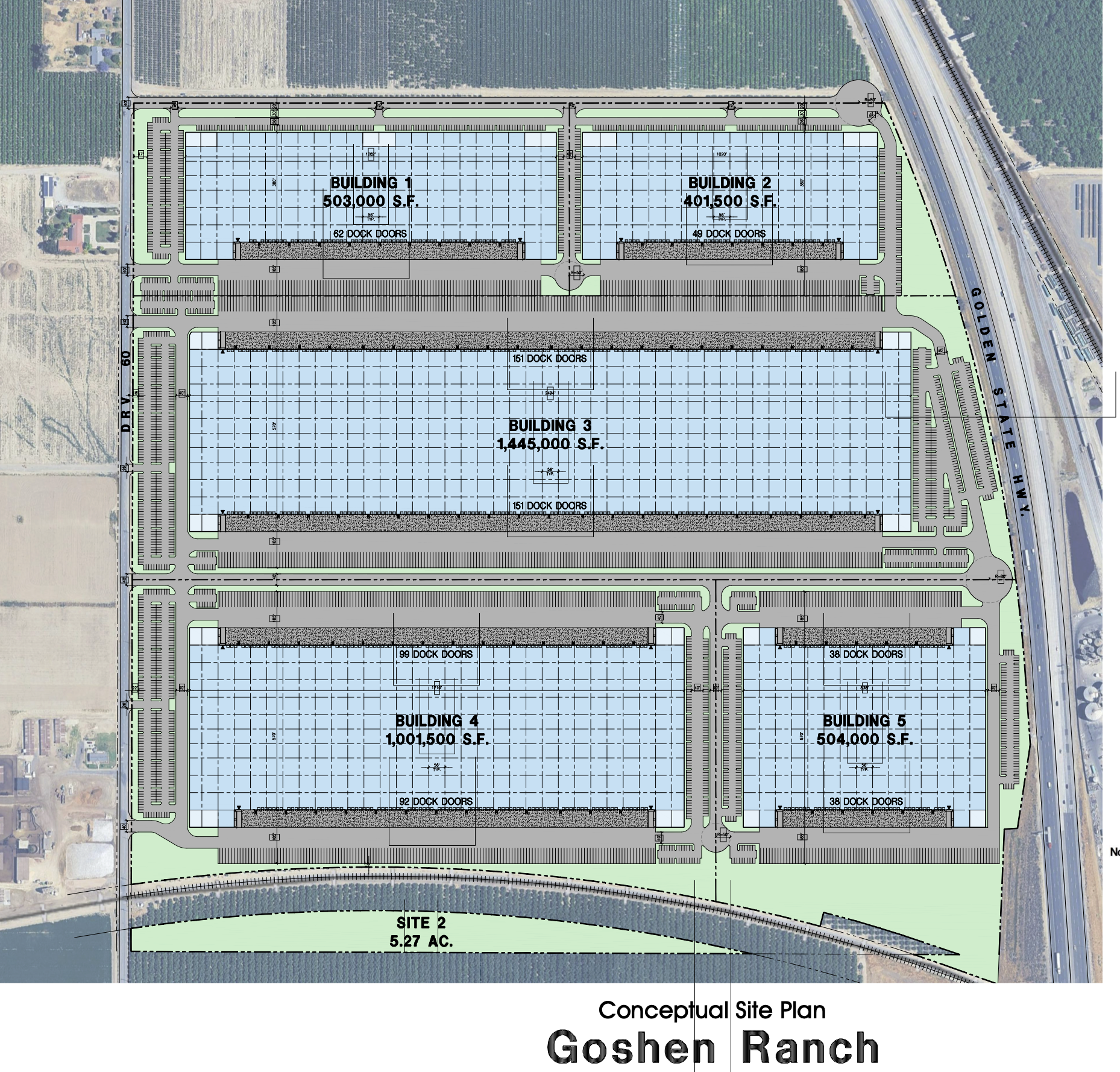
Most newsworthy is a developer initiated plan to build an industrial park on 190 acres west of Highway 99 and north of the Cross Valley rail track. The project was submitted to the county by developer Panattoni Development of Sacramento in concert with the big real estate firm Colliers International. The project was submitted to the county at their Project Review Committee meeting in June.
The site plan for the proposed warehouses shows 5 large buildings of various sizes that add up to 3,850,000 ft.² clustered along Highway 99 west of the highway and north of the Betty Drive interchange, called Goshen Ranch.
Development of the overall 718 acre plan would require cooperation from the City of Visalia who supplies sewer service to Goshen as well as approval from CalWater who supplies water to the community.
Another newsworthy part of a plan is to rezone 137 acres at the northwest corner of Highway 99 and 198, also currently in agriculture. Associate Director of the Tulare County Resource Management Agency Michael Washam says there’s no specific plan to develop this acreage but the site has been the subject of numerous commercial tire kickers in the past.The site enjoys the highest pass by traffic count in the region.
Besides these industrial and commercial potential projects, Goshen appears slated for more housing projects due to available land there, including this initiative to open more, but depending on sewer capacity from the City of Visalia.San Joaquin Valley Homes and Self Help Enterprises are busy with projects in Goshen now.
Just how the City of Visalia is going to react to these large projects at their doorstep ,just outside the city limits is not yet clear. Recently the City of Visalia initiated their own 900 acre expansion plan for industrial and other commercial development near the airport and along Caldwell Ave south of the airport.
You’ve got to give these guys credit for not giving up. It has been eight year this August that electric vehicle maker Faraday Future has leased a huge one million square foot former tire plant in Hanford California for their planned new assembly plant. So far the process has arguably been a dud and certainly no “Tesla killer” having manufactured only a handful of cars (16 since 2023) and losing hundreds of millions of dollars doing it. Ok now in August 2025 the LA-based company has a new plan to assemble not a $300,000 ultrahigh-end EV but a family minivan based on a Chinese-made model. Called the FX Super One, the vehicle is the result of a partnership with Chinese automaker Great Wall Motor who would deliver parts to Faraday Future in a bid to avoid high tariffs and get Trump administration approval to allow the assembly of the vehicle in their Hanford plant. The car would arrive as a so-called semi knock-down kit – a collection of parts required to assemble a product. The parts are typically manufactured in one country or region, and then exported to another country or region for final assembly. Faraday Future announced the new FX Super One electric minivan at an event in Los Angeles recently featuring an interactive smiley sun or other digital images where the grill is. But there’s more. One description says “When the vehicle is parked, F.A.C.E. can interact with passengers through voice recognition, visual cues, and even reactive communication, offering something akin to a conversational co-pilot.” According to Chinese media reports Great Wall Motor (GWM) has granted Faraday Future (FF) a license that will allow the Los Angeles-based electric vehicle maker to use imported auto parts in the assembly of its FX Super One, which shares a similar look with GWM’s Gaoshan multi-purpose vehicle (MPV). Those reports add that GWM is among the four Chinese automakers that have collaborated with FF based on the “Global Auto Industry Bridge Strategy” proposed by FF’s founder and co-CEO Jia YT. Jia spoke about the plan at this year’s BEYOND Expo tech event in May. FF said it already received more than 10,000 reservations for the luxurious full-size all-electric van, which features an interactive LED grille called F.A.C.E. to display images and videos. [Yiou Auto, in Chinese]
Over the years US lawmakers have supported a ban on the importation of Chinese-made automobiles into the US, but now FF hopes to break the ice by importing parts and doing the final assembly here.For now, auto parts, engines, transmissions, and electronics from China are subject to a 25% duty. Faraday Future is making the case in Washington looking to ride the wave of building more cars in the US. On July 24 FF leaders held what they call a a” well-attended and impactful reception at the Capitol Hill Club this week, drawing over a dozen members of Congress and key stakeholders from across the policy and business landscape. The event served as a platform to highlight Faraday Future’s ongoing efforts to bring advanced electric vehicle innovation and manufacturing jobs back to American soil.
Earlier this year FF’s Global President, Jerry Wang, met with Eric Trump, where he discussed Trump’s views on electric vehicles and the EV market. “We at Faraday Future have expressed our desire to play a role in the great American comeback we are seeing under this Administration, particularly as it relates to the automotive industry, which has been the bedrock of American industry for ages,” said John Schilling, Global Director of Communications and Public Relations at Faraday Future. “We were extremely honored by the attendance of numerous members of Congress who were interested in both our vehicles, because who wouldn’t be, but more importantly, our story about building and employing Americans,” continued Schilling. “We’re committed to expanding production here at home and look forward to working with Congress and the Trump Administration to help make that vision a reality.”
Faraday Future’s leadership emphasized that the company is aligning with the current Administration’s vision to reindustrialize America and revitalize core manufacturing sectors. “With plans to increase domestic production and invest in U.S. jobs, Faraday is proud to be a part of a new chapter in American innovation.” The website Carscoops says” If everything goes according to plan, and that’s a big if, the FX Super One will roll out in early 2026. The model will be assembled at the Faraday Future plant in Hanford, California, allegedly using 50% locally-sourced parts. Faraday Future didn’t reveal pricing but is already accepting pre-orders for a refundable deposit of $100.”
Gallo will soon be shutting down their 300,000 square-foot winery on the north end of San Miguel in San Luis Obispo County. The Modesto-based company, the world’s largest wine maker, will be permanently laying off 47 production workers effective September 8 according to a state WARN notice.The notices are published in order to give workers a 60-day notice of impending layoffs.The facility is located at 2425 Mission St, San Miguel, CA.
The winery is the former Courtside Cellars facility purchased by Gallo back in 2012.The facility both made wine and ran a bottling line in San Miguel, just north of Paso Robles.. The expected closure has been common knowledge, say wine industry sources. Gallo representatives were not available for comment.
Most recently, the California wine industry has been struggling with lower sales and a downturn in consumption among the younger set. The decline in sales has hit the lower priced wines that Gallo markets.
Gallo has been downsizing across the state and here with the sale of two wine making facilities in San Luis Obispo in the past year. They include the sale of the Edna Valley Vineyard facility in the south county and the former Wild Horse winery in the Templeton area, also last year. Gallo sold the former Wild Horse facility for $8 million to Continental Wine Collection according to published reports. Gallo retains the Wild Horse brand.
Wikipedia says Gallo was founded in 1933 by Ernest Gallo and Julio Gallo of the Gallo family, and is the largest exporter of California wines. It is the largest wine producer in the world, producing over 3% of the world’s annual supply of 35 billion bottles with an annual revenue of $5.3 billion. It is also the largest family-owned winery in the United States.Gallo employs about 3,500 people in Modesto and 2,500 in other parts of the state, country, and world.
The downturn in the wine market has hit the California wine industry hard as can be seen from those counties that have published their 2024 Crop Reports. That includes Santa Barbara County who reported winegrape values down 28% from the year before, Monterey County reporting decline of 22% and Napa County announcing winegrape values down 14.4% as well as a decline in production of 23,632 tons or almost 14%. San Luis Obispo County has yet to report but is expected to follow a similar trend.
Allied Grape Growers continue to advocate for vineyard removals across the state, including on the Central Coast. But the industry group says coastal growers brought more bearing acres into production in 2024 than vine acreage was pulled. Migration News says California harvested 2.8 million tons of wine grapes in 2024 but left up to 500,000 tons unharvested as wineries reduced their purchases. California grape growers cited lack of demand for grapes and the high cost of labor as their leading worries.
California had 575,000 bearing acres of wine grapes in 2025 plus 40,000 non-bearing acres. Most analysts think that bearing wine grape acreage must decrease to 500,000 to bring wine supply in line with demand. The fastest rising demand is for Prosecco, white blends and varietals like Sauvignon Blanc and Pinot Grigio, all affordable and often lower-alcohol wines,says Migration News.
The sales downturn has cut new job hiring in the wine industry in May 2025 by 30%, says one index.
The Paso Robles wine association, Paso Robles Wine Country, is working hard to make the best of it, announcing for a second year, targeted wine tasting events in Bakersfield and in Clovis in September featuring 40 wineries that will be offering a taste of the Paso Robles brand.
California new light vehicle registrations increased 6.6 percent during the first six months of this year versus a year ago.But auto dealers expect a different story for the rest of 2025 – projected to decline by about nine percent from the year earlier.
California New Car Dealers Assn says there is” heightened uncertainty” with the new vehicle sales outlook.With increased tariffs likely, this could lead to rising vehicle prices and at least in the short run, increasing inflation, lower economic growth, and stagnant household disposable income, all negatives for new vehicle sales, they say.
Other reports this week say tariffs on imported cars and auto parts cost General Motors $1.1 billion in the second quarter, the nation’s largest automaker said Tuesday.That was largely responsible for a 21% drop in net income for the period. The company said it expects tariffs to cost it between $4 billion to $5 billion by year’s end.Imported vehicles to the United States since April 3 now come with a 25% tariff.
Hybrids post big gains; ZEV share continues to slide
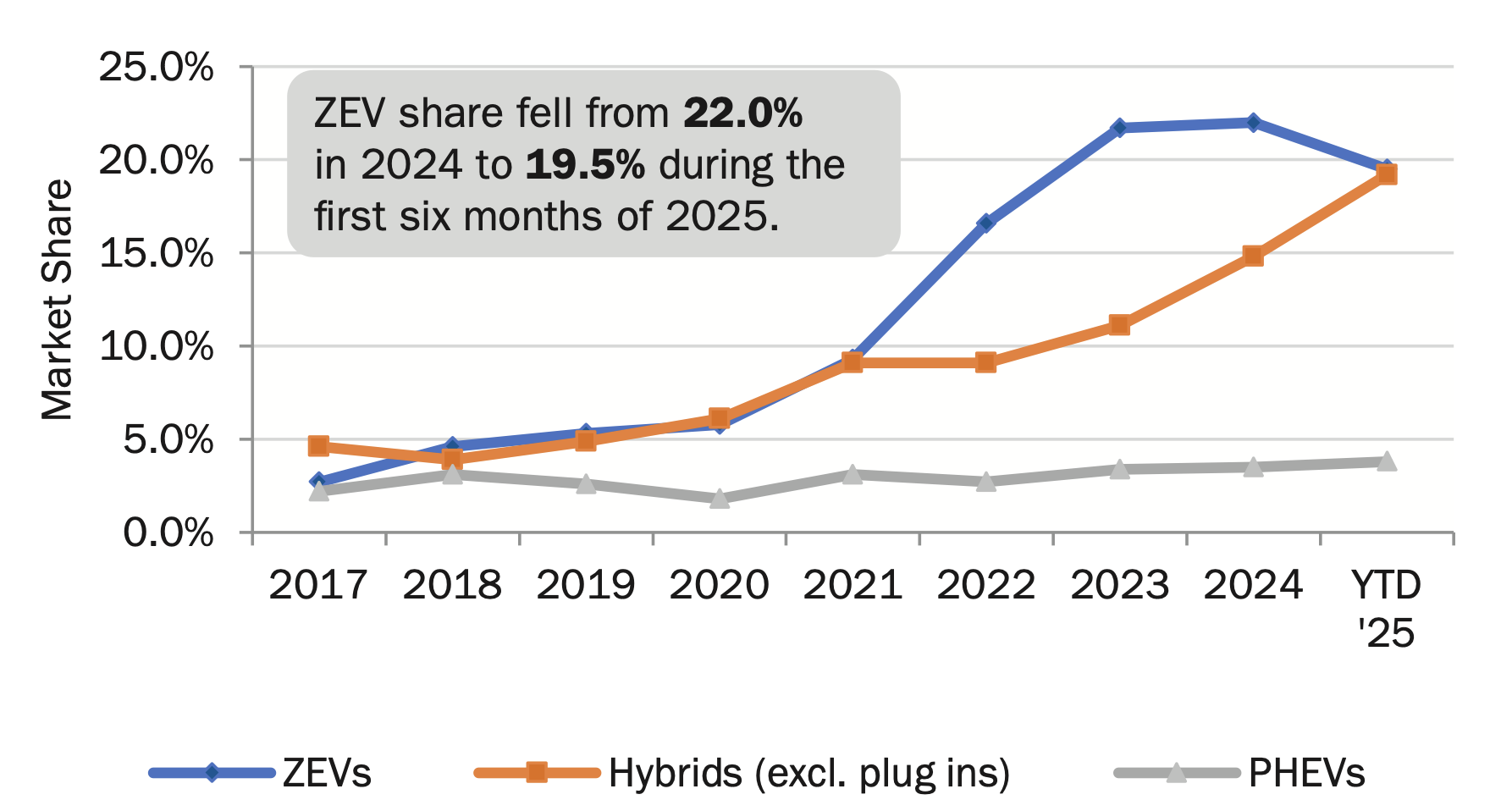
Drilling down to the latest numbers in the California autos report, hybrid vehicle registrations in the state increased 54 percent in the first half of this year and accounted for 19.2 percent of the market. ZEV(Zero Emission Vehicles) share in 2Q ‘25 fell to 8.2 percent, but is likely to increase in 3Q as consumers purchase vehicles before federal government incentives expire at the end of September.
Car dealer’s latest report says gasoline powered vehicles accounted for 55.3 percent of state new vehicleregistrations during the first six months of this year.
Internal Combustion Engine market share (including gasoline and diesel vehicles) was 57.5 so far this year,down from 61.7 percent in the first half of 2024 and 88.4 percent in 2018.Combined share for BEVs, PHEVs, hybrids,and fuel cell vehicles was 42.5 percent in the first half of 2025, up from just 11.6 percent in 2018.
Top selling vehicles in the first half year include Honda in small cars, Toyota Camry in the midsize category, Tesla Model Three in the near luxury category and Ford F series in full-size pick-ups. Tesla Model Y and Toyota RAV4 were top sellers.
Top sellers
Tesla as a brand year to date was down 18% in the state through the midyear compared to the same period in 2024. Buick registrations jumped 131% in the first half of the year- tops in the state. But Dodge fell the most – down 59%. Toyota by brand was the top performer in market share with 17.4% followed by Honda with 11% and Tesla with 8.8%.Toyota by brand was the top seller,followed by Honda with 11% and Tesla with 8.8%. Toyota was the most popular car in the used car market.
On July 24,2025, the Tulare County Public Health has confirmed two cases of measles, both children who were not vaccinated.They contracted the virus while traveling outside California. These are the first confirmed cases of measles in the county for 2025. But cases are rising in California and nationally, particularly among unvaccinated people.With this case, California had already recorded 18 confirmed measles cases, more than in all of 2024 combined. This is a trend nationwide and is the largest U.S. measles outbreak in decades. Some blame the anti-vaccine movement or vaccine hesitancy for the increase including current Secretary of Health and Human Services Robert F Kenday Jr. Why are cases up?
Declining vaccination rates: California kindergartner MMR coverage fell slightly—from 96.5% to 96.2%—but remains above the 95% threshold needed for herd immunity. However, regional pockets (e.g., Sutter County at 75.8%) fall below safe levels.Kern County’s vaccination rate is lower than the average but Tulare County and Kings County still have a 95% vaccination rate for kindergartners, as do most counties in the state.
International travel: Many cases originated overseas and were brought back by unvaccinated travelers. Public Health officials are actively working to identify and trace potential exposures, determine if those exposed have been vaccinated for the disease, and evaluate their potential for developing and spreading measles. Anyone who has not been infected with measles in the past and has not been vaccinated for measles is at risk of contracting the disease. About Measles Measles spreads easily through the air when an infected person breathes, talks, coughs, or sneezes. Thevirus can stay in the air and on surfaces for many hours, even after the infected person has left. Theinfected person can spread the disease up to four days before a measles rash appears and up to four days after the rash appears.
If other people breathe the contaminated air or touch the infected surface, then touch their eyes, noses, or mouths, they can become infected. Common symptoms for measles include:
High fever (higher than 101° F)
Cough
Runny nose
Red and watery eyes
Tiny white spots that may appear inside the mouth 2-3 days after symptoms begin.
Rash 3-5 days after other signs of illness. The “measles rash” typically starts at the face and then spreads down to the rest of the body. Complications from measles are more common in children younger than 5 and adults 20 years and older. These can include diarrhea, ear infections, and pneumonia. Death can occur from severe complications, and the risk is higher among younger children and adults. Important Guidance for Potential Exposures and Symptoms There is no specific treatment for measles; prevention through vaccination is the only effective way to protect yourself and the community. If you believe you have been exposed to measles or may be experiencing symptoms, call a healthcare provider immediately. Do not go directly to a healthcare facility before calling and making them aware of your measles exposure and symptoms. Please isolate yourself at home to prevent further potential spread until you have spoken with a healthcare professional.
Measles can be prevented with a measles, mumps, and rubella vaccine (MMR or MMRV). The MMRvaccine protects against three diseases: measles, mumps and rubella. The MMRV vaccine protects against four diseases: measles, mumps, rubella, and varicella (chickenpox). They are administered in two doses and are highly effective: two doses are 97% effective against measles and one dose is 93% effective. The spread of measles can be prevented if 2-dose coverage of the vaccine remains at 95% or above in the community. The measles-mumps-rubella (MMR) vaccine is effective. Two doses provide 97% protection against measles. Measles is very contagious. Measles spreads when someone infected speaks, coughs, sneezes or breathes. It can linger in the air up to two hours after the infected person has left. Unvaccinated people are at high risk. Roughly 90% of those unvaccinated and exposed to measles will contract the disease. Measles Activity in California, 2025 California Dept of Public Health says as of July 21, 2025, 18 confirmed measles cases have been reported with Tulare’s find the latest. The affected jurisdictions are:Fresno,Long Beach,Los Angeles,Orange, Placer, Riverside,Sacramento,San Mateo Santa Clara, Tulare (in July) Tuolumne, and Yolo. Measles Outbreaks in California In California in 2024, 15 cases were confirmed. In 2023, four cases were confirmed. In 2019, there were 73 confirmed measles cases in California. This included 41 cases linked to six outbreaks; defined as three or more cases. Of the six outbreaks, five were linked to patients with international travel. One had an unknown source. The largest outbreak had 21 cases and occurred in a health care setting.
From December 2014–April 2015, roughly 131 Californians got infected from an outbreak in Disneyland. The outbreak also infected residents of six other states, Mexico and Canada. Nationwide cases The U.S. Center for Disease Control says as of December 31, 2024, a total of 285 measles cases were reported by 33 jurisdictions. U.S. cases way up in 2025 As of July 22, 2025, a total of 1,319 confirmed measles cases were reported by 40 jurisdictions: Alaska, Arkansas, Arizona, California, Colorado, Florida, Georgia, Hawaii, Illinois, Indiana, Iowa, Kansas, Kentucky, Louisiana, Maryland, Michigan, Minnesota, Missouri, Montana, Nebraska, New Jersey, New Mexico, New York City, New York State, North Carolina, North Dakota, Ohio, Oklahoma, Oregon, Pennsylvania, Rhode Island, South Carolina, South Dakota, Tennessee, Texas, Utah, Vermont, Virginia, Washington, and Wyoming. Three people have died as a result of the disease this year. The last time the country saw a significant case spike was in 1992, when 2,126 people contracted measles, the CDC says. If you are planning to travel internationally, it’s essential to get vaccinated against measles before you go.