
 White House Press Release
WASHINGTON Sept 21, Today, as part of his We Can’t Wait initiative, President Obama announced that two nationally and regionally significant surface transportation projects in California will be expedited to put Americans to work building a 21st century infrastructure and providing California with more transportation choices. These projects will improve local and regional connectivity, providing for the safe and efficient movement of people, goods and services. Early, intensive coordination among agencies is expected to save up to 6 months on project schedules.
As part of a Presidential Executive Order issued in March of this year, the Office of Management and Budget is charged with overseeing a government-wide effort to make the permitting and review process for infrastructure projects more efficient and effective, saving time while driving better outcomes for local communities. The Administration’s efforts to continuously add more transparency, accountability, and certainty into the permitting and review process will enable project developers and private investors to more efficiently modernize our nation’s infrastructure. Additional expedited infrastructure projects will be announced in the coming weeks.
“Investments in infrastructure are putting people back to work in California by building and modernizing our transportation systems,” said U.S. Transportation Secretary Ray LaHood. “This is good news for the local economy, and it’s one more sign of President Obama’s commitment to help communities across the country move forward with these critical projects as quickly and efficiently as possible.”
California High Speed Rail – Central Valley Construction
State: California
Coordinating Agency: Department of Transportation, Federal Railroad Administration
Target date for completing Federal permit and review decisions: October 2013
The Fresno to Bakersfield section of the California High Speed Train (HST) System extends approximately 114 miles in California’s Central Valley and is a portion of Phase 1 of the HST system. Stations are planned at Fresno and Bakersfield, and a third Kings/Tulare Regional Station is being considered near Hanford.
The high-speed train project will support job creation in a region that is currently experiencing some of the nation’s highest unemployment rates. Once operating, projections estimate 4,500 boardings daily in Fresno and 5,100 in Bakersfield, with travel time between Fresno and Bakersfield estimated at 37 minutes.
Early, intensive coordination for project environmental reviews has supported a project schedule that is projected to save up to 6 months, enabling the project to meet funding deadlines and an aggressive construction schedule.
San Francisco Downtown Ferry Terminal
State: California
Coordinating Agency: Department of Transportation, Federal Transit Administration
Target date for completing Federal permit and review decisions: July 2014
The Downtown San Francisco Ferry Terminal expansion project will improve waterside and landside facilities at the city’s busy Ferry Terminal. The project, managed by the San Francisco Bay Area Water Emergency Transportation Authority, will expedite boarding for more than 10,000 daily passengers, provide better access to jobs and entertainment centers downtown, and improve connections to area pedestrian, bicycle, and transit facilities. Ferry Terminal improvements will also expand the region’s ability to provide vital transportation services in the event of an emergency.
The project is funded in part by the Federal Transit Administration (FTA), which is using new project management tools to engage other Federal agencies in order to improve the efficiency of environmental reviews and to facilitate greater interagency collaboration in the process. These innovations, in addition to leveraging lessons learned from prior projects, are projected to shave several months off the project schedule.

Weak El Nino Forecast Changes Wet Winter Outlook
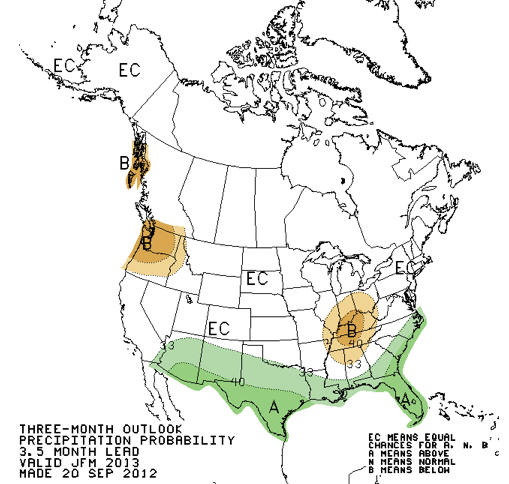 A September 20 NOAA Climate Prediction Center forecast is suggesting a change in the forecast for a wet winter across California in coming months. Even a month ago the CPC was showing prediction maps displaying increased likelihood of rain in the traditional wet months starting in December. Now the agency’s prediction maps maps are calling for simply “equal chances “ for a wet season although the Southwest gets wet and Pacific northwest looks drier than normal.
The forecast change relies on models showing a weakening of the trend for warmer than normal temps along the equator.
The Sept 20 CPC discussion says this.”DYNAMICAL FORECASTS, HOWEVER, ARE WEAKER NOW THAN 1 AND ESPECIALLY 2 MONTHS AGO. STATISTICAL MODELS GENERALLY HAVE PREDICTED SMALLER SST ANOMALIES. WHILE IT IS UNCERTAIN AT THIS TIME HOW LARGE SST ANOMALIES WILL BE OR HOW MUCH THEY WILL ALTER THE LARGE SCALE CIRCULATION IMPACTING NORTH AMERICA IT NOW SEEMS UNLIKELY THAT A STRONG EL NINO WILL DEVELOP.”
PG&E forecaster John Lindsey has said recently as well that he does not see a wet year for Central California this winter.

SLO Summer Tourism Stays Strong
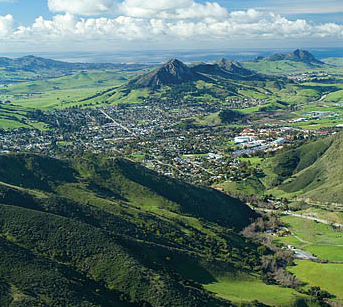 Hotels in San Luis Obispo County enjoyed increased occupancy,more rooms sold and higher rates in July and August,Smith Travel Research reports.
Separately the City Of San Luis Obispo reported higher TOT,bed tax receipts in July as well.
Regards hotel rooms sold, SLO metro area saw 5.9% more rooms sold than a year earlier,occupancy up 4.8% and that all important RevPAR up 10.9%. The trend follows year to date numbers for all of 2012. SLO metro increases for August are better than our neighbors Monterey and Santa Barbara counties who recorded only slight improvement over Aug 2011.
Occupancy at SLO hotels in August hit 81.1%,up from 77.4% for August of last year, the busiest month of the year for Central Coast visitation.
Regards the City of SLO TOT report, receipts are up 7.7%,The city projects a 4% increase for the fiscal year that started in July.

Tulare County Unemployment Rate Falls

The unemployment rate in the Tulare County was 15.0 percent in August 2012, down from a revised 15.7
percent in July 2012, and below the year-ago estimate of 16.2 percent. This compares with an unadjusted
unemployment rate of 10.4 percent for California and 8.2 percent for the nation during the same period., There are 2600 more jobs in the county in August 2012 than in August 2011.

SLO & State Jobless Rates Fall
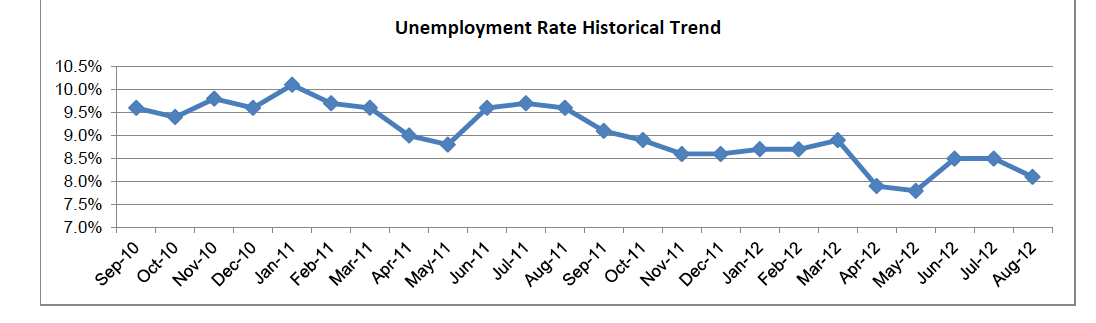
Both San Luis Obispo County and the state of California saw their jobless rates fall in August the EDD reports.
SLO County’s unemployment rate fell to 8.1%,down from 8.5% in July and down from 9.6% in August 2011. The report says SLO County has 2800 more jobs in August than year ago.
In California the unemployment rate decreased to 10.6 percent from.10.7% and 11.9% in August 2011., and nonfarm payroll jobs increased by 12,000 during the month for a total gain of 504,000 jobs since the recovery began in February 2010, according to data released today by the California Employment Development Department (EDD) from two separate surveys.
The year-over-year change (August 2011 to August 2012) shows an increase of 298,700 jobs (up 2.1 percent).
The federal survey of households, done with a smaller sample than the survey of employers, shows a decrease in the number of employed people. It estimates the number of Californians holding jobs in August was 16,404,000, a decrease of 38,000 from July, but up 203,000 from the employment total in August of last year.
The number of people unemployed in California was 1,935,000 – down by 27,000 over the month, and down by 243,000 compared with August of last year.

Container Maker Closing in Kingsburg
First printed Fresno Business Journal
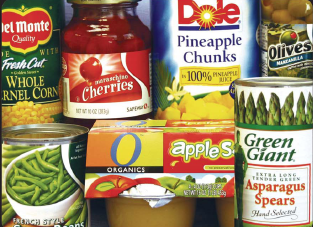
Silgan Containers will close its can making operation in Kingsburg as Del Monte winds down its fruit processing plant there. City manager Don Pauley confirms the tandem closures resulting in the loss of 53 jobs at Silgan by the end of October.
”Silgan leases space at the Del Monte plant site” says Pauley, “They “were the on-site supplier of the cans for the fruit plant” he adds.
Both Del Monte and Silgan are planning to consolidate their Kingsburg operations elsewhere – Del Monte to Modesto and Silgan to Riverbank although they are temporality laying off their Riverbank crew until January.
“Unfortunately Kingsburg is losing some pretty good paying jobs at Silgan averaging about $50k” adds Pauley.
Silgan started operations in 1899 packaging Carnation Milk at the time. The Nasdaq-traded company today has sales in excess of $2.2 billion.The Woodland Hills California-based firm makes metal containers, metal, composite and plastic vacuum closures and plastic containers. Its products contain some of the world’s best known branded consumer products, including Campbell’s Soup, Del Monte Fruits and Vegetables, Listerine and Friskies Pet Food.
Closure of the Del Monte cannery in Kingsburg is slated for the end of this packing season. The plant employed 1100 seasonal workers and about 70 full time.Some workers have been transferred to other local Del Monte plants.
Optimism
Pauley says Del Monte already has strong indication that their warehouse property will be sold quickly and now there is new optimism that the the old 1920s vintage cannery could get a new user as well says Pauly, reversing earlier pessimism.
“We have to wait until Del Monte clears out to show the space” adds Pauly,but interest in both properties is good.
Pauley says the city also got some good news with building plans filed for a new O’Reilly’s Auto Parts store and a new hardware store coming to town as well.

Sacramento Salmon Fall Run Looks Good

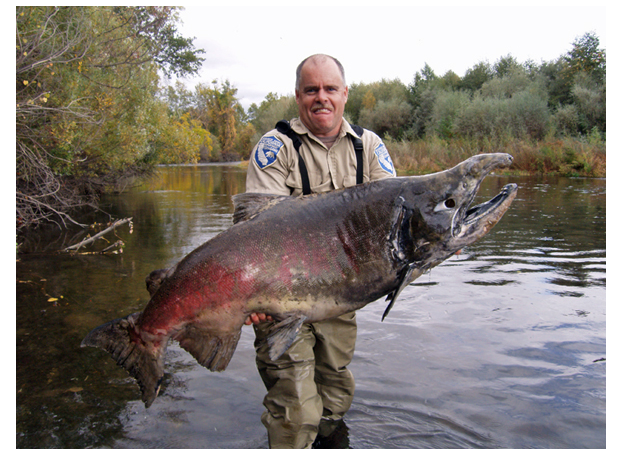
The Pacific Fisheries Management Council (PFMC) predicted last Spring that this Fall’s chinook salmon run on the Sacramento would be expected to yield 455,800 adult salmon coming back up the river to spawn. Although it is too early to tell if that will be accurate, Department of Fish & Game scientist Mike Brown is optimistic. ”It looks like we will have at least double the number coming up the river over last year.”
Brown looks at the “effort” exerted by anglers to catch the prized as one measure that DFG watch. The river is crawling with fishermen. “It sure is looking like a strong run” although we will have to wait through October and early November to get a final reading.
Best since 2005
This week the PFMC said almost 300,000 salmon have been caught off the coast this 2012 season by both sport and commercial fishermen through August 31. On the commercial side. they estimate about 173,000 chinook landings compared to 67,675 in 2011 and just 15,088 in 2010.The two previous seasons were canceled due to low population and fear of a virtual collapse of the fishery. Some predicted an extinction putting the blame on water pumps that sent Sacramento river water south.
Overall the PFMC has predicted the ocean abundance at at 2.5 million salmon in 2012 including 880,000 from the Sacramento – the largest forecast since 2005.
The rebound in the numbers of the iconic fish now has many disparate viewpoints patting themselves on the back, hailing their favored factors although scientists say ocean conditions are the biggest factor says Brown.”These fish populations are cyclical” although no doubt adequate river water releases, good management and restoration of fish habitat all play a part. Unlike some banner years it was a low rainfall year this past winter.Farmers are thankful. For once, it’s not the fishermen and environmentalists pointing at ag as the reason for low fish returns.
Likely most importantly – a strongly negative PDO (climate factor) for all of 20011 and all of 2012 has helped sustain growing salmon in the ocean with cold temps, strong upwelling and adequate food.
Fisherman this season have had high praise (“they are jumping right into the boat”,says one headline). Roger Thomas, president of the Golden Gate Fishermen’s Association, a group that includes roughly 50 Bay Area charter boats told one media outlet “We had sensational fishing the latter part of June, all of July and into August,” said Thomas, captain of the Salty Lady out of Sausalito. His customers have been averaging about one fish a person per trip.
If there is good news off the California coast,not so in Alaska this summer.
Acting U.S. Secretary of Commerce Rebecca Blank this month declared a commercial fishery failure on Alaska’s Yukon and Kuskokwim rivers and in the Cook Inlet due to low Chinook salmon returns during the 2012 fishing season and previous years.
The disaster declaration makes it possible for Congress to appropriate money toward alleviating the financial hardship to fishermen caused by the fishery disaster. If money is appropriated, NOAA will work closely with Congress and the state of Alaska to develop plans to assist coastal communities.
“Some Cook Inlet salmon fisheries have experienced revenue losses of up to 90 percent of their historical average during the 2012 season, seriously hurting local economies that are dependent on fishing,” said Acting Secretary Blank.

Ag Beat: Milk / Citrus /Eggs/ GM Foods / More
 California August Milk Production Falls 5.8%
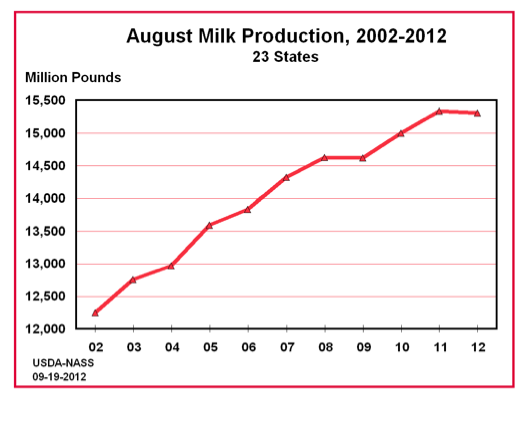
Those hot August days helped reduce milk production in California in August by 5.8% compared to the same month in 2011 while across the US production fell 0.2% says USDA. The California reduction came despite the fact USDA said there were 10,000 more cows milking than a year ago, just opposite the conventional wisdom who said there was massive liquidation. The decline in production is welcome in that it appears to have improved prices. Cheese on the CME hit $2 Sept 20, the highest level since July a year ago. That’s the best news of the year for hard hit dairy operators who have faced both sky-high feed costs and low milk prices for much of this year. Also, corn is down from $8.40 a bushel to $7.40 in the past month.
Citrus Value Up In California
USDA reports that the value of citrus in California has improved in the past few years reaching $1.56 billion in 2011-12 compared to $1.32 billion in 2009-10 and $1.31 billion in 2010-11. In the past year bearing acreage has climbed to 269,400, up 2000 acres.By contrast Florida acreage is the lowest since 1959 to 495,100 acres.The value fell in the past year from $1.81 billion to $1.80 billion.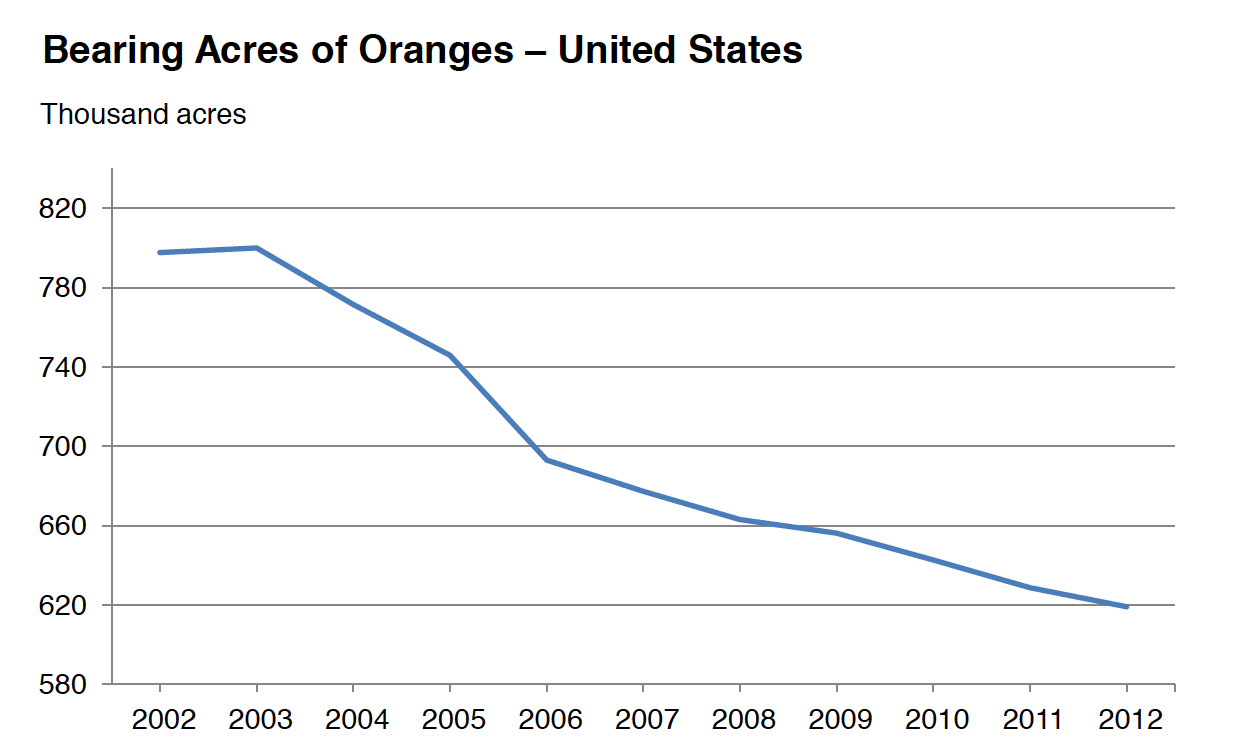
GMO Foods On Ballot
Proposition 37 would result in $1.2 billion in higher costs for farmers and food processors, higher prices for consumers and new regulations, according to an article published in Western Farm Press that refers to a new UC Davis study. The article is credited to the No on 37 campaign.
If passed, Proposition 37, which is on California’s November ballot, would require labeling of genetically engineered food.
Meanwhile grocer Whole Foods has endorsed the proposition setting up a November ballot battle.Meanwhile a French study suggested GM food is unhealthy.
Egg Shortage In Mexico Offer US Export Opportunity
NPR reports that Mexico is suffering an egg shortage. An outbreak of avian flu this summer, in the heart of the nation’s egg-producing region, caused a drastic dip in production and led to huge price increases. While the crisis has hit the country’s poor hardest, all Mexicans are hurting for eggs, which are as crucial a part of the Mexican diet as the tortilla.
According to the country’s poultry industry, Mexicans eat more eggs, per capita, than anyone else in the world. On average, they eat more than 430 eggs a year, which is almost double U.S. annual consumptionn.
Prices jumped when producers were forced this summer to slaughter 11 million hens after an outbreak of avian flu in the central Mexican state of Jalisco.
The egg price spikes and shortages got so rough that President Felipe Calderon took to the airwaves, vowing to crack down on speculators and reduce tariffs on imported eggs.
The first shipments from the U.S. have already arrived at Mexico City’s huge wholesale warehouse and are helping to stabilize prices. But egg vendor Adrian Hernandez says his clients don’t like the U.S. imports; they tell him the American eggs don’t have any flavor, and that the yolks are pale.
Farmland Prices Rise
For people trying to enter the business of farming, the cost of land can be a significant hurdle. Prices to buy or rent California farm and ranch land broke records this year, according to the U.S. Agriculture Department. The average price of California farmland stands at 7,200 dollars an acre. Property that has access to irrigation commands the highest prices. The cost to rent farmland has also increased.
Researchers Test Robotic Berry Harvester
What has 10 arms and has intrigued strawberry farmers? The answer is a robotic harvesting machine being tested at the Monterey Bay Academy. The machine uses sensors to choose strawberries of the right color and size. Next, robotic arms gently pluck the ripe fruit from vines, and deposit the berries on a conveyer belt that drops the berries into containers. The machine remains in the experimental stage.
CFB contributed

Arctic Sea Ice Reaches Lowest Extent For The Year And The Satellite Record

Sea ice can take many forms, as seen in this image of Arctic sea ice from a recent Operation IceBridge aerial survey. Varying thicknesses of sea ice are shown here, from thin, nearly transparent layers to thicker, older sea ice covered with snow. —Credit: NASA
High-resolution image
High-resolution image
The National Snow and Ice Data Center (NSIDC) is part of the Cooperative Institute for Research in Environmental Sciences at the University of Colorado Boulder. NSIDC scientists provide Arctic Sea Ice News & Analysis content, with partial support from NASA.
BOULDER, Colorado—Arctic sea ice cover likely melted to its minimum extent for the year on September 16, according to scientists at the National Snow and Ice Data Center (NSIDC). Sea ice extent fell to 3.41 million square kilometers (1.32 million square miles), now the lowest summer minimum extent in the satellite record.
“We are now in uncharted territory,” said NSIDC Director Mark Serreze. “While we’ve long known that as the planet warms up, changes would be seen first and be most pronounced in the Arctic, few of us were prepared for how rapidly the changes would actually occur.”
Arctic sea ice cover grows each winter as the sun sets for several months, and shrinks each summer as the sun rises higher in the northern sky. Each year, the Arctic sea ice reaches its minimum extent in September. This year’s minimum follows a record-breaking summer of low sea ice extents in the Arctic. Sea ice extent fell to 4.10 million square kilometers (1.58 million square miles) on August 26, breaking the lowest extent on record set on September 18, 2007 of 4.17 million square kilometers (1.61 million square miles). On September 4, it fell below 4.00 million square kilometers (1.54 million square miles), another first in the 33-year satellite record.
“The strong late season decline is indicative of how thin the ice cover is,” said NSIDC scientist Walt Meier. “Ice has to be quite thin to continue melting away as the sun goes down and fall approaches.”
NSIDC scientists have observed fundamental changes in the Arctic’s sea ice cover. The Arctic used to be dominated by multiyear ice, or ice that survived through several years. Lately, the Arctic is increasingly characterized by seasonal ice cover and large areas are now prone to completely melt away in summer.
“The later minimum date is somewhat surprising because we expected that the late melt in the Chukchi and East Siberian seas would result in cool surface waters that would quickly refreeze once the atmosphere cooled,” Meier said. “However, ice loss continued north of the Laptev Sea, opening up a gap in the ice cover that reduced extent.”


Dairy Watch: Tulare Meeting Focuses On Possible Change To Federal Orders
 Unhappy with the state regulated system that does not seem to listen to producers, the state’s dairymen centered in Tulare & Kings Counties are eying a big change that might or might not be a good idea ,shrugs Western United Dairymen president Tom Barcellos. WUD is sponsoring an “educational meeting” September 20 to look at both sides of aligning the dairy industry with the federal program. Any change would require a referendum and Barcellos for one, is not advocating either way, just yet.
The decision to set such a meeting stems from the producer community’s discontent with CDFA’s latest minimal changes to the pricing formulas. “After the last hearing decision, a lot of producers have shown interest in learning more about federal orders and we wanted to give them an opportunity to gain knowledge about its potential impact on California while looking at the pros and cons”, said WUD’s Barcellos.
The 10 a.m. meeting at the Tulare Ag Center’s Banquet Hall inside the Heritage Complex Building will feature Bill Wise, Market Administrator of the Arizona and Pacific Northwest orders, who will provide an overview of federal orders and highlight the differences with the California system. A significant portion of the meeting will be allocated for questions.
Barcellos says like this quandary, the dairy industry is divided on what approach to suggest to Congress who are being urged to pass a Farm Bill this year. This week local industry players including reps of each co-op met with local congressman Devin Nunes but failed to come up with a unified viewpoint on the best way to move forward on the Farm Bill.”We thought we were going to come out of the meeting with unified marching orders but it didn’t happen.”
In August – another group, the California Dairy Campaign (CDC) called on their Congressional delegation to put the Golden State in the Federal Milk Marketing Order system. CDC had also petitioned the California Department of Food and Agriculture last month to raise producer prices (as did WUD) to bring them more in line with surrounding states. CDFA did not adopt the petition so the producer organization is seeking an alternative.
CDC Executive Director, Lynne McBride tells Cheese Market News the organization would like to see something similar to a provision included in the 1996 farm bill. That plan would allow California to maintain its quota system and milk standards while participating in the Federal Orders. McBride says the measure was actually included in the ’96 Farm Bill but was never advanced at the state level and expired.
Barcellos says while producers remain upset with CDFA and Secretary of Ag Ross over their ruling,market conditions have improved in recent weeks due in part to “so many producers going out of business to the point there is dramatically less milk.”
Indeed, CDFA numbers show a 5% decline or more in milk volume(year over year) in some counties in July including San Joaquin,Madera, and Kings,all big volume counties. He also notes higher cheese prices that have bumped up even as the price of corn has come down some. ”I am more optimistic as we approach the end of the year.”
On the other hand don’t look for much expansion in the California dairy industry anymore predicts Barcellos.”Banks are more likely to lend you money to tear down your dairy and plant trees than to enlarge what you have.”