Exports Up / PC Exports Down

California Exporters Enjoy Slight Gain Over Same Time Last Year As PC Market Continues Its Decline

April 5, 2013 – LOS ANGELES, CALIFORNIA – Even if it isn’t immediately apparent, California’s export trade this February represented a modest increase over the same month last year, according to an analysis by Beacon Economics of foreign trade data released this morning by the U.S. Commerce Department.

The state’s exports in February 2013 totaled $12.70 billion, which might appear to be less than the $12.85 billion recorded in February 2012. However, 2012 was a Leap Year, adding an extra trading day to that month.

“Last February saw exporters benefit from the Sadie Hawkins Day Bump,” said Jock O’Connell, Beacon Economics’ international trade adviser. “This February, Sadie sat out the dance.”

When adjusting for both inflation and that bonus trading day last February, California’s February 2013 export trade showed an increase of 1.1% over the same month one year earlier.

The gain came as the result of a 4.3% real increase in shipments of manufactured products and an even more robust 5.9% rise in exports of non-manufactured goods (chiefly agricultural commodities and raw materials).  Restraining further growth in the state’s overall export trade was a relatively sharp 9.6% fall-off in re-exported goods.

Because detailed data on specific export commodities and their destinations can vary abruptly from month to month for a variety of factors, Beacon Economics’ analysis compares the latest three months with the corresponding period twelve months earlier.

That analysis reveals that California’s export of manufactured products continues to be slowed by an ongoing decline in shipments of electronic components used in the manufacture of personal computers. In the most recent three-month period (December 2012-February 2013), exports of these products were down 24.9% from the same period a year earlier.

“The chief culprit here is the growing popularity of smartphones and tablets, which has been shrinking consumer demand for PCs and curtailing trade in PC components,” O’Connell said.

Interestingly, in terms of employment, the manufacturing sector in California is doing better than initially reported. Recently released 2013 Benchmark revisions by the California Employment Development Department show that the state gained roughly 19,400 more manufacturing jobs through the end of 2012 than originally indicated, with most of the upward revisions coming from durable goods. “Compared to the rest of the nation, manufacturing employment growth has not been a bright spot in California,” said Beacon Economics’ Director of Economic Research Jordan Levine. “But the precipitous declines we were seeing in manufacturing jobs have largely been arrested.”

California’s exports to Mexico, the state’s leading foreign market, were down by 19.2% in the latest three-month period, largely because PC components have constituted as much as 30% of California’s export trade with its southern neighbor as recently as 2011.

Shipments to the state’s number two market, Canada, rose slightly by 1.2%, while exports to its third largest export market, China, slipped by 1.3%.

Perhaps surprisingly, given headlines about Europe’s persistent economic and financial woes, California exports to the European Union were up 3.9% over the latest three months, while exports to the Pacific Rim rose by just 2.2%.

Airborne shipments currently account for 44.3% of all state exports. By contrast, 34.0% of the state’s export trade went by sea, while the remaining 21.7% was transported overland to Mexico and Canada.

The overall outlook for the state’s exporters is mixed, with the rising value of the dollar and the risk of competitive currency devaluations presenting the most evident negatives for California exporters.

“Of course, all of this assumes that Kim Jong-un doesn’t do anything rash in the coming weeks,” said O’Connell.


 

Immigrant Docs Help Ease California’s Primary Care Shortage

Dr. Jose Chavez Gonzalez examines Graciela Jauregui at Riverside County Regional Medical Center (Photo by Jenny Gold/KHN).

RIVERSIDE, Calif. — When Jose Chavez Gonzalez moved to the United States from El Salvador, he took any job he could get — stocking warehouses, construction, cleaning houses and working in a meat processing plant.
But unlike most of the other immigrants he worked alongside, Chavez, 38, was a doctor with eight years of medical training. He came to the U.S. in the mid-1990’s to be with his family, but like all doctors from other countries, he still had to pass the U.S. medical boards and go through at least three years of residency in order to practice here. The process can be both expensive and time consuming, so during the day he worked various menial jobs and at night he studied for the boards.
“I had to do it. And I wouldn’t complain,” says Chavez. “It was OK to me. I mean, of course medicine is my passion, but since I didn’t have a license here, I couldn’t practice it.”
A quarter of U.S. doctors are foreign-born, mostly from countries like India that focus on training ­­medical students to work in the U.S.  Many other immigrant physicians never become American doctors, particularly those who come from Latin American countries like Chavez.
But a program at the University of California is seeking to change that, while at the same time helping to address the shortage of primary care doctors in the state. The UCLA International Medical Graduate Program offers Latino doctors a stipend along with board preparation classes, mentorship and references to help them find a good residency slot in primary care. In return, the doctors pledge to work in an underserved area of California for two or three years.
The program at UCLA was founded by Dr. Patrick Dowling and Dr. Michelle Bholat to help address the shortage of primary care doctors in the state, and a particular shortage of doctors of Latin American heritage. Though about 40 percent of the state’s population is Hispanic, only 5 percent of its doctors are.
Nearly half of the estimated 5 million Californians expected to be newly eligible for health insurance under the Affordable Care Act are Latino, and Dowling says it’s key that patients see a doctor who understands their language and culture.
“You can either do total body cat scans on everybody or you can sit down and try to understand what the patient is saying and why and what’s going on in their life,” says Dowling.
The program is small. But slowly, it’s making a dent.  Chavez was able to pass his medical exams in two years. Today, he’s hard at work as a first-year resident at the Riverside County Regional Medical Center. Most of his patients are Hispanic, and many are immigrants like him.
Graciela Jauregui came to the clinic with severe pain in her knee. She was born in Mexico but has lived in the U.S. for 17 years, working as a housekeeper. She’s 62 and doesn’t speak English. She says she always prefers to see a doctor who can actually understand her.
Speaking through an interpreter, Jauregui says, “All doctors are good people, but when they speak Spanish it’s better.”
Chavez’s fluency in Spanish is prized by his boss, Riverside’s chief of family medicine Dr. Geoffrey Leung. Leung says the clinic employs translators, but they are often in short supply. And even with a translator, important details can be lost.

Program founders Dr. Michelle Bholat and Dr. Patrick Dowling (Photo by Jenny Gold/KHN)
“No matter how good of a translator you have, your concern is that you may lose some part of the integrity of the message,” Leung says.
So far, the UCLA program has placed 54 Hispanic doctors into family medicine training programs – Dowling says that’s almost as many as came from all 10 California medical schools put together.
Dowling says hundreds and maybe thousands of immigrant doctors from Latin America could be practicing, but are instead working other – often menial – jobs. And that’s a wasted resource.
“I was just reviewing an applicant this morning who’s currently working in McDonalds,” Dowling says. “And I thought of the irony: She’s serving people Big Macs right now and what she could be doing is explaining to people that isn’t what you want you want to be eating.”
Chavez, for his part, is happy to be treating patients again: “[It] gave me the opportunity to stop working and focus full-time on studying. Without the program, I would still be working on construction.”
Kaiser Health News

Mortgage Rates Dip Lower

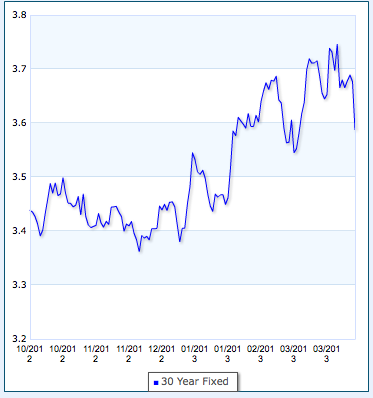
mortgage rates have been falling in recent days after a run up since the first of the year

MCLEAN, VA–(Marketwired – Apr 4, 2013) – Freddie Mac (OTCQB: FMCC) today released the results of its Primary Mortgage Market Survey® (PMMS®), showing average fixed mortgage rates dipping for the week amid recent data which indicates the manufacturing industry is slowing. The average 30-year fixed-rate mortgage has seesawed around 3.5 percent for the past two months, providing ongoing help to the housing recovery.
News Facts
30-year fixed-rate mortgage (FRM) averaged 3.54 percent with an average 0.8 point for the week ending April 4, 2013, down from last week when it averaged 3.57 percent. Last year at this time, the 30-year FRM averaged 3.98 percent.
15-year FRM this week averaged 2.74 percent with an average 0.7 point, down from last week when it averaged 2.76 percent. A year ago at this time, the 15-year FRM averaged 3.21 percent.
5-year Treasury-indexed hybrid adjustable-rate mortgage (ARM) averaged 2.65 percent this week with an average 0.5 point, down from last week when it averaged 2.68 percent. A year ago, the 5-year ARM averaged 2.86 percent.
1-year Treasury-indexed ARM averaged 2.63 percent this week with an average 0.4 point, up from last week when it averaged 2.62 percent. At this time last year, the 1-year ARM averaged 2.78 percent. 
.
“Fixed mortgage rates dipped slightly while the manufacturing industry showed signs of slowing. Regionally, both the Chicago [PDF] and Milwaukee purchasing manager reports for March fell below the market consensus forecast. On a national scale, both the ISM manufacturing and non-manufacturing indexes also showed reductions in growth.”
The trend reported by Freddie Mac could continue with US Treasury yields falling today near the lows of the year helping to drive tomorrow’s lending rates lower.

Gene Discovery May Yield Lettuce That Will Sprout In Hot Weather

Rows of green leaf lettuce in a field.
A team of researchers, led by a University of California, Davis, plant scientist, has identified a lettuce gene and related enzyme that put the brakes on germination during hot weather — a discovery that could lead to lettuces that can sprout year-round, even at high temperatures.

The study also included researchers from Arcadia Biosciences and Acharya N.G. Ranga Agricultural University, India.

The finding is particularly important to the nearly $2 billion lettuce industries of California and Arizona, which together produce more than 90 percent of the nation’s lettuce. The study results appear online in the journal The Plant Cell.

“Discovery of the genes will enable plant breeders to develop lettuce varieties that can better germinate and grow to maturity under high temperatures,” said the study’s lead author Kent Bradford, a professor of plant sciences and director of the UC Davis Seed Biotechnology Center.

“And because this mechanism that inhibits hot-weather germination in lettuce seeds appears to be quite common in many plant species, we suspect that other crops also could be modified to improve their germination,” he said. “This could be increasingly important as global temperatures are predicted to rise.”

Most lettuce varieties flower in spring or early summer and then drop their seeds — a trait that is likely linked to their origin in the Mediterranean region, which, like California, characteristically has dry summers. Scientists have observed for years that a built-in dormancy mechanism seems to prevent lettuce seeds from germinating under conditions that would be too hot and dry to sustain growth.

While this naturally occurring inhibition works well in the wild, it is an obstacle to commercial lettuce production.

In the California and Arizona lettuce industries, lettuce seeds are planted somewhere every day of the year — even in September in the Imperial Valley of California and near Yuma, Ariz., where fall temperatures frequently reach 110 degrees.

In order to jump-start seed germination for a winter crop in these hot climates, lettuce growers have turned to cooling the soil with sprinkler irrigation or priming the seeds to germinate by pre-soaking them at cool temperatures and re-drying them before planting — methods that are expensive and not always successful.

In the new study, researchers turned to lettuce genetics to better understand the temperature-related mechanisms governing seed germination. They identified a region of chromosome six in a wild ancestor of commercial lettuce varieties that enables seeds to germinate in warm temperatures. When that chromosome region was crossed into cultivated lettuce varieties, those varieties gained the ability to germinate in warm temperatures.

Further genetic mapping studies zeroed in on a specific gene that governs production of a plant hormone called abscisic acid — known to inhibit seed germination. The newly identified gene “turns on” in most lettuce seeds when the seed is exposed to moisture at warm temperatures, increasing production of abscisic acid. In the wild ancestor that the researchers were studying, however, this gene does not turn on at high temperatures. As a result, abscisic acid is not produced and the seeds can still germinate.

The researchers then demonstrated that they could either “silence” or mutate the germination-inhibiting gene in cultivated lettuce varieties, thus enabling those varieties to germinate and grow even in high temperatures.

Other researchers on the study were: Post-doctoral researcher Heqiang Huo and staff researcher Peetambar Dahal, both of the UC Davis Department of Plant Sciences; Keshavulu Kunusoth of Acharya N.G.

Ranga Agricultural University, India; and Claire McCallum of Arcadia Biosciences, which provided the lettuce lines with variants of the target gene to help confirm the study’s findings.

Funding for the study was provided the U.S. Department of Agriculture National Institute of Food and Agriculture and the National Science Foundation.


Valley Economic Indicator Rises To Highest Level In Three Years

click to enlarge

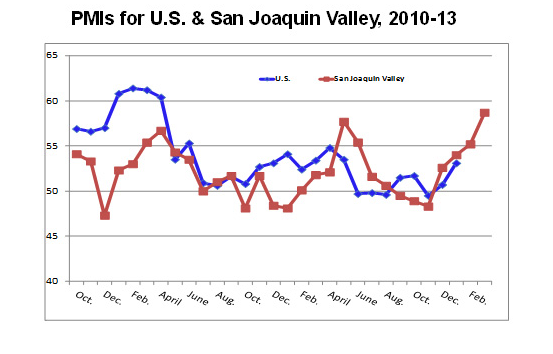
Fresno State’s Craig School of Business San Joaquin Valley Business Conditions Index advanced for a fourth consecutive month. During March the overall index expanded to 58.7 from 55.6 in February. An index of greater than 50 indicates an expansionary economy over the course of the next three to six months.
“The overall index jumped to its highest level in three years pushed higher primarily by construction and manufacturing expansion,” said Dr. Ernie Goss, a research associate from the Craig School who produces the index.
The index is a leading economic indicator from a survey of individuals making company purchasing decisions in the counties of Fresno, Madera, Kings and Tulare. The index uses the same methodology as that of the national Institute for Supply Management.
Survey results indicated that federal spending sequestration is having little impact on local business confidence. “This month we asked companies how the federal spending sequestration was affecting their company. Approximately 90 percent indicated that the cuts were having no impact on their company. The remaining 10 percent reported only modest impacts. None of the businesses reported significant impacts,” said Goss.
Other survey findings:
Employment moved above the growth neutral threshold for a fifth straight month. The job index climbed to 57.7 from February’s 51.1. While hiring has increased, most gains are among temporary and hourly workers. Giving the overall upward economic trend nationally, Goss expects to see healthy increases in the hiring of permanent works in the months ahead.
Wholesale prices declined to 60.4 from 66 in February according to the prices-paid index, which tracks the cost of raw materials and supplies. This month survey participants were asked how much they expected prices for their company’s products and services to increase in comparison to last year. On average, supply managers expect prices to grow by one percent for 2013, or less than the current rate of growth in the U.S. consumer price index.
Inventories expanded for businesses in March. The inventory index grew to 51.9 from 51.3 in February. Goss says the sluggish growth this is an indicator of weak business confidence.
Trade strengthened for March with a reading of 51.7, up from February’s 44.2. March imports expanded for the month with an import index of 56.3, up significantly from 51.9 in March.
Other components of the March Business Conditions Index were new orders at 62, up from 58.1 in February; production or sales at 63.5, up from February’s 55.6; and delivery lead-time at 58.4, down from 59.6 in February.

SLO Crops Set New $ 861.8 Million Record

San Luis Obispo County’s total gross crop values for 2012 are estimated at a record breaking value of $ 861,803,000 compared to $ 736,208,000 for 2011. This represents an increase of nearly 18 % in value compared to 2011.

For the second consecutive year, the strawberry industry remained in the top position in overall value in 2012.

The total value of strawberries was over $ 205 million representing 24 % of the combined value of the County’s entire agricultural industry. The pricing for fresh market berries was very strong and increased by 14% over 2011 levels.Over 123,000 tons of strawberries were picked in 2012 from roughly 3,000acres. There was a 2% increase in all berry production.

Wine grapes remained the number two ranked commodity in value in 2012.Production overall rebounded dramatically from the effects of the devastating April, 2011 frost to record breaking levels. Overall, total production increased 31% compared to 2011.

Strong prices and high demand for San Luis Obispo County’s wine grapes set a new record for value at over $197 million.
Wine grape acreage expanded by 3% in 2012,with the majority of new acreage planted in the north county. The county has close to 40,000 wine grape acres compared to 28,000 acres 10 years ago.

During 2012, the beef cattle industry felt the effects of local and nationwide drought conditions. The uncertainty of available grass for grazing due to continued dry conditions locally reduced herd numbers. Lack of grass resulted in reduced animal weight. Drought conditions across the United States increased the demand for locally raised beef cattle , creating strong prices.

Favorable weather conditions in 2012 led to increased yields for avocado, lemon and orange growers.Total production for avocados increased by 103% and lemons increased by 42%. However, price per ton for avocados and lemons fell by 48% and 54% respectively. The county has just under 5000 acres of avocados.

Orange growers produced 73 % more fruit over 2011 levels and saw very strong prices.

Fairly mild weather conditions during 2012 had variable effects on vegetable production. Overall, the value increased 17% over 2011. Consisting of primarily annual crops, this agricultural sector tends to be speculative on assessing future customer demands with growers making adjustments from year to year on what is grown.

Napa cabbage production increased by 41% and production of edible pod peas increased by 70% compared to 2011. Labor shortages had an impact on the vegetable industry in 2012. Broccoli is the most grown vegie at nearly 10,000 acres.

Nurseries Bouncing Back

The nursery stock industry remained relatively stable, with overall values declining only 1%. Indoor decorative production decreased and the value dropped 17% from 2011. Increased production, solid prices and improved demand for outdoor ornamental plants resulted in a sharp increase of 82% in value compared to 2011. Bedding plants, sod and ground cover plants increased by 7% in value over 2011. For the first time in several years, nursery stock producers are beginning to expand production.

Tulare County Solar Projects Sold

Five rural Tulare County solar projects now under construction were sold to an investment group this week. Reznick Capital Markets Securities (RCMS) announced this week the sale of ImMODO International Corporation’s (ImMODO) solar portfolio located in Tulare County, CA to an Institutional Investor. Financial details of the sale were not disclosed.
“There is significant demand in the market for the aggregation of quality distributed generation projects. Now that we are well past the uncertainty surrounding the ‘fiscal cliff’ and we can all see the landscape clearly, we expect to see more deals like this in 2013.”
The 22 MW aggregated solar portfolio (the Tulare PV Portfolio) has offtake contracts with Southern California Edison and Pacific Gas & Electric under the respective 20-year Feed-In Tariff (FIT) programs. Construction on the Tulare PV Portfolio, which will span five sites, is expected to start in the second quarter and be completed by the fourth quarter of 2013. ImMODO Energy Services Corporation will also be acting as the Engineering, Procurement & Construction (EPC) company and Operation & Maintenance (O&M) provider on the portfolio.
“The CREST and FIT programs represent an important move in California’s distributed generation market, and this transaction reflects an important shift in the marketplace,” said RCMS Vice President Conor McKenna. “There is significant demand in the market for the aggregation of quality distributed generation projects. Now that we are well past the uncertainty surrounding the ‘fiscal cliff’ and we can all see the landscape clearly, we expect to see more deals like this in 2013.”

CHSRA Staff Favor Rail Route West Of Hanford

click to enlarge

Staff of the California High Speed Rail Authority are recommending the board approve a west side alignment through Kings County with a”potential” station just west of Hanford. A report was released today. The board will hear the staff recommendation and testimony from interested parties at their April 4 meeting in Fresno. Kings County and its municipalities have stayed silent on the key choice that would route the 200 mph bullet train either to the east of Hanford or to the west of the city, each impacting farm properties in the way. Staff says the west alignment is $800 million less than the eastside route and has fewer impacts.

Disappointment  In Tulare County

However, the City of Visalia and Tulare County Council of Governments  have been strong supporters of a rail station on the eastside of Hanford with the city noting in a March 14 letter to the Authority that if the train system is built ”a station is necessary and warranted in the Kings County-Tulare County region,and ridership will be maximized by locating the station on the east side of Hanford.” The letter was signed by Mayor Amy Shuklian.

The Visalia letter points out that of the 1.12 million people that will be living in the two-county area by 2060 some 836,850 are projected to be living in Tulare County. The station should be as close as possible to the population centers to “maximize accessibility.” For Tulare County residents – a west of Hanford station near Armona  would be a 10-mile plus round-trip further than a Hwy 43 and Hwy 198 site.

Visalia leaders plan to protest the staff recommendation April 4.

“If they do not approve a station, I would find it totally unacceptable” says Hanford City Manger Darrel Pyle. Without a stop Kings County would see all the impacts but none of the benefits of the state’s largest public works project. Kings Supervior Richard Valle says he has been told the staff of the CHSRA will back the plan to build the Corcoran Bypass around the town. He says he is hopeful rumors that the Amtrak station in Hanford and Corcoran will be saved will be discussed at the Fresno meeting this week.

The approximately 114 mile long Fresno to Bakersfield Section is an essential part of the statewide HST System. As part of the Central Valley section of the HST System, it would provide
Fresno, Visalia, Tulare, Hanford, and Bakersfield access to a new transportation mode, and would contribute to increased mobility throughout California. This section will connect the south San
Joaquin Valley region to the rest of the statewide HST System via Fresno, Kings, Tulare, and Kern counties.
The report details the benefits of the western route.
Fewer impacts to aquatic resources than the BNSF Alternative and generally incorporates the least impacts to aquatic resources of the individual geographic alternatives.
    Fewer Section 4(f) uses than the BNSF Alternative and fewer than all individual geographic alternatives.
    Fewer effects on residences, commercial and industrial facilities, and community resources than the BNSF Alternative; effects vary by individual geographic alternative.
    Fewer construction impacts such as noise, farmland, air quality, cultural resources, parks, than the BNSF Alternative; effects vary by individual geographic alternative.
    Least constructability issues and lowest cost alternative (together with a similar alignment terminating with the Bakersfield South Alternative).
    Takes only 1 minute longer than the BNSF Alternative between Fresno and Bakersfield, plus adds 1 minute to the Bakersfield to Palmdale segment related to the Bakersfield station.
The estimated cost of the Preferred Alternative is about $800 million less than the BNSF Alternative, and is the lowest cost alternative of all possible alternative combinations (together with a similar alignment terminating with the Bakersfield South Alternative). The Preferred Alternative bypasses the downtown areas of the cities of Corcoran, Wasco, and Shafter and the unincorporated communities of Laton, Grangeville, Armona, and Allensworth, while also reducing the impacts in downtown Fresno and Bakersfield as compared to the BNSF alternative. Lastly, the Preferred Alternative minimizes constructability issues that can lead to delay and cost escalation.
Also today, the Madera County Board of Supervisors voted to withdraw from a lawsuit against the CHSR Authority over plans  for the  Madera to Fresno leg of the of the route,expected to break ground late this summer. Other entities still in the suit including both the Madera and Merced Farm Bureaus  say they are committed to the suit that will be heard by a judge April 19.

Corn Prices Drop As Supply Worries Ease… But It’s Too Early To Celebrate

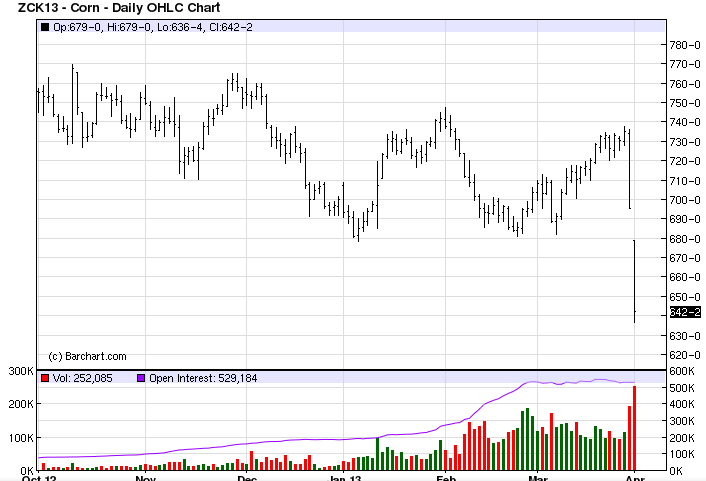
Central Valley dairymen are breathing a little easier this week as corn futures have been in a virtual free-fall over the past few days since USDA signaled there were ample supplies on hand,low demand and a good crop coming this summer.

corn free fall

Corn futures have declined about a dollar since last Thursday with May futures declining to $6.42 a bushel today.Corn jumped over $8 last summer as the extreme Midwest drought help drive future prices to record highs.
Prices in Chicago are down 23 percent since last year’s closing high of $8.3875 on Aug. 21.
Speculation has helped move commodity prices in wilder swings in the past few years many observers agree.
USDA is predicting farmers will plant 97.282 million acres this year, the most since 1936. Once the crop comes in – by September – future prices are now down to $ 5.51 bushel – closer to historical averages.
The reality is that a good moisture year will be needed in the Midwest for that to happen.So far this Spring moisture has been good in many parts of the corn belt.
California milk producers import the majority of their feed from the Midwest.
Livestock owners have been hurt hard by the drought last summer that helped drive increasing numbers of families out of the business in places like Kings County – where milk production has fallen by more than 9%.
Corn costs are the biggest expense dairymen face.The high price of corn also  whipsawed all livestock  owners as well as ethanol makers who rely on the feedstock to make biofuel.The record cost has idled scores of plants.
Too Early To Celebrate
Western United Dairymen president Tom Barcellos says it’s “too early to celebrate.We need relief on feed costs and on the milk price that needs to go up – to get a decent margin.”
Barcellos says that California producers are focusing on changing the milk marketing through a federal order instead of the state although they have not given on trying to change the California system through AB31.
Barcellos, who farms near Tipton, says milk volume is up this week as dairy cows enter the Spring Flush period when good weather boosts milk production.

Some Locations See Home Construction Double

Central Valley Home Building Up

Central Valley home builders pulled permits for 587 new homes during the first  three months of 2013 compared to 425 for the same period a year earlier. The figures come from Construction Monitor for Madera,Fresno,Kings and Tulare Counties.

Lennar Homes continues to lead the pack of home builders permitting 117 new homes in the region in the first quarter of the year compared to 74 for the first three months of 2012 when they were also the top builder.

Visalia new home building permits numbered 75 so far this year says the city compared just 34 for the first three months of 2012,showing the pace more than doubled. The city total building valuation is up 67% so far this year at $33.2 million compared to $19.8 million for the first quarter of 2012.

CENTRA COAST HOME PERMITS DOUBLE LAST YEAR’S PACE

Led by San Luis Obispo County the Central Coast saw new home building permits more than double in the first three months of 2013, Construction Monitor reports.

In the SLO/Santa Barbara two-county region contractors received 182 new home permits compared to 91 for the same period in 2012.

Of that, SLO County has been busier. For  the first quarter of 2013 SLO County builders got permits for 123 new sf homes vs 66 for the same period in 2012. Shea Homes is the busiest builder with 32 units.

Builders also got permits for 156 units of multi-family so far this year compared to just 21 units in the first three months of 2012.