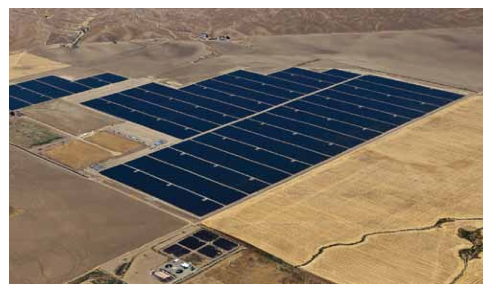
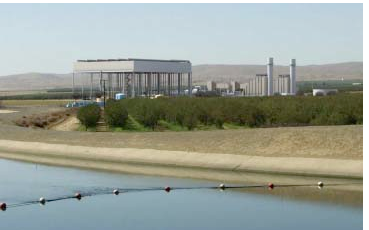
SOLAR: In Kings County, Enexco ( EDF – based in France) plans to build a 20MW solar facility on Corcoran Irrigation District land near Corcoran. The project released their public notice this week.The company is leasing 200 acres of a 560 acre parcel.
In Kern County the Pioneer Green Energy Solar Project requests approval of three Conditional Use Permits (CUPs), Lot Line Adjustment 28-11 and the cancellation of Williamson Act Land Use contracts 11-5 and 11-6, to allow for the construction and operation of 3 solar electrical generating facilities on a combined 720 acres in the A Zone District, which would generate a combined 125 megawatts (MW) of renewable electrical energy. All three project sites are located in unincorporated areas of western Kern County, near Lost Hills. NATURAL GAS: BNSF Railway has confirmed it will test the use of natural gas on their locomotives instead of diesel. If successful, the experiment could provide a new outlet for a abundant supply of cheap natural gas in North America.
Meanwhile the Ford Motor Co. said recently that it sold a record 11,600 natural gas vehicles in the 2012 model year year, more than four times the number it sold two years ago. General Motors Co. and Chrysler Group recently added natural gas pickup trucks to their offerings. On the car front Honda Motor Co. is selling more natural gas Civics.
Plentiful natural gas is is adding customers -particularly for truck fleets, buses, and taxis. One analyst is predicting 10% growth for nat gas use in transportation over the next five years.
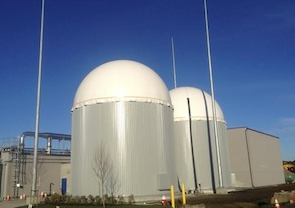
Harvest Power digester
TULARE: The Harvest-Tulare composting facility currently holds operating permits to compost green material, food, and dairy manure. The proposed project will increase and shift types of materials and quantities accepted at the facility. Harvest Power California LLC is proposing to add an anaerobic digester to the existing Harvest-Tulare composting operations to process organic materials into fuel and digestate that will contribute to soil amendment production. Both a high solids digester (processing food and green material) and a low solids digester (processing primarily food material) alternatives will be evaluated in the environmental document.
The proposed project will increase total tonnage at the site from 86,000 tons per year to a potential 216,000 tons per year. The increase includes both the proposed anaerobic digester and increasing tonnages at the composting facility. The facility will produce transportation fuel either through a compressed natural gas (CNG) refueling station or by injecting directly into a nearby natural gas pipeline. Therefore, both a CNG refueling station and direct injection to the natural gas pipeline will be evaluated.
SACRAMENTO – This morning at its business meeting, the California Energy Commission awarded $4,998,399 to Mendota Bioenergy, LLC.
The award will support the design, construction and operation of an advanced biorefinery demonstration plant in the Mendota area (Fresno County), where sugar beets will be used to create advanced biofuel ethanol.
“This award supporting the development of an advanced biorefinery will help to keep California as the leader in alternative fuel innovation,” said Energy Commission Chair Robert B. Weisenmiller. “Developing advanced fuels is essential to reducing greenhouse gas emissions to protect the environment and public health, and to meet the state’s climate change policies.”
The project is slated to use advanced enzyme and microbial techniques to convert 10,000 tons of sugar beets harvested throughout the year into 285,000 gallons of advanced biofuel ethanol. A demonstration plant will be built in Five Points, in the Mendota area. This project also supports the design and development of a future commercial-scale biorefinery center in Mendota, a town of less than 12,000 in western Fresno County. Eventually, the facility could produce 40 million gallons of biofuel annually.
The demonstration project is expected to create about 50 jobs, during construction and operation. The commercial biorefinery is expected to create approximately 250 direct and 50 indirect construction jobs, along with 100 long-term jobs, and 160 agricultural jobs.
The project provides an innovative use for an established local crop. Sugar beets have been grown in the area for more than 100 years, and were processed at a local Spreckels Sugar plant until it closed in 2008.
“This could be an excellent re-establishment of an old crop to a new end – to make advanced biofuels,” said Jim Tischer, project manager with Mendota Bioenergy. Tischer refers to the beets as “energy beets.”
This project is also notable for its technological and green aspects.
“This is the first energy beet project to advance to the pilot and demonstration phase in the United States,” Tischer said. With a year-round harvest schedule, the beet crop delivers ethanol yields that are greater per acre and have a lower carbon index than Brazilian sugar cane or North American corn.
Another green aspect of the biorefinery: Woody plant matter, as well as beets, will be used to produce about 15 percent of the ethanol at the Mendota plant. Also, the water in the beets will be captured during processing and recycled so that little water will be used in the plant.
The project will bring new jobs and opportunities to an area in need, and builds on the collaboration of dozens of beet farmers in the area who formed the Mendota Advanced Bioenergy Beet Cooperative after the local sugar plant closed five years ago. This effort led to the establishment of Mendota Bioenergy, LLC, in 2011.
“This is going to be a great opportunity in an area hard-hit by drought and unemployment,” said Phil Larson, a Fresno County Supervisor whose district includes Mendota. “This puts the possibility of 35,000 acres being put back in production for a crop that disappeared five years ago.”
“We’re in a high unemployment area so these jobs mean a lot,” said Mendota Mayor Robert Silva. “These folks know how to grow those beets; it’s great to see the beet industry get on its feet again.”
The award approved today is made through the Commission’s Alternative and Renewable Fuel and Vehicle Technology Program, created by Assembly Bill 118. For the current fiscal year, the program is slated to invest approximately $90 million to encourage the development and use of new technologies, and alternative and renewable fuels, to help the state meet its climate change goals. It is funded through vehicle and boat registration fees, as well as smog check and license plate fees.
(March 12, 2013) WASHINGTON — In response to the latest Wall Street Journal editorial on the federal Renewable Fuel Standard (RFS), the Advanced Ethanol Council (AEC) sent a one-pager to the Journal editorial board entitled “RIN Credits for Dummies.”
The Journal editorial board argues that higher prices for RFS “RIN compliance credits” is driving up the price of gasoline, and alleviating this government-induced burden will bring prices down. But in classic form, the Journal leaves out a few important facts (as taken from “RIN Credits for Dummies”):
A RIN is produced when a gallon of renewable fuel is produced. Oil companies can then split the RIN from the gallon when they buy the gallon of renewable fuel and sell it on the open market. So, in essence, the oil companies are buying and selling RINs to themselves and then complaining about it to the Wall Street Journal.
Oil companies can either buy a gallon of renewable fuel to comply with the RFS or buy a RIN credit on the open market. Oil companies have indeed bid up the price of RINs over the last few weeks, but they are doing so voluntarily to avoid the alternative of adding more ethanol to gasoline. Ethanol is 65 cents cheaper per gallon than gasoline today.
The oil industry’s excuse — that it cannot blend more ethanol because of the blend wall — is smoke and mirrors. Fifteen percent ethanol blends are approved for 75 percent of today’s vehicles which together account for 85 percent of miles traveled. It’s pretty simple; the oil companies will bury the truth and gouge the consumer to avoid blending alternative fuels.
The oil companies helped design and openly supported the open market RIN credit program they are now using to attack the RFS. The problem for the oil industry is the RFS and RIN credits are working to reduce our dependence on oil, break Big Oil’s monopoly on the gas pump, and create American jobs while also reducing gas prices.
In essence, the RFS is telling oil companies (because fuel markets are not free markets) to blend more of a domestically-produced, renewable and cheaper fuel. The oil industry is responding by leaning too heavily on RIN markets to avoid blending more of a domestically-produced, renewable and cheaper fuel. Instead of sniffing out the facts, The Wall Street Journal carries the oil industry’s water to the general public. The RFS is not the problem, it’s the solution.
More large utility-scale solar farms to be located in the Central Valley’s Tulare Lake Basin are on the drawing boards in 2013. Meanwhile, Tulare County appears to be planning to tighten rules on where developers can site new solar farms not yet approved.
In the early stage of permitting locally are a new 80MW solar farm on non-irrigated land south of Ducor in Tulare County,a 150MW solar farm along I-5 in Kings County, a 100MW project owned by SunPower near NAS Lemoore that is set to break ground in 2015 and news out of Westlands Water District that they have approved a preliminary plan to build a new energy transmission corridor through their jurisdiction located in Kings and Fresno counties. Also in an early stage – energy company NRG plans to expand the footprint of their solar farm near Avenal that produces 45MW of power.
Solar Policy Tweak
In Tulare County where an existing pipeline of some 250MW has been approved by the county, new solar projects are likely to to face restrictions on just where on Tulare County’s farm land they can locate. The Tulare County Board of Supervisors will take up what the county’s solar coordinator Mike Washam calls a “compromise” recommendation February 26 offered by the county’s Ag Policy Advisory Committee. The collaborative effort has included the Tulare County Farm Bureau who have raised questions about current policy.
Washam says a key new provision would be that a solar farm could not be located on irrigated land “that has been farmed with a permanent crop in at least one of the past 10 years” although land within a city’s urban boundary might be exempted.
The intent is to push solar developers on more marginal land in the county,land that would not mean a loss of prime ag land for crops. In many cases – land owners have argued they don’t have the water supply to continue cropping on all their land and leasing some land for solar made sense.
New Projects
Regards the new projects larger than 20MW in Tulare /Kings – they include:
Tulare Solar Center:owned by Sacramento-based company Wellhead Energy, the firm filed a preliminary CEQA document this week to build a 80MW,1,142 acre solar farm on nonirrigated land south of Ducor along Hwy 65. The intent is to sell the power to a utility like SCE beginning in early 2015 says spokesman Gary Franzen. The company owns several natural gas “peaker” power plants in Delano, San Joaquin,Huron,Firebaugh, Yuba City, Chula Vista and Escondido. The power projects are owned by Harold Dittmer.The site is close to a SCE substation.
Grow Holdings: Owner Quay Hays has downsized the original 250MW solar project on acreage along I-5 south of Kettleman City to 150MW in a new filing with the Kings County planning department. Hays says the project would be be built on fallow,disturbed farmland along a major state power grid that runs along I-5 making it easy to hook up with the grid. The developer continues to hope to build a green community(Quay Valley) on the several thousand acre site proposed five years ago and now seeks approval to build commercial buildings at the site as a first step.
SunPower /Henrietta : Last September SunPower advised that it had signed a Power purchase Agreement with Pacific Gas and Electric (PG&E), which will see the company deploy its SunPower Oasis power plant for the 100MW Henrietta Solar Project in Kings County, California.The site,approved by Kings County, is near NAS Lemoore. “We are very pleased to be working again with PG&E to deliver cost-competitive solar power at a 100MW scale, while creating jobs and economic opportunity for the local community,” said Howard Wenger, SunPower president, regions. PG&E estimated that the project will provide enough energy to power around 36,000 average California homes. The company’s anticipate construction starting in 2015, with completion and commercial operation reached by late 2016.
Westlands Water District Moves Into Renewable Power Business:
Its not that unusual for a number of California water districts to be involved in the electric power business often as a means to better store and move water or tap a revenue stream from a dam.But Westlands Water District – on the parched west side of the Valley – has no dam.
What they do have is plenty of sun, hundreds of thousands of acres of tainted and unused land and a location along the main power grid that feeds electricity to much of the state.
Now some Westlands property owners and the district itself are teaming up to develop a huge solar park in Kings County, not unlike an industrial park – to attract solar farm developers. In addition, in news this past week(Feb 19), the district’s water policy committee approved a plan that would make WWD the lead agency in a plan to build a high capacity transmission corridor in coming years and are preparing an environmental notice(NOP) as the lead agency regards the big project.
The proposed “master plan” if implemented – would help steer more utility-size solar farm developers to locate in the Westlands because they could more easily ship their power north and south. The area is already home to major grid transmission lines but not enough to handle the thousands of megawatts envisioned for industrial-sized Westlands Solar Park.
Their biggest competitor in the plan? Those massive proposed solar power projects in the desert of California that could supply much of the renewable power the state needs in the future. Their biggest ally – environmental groups like the Sierra Club who worry about the impact of these sprawling projects on fragile desert habitat and the critter who live there. Instead, the Sierra Club and others are lobbying the state and federal government to grow solar in the Central Valley – not on prime farmland but on spent farmland with no critters in the Westlands.
A study done for the Westlands Solar Park developers that include some Westlands farmers says while desert solar PV projects might be able to deliver power 8% cheaper than a west San Joaquin Valley site – that cost advantage would be more than off set in high transmission costs because the grid infrastructure is not yet there. According to estimates prepared by PG&E, the minimal network transmission upgrades that are required to ensure deliverability of 800 MW of solar PV from Westlands Solar Park would cost a total of $70 million, whereas the cost of network transmission upgrades required to deliver power from the desert would likely run much higher. Job one for this landowner group – convince state and federal regulators who approve where California’s renewable power for coming years will be located.
Energy Commission To Offer $5Mil Grant To Mendota Biofuel Maker
The California Energy Commission is expected to award a $5 million grant to Mendota Bioenergy,LLC at their Feb 28 meeting. The agenda items reads as follows: MENDOTA BIOENERGY, LLC. Possible approval of Grant Agreement ARV-12-033 for $4,998,399 with Mendota Bioenergy, LLC to design, construct, and operate the Advanced Biorefinery Center-Mendota Integrated Demonstration Plant. The project includes a 12-month harvest plan for 10,000 tons of energy beets and advanced enzyme and microbial conversion of the feedstock to 285,000 gallons of 200-proof advanced biofuel ethanol. The project also supports the design of a future 40 million gallons per year Advanced Biorefinery Center in Mendota, CA. The feedstock includes beets grown nearby.
Mighty Wind: 59 New Wind Projects On Line
The US Energy Information Service reports that approximately 40% of the total 2012 wind capacity additions (12,620 MW) came online in December, just before the scheduled expiration of the wind production tax credit (PTC). During December 2012, 59 new wind projects totaling 5,253 MW began commercial operation, the largest-ever single-month capacity increase for U.S. wind energy. About 50% of the total December wind capacity additions were installed in three states: Texas (1,120MW), Oklahoma (794 MW), and California (730 MW).
Wind plant developers reported throughout 2012 increasing amounts of new capacity scheduled to enter commercial operation before the end of the year. To qualify for the PTC last year, wind projects had to begin commercial operation by December 31.
On New Year’s Day, Congress enacted a one-year extension of the PTC and also relaxed the rules. Under this extension, projects that begin construction before the end of 2013 are eligible to receive a 2.2 ¢/kWh PTC for generation over a 10-year period.
For 2012 as a whole, the four leading states for wind capacity installations were California (1,789 MW), Kansas (1,447 MW), Texas (1,504 MW), and Oklahoma (1,382 MW). Wind turbines installed during 2012 were concentrated in the midwestern and southern Great Plains regions. These are regions with high-potential wind resources, low population density (thus reducing problems related to siting and permitting), and existing and planned transmission lines to carry wind power to where the electricity is needed.
Kern oil patch
Berry Petroleum With Large Stake in California – Purchased
LINN Energy, LLC (Nasdaq:LINE), LinnCo, LLC (Nasdaq:LNCO) and Berry Petroleum Company (NYSE:BRY) last week announced the signing of a definitive merger agreement pursuant to which LINN and LinnCo will acquire all of Berry’s outstanding shares for total consideration of $4.3 billion, including the assumption of debt. With the buy-out Houston based Linn will up its oil production and increase its holdings in California and the Permian Basin in western Texas increasing its proven reserves by 34 percent and its production capabilities by 30 percent. Berry’s reserves are estimated to be about 75 percent oil and liquids vs lower priced natural gas. Berry’s largest holding here is Midway-Sunset and North Midway in Kern County. About half of Berry’s capital has been invested in California where some expect a oil boom from its Monterey Shale formation. This formation is thought to hold over 400 billion barrels of oil, according to IHS Cambridge Energy Research Associates That would be close to half the conventional oil in Saudi Arabia.
Hydro Outlook Below Normal
The Northwest River Forecast Center’s most recent 2013 projections for April to September—typically the high hydro season—call for normal to below-normal water supply. This outlook is similar to last year’s, and significantly lower than 2011, which was an exceptionally high water year. Within the region, the driest forecasts relative to the norm are in the southeast, and the wettest forecasts are in the northwest. The water forecast is a key driver of EIA’s short-term energy outlook for hydropower generation in the region.
For this year’s forecast, the NWRFC shifted its reference period from 1971-2000 to 1981-2010, reflecting a drier measurement of normal. At the Dalles Dam on the Columbia River (a widely used reference point for the Pacific Northwest), the new 1981-2010 normal runoff is 101 million acre-feet, slightly lower than the 1971-2000 value of 107 million acre-feet.
In California’s Central Valley – runoff could be as low as 61% of average says the state Department Of Water Resources. DWR’s outlook suggests that the April-July period could produce as little as 770,000 acre-feet of San Joaquin River runoff, or just 61% of average. In 2012, 558,917 acre-feet (44% of average) of runoff was generated by the San Joaquin’s melting snowpack during a very dry year. This water year DWR has dropped the southern San Joaquin Valley’s overall 2013 outlook into a “dry year” classification. After a wet start to the water year few storms have entered California since the New Year.
Ethanol Makers Want Sorghum As Feedstock,Look To Capture More Co-Products
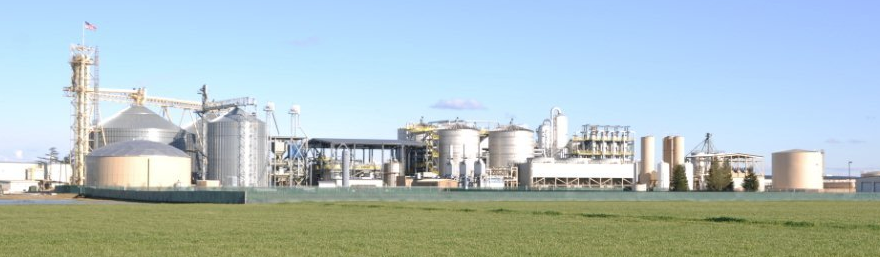
Aemetis ethanol plant in Keyes
Looking to wean themselves from corn, California’s ethanol makers are gearing up to use more grain sorghum to make low carbon biofuel and get paid more handsomely for it. Also, looking for profitability – a number of the ethanol companies are adding on-site production plants to capture more co-products that are part of the ethanol distilling process.
On January 15 biofuel company Aemetis idled its 60 million gallon plant near Modesto joining scores of ethanol plants in the Midwest who have shut down at least for a period because of the high price of corn.The industry’s trade group, the Renewable Fuels Association, tells the Associated Press that 20 out of 211 U.S. ethanol plants have halted production over the past 12 months -including five in January.
But Aemetis announced hope for a greener path a few days ago saying that it had agreed to contract with local farmers to plant seed sold by Chicago-based Chromatin for 30,000 acres of hybrid grain sorghum to be used to make ethanol starting this summer.
In a second major announcement February 18 Chromatin and Pacific Ethanol announced a similar agreement to contract with local farmers to plant 30,000 acres of sorghum near their Stockton plant.
“As the benefits of sorghum become more widely known, especially its resiliency, flexibility and its affordability compared to corn, we are optimistic that it will become the feedstock of choice in ethanol production” says Chromatin Chief Executive Officer Daphne Preuss.
“We are pleased to extend our collaboration with Pacific Ethanol, which previously confirmed that locally-grown sorghum is well-suited to ethanol production. We also welcome the opportunity to provide crop producers in California with a new market for their products by providing sorghum feedstocks that serve as an economical and energy efficient source of biofuel.”
“We have taken initiatives to diversify our feedstock base and further reduce the carbon profile of our ethanol. Our agreement with Chromatin represents one of these important initiatives and will help California farmers to produce sorghum for production of low carbon ethanol and high value animal feed,” said Neil Koehler, CEO of Pacific Ethanol.
Pacific Ethanol and Aemetis are not alone.
Tulare County’s Calgren Renewable Fuels has contracted for about 10,000 acres of sorghum this fall and 30,000 acres over multiple years to decrease the train loads of corn shipped in from the Midwest this year and after says Lyle Schlyer president of Calgren. Chromatin is the seed supplier as well. Calgren did a test run to make ethanol from sorghum last year that worked out fine says Schlyer. Air Liquide Plant
Also in Pixley Calgren has contracted with industrial gas provider Air Liquide to build a multi-million dollar CO2 plant that will help Calgren to demonstrate that it it has captured CO2 emissions that would otherwise contribute to global warming.Carbon dioxide is part of the fermentation process and all California industry is now mandated to cut CO2 emissions or pay into a cap and trade program. With the new plant in place the carbon dioxide is cleaned of any residual alcohol, compressed, and sold to other industries for carbonate beverages, or as a coolant in the food industry to name a few uses. Calgren’s neighbor California Dairies uses CO2 as a coolant. The rule of thumb is one pound of CO2 for every pound of produced ethanol (6.5 pounds per gallon).Schyler says the Pixley facility will be the first CO2 plant in the valley. French-owned Air Liquide who helped build the Calgren plant has said they expect to issue a press release soon on the project
Pacific Ethanol is also adding a corn oil extraction plant at their Stockton facility looking for more ways to boost their income.Corn oil is already captured at the Pixley Calgren plant.Of course the most important co-product from California ethanol plants is wet distillers grain used to feed millions of nearby cows Advanced Fuel
Shifting some ethanol production from corn to sorghum will please livestock critics of ethanol in California who have done a full court press both in the state and nationally to try to defund all corn ethnaol incentives that they say have helped drive up their feed costs.
With the agreement of the EPA grain sorghum as a substitute will qualify as an ”advanced biofuel” with half the lifecycle greenhouse-gas emissions of gasoline. U.S. gasoline and diesel producers are mandated to blend 2.75 billion gallons of advanced biofuels with their products in 2013 along with the 16.6 billion-gallons of biofuel that are corn-based.
Chromatin is currently working with California growers who are attracted to sorghum as a grain source because it is easy to grow, uses less fertilizer and water than corn and is tolerant to both heat and drought conditions. It is also an effective double crop alternative behind wheat or in rotation with cotton and vegetable crops. In addition, the residue from the harvest of sorghum grain can be used as high quality animal feed.
In the south Valley sorghum is being planted on more marginal lands with little or no irrigation but its success will depend on rainfall.
Ethanol plants in California have been seeking alternative crops to corn to reduce feedstock costs, to improve their carbon footprint and to source feedstock from locally grown energy-efficient crops. California-grown sorghum has proven to be cost effective and energy efficient, and using sorghum grain enables ethanol producers to qualify as Advanced Bio-fuel Producers and become eligible for financial incentives.
Just having their feedstock grown locally instead of sent by diesel powered unit trains across the country will help California ethanol makers show a greener footprint.That in turn will translate into preferred sales in California in coming years according to new state rules.
Advocates say sorghum uses from a third to half the water of corn, needs less nitrogen to produce the same yield, and has greater salt tolerance.
Sorghum has not been a big crop in California with much larger plantings in Texas and Oklahoma. Just 45,000 acres was planted in California in 2008 ,which is the latest period we have records.
Between these three ethanol makers alone, that could jump to 90,000 acres.
Increasing clean transportation options throughout the state, the California Energy Commission today approved $17,223,593 for a wide range of projects.
“These awards are helping to support the expansion of alternative fuels and zero-emission vehicles in California,” said Energy Commission Chair Robert B. Weisenmiller. “Additionally, the funded projects will reduce greenhouse gas emissions and other pollutants to protect our environment and improve the health of all Californians.”
The awards were made through the Commission’s Alternative and Renewable Fuel and Vehicle Technology Program, created by Assembly Bill 118. The program, which is essential to fulfilling the state’s pioneering climate-change policies, is slated to invest approximately $90 million during this fiscal year to develop new transportation technologies, as well as alternative and renewable fuels. It is paid for through surcharges on vehicle and boating registrations, and smog check and license plate fees.
These awards also assist in fulfilling Governor Brown’s executive order directing state government to support the rapid commercialization of zero-emission vehicles (ZEVs) in California, with a 2025 target of having 1.5 million ZEVs on the state’s roads. The order also requires the installation of sufficient infrastructure to support 1 million ZEVs in California by 2020.
The state’s investments in these projects are safeguarded by matching fund requirements for awardees, and by making payments on a reimbursement basis after invoices are submitted.
Central California projects include- FRESNO: Eslinger Biodiesel, Inc., will receive $6 million to build a commercial biodiesel production facility in Fresno. The first phase of this $32 million refinery is slated to be operating within a year of funding, producing 5 million gallons a year of biodiesel made from waste vegetable oils obtained from restaurants and commercial food producers, and animal fats obtained from rendering operations. Eventual production of biodiesel is expected to be 45 million gallons a year. The output will be shipped by pipeline to commercial blending facilities and is slated to be pre-sold to companies obligated to purchase carbon credit offsets. In addition to high-quality biodiesel, the plant will produce pharmaceutical and technical grade glycerin. Pipeline transport of fuel and waterless processing will result in near-zero production emissions at the facility. The new plant is located next to the Kinder Morgan terminal in Fresno. Sacramento Municipal Utility District will receive $1,819,166 to facilitate the completion of a project to demonstrate a patented process developed at the Argonne National Laboratory to optimize the production of biomethane and reduce carbon dioxide from anaerobic digestion. The project will be demonstrated at the American River Packaging organic waste recycling facility in Natomas. Paso Robles Waste & Recycle, will receive $300,000 to build a compressed natural gas (CNG) refueling station to serve a new fleet of CNG refuse haulers, as well as providing public fueling. CNG is much less polluting than conventional diesel. More than 50,000 gallons of conventional diesel fuel will be displaced by CNG annually by the five refuse trucks that will be initially used in the project. Once completed, the project is expected to create two permanent jobs. Paso Robles is located in San Luis Obispo County.
A new lawsuit says state regulators have allowed hydraulic fracturing, or fracking, to expand in California without legally required oversight.
The lawsuit, filed last week in Alameda County Superior Court by the Center for Biological Diversity, seeks to compel regulators to enforce existing state law that protects people and the environment from underground injections carried out by the oil and gas industry.
In a news release, the Center for Biological Diversity said the state has yet to regulate or even monitor the controversial practice of fracking, which involves injecting water and industrial chemicals, mixed with sand, at high pressure into shale formations to release previously inaccessible stores of natural gas or oil. The water-intensive and controversial process has expanded in many areas of the country, raising concerns about impacts on drinking water supplies.
“A looming fracking boom threatens to transform California, creating serious pollution risks to our air, water and climate,” said the center’s Vera Pardee said the release. “Existing rules clearly cover fracking, but state officials don’t regulate or even track this dangerous way of extracting oil and gas. The state needs to stop ignoring the law and start protecting our environment.”
According to the center, more than 600 wells in at least nine California counties were fracked in 2011 alone. Recent advances in fracking techniques are driving a growing interest in the Monterey Shale, a geological formation holding an estimated 15 billion barrels of oil.
California’s existing oil and gas regulations cover all forms of underground injection and clearly apply to fracking, the center said in its release. While fracking was exempted from the federal Safe Drinking Water Act in 2005, no such exemption exists in California law, the center said.
On the central Coast vineyard owners have increasing concern about fracking near their water source. The Wine Spectator has published an article this month suggesting a looming controversy. Central Coast “Oilers are intensely exploring the Central Coast. In December, mineral rights leases to 17,000 acres on federal lands near vineyards in southern Monterey County were sold, and another auction is scheduled for May 2013. Vintners are starting to wonder what fracking might mean for them. “We understand that energy is an issue, just as our water is an issue,” said Paula Getzelman, who grows 5 acres of Syrah, Grenache and Mourvèdre with her husband at Tre Gatti Vineyards in the Lockwood Valley of southern Monterey County, less than five miles from a recent federal lease sale. “What we’re saying is, if something spoils our water, we’re all done out here.” Paul Johnson, president of the Monterey County Vintners and Growers Association, agreed. “Oil companies are buying [mineral rights] up, and if oil companies are buying it, they are obviously planning on doing fracking,” said Johnson, who manages various Central Coast properties under his family’s Johnson Vineyard Com.”
The California Division of Oil, Gas, and Geothermal Resources (DOGGR) released a “discussion draft” of regulations for fracking in December and has said a more formal rulemaking process will begin in 2013. Information on the discussion draft is available here.
According to the Center for Biological Diversity, compliance with California’s existing oil and gas regulations would require disclosure of all fracking chemicals, as well as engineering studies and tests to evaluate the potential for underground migration of fracking fluids. State regulators would also need to ensure that fracking is conducted in a way that prevented, as far as possible, damage to life, health, property, and California’s water and other natural resources.
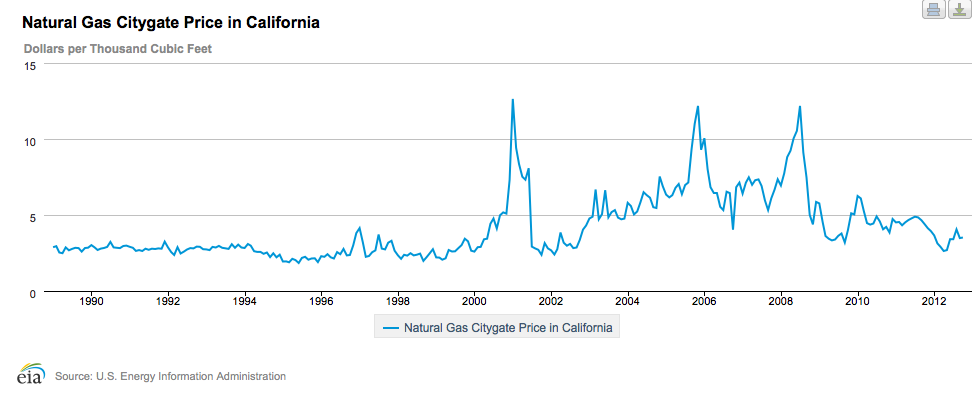
Average wholesale (spot) prices for natural gas fell significantly throughout the United States in 2012 compared to 2011 says the US Energy Information Service.The average wholesale price for natural gas at Henry Hub in Louisiana, a key benchmark location for pricing throughout the United States, fell from an average $4.02 per million British thermal units (MMBtu) in 2011 to $2.77 per MMBtu in 2012. That is isa 31% decline. This was the lowest average annual price at Henry Hub since 1999.
Natural gas meets 24 percent of U.S. energy demand, heats 51 percent of U.S. households and also cools many homes and provides fuel for cooking. It is also widely used to produce electricity, run huge broilers for industry and is a growing source for transportation fuel.
A mild 2011-12 winter, sustained high natural gas inventories, and rising natural gas production in the Marcellus and Eagle Ford basins contributed to lower average spot natural gas prices at Henry Hub. Average spot natural gas prices at Henry Hub fell despite rising natural gas use for power generation, lower overall natural gas net imports from Canada by pipeline, reduced liquefied natural gas imports, higher natural gas exports to Mexico, and temporary production shut-ins related to Hurricane Isaac. Total natural gas production was higher in 2012 than in 2011; however, in contrast to 2011, when production grew steadily over the course of the year, 2012 saw production generally remain flat, close to the level reached towards the end of 2011.
The decline in average wholesale natural gas prices was roughly uniform throughout the United States say the EIA.
The US will become a net exporter of natural gas expects the EIA. “U.S. natural gas production increases throughout the projection period outpacing domestic consumption by 2020 and spurring net exports of natural gas. Higher volumes of shale gas production are central to higher production volumes and an earlier transition to net exports than was projected earlier. U.S. exports of LNG from domestic sources rise to approximately 1.6 trillion cubic feet in 2027, double the 0.8 trillion cubic feet projected last year. The United States becomes a net exporter of LNG in 2016.”
One recent article points out that as a result of growing production here, coaxing natural gas from shale across the US puts the nation at an advantage compared to rest of the world and could even prompt more “in-sourcing” of companies returning to the US to manufacture.
“The United States’ #1 economic advantage against all other countries on Earth is its abundant natural gas reserves combined with its 1 million-plus mile natural gas pipeline distribution system. No other country has the combination of high natural gas production, low natural gas prices, and the ability to economically deliver natural gas to every major metropolitan city as well as to tens of millions of homes and businesses. It is an advantage the country cannot afford to squander.”
By contrast Chinese domestic natural gas production is very low, the country imports its natural gas by coastal terminals and needs to distribute it to the country’s interior.
California’s food processing plants rely heavily on natural gas to dehydrate and can fruits and vegetables.
As horizontal drilling and the controversial extraction technique known as fracking have made domestically produced natural gas more available and sharply cheaper, gas has been widely embraced by industry, electric utilities and trucking fleets.
A recent NY Times article point out the following.
The rapid development of shale gas technology has helped reduce energy imports and, in some cases, encouraged companies producing petrochemicals, steel, fertilizers and other products to return to the United States after relocating overseas. Natural gas exports are growing and terminals built to hold imported supplies are being repurposed for international sales.
The American petrochemical industry, for example, uses natural gas as both its primary raw material, in the form of liquid ethane, and as an energy fuel. And cheaper prices have led to a major expansion of capacity in the United States.
The hydrocarbon molecules in natural gas are split apart and then recombined as building blocks for many products, including bulk chemicals and fertilizers. The chemical ethylene, which is largely derived from natural gas, is used to make things like pool liners, building insulation and food packaging.
According to Kevin Swift, chief economist at the American Chemistry Council, European producers mostly use oil-derived raw materials for making these same products. “The U.S. has a competitive advantage when oil is seven times as expensive as natural gas, but now we have more like a 50-to-1 advantage,” he said. “The ‘shale gale’ is really driving this. A million B.T.U.’s of natural gas that might cost $11 in Europe and $14 in South Korea is $2.25 in the U.S. Partly because of that, chemical producers have plans to expand ethylene capacity in the U.S. by more than 25 percent between now and 2017.”
Staff of the California Energy Commission is rejecting criticism of the CEC’s approval of a licensee to operate a long-awaited natural gas fired power plant on the Valleys westside. The proposed project is scheduled to be approved January 9, 2013 by the full commission allowing Avenal Energy Project to begin to operate under an updated emission plan.
The $530 million project, first proposed in 2008, has been the subject of some 5 years of criticism and legal action by various environmental groups including San Francisco-based Center For Race Poverty & The Environment (CRPE) who argue that pollutants from the proposed plant would result in a disproportionate impact to low income or minority populations in the nearby towns of Kettleman City,Avenal and Huron.
The power plant is located in Kings County near the Avenal Cuttoff in the city limits of Avenal – west of I-5.
A December 31,2012 letter to the CEC from CRPE charges that the natural gas power plant will add to harmful emission levels in the nearby towns and that the plan does not meet the EPA’s most stringent rules on maximum emissions allowed on a per-hour basis.
The applicant counters that this facility will be the cleanest burning natural gas power plant built yet.
The project remains caught up in environmental justice concerns surrounding health problems in the Kettleman City area that have focused on a waste dump there as well. Advocates claim emissions from I-5 , toxic waste, pesticide pollution from farms and other air and water problems should limit new development that creates more problems.
Agreeing the project should move forward is CEC staff led by Richard Ratliff, Staff Counsel, who argues Avenal Energy’s latest application lowers the annual emissions of oxides of nitrogen (NOx) and carbon monoxide (CO) so that all criteria pollutant emissions allowed by the Avenal license would be below the threshold limits that require a federal Prevention of Significant Deterioration (PSD) permit. Avenal has received the federal PSD permit from the Environmental Protection Agency (EPA), but that permit is currently being litigated in the federal Ninth Circuit Court of Appeals, and it is unclear when that litigation will result in a decision says the CEC staff report.
The license was originally issued by the Energy Commission in December 2009 but the project faced years of foot dragging by the EPA and after the EPA’s approval ,forced by court action, more lawsuits from environmental groups that are still pending in court.
Because the issue remains tied up in court CRPE says the state Energy Commission should wait before approving Avenal’s latest emission plan.Among other things CRPE argues that the project does not meet a new EPA standard on one hour emissions put in place after the project was approved by the CEC .But the San Joaquin Valley Air Pollution Control District did an analysis that says the project does meet that higher standard.
CRPE questions the SJVAPCD analysis.The area “has worse air quality than any other region in the Nation.”
CEC staff suggest the commission approve the project despite CRPE’s claims,a likely outcome.
“The CRPE request should be rejected for three reasons: (1) As stated above, the amendment imposes more stringent requirements on Avenal, requiring reductions in criteria pollutant emissions; (2) the San Joaquin Valley Air Pollution Control District (SJVAPCD) has performed an analysis of N02 emissions impacts demonstrating compliance with the new federal standard, and Staff has independently reviewed and confirmed the validity of that analysis; and (3) the CRPE request in essence seeks to create a separate state forum in which to re-litigate issues already raised and resolved in the original proceeding, or to litigate the issues it has raised with regard to the federal PSD permit on issues that are outside the State’s purview, and that can only be resolved by the federal courts. “
The 600MW project would provide power to some 450,000 Valley homes and businesses The City of Avenal is hoping it moves forward as it will be the town’s largest property taxpayer and provide new employment. The project owner Houston-based Macquarie Energy , says during the nearly three-year construction period, 300-400 construction workers will be employed at the peak of construction with an average of 250 per month during the three-year construction phase.
During operation, the project will create 19-25 new well-paying jobs.
The California Energy Commission response to CRPE concludes:”Lower emissions equal lower potential environmental impacts. As such, the proposed amendment cannot result in any significant adverse environmental impact, making it eligible for the “common sense” exemption from the California Environmental Quality Act. (Cal. Code Regs., tit. 14,§ 15061, subd. (b)(3) [“CEQA applies only to projects which have the potential for causing a significant effect on the environment.”].)
Accordingly, the amendment would not result in a disproportionate impact to low income or minority populations. “
Even with a victory here Avenal Energy must get a power purchase agreement from a utility to move to a ground breaking.