(December 3, 2012) Stockton, CA – Chromatin Inc., a privately held provider of innovative crop breeding technology, sorghum seed products and feedstocks, announced it has generated the first crop of sorghum that has been grown and used for ethanol production by a California ethanol company, Pacific Ethanol, Inc. (NASDAQ: PEIX). This achievement paves the way for future opportunities to use locally grown sorghum as a versatile and resilient crop that is a more energy efficient and lower cost alternative to corn.
Using sorghum seed provided by Chicago-based Chromatin, Inc., L and R Mussi Farms of Stockton, CA produced 40 acres of sorghum that were harvested and delivered to Pacific Ethanol’s ethanol production plant in Stockton, CA.
“We were pleasantly surprised by sorghum’s flexibility. It’s a high-yielding, easy to grow crop regardless of environmental conditions, and it uses less fertilizer and less water than corn,” said Rudy Mussi co-owner of Mussi Farms. Daphne Preuss, Chromatin’s CEO commented “We were pleased to see that growers were able to plant and produce high quality sorghum with minimal modifications to their current practices and that ethanol plants encountered no difficulties in substituting sorghum for corn. In addition, Chromatin has shown that the residue left over after the harvest of sorghum grain can be used as high quality animal feed, further enhancing the output from the land used in production of this crop.”
Ethanol plants in California have been seeking alternative crops for corn to reduce feedstock costs, improve carbon footprint, and to source feedstock from locally grown energy-efficient crops. While sorghum imported from other regions has been used in California ethanol plants in the past, Chromatin’s program is the first instance of supplying locally grown grain to the Pacific Ethanol plant in Stockton, CA, resulting in greater cost efficiency and an improved carbon footprint. Consequently, by using sorghum grain, ethanol producers may qualify as Advanced Bio-fuel Producers and become eligible for financial incentives.
Neil Koehler, Pacific Ethanol’s CEO, stated, “During the third quarter, Pacific Ethanol used sorghum for approximately 30 percent of the feedstock at our Stockton plant. Blended with corn, sorghum has similar conversion properties to corn and produces even lower carbon ethanol.”
Chromatin is exploring other opportunities to grow sorghum grain in California and expects to expand its production in 2013.
A Tulare County ethanol plant Calgren Renewables is also planning to use local sorghum to make the biofuel.
GOP congressman Nunes votes’ No” on averting “Fiscal Cliff”
How Central California Congress members voted. While the US Senate voted overwhelmingly 89 – 8 in a bipartisan way to avoid the “fiscal cliff” the House of Representatives remains a house divided. The House voted 257-167, in favor but delegates from the center of California offered a split decision on the tax measure.
One hundred fifty-one Republicans joined 16 Democrats to vote against the deal, while 172 Democrats voted yes along with 85 Republicans.
Voting against the Senate-backed proposal were GOP House members Devin Nunes and Kevin McCarthy joining the Tea Party wing led by Number 2 GOP leader Eric Cantor while fellow GOP members Denham and Gallegy voted yes along with their GOP majority leader, Mr Boehner. On the Demo side – Jim Costa and Lois Capps voted aye.
Rep. Jim Costa, D-Fresno said after the vote “Far too many of those serving in this institution lack the will to put the country first and partisan interests last.”
The legislation also includes a one-year extension of the Farm Bill.
Latest Tax Measure Bolsters Renewable Energy
The last minute tax bill approved over New Years include several measures to bolster renewable energy, critical in Central California. These measures include:
Extension of wind energy tax credits, part of the bill to avert the “fiscal cliff” that now moves to President Obama for his expected signature.The version included in the deal would cover all wind projects that start construction in 2013. Companies that manufacture wind turbines and install them sought that definition to allow for the 18-24 months it takes to develop a new wind farms.
Kern County, whose wind energy industry rivals its oil industry has a huge stake in the issue.”The Kern County wind industry is committed to making increased wind generation here a reality,” wrote wind energy representatives Linda Parker and Peter Kelley in the October issue of the Kern Business Journal. “The power of wind is too important to Kern County’s economy, job creation and our own independence to let this opportunity pass by.”
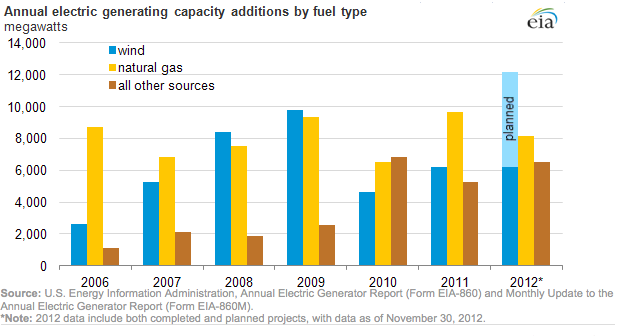
Wind set a new record in 2012 by installing 44 percent of all new electrical generating capacity in America, according to the Energy Information Administration, leading the electric sector compared with 30 percent for natural gas, and lesser amounts for coal and other sources.
However, America’s wind energy workers have been living under threat of the PTC’s expiration for over a year and layoffs had already begun, as companies idled factories because of a lack of orders for 2013. Uncertain federal policies have caused a “boom-bust” cycle in U.S. wind energy development for over a decade.
Half the American jobs in wind energy – 37,000 out of 75,000 – and hundreds of U.S. factories in the supply chain would have been at stake had the PTC been allowed to expire, according to a study by Navigant Consulting.
Biofuels production gets a a boost as well.
Cellulosic biofuels producer tax credit. Under current law, facilities producing cellulosic biofuel can claim a $1.01 per gallon production tax credit on fuel produced before the end of 2012. This provision was created in the 2008 Farm Bill. The provision would extend this production tax credit for one additional year, for cellulosic biofuel produced through 2013. The proposal also expands the definition of qualified cellulosic biofuel production to include algae-based fuel. This provision is estimated to cost $59 million over ten years. Incentives for biodiesel and renewable diesel. The bill extends for two years, through 2013, the $1.00 per gallon tax credit for biodiesel, as well as the small agri-biodiesel producer credit of 10 cents per gallon. The bill also extends through 2013 the $1.00 per gallon tax credit for diesel fuel created from biomass. This provision is estimated to cost $2.181 billion over ten years.
The biodiesel tax incentive expired on Dec. 31, 2011. A recent study found that the industry would have produced an additional 300 million gallons this year with the tax incentive in place. That would have supported some 19,213 additional jobs, for a total of 83,258 jobs supported by the industry nationwide, according to the study, conducted by Cardno ENTRIX, an international economics consulting firm. Cellulosic biofuels bonus depreciation. Under current law, facilities producing cellulosic biofuel can expense 50 percent of their eligible capital costs in the first year for facilities placed-in-service by the end of 2012. This provision was created in the 2008 Farm Bill. The provision would extend this bonus depreciation for one additional year for facilities placed-in-service before the end of 2013. The proposal also expands the definition of qualified cellulosic biofuel production to include algae-based fuel. This provision is estimated to cost less than $500,000 over ten years. Agricultural Programs. Section 701 of the Bill extended all provisions of the 2008 Farm Bill through September 30, 2012 – including funding levels for mandatory programs.
Many wind projects are planning to come on line before the end of 2012, in advance of the possible expiration of a federal incentive, the wind production tax credit (PTC). It appears that wind developers are pushing to complete projects in 2012 to qualify for the PTC. Under current law, projects that begin operating prior to the end of 2012 are eligible to receive a 2.2-cent PTC for each kilowatthour of generation over a 10-year period.EIA collects monthly updates on modifications, retirements, and additions to the nation’s fleet of power plants, including the planned date of commercial operation for new generators.
Wind plant developers reported increasing amounts of new capacity scheduled to enter commercial operation in 2012 as the year progressed. Even as completed projects accumulated during 2012 , the amount of capacity expected to come on line before the end of the year continued to increase.
As of November 30, 2012, the wind capacity planned to come on line by the end of December would account for approximately half of the total 2012 wind capacity additions.
Wind generators accounted for a significant portion of capacity additions since 2007 ( click chart below), and were the largest source for generating capacity additions in 2008 and 2009.
US will see an addition of 12,000mw of power this year due to tax credit
If all planned wind generators for 2012 come on line, as reported by industry participants, wind capacity additions could top 12,000 MW for this year. This would account for 45% of total additions and exceed capacity additions from any other fuel source, including natural gas, which was the leading fuel source for electric generating capacity additions in 2010 and 2011.
Source: U.S. Energy Information Administration, Annual Electric Generator Report (Form EIA-860) and Monthly Update to the Annual Electric Generator Report (Form EIA-860M).
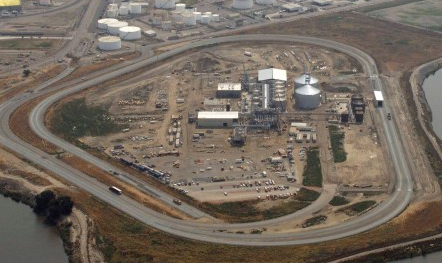
Plains Exploration and Production Co (PXP) has filed a preliminary notice with San Luis Obispo County that it will seek to expand its oil field in Price Canyon near Pismo Beach from 100 oil wells currently to 350. The drilling is planned on hillsides on both sides of the highway and include 11 new pads. A new pipe will cross Pismo Creek that also runs at the base of the canyon.
County planner John McKenzie says the company has been asked to respond to questions regarding any potential use of the controversial practice of fracking at the site but has indicated it will be doing more of the traditional steam injection to coax heavy oil out of the ground.
McKenzie says the environmental review of the big project could take a year or longer and of course, include public hearings.
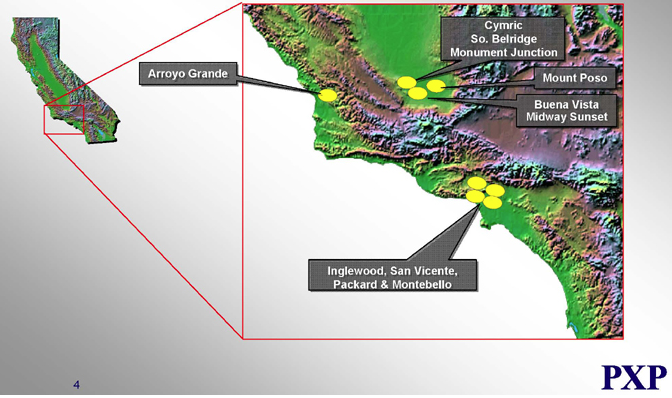
The oil field is the largest in SLO county. A 2010 PXP release refers to the multi-phase Price Canyon project said “PXP holds a 100% working interest in the Arroyo Grande Field located in the Santa Maria Basin in San Luis Obispo County, California. This is a long-lived field that has heavier oil (12 to 16 degree API gravity), well depths averaging 1,700 feet and requires continuous steam injection. In 2009, PXP spent $4 million on capital projects in this field and drilled 7 wells.”
Fast forward to 2012 and you see a major increase in activity on the project. Plains Exploration is the largest commercial building applicant in San Luis Obispo County this year after the two huge solar projects on the Carrizo Plain. Already this year,PXP has submitted applications for about 100 permits for improvements in the Price Canyon area valued at over $40 million. With plans for more than 3X the wells – it’s clear these guys are planning to spend lots more money and believe there is plenty more oil in Price Canyon.
The county notice calls the expansion Phase V of their project . The field is said to be 320-acres which is within the larger 1,480-acre Price Canyon Unit as defined by the California Division of Oil, Gas & Geothermal Resources (DOGGR).
project location
In 2011 PXP got approval to build a water recycling operation in Price Canyon that discharges back into Pismo Creek. PXP needed the facility to have enough water to boost production of the heavy crude oil by what is expected to be thousands of barrels a day – up from around 1300 a day now. The water facility will be ready for operation next year.
If they are planning more oil rigs,not far away there could also be more houses too. Price Canyon has been in the news recently because of a development plan adjacent the City of Pismo Beach that would roughly double the number of residential units in town if it moves forward.Better get used to living near oil rigs down the block. Mining Giant Buys PXP
The big got bigger this month. Earlier in December it was announced that the mining giant Freeport-McMoran was buying Houston-based Plains Explorations and Production for approximately $6.9 billion in cash and stock. Beside holdings in Price Canyon called the Arroyo Grande Oilfield,PXP also has extensive oil holdings elsewhere in southern California and the San Joaquin Valley. The company is also drilling off the coast near Vandenberg. They are said to be the fourth largest oil company in the state.
Locally PXP has a regional office in San Maria. In California, PXP says they have 430 personnel and on average over 400 contract personnel.
On the fracking issue, the worries about the use of some chemicals in injected water to extract petroleum products has heated up and now the Brown administration has signaled interest in getting involved on the state level. A draft proposal requires the oil industry to disclose where in the state they are using hydraulic fracturing, commonly referred to as “fracking. Brown’s proposal comes as a critical new movie on the practice called Promise Land is set to be released in theaters December 28.
Also NRDC says in October – “Plains Exploration and Production Company (PXP) released a long-awaited study on the oil drilling company’s hydraulic fracturing operations at the Inglewood Oil Field in the Baldwin Hills area of south Los Angeles. While it took a year to compile the study, this report actually was years in the making as it comprised one of a host of new requirements imposed on PXP through a July 2011 settlement that resolved a lawsuit brought by NRDC and three other plaintiffs in 2008.
The study appears to have found that two test frack jobs at the Inglewood field did not result in adverse impacts to groundwater or community health, nor did they cause additional ground movement or subsidence. We are reserving judgment until we’ve had a chance to carefully review all of the study’s findings, as well as the hundreds of pages of dense, technical information the author has offered to support those findings.”
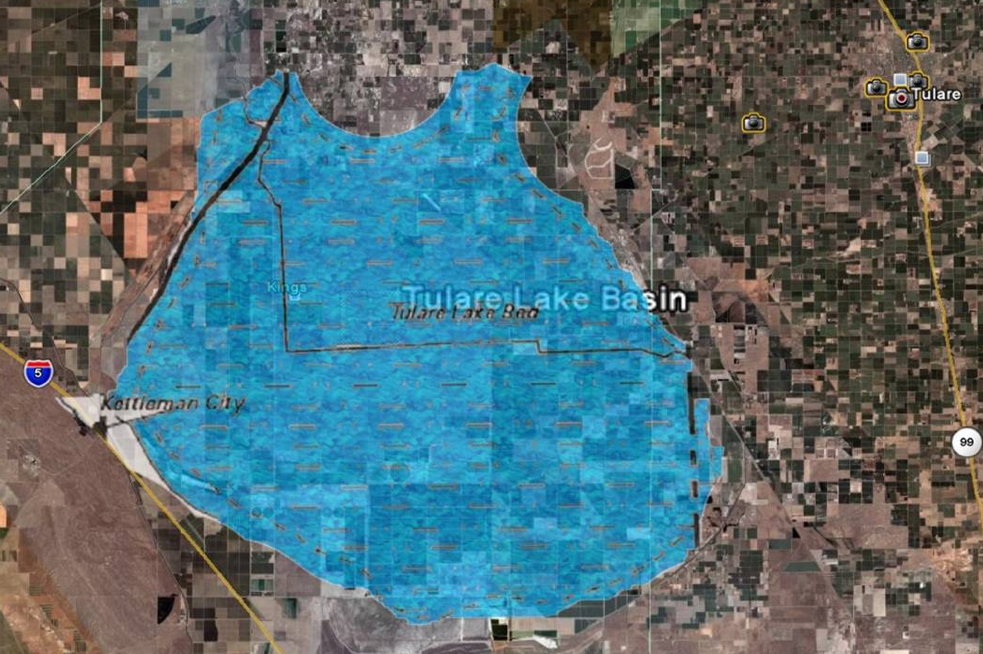
Kings and Tulare Counties’ mostly dry Tulare Lake bed – once the largest body of water west of the Mississippi – is now sporting fields of solar panels by the thousands with more to come.
Tulare lakebed covers much of Kings County and SW Tulare County(click for larger view)
This past week two new solar project applications were received by the Kings County planning department including a 155 acre, 20 megawatt solar project on farm land owned by JG Boswell, the largest farmer on the old lakebed or anywhere else.
Historically,while the lakebed was often filled in winter with water -flooding in 1938 and 1955 prompted the construction of the Terminus and Success Dams on the Kaweah and Tule Rivers in Tulare County and Pine Flat Dam on the Kings River in Fresno County, rivers that all drain here. The lakebed’s outline can still be seen from the air covering a large part of Kings County and a portion of western Tulare County.
While the farmland here grows crops there are large fallow sections with high salinity soils – impaired farmland now considered ripe for solar development.
Tulare Lake drains key Central Valley rivers
According to the application, the Boswell solar farm would be developed by Solar Project Solutions(SPS) – a joint venture that includes Samsung Green Repower, LLC and Solar Managers, LLC. The group develops, finances and operates utility scale photovoltaic projects, power sold to the grid.
Like many others in these two counties the solar arrays would be installed on land with a Williamson Act contract. Kings and Tulare counties have supported solar use on farmland that is non-prime ag land but now there is push back as we will discuss.
Korean-based SPS is familiar with the vast treeless old lakebed with a portfolio of 130 MW,over 1200 acres near Alpaugh and Allensworth on the edge of lakebed in Tulare County with several projects nearing completion. Most of that acreage had been fallow due to inadequate access to water.
look ma, no trees in an old lakebed – Kansas South project
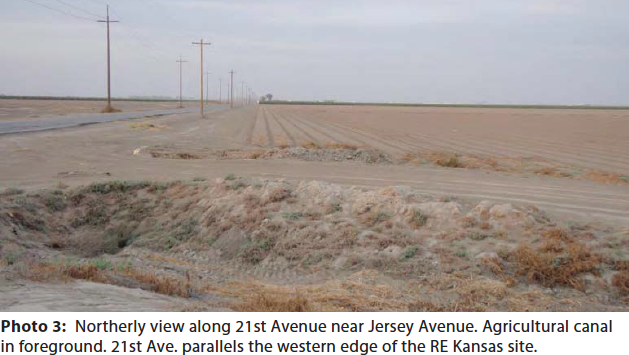
Also in the old Tulare lakebed but in Kings County near Kettleman City, Westlake Farms is proposing to lease 220 acres to EE Kettleman Land LLC, a San Diego firm who pioneers new solar farms around the state. This would be the third utility-size solar project on Westlake Farms vast acreage in Kings County that sprawls along miles of Highway 41 between Stratford and Kettleman City. One of those projects is Kansas South – under construction now and being developed by Recurrent Energy of San Francisco.
Nearby in Corcoran ,there are 2 new solar farms that are approaching the construction phase says a city report this week .” The first project is located on the 140 +/- acres at the City Well Fields North of town on Nevada Ave. This is supposed to be a 12 MW solar project being put together by EDF Renewable Energy – formerly enXco. They are currently in the permit process having already worked out a purchase contract with PG&E for renewable energy.
At this time they are telling us that their project, which is being built in
conjunction with a second project 20 MW project located on CID property just East of our property, is moving along very quickly for projects of this type.“
SPS also has a 60 megawatt project just outside the Corcoran city limits in conjunction with Corcoran ID, also in Kings County.
And there is more to come. Pacific Gas and Electric Co. agreed to buy electricity from a 100-megawatt solar power plant SunPower Corp. plans to build near NAS Lemoore on the edge of the lake.The Henrietta Solar Project, expected to be b approved by the California Public Utilities Commission would start construction in 2015 SunPower announced recently.
Tulare County lakebed projects
A few miles south in Tulare County, planner Mike Washam says a large share of the 270 MW of power approved by the county Board of Supervisors on farmland to date has been approved in the lakebed near Alpaugh including another new 20 MW project to be submitted soon that would add up to nearly 200 MW in Tulare County’s arid western edge.
Moratorium?
Not that everyone likes the idea of solar generation on farmland. In Tulare County the Board of Supervisors this week is considering a possible “moratorium” on new solar projects in county. But an alternative proposal expected to have majority support would lay out areas in the county were solar units on farmland would be generally supported including all of the old lakebed area in the se portion of the county.
The new policy would prohibit solar in the 127,000 acre citrus belt, on prime farmland that is not in a city urban boundary(where it is likely to be developed for city uses) as well as Class 1 soils. That would add up to around 870,000 acres in the county that would be off limits to these projects. There are 333,000 acres of trees and vines planted in the county,considered unsuitable for solar, and about 700,000 acres of ‘pasture”.
As of now – there are about 3000 acres of solar projects in the county either built or in the pipeline.
A second stipulation could be added that the proponent must show that the land where the project is proposed lacks an adequate water supply.
Criticism came from the Tulare County Farm Bureau of current policy was heard in this letter submitted this fall.
“Before any further permits are reviewed for solar installations, Farm Bureau would request that Tulare County develops a clear policy on solar installations with regards to prime farm land in Tulare County. We are concerned that the non-prime “case by case” approach is not yet clearly defined for prime farm lands, and we strongly discourage the county from permitting any solar development on lands that can support viable agriculture production.
Farm Bureau does not support the conversion of prime farmland to non-agricultural uses, and we view solar as a development that will displace the agricultural capability of this land and impair its future productivity. We object to solar projects being sited on prime farmland and believe that other marginal or impaired lands exist in the County that is more suitable for this use. If Williamson Act parcels on marginal or impaired grounds do exist and are most preferable for development, we would also ask the county to strongly consider enacting SB 618 law, and place solar easements on those parcels where applicable.“
Westlake Farms owner Ceil Howe doesn’t think much of Farm Bureau’s restrictions proposed both on the statewide level and by county.”The bottom line is that it’s my property and I’ll do with it what I want.” As a practical matter, he says ,”water is pretty tight on the Westside” and “solar projects may be the best return a guy can get. ” His farm alone has 12,000 acres fallowed this year.
These gas prices are giving me – well,indigestion.
California gas prices that were heading straight for $5 in October are now down – going on $1.10 this week – from a high of $4.65 on average in the state in October to around $3.59 a gallon today statewide says Gas Buddy.
Better yet, there has been a steady drop in the lowest price for gas in the state now down to $3.12 in the San Jose and Lodi area this week.It’s down to $3.29 in Fresno, $3.33 at stations in Tulare and in San Luis Obispo the low price is $3.63 at Costco.
Some areas of the U.S. are seeing prices under $3 a gallon, and here in Southern California there is a lot more room for prices to fall judging by wholesale gas prices,” said Auto Club spokesperson Jeffrey Spring.
“As of Wednesday(Dec 5), Los Angeles reformulated gasoline wholesale prices were $1.20 lower than the current Los Angeles average price. Normally the margin between wholesale prices and prices at the pump is much lower.”
But there is a familiar story bubbling up in the news this week.
Refiners are having some maintenance issues and there are plans to idle capacity to do annual upkeep after the first of the year.Bloomberg reported December 10 that future prices are up in the past few days and the 7-week drop in retail prices may be ending.
So much for $3 gas.
One issue here appears to be lack of competition.
In May 2012, seven companies made 94% of all sales. The seven companies are all vertically integrated with both retail sales and refinery operations. Sales data is available from the California State Board of Equalization.
Consumer groups last month asked the California State Attorney General Kamala Harris to launch a criminal investigation into the conduct of oil companies in the state based on new information that oil refiners were running refineries and building inventories even when they said that they were performing maintenance when prices spiked over few days in September/October.
SANTA MONICA, Calif., Nov. 15, 2012 /PRNewswire via COMTEX/ — In a letter today, Consumer Watchdog called on California State Attorney General Kamala Harris to launch a criminal investigation into the conduct of oil companies in the state based on new information that oil refiners were running refineries and building inventories even when they said that they were performing maintenance.
Research done by McCullough Research released at a Sacramento hearing this week suggests refiners used their dominant market power to raise prices in October when gas prices in California spiked 50 cents even as their inventory of gasoline built up (see chart). The refiners claimed prices spiked because of refinery outages. ” In May 2012, seven companies made 94% of all sales. The seven companies are all vertically integrated with both retail sales and refinery operations” says a paper released.Based on the research,Consumer Wathdog filed the complaint with the Attorney General.
inventory of gasoline spikes even as price spikes.Where’s the shortage”?
The full letter follows below.
“It appears that California’s oil refineries falsified public information to drive up the price of gasoline, an allegation that, if true, is criminal conduct and reminiscent of the Enron-like manipulation of the California energy market,” Consumer Watchdog’s president Jamie Court and Energy Project Director Liza Tucker wrote to Attorney General Harris. “This unprecedented information demands a criminal investigation.”
Consumer Watchdog reiterated its call for the AG to block the merger of Tesoro and BP, pointing out that if Tesoro takes over BP’s refinery in Carson, that will leave two companies-Tesoro and Chevron-controlling 54 percent of California’s already overly concentrated gasoline market and exacting a heavy price from consumers.
“Information we learned today only reinforces our call for blocking the merger. McCullough Research reports today that refineries in the state were making gasoline while telling the public that they weren’t because of outages or maintenance. McCullough Research analyzed thousands of pages of documents and discovered refineries were operating during supposed outages and maintenance shutdowns.
“McCullough says that in May, when Royal Dutch Shell’s Martinez plant was supposedly down for two weeks for maintenance, it was making gasoline at least half the time. State air monitors showed nitrogen oxide emissions associated with making gasoline returned to normal at that location a whole week before the refinery reported coming back on line.
“At Chevron’s Richmond refinery, emissions reports suggest that the refinery never shut down, though it reported being down for two weeks in May. Supplies were actually growing in May when consumers here paid at least 50 cents more per gallon than the national average, the group said. October’s huge price hike that pushed gasoline up 50 cents a gallon in the space of a week was partly blamed on Chevron’s Richmond fire in August. But McCullough says that Chevron’s supplies at the time were only growing.
“When the state only has ten to thirteen days of gasoline supply on hand, misinformation about a week’s worth of gasoline can cost the consumer $1 per gallon or more at the pump. False information can set the commodities markets on fire. Oil companies know this well and their profits are dependent on misaligned expectation in the commodities market. We urge you take action immediately to prevent California consumers from being gouged by the same type of artificial manipulation of the energy markets that occurred during electricity deregulation.”
Consumer Watchdog is a nonprofit, nonpartisan consumer advocacy organization with offices in Santa Monica, CA and Washington, DC. Find us online at www.consumerwatchdog.org .
Snowpack in California likely will shrink noticeably during the next 30 years and could, paradoxically, result in increased risk of flooding as well as less water available for agriculture, according to a climate change study from Stanford University researchers.
Published in the journal Nature Climate Change, the study led by climate researcher Noah Diffenbaugh forecasts big challenges ahead for the Western U.S. and California in a projection of Northern Hemisphere snowpack through the 21st century.
There will be less water available for irrigation and farming in the summer and more springtime runoff that levees and dams will have to contend with.
“The Western U.S. exhibits the strongest increases in the occurrence of extremely low snow years in response to global warming,” Diffenbaugh explained in a story posted by the Stanford Woods Institute for the Environment. This phenomenon also will be accompanied by low snow accumulation. “It also exhibits some of the strongest decreases in runoff that occurs during the growing season.” Diffenbaugh is a center fellow and assistant professor in Stanford’s Department of Environmental Earth System Science.
The researchers used climate modeling techniques that integrated predicted future data using past data on average and extreme rates of precipitation, accumulation and runoff from 1976 to 2005. The researchers found that continued emissions of greenhouse gases such as carbon dioxide will result in “substantially” reduced snowpack during the next few decades so that low snow years could become the new normal (more than 80 percent of the time) by 2070 in the Western U.S., Alpine Europe, Central Asia and downstream of the Himalayas and Tibetan Plateau.
“Our results suggest that global warming will put increasing pressure on both flood control in the cold season and water availability in the dry season, and that these changes are likely to occur in some of the most densely populated and water-stressed areas of the planet,” Diffenbaugh said.
Hydroelectric production, recreation industries dependent on snow and water, and ecosystems also could suffer, the researchers said.
View an abstract and buy the full study published in Nature Climate Change
Propel Fuels and Solazyme have partnered to launch the nation’s first publicly available algae-derived biodiesel at Propel stations across the Bay Area.
In this month-long pilot program, Solazyme’s high quality algae-based SoladieselBD will be offered in a B20 blend for the same price as conventional diesel fuels. This groundbreaking fuel will be available exclusively at Propel’s Clean Fuel Points in Redwood City, San Jose (North 1st Street), Berkeley, and Oakland.
Propel’s B20 is made of 20% SoladieselBD (an algae-derived biodiesel made by Solazyme) and 80% petroleum diesel. Domestically produced from micro algae that efficiently convert sugars into renewable oil, SoladieselBD is a clean-burning, precision quality fuel that is compatible with all diesel vehicles.
Testing undertaken by the National Renewable Energy Laboratory (NREL) shows that, in a 20% blend, SoladieselBD significantly outperforms ultra-low sulfur diesel in total hydrocarbons (THC), carbon monoxide (CO) and particulate matter tailpipe emissions. This includes an approximate 30% reduction in particulates, a 20% reduction in CO and an approximate 10% reduction in THC.
Innovative technology will demonstrate production of low cost cellulosic sugars from sugar cane bagasse
VISALIA, California. November 14, 2012 – Edeniq, a biomaterials and sustainable fuels technology company, today announced that it has begun engineering and construction of a bagasse to sugars demonstration-scale plant together with its partner, Usina Vale, a Brazilian sugar and ethanol producer. The demonstration plant will produce cellulosic sugars from sugarcane bagasse, the fibrous by-product of sugarcane juice extraction. Cellulosic sugars will be converted into ethanol at the site, showcasing how sugarcane mills can increase ethanol production economically with Edeniq’s patented bolt-on technologies. The plant will handle up to 20 tons per day of bagasse and will be co-located at Usina Vale’s ethanol and sugar production site in São Paulo State, Brazil.
Edeniq and Usina Vale cooperated to conduct a feasibility study to evaluate the economics of integrating Edeniq’s technology into Usina Vale’s plant to produce cellulosic ethanol. After the successful results of the feasibility study, Edeniq and Usina Vale signed a collaboration agreement under which they are jointly funding the bagasse to sugars demonstration-scale plant, which will be a first of its kind in the region. Co-locating the demo plant at Usina Vale’s commercial site will accelerate the technology scale-up from demo to full-scale, and the technology will then be deployed at affiliated ethanol plants.
“Brazil has a large and growing demand for ethanol” said Pedro Augusto Menezes de Toledo Florencio, CEO of Usina Vale. “We believe Edeniq’s technology will allow us to increase ethanol production in a very economical way, allowing us to meet the growing demand of our customers and our country.”
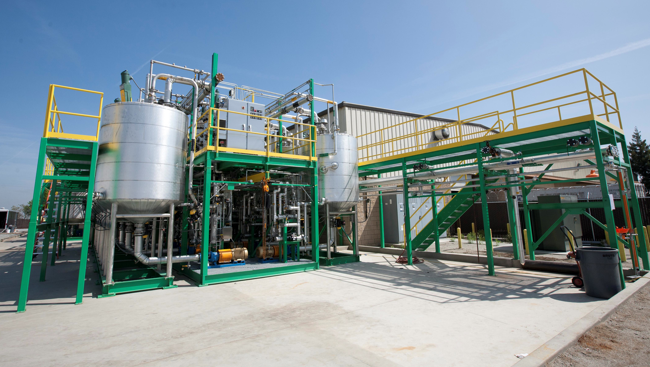
Edeniq’s technologies efficiently break down biomass to liberate cellulosic sugars that can be converted into ethanol and other products. Edeniq owns and operates a fully integrated two ton per day pilot plant in Visalia, California, in partnership with Logos Technologies, which is currently in operation converting cellulosic feedstock into low-cost cellulosic sugars and cellulosic ethanol. Key to the process is Edeniq’s proprietary Cellunator™, which mechanically pre-treats biomass so that it can be more easily converted to sugars, increasing sugar yield and thus driving an increase in ethanol yield. The Brazil plant will also include the company’s proprietary reactor design for continuous enzymatic conversion of biomass to sugar.
“Through this partnership with Usina Vale, we are further demonstrating our model of increasing the efficiency, scalability and sustainability of biofuels through low capital and operating cost technologies that can be integrated directly into existing ethanol production sites,” said Brian Thome, President and CEO of Edeniq. “Edeniq is developing the lowest cost route to cellulosic sugars, which will lead to low cost ethanol production for our partners like Usina Vale.”