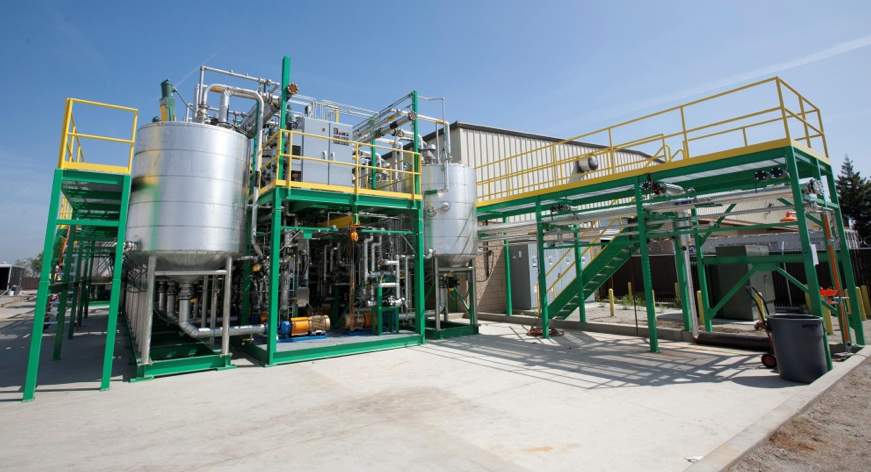
Visalia-based Edeniq has inked two deals this month that will utilize company technology to increase production of biofuel and other refined products at two California ethanol plants helping to make them more profitable. Both deals have been previewed by Sierra2theSea in past articles.
In Stockton, Pacific Ethanol announced it will use Edeniq technology to extract corn oil by the second quarter of 2013 improving the margins of their operation. “Our Stockton plant is the second of our facilities to implement corn oil separation technology, and we expect to soon award contracts for our two other Pacific Ethanol plants.”said CEO Neil Koehler. Corn oil is used for cooking and it is also a feedstock used for biodiesel. The Calgren ethanol plant in Tulare County extracts corn oil in their operation.
Also this week, Aemetis, Inc., an advanced fuels and renewable chemicals company, has entered into an agreement to install Edeniq technology at the Aemetis Advanced Fuels Keyes plant in California. Aemetis will install Edeniq’s proprietary Cellunators(TM) to boost ethanol yields and will conduct large-scale commercial testing of Edeniq’s cellulosic ethanol Pathway(TM) platform.
Edeniq’s Cellunator(TM) technology produces sugars by milling corn and other plant materials into “right-sized” particles of feedstock that can be more easily converted. Edeniq is installing Cellunators(TM) at Aemetis’ Keyes, California facility, which currently produces 60 million gallons of ethanol annually. Aemetis is also one of three ethanol producers working with Edeniq on the company’s Pathway platform, a patented process that integrates enzymes with the Cellunator(TM) technology to produce cellulosic ethanol using the existing plant infrastructure. Aemetis is testing the commercial feasibility of the Pathway(TM) platform on site at their plant.
“The relationship with Edeniq will allow us to further expand our production of advanced biofuels,” said Eric McAfee, Chairman and CEO of Cupertino, California based Aemetis, Inc. “The addition of Edeniq’s technology is expected to immediately improve our ethanol yield, and allow us to produce cellulosic ethanol at commercial scale by upgrading the existing corn ethanol production facility. Edeniq’s technology will help us lead the transition to next generation, lower carbon, lower cost biofuels derived from a variety of renewable feedstocks such as grasses, agricultural residues, and purpose-grown energy crops.”
Edeniq owns and operates a demonstration-scale production facility in Visalia, California, which is currently converting a range of cellulosic feedstock into low-cost cellulosic sugars and cellulosic ethanol. In June, Edeniq received a $3.9 million grant from the California Energy Commission (CEC) as part of California’s Alternative and Renewable Fuel and Vehicle Technology Program.
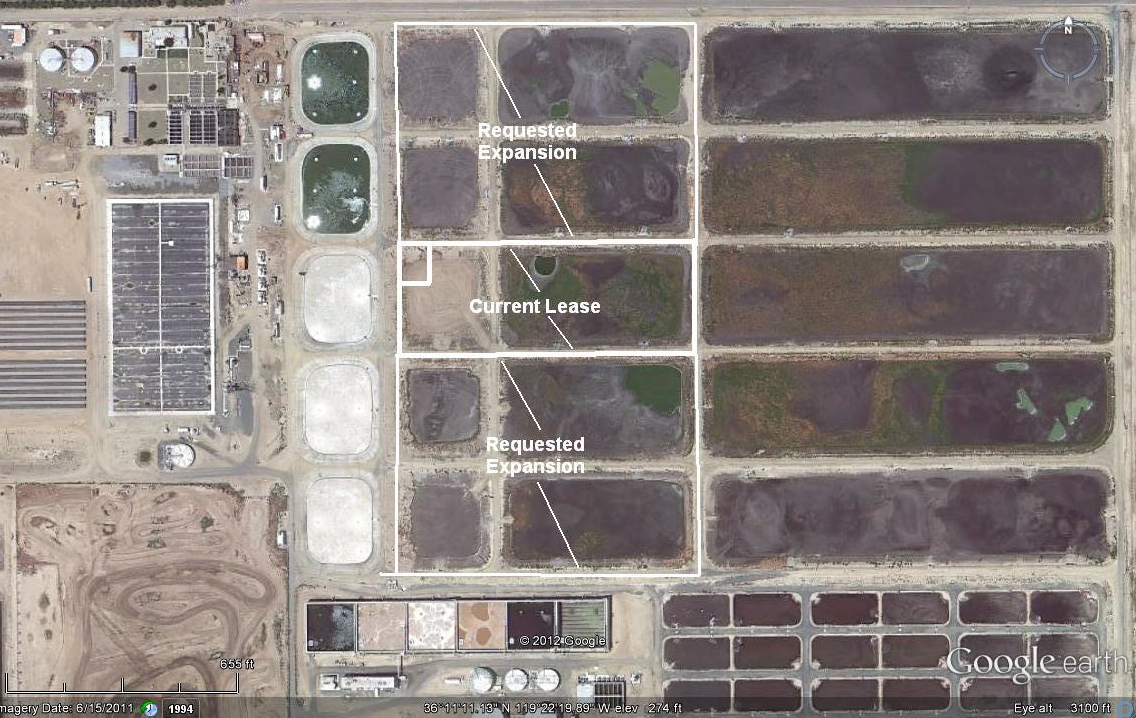
The company that is experimenting on four acres near the Tulare wastewater treatment plant to grow algae for fuel wants to enlarge the test plot to 20 acres. Pacific Algae,backed by Texas investors already leases four acres in the old industrial wastewater treatment ponds. This site was selected because of the availability of nearly pure CO2 in the exhaust from the fuel cells that would be used to grow algae for the production of oil as a base for synthetic fuels says city Public Works director Lew Nelson.
The company has identified a number of providers of technology for various parts of the process, for growing seed algae, for growing the algae to maturity, for harvesting and drying the algae and for processing the oil in preparation for production of synthetic fuel. Many of the technologies are currently bench scale or small pilot processes and would benefit from use at the large commercial pilot scale that is being proposed at the treatment plant says Nelson.
One huge target market – bio-aviation fuel.
Tulare Firm Wants To Make Biofuel
Harvest Container who has a composting facility on Lovers Lane near Tulare is working on an EIR with the county and published this notice recently.The Harvest-Tulare composting facility currently holds operating permits to compost green material, food, and dairy manure. The proposed project will increase and shift types of materials and quantities accepted at the facility. Harvest Power California LLC is proposing to add an anaerobic digester to the existing Harvest-Tulare composting operations to process organic materials into fuel and digestate that will contribute to soil amendment production. Both a high solids digester (processing food and green material) and a low solids digester (processing primarily food material) alternatives will be evaluated in the environmental document. The proposed project will increase total tonnage at the site from 86,000 tons per year to a potential 216,000 tons per year. The increase includes both the proposed anaerobic digester and increasing tonnages at the composting facility. The facility will produce transportation fuel either through a compressed natural gas (CNG) refueling station or by injecting directly into a nearby natural gas pipeline. Therefore, both a CNG refueling station and direct injection to the natural gas pipeline will be evaluated.
Cap & Trade To Start In California
California’s cap-and-trade system to reduce greenhouse gas emissions is set to launch January 1, 2013, when emission permits that can be traded will be issued. Emitting firms can use the permits that they receive from the state government, buy permits, or buy offsets for their emissions from projects that remove carbon dioxide or other greenhouse gases from the atmosphere.
AB 32 aims to reduce California’s emissions to 1990 levels by 2020, a reduction of about 30 percent.
Biodico and Navy Sign Renewable Fuel Agreement
PORT HUENEME, California – This month Biodico announced signing a new agreement with the U.S. Navy for the development and evaluation of advanced biofuels and bioenergy. The goal is to jointly develop renewable fuel and energy technologies that are appropriate for use at U.S. Naval and DoD facilities worldwide. The collaboration between the Navy and Biodico will optimize the operation of sustainable biorefineries producing renewable petroleum diesel equivalent liquid fuels, bio-based products and energy using renewable resources at Department of Defense (DoD) facilities. The optimization will allow production at the lowest possible cost. The production process will also benefit the commercial sector by providing a cost-effective process to produce renewable fuel and energy in a sustainable manner. The collaboration is partially supported by grants from the California Energy Commission.
Secretary of the Navy, Ray Mabus, has directed the Navy to reduce its dependence on petroleum by 50% by 2020. By producing petroleum diesel equivalent liquid fuels, bio-based products and energy on site, the Navy can help meet this objective and provide better security for its energy supplies. Work under the new contract will include a range of technologies including but not limited to transesterification, gasification, gas to liquids, hydrogenation, anaerobic digestion, catalysis, and the production and processing of feedstocks and co-products.
California State Senator Fran Pavley (D-Agoura Hills) remarked, “This announcement is an exciting outcome of the collaboration between Biodico, the Navy and the California Energy Commission. This work is a direct result of California’s commitment to reduce our dependence on foreign oil. The collaboration between Biodico, the Navy and the California Energy Commission will enhance our national security, provide new jobs and improve the environment. It will demonstrate and commercialize advanced biofuel and bioenergy technologies that will be utilized throughout the world. The integration of sustainable agriculture with renewable combined heat and power produced on-site will produce inexpensive advanced biofuels.”
According to Biodico’s President and Founder, Russell Teall, “As part of this agreement we are building a sustainable biorefinery at Naval Base Ventura County that will produce biofuel and bioenergy at prices competitive with unsubsidized conventional fuel and power. The facility is privately funded, with some of the innovations supported by grants from the California Energy Commission. Sen. Pavley’s landmark initiatives have helped make this project possible. ”
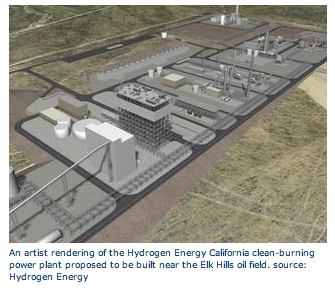
Withe the backing of the Obama administration a $2.8 billion Kern County energy project would use Utah coal in the San Joaquin Valley to make hydrogen and electric power as well enhance oil recovery and make fertilizer. How can they use coal in our polluted basin?
That’s what the Sierra Club wants to know raising objections about the innovative yet controversial project in recent months.
Its called Hydrogen Energy California (HECA) and here’s the pitch according to the applicant.
“The Hydrogen Energy California project (HECA) will generate clean energy for California while creating jobs and economic and environmental benefits for Kern County. This video describes HECA’s unique method of creating clean hydrogen from coal and petroleum coke, and its “closed loop” process for capturing and safely storing underground 90% of its carbon dioxide (CO2) emissions.” says applicant SCS Energy.
The project is called HECA was formerly owned by Hydrogen Energy International (HEI) jointly operated by BP and Rio Tinto); Fluor, URS and GE Energy The location is Elk Hills – west of Bakersfield.
SCS Energy agreed to take over the HECA project in May 2011. BP and Rio Tinto had both invested $55 million to lay the groundwork for HECA’s feasibility.
Department of Energy has invested $54 million in the project under a financial assistance agreement with HECA. HECA can access the remaining $354 million in financial assistance under HECA’s Clean Coal Power Initiative (CCPI-3) award which is a US $308 million awarded from the DOE in July 2009. The California State Public Utilities Commission also awarded $30 million in February 2009; $17 million of which had been received as of June 2010.
The project would gasify blends of petroleum coke (25 %) and coal (75%) to produce hydrogen to fuel a combustion turbine operating in combined cycle mode. The gasification component would produce 180 million standard cubic feet per day of hydrogen to feed a 400 megawatt gross, 288 MW net combined cycle plant providing California with baseload power to the grid.
The gasification component would also capture approximately 130 MMSCFD of carbon dioxide (or approximately 90 percent at steady-state operation) which would be transported and used for enhanced oil recovery and sequestration (storage) in the Elk Hills Oil Field Unit. The HECA project would also produce approximately 1 million tons of fertilizer for domestic use. Pollution Questions
While the proponents emphasize the economic benefits- critics point to potential environmental consequences.
A Sierra Club rally at the Kern County Administration Building
on Truxtun in July,20 residents gathered to speak out against the Hydrogen Energy California (HECA) project followed by a hearing where farmers and others raised serious concerns about the proposed plant. The critics pointed to the shipping of material to the Valley with the resulting pollution.
Sierra Club staff attorney Andrea Issod said “California doesn’t need the electricity that HECA would generate, but it does need better air quality. HECA is a bad investment in an old, dirty fuel that harms people from cradle to grave.”
Issod added, “Redirecting that investment to cleaner renewable technologies would be a much smarter move for California’s energy future.”
Farmers like Franz are also concerned about threats to livelihood. “HECA will cut their prime farmland in half with a rail spur and damage their crops with additional air pollution.” Franz was among several farmers who spoke at the hearing.
Sierra Club letters to the California Energy Commission have questioned the extent of air impacts from the project.
Sorting all this his out is the California Energy Commission who will make the decision if the project moves forward.The California Energy Commission staff will conduct a data response workshop for the proposed Hydrogen Energy California (HECA) project. All interested parties, agencies and members of the public are invited to participate in the workshop which will be held: WEDNESDAY, November 7,2012 3:00 PM 6:00 PM for public questions and comments at the Double Tree Inn , Bakersfield California Room , 3100 Camino Del Rio Court ,Bakersfield, CA 93308.
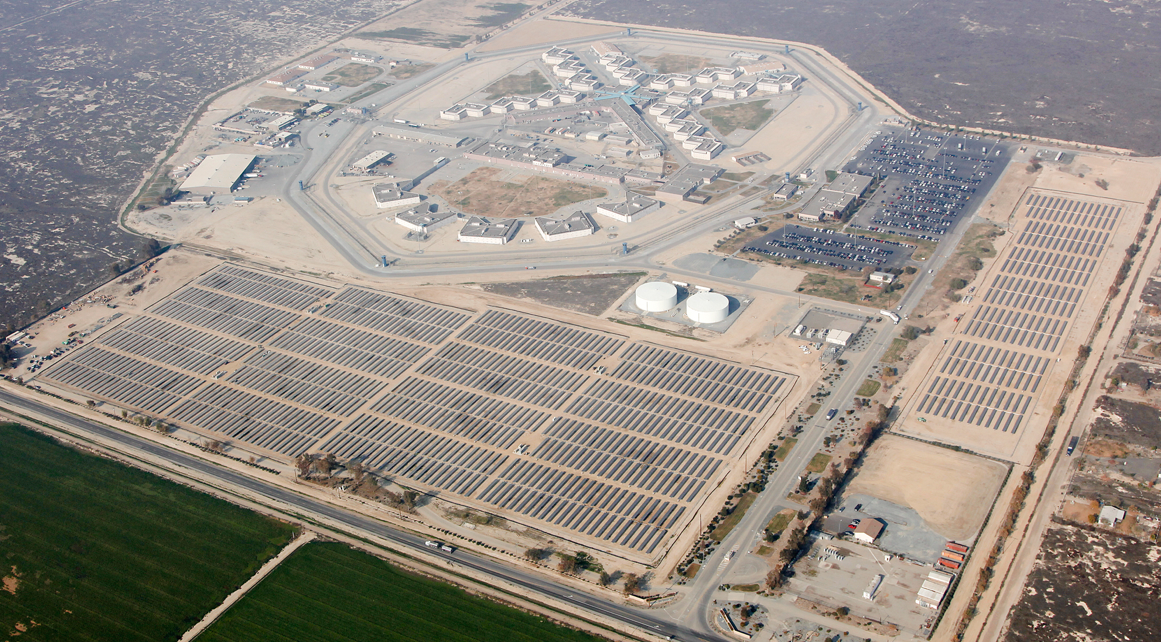
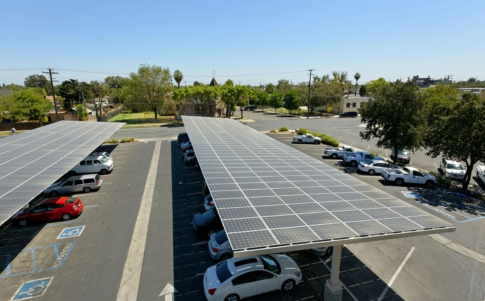
Discounted power saves tax dollars, curbs greenhouse emissions. (Solar panels at Delano prison pictured.)
The California Department of Corrections and Rehabilitation (CDCR) today announced that solar energy fields that generate electrical power for four of its prisons are now running at full capacity, thereby reducing greenhouse gas emissions and saving $45 million in energy costs over the next 20 years.
“These solar fields benefit the environment and show a responsible stewardship of taxpayer dollars,” CDCR Secretary Matthew Cate said. “These solar fields will prevent a billion pounds of greenhouse gases from being emitted to the air and make the prisons less reliant on power generated by natural gas and nuclear sources.” A dedication ceremony was held today at North Kern State Prison, one of the institutions powered by solar energy.
Approximately 56,000 solar panels, which generate 14 megawatts of power, were constructed adjacent to the four prisons at no cost to taxpayers by Sun Edison Corp. In return, CDCR purchases the electrical power from Sun Edison at discounted rates, which results in reduced energy costs. (14 megawatts of power is roughly equivalent to the energy required to power at least 45,000 homes.)
In addition to North Kern State Prison in Delano, solar fields are generating power for Chuckawalla Valley and Ironwood state prisons in Blythe and the California Correctional Institution in Tehachapi. A fifth field of photovoltaic panels are currently under construction at California State Prison, Los Angeles in Lancaster and an expansion of the Tehachapi field will add approximately 3.3 megawatts of power by early 2013.
The State of California also has awarded contracts to Sun Edison to construct an additional 20 megawatts of solar capacity at other prisons in Northern California. Those sites are still being evaluated and have the potential to reduce CDCR’s electrical costs by an additional $45 million over 20 years.
The solar fields are part of CDCR’s “Going Green Initiative” which includes recycling and water conservation projects that improve energy efficiency in all 33 prisons by reducing electricity and natural gas use. All of the energy saving projects are paid for without the use of state general fund tax dollars and are financed with low- or no-interest loans, such as those from Federal American Recovery and Reinvestment Act funding.
SACRAMENTO – The California Energy Commission today approved a $1 million research grant to Pacific Gas & Electric Company (PG&E) to demonstrate a compressed air energy storage (CAES) plant.
“In order to meet California’s renewable energy goals, it is critical that we invest in energy storage research,” said Energy Commission Chair Dr. Robert B. Weisenmiller. “This project is expected to reduce greenhouse gas emissions, improve grid reliability, and lower electric power system costs.”
The San Francisco-based utility company will verify the performance of advanced, CAES technology to provide support to the state’s electric grid. The project will use excess wind energy to compress air into depleted natural gas reservoirs within PG&E’s territory. The stored compressed air will be used to generate electricity during high demand periods.
The first phase of the project aims to establish costs and benefits of the technology, and validate system reliability and durability to select a suitable site for the plant in California. When completed, the facility will be the third CAES plant operating in the world, and the first on the West Coast.
The Energy Commission grant will provide a cost share for the first phase of the project costing $50 million. The remaining balance will be paid for by the U.S. Department of Energy and other funding sources.
Commissioners also approved a $200,000 grant to the University of California, Berkeley to develop a guidebook on Building Efficiency Standards benefits for Local Governments as it pertains to natural gas efficiency standards. The project will document the environmental, economic, and equity costs and benefits of mandatory and voluntary natural gas efficiency standards, both for new buildings and for retrofits of existing commercial and residential structures.
Funding for the projects come from the Energy Commission’s research and development program. The program supports public interest research and development that helps improve the quality of life in California by bringing environmentally safe, reliable, and affordable energy services and products to the marketplace.
Funds will be paid to the grantees upon receipt of invoices.
Oil company biggie Chevron Corporation is also big in solar and continues to build an impressive portfolio in the Central Valley in saving cities and other public agencies big time on their power bills.Turns out the number two US oil company is also one of the nation’s largest installers of solar energy systems for education and government institutions. Who knew?
This week , the Chevron subsidiary, Chevron Energy Solutions(CEC), is busy pitching the City of Lemoore city council to install solar panels at 8 city well/pump sites that would generate 70% of the electricity consumed at those scattered locations. Adding up the units they require 2.4MW of power, a number that is higher than earlier estimated because of the need to reduce arsenic levels in city water.
City administrative analyst Lauren Apone says although the CEC project will cost the city $9.1 million to be financed over 30 years, the net savings would be $25.1 million in power they don’t have to buy for the city’s Water and Sewer Funds.
Already, the city has used Chevron Energy Solutions to improve energy efficiencies at their big Cinnamon Municipal Complex with solar systems as well as solar panels on the city police department parking building.These units are already generating about 10% more electricity than had been anticipated says a city staff report.The $3.9 million project authorized in 2008 did the following:
• Solar systems on roof of Cinnamon Municipal Complex and a solar parking shade
structure at the Police Department
• Lighting upgrades at 8 facilities
• Major HVAC upgrades at 2 facilities
• Roof replacement of Cinnamon Municipal Complex
• Wastewater circulation system installation
• Weather based irrigation system installation at four parks
In June 2012 the city also agreed to have Chevron replace 1200 street lights in town with LED lights.
CEC is duplicating these energy saving efforts across California. Company projects number in the hundreds.
SF-based CEC has been busy in the Central Valley working recently with 13 Central Valley public agencies on energy saving projects,mostly solar, with a total saving in excess of $60 million,not including this Lemoore deal expected to be approved this week.Here is the customer list and the savings according to CES.
City of Hanford $4.3 million
City of Lemoore Phase 1 $3.9 million
City of Lemoore Phase 2 $0.7 million
City of Delano $3.4 million
City of Dinuba $4.0 million
County of Kings Phase 1 $3.0 million
County of Kings Phase 2 $8.4 million
County of Kings Phase 3 $4.1 million
County of Tulare $7.3 million
Fresno State University $12.0 million
State Center Community College District, Fresno $2.5 million
Lemoore Union High School District $3.0 million
USPS Fresno $1.7 million
A sister company Chevron Technology Ventures, (CTV) , evaluates and demonstrates emerging technologies. In October 2011, CTV launched a unique demonstration project to test the viability of using solar energy to enhance oil production. The Coalinga, California, project uses more than 7,600 mirrors to focus the sun’s energy onto a solar boiler. The steam it generates is injected into oil reservoirs to increase production. The project is the largest of its kind in the world.
More hydroelectric power is being planned for both the San Joaquin River at Friant Dam and on the Kaweah River at Terminus Dam.
At Friant, the 8 member water districts who own the Friant Power Authority plan to upgrade a 2MW power plant on the San Joaquin River by another 7MW to utilize the higher flows of water that are heading down the river as part of the restoration process. The dam already has two other hydropower plants flows that go both north on the Madera Çanal and south on the Friant Kern, each in operation since 1986.
Friant water officials have said with reduced flows not being diverted both north and south due to the legal settlement to help salmon restoration they would be losing some $2.7 million annually in power revenues that help the water districts. Instead, more water is being released down river.
In the works since the settlement was put in place in 2006 the $25 mili project is going out to bid for the equipment to build a new 7MW facility adjacent to the existing 2 MW River Outlet Powerhouse.The renewable energy project is slated to be on line in summer 2014 says Orange Cove ID engineer Fergus Morrissey.
”We have our FERC license,the power has been sold and all approvals are in place.”
On the Kaweah River a $15 million hydro project would add 9MW of electricity generating capacity to the 20MW Terminus power project alredy in place according to a preliminary permit application filed with the Federal Energy Commission (FERC) in July.
“We have flows coming out of the dam that sometimes exceed our capacity to capture them” says Gene Kilgore of Kaweah power Authority, owned 75% by Kaweah Delta Water conservation district and 25% by Tulare Irrigation District. The power plant can utilize flows up to 1500cfs now says Kilgore but they want to be able to handle peak flows of 2500 to 2800cfs he says.
The FERC notice “gives us the right to move forward on the project” but it is not a final OK that will still require several years to finalize.In fact Kilgore says it starts the process for his group to do a formal feasibility study.
Even more daunting however is the project will require a ruling by the State Water Resources Board to utilize the water even though they want only to utilize the existing supply, essentially borrow the water for a short period and plan no appropriation. “But that could take 5 years” he shrugs.
The power plant would be upgraded from 20MW to 29MW of power.Its nameplate power was last increased in2004 form 17MW upon the completion of the dam enlargement project.
Currently the electricity is sold to SCE but once the 9MW comes on line the number of potential buyers are numerous since the power market has opened up and will likely continue to do so.
Kilgore adds “federal officials are really pushing more hydro power where there is an opportunity ” because renewable power offers fewer greenhouse gas emissions.
A version of this story first appeared in Fresno Business Journal
Deserved or not, Fresno is known as the nation’s smog capital.
But our fuel supply has been getting greener with California gasoline blended today with 10% ethanol, up from 5.7% and as of last month Fresno diesel shipments being blended with 5% biodiesel. That’s what one of the nation’s largest fuel pipeline owners and the largest refinery and pipeline operator in California – Kinder Morgan – began doing in August at their key Fresno terminal that connects Bay Area refineries to the mid-state’s downstream users.
Kinder Morgan spokesperson Emily Mir says the company began blending ”in response to strong interest from …customers” investing “several million dollars to allow both its Fresno and Colton terminals to blend up to 20 million gallons per year of B100. In both terminals Kinder Morgan has invested in offloading capabilities” says Mir, and is now blending” the B100 at a 5% ratio into the incoming diesel pipeline manifold” that goes to their customers.
In a Kinder Morgan financial report the company said they are spending $16.2 million to build biodiesel blending facilities in four Western US cities that include Fresno.
Kinder Morgan is not alone.Major players like Chevron and Exxon are helping to push the new fuel standard to 5% biodiesel in response to both federal and state mandates.Kinder Morgan is doing the same in other states, in Arizona and in Nevada. These new rules help the diesel fuel supply to ‘green up’ on both its carbon content to reduce global warming and on the toxicity of its pollutants with vegetable or animal fat-based biodiesel estimated by EPA to be 78% cleaner than petroleum-based diesel when it burns.
Kinder Morgan terminal,Fresno
Diesel pollutants like particulates have been implicated in severe air problems in the Central Valley that have a cost us in both community dollars and lives. 100% biodiesel cuts particulate matter emissions compared to traditional diesel by around half. Regards greenhouse gases, biodiesel makes a 57% cut says EPA. 45 Million Gallon Biodiesel Plant Next Door
In a move coordinated with Kinder Morgan, Fresno entrepreneur Jeremy Eslinger has filed for a conditional use permit from the city for a 45 million gallon biodiesel manufacturing facility next to the same Fresno Kinder Morgan terminal on Malaga. Eslinger say his start-up company will lease 15 acres for the project from Kinder Morgan as they will supply biodiesel for blending into California diesel fuel market underway now by Kinder Morgan.” We have a memorandum of understanding“ says Eslinger, suggesting they hope to get the green light on their CUP application around October 1.
The first phase of the project that is expected to be operational next summer is pegged at about a $20 million investment says Eslinger. Construction would start in January.
Plans for the production plant have been in the works for several years says Eslinger,originally slated for a site in Firebaugh. But locating the production plant next to Kinder Morgan is literally a pipeline to the market and Eslinger’s business plan calls for Kinder Morgan to utilize 15,000 gallons a day within 6 months on the way to gearing up to 135,000 gallons a day.There are no hazardous waste or water use associated with the 18,500 sf plant he says.The facility would employ 48.
Eslinger says the biodiesel will be made from various biomass feedstock including algal oils,seed oils,animal fats and waste vegetable oils.Eslinger says they may use soybean,camelina or canola oil grown on Fresno westside’s degraded land for some feedstock.
Eslinger and family are in the custom harvest business in Dos Palos and expect to supply the plant with some Valley grown feedstock, another economic benefit of the project.
Initial production is set at 5 million gallons a year in what will be a three-phase project offering a “continuous supply” of biodiesel for Kinder Morgan to pass on to their customers that include Chevron,Shell,Valero,Conoco Phillips and Tesoro says Eslinger’s application. As with ethanol blends, the industry wants a standard blend that will go to most customers. Sounds like there is good chance this Fresno mix will end up in your pickup’s fuel tank although others in the Valley already make or want to make biodiesel.
Eslinger believes teaming up with Kinder Morgan will help cut transportation costs to customers that will help convince them to buy from his start-up company.Cutting costs will help keep the price of biodiesel – a few cents higher than diesel – from getting out of hand, he expects. Mandates for cleaner fuel
Incentivising investment in new blending capabilities are two major regulations – one federal and one state – that are mandating a gradual shift of our fuel supply to increasing use of lower carbon sources. The federal Renewable Fuels Standard(RFS) as revised in 2007 expanded the RFS program to include diesel, in addition to gasoline and increased the volume of renewable fuel required to be blended into the nation’s transportation fuel from 9 billion gallons in 2008 to 36 billion gallons by 2022. The amount increases over time.
California Energy Commission staffer Gary Yowell says California’s share of biodiesel to be blended into the diesel supply adds up to 120 million gallons in 2013 under RFS compared to current blending of about 36 million gallons.”That’s the big driver” says Yowell. California biodiesel plants are running under 50% of capacity right now, he says.
“We are at about 1% biodiesel now” with the new 5% standard sweeping into the state this summer. California is using nearly 4 billion gallons of diesel fuel a year now.
Under RFS there is an incentive to do the blending where refiners can also earn more Renewable Identification Numbers (RINs), worth about $1.50 to $2 per gallon of biodiesel,say sources,encouraging self production.
The state mandated Low Carbon Fuel Standard is another driving force despite the fact it faces a court challenge on appeal. The standard enacted by California in 2007, with specific eligibility criteria defined by the California Air Resources Board in April 2009 took effect in January 2011. The law was ruled unconstitutional by a Fresno judge at the encouragement of out of state energy providers.The LCFS requires fuel providers to reduce greenhouse gas emissions to 1990 levels with a 10% reduction in the “carbon intensity” (CI) of transportation fuels in California by 2020. That could further drive up demand for biodiesel produced in the state.Despite the lawsuit. the state ARB is issuing credits for low carbon fuel that are being traded now providing a few cents of profit for advanced biofuel, low in carbon content.
Helping to stimulate interest in buying,government agencies including the Navy and GSA are bidding for advanced biofuels that include biodiesel – this year.
If biofuels live up the promise,it will be a home run for the Valley were virtually all of the experimenting is being done for a simple reason; it’s where the crops grow and the animals feed and the waste material from both pile up – creating a golden opportunity.
Three multi-million dollar waste-fed biomass digesters are in the works in Tulare County that will turn trash to cash, mostly into energy related products.
Largest and nearest at hand is Colony Energy’s $20 million,4 million gallon anaerobic digester/cogeneration complex on ten acres of City-owned land located at 2450 W. Paige Ave.The firm will lease the land from the city next to the wastewater treatment plant. VP for project development Matt Schmitt says the project has now received all environmental approvals and will break ground in the first quarter of next year. ” WM Lyles will build our project that should be operation in mid-2014.”
Schmitt says the plan is to accept about 25 loads a day of mostly food waste,about 20% cow manure and the rest ag waste to produce approximately 700,000 cubic feet per day of biogas,essentially CNG.”We will connect to the SoCal pipeline and the gas will go out to customers.” Some will be converted to LNG he says.
The project also features a combined heat and power plant to create electricity and heat in the form of steam or hot water.The steam/hot water has the potential for being used by the City at its wastewater treatment plant to heat the existing digesters and thereby improve efficiency.
Colony Energy is counting on increased demand for renewable biogas in California and has plans to duplicate the project at several other locations in the state says Schmitt. The Tulare project should generate over 30 jobs.
Anaerobic digestion uses naturally occurring microorganisms to break down organic materials and produce biogas, a mixture of methane and carbon dioxide. The biogas can be combusted to produce renewable electricity, cleaned to pipeline natural gas standards, or further processed into compressed natural gas (CNG) fuel. Through anaerobic digestion, many goals can be accomplished:
Divert organic materials from landfills and incinerators
Generate clean, distributed, renewable energy
Restore and maintain healthy soils using compost products
Displace chemical fertilizers
Create green jobs
Also near Tulare,Harvest Power, who owns Tulare County Compost on Lovers Lane has plans for building a new anerobic digester that will turn organic waste into fertilizer and energy. Harvest Power,based in Washington, recently secured $110 million from venture capital investors including Kleiner Perkins to build facilities at multiple locations The unit will break down food scraps and yard clippings in a closed vessel, producing both fertilizer and biogas that can be used to produce electricity or be processed into compressed natural gas for transportation fuel. Harvest Power is working on a full EIR with the county confirm county officials.The company refused comment.
Another closed vessel digester is going to be built at Calgren Renewable Fuels plant in Pixley taking piped-in cow manure and converting it to biogas to power its ethanol making operation.The $10 million project on Highway 99 faces hurdles in the form of opposition from neighbors that has stalled their mitigated negative declaration- based application to the county.The Pixley Biogas project received a $4.7 million grant from the California Energy Commission but despite a redesign to meet concerns of California Dairies with a plant nearby,the project has been stalled until now.
This week president of Calgren,Lyle Schlyer said the company will now go through a formal EIR to get the project built.The EIR is expected to take about 6 months.
California ethanol producing plants from Tulare County to Sacramento are working hard to wean themselves from high priced Midwest corn, company officials recently told a committee of the California Energy Commission.
Speaking to a fuels committee of the state agency, Pixley-based Calgren Renewable Fuels president Lyle Schlyer said they hope to encourage local farmers to grow grain sorghum(milo) in enough quantities to replace as much as 20% of the Midwest corn they import by the trainload now. Using milo requires few modifications to the plant to make ethanol and other co-products.
Midwest corn has been hit hard by a 60-year drought that has sent the price sky high for users including biofuel plants, food companies and livestock owners alike. The later two blame ethanol plant owners instead of Mother Nature.
“We’re all losing money right now”Schlyer admits for the state’s handful of ethanol producers. Corn prices have jumped from around $5 earlier this summer to near $8 a bushel, squeezing margins.
Understandably, the plants are looking to alternative feedstock to keep making ethanol that is blended across the US as a oxygenate in our gasoline.
Move to Help Dairy industry
Schlyer says “grain sorghum is not an ideal feedstock for dairy and …we think we can convert it into a good feedstock, so we won’t be competing with them for corn.” Some of most vocal criticism of the corn ethanol industry has come from California dairy producers.
“But we still need to find(milo) growers. So what we’re going to do in our current program is go out and see what we can do to incentivize growers, essentially contract for acreage.”
The diversification goes beyond feedstock. Schlyer says they are also seeking permit modifications to install a biodiesel production facility at their Pixley plant. “Using our extracted vegetable oil as feedstock, we believe we can produce some of the lowest carbon intensity biodiesel in California and not have to ship that stuff back to Illinois, to find a processor who is well suited to use it.” He adds the investment could be in the $5 to $10 million dollar range.
Their Ship Comes In
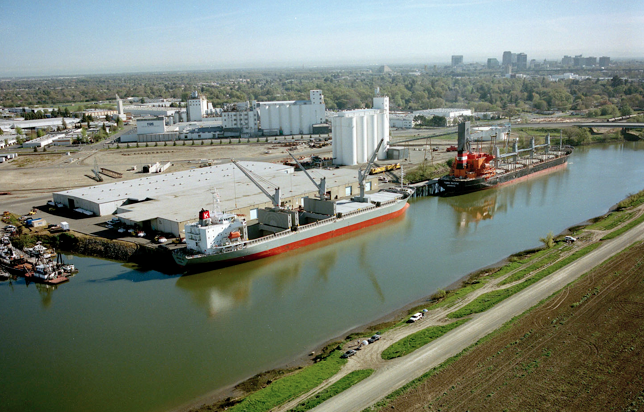
Port of Stockton
Well known player Pacific Ethanol based in Sacramento, says they too are bringing in milo instead of Midwest corn by the unit-train load,100 cars each, confirms company spokesman Paul Koehler.
CEO of Pacific Ethanol Neil Koehler told the same CEC committee August 1 they hope to bring in a vessel-load of sorghum from Argentina that could replace up to 5% of the Midwest corn they need to buy currently. This week, Paul Koehler confirmed the shipment “is likely to come into the Port of Stockton” where they have an ethanol plant – this fall. “I looks like it will happen.”
Pacific Ethanol like others, is adding corn oil extraction at 4 plants in the West that will give them another high value co-product to sell as did Calgren in Tulare County last year,helping them to move to profitability.
Energy Tubers in Fresno County
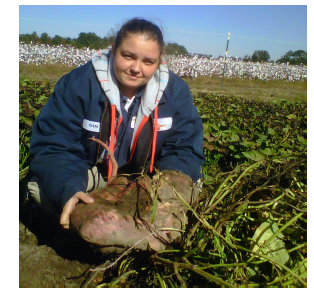
Even more more ambitious, owners of the Keyes, California biofuel plant Aemetis CEO Eric McAfee told the committee about their code name energy tubers. ”We went on a worldwide search over the course of half a decade and we came up with a product that the USDA believes is the highest yield in ethanol per acre, even in excess of Brazilian sugarcane. It happens to be a Peruvian product that the Chinese used a lot during the Mao Tse Tung revolution because they sent the intellectuals out to the farms and they were starving, and they wanted the fastest growing, highest yielding biological transformation of solar energy to starch that was possible, and they developed a product called CX1.” The code name refers to a large energy tuber, a casaba-like root plant (see picture).
“Over 15 years, the USDA commercialized it and we are the first company in the Western United States to actually take it into commercial production. Last year, we planted a field in Fresno County and we produced more than 1,900 gallons per acre of ethanol if you take the starch, convert to sugar, multiply it out, you end up with 1,900 gallons an acre of ethanol. This is between 10 and 20 percent more than you would get if you would have grown sugarcane in Fresno. And it’s almost four times the production of Ethanol from corn. If you can get four times the amount of fuel and so you have a lower cost biofuel at the pump.”
Mcafee says they are harvesting a crop in Fresno County this October.Mcafee continued that “within 48 months, we could be entirely weaned off of Midwestern feedstock and weaned off of corn if we continue to make just moderate investments and scaled up CX1 as a feedstock in the Central Valley. We would no longer import feedstock from the Midwest.”
“ I was just in Canada about a month ago and was with a grain company that scaled up a canola product to a million acres over the course of about five years, and had extensive discussions around the resource constraints to get us from zero to 30,000 acres, and I think it’s a very very achievable goal; we’re not going to have to do the million acres the Canadians did in order to have an impact.”
If Aemetis were to fund the scale-up,“we’d probably be at five percent weaned off(corn)next year, 20 percent the year after that, 60 percent the year after that, and 100 percent the year after that. The scale-up is pretty rapid.”
Aemetis recently designed, built and began to operate a corn oil extraction unit at Keyes that will produce about 2 million gallons per year of extracted oil for biodiesel or animal feed and reduce the carbon footprint of the facility that will be important over the next few years to comply with the state Low Carbon Fuel Standard. The LCFS mandates a cut of our fuel’s carbon emissions by 10% to reduce global warming.
Likewise at Pacific Ethanol with both near term and long focus is to reduce Midwest corn imports.
grain sorghum-milo
Says Neil Koehler, “Our goal” is to use“ locally produced corn and milo, and we would hope that that would be 25 to 40 percent over the next one to two years. We have programs in place that we’re looking for some support on to put in a five million gallon cellulose increment into our existing facilities.. in the range of 10 percent additional, with “the majority of our feedstock being both locally grown and new feedstocks over the next three to four year period.”
To accomplish that, Pacific Ethanol is working with Visalia-based EdenIQ to do a “bolt on” cellulosic plant to an existing corn ethanol facility that will work with a variety of feedstock.Paul Koehler says talks with EdenIQ “are mature” to launch the project. Similar work is underway at Aemetis with federal incentives in place to make cellulosic biofuel.
All the state’s plants including EdenIQ continue to lobby the California Energy Commission to help them financially move in the new direction agreeing to a compromise with critics recently over future state corn ethanol subsides. Late last month Governor Jerry Brown signed AB 523 by Assemblyman David G. Valadao into law. AB 523 eliminates all future state funding for the production of ethanol derived from corn after July 2013,less than a year from now.
Currently, approximately $6 million dollars is provided and AB 523 would redirect that money away from corn ethanol and towards other forms of renewable energy, including ethanol not derived from corn.”Over a year ago, we brought together our friends in Agriculture and many from the environmental community to oppose further state funding for the production of corn ethanol,says Valadao.
With red ink at these plants, the issue is one of survival near term. They say they hope to see the CEC support continue at least until July 2013noting that Midwest states continue to help their plants.