
Tulare County Tightening Solar Farm Locations
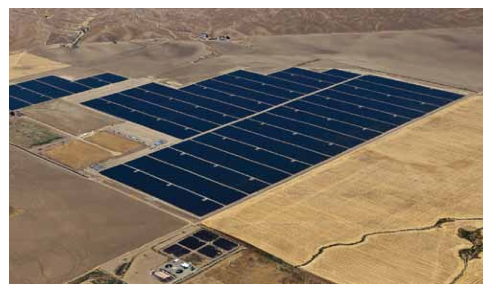
More large utility-scale solar farms to be located in the Central Valley’s Tulare Lake Basin are on the drawing boards in 2013. Meanwhile, Tulare County appears to be planning to tighten rules on where developers can site new solar farms not yet approved.
In the early stage of permitting locally are a new 80MW solar farm on non-irrigated land south of Ducor in Tulare County,a 150MW solar farm along I-5 in Kings County, a 100MW project owned by SunPower near NAS Lemoore that is set to break ground in 2015 and news out of Westlands Water District that they have approved a preliminary plan to build a new energy transmission corridor through their jurisdiction located in Kings and Fresno counties. Also in an early stage – energy company NRG plans to expand the footprint of their solar farm near Avenal that produces 45MW of power.
Solar Policy Tweak
In Tulare County where an existing pipeline of some 250MW has been approved by the county, new solar projects are likely to to face restrictions on just where on Tulare County’s farm land they can locate. The Tulare County Board of Supervisors will take up what the county’s solar coordinator Mike Washam calls a “compromise” recommendation February 26 offered by the county’s Ag Policy Advisory Committee. The collaborative effort has included the Tulare County Farm Bureau who have raised questions about current policy.
Washam says a key new provision would be that a solar farm could not be located on irrigated land “that has been farmed with a permanent crop in at least one of the past 10 years” although land within a city’s urban boundary might be exempted.
The intent is to push solar developers on more marginal land in the county,land that would not mean a loss of prime ag land for crops. In many cases – land owners have argued they don’t have the water supply to continue cropping on all their land and leasing some land for solar made sense.
New Projects
Regards the new projects larger than 20MW in Tulare /Kings – they include:
Tulare Solar Center:owned by Sacramento-based company Wellhead Energy, the firm filed a preliminary CEQA document this week to build a 80MW,1,142 acre solar farm on nonirrigated land south of Ducor along Hwy 65. The intent is to sell the power to a utility like SCE beginning in early 2015 says spokesman Gary Franzen. The company owns several natural gas “peaker” power plants in Delano, San Joaquin,Huron,Firebaugh, Yuba City, Chula Vista and Escondido. The power projects are owned by Harold Dittmer.The site is close to a SCE substation.
Grow Holdings: Owner Quay Hays has downsized the original 250MW solar project on acreage along I-5 south of Kettleman City to 150MW in a new filing with the Kings County planning department. Hays says the project would be be built on fallow,disturbed farmland along a major state power grid that runs along I-5 making it easy to hook up with the grid. The developer continues to hope to build a green community(Quay Valley) on the several thousand acre site proposed five years ago and now seeks approval to build commercial buildings at the site as a first step.
SunPower /Henrietta : Last September SunPower advised that it had signed a Power purchase Agreement with Pacific Gas and Electric (PG&E), which will see the company deploy its SunPower Oasis power plant for the 100MW Henrietta Solar Project in Kings County, California.The site,approved by Kings County, is near NAS Lemoore. “We are very pleased to be working again with PG&E to deliver cost-competitive solar power at a 100MW scale, while creating jobs and economic opportunity for the local community,” said Howard Wenger, SunPower president, regions. PG&E estimated that the project will provide enough energy to power around 36,000 average California homes. The company’s anticipate construction starting in 2015, with completion and commercial operation reached by late 2016.
Westlands Water District Moves Into Renewable Power Business:
Its not that unusual for a number of California water districts to be involved in the electric power business often as a means to better store and move water or tap a revenue stream from a dam.But Westlands Water District – on the parched west side of the Valley – has no dam.
What they do have is plenty of sun, hundreds of thousands of acres of tainted and unused land and a location along the main power grid that feeds electricity to much of the state.
Now some Westlands property owners and the district itself are teaming up to develop a huge solar park in Kings County, not unlike an industrial park – to attract solar farm developers. In addition, in news this past week(Feb 19), the district’s water policy committee approved a plan that would make WWD the lead agency in a plan to build a high capacity transmission corridor in coming years and are preparing an environmental notice(NOP) as the lead agency regards the big project.
The proposed “master plan” if implemented – would help steer more utility-size solar farm developers to locate in the Westlands because they could more easily ship their power north and south. The area is already home to major grid transmission lines but not enough to handle the thousands of megawatts envisioned for industrial-sized Westlands Solar Park.
Their biggest competitor in the plan? Those massive proposed solar power projects in the desert of California that could supply much of the renewable power the state needs in the future. Their biggest ally – environmental groups like the Sierra Club who worry about the impact of these sprawling projects on fragile desert habitat and the critter who live there. Instead, the Sierra Club and others are lobbying the state and federal government to grow solar in the Central Valley – not on prime farmland but on spent farmland with no critters in the Westlands.
A study done for the Westlands Solar Park developers that include some Westlands farmers says while desert solar PV projects might be able to deliver power 8% cheaper than a west San Joaquin Valley site – that cost advantage would be more than off set in high transmission costs because the grid infrastructure is not yet there. According to estimates prepared by PG&E, the minimal network transmission upgrades that are required to ensure deliverability of 800 MW of solar PV from Westlands Solar Park would cost a total of $70 million, whereas the cost of network transmission upgrades required to deliver power from the desert would likely run much higher. Job one for this landowner group – convince state and federal regulators who approve where California’s renewable power for coming years will be located.