NRG Turns On Air Cooled Marsh Landing Power Plant

Retires 2 Older Units That Used Sea Water For Cooling

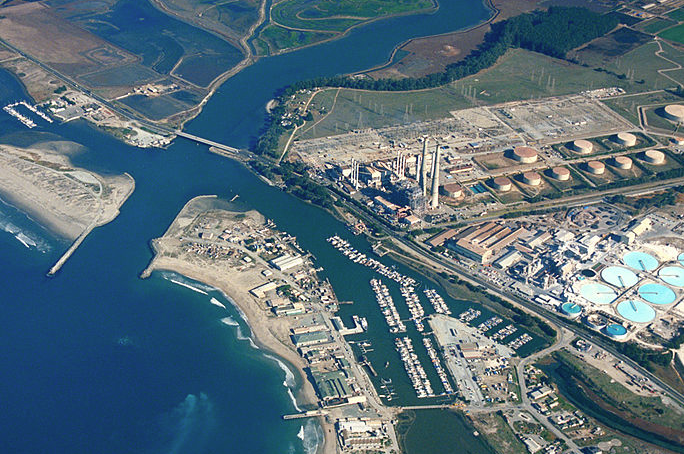
Marsh Landing power plant.May look familiar to folks around Morro Bay(click to enlarge)

Energy firm NRG this month switched on its new 720MW Marsh Landing nat gas power plant that has been compared to Morro Bay’s units in vintage, operations and appearance. Unlike Marsh Landing – there are no plans to modify and upgrade the Morro Bay units.
-May. 1, 2013, NRG Energy, Inc. (NYSE: NRG), entered commercial operation at its Marsh Landing Generating Station, a natural gas–fueled, peaking facility located near Antioch, CA, in the San Francisco Bay Area. The plant provides 720 megawatts (MW) of flexible electrical generation to the California grid that can supply up to 650,000 homes. The fast-start technology employed by Marsh Landing supports the integration of new renewable energy sources that are expected to come online in the next decade.
“Our Marsh Landing team worked closely with a very effective construction team from Kiewit to safely build this facility on-budget and on-time,” said John Chillemi, Senior Vice President and Regional President, West. “Our goal was to bring this facility online before the California summer peak arrived, and we were able to make it happen.”
During the peak period of construction, this project created nearly 600 jobs in the local community. Bringing the new facility online also allows NRG to immediately retire two less-efficient, 1960s-era units at its adjacent Contra Costa Generating Station (CCGS) that relied on once-through cooling. Replacing the older units nets a nearly 50 MW gain in power with a fraction of the environmental impacts. Marsh Landing’s fast-start technology will bring it to full capacity in minutes where CCGS took hours, providing more power faster—and with lower emissions.
During construction, the station followed the highly respected Leadership in Energy and Environmental Design (LEED) building standards, which serve as the U.S. Green Building Council’s national model for environmentally friendly construction.
The Marsh Landing station will employ technologies to meet or exceed the state of California’s strict standards for emissions control and air quality. The turbines will operate with ultra-low nitrogen oxides (NOx) combustors, a selective catalytic reduction (SCR) system will be installed to further reduce the NOx emissions, and an oxidation catalyst system will be utilized to reduce carbon monoxide and other organic compound emissions. Marsh Landing’s state-of-the-art air-cooling system uses a minuscule amount of water compared to facilities relying on water-cooled systems, advancing California’s policy of reducing the use of water associated with the generation of electricity. In fact, Marsh Landing’s maximum use of 50 acre-feet of water per year represents a 99.99 percent decrease from CCGS’ maximum annual use.
The facility is located on a 27-acre parcel of industrial-zoned land approximately 50 miles east of San Francisco. Through a 10-year power purchase agreement, Pacific Gas and Electric Company will obtain the entire output of the facility.

Nuclear Resurgence Dims Due to Rising Costs, Low Demand

San Onofre near San Diego

from ENR- Engineering News-Record

by Scott Judy

In the span of a single week, the nuclear power industry’s hoped-for U.S. resurgence took a few steps backward as several projects and existing plants from across the country either were shut down or began to face increased scrutiny from regulators due to ongoing problems and financial issues.
The setbacks raised the specter of a long-term decrease in domestic nuclear power-generation capacity, claimed Peter Bradford, a former member of the U.S. Nuclear Regulatory Commission (NRC) who is now an energy policy and law professor at the Vermont Law School. If the trend continues, Bradford says, “U.S. nuclear-power output will have reached a peak a few years ago that it will not attain again in our lifetimes.”
The setbacks came in quick succession.
On April 30, the NRC rejected a license application from Nuclear Innovation North America for its 2,700-MW South Texas Project Units 3 and 4, near Bay City, Texas, due to Mitsubishi’s majority ownership stake, a violation of the Atomic Energy Act.
Citing lowering demand for electricity, Duke Energy on May 2 notified the NRC of its plan to suspend its application for two new 1,100-MW nuclear units at its Shearon Harris nuclear plant in Wake County, N.C. Dhiaa Jamil, president of Duke Energy Nuclear, stated, “Our most recent forecast indicates two additional nuclear units at Harris will not be needed in the next 15 years.”
Additionally, on May 7, Dominion permanently shuttered its 556-MW Kewaunee nuclear plant, near Green Bay, Wis. The company stated it was “unable … to take advantage of economies of scale, and Kewaunee’s power-purchase agreements were ending at a time of projected low wholesale electricity prices.”
Also in early May, Edison International officials stated they may decide to shut down the utility’s 2,350-MW San Onofre nuclear plant in San Diego County, Calif.—currently off line—if it can’t overcome problems at one of the units, Power magazine reported( last week the federal government again postponed a decsion to reopen the plant).
That same week, the Florida Senate unanimously passed new restrictions on the state’s nuclear cost-recovery law, which allows utilities to charge customers for the costs of nuclear projects years ahead of the start of construction. Among other requirements, the new regulations will force utilities to prove their planned projects have “reasonable” costs.
One project at the center of the political debate in Florida over heightened scrutiny for nuclear project financing was Duke Energy’s proposed $20-billion, 2,200-MW project in Levy County.
When announced in 2008, Progress Energy, which has since merged with Duke, estimated the cost of the project at about $14 billion. Today, while Duke has yet to state whether or when it will start construction, the utility estimates the plant’s cost at between $19 billion and $24 billion. Last November, despite that rise in price—and the growing popularity of natural gas as a cost-effective energy source—the Florida Public Service Commission deemed the project “feasible” and allowed the utility to continue charging customers an additional $143 million in fees, according to the Tampa Bay Times.

Challenge To Tulare Digester Project

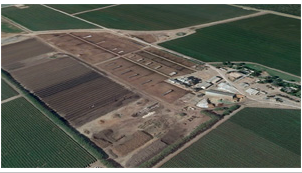
Neighbor Sundale Vineyards has appealed a county Planning Commission approval of an EIR for the Harvest Power project expansion. The project heard a few days ago will be appealed to the June 11 Board of Supervisors meeting.County staff says Sundale is questioning the adequacy of the Harvest Power environmental impact report.

The Harvest-Tulare composting facility(Tulare County Compost) on Rd 140 near Tulare currently holds operating permits to compost green material, food, and dairy manure and the company wants to increase and shift types of materials and quantities accepted at the facility. Both a high solids digester (processing food and green material) and low solids digester (processing primarily food material) alternatives will be studied.

They seek a permit to allow a maximum tonnage to increase from 156,000 tons per year to a potential 216,000 tons per year. An additional 60,000 tons will be allowed at the proposed anaerobic digester facility. The facility will produce transportation fuel through a compressed natural gas (CNG) refueling station.

Fresno University Helps Certify New Micro-Power Generators

A small group of engineers, equipment manufacturers and water delivery specialists gathered at Fresno State’s International Center for Water Technology (ICWT) to certify the performance of an energy recovery system never before used in the United States.

Zeropex, an “energreen” company based in Norway, developed a new power-generating system called “in-conduit micro-hydro electrical power generation.” It involves generating electrical power from existing water-delivery systems run by entities such as cities and water districts.

“This is a way of recovering energy that is normally lost in water delivery systems,” noted Sandy Walker, vice president of Zeropex. “Delivery systems typically build up large amounts of pressure required to move water over long distances. When the water reaches a delivery point, the system uses a pressure-reducing valve that burns off the excess pressure. This new system recovers the energy that is lost and generates electricity with it.”

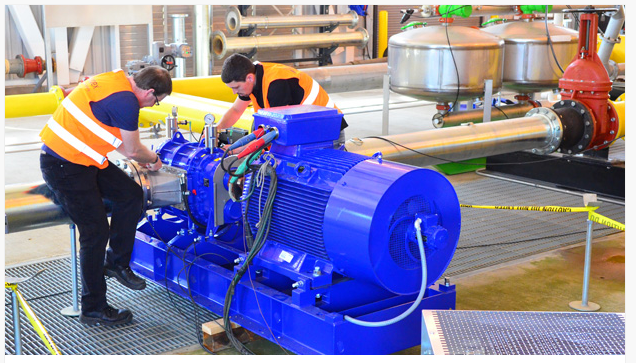
The Zeropex power generation system is fairly simple: it features a turbine and generator installed in-line in the water system pipeline, plus a control system that monitors and delivers the electrical current.

“The basics of the system are basically off-the-shelf components,” Walker said. “The delivery and monitoring of the power was developed and patented by Zeropex.”

The Water and Energy Technology Laboratory (WET Lab) housed in the ICWT serves as an internationally recognized testing facility for all types of water technology equipment and delivery systems, said Ed Norum, engineer for Fresno State’s Center for Irrigation Technology. The WET Lab is certifying performance of three Zeropex micro-generators before they are delivered to the company’s first two U.S. customers – the San Jose Water Co. and the City of Avenal.

Once installed, the units will return a constant amount of electrical power back into each city’s operating grid, providing renewed energy that up until now has been lost.

According to Norum, representatives from the company contacted Fresno State because of the WET Lab’s status as a recognized testing facility.

“We’re absolutely the ideal facility for the need that they have,” Norum said, providing calibrated certification that the equipment will do what it’s designed to do, prior to it being delivered to customers.

Zeropex micro-hydro systems have been purchased and installed in several European countries including Norway and the United Kingdom. Walker said she hopes Zeropex will be able to respond to the growing market need for renewable water energy technologies in this region.

“In-conduit micro-hydro is an emerging field that offers some unique benefits for California,” she said. “It combines the ability to deliver reliable constant power to the electric grid while being a cost effective renewable energy source. In addition, it eliminates the risks associated with fossil fuels like natural gas and oil, and it is an invaluable tool for water agencies to reduce their carbon footprint.”

Walker expressed her appreciation to Fresno State for the opportunity to conduct commercial scale testing at the WET lab. “Our experience here has been world class,” she said.

For more information, contact Steve Olson, 559.278,5680 or steveo@csufresno.edu.

Gas Prices Head Lower Across California On Tax Day

It’s tax day and usually not a time for celebrating. But there is some good news at the pump and more expected looking forward to the busy summer driving season. The savings amount to giant tax break for the American consumers and businesses as well.

Today the average price across California is $3.95 a gallon – down from $ 4.23 at the beginning of March. Analysts say they expect the price to head lower. Helping to fuel the supply here is the restart of the big Chevron Richmond refinery after eight months of operating at half production levels.

There is help from the crude side. GasBuddy.com Senior Petroleum Analyst Patrick DeHaan says “Oil prices have been under attack in the last few weeks, perhaps a remarkable turn around given what is considered normal for this time of year. Today oil prices began this week by shedding nearly $2/bbl, bringing them down to $89/bbl, something that is highly unusual this time of year, but goes to show how rising domestic supply and availability may be keeping a lid on oil prices.

In fact the Energy Department is expecting a national summertime average of $3.63 – down 6 cents for last year.
“The good news is that lower oil prices will be a leading contributor to lower pump prices – now 40c/gal lower than a year ago.” says Gas Buddy.

Gas stations in the Tracy/Salinas area are selling fuel for under $3.50 a gallon according to Gas Buddy. SLO is down to $3.93 this week at one station and down to $3.75 at multiple stations in both Tulare and Fresno.

“Across the rest of the United States, prices will likely continue to slip this week. We could start to see a few $2.99s popping up in the week ahead in the south, with some $2.99’s spread around South Carolina, Texas, Tennessee, and Oklahoma.

OPIS and GasBuddy estimate that the per diem aggregate fuel cost for American motorists is at least $170-million below last year. The distance may even be greater, since GasBuddy calculates that the gap between the best motor fuel price offers and the average numbers has continued to be much wider than it was in 2012” says Gas Buddy analyst DeHaan.

California Wind Power Blows Away Production Record

New all time high for wind energy set Sunday
FOLSOM, Calif.
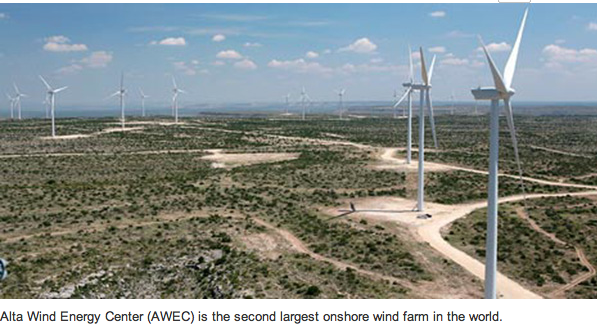
Wind farm in Kern county

Wind power is gaining speed. The California Independent System Operator Corporation (ISO) reports a new record was set when turbines spinning within the ISO power grid combined to produce a new record of 4,196 megawatts (MW) at 6:44 p.m. on Sunday.

The ISO is the main operator for the state’s high voltage network, serving about 80 percent of the Golden State. On Friday, total wind levels surpassed the 4,000 MW milestone when 4,095 MW helped to power California. Previously, the all time record peak output for wind energy was3,944 MW on March 3, 2011.
“With these impressive wind production levels, California is well positioned to meet the33 percent by 2020 green power goal,”said ISO President and CEO Steve Berberich.“Our control center operators are tracking a steady increase in renewable energy and we are leveraging the latest forecasting technology as well as complementary flexible resources to capture and optimize this carbon free power supply.”
There is a total of 5,899 megawatts of wind plant capacity installed within the ISO grid. Not all of the wind power was available yesterday as a result of routine generation and transmission outages. California is now the second largest producer of wind power next to Texas. The independent system operator ERCOT, which serves about 80 percent of the Lone Star State, reports 10,407 MW of wind generation installed and achieved a record peak of 9,481 MW on February 9, 2013.
In 2011, 921.3 megawatts was installed in the state.. Most of that activity occurred in the Tehachapi area of Kern County, with some big projects in Solano, Contra Costa and Riverside counties as well.As of late last year  Kern County was  reviewing a number of other proposed wind projects that would generate a combined 4,600 megawatts of renewable energy if approved.

Tulare County Solar Projects Sold

Five rural Tulare County solar projects now under construction were sold to an investment group this week. Reznick Capital Markets Securities (RCMS) announced this week the sale of ImMODO International Corporation’s (ImMODO) solar portfolio located in Tulare County, CA to an Institutional Investor. Financial details of the sale were not disclosed.
“There is significant demand in the market for the aggregation of quality distributed generation projects. Now that we are well past the uncertainty surrounding the ‘fiscal cliff’ and we can all see the landscape clearly, we expect to see more deals like this in 2013.”
The 22 MW aggregated solar portfolio (the Tulare PV Portfolio) has offtake contracts with Southern California Edison and Pacific Gas & Electric under the respective 20-year Feed-In Tariff (FIT) programs. Construction on the Tulare PV Portfolio, which will span five sites, is expected to start in the second quarter and be completed by the fourth quarter of 2013. ImMODO Energy Services Corporation will also be acting as the Engineering, Procurement & Construction (EPC) company and Operation & Maintenance (O&M) provider on the portfolio.
“The CREST and FIT programs represent an important move in California’s distributed generation market, and this transaction reflects an important shift in the marketplace,” said RCMS Vice President Conor McKenna. “There is significant demand in the market for the aggregation of quality distributed generation projects. Now that we are well past the uncertainty surrounding the ‘fiscal cliff’ and we can all see the landscape clearly, we expect to see more deals like this in 2013.”

LA Water & Power Selling Stake In Coal Plants

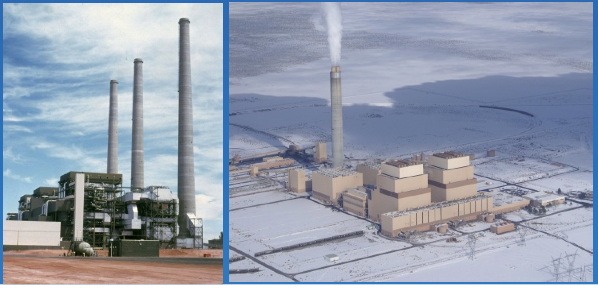
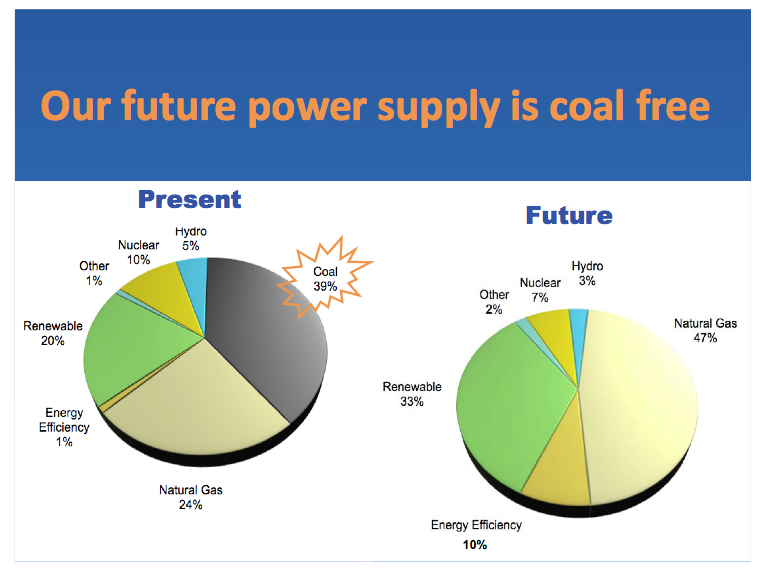
LOS ANGELES— The Los Angeles Department of Water and Power took historic steps this month towards eliminating coal from LA’s power supply when it announced that representatives of LADWP and Salt River Project have reached sufficient progress on the principle terms to sell its stake in Navajo Generating Station for the two utilities to move forward to negotiate a definitive agreement that would end LA’s use of coal-fired power from the plant by the end of 2015 – four years earlier than mandated by California state law. In addition LADWP would end a contract with a  a second coal plant in Utah by 2025 at the latest, with efforts to begin that transition no later than 2020.

click to enlarge

“The era of coal is over. Today we affirm our commitment to make Los Angeles a cleaner, greener, more sustainable city,” said Mayor Villaraigosa. “By divesting from coal and investing in renewable energy and energy efficiency, we reduce our carbon footprint and set a precedent for the national power market.”
Thomas R. Sayles, President of the Board of Water and Power Commissioners, said, “Today we continued the Board’s efforts to meet environmental mandates efficiently and in a cost effective manner while maintaining a reliable power supply for our customers.”
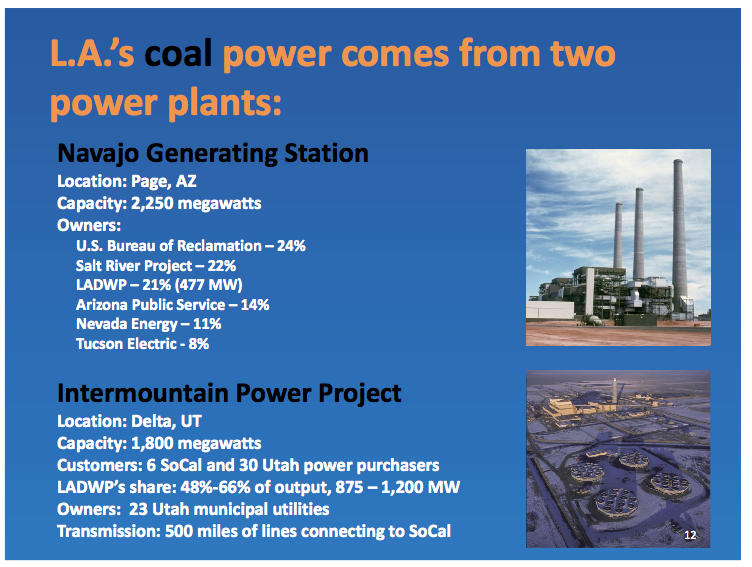
LADWP currently owns a 21% interest in the 2250 megawatt (MW) Navajo Generating Station, receiving 477 MW of coal-fired power from the plant. “We are very pleased that we have made progress  with Salt River Project to enable moving forward with the negotiation of the final agreements that would enable LADWP to fully divest of coal power from Navajo by the end of 2015,” said Ronald O. Nichols, LADWP General Manager.  “This will close a chapter on our reliance on coal-fired power in Los Angeles.  Our efforts to create a clear path to ending our use of coal-fired power from the Intermountain Power Project is also a major achievement for a complex arrangement involving 30 Utah public power utilities and 6 California municipal utilities who receive power from that project.  This allows us to focus on the new low-carbon future of Los Angeles.”
Eliminating coal power from Intermountain Power Plant (IPP) was more complex than negotiating the terms of sale of Navajo because LADWP does not own any part of IPP.  LADWP is one of six Southern California municipal utilities that purchase coal power from the 1,800-megawatt (MW) Intermountain Power Project located in Delta Utah under a long-term power purchase agreement that expires in 2027.  IPP is owned by 23 municipal utilities in Utah and supplies power to 30 utilities in Utah and six utilities in Southern California, including LADWP.  Under California law, SB 1368, electric utilities will not be allowed to import power into the state that exceeds a fossil fuel emissions cap after their current contracts expire. The emissions cap is set at the level of an efficient, combined cycle natural gas power plant.
The Board’s action today approves LADWP’s portion of the amendment to the long-term power sales agreement to stop taking coal power from IPP earlier than 2027 and build a smaller natural gas plant that complies with California emission standards.  LADWP and other Southern California municipal utilities will

continue to receive renewable energy from Southern Utah from the Milford Wind project; with power delivered over the same transmission line that presently also delivers power from the Intermountain Power Project.  The contract provides for beginning LADWP’s transition out of coal power from IPP with the commencement of engineering, design and construction of the smaller natural gas-fired generating plant by 2020 and completely eliminating coal power from IPP no later than 2025.  The smaller plant, estimated at between 600 – 1200 megawatts, will allow LADWP and the other local municipal customers to develop more renewables and bring it to Southern California along existing transmission lines.
“Working with IPP and its other customers, we have developed a win-win-win solution that is good for Southern California and good for Utah,” said Aram Benyamin, LADWP Senior Assistant General Manager – Power.  “Siting and building a new power plant and the transmission lines to deliver replacement power to Los Angeles would have cost at least twice that of rebuilding at IPP.  By using an existing power plant site and existing DC Southern Transmission System  for delivery of power from the future project and transforming it we will save money, time, reduce emissions by over 2/3 that of the existing plant, be able to build more renewables and bring that power home to Los Angeles.  That’s a homerun.”
The amendment is subject to approval by the Los Angeles City Council, will be considered by the other municipal purchasers and is currently being ratified by the 23 Utah owners.
Today’s actions by the Board are the latest steps taken to transform LA’s energy supply and create a clean energy future.  Other major accomplishments include reaching 20% renewables in 2010, establishing and implementing a 150 MW Solar Feed-In Tariff program, approving the largest utility-scale solar developments of any municipal utility in the country, completing the utility-built Adelanto and Pine Tree Solar Plants and more than doubling the LADWP’s investment in energy efficiency, among others.
The transformation of LADWP’s historic energy supply is well-underway. “Eliminating coal is one leg of our transformation, but we can’t stand on that leg alone – we have to replace that power supply,” said Ronald O. Nichols, LADWP General Manager. “That is why for several years now and for several more to come, LADWP has been taking steps to replace coal power with a combination of greatly increased commitment to energy efficiency, expanded renewable energy, and balancing that with a necessary amount of low-carbon natural gas power. “All of these elements will come together to ensure a reliable, cost effective power supply transformation.”
# # #

U.S. Solar Market Grows Record 76% in 2012

Carrizo Plain in SLO County

WASHINGTON, DC and BOSTON, MA – GTM Research and the Solar Energy Industries Association® (SEIA®) today released U.S. Solar Market Insight: Year-in-Review 2012, the definitive analysis of solar power markets in the U.S.
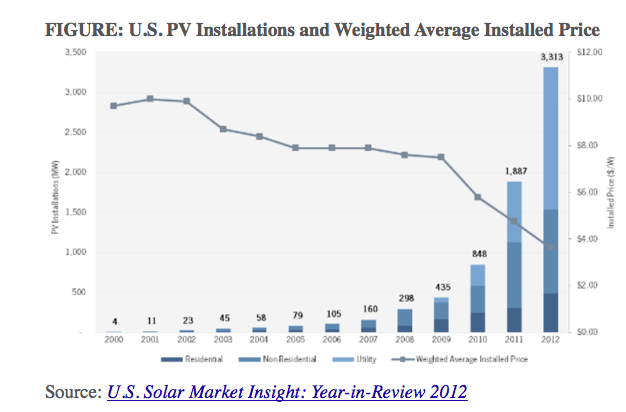
With another record-breaking year, solar is the fastest growing energy source in the U.S., powering homes, businesses and utility grids across the nation. The Solar Market Insight annual edition shows the U.S. installed 3,313 megawatts (MW) of solar photovoltaics (PV) in 2012, a record for the industry. Perhaps most importantly, clean, reliable, affordable solar is continuing a major growth pattern that has made it a leading source of new electricity for America that’s increasingly competitive with conventional electricity across dozens of states today.

Even with the cost of solar falling for consumers, the market size of the U.S. solar industry grew 34 percent from $8.6 billion in 2011 to $11.5 billion in 2012—not counting billions of dollars in other economic benefits across states and communities.  As of the end of 2012, there were 7,221 MW of PV and 546 MW of concentrating solar power (CSP) online in the U.S. — enough to power 1.2 million homes.
At the state level, 2012 was another year for breaking records. California became the first state to install over 1,000 MW in one year, with growth across all market segments. Arizona came in as the second largest market, led by large-scale utility installations, while New Jersey experienced growth in the state’s non-residential market. The top 10 largest state solar markets in  megawatts  in 2012 were:
1. California – 1,033
2. Arizona – 710
3. New Jersey – 415
4. Nevada – 198
5. North Carolina – 132
6. Massachusetts – 129
7. Hawaii – 109
8. Maryland – 74
9. Texas – 64
10. New York – 60
MW of PV installed during 2012

In addition to record annual installations, the fourth quarter (Q4) of 2012 shattered all-time quarterly records as well, with 1,300 MW of installed PV, besting the previous high by a whopping 64 percent. The residential and utility segments had their best quarters ever, installing 144 MW and 874 MW respectively.
“2012 was a busy year in the U.S. solar market,” said Shayle Kann, vice president at GTM Research. “The market value of U.S. solar installations reached $11.5 billion in 2012, up from just $3.6 billion in 2009. Amidst this boom, the industry faced newly-imposed import tariffs on Chinese solar cells and ongoing consolidation in the manufacturing space. In 2013, we expect another strong year, driven in part by new mechanisms to increase the availability, and lower the cost, of solar project financing.”
The residential market saw meaningful growth in California, Arizona, Hawaii, Massachusetts, and New York, as average residential system prices dropped nearly 20 percent in one year – from $6.16 per watt in Q4 2011 to $5.04 per watt in Q4 2012. SEIA and GTM Research expect residential solar to surge in 2013 and beyond, as third-party solar financing options spread across the country.
The non-residential segment, which includes commercial, governmental, and non-profit systems, installed more than 1,000 MW in 2012. Leading non-residential markets included California, New Jersey, Arizona, Massachusetts, and Hawaii.
Meanwhile, the utility market continues to be dominated by installations in the desert southwest. There were 152 utility solar installations in 2012, and eight of the ten largest projects currently in operation were completed in 2012. These installations represented 54% of total installed capacity, or 1,782 MW.
“There were 16 million solar panels installed in the U.S. last year – more than 2 panels per second of the work day – and every one of these panels was bolted down by a member of the U.S. workforce,” said Rhone Resch, president and CEO of SEIA. “We’ve brought more new solar online in 2012 than in the three prior years combined. This sustained growth is enabling the solar industry to create thousands of good jobs and to provide clean, affordable energy for more families, businesses, utilities, and the military than ever before. This growth simply would not have occurred without consistent, long-term policies that have helped to ensure a stable business environment for this country’s 5,600 solar companies – many of them small businesses.”
SEIA and GTM Research expect the growth to continue into 2013 and beyond. For this year, the report forecasts 4,300 MW of new PV installations, up 29 percent over 2012, and 946 MW of concentrating solar power. Over the next four years, the residential and non-residential markets are expected to gain market share as system prices decline, the industry becomes even more efficient, and new financing channels arise. “All of these data point to solar having turned the corner,” added Resch.  “Solar is an affordable option for homes and businesses today, and is well on its way to becoming a substantial part of America’s energy portfolio.”
Key Report Findings
PV installations grew 76% in 2012 to reach 3,313 MW
There are now more than 300,000 PV systems operating across the U.S.
The U.S. installed 11% of all global PV in 2012, the highest market share in at least fifteen years
Cumulative PV capacity operating in the U.S. as of the end of 2012 stood at 7,221 MW and cumulative operating concentrating solar stood at 546 MW
Twelve states installed over 50 MW of solar each in 2012, up from eight in 2011
There were over 90,000 solar installations in 2012, including 83,000 in the residential market alone
The non-residential segment, which includes commercial, governmental, and non-profit systems, installed more than 1,000 MW in 2012. Leading non-residential markets included California, New Jersey, Arizona, Massachusetts, and Hawaii.
Weighted average PV system prices fell 27% in 2012, reaching $5.04/W in the residential market, $4.27/W in the non-residential market, and $2.27/W in the utility market

Westlands WD Launches Review Of Mega-Solar Farm

Would Bolster I-5 Transmission Corridors

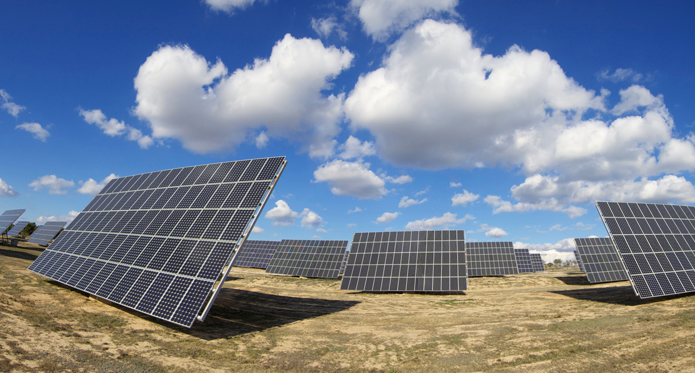
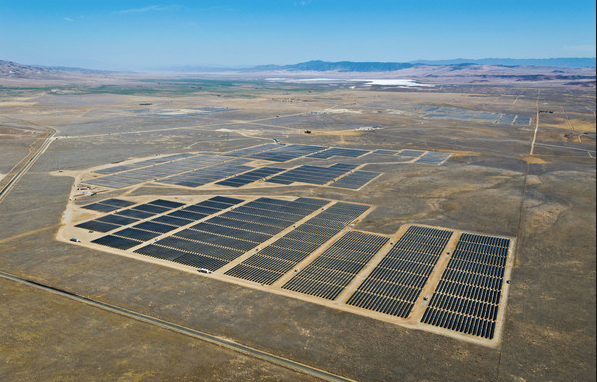
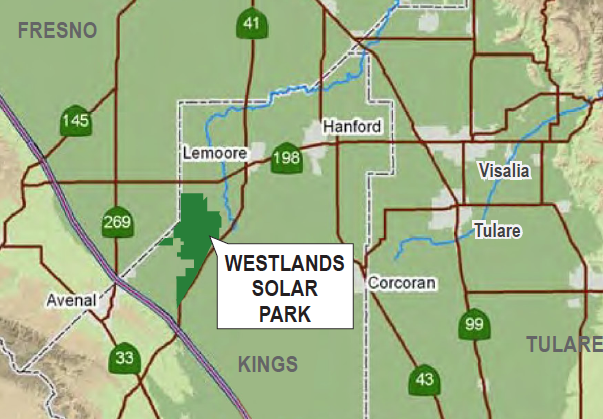
Westlands Water District announced last week they would launch an environmental review of a planned 2400 megawatt solar industrial park on 24,000 acres in their jurisdiction – located in Kings County.

The big project – in the discussion stage for several years – would begin the multi-agency approval process to cluster solar farms along the busiest north-south power transmission corridor in the state adding capacity to that corridor as it seeks to draw solar developers to build what would be billions of dollars of solar panels in coming years.

In a chicken and egg scenario the developers and water district understand you can’t generate all those electrons without a way to get the juice to urban areas on this already busy energy corridor.

Sun vs Nuke

The review states that the the “overall pacing of solar development is expected to proceed at an average rate of 2,000 acres (or 200 MW) per year over 12 years.” At buildout – 2400 MW of electricity generation would exceed that of Diablo Canyon nuclear power plant.

Ironically, its another advocate group that just 2 years ago was pitching a similar size nuclear power plant to be located nearby – also in the Westlands – a plan that you don’t hear much about any more.

Wastelands engineer Kit Buelna said the water district would be holding a scoping session on the solar master plan April 9 at the Fresno Westlands office. A full environmental review could last a year or longer.

So why is this embattled water district – the focal point for many controversial water issues in California and the largest ag district in the US – now looking at the rewnewable energy business?

In their preliminary notice Westlands says they wish to “retire”  these “drainage impaired” lands, laden with salt and selenium and no longer receive surface water delivery for them from the federal Central Valley project. As such the lands would be considered non-prime and under the Williamson Act as amended in October 2011”would be eligible for conversion to Solar Access Easements.”

Offering these tainted ag lands to both regulators and developers is in contrast to large solar projects in California’s more biologically sensitive desert areas – hoping to attract favor for more Central Valley solar projects but still avoiding the prime ag-land issue raised by the Farm Bureau and others.

To encourage developers to locate solar farms in western Kings County the plan offers these objectives for the addition of the Westlands Transmission Corridor.

• Help provide reliability, flexibility, and stability to the State electrical grid by completing needed upgrades to the Gates to Los Banos segment of the Central California Transmission Corridor.
• Provide for electrical transmission through the areas of physically-impaired retired farmland in the interior eastern portions of the Westlands Water District in order to facilitate the productive reuse of these retired lands for renewable solar generation.
• Adopt a transmission route that achieves the primary objectives of this transmission facility in a manner that is cost-effective and results in the least impacts to the environment and the
agricultural community.

Political Headwinds

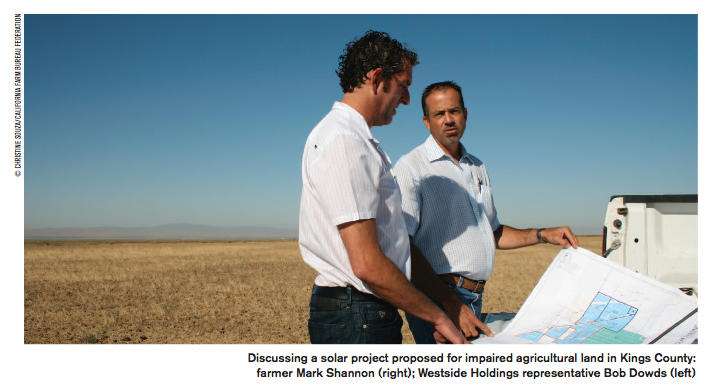
So called sponsors of the plan – land owners on or near the Shannon Ranch called Westside Holdings spokesperson Josh Martin adds several  other key points: The first pilot project is near and long term – the overall project faces political headwinds.
 
– Westside Holdings (Westlands Solar Park) now has a little more than 20MWs of short term projects under PPA negotiation or MOU aka “pilot” projects for the initial phase of the master plan.  The pilot projects are expected to begin construction in 2014.
 
– Leaders in the State of California and Federal Government have endorsed the idea of converting drainage impaired farm ground into solar generation but to date we have not yet seen the political will and ambition to join forces with Westlands and the Westlands Solar Park team to support the project in any major capacity, especially with identification and approval of new transmission that can serve the resource area as well as have additional reliability benefits in the central valley region.  Instead the state has focused continued efforts on the desert areas under the process known as DRECP trying to find new or different ways of developing projects in the CA desert.
 
The WSP team still believes strongly in the future of solar energy as a peaking energy resource in CA, the costs are coming down dramatically and retail prices are going up creating a convergence of greater opportunity on the near term horizon for the state solar market.  With some leadership from state regulators at the CEC, PUC, and ISO as well as federal agencies the Westlands Solar Park is well positioned for success that will benefit: farmers, environmental groups, and valley communities.

To distinguish the Westlands location from California desert locations an analysis of comparable costs for each found that solar PV projects in the Westlands Solar Park will have lower integration costs, be less susceptible to wildfires, and have no adverse environmental impacts, and no reduction in import capacity compared to similar sized solar projects in the desert.

While power delivered from Westlands might be 8% higher than some desert solar projects that receive more solar radiation – that cost can be more than offset by substantial savings in transmission costs from the Westlands says a 2011 study.
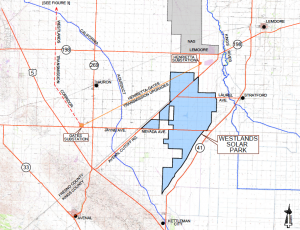
Lower Transmission Cost

The study compares the cost of delivering 800 MWs of solar PV production from the Westlands Solar Park at $2.27/MWh or about $70 million to upgrade the transmission network. Using figures from two large desert projects – far from the statewide grid – we see costs of $9.40 to $21.08/MWh in the case of SCE’s Lugo-Pisgah project, which could move as much as 1,750MWs with a total cost of $750 million. In another case, the transmission-related cost of renewable energy carried by the Pisgah-Lugo project is $24.32/MWh.

This puts the total transmission cost as much as 10X as much as the Central Valley site, and no unhappy tortoises. Convincing the leadership in the state at key agencies like the California Energy Commission,ISO and PUC that this makes sense is job-one for the proponents. Likewise for federal authorities who are backing huge desert projects in the  Ultimately, the big private utilities must be convinced as well.

The Westlands Solar Park(WSP) is the only state (RETI) designated renewable energy zone in Central California and it is the  state energy zone with the strongest levels of support from both environmental and agricultural communities say WSP.

By working to get all approvals in place Westlands – the water district and WSP -the developers – hope to have the pathway cleared perhaps a year from now so that solar developers won’t encounter long permitting delays and lawsuits that they often find elsewhere in California.

Environmental Groups Back Project

Environmentalists seem to back the idea.

In 2012 Defenders of Wildlife strongly recommended steering more solar projects ”to low-value, low-conflict areas and degraded agricultural lands—aiming to avoid or minimize adverse impacts on wildlife, valuable agricultural lands, and high-value resource lands such as vernal pools, foraging habitat, riparian corridors and transitional biotic zones. This approach has two clear benefits: protecting vital natural resources and speeding up the permitting process for renewable energy projects.”

Defenders pointed out that “Energy planners are concerned over the cost of adding transmission lines to move renewable power from rural areas where it is expected to be generated to urban areas where it is needed.”

Back then former Sierra Club spokesperson Carl Zichella said “They could build 1000MW of solar power in Westlands right now without adding any new transmission capacity”. Zichella strongly supported the idea of placing utility-size solar on retired farmlands like in the Westlands. The lands are tainted by salinity and contamination and unlike more natural areas – attract little wildlife.

“I see plenty of reasons to do the Westlands solar project and no reasons why not.”

Already the Westlands Water District has welcomed several other solar projects in the face of more drought as well as regulatory cut-backs on water. As a result, many of the district’s farmers are seeking new economic uses for their land.

The majority of the solar PV projects proposed for Fresno County are in the district, including the high-profile Westlands Solar Farms (not affiliated with Westlands Solar Park). Other large Westlands WD located solar projects are Mustang in Kings County on 1400 acres being proposed by Recurrent and in Fresno County – a 1890 acre project near Mendota being  proposed by SunPower that could generate 200MW. The 100MW Henrietta project in Kings County is also in the district-  owned now by SunPower and moving forward with a power purchase agreement in hand from PG&E.

Defenders Of  Wildlife argue that such projects on “degraded” and “impaired” ag lands will help avoid farmland of higher quality as well as avoiding sites that are more sensitive environmentally with wildlife impacts for example – some desert site proposals pending.
To help this area the group urges the PUC to upgrade electricity infrastructure in this sector both north/south and east/west arguing a mid-state location makes more sense geographically, financially and environmentally. Because of the renewable power potential in Kern, Kings,Tulare and Fresno counties, upgrading the transmission infrastructure or not – will tell the tale of just how big Westlands Solar Park as well as other Central Valley renewables will get.