Environmental groups,Native Americans & fishermen blast Vandenberg pilot offshore wind project

Base could get more renewable power

-October 29,2021-

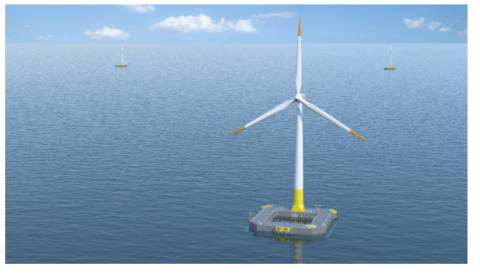
While acknowledging the need to move quickly in California to become carbon neutral and battle climate change at our doorsteps, the state’s biggest environmental groups, local tribes as well as area fishermen are all blasting a small pilot offshore wind project 3 miles off the Vandenberg Air Force base coast. It would be the first offshore wind project in California waters.
Screen Shot 2021-10-28 at 11.26.51 AM
Developers say the demonstration project could test the floating technology expected to be used on a much larger scale in the next few years.

The California State Lands Commission approved a final EIR for the project October 22, on a 3 to 0 vote to study the potential impacts of two wind-power companies competing for the right to build a 2 to 4 turbine project. Commissioners were careful to note that allowing the study to go forward does not mean approval is at hand. So far, a draft report included plenty of concerns.

Unlike the much larger offshore wind project off the Morro Bay coast, these applications are in state-managed waters, where the State Lands Commission has jurisdiction. They each plan to generate 40 to 60 megawatts of wind power compared to 3,0000 MW about 20 to 30 miles off the coast of Morro Bay. The same groups have carefully avoided blunt criticism of the larger offshore projects that President Biden has announced recent support for along all US coastal waters.

The pilot project along the 42 mile base coastline might be considered untouched oceanfront with rich wildlife habitat. On the other hand, the same place is an active military base that fires rockets regularly into space a few feet from the same oceanfront. It is both a natural landscape and an industrialized military zone and has been since 1941. The tension between these two realities is clear.

Really bad idea?

Criticism of the Vandenberg pilot project by commenters in the draft EIR includes tough words like “ This is a bad idea, a really bad idea, you don’t want to do this” from Tom Hafer, President of Morro Bay Commercial Fishermen’s Organization.

Like other critics, Hafer points out the pilot wind farm is in shallow waters while the pending bigger project is in deep water far off the coast. ”The biology, geology, wind, and fisheries are totally different. We think this area is too valuable to the local fishing industry for an experiment that doesn’t mean anything.”
lining up against pilot project

A combined environmental group letter that includes Audubon, SurfRider and Sierra Club among others, concludes “Our organizations believe that the two proposed projects… that have been submitted to the CSLC are not appropriately sited and will have significant impacts, and are therefore not in the best interests of the state.”

The groups point out “Numerous species of importance have “nearshore affinity” making it likely they will have more of an impact on biological resources than alternative sites farther offshore.

Adding their voice, the Nature Conservancy writes that the coastline along Vandenberg AFB and Point Arguello are generally undeveloped, relatively undisturbed, and have high biodiversity and intact land-sea connectivity. The natural diversity and ecological intactness of the beaches and the coastal terrace make this part of the coast relatively ‘wild’.

Then there are fears expressed by another group that these turbines will be massive bird killers. Bird mortality will be a concern no matter where OSW projects are located, but will likely be less so the farther offshore they are located. Others fear for the sea turtles.

Another stakeholder, the Northern Chumash Tribal Council says they have “learned that the technologies are not available to build and sustain these wind generation farms, no one has built one that works on our west coast. NCTC does not support this proposed project in its current form.”

A Lands Commission staff report summarizes ”Generally, Consulting Tribes expressed strong opposition to the proposed Projects based on the cultural significance of this stretch of the coast, both on- and offshore. In addition to the potential physical disturbance or destruction of physical Tribal cultural resources including burials, villages, and other sites containing cultural materials, the Tribes noted that the proposed Project areas encompass a sacred spiritual area known as the Western Gate, where souls move from this realm to the land of the dead. Consulting Tribes also expressed concern that the proposed Projects would benefit private companies at the expense of the environment and the Chumash people.”

Despite all the negative comments, the Lands Commission board approved hiring a consultant to do a final EIR to be prepared before any lease of state waters is approved or not – likely next year.The agency has been studying the applications since 2019.

What’s the counter argument?

Responding to comments that a pilot was not in the best interests of the state, one of the company’s representatives Ideol’s Bruno Geschier said there is “not one place in the world where offshore wind has happened without there being first a pilot project being built.” Both developers -Ideol and Cierco are European, where offshore wind has taken off.

With no offshore wind projects built off California, proponents say it just makes sense that a very small-scale project be tested first before the Central Coast sea is filled with this new technology. California needs the 24 -hour power that offshore wind can generate to dial back global warming that poses the potential collapse of our habitat and all species who live in California,including those at sea.

Consider the alternative of not building renewable power offshore. As it is, the rising concentration of carbon dioxide in the atmosphere is driving up ocean surface temperatures and causing ocean acidification. They both interact to the detriment of marine ecosystems.

Besides that, there is a practical argument that suggest the site might make sense, located at the doorsteps of Vandenberg AF base

Base would get power

Perhaps unappreciated and never discussed by the Commission is the fact the developers plan to generate wind energy to help power the military installation. The power generated from the turbines is intended to feed power directly to the Vandenberg Air Force Base as well as interconnecting to the broader California electricity grid.

One of the developers of the project says the purpose of the development is to “provide energy security and resiliency to VSFB in support of the missions of the 30th Space Wing and the Air Force Space Command to, respectively, “provide robust, relevant, and efficient spaceport and range capabilities for the nation,” and to “provide resilient and affordable space capabilities for the Air Force, Joint Force, and the nation.” According to one developer- IDEOL, 20 MW of renewable electricity could be provided to VSFB by the proposed Project.” Also, the pilot could “serve as a test facility for multiple branches of the DoD in their evaluation of the potential impacts of future commercial-scale offshore wind facilities on their unique missions, and more broadly on military operations and readiness along the U.S. West Coast.”

So if the power is needed by the base – why don’t we hear from the Department of Defense?
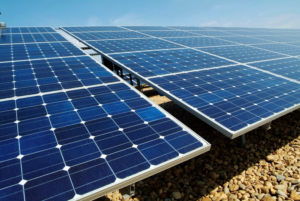
Screen Shot 2021-10-29 at 7.18.16 AMThe base has been working in recent years on becoming more self-sustaining in energy and less dependent on the vulnerable PG&E grid. They added a 28MW solar farm a few years ago that handles about 35% of the base’s energy needs. Now there are plans for battery storage units on the base too.

Do they want offshore wind to be part of their power mix? The Department of Defense has yet to formalize any agreement with the wind power developers but DOD representative Steve Chung says they are working on such an agreement that may be finalized. No date is promised.

Further Ideol says the pilot would “serve as a test facility for multiple branches of the DoD in their evaluation of the potential impacts of future commercial-scale offshore wind facilities on their unique missions, and more broadly on military operations and readiness along the U.S. West Coast.”

Already the base has signaled it was to add battery storage units to supplement the 28MW solar plant ,one of the largest solar energy generators in the Air Force. DOD recently awarded a $500,000 grant to study adding more battery units.

“The solar array is capable of generating more electricity during daylight hours than Vandenberg can use,” says the base’s energy consultant Bill Toman. “Because we are currently prohibited from exporting excess generated power to PG&E’s electric grid, some of the solar panels and their associated inverters have to be turned off in order for the solar generation to exactly match the base’s electric demand – a process called curtailment.”

Because the current solar power contract requires a minimum amount of electricity be consumed by Vandenberg AFB each year to avoid curtailment, one solution to maximize consumption is storing excess solar energy in utility scale batteries, which can then provide power into the early evening hours after sundown.

In addition, battery storage on base will provide mitigation for California wildfire risk management policies which now authorize PG&E to shut off the region’s electric transmission grid if adverse weather conditions exist, which in the past have led to catastrophic wildfire ignitions and propagation.”

With an opportunity to significantly add 24-hr power at their doorsteps Vandenberg (DOD) approval of the pilot project may be a key factor as the state considers a lease particularly if the developers can figure out ways to mitigate the negative impacts these groups anticipate. That should become clearer as the final EIR on the pilot projects is completed.

Developers hint at more to come off this part of the coast.Wind speeds off of Pt Arguello and Pt Conception are more impressive than off Morro Bay and expansion in this sector could happen here too, far beyond these first pilot projects.

Vandenberg offshore wind project likely first to deploy

The other factor is timing. Despite strong federal and state support for a large-scale project off Morro Bay, the reality is that wind power at sea is likely still a decade off. But Vandenberg’s construction could start in the first quarter of 2023 and produce power for the base as soon as 2024.

By contrast, Castle Wind CEO Ala Weinstein expects that even after auction results are settled it will still be perhaps 7 years to go through the planning and permitting issues with an extended construction period to follow.

“You’re probably looking at a decade from next year”- 2032 – “until the electrons from offshore wind units will go into the grid,” Weinstein recently told the press.



Why offshore wind needs Diablo Canyon

Won’t be saving the planet until 2029

-September 30,2021
Screen Shot 2021-09-27 at 12.33.14 PM
Do the math. The White House made a big announcement May 25 that the 
“initial areas for offshore wind development in the Pacific Ocean could bring up to 4.6 GW of clean energy to the grid, enough to power 1.6 million American homes.
The Biden statement continues “More specifically, the Department of the Interior, in coordination with the Department of Defense, identified an area (“the Morro Bay 399 Area”) that will support three gigawatts(GW) of offshore wind on roughly 399 square miles off California’s central coast region, northwest of Morro Bay.”
 
So the federal government is opening enough of the seascape off the Morro Bay/Cambria coast to produce 3,000 megawatts of power that will have to be brought to shore by cable or pipeline to feed into the state’s bulk energy grid.
 
Keep in mind a key logistic fact – a massive investment by ratepayers in transmission infrastructure, high voltage power lines and substations- is already in place here – both in Morro Bay and at Diablo Canyon- that feeds electrons into the state’s biggest load centers – the major big population areas.
 
Screen Shot 2021-09-27 at 6.11.46 AM
It is those existing transmission lines -soon both mothballed- that have put us on the offshore windpower map because they are already paid for and in place!
 
Sounds better for the ratepayer and good for the planet as much of the state burns and climate-influenced drought is everywhere. How might it work?
 
The PG&E substation at Morro Bay can handle only around 1000MW. Where will the rest be brought on shore to power all those homes in the future?
 
More battery storage co-located
 
To make that power more useful, the owner of the former power plant at Morro Bay, Vistra Energy, plans a 650MW battery storage facility right next to the substation that connects to the existing 230kw transmission lines into the Central Valley.
 
The current plan would be to have the facility online by the end of 2024 when the first unit of Diablo Canyon goes offline.
 
There is another place that power could land that could connect to the existing grid – a place where the big transmission lines can accommodate about 2,200MW- another SLO coastal location that will also soon lose a power plant. Diablo Canyon is a big energy source – about 9% of the state’s energy portfolio and it’s about to go dark.
 
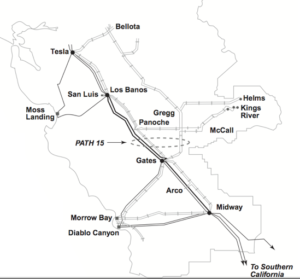
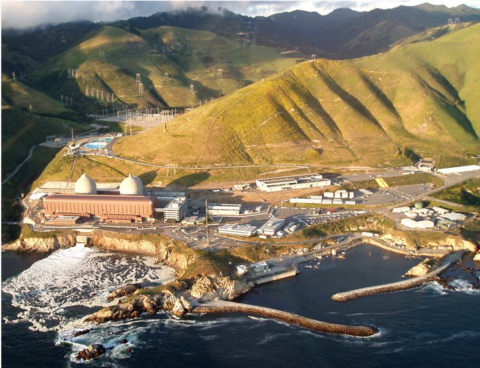
Screen Shot 2021-09-27 at 6.12.34 AMThe twin-unit nuclear power plant at Diablo Canyon will be mothballed as soon as 2024/25 – but not the multi-million dollar infrastructure that connects to it -the 500kw power lines that march across the SLO County foothills to link to the big Pathway 15 transmission line that runs up and down California along I-5. Among its important functions –  to feed power from the nuclear power plant that pumps drinking water from northern California over the Tehachapis into LA.          
 
In late July, the federal agency in charge of leasing of federal waters for energy production, BOEM announced “As part of the Biden-Harris administration’s commitment to creating nearly 80,000 jobs through developing 30 gigawatts of offshore wind energy by 2030 (nationwide), the Department of the Interior’s Bureau of Ocean Energy Management  announced two actions advancing the federal wind leasing process offshore California.”
 
Not detailed here is BOEM’s plan for offshore wind off Humboldt where the wind blows harder but there is little existing infrastructure.
 
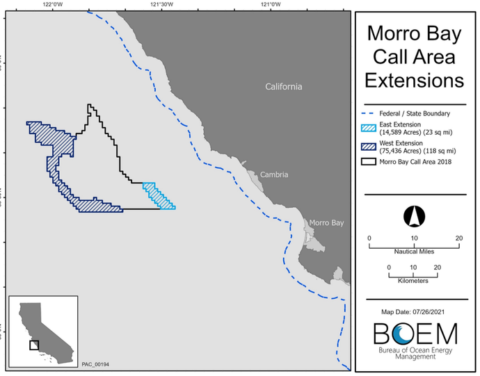
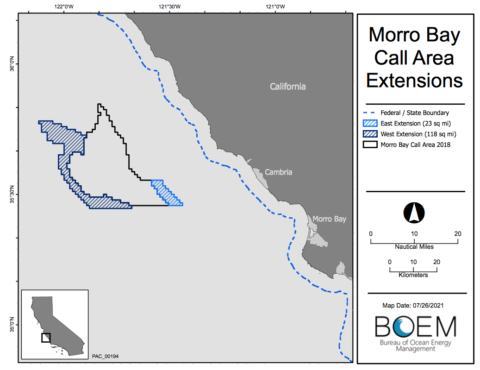
Of more interest to the Central Coast, BOEM published a Call for Information and Nominations to request information from the public and determine industry interest in commercial offshore wind energy development for two new areas within a 399-square-mile area located off central California. The new area is identified as the Morro Bay Call Area East and West Extensions. These areas are adjacent to the Morro Bay Call Area, originally identified by BOEM in 2018.
 
Screen Shot 2021-09-29 at 2.44.06 PMOf note- the expanded areas are each east and west of the existing call area with the eastern extension now closer- 21 miles from the Cambria shore – not 30 miles away like before.
 
Call area expansion
 
The new extensions of the area where huge floating wind turbines may be sited is now 20% larger compared to the 2018 Call Area -from 311 square mile to 399 square miles. The 2018 Call Area was estimated to accommodate about 2.4GW of power. With the new additional acreage, the Biden call for 3GW can be generated.
 
Note that the power estimate does not call for the use of waters off of Diablo Canyon that BOEM announced in May would not be leased for now. The decision comes as apparently the Dept of Defense still has issues with opening these waters.
 
BOEM says “The DoD conducts offshore testing, training, and operations on the OCS offshore the central coast of California. Because the DoD testing, training, and operations off the coast of California are essential to national security, DoD played a critical role in identifying these new areas for offshore wind development.”
 
That does not mean the Diablo Canyon’s on-shore power infrastructure can’t be used. Indeed it must be used to make this work.
 
Consider that power generated off Morro Bay could be connected to Diablo Canyon by a second underwater cable in addition to a 34 mile long cable from the western extension to the Morro Bay substation. Diablo Canyon is only about another 10 miles from Morro Bay.
 
Another benefit of connecting to the Diablo Canyon power plant site – a developer like Vistra can build an enclosed battery storage facility here too – as they are already doing in Morro Bay –  the world’s largest. Vistra has built one in Moss Landing as well.
 
One logical location for a battery facility – the big Diablo Canyon turbine hall, never contaminated with nuclear material and large enough to house a lithium battery plant at 207,000sf.
 
The building is in so-called “Parcel P” – a 600-acre industrial area at Diablo that is earmarked to remain,with buildings used for repurposing as long as each poses no danger. Also to be retained is the breakwater area where any cable connection may come in.
 
The PUC suggests battery storage and renewable energy projects be “co-located” to maximize stability of the grid and spread out power availability over time.
 
Furthering the goal of producing 3GW of renewables, AB 525  targeting Diablo Canyon,authored by Assemblyman Jordan Cunningham, was just signed by the Governor recently. It requires the California Public Utilities Commission to identify a specific target of three gigawatts by 2030 for offshore wind development. “We have the grid tie-in, we’ve got space in Morro Bay where they’re potentially looking at siting the largest battery storage facility in North America. We need to seize these opportunities. Its jobs and its power we desperately need,” Cunningham said.
 
There is roughly $4 billion in PG&E’s decommissioning trust fund for the plant, Cunningham said. The key will be using it as soon as possible to serve as a “direct economic stimulus for the community,” he added.
 
Multiple leases?
 
One more item of interest – expanding the generation area to near 400 square miles makes it likely there may be multiple awards of the lease areas -perhaps three leases if BOEM decides so. The local favorite developer – Castle Wind/Trident says they want to deliver 1000MW only.They are lobbying BOEM for a merit point system regards the lease/ auction to include community involvement with stakeholders that Castle has targeted including the City of Morro Bay and the local fishing industry – not just the highest money bidder.BOEM spokesperson John Romero says the federal agency “will consider that. “
 
Save the planet?
 
By the way, don’t look for offshore wind to save the planet from wildfires and global warming any time soon.Castle Wind estimates the turbines won’t be spinning until 2029! They originally estimated 2025.
 
Besides Castle Wind, there were 13 other developers who expressed interest in the project in 2018 and now this round, several more have surfaced.
 
In a regulatory filing, energy companies Shell Oil and BP as well as RWE Renewables and Total Energies expressed new interest submitting their request in the September comment period that has now closed. BOEM is targeting fall of 2022 to sign a lease, says spokesman Romero.
Here is one more nugget to chew on. Using the existing infrastructure on the Central Coast could accommodate more than 3GW according to one estimate that suggests we could handle 5GW!
 
Despite all this potential – there is doubt out there. One Morro Bay fisherman commented to BOEM “I am a 48 year central California commercial fisherman. The ocean is not a place to be industrialized. The size and scope of these wind farm projects is very disturbing. I really wish you would reconsider. Thank you, Robert R Maharry owner/operator fishing vessel Migrator. “
 
 
captions:
Infrastructure plays a key role in plans for offshore wind
map: how transmission lines connect to statewide grid
map of expanded call area includes some areas closer to shore

Around Kings County -Sept 15

-September 18,2021-

Solar updates

Screen Shot 2021-09-18 at 5.12.57 AM
No power from slave labor after all

A critic of three Westlands Solar Park projects in Kings County ended up withdrawing an appeal from the BOS recently that had claimed Westlands would not certify they would not use solar panels from China that used slave labor. It turns out that the developer of the solar projects – CIM group – says they are indeed, in compliance.

“With regard to solar panels, supply chain traceability protocol is now part of the law. Any product coming into the U.S. regardless of where it’s coming from, has to demonstrate with supply chain documentation and certification that the product is not coming from any of the jurisdictions associated with forced labor” says a note to this reporter. Looks like there will be no lawsuit over this after all.

Farms supply solar to self driving car start-up

Tulare & Reedley farms are supplying solar power to a Bay Area self-driving car company. Cruise self-driving cars is developing a ride-hailing service in San Francisco, where its cars are being tested on the city’s streets — both with and without drivers. When the company’s cars are charged in San Francisco, they get the same electricity from the same grid as everyone else. But Cruise is paying undisclosed sums to local farmers Sundale Vineyards near Tulare and Moonlight Co near Reedley in exchange for renewable energy credits that correspond to the same amount of power Cruise uses from the grid.

Battery power making a difference

More Kings County solar farms are adding battery storage to their existing and new solar projects joining others statewide supplying renewable power when the sun does not shine.

Last year, the state energy regulator – CAISO had around 550 MW of storage on its system; today, that number has grown to a little over 1,500 MW, and is expected to top 3,000 MW by the end of the year according to the California Energy Commission.

Opposition scuttles state canal bill

Opposition from the Sierra Club and others to a bill carried by state Senator Melissa Hurtado (D–Sanger) forced the postponement of Senate Bill 559 – The State Water Resiliency Act of 2021 – after the Assembly gutted its funding and amended it to include additional hurdles.

The bill would have provided $785 million to repair canals, roads and bridges damaged by subsidence including at least $100 million for the Friant Kern. The funds would have gone towards repairing sections of the Friant-Kern, the Delta-Mendota Canal, the San Luis Canal and the California Aqueduct, all important water conveyances to Central valley ag interests and a number of communities.

The canals have already secured some federal funding for their subsidence repair. In addition the Friant Kern Canal has secured $125 million from the Eastern Tule GSA farmers to help repair a 30 like stretch near Porterville where the land has sunk about 12 feet. Despite the shelving of the state monies, work on the canal repair is scheduled to begin this December using federal and local monies.

Opposing any state public funding for the waterways, Sierra Club has argued that “those entities who receive water from these canals should share the cost of repair; not state taxpayers.” They say “this bill would authorize the use of state funds in the restoration of a federal canal project, subsidizing profits of a single industry and violating the beneficiary pays principle that requires those who benefit from a project pay for the maintenance and operation of the project.”

But as mentioned,in the case of the Friant Kern, one farmer group has agreed to pay $125 million and another group $50 million in capital funding along with their maintenance payments to the Bureau of Reclamation.

Besides that argument Hurtado responds he public has a role in that climate change has amped up the western drought . “Repairing critical water infrastructure is part of the solution to adapting to climate change” she says.

A dry canal will lead to collapse of the Valley economy to make matters worse and everyone has a stake in not letting that happen. It is not just farmers but farmworkers and their families who depend on that water.

“Water supply reliability is central to the production of food in California, and vital to the rural communities and statewide economy that is supported by the agriculture industry,” argues California Citrus Mutual President and CEO Casey Creamer.

Attachments area

Kern hit by insurance and oil industries layoffs/ electric car update

-September 9,2021-

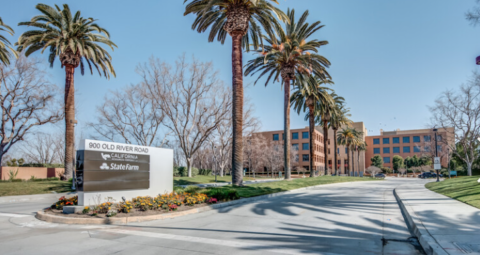
Screen Shot 2021-09-08 at 6.23.53 AMThis month Kern County has been hit by a wave of business closures in both the insurance and oil industries- mainstays of the local economy. State Farm Insurance will discontinue their operations center in Bakersfield, laying off 230 according to a state WARN notice.The company released a statement saying “As we first announced in 2017, State Farm® projected we would exit the Bakersfield Operations Center in 2021. Late last year, we shared that we plan to exit the facility by the end of October 2021.”

The office once boasted 1300 employees. State Farm has been consolidating offices in California and now seems to be moving more services to Texas.

The operations center is located in Bakersfield’s largest office complex on Old River Rd – now owned by a bankrupt oil company California Resources Corp, who has also announced layoffs in the county.

In related news, oil giant Basic Energy Services announced layoffs of around 800 in Kern County in the past few weeks.The company also known as C&J Well Service is in bankruptcy and is being targeted for a court backed acquisition by Berry Corp to takeover the Basic Energy business in California.

Electric cars gain traction

Screen Shot 2021-09-09 at 7.23.07 AMThe California New Car Dealers Association says combined hybrid and electric vehicle market share during the first quarter of 2021 exceeded 20%. That is about double the market share it was in 2017 as more buyers are electing electric cars or hybrids. To encourage more buyers, the energy commission says the state will need nearly 1.2 million public and shared chargers by 2030 to meet the fueling demands of the 7.5 million passenger plug-in electric vehicles (EVs) anticipated to be on California roads.

Trucks are next and the California Energy Commission expects 157,000 chargers will be required by 2030 to support 180,000 medium- and heavy-duty electric trucks and buses also anticipated.

Space-Based Solar Power?

-August 25,2021-

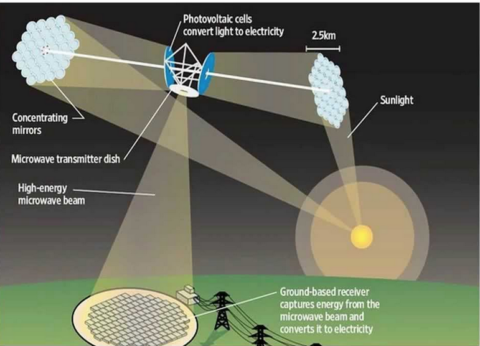
Caltech Gifted $100 Million to Develop Space-Based Solar Power Tech

Caltech on Tuesday revealed the institution has been gifted more than $100 million by a businessman and university trustee to develop technology to collect solar power in space and beam it back to Earth.

The endowment was made anonymously in 2013 by Irvine Company Chairman and Caltech Board of Trustees member Donald Bren, Caltech said in a written statement. But the source of the gift was disclosed this week, as the Space-based Solar Power Project which it funded approaches a breakthrough.

Researchers are preparing to unveil “multifunctional technology-demonstrator prototypes” by next year according to Caltech.

“SSPP aims to ultimately produce a global supply of affordable, renewable, clean energy,” the statement said. “A key benefit of harnessing solar power from space is that it provides access to the sun to create power all day, every day, free from weather constraints or darkness of night.”

Bren’s interest in space-based solar technology became piqued in 2011 when he read an article on the topic in Popular Science magazine, according to the university.

“I have been a student researching the possible applications of space-based solar energy for many years,” Donald Bren said. “My interest in supporting the world-class scientists at Caltech is driven by my belief in harnessing the natural power of the sun for the benefit of everyone.”

After speaking with Caltech’s then-President Jean-Lou Chameau, “…he and his wife, Brigitte, a Caltech trustee, agreed to make the donation to fund the project,” the Caltech statement said. “The first of the donations that now exceed $100 million was made that year through the Donald Bren Foundation, and the research began.”

The Brens have no financial stake in the project, Caltech Professor of Electrical Engineering and Medical Engineering and Co-Director of Caltech’s Space-Based Solar Power Project  Ali Hajimiri said.

“It shows the magnitude of the generosity,” he said. “They really want to change the world and truly see this as an opportunity to make a lasting difference for the planet, while generating a broad range of novel technologies with impact in many areas such as wireless power, communications, and sensing.”

Caltech President Thomas F. Rosenbaum thanked the Brens for their support.

“Donald Bren has brought the same drive and discipline that he has demonstrated with master planning communities to the Space Solar Program,” he said. “He has presented a remarkable technical challenge that promises a remarkable payoff for humanity: a world powered by uninterruptible renewable energy.”

More information on Caltech’s Space-based Solar Power Project is available online at spacesolar.caltech.edu.

Screen Shot 2021-08-25 at 6.55.40 AM

Gas prices expected to fall

-August 25,2021-

Screen Shot 2021-08-25 at 6.12.05 AMGas prices are down in the past week as the extended price rise is over now.For the second straight week the nation’s average gas price has fallen, declining 3.3 cents per gallon from a week ago to $3.14 per gallon today according to GasBuddy.In California the trend is down but not yet dramatic.
But watching wholesale prices, analyst predict prices at the pump are in for a steady decline by September. As stations get a new supply you should feel the relief .Already they are paying at least 3 cents less than week earlier. Analyst Tom Kloza expects as much as 40-50 cent drop in retail prices by fall. AAA spokesperson Jeanette McGee says “Cheaper crude, softening demand and growing stock levels equal the right combination for cheaper prices at the pump, which many Americans would likely welcome after such an expensive summer.” 

BOEM Advances Offshore Wind Leasing Process in California

Public Input Sought on Offshore Wind Areas off California North and Central Coasts

 -August 3,2021-

As part of the Biden-Harris administration’s commitment to creating nearly 80,000 jobs through developing 30 gigawatts of offshore wind energy by 2030, the Department of the Interior’s Bureau of Ocean Energy Management (BOEM) today announced two actions advancing the federal wind leasing process offshore California.

Screen Shot 2021-08-03 at 7.57.09 AM

First, BOEM will publish a Call for Information and Nominations (Call) to request information from the public and determine industry interest in commercial offshore wind energy development for two new areas within a 399-square-mile area located off central California, identified as the Morro Bay Call Area East and West Extensions. The new areas are adjacent to the Morro Bay Call Area, originally identified by BOEM in 2018. The extension areas will be included in BOEM’s overall analysis of the Morro Bay 399 Area.

Second, BOEM has formally designated the Humboldt Wind Energy Area (WEA) offshore northern California and will now proceed with an environmental review of this area, as required under the National Environmental Policy Act (NEPA).

“Today’s announcement builds on an earlier agreement between the White House, the Department of the Interior, the Department of Defense, and the state of California to advance areas for offshore wind off the northern and central coasts of California,” said BOEM Director Amanda Lefton. “If approved for offshore wind energy development, these areas could bring us closer to reaching this administration’s goal of deploying 30 gigawatts of offshore wind by 2030.”

On May 25, 2021, the Departments of the Interior and Defense and the state of California announced their agreement to advance areas for wind energy development offshore the northern and central coasts of California, enabling a path forward for the Humboldt Call Area and areas within and adjacent to the Morro Bay Call Area.

“While we are still in the initial stages of BOEM’s leasing process, today’s announcement reflects years of working with ocean users, Tribal governments and local, state, and federal agencies to obtain the best available information to reduce potential conflicts,” said BOEM Acting Pacific Region Director Thomas Liu. “The Morro Bay Call and Humboldt Environmental Assessment offer important opportunities to further solicit feedback from Tribes, ocean users and stakeholders.”

In addition to contributing to the goals of the Biden-Harris administration, the development of offshore wind energy can help California reach its goal of 100 percent carbon-free energy by 2045, create good-paying union jobs, and foster investments in coastal communities. Offshore wind resources are typically stronger and more consistent than winds over land and are especially strong in the evening hours when solar energy production drops off, ensuring that offshore wind energy can make an important contribution to California’s electric grid.

Morro Bay Call Area – East and West Extensions

The Morro Bay Call Area East Extension and the Morro Bay Call Area West Extension offshore the central California coast consist of approximately 141 square statute miles (90,025 acres).

BOEM will publish the Commercial Leasing for Wind Power Development on the Outer Continental Shelf Offshore Morro Bay, California, East and West Extensions – Call for Information and Nominations in the Federal Register on July 29, 2021, which will initiate a 45-day public comment period. BOEM will accept nominations and comments until September 13, 2021. Additional information on the Call and how to comment can be found at https://www.boem.gov/renewable-energy/state-activities/morro-bay-call-extension-areas.

Humboldt WEA

BOEM is also designating nearly 132,369 acres (206.8 square miles) as a WEA offshore Humboldt County in northern California. BOEM will conduct an environmental assessment (EA) of the WEA, per NEPA.

The EA will consider potential environmental consequences of site characterization activities (e.g., survey activities and core samples) and site assessment activities (e.g., installation of meteorological buoys) associated with issuing wind energy leases in the WEA. The EA will also consider project easements associated with each potential lease issued, and grants for subsea cable corridors through state tidelands.

As part of BOEM’s scoping process, BOEM is seeking public comments on what should be considered as part of the EA. BOEM also will use these comments as input for its consultation under section 106 of the National Historic Preservation Act. Additional information on how to comment can be found at https://www.boem.gov/renewable-energy/state-activities/humboldt-wind-energy-area.

Wal-Mart pumped up for new gas stations

Two new ones underway in Fresno
-July 29,2021-
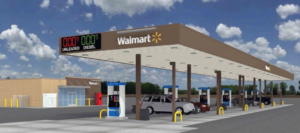
Screen Shot 2021-07-25 at 6.48.26 AMCalifornians are buying more electric cars but Walmart appears to be pumped up on building large new gasoline stations around Fresno.
 
In April the big retailer opened its first filling station in California in Kerman at a SuperWalmart there.
 
Now the company is under construction with two more stations in Fresno, one at 5111 E. Kings Canyon and one at 
7065 N. Ingram.This second site will have a natural gas fueling unit at the rear of the Walmart as well.
 
Each of the new stations will feature 12 pumps and a convenience  store kiosk displacing about a half acre in the parking lot of each supercenter. They are valued at $1.2 million each.
 
The Wall St Journal reported a few years ago, “For 20 years, Wal-Mart Stores Inc. has let Murphy USA Inc. build and operate gas stations in the parking lots of its stores. Now, the retailer has decided it wants to pump its own gasoline. Wal-Mart’s move to build future gas stations without Murphy USA marks the unraveling of an unusual alliance first forged in 1996 between two large Arkansas companies.”
 
Before now, Walmart company had gas stations in California only at their Sam’s Club stores, since 1997.They are now rolling out more in front of their more than 4500 stores across the nation.When building new stores, Walmart has said it plans to add its own fuel service stations in as many as possible.
 
The rapid rollout of large new stations around Fresno are making it likely the company will continue to add more gas stations at more of their 18 Walmarts from Fresno to Bakersfield.
 
Gasoline sales plunged during the worst of the pandemic in 2020 but have rebounded nicely though not as high as they were in the summer of 2019.
 
Some speculate that with the increase in fuel mileage and the number hybrid and electric cars being sold, gasoline stations may become unprofitable in the future. How soon will gas-powered cars be driven off the road by electric vehicles? One analysis says ”If the large car companies have their ways, a decade from now the number of gas stations could be cut by half. However, stations will need to be available for older cars. The typical American car has been driving for over 11 years. But, by 2030 many of those will be gone.”
 
The National Association of Convenience Stores says 120,000 so-called “C stores” also sell fuel, accounting for the majority of gas stations. While the gasoline brings you in, the C store makes the business really work. But the entire business starts to look a bit like a house of cards when you inventory the threats. Boston Consulting Group calculates that between 25% and 80% of gas stations could be unprofitable by 2035.
 
The threats are not slowing down new construction.
 
Visalia’s largest gasoline station is being proposed on Whitendale  and Mooney at the former ToysR Us parking lot area. Bakersfield- based Fastrip plans to build a 24-pump service station at that corner.Tulare County’s Hwy 99 is getting about 10 new stations from south to north being planned.
 
Walmart competes with Fastrip in Kerman where they both are offering the cheapest price in town at $3.93 today according to GasBuddy.

Ethanol producers see highest price in years

-June 23,2021-

Pacific Ethanol idled plant in Madera

It has been a long time since corn based ethanol producers have seen  prices like this. About 40% of U.S. corn is refined into ethanol. With few driving, the pandemic crushed ethanol prices paid to farmers recently.

Iowa farmer Kelly Nieuwenhuis told the farm press “It’s definitely been feast or famine the past year,” he says. “It was roughly 9 months ago ethanol prices were in the upper 70 cents a gallon range, and now we’re shipping ethanol to California  for $2.90 per gallon. 

Prices this high have not been sine since 2014 and then only for short while.

Plenty of US ethanol plants shut down in the past year due to all that red ink including several here in California.

What about competition from electric vehicles? The Iowa farmer says ” I’m not against electric vehicles – they will be part of the transportation system – but it’s unrealistic for anyone to think they will be a large percentage of it. I feel confident there will be a bright future for biofuels.”

Indeed 2 closed ethanol plants in California will now make the biofuel, biodiesel.

Valley oil prices tops $70

-June 23,2021-
 
Lights out at Santa Maria oil refinery2020-08-12 at 1.22.55 PMKern oil producers are cheering for a change as Midway-Sunset oil has climbed over $70. The increase follows a worldwide price recovery from the pandemic. The last time crude prices were at this level was mid-2018 and red ink has been the order of the day since. Kern County makes up about 70% of the state’s oil production.
 
But the future does not look promising for oil producers here. California Governor Gavin Newsom has proposed a ban on hydraulic fracturing, as well as outlawing the combustion engine and a total ban on oil production by 2045.
 
Motorists may not be cheering as the cost for a fill-up is now north of $4.25 a gallon.US gasoline demand easily set a new post-COVID Sunday record last week, up 8.9% from the prior Sunday and 7.5% above the average of the last four Sundays.
 
Wall St Journal points out that the new preference for green energy is likely to depress spending on oil extraction, setting the stage for supply shortages and higher fuel prices. Oil prices are double  what they were last October and some wager we will soon be looking at $100 oil.
 
Again, is this good news for the oil patch who feared regulation would hurt the price of oil?
 
Despite higher gas prices, Kings County continues to offer some of the lowest pump prices in the state around Lemoore at Yokut Gas and Fastrip.