
Base could get more renewable power
-October 29,2021-
While acknowledging the need to move quickly in California to become carbon neutral and battle climate change at our doorsteps, the state’s biggest environmental groups, local tribes as well as area fishermen are all blasting a small pilot offshore wind project 3 miles off the Vandenberg Air Force base coast. It would be the first offshore wind project in California waters.
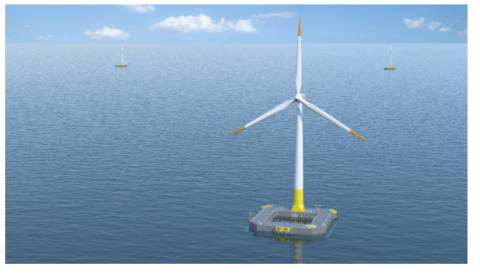
Developers say the demonstration project could test the floating technology expected to be used on a much larger scale in the next few years.
The California State Lands Commission approved a final EIR for the project October 22, on a 3 to 0 vote to study the potential impacts of two wind-power companies competing for the right to build a 2 to 4 turbine project. Commissioners were careful to note that allowing the study to go forward does not mean approval is at hand. So far, a draft report included plenty of concerns.
Unlike the much larger offshore wind project off the Morro Bay coast, these applications are in state-managed waters, where the State Lands Commission has jurisdiction. They each plan to generate 40 to 60 megawatts of wind power compared to 3,0000 MW about 20 to 30 miles off the coast of Morro Bay. The same groups have carefully avoided blunt criticism of the larger offshore projects that President Biden has announced recent support for along all US coastal waters.
The pilot project along the 42 mile base coastline might be considered untouched oceanfront with rich wildlife habitat. On the other hand, the same place is an active military base that fires rockets regularly into space a few feet from the same oceanfront. It is both a natural landscape and an industrialized military zone and has been since 1941. The tension between these two realities is clear.
Really bad idea?
Criticism of the Vandenberg pilot project by commenters in the draft EIR includes tough words like “ This is a bad idea, a really bad idea, you don’t want to do this” from Tom Hafer, President of Morro Bay Commercial Fishermen’s Organization.
Like other critics, Hafer points out the pilot wind farm is in shallow waters while the pending bigger project is in deep water far off the coast. ”The biology, geology, wind, and fisheries are totally different. We think this area is too valuable to the local fishing industry for an experiment that doesn’t mean anything.”
A combined environmental group letter that includes Audubon, SurfRider and Sierra Club among others, concludes “Our organizations believe that the two proposed projects… that have been submitted to the CSLC are not appropriately sited and will have significant impacts, and are therefore not in the best interests of the state.”
The groups point out “Numerous species of importance have “nearshore affinity” making it likely they will have more of an impact on biological resources than alternative sites farther offshore.
Adding their voice, the Nature Conservancy writes that the coastline along Vandenberg AFB and Point Arguello are generally undeveloped, relatively undisturbed, and have high biodiversity and intact land-sea connectivity. The natural diversity and ecological intactness of the beaches and the coastal terrace make this part of the coast relatively ‘wild’.
Then there are fears expressed by another group that these turbines will be massive bird killers. Bird mortality will be a concern no matter where OSW projects are located, but will likely be less so the farther offshore they are located. Others fear for the sea turtles.
Another stakeholder, the Northern Chumash Tribal Council says they have “learned that the technologies are not available to build and sustain these wind generation farms, no one has built one that works on our west coast. NCTC does not support this proposed project in its current form.”
A Lands Commission staff report summarizes ”Generally, Consulting Tribes expressed strong opposition to the proposed Projects based on the cultural significance of this stretch of the coast, both on- and offshore. In addition to the potential physical disturbance or destruction of physical Tribal cultural resources including burials, villages, and other sites containing cultural materials, the Tribes noted that the proposed Project areas encompass a sacred spiritual area known as the Western Gate, where souls move from this realm to the land of the dead. Consulting Tribes also expressed concern that the proposed Projects would benefit private companies at the expense of the environment and the Chumash people.”
Despite all the negative comments, the Lands Commission board approved hiring a consultant to do a final EIR to be prepared before any lease of state waters is approved or not – likely next year.The agency has been studying the applications since 2019.
What’s the counter argument?
Responding to comments that a pilot was not in the best interests of the state, one of the company’s representatives Ideol’s Bruno Geschier said there is “not one place in the world where offshore wind has happened without there being first a pilot project being built.” Both developers -Ideol and Cierco are European, where offshore wind has taken off.
With no offshore wind projects built off California, proponents say it just makes sense that a very small-scale project be tested first before the Central Coast sea is filled with this new technology. California needs the 24 -hour power that offshore wind can generate to dial back global warming that poses the potential collapse of our habitat and all species who live in California,including those at sea.
Consider the alternative of not building renewable power offshore. As it is, the rising concentration of carbon dioxide in the atmosphere is driving up ocean surface temperatures and causing ocean acidification. They both interact to the detriment of marine ecosystems.
Besides that, there is a practical argument that suggest the site might make sense, located at the doorsteps of Vandenberg AF base
Base would get power
Perhaps unappreciated and never discussed by the Commission is the fact the developers plan to generate wind energy to help power the military installation. The power generated from the turbines is intended to feed power directly to the Vandenberg Air Force Base as well as interconnecting to the broader California electricity grid.
One of the developers of the project says the purpose of the development is to “provide energy security and resiliency to VSFB in support of the missions of the 30th Space Wing and the Air Force Space Command to, respectively, “provide robust, relevant, and efficient spaceport and range capabilities for the nation,” and to “provide resilient and affordable space capabilities for the Air Force, Joint Force, and the nation.” According to one developer- IDEOL, 20 MW of renewable electricity could be provided to VSFB by the proposed Project.” Also, the pilot could “serve as a test facility for multiple branches of the DoD in their evaluation of the potential impacts of future commercial-scale offshore wind facilities on their unique missions, and more broadly on military operations and readiness along the U.S. West Coast.”
So if the power is needed by the base – why don’t we hear from the Department of Defense?
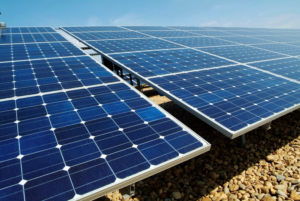 The base has been working in recent years on becoming more self-sustaining in energy and less dependent on the vulnerable PG&E grid. They added a 28MW solar farm a few years ago that handles about 35% of the base’s energy needs. Now there are plans for battery storage units on the base too.
Do they want offshore wind to be part of their power mix? The Department of Defense has yet to formalize any agreement with the wind power developers but DOD representative Steve Chung says they are working on such an agreement that may be finalized. No date is promised.
Further Ideol says the pilot would “serve as a test facility for multiple branches of the DoD in their evaluation of the potential impacts of future commercial-scale offshore wind facilities on their unique missions, and more broadly on military operations and readiness along the U.S. West Coast.”
Already the base has signaled it was to add battery storage units to supplement the 28MW solar plant ,one of the largest solar energy generators in the Air Force. DOD recently awarded a $500,000 grant to study adding more battery units.
“The solar array is capable of generating more electricity during daylight hours than Vandenberg can use,” says the base’s energy consultant Bill Toman. “Because we are currently prohibited from exporting excess generated power to PG&E’s electric grid, some of the solar panels and their associated inverters have to be turned off in order for the solar generation to exactly match the base’s electric demand – a process called curtailment.”
Because the current solar power contract requires a minimum amount of electricity be consumed by Vandenberg AFB each year to avoid curtailment, one solution to maximize consumption is storing excess solar energy in utility scale batteries, which can then provide power into the early evening hours after sundown.
In addition, battery storage on base will provide mitigation for California wildfire risk management policies which now authorize PG&E to shut off the region’s electric transmission grid if adverse weather conditions exist, which in the past have led to catastrophic wildfire ignitions and propagation.”
With an opportunity to significantly add 24-hr power at their doorsteps Vandenberg (DOD) approval of the pilot project may be a key factor as the state considers a lease particularly if the developers can figure out ways to mitigate the negative impacts these groups anticipate. That should become clearer as the final EIR on the pilot projects is completed.
Developers hint at more to come off this part of the coast.Wind speeds off of Pt Arguello and Pt Conception are more impressive than off Morro Bay and expansion in this sector could happen here too, far beyond these first pilot projects.
Vandenberg offshore wind project likely first to deploy
The other factor is timing. Despite strong federal and state support for a large-scale project off Morro Bay, the reality is that wind power at sea is likely still a decade off. But Vandenberg’s construction could start in the first quarter of 2023 and produce power for the base as soon as 2024.
By contrast, Castle Wind CEO Ala Weinstein expects that even after auction results are settled it will still be perhaps 7 years to go through the planning and permitting issues with an extended construction period to follow.
“You’re probably looking at a decade from next year”- 2032 – “until the electrons from offshore wind units will go into the grid,” Weinstein recently told the press.