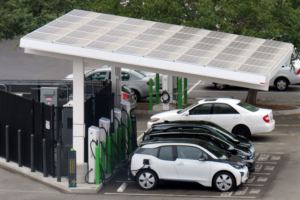
CPUC approves $11.7M for three new PG&E vehicle-to-grid pilots

-May 17,2022-

Screen Shot 2022-05-17 at 1.43.33 PMThe California Public Utilities Commission (CPUC) has approved $11.7 million in funding for Pacific Gas and Electric Company (PG&E) to develop three new pilot programs to test how bidirectional electric vehicles (EVs) and chargers can provide power to the electric grid and other benefits to customers.

PG&E will test bidirectional charging technology in a variety of settings, including in homes, businesses and with local microgrids in select high fire-threat districts (HFTDs). The pilots will test the ability for the EV to send power back to the grid and provide power to customers during an outage. PG&E expects its findings will help determine how to maximize the cost-effectiveness of bidirectional charging technology in providing a variety of customer and grid services.

The new pilots are separate and in addition to the collaborations announced in March with both General Motors (earlier post) and Ford Motor Company (earlier post), and will help to inform the Department of Energy Memorandum of Understanding that PG&E and a collaboration of industry, government and labor leaders signed in April focused on accelerating “vehicle-to-everything” technologies.

Each of the new pilot programs offers a financial incentive for participating customers and additional benefits for those in disadvantaged communities. All three are expected to be available to customers in 2022 and 2023 and continue until incentives run out. PG&E expects customers will be able to enroll in the home and business pilots in late summer 2022.

The 400,000 EVs registered in PG&E’s service area along with the quickly growing number of EVs across California represent a flexible grid resource, which could offer cost savings associated with operating and maintaining the grid as well as for customers who own an EV or are a part of a bidirectional EV-enabled community microgrid. Additionally, using EV batteries for power could reduce the need to build new standalone energy storage systems.

The approved pilot programs:

V2X Residential Pilot ($7.5 million). The V2X Residential Pilot will focus on spurring adoption of V2X (bidirectional technologies) for 1,000 single-family residential customers with light-duty EVs by 2023. Residential customers will receive at least $2,500 for enrolling, and up to an additional $2,175 depending on their participation.

The pilot would seek to demonstrate V2X light-duty EVs and show how this technology can reduce the total cost of EV ownership once barriers are overcome. The pilot will seek to prove out five value-streams: backup power in 2022; followed by customer bill management, system real-time energy, system renewable integration and EV export for grid services (such as system resource adequacy, system capacity) in 2023.

V2X Commercial Pilot ($2.7 million). The pilot with business customers will explore how medium- and heavy-duty and possibly light-duty EVs at commercial facilities could help customers and the electric grid in various ways. These include providing backup power to the building if the power is out, optimizing EV charging and discharging to support the deferral of distribution grid upgrades, and aligning EV charging and discharging with the real-time cost of energy procurement. This pilot will be open to approximately 200 business customers who will receive at least $2,500 for enrolling, and up to an additional $3,625 depending on their participation.

V2M Public Safety Power Shutoff Microgrid Pilot ($1.5 million). The microgrid pilot will explore how EVs—both light-duty and medium- to heavy-duty—plugged into community microgrids can support community resiliency during Public Safety Power Shutoff events. Customers will be able to discharge their EVs to the community microgrid to support temporary power or charge from the microgrid if there is excess power.

Following initial lab testing, this pilot will be open to up to 200 customers with EVs who are located in High Fire-Threat District (HFTD) locations that contain compatible microgrids used during Public Safety Power Shutoff events. Customers will receive at least $2,500 for enrolling, and up to an additional $3,750 depending on their participation.

PG&E has submitted a fourth proposed pilot focused on creating ways for EVs to participate in CAISO markets; this was rejected by the CPUC in its current form.

SoCalGas parent Co wants piece of Morro Bay wind farm

-April 15,2022-

The Gas Company wants a piece of the Morro Bay wind farm and has been offered a 24% stake in the proposed multi-billion dollar project. So, what does a natural gas supplier want with a wind farm?

Screen Shot 2022-04-07 at 12.59.51 PMLike all California utilities, SoCalGas is looking to decarbonize the energy they deliver to residents and industry by pipeline to cool global warming.The idea is to replace fossil fuel-derived natural gas with renewable gas or “green hydrogen” – an ubiquitous gas with many uses and potentially a very bright future.
SoCalGas parent company is Sempra, based in San Diego. Its operating companies include both Southern California Gas Company and San Diego Gas & Electric in Southern California. SoCal distributes gas from San Luis Obispo in the north to the Mexican border in the south.

Now Sempra is poised to enter the offshore wind sector under a deal that would have it join French energy giant Total Energies in a planned project off California.Total Energies in March announced they would join Castle Wind to build the project and be part of an auction to lease seabed off the Central Coast this fall.

Days later – this month Sempra and Total Energies said Sempra would acquire a part of Total Energies’ stake in the merger joining the three major players in the deal to construct a 1GW offshore wind project using floating turbines about 30 miles off the coast connected by pipeline to the Morro Bay shore.

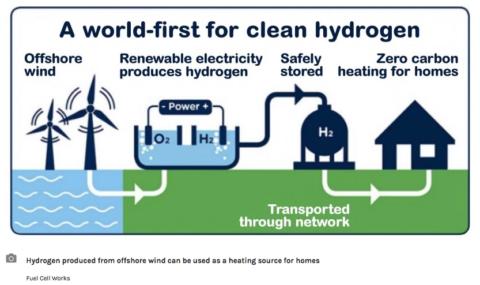
How does hydrogen fit into all this? A White House issued primer explains the basics. Hydrogen is the simplest and most abundant element in the universe. It is found within water and all living matter, but it rarely exists as a gas on Earth—it must be separated from other molecules requiring some energy source and catalysts to do the work.The most abundant supply is water – H2O.Water can be split by electricity into hydrogen and oxygen. It just so happens that offshore wind blows steady just where there is plenty of water – the Pacific.

So both the source material and the power source are coincidently co-located.Besides that fact, it turns out you can generate hydrogen gas offshore by electrolysis on a floating turbine and ship it back to land using the pipelines.

Once it arrives it can be stored or fed into the same pipeline infrastructure we use to ship natural gas to every home and factory.It means that “green hydrogen’” – produced without any release of carbon – can help facilitate an affordable energy transition.Combining the processes may well be the best path to create renewable, consistent, cost-efficient power suggests advocates.

Desalination too

There is another important process that can happen at sea – offshore desalination that takes place below the surface, using a reverse osmosis process. Unlike land-based desalination there is no waste issue -brine disposal – like onshore facilities have. The clean drinking water is then piped to shore and distributed to a thirsty California.

There is a small Santa Barbara company SeaWell that is offering a pint-size version of this offshore model (without the hydrogen) powered by wave action, being discussed by Santa Barbara County, Vandenberg SFB and San Luis Obispo County, says a Santa Barbara County official.

For the huge population that lives close to the coast in California – about 40% of the people – there would now be a nearby source not just for electric power and heat but also game changing transportation fuel to replace diesel fuel and now drinking water -all stuff in very short supply.

In recent days, Southern  California Gas announced its proposal to develop what would be the nation’s largest green hydrogen energy infrastructure system (the “Angeles Link”) to deliver renewable energy to the Los Angeles region. The Angeles Link would support the integration of more renewable electricity resources like solar and wind and would significantly reduce greenhouse gas emissions from electric generation, industrial processes, heavy-duty trucks, and other hard-to-electrify sectors of the Southern California economy. The proposed Angeles Link would also significantly decrease demand for natural gas, diesel, and other fossil fuels in the LA Basin.Among the goals -displace up to 3 million gallons of diesel fuel per day by replacing diesel powered heavy-duty trucks with hydrogen fuel cell trucks. In addition the plan would provide the clean fuel to convert up to four natural gas power plants to green hydrogen in the LA Basin.

Around 450 gigawatts of offshore wind energy could produce 24 billion kg/year of hydrogen, enough to power around 74 million homes in a year, according to one study.

Besides the other uses, hydrogen can be used to store excess power. Instead of wasting extra energy produced by wind and other renewables- it can be converted into hydrogen. This hydrogen could be stored and then converted back into electricity by fuel cells or hydrogen-driven turbines when needed.Hydrogen fuel cells produce electricity by combining hydrogen and oxygen atoms. The hydrogen reacts with oxygen across an electrochemical cell similar to that of a battery to produce electricity, water, and small amounts of heat.

If SoCalGas wants to invest in offshore wind – the other big natural gas supplier in California -PG&E could be a player as well serving their 70,000 square miles territory in Central and Northern California.Like their southern California counterpart, PG&E wants to continue to use their network of pipelines to deliver to homes and factories and is under the gun to cut carbon emissions in a big way, too.

With green hydrogen coming ashore in SLO County there stands to be new investment in hydrogen facilities and infrastructure on shore, side by side with electric facilities and substations and all the jobs that go with both.
Attachments area

Gas prices cut demand -spur electric car sales

-April 2,2022-

Gasoline demand drops as prices rise

Energy Information Administration’s petroleum supply monthly, published on Thursday March 31, showed that total product supplied—the proxy for total oil demand—averaged 19.731 million barrels per day (bpd) in January.

EIA’s weekly data pegged American oil demand at a much higher level—21.7 million bpd.

“While weekly data pegged demand at 21.7m b/d, the monthly data cuts it back almost two million barrels a day to 19.73m b/d,” Javier Blas, energy and commodities columnist at Bloomberg, said on Thursday, also noting the “huge downward revision to U.S. oil demand for January 2022.”

The downward revision could be a sign that demand was not as strong as many analysts believed earlier this year.

Latest numbers

In the latest weekly assessment, the EIA estimated that gasoline demand alone fell from 8.63 million bpd to 8.5 million bpd last week.

“The drop in gas demand, alongside growth in total stocks, contributes to price decreases. If demand continues to decline as gasoline stocks continue to build, the national average will likely continue to move lower,” AAA said on Thursday, noting that gasoline prices have fallen this week slightly.In California the average price has dropped  4 cents says AAA to $5.86.

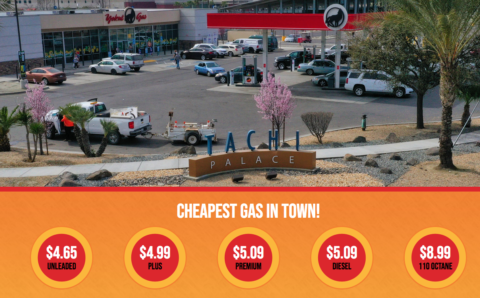
Screen Shot 2022-04-02 at 7.28.53 AMAs usual the cheapest price for gas as of April 2 is in Lemoore Calif at Yokut Gas is selling for $4.65 gallon. The Native American owned station is expected to add another 16 pumps to their popular station later this year. Several other local stations are below $5 as well.
“The downdrafts will continue as oil drops after the SPR announcement,” GasBuddy’s head of petroleum analysis, Patrick De Haan, said on Thursday after the U.S. announced the largest-ever SPR release. “Nearly all states will see falling #gasprices over the next week and potentially beyond,” De Haan added.

President Biden announced a release of 1 million barrels day from the Strategic Petroleum Reserve- about 5% of daily oil consumption in the US.That amount more than makes up for Russia imports to the US at 700,000 barrels a day -now banned.

The latest EIA numbers (March 31) show total oil stocks in the United States are down by 151.7 MMbbl (-11.8%) versus a year ago and stand at 1.139 billion barrels (excluding the Strategic Petroleum Reserve). So with the new release from the SPR almost all of the deficit will be made up.

Worldwide many other countries  plan to release oil from their reserves too.The International Energy Agency said Friday that its 31 member nations had agreed to a new release of emergency oil reserves in what is turning into a historic, wide-reaching effort to calm global markets roiled by Russia’s invasion of Ukraine.

Electric car sales jump

From press reports

U.S. automakers on Friday reported a slump in first-quarter domestic sales, as the entire industry was slammed by chip shortages and disruptions to supply chains.

Toyota, which in 2021 upstaged GM as the top-selling automaker in the United States, outsold the company in the first quarter on increased demand for its Lexus hybrid and electric vehicles.

South Korea’s Hyundai Motor and Kia Motors and Japan’s Mazda Motor Corp all posted a drop in overall U.S. quarterly auto sales. Hyundai said electrified vehicle retail sales surged 241% in the January-March period from a year earlier.

“If gas prices remain high, that’s going to continue to push consumers toward green technology,” said Randy Parker, Hyundai’s senior vice president for U.S. sales.

UPDATE: TESLA

Tesla just reported first-quarter vehicle production and delivery numbers for 2022.

Here’s how they did.

Electric vehicle deliveries (total): 310,048

Electric vehicle production (total): 305,407

Over the same period last year, Tesla delivered 184,800 electric vehicles and produced 180,338 cars.

Biggest solar farm getting bigger

Tulare County solar farm -Rexford 2 – plans expansion

-March 19,2022-

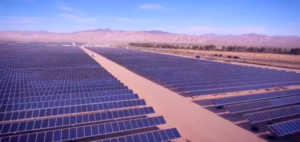
Screen Shot 2022-03-17 at 5.11.07 PMDevelopers of the Rexford Solar Farm -8 Minute Solar – already approved by Tulare County in 2020, wants now to build a second “Rexford 2” project.Together, the Rexford Solar Farm would be the largest in the US at 1200MW of solar and 1200 MW of battery storage.
The Rexford 1 project is a 700MW solar farm and 700MW of storage located on 3614 acres in southern Tulare County.

Now in Phase 2, the project would add 1200 acres and an additional 500MW of ground mounted solar and 500MW of storage. This spring Phase 1 is expected to begin operation. Both projects are near the town of Ducor.

The proposed Rexford 2 project would involve the construction of both transmission and collector lines. Power generated by the proposed Project would be transmitted to the Southern California Edison (SCE) Vestal Substation via an up to 230 kilovolt (kV) overhead and/or underground gen-tie line

In accordance with the California Environmental Quality Act, the County of Tulare Resource Management Agency (RMA) will be preparing a Supplemental EIR to evaluate the environmental effects associated with the Rexford 2 project.

A scoping meeting is scheduled for March 31, 2022 at 1:30 P.M. in Conference Room F of the Tulare County Resource Management Agency

8minute Solar Energy (8minute) announced that the company has executed a 15-year power purchase agreement (PPA) with Clean Power Alliance (CPA). Because it has both PV and storage, the units can deliver power to the grid both day and night.

How big could the Morro Bay wind project be? Maybe $2 billion big?

-March 19,2022-

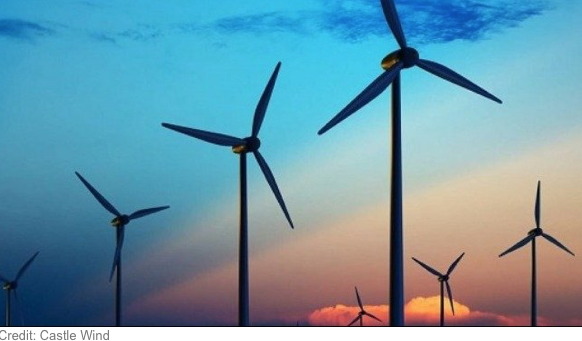
Screen Shot 2022-03-19 at 2.49.24 PMThe results are in from the first federal government auction of leases offshore of New York for the right to build wind farms on the Atlantic ocean seabed.The auction, carried out by the Bureau of Ocean Management (BOEM) February 25 resulted in bids on six lease areas that brought in a record $4.37 billion. Once the sites are fully developed, the sale of more than 488,000 acres is expected to produce up to 7 gigawatts of clean energy (7000MW), enough to power nearly 2 million homes, the agency said.
 
The Biden administration, eager to secure this renewable energy resource, wants the projects fast tracked. Some could be operating by 2028.
 
Now BOEM is turning its sights to the West Coast with the agency preparing to lease 241,000 acres of seabed off the Morro Bay/Cambria coast as soon as this fall for floating offshore wind production. Biden has announced the area could produce 3000MW of power once fully developed, enough to light up one million homes.
 
It would come ashore at two key landings where the grid to carry the power to homes across California is already in place – Morro Bay and Diablo Canyon.Morro Bay’s grid capacity is only 1000MW. Needing that 2000MW infrastructure behind Diablo Canyon, one can see why the wind industry is counting on the nuclear plant to shut down as expected.                    
 
This is all a big deal – but how big? Using the same formula as the NY auction – $9000 per acre-  the auction off Morro Bay might yield $2.1 billion after the competitive bids are added up.
 
New joint venture
 
The price tag is probably not a surprise to the expected bidders who are already lining up for the right to be at the table off the West Coast. Arguably the best known bidder locally – Castle Wind has a new well healed partner, the company announced only days ago – March 2. That would be French energy giant TotalEnergies, who”entered the JV and acquired the shares previously held by EnBW North America” according to the company. Big in renewables,  the company is said to be the 4th largest oil and gas company in the world with plenty of experience working offshore.
 
This new partnership is poised to participate in the anticipated Bureau of Ocean Energy Management lease sale in late 2022. Total Energy was one of the winners in the NY auction, ponying up $795 millions for 84,332 acres, the company announced.They did it under an LLC called Attentive Energy.
 
Besides the now deep pocket Castle Wind/TotalEnergy joint venture, another European company – Ocean Winds was also a winner in this auction and already on record as wanting to make bid in the upcoming Morro Bay leases.Ocean Winds is the result of a 50-50 joint venture by EDP Renewables (EDPR) from Spain and ENGIE, based in France. In the New York auction this partnership paid $765 million to lease 71,522 acres.`
 
What’s next
 
So what is next? BOEM spokesman John Romero says next month, look for a draft EIR for the Morro Bay wind area that will be open to public comment and offer more local public meetings.
 
Also in April, BOEM will release a ”proposed sale notice” that will be eventually modified into the terms outlined in the final sale notice this fall.  Romero says the proposed sale notice is expected to include  terms on how BOEM will evaluate each bid, perhaps weighing factors besides the dollar value of the bid .That may be a nod to Castle Wind who has been engaging with the local community and fishing industry to come to a meeting of the minds. Does that count for anything? Romero implies it may.
 
Even if that is part of the equation, companies have to be ready to plop down millions of dollars that are completely at risk and can’t begin to be recouped (or not) some 8 to 10 years out.
 
These companies are looking worldwide for opportunity.Here is how TotalEnergies describes the significance of the recent auction.
 
“This grand entrance into offshore wind in the U.S. is a major step toward our goal of reaching 100 GW of renewable electricity generation capacity worldwide by 2030. This development adds another dimension to our renewable business in the U.S., currently representing 4 GW of solar farms under development. This is the largest renewable energy project TotalEnergies has ever undertaken and we now have a portfolio of over 10 GW of offshore wind projects, a technology in which we aim to be a world leader by leveraging our offshore expertise.” said Patrick Pouyanné, chairman and CEO of TotalEnergies.
Alla Weinstein, CEO of Castle Wind commented on the joint venture. “We have come a long way since first identifying the opportunity for offshore wind development in California in 2016 and stand today at the precipice of a generational opportunity to secure California’s clean energy future. We are excited to begin the next chapter of this journey. TotalEnergies’ experience and expertise, with over 10 GW of offshore wind projects under development, will be invaluable as we work towards making offshore wind a reality in California.”
 
A company release said “TotalEnergies has been a long-time renewable energy player in California as the majority shareholder of San Jose-based SunPower since 2012.
 
In February 2022, TotalEnergies purchased SunPower Corp.’s Commercial & Industrial Solutions business, integrating the team of nearly 300 and further enhancing its footprint in the solar industry. The Company has offices in San Francisco and Los Angeles.”
 
There are other big, transformed oil companies ready to bid on the California leases including Norwegian-owned Equinor who has other leases off the Atlantic coast as well as Dutch-owned Shell, partner in two winning NY auction leases among others. All heavyweights – every one of them.
 
According to a 2016 study from the National Renewable Energy Laboratory, there is more than 158,000 GW of capacity off the shore of California. Floating wind energy technology is gaining interest offshore of California where water depth drops off rapidly, making most federal and state waters too deep for fixed, bottom-mounted turbines.
 
Another factor makes offshore wind particularly attractive -offshore wind offers consistent generation throughout a 24-hour period- unlike solar.

Gas prices -Newsom says he plans tax rebate to Californians

-March 10,2022-
Screen Shot 2020-07-26 at 7.12.26 AMCalifornia Governor Gavin Newsom wants to implement a tax rebate to motorists due to the big spike in gasoline prices. Newsom said he will file a specific proposal to the legislature soon. But he refused to budge on calls to pump more oil from California fields. Here is how laid it out it out at the State of State address a few days ago.
In January we proposed to pause the gas tax increase.

Now, it’s clear we must go further.

That’s why — working with Legislative leadership — I’ll be submitting a proposal to put money back in the pockets of Californians, to address rising gas prices.

But at a time, when we’ve been heating and burning up, one thing we cannot do is repeat the mistakes of the past by embracing polluters. Drilling even more oil, which only leads to even more extreme weather, more extreme drought, more wildfire.

Entering the debate this week was House GOP leader Kevin McCarthy from Kern County who presented a letter to Newsom” calling for looser oil permitting — including a repeal of the governor’s ban on fracking — to help dull economic pain expected from President Joe Biden’s move earlier in the day to halt U.S. imports of Russian crude”reports there Bakersfield Californian

“The congressman also pressed the governor to grant oil producers’ pending and forthcoming permit applications for oilfield work in the state. He noted the Newsom administration has approved just 67 new drilling permits so far this year, even as more than 1,000 applications await review.”


More Californians choose hybrid/electric transportation as oil prices rise

-February 26,2022-

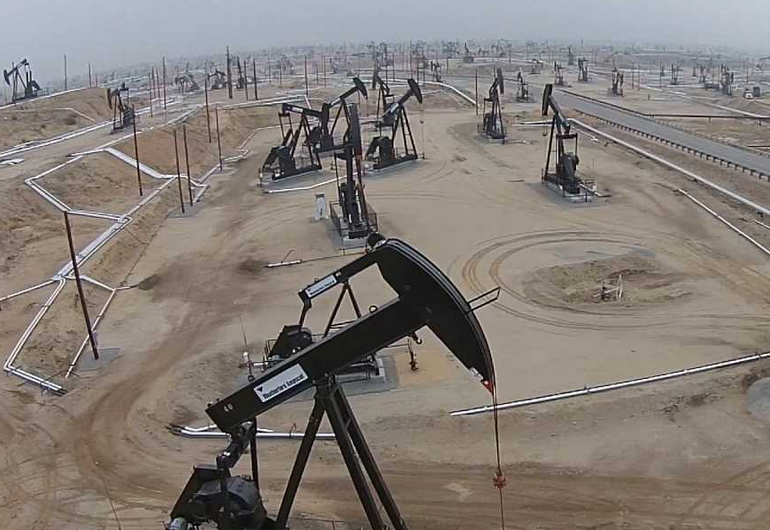
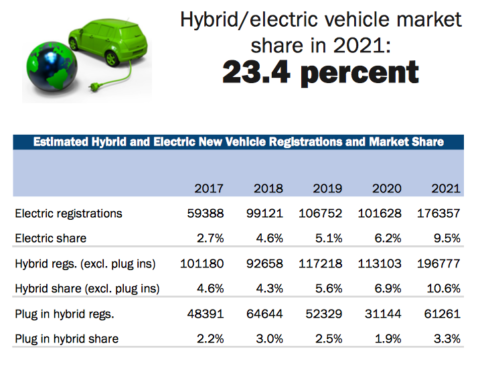
Screen Shot 2022-02-24 at 9.06.02 AMThe California New Car Dealers Assn says nearly a quarter of new purchases of vehicles in 2021 were in the hybrid /electric category as oil and gas prices in the state punish motorists. By comparison, the market share for alternative fuel vehicles was around 9% in 2017. Plug in hybrid share went from 1.9% of sales in 2020 to 3.3% last year as more carmakers offered the product. Now electric trucks are hitting the market.

In the past year, the average price for gasoline in California has climbed from $3.08 in January 2021 to $4.80 as of Feb 25, 2022, a jump of almost 40%.Ouch!

Californians are using less gas than they used to pump. In 2015 the state recorded just over 15 billion gallons sold in California or about 4.4 million gallons a day according the the Energy Information Agency.The latest figures available for 2021 – shows about 3.7 million gallons a day sold – up from pandemic numbers in mid-2020 when the number was as low as 2.7 million gallons a day for a period. Everyone stayed home.

Overall, California gas sales have plunged from a high of over 8 million gallons a day in 2006 to 3.7 million gallons a day, today. This is in great part due to much higher average mileage of the California fleet including a ramp-up of non-petroleum cars.

The pandemic hurt oil demand, idling many rigs that might produce new product during the pandemic.Today the Baker Hughes Rig Count shows 645 rigs active in the US, up 248 from a year ago but down from a rig count of over 2000 in 2014 and much higher earlier -as high as 4500 in the 1980s.

Reports say the oil exploration industry is reluctant to again “drill baby drill” to produce more barrels having been burned by collapsing demand during the pandemic. But now with a huge price increase -drillers ought to be motivated.

With the war in the Ukraine, experts say prices at gas pumps could go up across the country by as much as 20 to 30 cents a gallon pushing the average in California well above $5.

More domestic oil?

California Kern crude is now selling for $95 a barrel – up from $53 a barrel in January 2021, one would think a good incentive.

Year-over-year oil exploration in the U.S. is up 70.5 percent. Gas exploration is up 36.3 percent. The weekly average of crude oil spot price is 54.7 percent higher than last year and natural gas spot prices are 41.6% percent higher than last year.

To help California Gov Newsom’s budget calls for a tax holiday on a proposed tax hike of 3 cents that would be a little relief. A bill in Congress called the Gas Prices Relief Act of 2022 would cut the 18.4 cents per gallon gas tax levied by the federal government through the end of 2022.

In 2019, the U.S. imported 9% of the petroleum it used, the lowest since 1957. The largest sources of U.S. imported oil were: Canada (49%), Mexico (7%), Saudi Arabia (6%), Russia (6%), and Colombia (4%).

According to the American Petroleum Institute, the oil and natural gas industry supports nine million U.S. jobs and makes up seven percent of the nation’s gross domestic product.] As of 2021, the petroleum and natural gas industries support 10.3 million jobs and make up 8% of the U.S. GDP.

Kern County officials are lobbying regulators to loosen red tape on the county’s oil producers. A Kern Economic Development leader recently wrote “Despite the fact that Kern County has the most stringent O&G permitting regulations in the world, many state policymakers continue to pursue and advocate for energy policies that favor and (indirectly) incentivize foreign production over local production. Since 2020, the time it takes to receive an approval for well stimulation has skyrocketed from an average of less than 200 days to now more than 600 days, according to the California Geologic Energy Management Division.

Due to global warming concerns, many leaders want to wean California from using any petroleum.But slamming on the brakes all at once may not work either, as a political reality.

The EDC writer notes” the fact that Kern County has been declared the energy capital of California. The region is one of the top oil-producing counties in the U.S. and generates more than 50 percent of the state’s renewable energy. The nation’s largest wind and geothermal facilities as well as the second-largest solar field call Kern County home.”

More low income EV sales?

As for encouraging more EV car sales, one green car advocate says” California is lowering the MSRP and income caps for its Clean Vehicle Rebate Project (CVRP), which provides rebates of up to $2,000 for EVs and $1,500 for plug-in hybrids.

Starting February 24, new rules will lower the income cap for single filers from $150,000 to $135,000, according to the program’s website. The cap for head-of-household filers will drop from $204,000 to $175,000. The joint-filer cap will decrease from $300,000 to $200,000.

This means fewer high-income car buyers will qualify for the rebate, potentially leaving more funds available for buyers that are more likely to need the rebate to be able to affo

Strong Year-End Finish for Electrified Vehicle Sales as Choices, Popularity Grow

Screen Shot 2021-09-09 at 7.23.07 AM

January 28, 2022 – IRVINE, Calif., /PRNewswire/ — Despite industry-wide inventory constraints and overall slow new-car sales growth throughout the year, sales of battery-powered electric vehicles (EVs) surged to hit a new record with a strong year-end finish in Q4 2021, according to a new report from Kelley Blue Book. In the fourth quarter, EV sales jumped 72% year-over-year to a record 147,799 units. EV market share in Q4 was 4.5%, also a record high for the segment.
There is no doubt we are in the electrified-vehicle decade, and our Cox Automotive experts forecast even further growth.
Electric vehicle popularity continues to grow – nearly half-a-million buyers bought an EV in 2021 – and the number of pure EV choices continues to improve. There were 25 different EV models sold in Q4 2021, and several new nameplates are on the horizon for 2022.
In all, nearly 1.5 million electrified vehicles – the combined total of EVs, hybrids and plug-in hybrids – were sold in the United States last year. Electrified vehicle sales accounted for 9.7% of all sales in 2021, and in the fourth quarter 11.8% of sales were electrified. Yet sales might have increased even more last year if inventory and supply issues had not been as problematic. For example, battery and production troubles all but eliminated Chevrolet Bolt and Bolt EUV sales in the second half of the year, and hybrid-leader Toyota struggled with inventory throughout much of the fourth quarter.
“There is no doubt we are in the electrified-vehicle decade, and our Cox Automotive experts forecast even further growth of electrified vehicles in the years ahead,” said Matt Degen, editor for Kelley Blue Book. “The automotive marketplace continues to evolve and diversify more with each passing year. Hybrids are now mainstream products, and more than a dozen new EVs are slated to launch in 2022 – including the much-anticipated and potentially high-volume Ford F-150 Lightning. While consumer survey data continues to indicate that EVs are too expensive and concerns remain about range and charging availability, consideration for the segment has never been higher. As EV availability expands and capability improves, even more new-car buyers likely will make the choice to buy electrified in 2022.”
Among EVs, Tesla remains the top player with 72% share of the EV market. While that number is slightly down from near 80% in 2020, Tesla still delivered significant 71% year-over-year growth during a very tough year in the automotive marketplace. Beyond its perch atop the EV segment in 2021, Tesla also dominated among luxury brands, outselling Audi, BMW, Lexus and Mercedes-Benz in the U.S. market.
In addition, sales of hybrid vehicles jumped 84% year-over-year in 2021, led by Toyota. More than half of the nearly one million hybrids sold in the United States last year hailed from either Toyota or Lexus. Toyota’s new-car sales are now 25% electrified, all with hybrids for now, but the company plans to add EVs starting this year. Beyond Toyota, Honda and Ford also remain significant players in the hybrid category.

Higher rebates for EVs

Southern California Edison announced this month that it is offering a $4,000 rebate to income-qualified customers who buy or lease pre-owned electric vehicles.


Screen Shot 2021-12-09 at 7.36.22 AM
SCE has been offering a $1,000 rebate through its Pre-Owned EV Rebate program to residential customers who purchase or lease a used EV. But the electric company has now quadrupled the rebate amount for those who either live in a state-designated, income-qualified household or who are enrolled in certain state or federal income assistance programs.
“We want the benefits of clean transportation to be available to all our customers, including those who are buying pre-owned EVs,” said Carter Prescott, SCE director of Electrification. “And now we’re happy that we can provide additional help to customers who may need it.”

Rebates for new and used EVs have been available to SCE customers since 2017. Earlier this year, the utility extended its program for used EVs to lend a hand to more cost-conscious customers seeking to go electric. Federal and state

government programs also offer rebates and other incentives to lower the cost of buying new electric cars.

Income-qualified SCE customers who buy or lease pre-owned electric vehicles may be eligible to receive a $4,000 rebate.

The Pre-Owned EV Rebate program is available to first, second and third owners or lessors of pre-owned EVs. By overcoming one of the key barriers to EV ownership — affordability — the program aims to stimulate EV adoption, a key component in helping the state meet its critical climate and air quality goals. 
“Many people, regardless of income, would rather buy pre-owned vehicles instead of new, and SCE’s pre-owned EV rebate may make the difference between those customers buying an EV rather than a car powered by fossil fuel,” Prescott said. “At SCE, we also strive to ensure that our programs help communities that are most impacted by harmful vehicle emissions.”

Applying for the rebate can be done online in a few minutes. SCE customers simply need to go to evrebates.sce.com

and enter their SCE service account number and current vehicle registration card number. Up to three consecutive owners of a single EV are eligible for a rebate, and up to three EVs at each SCE customer address can receive rebates. Those applying for the higher rebate amount will be asked to provide information proving that they qualify.

We want the benefits of clean transportation to be available to all our customers, including those who are buying pre-owned EVs. And now we’re happy that we can provide additional help to customers who may need it.”

Carter Prescott, SCE Director of Electrification

Customers can also shop for used EVs online and compare the price of owning them to similar gas-powered cars at cars.sce.com

SCE building 225MW battery storage project in Springville

-November 22,2021-

Screen Shot 2021-11-20 at 8.36.30 AMLooking to speed an emergency project by this coming summer, Southern California Edison has announced it will build a multi-million dollar battery storage complex at the Springville substation in Tulare County. The project is one of three that SCE will build over the next 9 months at a cost of $1.22 billion.They add up to 535MW of storage with the Springville project being 225MW,nearly half the total.That would put the value of the local project at around $500 million.

The Springville  project will download power to the battery storage modules from their Big Creek hydro facilities in the Sierra when demand is low and release it to the grid when power demand is high in the SCE service area. SCE will use lithium-ion batteries with 4-hour dispatch capability.Power is needed California energy officials say, to meet potential summer demand this coming year.

The state wants to add an additional 5000MW to the power supply to be ready for more extreme weather events that have resulted in power shutdowns.

On July 30, 2021, Governor Newsom proclaimed a state of emergency in California due to the increasing effects of climate change and their impact on the state’s electric system. The Emergency Proclamation states that “it is necessary to take immediate action to reduce the strain on the energy infrastructure, increase energy capacity, and make energy supply more resilient this year to protect the health and safety of Californians.”

Additionally, the Emergency Proclamation notes that “a second summer of extreme drought, heat, and fire in 2022 would pose an even more grave threat to California’s energy supply, unless additional actions to increase California ‘s energy infrastructure and capacity begin now.”

Reports say that Pedro Pizarro, president and CEO of Edison International, says his team will build the roughly 535 MW of storage by mid-summer and is also working on securing more than 230 MW of capacity from third parties. SCE, which serves more than 15 million people across Southern, Central and Coastal California, has contracted with Ameresco and filed papers with the CPUC outlining plans to build the capacity at its Springville (225 MW), Hinson (200 MW) and Etiwanda (112 MW) substations.These later two stations are in southern California.

SCE will use land at its existing substations to quickly develop, permit and interconnect the battery storage resources.The battery energy storage systems are expected to be online by August 2022.

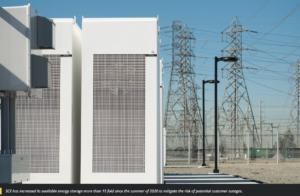
SCE will substantially increase the amount of energy storage capacity it has available to mitigate the risk of potential customer outages if the West experiences a summer of extreme heat. The additional 535 MWs of SCE-owned storage complement the long-term capacity contracts completed last year — 1,355 MWs of utility-scale battery storage and 5 MWs of demand response that uses energy from customer-owned energy storage. It will bring SCE’s total amount of installed and procured storage capacity to about 2,810 MWs. 

“The steps we are taking today will benefit our customers in many ways. They will make the grid more resilient to the effects of extreme weather and will help us continue our progress toward the clean energy future, which is essential to combating climate change,” said Kevin Payne, president and CEO of SCE. “Electric utilities like SCE have a critical role in integrating renewable energy into the grid. The clean energy then powers clean transportation and buildings, and in doing so, creates clean energy jobs that benefit Southern Californians economically and environmentally.”

By locating the battery storage at its substations, SCE will be able to meet electricity demands more effectively in the San Joaquin Valley, Rancho Cucamonga and nearby communities as well as the greater Long Beach area, including the Port of Long Beach, while enhancing overall grid reliability. The batteries can be charged when electricity demand is lower and store nearly 2,150 megawatt-hours. They will also decrease the grid’s dependence on natural gas power plants as California transitions to a clean energy future.

As laid out in Pathway 2045, SCE estimates the state needs to add 30 GW of utility-scale storage to the grid and 10 GW of storage from distributed energy resources to meet the state’s clean energy and carbon neutrality goals. These new battery energy storage systems will help California meet these goals and also help Edison International, SCE’s parent company, meet its 2045 net-zero greenhouse gas emissions commitment.