-July 27,2022-
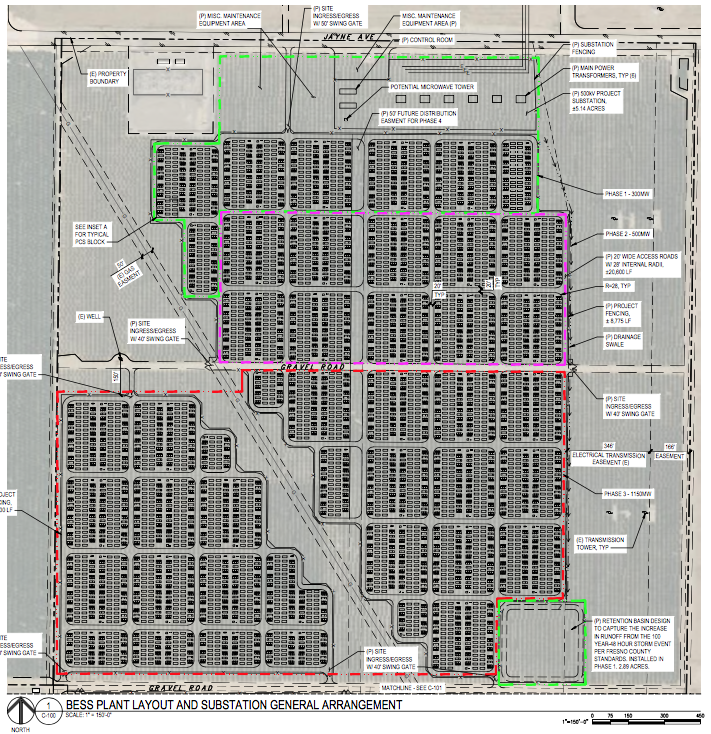
 What would be by far the world’s largest energy storage project is being planned in western Fresno County next to the important Gates substation.Florida-based Key Energy Storage, LLC is proposing to construct and operate the Key Energy Storage Project on approximately 318-acres of private ag land in western Fresno County.
The site is located 4 miles southwest of the City of Huron, 0.4 mile east of Interstate 5 (I-5), immediately south of W. Jayne Avenue, between I-5 and South Lassen Avenue (State Route 269), and adjacent to PG&E’s existing Gates Substation.
According to their application with the county, a Notice of Preparation(NOP), the energy storage facility would consist of lithium-ion batteries with the potential to store approximately three (3) gigawatts of energy-3000 megawatts. That is more than enough battery storage to hold all Diablo Canyon nuclear plant can generate and 7X larger than the Moss Landing Battery Storage, currently the world’s largest.
‘this one proposed Fresno County project matches all the energy storage in California currently!’
At a recent celebration of the Moss Landing project, Elliot Mainzer, president and CEO of the California Independent System Operator called the influx of battery storage capacity on the grid over the past year “an incredible growth curve, an incredible success story,” adding that “We’ve entered a golden age of energy storage here in California.” The ISO now has more than 3,160 MW of battery storage connected to the grid and is expected to add another 700 MW by the end of June.
So this one proposed Fresno County project matches all the energy storage in California currently!
The Key Energy project is being designed to hold solar power energy generated in daytime for hours after the sun goes down. The energy storage project is being sited in the solar panel laden Westlands Water District not far from the 20,000-acre Westlands Solar Park.Solar facilities are located to the north and southwest of it.
The project would also include a 500-kilovolt (kV) overhead generation tie line, which would extend north to the adjacent Pacific Gas and Electric (PG&E) Gates Substation.This line would be installed on new steel or concrete poles, each up to 150 feet tall and spaced at approximately 500-foot intervals.
Buildout of the Project would occur in phases, with Phase I expected to come online in 2025, and Phase 2 expected to come online by 2026. After that, Phases 3 and 4 are expected to come online between 1 to 3 years after the previous phase, based on the region’s increasing demand for energy storage.
The Project would include development of an energy storage system facility and associated on-site support facilities including a substation, inverters, collector lines, fencing, access roads, supervisory control and data acquisition (SCADA) system, and other ancillary facilities or equipment.
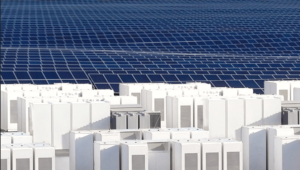
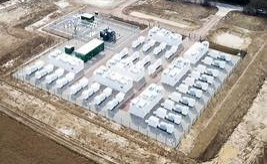
The lithium-ion battery storage system would consist of battery cells assembled in a series of modules connected together like a giant Lego puzzle (see pic).
Cap
renewable projects pair solar with batteries
2 Attachments

 AAA says pump prices on the West Coast have increased due to ongoing refinery maintenance at roughly six refineries, severely limiting the region’s supply. However, refinery restarts and California officials “allowing less expensive winter-blend gasoline to be sold a month ahead of schedule should offer drivers relief at the pump in the coming days.”News reports say gasoline prices in California could fall 50 to 90 cents a gallon very soon. That’s the view of experts such as Patrick De Haan, head of petroleum analysis for GasBuddy, which tracks prices. Severin Borenstein, an energy economist at University of California, Berkeley, predicts a plunge of at least 50 cents a gallon “within the next week.”
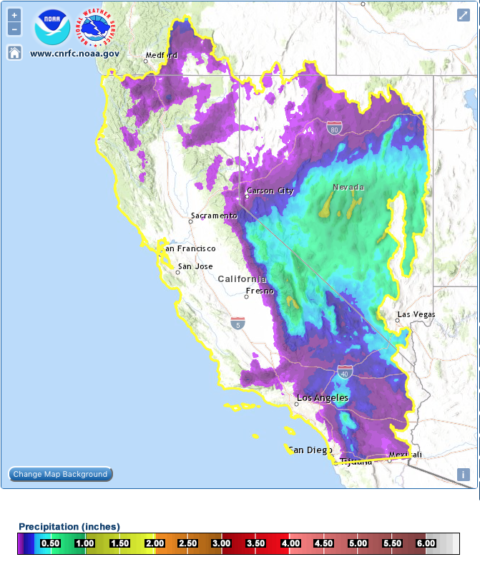 NOAA’s California/Nevada River Forecast Center expects the Southern Sierra between Fresno and Bakersfield to enjoy over an inch of precip in the next 6 days (see map).The storms are part of a spillover of the vigorous monsoon storms hitting Arizona.Nevada and Colorado this summer.A monsoon storm dumped heavy rain across the Las Vegas Valley on Thursday night, triggering flash flooding along the Las Vegas Strip and several famous casinos.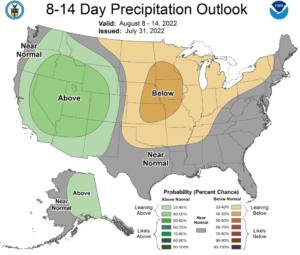

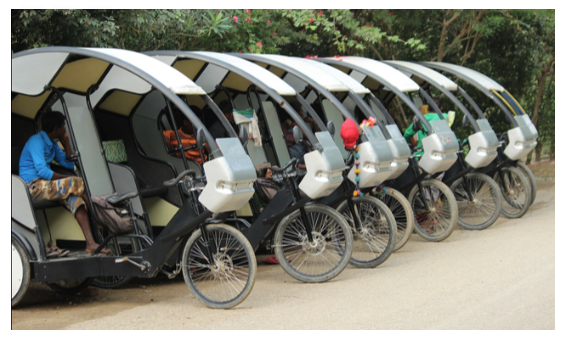
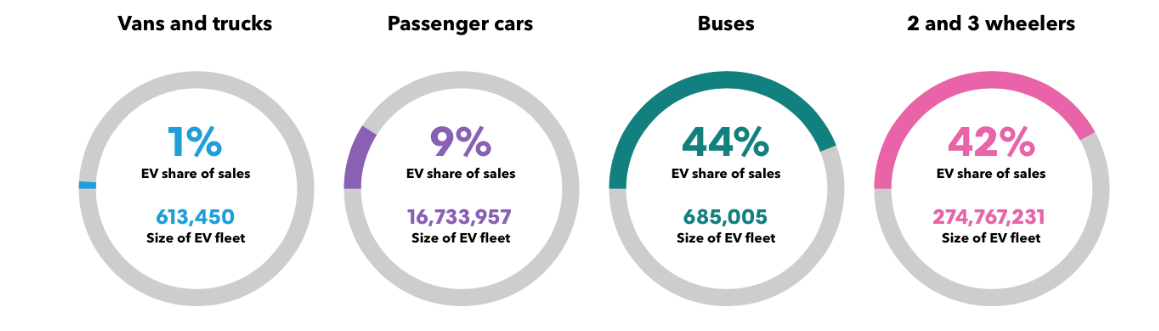 While most of us think Tesla passenger cars when it comes to EV (electric vehicle) sales, worldwide the biggest sales category by far, is coming from small two and three wheel EVs. According to Bloomberg the fleet of electric 2 and 3 wheelers totals 275 million using 2021 numbers while the fleet of electric passenger cars is a fraction of that – 17 million. Asian countries lead to way in unhooking those polluting petroleum based motorcycles and 3 wheel ‘Tuk-Tuks ‘ in favor of new electric versions.
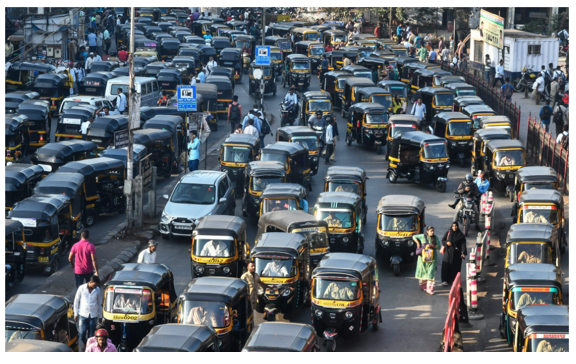 But its those iconic people and cargo carrier around the world -tuk tuks seen in crowed cities of Asia and the Middle East the are in the spotlight .Bloomberg says almost 40% of India’s huge three-wheeler fleet is already electric. China now has 685,000 electric buses on the road and 195 million electric two-wheelers.
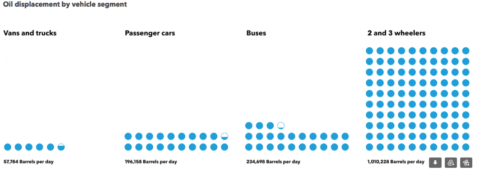 The contribution of these millions of small footprint vehicles are both clearing the air in the most polluted cities of the world and reducing world oil consumption with over 1 million barrels of oil displaced by these electric vehicles.Electric passenger cars are a small slice of that but growing fast.

 Renewable fuels are becoming a larger part of California’s transportation fuels market, as shown by recent announcements to invest in renewable fuel production made by several California petroleum refineries. This shift to renewable fuels is being driven by government incentives. According to the EIA, renewable diesel production capacity could represent 20 percent of total diesel production on the West Coast by 2024.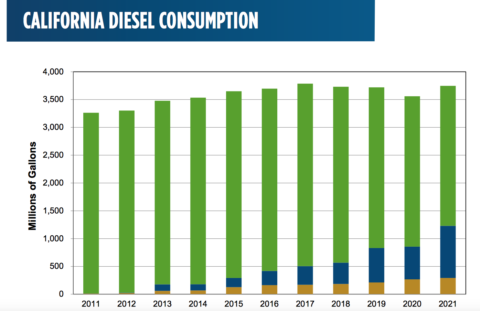
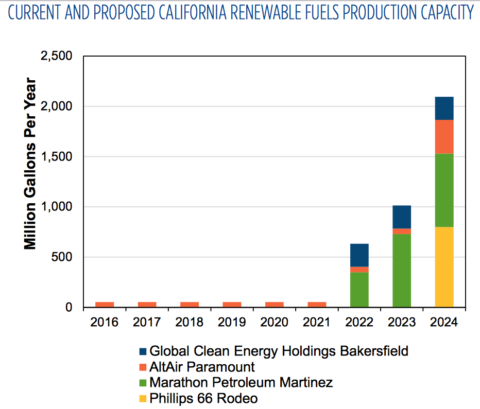 Adding that new supply
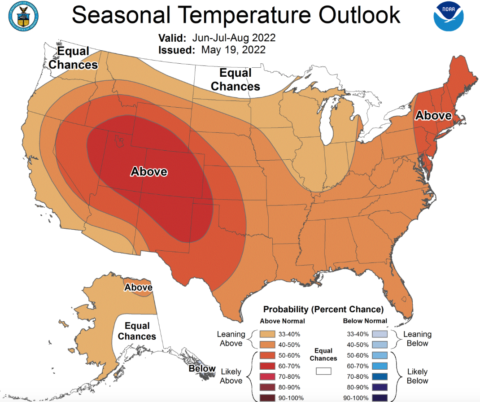 US Rockies will bake says NOAA
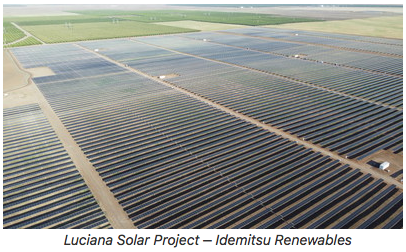 The Luciana solar project, a 73-MW solar project in Tulare County, California, has achieved commercial operation and is expected to generate clean and affordable power equivalent to the needs of over 20,000 California homes.
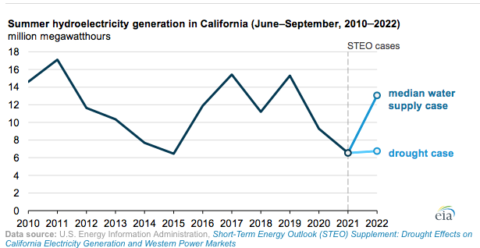 As part of a supplement to our Short-Term Energy Outlook, we analyzed how drought conditions could affect hydroelectric generation in California this summer. California hydroelectric generation would be 48% less this summer in an alternative case that assumes drought conditions compared with a case that assumes relatively normal water conditions. This shortfall would need to be made up from other sources of electric power supply.
 California Gov. Gavin Newsom wants to add up to $400 million to the 2022-23 budget to accelerate development of a potential huge global supply of lithium and clean energy at the south end of the Salton Sea, and developers there could have access to $1 billion more in “green energy” tax credits in coming years.