California Energy Commission approves $2.9B investment for zero-emission transportation infrastructure

15 December 2022

Screen Shot 2023-01-04 at 6.01.46 PMThe California Energy Commission (CEC) approved a $2.9-billion investment plan that accelerates California’s 2025 electric vehicle (EV) charging and hydrogen refueling goals. The funds will support the deployment of thousands of zero-emission trucks, school buses and transit buses to deliver clean air benefits to communities hit hardest by the impacts of pollution from medium- and heavy-duty vehicles.

The 2022-2023 Investment Plan Update increases funding for the CEC’s Clean Transportation Program by 30 times compared to 2019 with an additional $2.4 billion from the recent state budget that will be spent over the next four years and with at least 50% targeted to benefit priority populations.

CEC staff estimates the plan will result in 90,000 new EV chargers across the state, more than double the 80,000 chargers installed today. Combined with funding from utilities and other programs, these investments are expected to ensure the state achieves its goal to deploy 250,000 chargers by 2025.

This transformative investment will deploy charging and refueling infrastructure swiftly and equitably to make sure drivers of zero-emission cars and trucks feel confident they can refuel wherever they go. The plan will increase access to charging and hydrogen fueling for individuals, businesses and public agencies, while supporting our emerging manufacturing ecosystem and creating jobs. Most importantly, it provides critical funding to support the move away from dirty trucks and buses that have burdened our most vulnerable communities for too long.

Post Office to deploy 66,000 Electric Vehicles by 2028 / US EV sales jump

One of the Largest Electric Vehicle Fleets in the Nation
Initiative Boosted by Postal Service “Delivering for America” Network Modernization and Funding from Congress

-January 1,2023-

Screen Shot 2023-01-04 at 5.53.35 PMThe US Postal Service anticipates increasing the quantity of purpose-built Next Generation Delivery Vehicles (NGDV) to a minimum of 60,000 of which at least 45,000 will be battery electric by 2028. NGDV acquisitions delivered in 2026 and thereafter expected to be 100% electric.
Postal Service expects to purchase an additional 21,000 battery electric delivery vehicles through 2028, representing a mix of commercial-off-the-shelf (COTS) vehicles. Acquisitions delivered in 2026 through 2028 expected to be 100% electric.
Feasibility of achieving 100% electrification for the overall Postal Service delivery vehicle fleet will continue to be explored.
Beyond vehicle mix changes, postal network modernization efforts will drive additional substantial carbon reductions through logistics improvements and reduced transportation
Total investment expected to reach $9.6 billion including $3 billion from Inflation Reduction Act funds.
WASHINGTON — The United States Postal Service today announced that it expects to acquire at least 66,000 battery electric delivery vehicles as part of its 106,000 vehicle acquisition plan for deliveries between now and 2028. The vehicles purchased as part of this anticipated plan will begin to replace the Postal Service’s aging delivery fleet of over 220,000 vehicles.

The Postal Service anticipates at least 60,000 Next Generation Delivery Vehicles (NGDV), of which at least 75% (45,000) will be battery electric. As part of this plan, a total of 21,000 additional commercial off-the-shelf (COTS) vehicles are also expected to be battery electric, depending on market availability and operational feasibility. The Postal Service also anticipates including internal combustion vehicles necessary to meet immediate vehicle replacement needs.

In keeping with the Postal Service’s priority to provide its carriers and communities with safer, more efficient vehicles as soon as possible, these vehicles will, unlike the vehicles they are replacing, feature air conditioning and advanced safety technology and are more suited to modern day operational requirements. For any COTS vehicles purchased, the Postal Service will include a preference for domestic manufacturing.

Today’s announcement is enabled by the Postal Service’s overall network modernization efforts which allows for a more rapid deployment of EVs, and its improving financial condition which includes $3 billion in congressional funding appropriated under the Inflation Reduction Act (IRA).

The Postal Service will continue to evaluate and procure vehicles over shorter time periods to be more responsive to its evolving operational strategy, technology improvements, and changing market conditions, including the expected increased availability of BEV options in the future.

Postmaster General Louis DeJoy commented, “We have a statutory requirement to deliver mail and packages to 163 million addresses six days per week and to cover our costs in doing so – that is our mission. As I have said in the past, if we can achieve those objectives in a more environmentally responsible way, we will do so.”

“The Postal Service’s vehicle initiative, and I personally, have benefited from the collaborative spirit of John Podesta, Senior Advisor to the President and leader of the Office of Energy Innovation, as well as leaders within the Council on Environmental Quality and the Climate Policy Office. These professionals have demonstrated a real appreciation and understanding for how vehicle electrification can be incorporated into the Postal Service’s mission and transformation, while not distracting from it. In our own way we have all been faithful stewards of how IRA funding and Postal funding will be spent.”

“The $3 billion provided by Congress has significantly reduced the risk associated with accelerating the implementation of a nationwide infrastructure necessary to electrify our delivery fleet. While most of the electric vehicle funding will continue to come from Postal Service revenues, we are grateful for the confidence that Congress and the Administration have placed in us to build and acquire what has the potential to become the largest electric vehicle fleet in the nation.”

“What is less widely understood is that our network modernization initiative is necessary to enable this vehicle electrification and will also provide meaningful cost and carbon reductions in other ways. A key focus of our modernization effort is to reduce inefficient transportation and improve distribution operations, resulting in far less air cargo and far fewer truck trips. When combined with our substantial commitment to the electrification of our delivery vehicles, the Postal Service will be at the forefront of our nation’s green initiatives.”


WSJ: US EV sales jump

U.S. electric-vehicle sales leapt by two-thirds in 2022 while the broader auto market contracted, newly released year-end figures show, as fresh plug-in models from traditional auto makers whittled away at EV juggernaut Tesla Inc.’s lead.
Auto makers sold 807,180 fully electric vehicles in the U.S. last year, or 5.8% of all vehicles sold, up from 3.2% a year earlier, according to year-end figures released this week by market-research firm Motor Intelligence. In comparison, total U.S. auto sales fell 8% in 2022 from a year earlier.

Castle Wind – the prime mover in pushing for Morro Bay wind project, left out in latest government auction

 -December 8,2022-

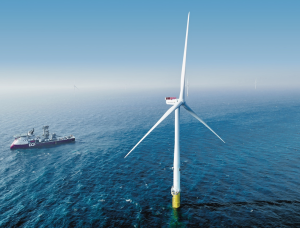
Screen Shot 2022-12-09 at 8.29.41 AMThis month the US government auctioned 5 leases off the California coast to companies who will build floating wind turbines some 25 miles offshore. The abundant blowing wind is expected to light up 1.5 million homes a decade from now or sooner. The five leases, final as of Dec 7, are valued at $757 million.

The Morro Bay coastal waters will see three of these projects connected by undersea cables to power substations in Morro Bay and Diablo Canyon. Humboldt will see two more.

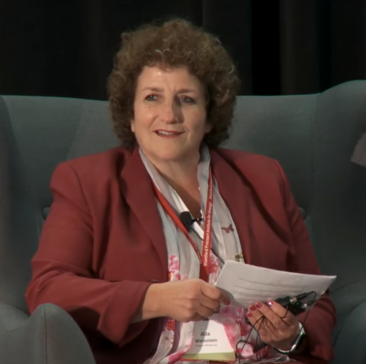
This just didn’t happen here by chance. There was a prime mover to launch this huge project, a company called Trident Winds and its founder Russian-born engineer Alla Weinstein who pioneered the Morro Bay-specific effort 8 years ago. They have been lobbying at the city, county, state and federal levels and meeting with local stakeholders. That includes negotiating with a skeptical local fishing industry to allow deep water wind turbines in their fishing grounds to help meet demand for non-carbon renewable energy that advocates feel could help save the planet.

Shore infrastructure in place

After researching the idea, Weinstein found that there is indeed abundant wind off Central Coast shores and critically pointed out that there was existing unused transmission infrastructure onshore that could be tapped to connect thousands of offshore megawatts to the California grid. That included multi- millions of dollars of existing transmission lines connected to the mothballed Morro Bay gas powered power plant and the Diablo Canyon nuclear power facility, set to be mothballed by time the wind turbines might be operating.

In 2016 Weinstein and her new company Trident Winds (later Castle Wind) submitted an unsolicited lease request to a federal agency to put 100 floating offshore wind platforms in US waters – some 33 miles north of Morro Bay. That started the ball rolling.

In 2015, the Tribune wrote ” In a generation or two, offshore wind farms could be as common along the California coast as off-shore oil rigs are today. And Morro Bay could be the community where the offshore wind industry gets its start in the Golden State.”

This month that same Bureau of Ocean Energy Management (BOEM) auctioned the leases allowing nearly 40 bidders – many from Europe -who expressed interest in the competitive bidding process off Morro Bay that Mrs Weinstein set in motion back in 2016.

Ironically and sadly for Weinstein and partners, the winners of the bidding did not include their company, the firm that proposed the ambitious effort and that has lobbied at all levels of the government to make it happen.

Weinstein became a familiar face around San Luis Obispo building support for new industry and an idea – tap the wind – not oil- off our shores to fight global warming. Support built for the plan bubbling up right to the top to the President of the US and the State of California who now vows to permit 5,000MW once built out.

A bummer

Among those who feel badly for Weinstein and hailed her efforts is the president of the Morro Bay Fishermen, Tom Hafer, who worked closely with her and their team for years telling this reporter that their loss was “just a bummer” given all the time Weinstein spent in Morro Bay working on details with city and the fishing community to avoid a local war over this new ocean venture.

As a part of lengthy negotiations,the city,Weinstein and the fishermen agreed to form the Morro Bay Lease Areas Mutual Benefits Corporation that will be open to all developers and qualified fishermen; it was announced in October of this year. The pact is modeled after an agreement between international cable companies and the local fishing industry some years back. The new agreement includes the California Coastal Commission that hopefully will ensure followthrough by the winning wind companies even though Castle Wind was not one of them.

In a news release in October, Weinstein explained the need for mitigation for the fishing industry, Morro Bay’s claim to fame.

“With any energy project of this magnitude, there are likely to be impacts. Our approach has been to acknowledge, as early as possible, that impacts may occur, which is why we have been working directly with the Central Coast fishermen since the inception of Castle Wind. By establishing the Morro Bay MBC at this early stage in the process, Castle Wind has created a platform for the developers to mitigate anticipated impacts of offshore wind to the commercial fishing industry…”

In an email to this reporter Weinstein said she and her company are of course “disappointed that Castle Wind, our joint venture partnership with TotalEnergies, did not win a lease in the BOEM auction.” Still she and her company were the first advocates for “a multi-factor auction format that helps ensure local affected communities share in the benefits of offshore wind and that any impacts of offshore wind development are mitigated.” So the auction included credit for working with local stakeholders besides the dollar amount of the bid.

“Trident Winds is proud of the work we did to initiate development of the offshore wind market in California, beginning with the submittal of its unsolicited lease request in January 2016. From those early days, Trident Winds established itself as a leader in the development of a new offshore wind industry that recognizes all voices must have a seat at the table and ensures an equitable distribution of benefits to affected stakeholders. This led to the establishment of a Community Benefits Agreement with the City of Morro Bay, the creation of a Mutual Benefits Corporation with the Central Coast fishing community. The move should ” incentivize other developers to make the same commitments.”

A BOEM release Dec 7 says “The lease sale included a 20-percent credit for bidders who committed to a monetary contribution to programs or initiatives that support workforce training programs for the floating offshore wind industry, the development of a U.S. domestic supply chain for the floating offshore wind energy industry, or both. This credit will result in over $117 million in investments for these critical programs or initiatives.
The auction also included 5% credits for bidders who committed to entering community benefit agreements (CBAs). The first type of agreement is a Lease Area Use CBA with communities, stakeholder groups, or Tribal entities whose use of the lease areas or use of the resources harvested from the lease areas is expected to be impacted by offshore wind development. The second type of agreement is a General CBA with communities, Tribes, or stakeholder groups that are expected to be affected by the potential impacts on the marine, coastal or human environment from lease development.”

Moving on themselves, Weinstein vows to continue working on offshore wind projects elsewhere in the US including in the state of Washington where they are launching a new project.

So who were the winners of the Central Coast auction?

Ocean Winds – a partnership between French and Portuguese-based firms – and the Canada Pension Plan Investment Board have formed a joint venture called Golden State Wind.The JV was awarded an 80,418-acre lease area by the U.S. Bureau of Ocean Energy Management this month off Morro Bay.

When fully built out the lease area could accommodate about 2,000MW of offshore wind energy, generating enough energy to power the equivalent of 900,000 homes. This will bring the U.S. and California closer to meeting their clean energy goals of 15 GW of floating offshore wind generation by 2035 in the U.S. and 5 GW by 2030 in California.

Another Morro Bay lease was won by Equinor Wind US LLC who made the winning $130 million bid for a similar size 80,062-acre lease in the Morro Bay area. Equinor Wind is an arm of Equinor, based in Norway.

The last Morro Bay lease was won by Invenergy-California Offshore LLC, based in Chicago, a similar size.

If all three produce 2 GW- that is 6GW of power!

Two important points

Two more points to conclude with. Despite appreciating the efforts to mitigate the effects on the local fishing industry Hafer is still skeptical about the potential harmful effect of this new industry on their livelihoods including fears that this new technology – floating wind -may not work as promised.

Secondly readers should appreciate that bringing in 5,000MW will depend on Diablo Canyon infrastructure and transmission lines that will be needed, requiring the nuclear power plant to go offline before offshore wind comes online.



Central Valley renewables helps replace ag job losses

-November 9,2022-

From Public Policy Institute of California

Largest solar project on the drawing boards click to enlarge
Largest solar project on the drawing boards
click to enlarge

Lorelei Oviatt, director of Kern County’s Planning and Natural Resources department, says her county is pretty far along the renewable path, with some 157,000 acres of wind and solar. The county’s solar projects currently hire 90% of their workers locally, she said, but the path forward isn’t necessarily easy. Property and sales tax revenues remain a concern. “All we have is land to produce the money that keeps our libraries open, keeps Meals on Wheels going, and law enforcement [going]. When we lose agriculture, we’re not just losing jobs,” Oviatt said, but also revenue. “Jobs are great,” she said, “but nobody wants to live in a community that doesn’t have services.” Still, Oviatt says, solar does offer the opportunity to “remonetize” lands leaving irrigated production.
Mayor Rey León of Huron concurred with Oviatt, saying that while solar development is attractive, he has some concerns in a traditionally agricultural region. “Acreage that goes out of production is taking out local jobs….There’s some fine-tuning to do to ensure that there’s equity.” Huron is one of the poorest cities in the state of California, and agriculture has been its economic backbone. Now “[l]ettuce season is all but dead.” Training and education, he said, are key to help former agricultural workers and young people make the transition. “Our high schools and community colleges need to…have more resources and provide more opportunities for our kids….These students need to be the engineers, the attorneys within the clean energy industry, the managers, the trade workers. Those are good jobs.”
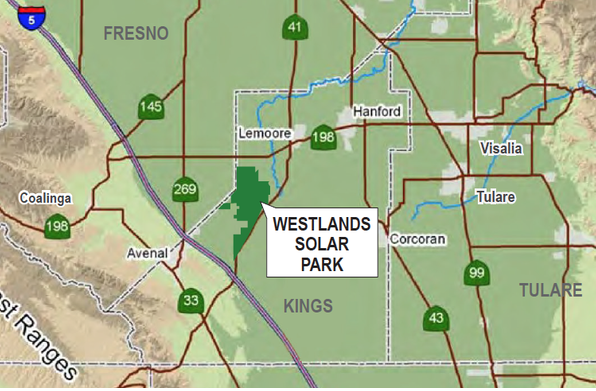
Dan Kim of Golden State Clean Energy described both the promise and hurdles to solar development in the valley. He said that the company’s current project, Westlands Solar Park, is on track to provide over 1,000 MW of electricity when complete. But the industry has been stymied by rising costs and transmission constraints. “When we started, the interconnection process would take about three years from beginning to end,” he said. “Currently…the timeframe is upwards of almost seven to eight years.”
The difficulty of getting projects online will make it challenging to meet the state’s increasingly ambitious renewable energy needs, Kim said. Not long ago, the state’s needed annual build-out of renewable capacity was estimated at 4,000 MW annually—but that projection was recently raised to 6,000–7,000 MW annually. “That’s going to strain the interconnection timing.”
This is where the state comes in. Erica Brand of the California Energy Commission (CEC) said a suite of generation, energy storage, and transmission investments are needed to achieve SB 100’s goals. “We need a significant build-out of clean energy in the state over the next 25 years in many regions of the state, including the San Joaquin Valley.” While the clean energy transition offers exciting opportunities for the San Joaquin Valley, “we also need to be sure the pathway to achieving SB 100 is affordable, equitable, reliable, and implemented in a way that supports local land-use priorities.” She says the CEC is working to integrate more local land-use data into its planning efforts.

Big battery storage project on deck near Visalia

500MW BESS would connect to SCE & Big Creek hydro

-October 25,2022-

Tesla BESS
Tesla BESS

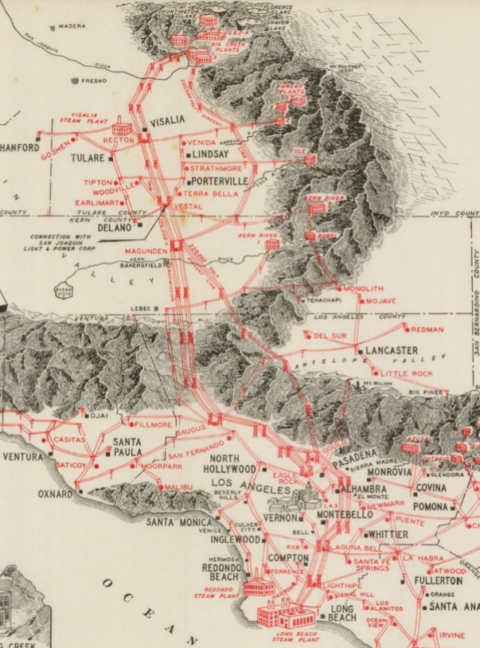
The intersection of one of the biggest hydro power projects in California with a transmission conduit to Los Angeles comes through Visalia at a place just east of town – SCE’s Rector substation.

That’s also where a farmer with nearly 50 acres wants to pull fruit and nut trees to contract his land to a NY renewable energy developer with a plan to build what appears to be one of the nation’s largest battery storage facilities.

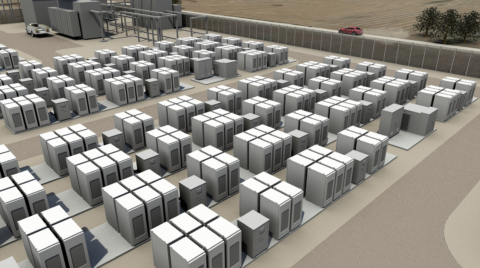
At 500 MW, this half-mile field of some 400 battery modules called a Battery Energy Storage System – BESS – will receive power from the giant Big Creek hydroelectric complex in the Sierra to store and then ship to Edison customers when they need it the most. Big Creek’s power output is 1000 MW from falling water at 27 dams with familiar names like Shaver and Huntington Lakes. First generating power in 1913, this network of dams has inspired the nickname, “The Hardest Working Water in the World.” Seems some of these hardworking watts will rest in Visalia before being put to use at customer’s homes and businesses, giving SCE flexibility.

Rector substation connects Big Creek to LA
Rector substation connects Big Creek to LA  -historical rendering

Power stored at the new BESS facility could also come from one or more of the many big solar projects in the Central Valley.

This advanced battery storage facility will have 12 hour storage capability resulting in a power rating of 6000MWh. Currently, the title of world’s biggest battery storage project is held by Vistra Energy’s Moss Landing Energy Storage Facility (400MW/1,600MWh), in California. This proposed BESS would-be three times that output.

Proposing the Visalia area project is New York-based Terra-Gen who owns the big Alta Wind project in Kern County with four BESS projects in that county under construction.

As of October 26 Terra-Gen will be in front of the Tulare County Planning Commission to seek approval for construction of this project.

2024 construction

Terra-Gen spokesman for the project Pete Lai says the company hopes to begin construction of the Visalia project in 2024 and switch it on by 2025.

Not just for LA, the new power storage units will be beneficial for a stable flow of electricity for the Valley including in emergencies like fire or power outage. Lai says the long duration could supply power to parts of state over extended periods, a feature the PUC has been looking for. There are just a few of these longer duration BESS projects.

The battery storage projects take utility-scale solar or wind and store the power after the sun goes down to supply peak demand all over California in the late day to bed-time hours.

Growing renewables

Farmers in the Kaweah watershed are being encouraged to idle some of their land to reduce groundwater pumping, as they are all over the Valley,a choice farmers are making increasingly is to grow renewable energy on these lands.

The nearly 50-acre site is currently an operating walnut, persimmon, and pomegranate farm with an existing house on the western side of the property parcel adjacent to Road 148. Project facilities will be constructed within the existing orchard, and rows of trees will be maintained along the western side of the site to minimize views to project facilities from public roadways. says a county report. The site is less than a mile from either Visalia and Farmersville city limits.

The County staff report says 4-Creeks ESS, LLC (Terra-Gen) proposes to construct, own, and operate the 4 Creeks Energy Storage Project, a lithium-ion battery energy storage facility capable of delivering up to 500 MW of energy storage capacity with up to a 12-hour capacity rating. The project will interconnect to the existing, adjacent Southern California Edison (SCE) 230kV Rector Substation via an approximate 700-foot generation tie-line (gen-tie).

Safety issue

The staff report says the proposed development would not be expected to result in a cumulatively considerable contribution to impacts in the area.

Asked about safety, Peter Lai says this project will be built to a high standard of fire protection, noting that lithium-ion units are being installed all over the world at places like hospitals and schools. “We will have multiple layers of safety systems and monitoring by humans on a 24 hour basis.”

Tulare County is already home to what will be the nation’s largest solar farm near Terra Bella/Ducor. Rexford 1 covers more than 3,600 acres and will generate 700 megawatts of electricity and another 700 megawatts of battery storage. Recently the Planning Commission approved plans for Rexford 2, on 1,200 acres generating around 500MW with an additional 500 megawatts of battery storage.This project is owned by Avantus, formerly known as 8 minute Solar Energy.

Big money

The applicant on this Visalia project – Terra-Gen recently completed US$969 million project financing for the second phase of Edwards Sanborn Solar-plus-Storage facility in Kern County which will bring it to 3,291MWh of energy storage capacity.The next phase is expected to come online in the third quarter of 2023.

These high dollar amounts make it clear the4 -Creeks Visalia project must be valued in the hundreds of millions as well .Peter Lai did not have a dollar value for the project’.

California is in a hurry to complete more battery storage.SCE themselves have built 2.3 GW of storage today with plans to have another 2.8 GW in place by 2024, says a spokesperson. A gigawatt is equal to one billion watts or 1000MW.

Making the modules in California is itself gearing up in nearby Lathrop, near Stockton, where Tesla now has a dedicated Megapack grid-scale BESS gigafactory. The facility is currently ramping up to its planned 40GWh annual production capacity to help meet plenty of demand.

_______________

Caption” A large Tesla-built BESS
also: Location of the 4-Creeks BESS
2
Attachments
• Scanned by Gmail


Spot price California wholesale gasoline drops $2.50 in two weeks

October 21,2022

LA wholesale gasoline price

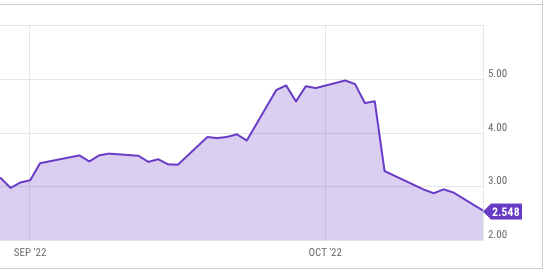
Los Angeles Reformulated RBOB Regular Gasoline Spot Price is at a current level of $2.548, down from 2.883 the previous market day and down from 2.604 one year ago. This is a change of -11.62% from the previous market day and -2.15% from one year ago.

Even more impressive is the drop from the second week in October when the spot price was $5 a gallon -now cut in half as refineries resumed normal operations.

What does a drop of $2.50 gallon on the spot market mean? Certainly it should mean a drops of $2.50 a gallon at the pump as these lower prices hit the gas stations.

Screen Shot 2022-10-21 at 8.02.22 AMThe last two weeks of September the California spot market for gasoline shot up by about two dollars per gallon analysts say . The increase was reflecting a shortage of California gasoline, probably caused by refineries being down for maintenance and in one case unplanned disruption. notes the Sacramento Bee. Some of those refineries are now increasing output and Gov. Newsom moved forward the switch to winter blend gasoline. During the summer, California refineries have to produce gasoline that will help curb pollution. Winter blends don’t have such strict requirements, and are less expensive to produce. Newsom recently told refineries to start their winter blends immediately rather than wait until next month.
That may be a key factor we as we are and will get more relief at the pump. Gas prices in the Golden State have dropped 32 cents in the past week as of today says AAA. With an eye on wholesale – those retail prices should continue way down.

Gasoline price down in most competitive election states

October 20,2022-

If the price of gasoline is the top midterm election issue this November, Democrats can breath a little easier as AAA says the price fell in the past week in competitive election states where the vote is close and people are beginning to vote (as of October 20.)

After climbing for several weeks, across the US, gasoline prices are down. In closely watched competitive election  states where the electorate is divided nearly 50-50 between the GOP and Democrats- like Nevada- prices at the pump are down 20 cents in the past week. Wisconsin is down 18 cents, Texas is 7 cents cheaper this week, Ohio down 13 cents, Georgia down 3 cents while Pennsylvania is up 2 cents.

If voters focus on the short term – its a plus for Democrats while if you remember prices vs last year the news is not so rosy. Prices are up nationwide by 56 cents year over year.

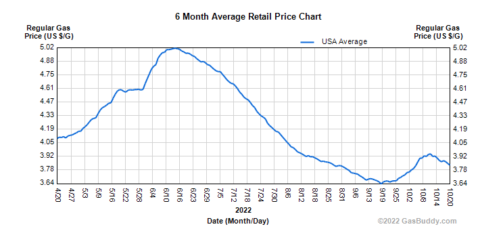
Still, the average price gas across the US has dropped dramatically from earlier this summer says Gas Buddy(see chart)

Screen Shot 2022-10-20 at 7.56.05 AM


AAA says as of Oct 17 that domestic gasoline demand decreased as fewer drivers fueled up in the first half of October. According to the Energy Information Administration (EIA), gas demand decreased nationally from 9.47 million b/d to 8.28 million b/d, and total domestic gasoline stocks increased by 2 million bbl to 209.5 million bbl.

Lower gasoline demand, amid increasing supply and fluctuating oil prices, has contributed to the national average moving downward. If demand continues to drop coupled with a slide in oil prices, drivers could see increases in prices at the pump start to slow and even come down through the week.

In California  with an average of $5.875/gal-  the price has now dropped about 55cts/gal in under 2 weeks says oil analyst Tom Kloza.
.
The national average pump price for a gallon of gas decreased three cents over the past week to hit $3.88. October 17 national average of $3.88 is 20 cents higher than a month ago and 56 cents more than a year ago.

In the past day President Biden said he would release more oil from the Strategic Oil Reserve to try to bring prices down more.

Offshore wind lease sale set for December 6

-October 18,2022-

European offshore wind

WASHINGTON — In a new development in the pursuit of a clean energy future, the Department of the Interior today announced that the Bureau of Ocean Energy Management (BOEM) will hold an offshore wind energy lease sale on Dec. 6, 2022, for areas on the Outer Continental Shelf (OCS) off central and northern California.

This will be the first-ever offshore wind lease sale on America’s west coast and the first-ever U.S. sale to support potential commercial-scale floating offshore wind energy development. This sale will be critical to achieving the Biden-Harris administration’s deployment goals of 30 gigawatts (GW) of offshore wind energy by 2030 and 15 GW of floating offshore wind energy by 2035.

“The demand and momentum to build a clean energy future is undeniable. I am proud of the teams at the Interior Department that are moving forward at the pace and scale required to help achieve the President’s goals to make offshore wind energy, including floating offshore wind energy, a reality for the United States,” said Secretary Deb Haaland. “Today, we are taking another step toward unlocking the immense offshore wind energy potential off our nation’s west coast to help combat the effects of climate change while lowering costs for American families and creating good-paying union jobs.”

Among the stipulations announced today, BOEM will offer bidding credits for bidders who enter into community benefit agreements or invest in workforce training or supply chain development; require winning bidders to make efforts to enter into project labor agreements; and require engagement with Tribes, underserved communities, ocean users, and agencies.

In May 2021, Secretary Haaland and California Governor Gavin Newsom joined Biden-Harris administration leaders to announce an agreement to advance areas for wind energy development offshore the northern and central coasts of California. The California sale reflects the leasing path announced last year by Secretary Haaland and last month’s announcement of a new deployment goal of 15 GW of floating offshore wind energy by 2035.

BOEM will offer five California OCS lease areas that total approximately 373,268 acres with the potential to produce over 4.5 GW of offshore wind energy, power more than 1.5 million homes, and support thousands of new jobs.

“Today’s announcement represents years of close coordination and engagement with the state of California, Tribes, ocean users, local communities and all interested parties to move us closer towards achieving the administration’s vision to fight climate change and realizing California’s clean energy future, while creating a domestic supply chain and good-paying union jobs,” said BOEM Director Amanda Lefton, who will deliver remarks this morning at the Offshore WINDPOWER 2022 Conference. “BOEM remains committed to ensuring transparency and active engagement with stakeholders throughout the post-leasing process.”

To date, BOEM has held 10 competitive lease sales and issued 27 active commercial wind leases in the Atlantic Ocean from Massachusetts to North Carolina.

The California Final Sale Notice (FSN), which will publish in the Federal Register later this week, provides detailed information about the final lease areas, lease provisions and conditions, and auction details. It also identifies qualified companies who can participate in the lease auction.

The FSN includes three lease areas off central California and two lease areas off northern California. It also includes several lease stipulations designed to promote the development of a robust domestic U.S. supply chain, advance flexibility in transmission planning, and create good paying union jobs. Among the stipulations announced today, BOEM will offer bidding credits for bidders who enter into community benefit agreements or invest in workforce training or supply chain development; require winning bidders to make efforts to enter into project labor agreements; and require engagement with Tribes, underserved communities, ocean users, and agencies.

On May 26, 2022, the Department announced the Proposed Sale Notice for offshore wind energy development located offshore central and northern California. During the 60-day comment period, BOEM received valuable feedback on several lease stipulations that reaffirmed BOEM’s commitment to create good-paying union jobs and to engage with Tribal governments, underserved communities, ocean users and other stakeholders.

‘Minimobility’ could fill the gap between micromobility and electric cars, analysts say


The McKinsey Center for Future Mobility says cities may need to prepare for a transit option between a bicycle and a car.

October 8,2022-

By Charles Pekow

Screen Shot 2022-10-09 at 7.42.13 AM

A Toyota i-Road minimobility concept vehicle 

“Minimobility” vehicles may be the next wave of transportation coming to cities, according to a September report by the McKinsey Center for Future Mobility, an international mobility consulting firm.

Shared use of these three- or four-wheeled electric-powered vehicles that carry one to two people is gaining interest in Europe, especially in France, according to the center.

The total addressable market for such vehicles could reach ”$100 billion annually across China, Europe and North America by 2030,” the report said. “In urban areas, minimobility may emerge as a viable alternative, bringing the added benefits of decreased congestion, reduced space requirements and lower emissions.”

Minimobility vehicles are easier to build, smaller, cheaper and more energy efficient than cars, according to the report. They are also slower and potentially safer than other mobility types.

TRENDLINE

Inside the energy transition to renewables

Unlike traditional micromobility vehicles such as scooters, bicycles and mopeds, they allow drivers and passengers to sit comfortably, carry more cargo, and provide weather protection, said Kersten Heineke, the center’s co-leader, in an interview.

The report says municipalities may add them to their vehicle sharing mix, but Heineke said private ownership would likely become a bigger market. “The best analogy is the retirement communities in Florida and California and other places where people use golf carts to go from A to B,” he said.

The report says manufacturers could build minimobility vehicles to go about 55 mph. But they are better suited to going 25 to 30 mph on city streets and could use GPS to prevent them from going faster than 12 or 15 mph when driven off-road, such as in a bike lane, Heineke said.

Governments will have to decide what, if any, licenses people will need to drive them on or off roads, he added. It wasn’t long ago that no one was talking about e-scooters, “and now they are everywhere,” he said.

The range between charges remains undetermined but will probably vary between 40 and 100 miles as “you will not do a 40-mile commute every day,” Heineke said. He anticipates that owners will be able to charge minimobility vehicles using standard electric outlets.

Foreign manufacturers have shown more interest than American ones; the first minimobility vehicles in the U.S. will probably be imports, Heineke said. Mobiag, a mobility tool maker, reported that Renault, Toyota and Nissan are among the automakers that have proposed prototypes for such vehicles.

Valley rooftop solar installations head higher


Solar plus batteries help keep the lights on during recent heatwave

-Ocotober 8,2022-

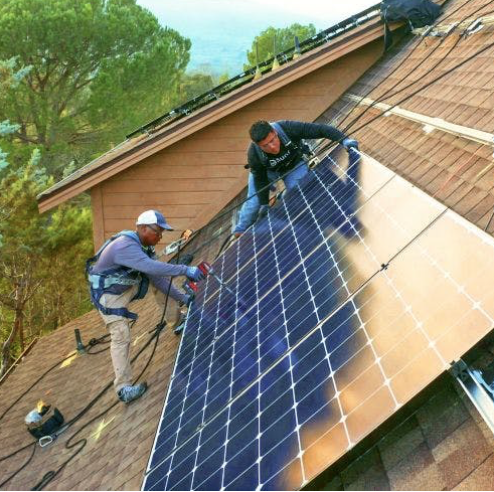
Screen Shot 2022-09-30 at 12.36.39 PMResidential “rooftop” solar panel installations are heading higher this year according to the website Construction Monitor. Permits for residential solar units in Tulare, Kings, Fresno and Madera counties number 16,126 through September of this year, valued at nearly $400 million. That is up from 13,216 permits over the same time in 2021 and nearly double what it was in the first 9 months of 2020 when 8529 solar installations were permitted.

Who is the top solar installation company in the four-county area? Sunrun leads the pack with 3749 systems installed at an average price of $18,860, the lowest per-unit price of any of the top 15 companies doing work in the Central Valley. In terms of number of units, Solgen Electric is number two with 1052 units installed so far this year. Solar Negotiators are third with 794 units.

Among the reasons to go solar,homeowners can count on solar energy systems as a proven savings and investment tool with locked-in returns over 25 years.

San Francisco-based Sunrun advertises that “you can be your own electric company” adding that with net metering you can balance the amount of electricity you draw from the grid, and how much excess solar electricity you push into it. “So when you use less electricity than you make, you get credit from the utility company.”

Sunrun focuses on a power purchase agreement business model where Sunrun installs and maintains a solar system on a customers home, then sells power to the customer at an agreed upon rate for a 20- or 25-year term. This business model allows property owners to install solar at no upfront cost, but without the benefits (such as tax breaks) or some risks that come with being the owner of the system. The company partners with Costco and The Home Depot to market their products inside the stores. In 2021, the company installed solar systems capable of generating 792 megawatts of power.

Sunrun and others pair battery units with their panels.Having both home solar as well as a linked battery unit does make your household a socially-useful electric company, it turns out, helping to keep California’s lights on when there is a power issue in the area we all learned recently.

An analysis by the California Solar and Storage Association (CALSSA) shows that California had more than 80,000 customer-sited batteries connected to the electric grid capable of providing 900 MW of solar power.

“The biggest battery in the world is located in garages around California and they are helping keep the lights on for everyone”

While not all the batteries were set to discharge during the peak hours of 4 p.m. – 9 p.m. on September 6, an estimated 76% were, which as a fleet, were capable of providing up to 684 MW of power at any given moment. CALSSA estimates that 50% of these batteries’ aggregate power was put into use during peak hours, providing approximately 340 MW of power. To put this into perspective, 340 MW is more than a mid-sized power plant.

“The biggest battery in the world is located in garages around California and they are helping keep the lights on for everyone”

When California suffered rolling blackouts in August 2020, California had 30,000 distributed batteries with the potential to discharge 500 MW of power. In just two years, 50,000 consumers added 400 MW of clean sun-charged battery power. The current 900 MW of distributed batteries in California is nearly the size of Diablo Canyon’s Unit 1.

“The biggest battery in the world is located in garages around California and they are helping keep the lights on for everyone,” said Bernadette Del Chiaro, CALSSA executive director. “While it goes largely unrecognized by utilities and grid operators, these consumer investments in clean energy played a crucial role during this week’s heat wave helping keep the lights on not just for the homeowners and businesses who made the investment but for everyone.”

In February 2022, Ford announced a partnership that makes Sunrun the official installer of its bidirectional charging station for the F-150 Lightning, allowing customers to charge their truck at home, but also use the vehicle battery for backup power during a grid outage.