
-April 15,2022-
The Gas Company wants a piece of the Morro Bay wind farm and has been offered a 24% stake in the proposed multi-billion dollar project. So, what does a natural gas supplier want with a wind farm?
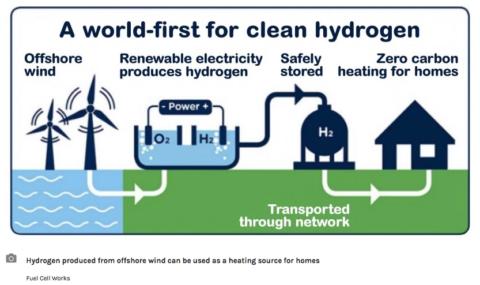 Like all California utilities, SoCalGas is looking to decarbonize the energy they deliver to residents and industry by pipeline to cool global warming.The idea is to replace fossil fuel-derived natural gas with renewable gas or “green hydrogen” – an ubiquitous gas with many uses and potentially a very bright future.
SoCalGas parent company is Sempra, based in San Diego. Its operating companies include both Southern California Gas Company and San Diego Gas & Electric in Southern California. SoCal distributes gas from San Luis Obispo in the north to the Mexican border in the south.
Now Sempra is poised to enter the offshore wind sector under a deal that would have it join French energy giant Total Energies in a planned project off California.Total Energies in March announced they would join Castle Wind to build the project and be part of an auction to lease seabed off the Central Coast this fall.
Days later – this month Sempra and Total Energies said Sempra would acquire a part of Total Energies’ stake in the merger joining the three major players in the deal to construct a 1GW offshore wind project using floating turbines about 30 miles off the coast connected by pipeline to the Morro Bay shore.
How does hydrogen fit into all this? A White House issued primer explains the basics. Hydrogen is the simplest and most abundant element in the universe. It is found within water and all living matter, but it rarely exists as a gas on Earth—it must be separated from other molecules requiring some energy source and catalysts to do the work.The most abundant supply is water – H2O.Water can be split by electricity into hydrogen and oxygen. It just so happens that offshore wind blows steady just where there is plenty of water – the Pacific.
So both the source material and the power source are coincidently co-located.Besides that fact, it turns out you can generate hydrogen gas offshore by electrolysis on a floating turbine and ship it back to land using the pipelines.
Once it arrives it can be stored or fed into the same pipeline infrastructure we use to ship natural gas to every home and factory.It means that “green hydrogen’” – produced without any release of carbon – can help facilitate an affordable energy transition.Combining the processes may well be the best path to create renewable, consistent, cost-efficient power suggests advocates.
Desalination too
There is another important process that can happen at sea – offshore desalination that takes place below the surface, using a reverse osmosis process. Unlike land-based desalination there is no waste issue -brine disposal – like onshore facilities have. The clean drinking water is then piped to shore and distributed to a thirsty California.
There is a small Santa Barbara company SeaWell that is offering a pint-size version of this offshore model (without the hydrogen) powered by wave action, being discussed by Santa Barbara County, Vandenberg SFB and San Luis Obispo County, says a Santa Barbara County official.
For the huge population that lives close to the coast in California – about 40% of the people – there would now be a nearby source not just for electric power and heat but also game changing transportation fuel to replace diesel fuel and now drinking water -all stuff in very short supply.
In recent days, Southern California Gas announced its proposal to develop what would be the nation’s largest green hydrogen energy infrastructure system (the “Angeles Link”) to deliver renewable energy to the Los Angeles region. The Angeles Link would support the integration of more renewable electricity resources like solar and wind and would significantly reduce greenhouse gas emissions from electric generation, industrial processes, heavy-duty trucks, and other hard-to-electrify sectors of the Southern California economy. The proposed Angeles Link would also significantly decrease demand for natural gas, diesel, and other fossil fuels in the LA Basin.Among the goals -displace up to 3 million gallons of diesel fuel per day by replacing diesel powered heavy-duty trucks with hydrogen fuel cell trucks. In addition the plan would provide the clean fuel to convert up to four natural gas power plants to green hydrogen in the LA Basin.
Around 450 gigawatts of offshore wind energy could produce 24 billion kg/year of hydrogen, enough to power around 74 million homes in a year, according to one study.
Besides the other uses, hydrogen can be used to store excess power. Instead of wasting extra energy produced by wind and other renewables- it can be converted into hydrogen. This hydrogen could be stored and then converted back into electricity by fuel cells or hydrogen-driven turbines when needed.Hydrogen fuel cells produce electricity by combining hydrogen and oxygen atoms. The hydrogen reacts with oxygen across an electrochemical cell similar to that of a battery to produce electricity, water, and small amounts of heat.
If SoCalGas wants to invest in offshore wind – the other big natural gas supplier in California -PG&E could be a player as well serving their 70,000 square miles territory in Central and Northern California.Like their southern California counterpart, PG&E wants to continue to use their network of pipelines to deliver to homes and factories and is under the gun to cut carbon emissions in a big way, too.
With green hydrogen coming ashore in SLO County there stands to be new investment in hydrogen facilities and infrastructure on shore, side by side with electric facilities and substations and all the jobs that go with both.
Attachments area