
-April 17,2022-
Finger pointing by both Democrats and Republicans don’t tell the story here. But the charts don’t lie.
All those key ingredients of your morning breakfast are way up in price. From milk to eggs to bacon, coffee and orange juice – all are double digits higher than consumers paid a year ago.
 Of course those breakfast price hikes might scramble your budget but you cant go without breakfast ,right? Each product has their own story to tell, but all are in short supply.
Breakfast foods are reaching a 10-year high thanks to supply chain woes, bad weather, war, reduced supply and renewed demand as the pandemic eases.
Bacon is a whopping $1.71 more than it was pre-pandemic. A pound of coffee beans will set you back an extra dollar. And for just toast – an extra 17 cents.
And the squeeze is on when it comes to oranges and orange juice too.
Collapse of the Florida orange industry
The Department of Agriculture predicting the smallest crop of oranges in Florida since 1945 with orange production down 16%, but at the same time – demand for orange juice continues to climb. Experts expect prices to climb and attribute the low crop to citrus greening, an incurable plant disease caused by infection from an Asian insect that turns oranges bitter and green. Add those deep freeze events and hurricanes, each associated with global warming, that adds up to a virtual collapse of the Florida citrus industry in the past decade.
Consider that Florida in the 1990s regularly harvested 200 million boxes of oranges each year -221 million 1996. By 2011 it was down to 147 million boxes.
In the latest forecast for 2022, Florida will harvest a pitiful 38 million cartons – down nearly by half from just one year earlier! Looking closer – USDA says the lower supply is coming from an estimated 51% fruit that simply drops from the trees.
The decrease in orange volume has hit the orange juice market where most of the state’s crop end up.
So the price of OJ futures is up 59% based on low supply and consistent demand- people thirsty for that Vitamin C rush.
OK, it hard to blame anyone but Mother Nature for all this. Prices of oranges, tangerines and other types of citrus jumped 6.8% in February as overall food prices continue to rise, according to the U.S. Bureau of Labor Statistics’ Consumer Price Index.
The increase in price has helped another state California – where the industry, not impacted by citrus greening, is producing an expected 51 million boxes, higher than Florida’s 38 million.
Milk producers enjoy higher prices
How about milk? Dairy operators will tell you their biggest input cost is feed – led by corn.And corn too is sky high. Farmers have to ship corn to California with the price near $8 a bushel compared to half that in 2020.You can blame multiple factors including oil and diesel fuel transportation costs impacting fertilizer prices as well.
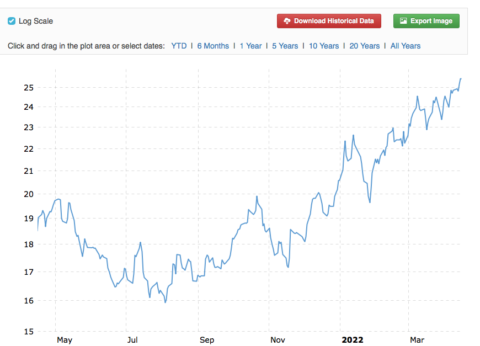
To compensate, milk prices stand at near $25 per/cwt.This milk price chart looks like many other farm commodities.Dairy operators say this is the first time in a few years they making money.
Prices are likely to remain high as long as global milk output is in decline. USDA’s Dairy Market News described the situation in Europe, offering a summary that will surely feel familiar to American dairy producers. “Farmers would like to take advantage of strong milk and dairy prices, but the increased costs of feed, labor, replacement heifers, and other farm inputs make expansion difficult.” The upshot is less supply of this breakfast item too.World shortages has juiced US milk production with record exports leaving less milk for domestic use.
This week corn futures rose to an almost 10-year high of $7.86 per bushel on prospects of stronger demand against smaller production and supply chain issues.The price is highest since 2012. Surging crude oil prices, and news from the Biden administration that it will increase ethanol usage this summer helped to support new buying. At the same time, dry conditions in Brazil, smaller-than-expected planting areas in the U.S, and delay in China’s corn planting amid lockdowns are set to cause significant production losses. This added to the already existing fears of supply disruptions from Russia and Ukraine, the two major global corn exporters. Since Russia invaded Ukraine, Ukraine suspended commercial shipping at its ports while Russia paused grain trade following the West’s trade sanctions on Moscow.
What about coffee? Here is five-year chart for coffee prices.Coffee prices have been rising for 17 consecutive months. Coffee consumption in US reached a 20-year high, according to National Coffee Association. The NCA’s 2022 Spring National Coffee Data Trends report found 60% of the US population drinks coffee every day – a 14% increase since January 2021.
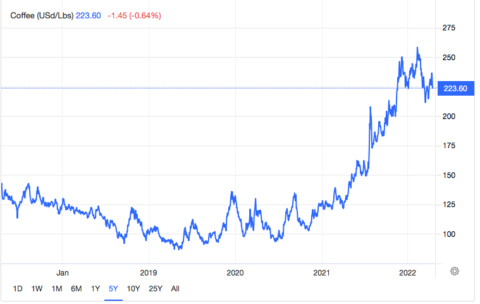
Couple this with good demand and falling supply due in part to extreme weather events, it seems.
One report notes that In 2021, both frost and drought struck coffee crops in Brazil, the world’s largest exporter, with losses .estimated around 10 million bags, equivalent to more than a third of annual U.S. coffee purchases. U.S. consumer coffee prices are now at a nine-year high, and the shortage isn’t going away any time soon. In addition to weather extremes, climate change is fueling pests and disease damage, such as coffee leaf rust, which wreaked havoc across Latin America in the past decade and is now hitting crops in Hawaii.
As for bacon – all meat prices are up as the industry has consolidated. Ground beef prices rose nearly 13%; pork — including ribs and roasts, whose prices rose 14.22%; chops, which saw a 14.5% increase in price; bacon and breakfast sausages, whose prices spiked nearly 16%.
Corn prices up too
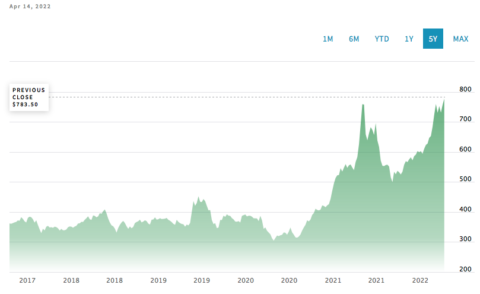
All these meat sources depend on corn with fewer US corn acres forecasted to be planted this year.That has driven up the future price of corn late this year.Higher fertilizer prices are an incentive to not plant corn. Meanwhile there is concern over 500 million corn bushels still trapped in Ukraine for the foreseeable future.
If there is some good news for you to chew on -look to Kellogg’s,
the big cereal maker who transforms 200 tons of corn every day into Snap/ Crackle & Pop and the rest – 25% more than in 2016.
Around half is used to create Cornflakes and Coco Pops, a kids favorite. The good new , since 2011 Kellogg’s has removed 11,000 tons of sugar from its cereals and plans to cut down on salt.
But don’t look for a price break.