Port San Luis Plans Huge New Campground / New Fish Growing Pens Studied

Harbor Terrace is an approximately 50-acre site above San Luis Bay, the site of a former mobile home park. The entrance to the new facility will be just east of the access road to Diablo Canyon.Once constructed, the proposed campground will help meet the need for lower cost accommodations in the region by providing a mix of tent camping, tent cabins, and RV sites serving up to 300 visitors at a time.

The developer, Bay Area-based GMB Realty Partners says “Our vision for Harbor Terrace is to create a truly unique Coastal Camping Resort where every view is a coastal view.”

The resort offering will include 102 RV locations,50 tent camp sites,25 tent cabins, a main lodge, a restaurant ,market-deli, boat and trailer spaces and other harbor uses.

Harbor manager Steve McGrath of Port San Luis says the hillside project will boost tourism, be a “significant source of  revenue” for the district and  offer storage facilities for fishermen,a big draw to the area.Clearly it will help other Avila Bay businesses, including port concessions as well.

The California Coastal Conservancy a state agency established in 1976 to enhance coastal resources and access has reviewed the plan is expected to approve a memorandum of understanding with Port San Luis on the project in February. “In return for the Conservancy carrying out the entitlement activities, the District will agree to provide the Conservancy with a portion of any revenue it may receive from the leasing of the site to a private entity for the construction and eventual operation of the campground “says minutes of a December joint meeting. The conservancy will approve a $400,000 grant to help to establish the campground there.

The Port San Luis dsirct has been in the planning phases for Harbor Terrace for over 10 years.GMB has estimate the cost of the project at $15 million. Once all approvals are in place the project will take 15 to 18 months to build, says the developer.

Port San Luis ,located in Avila Bay on on a south-facing beach with the prevailing winds and swell from the north offers a sheltered cove and some of the greatest weather on the entire Central Coast.

The Coastal Conservancy notes that Harbor Terrace could be attractive to moderate to lower income visitors.” Out of more than 1,600 hotels, RV parks and campgrounds in California’s coastal counties, fewer than 10% offer accommodations under $100 per night” says a Conservancy report on the project.

“All of these improvements will be designed and sited to minimize impacts to the area’s natural and scenic resources and to meet today’s energy efficiency standards. “ says a Conservancy report.

sea bass

Growing Pens For Sea Bass Planned At Port San Luis

Central Coast sea bass fishing could get better once growing pens to add to their local population get growing this year.Port San Luis Harbor manager Steve McGrath says the pilot project is modeled after sea bass growing pens in southern California where they have successfully boosted the fishery there.”We will see how it works in these colder waters” says McGarth.

The growing pens were used at Port San Luis on Avila Bay to grow salmon and sturgeon but were discontinued after it was determined by  California DF&G that the practice could be harmful to the wild salmon  population. But there is no such problem with sea bass.

The district filed a negative declaration this  month and will now go to the California Coastal Commission and State Lands Commission for their blessing.
McGrath says the project could start this summer. The hatchery fish will be pend in the ocean at Port San Luis and feed for 2 to 3 months before being released. McGrath says before the fish are a year old they can be caught.

Coast Biz Beat/ Outdoor Amphiteatre / New Cinema / SLO Airport

Edward Cinema Coming To Santa Maria

Edwards Theatre is building a $ 8.6 million 14-screen movie theater in the Santa Maria Town Center complex. The new cineplex replaces the former Gottschalks building and is expected to open late this year.

SLO Airport Traffic Down 4.7%

San Luis Obispo Regional Airport recorded a down year in 2012 accommodating 259,505 passengers compared to 272,429 in 2011 – a 4.7% decline. The numbers are down from the years 2002 to 2008  when the airport saw an average more than 300,000 passengers fly here.Airport management says demand is there but the number of seats in the market available  though the 2 airlines based here are down compared to earlier this decade.

3000 seat outdoor amphitheater set to open this summer

Outdoor Amphitheater In Wine Country

Paso Robles, CA. – San Francisco based Prescient Entertainment, in partnership with AEG Live, has been selected as the exclusive promoter to book the inaugural concert season at the 3,300 seat VinaRobles Amphitheatre, which is set to open in summer 2013.

The new state-of-the art boutique amphitheatre is located adjacent to Vina Robles Winery’s existingHospitality Center in the heart of Paso Robles wine country. The amphitheatre, nestled on a picturesque oak-dotted hillside, will feature a combination of tiered reserved seats, VIP boxes, and general admission lawn seating; offering a variety of ticket pricing options for concert-goers. VIP and Season ticket holders will be able to immerse themselves in the full concert experience with access to luxury services including valet parking, VIP/artist reception area, and first-class pre show dining options.

The venue is scheduled to host 15 to 20 events a year between April and October beginning in midsummer of 2013. Opening day has not yet been scheduled. “I am excited to partner with AEG Live and Vina Robles Winery to book our first of many seasons at this incredible new venue.” says Lee Smith, President of Prescient Entertainment. “The addition of booking the Vina Robles Amphitheatre was a natural fit for us because we already produce concerts in similar venues in both Northern and Southern California. Vina Robles will allow us to bring these same artists to Paso Robles as they travel between cities.”

General Manager, Tim Reed who has overseen the development of the project says, “This facility represents a new high-water mark for entertainment on the Central Coast and will forever change the local concert-going experience. We look forward to working with Lee and his team to bring first class concerts to Paso Robles. The Vina Robles Amphitheatre will become the premier outdoor entertainment destination between Santa Barbara and the Bay Area.”

Oner Hans Nef describes the winery’s plan”.We craft wines that represent a stylistic bridge between the Old and New worlds, capturing the finesse associated with European wines while celebrating the bold natural flavors of our estate vineyards in Paso Robles. Here, proprietor Hans Nef and managing partner Hans – R. Michel bring their Swiss heritage to California’s Central Coast, where they aim to unite the
best of both experiences. We specialize in varieties that excel in the complex soils and nuanced microclimates of Paso Robles, and we also embrace unconventional blends as an opportunity to create wines of distinctive quality and character.”

After Wet December – Dry Winter Looms

Tale Of Two Winters & Two Californias

It poured in Northern California in December as rainfall totals were over 200% of normal for the water year starting October 1 and going into the New Year.

Even today – three weeks later – the state DWR says  the Northern California  Water Index stands at 142% of normal for this date with 33 inches of precipitation so far. The agency says in an average water year (ending after April) we can expect around 50 inches in the bucket.

For the 5-station San Joaquin Valley Index – more indicative of our neck of the woods – the index is at 109% of normal for the date having already received about half the 40 inches we can expect by the end of April in a “normal “ year.

But if this football game’s first half has been full of stormy excitement – the second half – January and now likely February seem like a much different team has showed up on the field and they are a quiet and  literally – cold bunch.

“February like January looks on the dry side” says Alan Fox of Fox Weather who predicted the record breaking storms in late November and December characterized by what NOAA called “ atmospheric rivers “ of tropical moisture that funneled into California. Some places along the Feather River  got over 2 inches an hour one of those events.

At that time Fox saw a a wet winter ahead but changes in sea temperatures to the cool side along the equator have changed the ballgame. The El Nino pattern is gone.

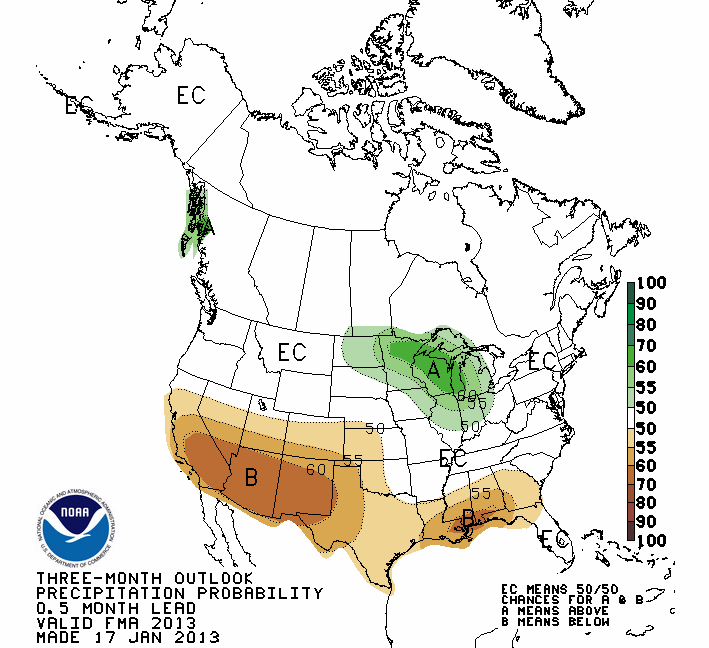
NOAA’s Climate Prediction Center has recently (Jan 17) published this three month map with big brown spot signaling dry weather over central and southern California the rest of this winter.

Not only is this bad news for central California but for drought stricken states in parts of the Midwest who desperately need rain this coming Spring to avoid another bad corn and soybean crop year

Tale Of Two Winters

After flowing freely in December the spigot seemed to be shut on “off” as of January. At the key northern reservoir at Shasta Dam that had seen 31 inches of rain in November and December –  the rain gauge measured just 0.08 inches over the first 21 days of this month.

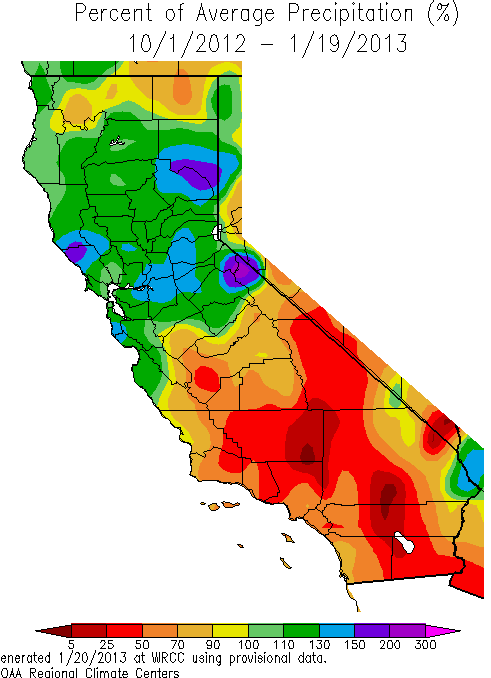
click to enlarge- TWO CALIFORNIAS

If it as a tale of two winters it is also a tale of two Californias so far this water year. This map tells the story showing the percent of average rainfall from Oct 1 through Jan 20 with part of northern California at 200%( purple) and parts of southern California at 25% of average( brown).

More dry cold weather is in the offing Fox says.

Still, forecaster Fox says he is “not giving up on February” and expects a few storms to come into the state over the month coming up.

“January 24,25 ,26 could see a small amount of rain and Feb 5,6 should see a storm that will drop snow in the Sierra “ he says.

Central Coast forecaster John Lindsey says today to expect unsettled weather for this region starting Wednesday and more promising – ”rain showers forecast on Saturday into Sunday.”

But those big rain events of December are long gone.

Union Bank Names Branch Closures On Central Coast

UNION BANK AT MORRO AND MARSH IN SLO WILL CLOSE

As as a result of the purchase of Santa Barbara Bank and Trust last year Union Bank will close some 16 branches on the California coast from Beverly Hills to the Bay Area.

On December 29,2012 the San Francisco-based bank filed notices of closures with the Department of  Treasury on the Central Coast at 1140 Morro Street in San Luis Obispo, 335 E Betteravia Rd in Santa Maria,,200 N “H” St in Lompoc, and 1714 Mission Dr in Solvang – all towns with duplicative Santa Barbara Bank and Trust locations. The bank has indicated the closures would take place by April.

All notices are listed on the US Treasury website,Office of the Comptroller of the Currency.

UnionBanCal Corporation (“UNBC”) and its primary subsidiary, Union Bank, N.A. (“Union Bank”),  announced in Deecmber that it has completed its $1.5 billion purchase of Pacific Capital Bancorp (“PCBC”), a bank holding company headquartered in Santa Barbara, California. As part of the transaction, Santa Barbara Bank & Trust, N.A. will be merged with and into Union Bank on December 3, 2012, with Union Bank continuing as the surviving entity. The merger received final regulatory approval on November 14, 2012.

Through the transaction, Union Bank acquires $3.7 billion in loans held for investment and $4.7 billion in deposits, as of September 30, 2012.

The Union Bank purchase of Santa Barbara Bank & Trust branches on the Central Coast will result in the layoff of 468 employees,most of them by April, said bank spokesman Dan Weidman. Here is the bank’s statement. 
“Union Bank will retain 570 Santa Barbara Bank & Trust employees, including most customer-facing positions across the bank.  468 positions will be eliminated over the course of the next twelve months. 80 percent of those whose positions have been eliminated will not depart the bank until at least April 30, 2013. Union Bank currently has 175 open positions from Los Angeles to San Jose for which impacted employees can apply.”
That would leave about 300 without a job even if they can fill an open position that may be a hundred miles or more from where they live now.
Santa Barbara Bank and Trust had 46 locations from Gilroy south to Beverley Hills. Union Bank has some duplicate locations with Santa Barbara Bank & Trust including San Luis Obispo and Santa Maria in our reading area.
Union Bank is slated to brand all the SBB&T locations as Union Bank.
Using the company figure of 468 position layoffs and 16 branch closures the numbers average around 30 people per branch who will lose their jobs.

Plans for 350 Oil Wells Near Pismo

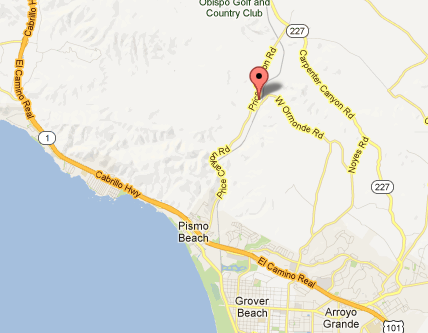
Plains Exploration and Production Co (PXP) has filed a preliminary notice with San Luis Obispo County that it will seek to expand its oil field in Price Canyon near Pismo Beach from 100 oil wells currently to 350. The drilling is planned on hillsides on both sides of the highway and include 11 new pads. A new pipe will cross Pismo Creek that also runs at the base of the canyon.

County planner John McKenzie says the company has been asked to respond to questions regarding any potential use of the controversial practice of fracking at the site but has indicated it will be doing more of the traditional steam injection to coax heavy oil out of the ground.

McKenzie says the environmental review of the big project could take a year or longer and of course, include public hearings.

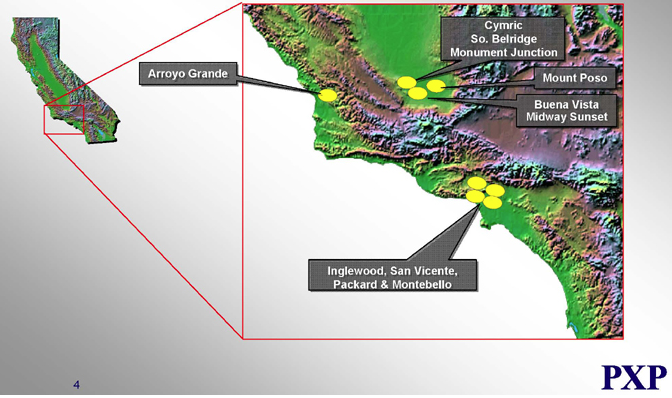
The oil field is the largest in SLO county. A 2010 PXP release refers to the multi-phase Price Canyon project said  “PXP holds a 100% working interest in the Arroyo Grande Field located in the Santa Maria Basin in San Luis Obispo County, California. This is a long-lived field that has heavier oil (12 to 16 degree API gravity), well depths averaging 1,700 feet and requires continuous steam injection. In 2009, PXP spent $4 million on capital projects in this field and drilled 7 wells.”

Fast forward to 2012 and you see a major increase in activity on the project. Plains Exploration is the largest commercial building applicant in San Luis Obispo County this year after the two huge solar projects on the Carrizo Plain. Already this year,PXP has submitted applications for about 100 permits for improvements in the Price Canyon area valued at over $40 million. With plans for more than 3X the wells – it’s clear these guys are planning to spend lots more money and believe there is plenty more oil in Price Canyon.

The county notice calls the expansion Phase V of their project . The field is said to be 320-acres which is within the larger 1,480-acre Price Canyon Unit as defined by the California Division of Oil, Gas & Geothermal Resources (DOGGR).

project location

In 2011 PXP got approval to build a water recycling operation in Price Canyon that discharges back into Pismo Creek. PXP needed the facility to have enough water to boost production of the heavy crude oil by what is expected to be thousands of barrels a day – up from around 1300 a day now. The water facility will be ready for operation next year.

If they are planning more oil rigs,not far away there could also be more houses too. Price Canyon has been in the news recently because of a development plan adjacent the City of Pismo Beach that would roughly double the number of residential units in town if it moves forward.Better get used to living near oil rigs down the block.
   
Mining Giant Buys PXP
The big got bigger this month. Earlier in December it was announced that the mining giant Freeport-McMoran was buying Houston-based Plains Explorations and Production for approximately $6.9 billion in cash and stock. Beside holdings in Price Canyon called the Arroyo Grande Oilfield,PXP also has extensive oil holdings elsewhere in southern California and the San Joaquin Valley. The company is also drilling off the coast near Vandenberg. They are said to be the fourth largest oil company in the state.
Locally PXP has a regional office in San Maria. In California, PXP says they have 430 personnel and on average over 400 contract personnel.
On the fracking issue, the worries about the use of some chemicals in injected water to extract petroleum products has heated up and now the Brown administration has signaled interest in getting involved on the state level. A draft proposal requires the oil industry to disclose where in the state they are using hydraulic fracturing, commonly referred to as “fracking. Brown’s proposal comes  as a critical new movie on the practice called Promise Land is set to be released in theaters December 28.
Also NRDC says in October – “Plains Exploration and Production Company (PXP) released a long-awaited study on the oil drilling company’s hydraulic fracturing operations at the Inglewood Oil Field in the Baldwin Hills area of south Los Angeles. While it took a year to compile the study, this report actually was years in the making as it comprised one of a host of new requirements imposed on PXP through a July 2011 settlement that resolved a lawsuit brought by NRDC and three other plaintiffs in 2008.
The study appears to have found that two test frack jobs at the Inglewood field did not result in adverse impacts to groundwater or community health, nor did they cause additional ground movement or subsidence. We are reserving judgment until we’ve had a chance to carefully review all of the study’s findings, as well as the hundreds of pages of dense, technical information the author has offered to support those findings.”

SLO Sales Tax,Bed Tax Revenue Climb

Hottest retail area is Los Osos Valley Rd says new report

Sales tax revenue for the second quarter of 2012 was up 7.1% in 2012 after climbing 9.2 % the last quarter.  The trend is positive both here and nationally with an expected increase of of 4.1% in Holiday sales by the National Retail Foundation.

SLO city sales grew strongest Sales the Los Osos Valley Rd corridor up 25.4% in the latest quarter with a 9% increase Downtown but a 10% decline in the Madonna retail area.

Statewide the SLO quarterly newsletter published by their finance  department  reports that auto sales receipts are up 22.8% in SLO with restaurants  and liquor sales up 26%. Speciality stores and sporting goods stores were each up a hefty 34 to 35%.

The city reports says sales tax revenue for all the county for the quarter was up nearly 13%.

On the bed tax front the city reported October TOT tax up 7.3% and 6.9% year to date as more visitors stayed in our hotels.

Next month we will get a report that  will include the newly opened Hotel Granda that will add 17 rooms to the 2127 hotel rooms already in the city.

Southland Home Prices Up 17%

Pace Of Sales Up 14%

December 12, 2012

La Jolla, CA—Southern California’s housing market continued its gradual recovery last month, logging the highest November sales in six years amid strong demand from investors and move-up buyers. The median sale price rose nearly 17 percent from a year earlier, the result of price appreciation as well as the ongoing shift toward fewer foreclosure resales and more mid- to high-end activity, a real estate information service reported.

A total of 19,285 new and resale houses and condos sold in Los Angeles, Riverside, San Diego, Ventura, San Bernardino and Orange counties last month. That was down 8.5 percent from 21,075 sales in October, and up 14.2 percent from 16,884 sales in November 2011, according to San Diego-based DataQuick.

A decline in sales from October to November is normal for the season. Last month’s sales were the highest for the month of November since 23,005 homes sold in November 2006, though they were 11.3 percent below the November average of 21,730 since 1988, when DataQuick’s statistics begin. The low for November sales was 13,173 in 2007, while the high was 31,987 in 1988.

The median price paid for a home in the six-county Southland was $321,000 last month, up 1.9 percent from $315,000 in October and up 16.7 percent from $275,000 in November 2011. The September, October and November medians are the highest since the median was $330,000 in August 2008. The Southland median has risen or held steady month-to-month for 10 consecutive months and has increased year-over-year for eight consecutive months.

The median and other price gauges are rising mainly for two reasons: First, higher demand, triggered largely by ultra-low mortgage rates, has coincided with a dwindling supply of homes for sale, which has pushed prices up. Second, the market is rebalancing: Discounted foreclosures are becoming a much smaller portion of sales, while more expensive move-up homes are responsible for a larger share of sales. This change in the market mix puts upward pressure on the median sale price.

“The government’s offered people an amazing gift in the form of extraordinarily low mortgage rates. But that’s not the only thing fueling these sales gains. Investor activity and cash purchases remain unusually high, and more buyers feel confident about their jobs, the economy, and the likelihood housing prices have bottomed and are likely to rise. We’re also seeing more non-distressed sales, where people sell at a profit and buy another house, triggering more move-up activity,” said John Walsh, DataQuick president.

Activity rose sharply in most mid- to-higher-cost markets in November. Home sales between $300,000 and $800,000 – a range that would include many move-up buyers – jumped 34.6 percent year-over-year. November sales over $500,000 rose 47.5 percent year-over-year, while sales over $800,000 rose 46.8 percent compared with November 2011.

Last month 24.1 percent of all Southland sales were for $500,000 or more, up from 23.7 percent in October, and up from 18.3 percent a year earlier. Last month’s level of $500,000-plus sales was the highest since July 2008, when it was 26.1 percent.

Lower-cost areas again posted the weakest sales compared with last year. The number of homes that sold below $200,000 fell 18.7 percent year-over-year, while sales below $300,000 dipped 7.8 percent. Sales in the more affordable markets have been hampered by the slowdown in foreclosure activity, which results in fewer foreclosed properties listed for sale. Also, lower-cost markets typically have a relatively high percentage of homeowners who owe more than their homes are worth, meaning they can’t sell and move.

While inventory and sales have declined in many of these lower-cost areas, higher demand has pushed prices up. In November, price levels for the lowest-cost third of Southern California’s housing stock rose 24.4 percent year-over-year, while they increased 11.6 percent in the middle and 8.7 percent in the top third of the market.

Last month foreclosure resales – properties foreclosed on in the prior 12 months – accounted for 15.3 percent of the Southland resale market. That was down from 16.3 percent the month before and 31.6 percent a year earlier. Last month’s level was the lowest since foreclosure resales were 13.6 percent of the resale market in September 2007. In the current cycle, foreclosure resales hit a high of 56.7 percent in February 2009.

Short sales – transactions where the sale price fell short of what was owed on the property – made up an estimated 26.6 percent of Southland resales last month. That was down slightly from an estimated 27.6 percent the month before and up from 25.4 percent a year earlier.

Credit conditions didn’t seem to change much in November, though the share of purchase loans above $417,000 edged higher.

Jumbo loans, mortgages above the old conforming limit of $417,000, accounted for 21.0 percent of last month’s Southland purchase lending, up from 20.7 percent the prior month and up from 14.6 percent a year earlier. In recent months the jumbo share has been the highest since December 2007, when jumbos made up 21.7 percent of the purchase loan market. In the months leading up to the credit crunch that struck in August 2007, jumbos made up close to 40 percent of the market.

With rates on fixed 30-year loans so low, and aversion to risk in the marketplace so high, the use of adjustable-rate mortgages (ARMs) remains extraordinarily low in an historical context. Last month 5.7 percent of Southland home purchase loans were ARMs, compared with 6.0 percent in October and 6.2 percent a year earlier. Since 2000, a monthly average of about 33 percent of Southland purchase loans were ARMs.

Government-insured FHA loans, a popular low-down-payment choice among first-time buyers, accounted for 15.9 percent of all purchase mortgages last month. That was about even with 15.8 percent in October and down from 21.7 percent a year earlier. In recent months the FHA share has been the lowest since summer 2008. To some extent the decline reflects tighter FHA qualifying standards implemented in recent years as well as the difficulties first-time buyers are having competing with investors.

The most active lenders to Southland home buyers last month were Wells Fargo with 8.3 percent of the market, Prospect Mortgage with 2.8 percent and IMortgage.com with 2.3 percent.

Investors continue to account for a near-record share of sales.

Absentee buyers – mostly investors and some second-home purchasers – bought 28.3 percent of the Southland homes sold last month. That was about even with 28.4 percent the prior month and was up from 25.1 percent a year earlier. The record was 29.9 percent in February this year, while the monthly average since 2000 is 17.6 percent. Last month’s absentee buyers paid a median $254,523, up 27.3 percent from a year earlier.

Buyers paying with cash accounted for a near-record 33.0 percent of November home sales, up from 32.8 percent the month before and up from 29.5 percent a year earlier. Cash purchases peaked at 33.7 percent of all sales this February, and since 2000 the monthly average is 16.8 percent. Cash buyers paid a median $263,000 last month, up 27.1 percent from a year ago.

Not all investors pay cash, and not all cash buyers are investors. Last month about 62 percent of the Southland homes bought by absentee buyers were purchased with cash. About 54 percent of the homes purchased with cash were sold to absentee buyers.

Home flipping edged higher. Last month 6.2 percent of all homes sold had sold twice on the open market within a six-month period, up from 6.1 percent in October and up from 3.7 percent a year earlier.

DataQuick monitors real estate activity nationwide and provides information to consumers, educational institutions, public agencies, lending institutions, title companies and industry analysts.

The typical monthly mortgage payment Southland buyers committed themselves to paying last month was $1,146, up from $1,115 the month before and up from $1,049 a year earlier. Adjusted for inflation, last month’s typical payment was 51.7 percent below the typical payment in the spring of 1989, the peak of the prior real estate cycle. It was 60.4 percent below the current cycle’s peak in July 2007.

Indicators of market distress continue to move in different directions. Foreclosure activity, while above long-term averages, continues to drop and is far below peak levels. Financing with multiple mortgages is very low, and down payment sizes are stable, DataQuick reported.


Sales Volume Median Price
All homes Nov-11 Nov-12 %Chng Nov-11 Nov-12 %Chng
Los Angeles 5,859 6,637 13.3% $308,000 $350,000 13.6%
Orange 2,297 2,879 25.3% $400,000 $450,000 12.5%
Riverside 2,971 3,274 10.2% $195,000 $229,000 17.4%
San Bernardino 2,378 2,304 -3.1% $155,500 $183,000 17.7%
San Diego 2,754 3,371 22.4% $315,000 $358,000 13.7%
Ventura 625 820 31.2% $349,550 $370,000 5.9%
SoCal 16,884 19,285 14.2% $275,000 $321,000 16.7%

Tesco Throwing In The Towel On Fresh & Easy

No as easy as they thought

Decision taken to conduct strategic review of Fresh & Easy; all options under consideration; Tim Mason, CEO of Fresh & Easy, to leave Tesco

British grocer Tesco announced this week that they would put the US market chain up for sale after several years of struggling to turn profit.
The small format stores compared to Trader Joe’s by some, never garnered a strong following.
The company has 199 stores in the US including several in the Central California region in the S2S reading area. They include one in Santa Mara, one in San Luis Obispo and in the Valley, six locations in Fresno County, one in Lemoore in Kings County, and six locations in Kern County. Stores had been announced in Tulare and Visalia but never seemed to happen.
The company made this announcement.
“In October, we announced that new capital investment in Fresh & Easy was to be tightly constrained whilst the business focused on reducing costs and improving the profitability of its existing stores.
It is now clear that Fresh & Easy will not deliver acceptable shareholder returns on an appropriate timeframe in its current form.
We have therefore appointed Greenhill to assist with the review of options. In recent months, we have had a number of approaches from parties interested in acquiring either all or part of Fresh & Easy, or in partnering with us to develop the Fresh & Easy business. We will communicate progress on this process when we present our full year results for the current financial year in April 2013.
We are also announcing that Tim Mason is to leave Tesco after 30 years’ service with the company.”
Philip Clarke, Chief Executive said:
“I have been clear since my appointment as CEO was announced that my role is to deliver long-term value for shareholders. Following a year in which my priority for Fresh & Easy was to improve its performance, I have now made a fully-informed assessment of its longer term potential.
“Whilst the business has many positives, its journey to scale and acceptable returns will take too long relative to other opportunities. I have therefore decided to conduct a strategic review of Fresh & Easy, with all options under consideration.
“Tim Mason, who leaves Tesco today, has played an important part in our success over a 30 year career with the company, and he leaves with my thanks and good wishes.”

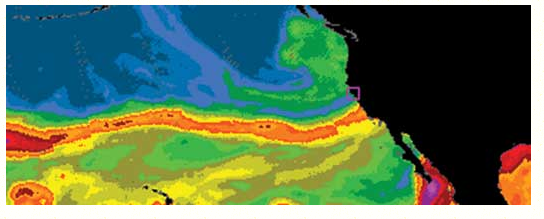
NOAA Installing“Atmospheric River” Monitoring Stations On Coast

atmospheric river of moisture streams into California

Just days after a soaking winter storm hit the state NOAA announced that its scientists and colleagues are installing the first of four long-term “atmospheric river observatories” in coastal California this month to better monitor and predict the impacts of landfalling atmospheric rivers. These powerful winter systems, sometimes called “pineapple express” storms, can be beneficial, in that they help to fill the state’s reservoirs, but they can also cause destructive floods and debris flows.

The coastal observatories, which are arrays of custom instruments, are being installed in
collaboration with the California Department of Water Resources and Scripps Institution of
Oceanography, University of California San Diego. The observatories will give weather
forecasters, emergency managers and water resource experts detailed information about
incoming storms such as winds and water content.

“California needs to know how and where it might rain or snow, when and where to
expect flooding,” said Michael Anderson, Ph.D., state climatologist with the California
Department of Water Resources. “The observatories will also help state officials and scientists
monitor changes in atmospheric rivers associated with climate change.”

This month’s installation of an atmospheric river observatory in Bodega Bay, Calif., will
be followed by installations at Eureka, Point Sur and Goleta. The move to set up the four
observatories and other weather instruments throughout the state came after NOAA
researchers and academic scientists spent several winters testing and selecting the most
effective arrays of instruments for collecting useful information for decision makers. Installation
of all four observatories is expected to be completed by early 2014.

“With satellites, we can see the tell-tale water vapor signature of an incoming
atmospheric river over the ocean. However, NOAA’s offshore observing systems do not
measure another key factor—strong low-altitude winds,” said Martin Ralph, Ph.D., a research
meteorologist and branch chief in NOAA’s Earth System Research Laboratory in Boulder, Colo.
“With our new sensors, we’ll be able to measure those winds and more, to understand just how
much moisture is moving in, which largely controls how extreme the precipitation inland will
become. This information will ensure that meteorologists and emergency managers have
additional information to keep the public informed about these potentially destructive storms.”

Santa Barbara Bank & Trust Will See 468 Laid Off

The Union Bank purchase of Santa Barbara Bank & Trust branches on the Central Coast will result in the layoff of 468 employees,most of them by April, says bank spokesman Dan Weidman
Here is the banks statement.
“Union Bank will retain 570 Santa Barbara Bank & Trust employees, including most customer-facing positions across the bank.  468 positions will be eliminated over the course of the next twelve months. 80 percent of those whose positions have been eliminated will not depart the bank until at least April 30, 2013. Union Bank currently has 175 open positions from Los Angeles to San Jose for which impacted employees can apply.”
That would leave about 300 without a job even if they can fill an open position that may be a hundred miles or more from where they live now.
Santa Barbara Bank and Trust had 46 locations from Gilroy south to Beverley Hills. Union Bank has some duplicate locations with Santa Barbara Bank & Trust including San Luis Obispo and Santa Maria in our reading area.
The Japanese-owned bank has not said which former SBB&T branches they will close but it is clearly in double figures.
Union Bank is slated to brand all the SBB&T locations as Union Bank.