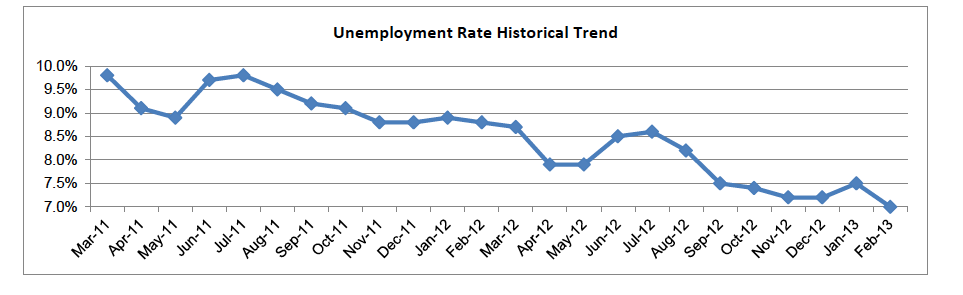
The unemployment rate in the San Luis Obispo County was 7.0 percent in February 2013, down from a revised 7.5 percent in January 2013, and below the year-ago estimate of 8.8 percent. This compares with an unadjusted unemployment rate of 9.7 percent for California and 8.1 percent for the nation during the same period. The rate is lowest since 2011 when the EDD changed the way they figured the rates. Prior to this in – 2007 and before the county routinely had rates in the 5% range or less.
A closer look at the SLO numbers shows more than 5100 more jobs in Feb 2013 compared to same month in 2012.The biggest jump came in the business and professional services category. Helping to lower the rate from January 2013 to February was a 1% decline in the labor force .Layoffs in local government sector numbered more than 2000 in February.
Grading for the construction a 236 boutique hotel in Paso Robles has started. Ayres Hotels of Southern California has started work on the first phase of its planned development on 20 acres on Buena Vista Dr. The city approved the big project last year designed to service the city’s growing tourism business. Ayres operates 20 upscale hotels around southern California with a European flair. The first phase with 169 rooms with fireplaces and patios is expected to be open in the summer of 2014.
SLO Year Over Year Unemployment Falls
The unemployment rate in the San Luis Obispo County in January 2013 was 7.5 percent, up from a revised 7.2 percent in December 2012, and below the year-ago estimate of 8.9 percent.
The rise in unemployment in January came in response to an increase in the number of people in the labor market in January – almost 3000 more in one month. From December 2012 to January of this year there were 2300 more people working indicating a robust job market although more than had joined the search for a job.
Year over year, SLO County recorded an 8.1% increase in the number of people working from101,2000 in Jan 2012 to 109,400 in Jan 2013 That included 800 more farm jobs year over year.
SLO To See 17,900 Jobs Added By 2020.
Total employment in SLO County should reach 132,000 by 2020 in San Luis Obispo County – a new EDD projection estimates. Some 61% of those new jobs are expected to come in four sectors.
Retail trade sector is projected to grow 25.4 percent over the 10 year
period, adding 3,300 jobs.
Leisure and hospitality industry is expected to increase by 19.6 percent
,with almost 90 percent of its growth in the accommodation and food services sector (2,600 jobs.
Professional and business services employments projected to add 2,600 jobs,through the projections period.
Mining, logging and construction is expected to be the fastest
growing industry with a 44.9% growth rate.
Last week, the California Farm Bureau Federation, the Marin County Farm Bureau and the Sonoma County Farm Bureau joined in a petition to a federal appeals court, urging the court to give the Drakes Bay Oyster Co. a new hearing—and a new chance to continue its sustainable aquaculture operation.
The company and its owners, Kevin and Nancy Lunny, carry on a decades-long tradition of mariculture in Drakes Estero. The oyster farming operation has been there since the 1930s—so long that few people remember the estero before the farm existed. It was there long before the Point Reyes National Seashore was established in 1960.
Despite a record as excellent stewards of the land and of the estero, the Lunnys and their farm face eviction.
The National Park Service determined that the oyster farm had to go and pulled out all the stops in its efforts to evict the farm, even though its presence adds to the overall character of the area. The Lunnys, Sen. Dianne Feinstein, Farm Bureau and other advocates have pointed out a long history of shoddy, slanted pseudo-science used by the Park Service in an effort to justify removing the oyster farm.
Despite protests from the West Marin community, Interior Secretary Ken Salazar decided last November that the farm would have to leave when its lease expired. Only a last-minute stay from a federal court last month allowed the Lunnys to remain in business, while the court considers their appeal.
If you’ve been following the case like I have, you know that Drakes Bay Oyster Co. is a prime example of the local, sustainable agriculture that many Bay Area residents prize. If you haven’t been following the case, you might be surprised by the range of individuals, groups and organizations that joined together in the petition last week on behalf of the Lunnys.
Along with CFBF and the two county Farm Bureaus, the petitioners included famed Berkeley chef Alice Waters; the Hayes Street Grill, a fish restaurant in San Francisco; the Tomales Bay Oyster Co.; the Marin County agricultural commissioner; Food Democracy Now; Marin Organic; and the Alliance for Local Sustainable Agriculture.
These folks may all come at this issue from different angles, but we end up at the same place: What’s happening to the Drakes Bay Oyster Co. is wrong.
The petition was written by Judith Teichman, a San Francisco attorney who assembled the coalition favoring the farm’s continued operation. It notes that closing down Drakes Estero as a source of fresh, sustainably raised shellfish would wreak havoc with the world-famous local, sustainable food and agriculture of the Bay Area. It would also disrupt shellfish cultivation on Tomales Bay. It would put 31 people out of work, some of whom have worked for the oyster farm for 30 years.
Closing the oyster company would also be a serious setback for modern environmental thinking, the petition says. Leading voices in the environmental movement have called for 21st century conservationists to embrace a more people-friendly ethic that supports working landscapes—just the sort of operation that Drakes Bay Oyster Co. represents.
Old-fashioned environmental activists want to force people off the land, to return it to some sort of pre-human condition. That thinking leads to confrontation instead of collaboration, and to situations where progressive, thoughtful farmers and ranchers like the Lunnys get pushed aside because of someone’s interpretation of the purity of nature.
For Farm Bureau, the case has implications beyond Drakes Estero.
Half of the land in California is owned by the federal or state government. Rural communities, where many Farm Bureau members live and work, depend on multiple use of these lands. National parks and wilderness areas operate under land-management rules that allow for human presence and use, even when the primary mandate is for preservation and environmental protection.
To ban an operation such as Drakes Bay Oyster Co. on the ideological belief that it should not exist in a national park or wilderness area—despite evidence that the farm provides important economic, cultural and social benefits—sets an awful precedent for everyone who believes that humans and nature can and must co-exist sustainably.
That’s why Farm Bureau supports the Lunnys and Drakes Bay Oyster Co. If the bureaucrats and the kick-the-humans-out branch of environmentalism can run the Lunnys out, you can bet they’ll keep trying to throttle more wise uses of taxpayer-owned lands.
That narrow, preservationist vision never worked and doesn’t now. The appeals court will hear the oyster farm’s case in May, and we hope it will restore common sense to the management of the Point Reyes National Seashore
Pirates Cove near Avila will get makeover improving the trail that runs above it along Cave Landing Rd and the rough trail that leads to Shell Beach.
The County of San Luis Obispo General Services Agency has issued an environmental notice it intends to do a major construction of a bike/pedestrian trail of approximately 1,800 linear feet long and approximately 12 feet wide with some 800 feet of this proposed trial is located within the abandoned road segment of Cave Landing Road.
The notice says this trail will be made of decomposed granite or similar permeable surface and will require removal of approximately 800 linear feet of existing abandoned road pavement. A 30 foot span bridge will cross a natural drainage way; 2) formalization of the Pirates’ Cove parking lot by leveling, resurfacing with asphalt, landscaping, and providing 35 parking spaces; 3) installation of drainage improvements of vegetated bio-swales and two level spreaders in the parking lot area; 4) Improvement of the existing pedestrian trail from the parking lot to Pirates Cove beach including: a four foot wide trail; additional water bars for drainage; stairs to the beach; and rails or fencing as necessary; 5) construction of accessory facilities including a waterless vault restroom, picnic tables, benches, garbage cans, and interpretive signs, and 6) regular maintenance of these facilities.
This project will also require a variance of the Bluff Top Setback and Development on Slopes of 30 percent standards and a waiver of the fencing and screening standard for side and rear setbacks. This project will result in approximately 700 cubic yards of ground disturbance, on two parcels totaling approximately 53 acres.
From the Sierra to the Coast, our real estate market is on the mend with new home permits much stronger than a year ago and the value of existing homes for re-sale higher as well.
According to Construction Monitor, San Luis Obispo County reported permits for 98 new single family homes for the first two months of 2013 compared to just 50 for the same period in 2012.
Comparing the first two months of 2013 in the Central Valley town Visalia – the city reports home building permits jumped 125% over 2012 with building permits for new single family dwellings at 45 permits issued compared to 20 in 2012. Total valuation was up 107%, again due to the home building bump, to $19,772,606 for the first two months of 2013.
On a broader scale for the Central Valley counties of Madera,Fresno,Kings and Tulare combined – the region reported 328 new single family home permits for Jan /Feb 2013 compared to 243 for the same period in 2012. In Kern County sfh permits jumped from 156 to 246 in Jan/Feb 2012.
In the larger existing home market the median sales price year over year in January 2013 jumped 10.9% in Tulare County,15% in Fresno County,19.5% in Monterey and 11.7% in Santa Barbara County.SLO County numbers for January 2013 were not available through Dataquick.
Sales of new homes according to Dataquick were up double digits in most Central California counties as well. Sales in Kings County jumped from 4 to 25 year over year in January.
More visitors translated into higher Central Coast hotel revenue in January compared to the year before.
According to Smith Travel Research San Luis Obispo county hotels posted a 9% increase in room revenues, with occupancy up 3.1%. RevPAR was up 6.7%. SLO’s average rate was $97,08 up form $93.73 in January 2012.
In Santa Barbara county room revenue was up 6.3%,occupancy was up 2.5% and RevPAR increased 3.9% vs January 2012.The average rate was just under $130.
In Monterey County room revenue was up 11.9%,occupancy increased 6.3% and RevPAR jumped 11.2% The average rate was $127.17.
For the state as a whole, room revenue was up a strong 9.5% in January 2013 compared to January 2012.
Small Central Coast airports like Monterey, SLO and Santa Maria can only hope that competition and mergers in the airline industry will mean their operations have a future. What is clear is that the decisions will be out of local hands.
“Airlines are in business to make money and if the can get a better return elsewhere” they don’t care so much “there might be untapped demand in our market” says San luis Obispo airport manager Richard Howell.
American Airlines new logo
SLO has been lobbying United Airlines to do a connecting flight from SLO to Denver for many months and although Howell says there is no definitive answer yet he thinks United will say no. ”They are risk adverse.”
As of now, United flies only SF and LA daily routes out of SLO. The airport’s only other flight is to Phoenix flown by US Airways. Phoenix is US airways hub but the merger with American Airlines announced in recent days may change that suggests Howell.”The new airline could see fewer flights to Phoenix and more to Dallas – that bigger American Air hub. He suspects the Tempe Arizona corporate office will be shut down and Phoenix become a a much less traveled city. Arizona press reports says one US Airways office has 750 employees.
The local Business Journal quoted Robert Mittelstaedt, dean of the W.P. Carey School of Business at Arizona State University, saying, “Phoenix is going to lose some jobs” if either merger goes through because of the HQ shift. It also would mean a significant loss of one of the Phoenix area’s largest employers and hometown corporate names. US Airways is Arizona’s 13th-largest employer. With the merger, American and USAir have created the largest US airline from the ashes of Americans filing of bankruptcy in 2011. American withdrew their flights from SLO as did Delta some years ago in those turbulent times.
How about now? Will the new American continue to service little ol’ SLO?
Howell says the West Coast fares are not as lucrative per passenger mile as other parts of the US citing a return of 11% flying out of North Dakota where there is an oil boom vs 4% here where the market is more mature and there are lots of players and mega-airports.
SLO lost seats on flights since 2007 with the coming of the great recession. In the fall of 2008, the airport experienced a 38 percent reduction in seat capacity as airlines responded to high oil prices and a poor economic climate by removing aircraft from their fleets, Howell remembers.
Looking At The Numbers
SLO flights used to attract 350,000 passengers annually but are now down to 260,000 as of 2012. Of that – a little over 100,000 flew on US Airways and rest on United. Some airlines report a pilot shortage that may contribute to tailwinds experienced by our smaller airports.
Boardings for a year period ending Sept. 30, 2012, at airports across the US were up 0.08 percent, according to the trade group Airports Council
International of North America. For small hub airports, scheduled flights are down 4.84 percent and the number of aircraft seats available is off 2.94 percent, the same Airports Council International reports.
Meanwhile airports like Santa Maria cheer the coming of new players like Allegiant announcing flights to Hawaii starting last year drawn in part by the addition of an extra 2000 ft added to the runway allowing larger planes to land. The runway is longer than either Santa Barbara or SLO.
But that decision has now been reversed.
Allegiant airlines “suspended” weekly flight to Hawaii as of December but said the flights would be resumed in March and ramped up this summer when demand would be better. But Howell says the Official Airline Guide that would typically list this summers flights by now has no flight listed from Santa Maria to Honolulu this summer. Allegiance’s website does offer flights but calls to the company for clarification were not answered due to the “high volume of calls.”
Last year when Allegiant announced the Santa Maria flights they also announced flights from Monterey to Honolulu. But that plane never took off. Total passengers through Monterey on all airlines is down slightly in the past few years – similar to SLO.
Still some newer players could make a difference as the big merge with the bigger. Frontier Air just announced they would serve the Fresno to Denver market beginning in May. Frontier also flies from Santa Barbara.
Seaport Airlines may be shopping for other cites to fly from. The airline now has a code share agreement with Alaska Airlines.
One smaller California market that seems to be recovering from the pre- 2008 slowdown is Bakersfield where in calendar year 2012 saw 271,000 passengers,best since 2008 when they had 285,000 users. The high was in 2006.
New Home Building In SLO County Way Up Commercial Surges Too
Home builders in San Luis Obispo county responded to the improving real estate market by permitting 350 new homes in 2012 compared to just 106 in 2011. The value of all new single family homes jumped from $32.4 million in 2011 to $117.2 million in 2012 according to Construction Monitor.
The busiest market in the county was in the Nipomo unincorporated area where Shea Homes permitted 62 new homes, making it the busiest general contractor in the county. Next was Paso Robles with 40 sfh permits issued,24 of them by builder Wathen Castanos, the county’s second largest home builder.
The City SLO permitted 30 new homes and Arroyo Grande permitted 20. Pismo approved 13 new homes and Morro Bay 8. There was some home building activity in Cayucos and Templeton.
Mangano Homes, formerly one the largest builders in Tulare County, is now poised to be a bigger player in home building in SLO City in 2013.
The company’s president Andy Mangano announced that “Mangano Homes, Inc. of San Luis Obispo has been engaged by Resmark Land and Housing and its investors to construct the Serra Meadows residential neighborhood. Serra Meadows is located on Prado Road just east of Higuera in San Luis Obispo, and will consist of a single‐family neighborhood totaling 177 homes as well as commercial property.
Mangano Homes anticipates that production will commence in Spring 2013. The company’s first priority will be completing infrastructure improvements including the work on Prado Road.
Countywide in the residential category – solar projects shined in 2012 with 426 – mostly roof top projects – valued at $86 million vs 93 projects valued at $1.5 million in 2011.
Commercial Pick Up
In the commercial category activity picked up in the office sector with 38 projects valued at $15 million in 2012 compared to 12 projects valued at $1.2 million.There were 18 motel projects valued at $1.4 million compared to 7 – worth $533,000 in 2011. Other sectors that showed big gains were 110 retail building projects valued at $12.8 million vs 34 at $7.5 million in 2011.
Industrial projects surged as well in 2012 with 88 at $119 million in value vs 33 for $17.8 million.
Don’t forget ag building that included 86 buildings for $16.4 million vs 31 ag buildings in 2011 valued at $3 million.
Total commercial valuation for 2012 was lower than 2011 ( $447 million vs $977 million) because of the mega-solar projects in the Carrizo Plain that were first permitted in that year, valued at $901 million.
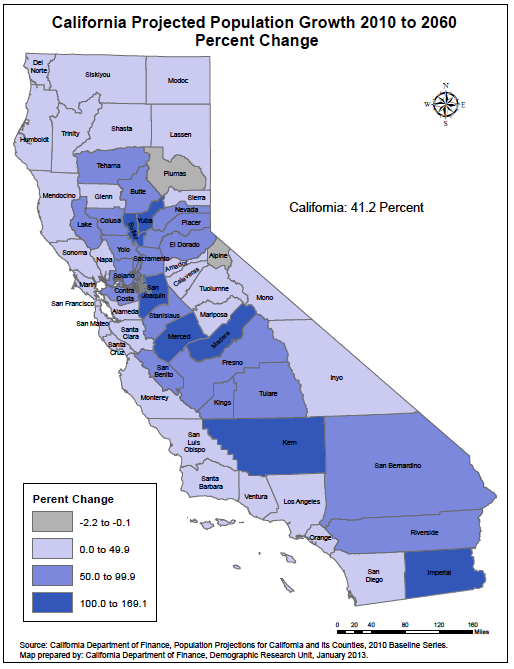
San Luis Obispo’s population mix will change in coming years says a new state Finance Department demographic report. At just under 270,000 people in 2010, the county will grow to 274,000 by 2015 , around 288,00 in 2020 and 353,000 by 2060.
As of 2010 in SLO County there were 56,309 Hispanics and 191,725 Whites. By 2060 there will be 173,000 Whites, a decrease from today, and over 136,000 Hispanics.
The median age of a resident of SLO County will rise from 39.5 to 40.5 in 2060.That compares to a county with more Hispanics like Tulare County where the median is 29. About half the population in SLO county – 133,000 residents are age 40 or older.
Across California there were nearly 10 million baby-boomers in 1990,the majority being White. The White baby-boomer population is now aging into
retirement and all will likely retire in the next two decades.But as the SLO figures show – that White Baby Boomer trend will end. Hispanics will be moving toward a majority here as well as the rest of the state where it is happening much sooner.
click to enlarge
The latest California projection series indicates that the Hispanic population will be even with the number of non-Hispanic Whites by mid-2013. Early in 2014, the Hispanic population will become the plurality in California for the first time since California became a state.
Southern California will lead the State’s growth over the next 50 years (2010 to 2060),growing by 8.3 million to 31 million in population. For this report, in the interest of geographic simplicity, Southern California includes San Luis Obispo, Santa Barbara,Kern, San Bernardino, Ventura, Los Angeles, Orange, Riverside, San Diego, and Imperial counties.
California’s population will cross the 50 million mark in 2049 and grow to nearly 52.7 million by 2060, according to the new population projections released by the Department of Finance.
This population gain – nearly 15.4 million between 2010 and 2060 – would exceed the current populations of either Illinois or Pennsylvania, and would represent enough new residents to currently rank as the fifth largest state in the Union. The 2060 population will be 39 percent higher than the state’s most recent 2012 population estimate.
Camp Roberts Gets Perimeter Fence Upgrade
The United States Army, represented by the Network Enterprise Technology Command/9th Army Signal Command (NETCOM) and U.S. Army Garrison, Presidio of Monterey (POM), is proposing to expand the existing perimeter fence around the CAMP Roberts Satellite Communications (SATCOM) site. The fence would be expanded to the west of its current location; extending about 1 mile longer and encompassing approximately 57 acres of additional land outside the existing perimeter fence. Additional structures would include security lighting and cameras on the interior side of the fence, and a 40-foot-wide clear zone would be established along the fence
Cambria Eatery Under Construction
Construction of a new restaurant/bar at the former Hamlet location in north Cambria is underway at 7432 Exotic Garden Dr. The building permit is for Centrally Grown Inc to build 6664 sf of buildings on the site valued at $800,000. The permit was issued in December.
According to their website Centrally Grown, owned by Dave Robertson, is a” 3+ acre site located on scenic California Coast Highway 1 between the artist haven-town of Cambria and Hearst Castle State Monument. The new home of Centrally Grown is the former Hamlet restaurant and exotic gardens, a popular local landmark that had fallen into financial difficulties in the last decade.” The Hamlet closed this time last year.
Robertson purchased the place in 2012 for $2.47 million. He says the new complex should employ 30 to 40.
The website continues that “Robertson will revitalize the site and build on its rich tradition as he showcases Centrally Grown products with a healthy bistro, flatbed produce market, working gardens and small mercantile along with creating a venue for local entertainers and artists. us a will initially focus on reducing waste associated with food production, processing, packaging, transport and consumption; reducing chemicals in food, body and land and creating a smaller environmental footprint and a healthier community. All products developed by Centrally Grown will be locally sourced from sustainable production and will reflect impeccable quality.”
Robertson says that the new loft restaurant will offer” California cuisine and world-inspired fare in a modern atmosphere. Feel free to bring lunch up from the deli for a casual afternoon, or join us for dinner while the sun sets over the breathtaking Pacific Ocean.”
The eatery’s’ website says expect to visit their new eatery in Spring 2013. The company is already catering its fare.
Robertson’s career successes include 26 different business ventures that have paved the way for his most ambitious project to date: the creation of the Centrally Grown brand, based on the Central Coast of California.
San Luis Obispo homes sold for a median price of $414,600 compared to around $391,000 in November and around $367,000 in December 2011.The figures for existing homes according to the California Association of Realtors show a rebound in prices here as well as much of California. The statewide median was $366,930 compared to $289,000 a year ago – a jump of 27%.
Sales were also up in SLO County,11% higher for the month and 11.3% year over year.
Santa Barbara’s median price climbed 41% year over year in December to $588,000.
12 Ave building in Paso Robles will house Artisan Restaurant
Paso Robles Building Permits Boomed In 2012
Fueled by growth in dining and the wine and beer industries Paso Robles enjoyed a good year for building permit activity in 2012.
In 2012 the city permitted 40 new homes compared to just 18 in 2011. The total value of all permits was $30 million vs $9 million in 2011. Some 22 retail and dining permits were issued by the city vs 5 for all of 2011. There were 29 solar projects permitted in 2012 vs 5 for 2011. All figures courtesy Construction Monitor.
Permits include projects underway now including a 40,000sf expansion for the Firestone Walker Brewery for ITS bottling operation along Hwy 101.The permits includes an addition of 72 parking places for their new restaurant.
New in January is a permit to do tenant improvements for Artisan Restaurant in Paso Robles at 839 12th Ave valued at $800,000. NK Builders who are also the owners of the building are doing the work that includes a raised concrete dining patio encroaching on the walkway,the first eatery in town to do permanent street side dining along the sidewalk. The highly regarded Artisan Restaurant is currently at 1401 Park Ave in Paso Robles. NK Builders has constructed a 13,600sf half block building on 12th.