Get Out The Ark? 5 Day Storm A Real Soaker

Writing an article for the California Citrograph magazine back in August about the prospects for a wet winter in California meteorologist Alan Fox wrote:

“We expect that the combined contributions of El Nino and expected PNA pattern (cold SSTA area off northern California) will encourage recurrent periods of storms moving into central and southern California during mid-December 2012 and January 2013. Because of the proximity of cold airmasses and the supply of cold air from the west and northwest into California, we expect that snow amounts will be abundant in the Sierra Nevada this season for the region that includes
the following watersheds: Upper San Joaquin, upper Kings, Merced, Stanislaus, Tuolumne, American, Yuba, and south portion of the Feather.”

Looks like the pattern may be emerging a few weeks early and with an attitude.

This week Alan’s privately circulated Fox Weather report is predicting a real soaker reminiscent of the weak El Nino year of 1969 he says – what he calls an ”humongous storm” that is now expected to hit Northern and Central California over a five day period – November  28,29,30 and December 1& 2.

Particularly strong will be rainfall totals on the 30th (Friday) he says with Sacramento getting 1.6 inches in one hour and 14 inches of rain in 24 hours hitting the Napa region. He predicts up to 2.5 inch an hour in the Feather River area.

Rainfall will be impressive in the Santa Lucia mountains on SLO’s northern boundary with a five day total of 21.6 inches on Anderson Peak and 17 inches in Big Sur, he predicts.The Santa Cruz foothills could receive 12.51 inches over this period , all sand bag numbers.

In the mid San Joaquin Valley, Fox is predicting the five day total should be 3 inches in Fresno and 2.86 in Visalia but falling well off further south with Bakersfield receiving just 0.39 inches for the five days.Southern California may not get much either. Mariposa, above Fresno, gets over 10 inches as the Sierra foothills get plenty of rain and runoff.

The upper San Joaquin watershed- key for water users in the Central Valley would get 13.4 inches of water at Tamarack at 7600 ft and 33 inches of snow,nearly 3 ft.That will make them happy at nearby China Peak. The nearby Huntington weather station has only 5 inches in the bucket so far this year with an annual average of 42 inches .So this five day total would take it to approaching  half a years supply well before Christmas,good news for farmers.

Bear Valley skiers will be happy getting near 46 inches at Gianeli at 8400 ft.

If there is good news for the snowpack there may be flooding problems in the Valley and especially the Delta region where the storm will target.

Much of Central California’s water supply and agricultural areas are protected by a set of levees along the Sacramento and San Joaquin Rivers that are in serious danger of failure during an extreme flood or major earthquake. The 1,600 miles of levees protect 500,000 people, 2 million acres of farmland, and structures worth $47 billion. Of particular concern is the delta at the confluence of California’s Sacramento and San Joaquin rivers, about 80 miles inland from San Francisco Bay. The Delta Region receives runoff from more than 40% of California, and is the hub of California’s water supply system, supplying water to 25 million people and 3 million acres of farmland.

Fox says this storm pattern is not just the largest one this year but  perhaps biblical in scale – an ARkStorm (for Atmospheric River 1000 Storm), It is a hypothetical but scientifically realistic “superstorm” scenario developed and published by the United States Geological Survey, Multi Hazards Demonstration Project (MHDP). It describes an extreme storm that may impact much of California causing up to $725 billion in damages and repair (most caused by flooding), and affect a quarter of California’s homes.

Such an event would be similar to intense California storms which occurred in 1861 and 1862.[1] The name “ARkStorm” means “Atmospheric River (AR) 1000 (k).” The name was created as a way of quantifying the magnitude of west coast storms. It also meant to be drawn as a parallel to the biblical Noah’s Ark story.

So far the NWS SF says there are some chances for flooding over the coming weekend but does not see the potential for a massive event .

Another Take

Here is another take of the effect of these upcoming storms on the SLO region from PG&E forecaster John Lindsey.

A cold front from this low pressure system will pass the Central Coast on Wednesday between 10 a.m. and 2 p.m. with
moderate gale to fresh gale force (32- to 46-mph) southeasterly winds along the coastline and moderate rain throughout San Luis Obispo County.

Rainfall amounts on Wednesday will range between 0.75 and 1.25  inches with the coastal mountains receiving over 2.00 inches. Snow will develop in the Sierra above 5,500 and 7,000 feet on
Wednesday with a foot of new snow by Thursday morning.

Moderate to fresh (13- to 24-mph) southerly winds and a few scattered rain showers are expected on Thursday.

A stronger and even wetter Gulf of Alaska storm system is forecast to move southeastward towards the Central Coast on Friday. The associated cold front will reach northern
San Luis Obispo County by Friday evening producing rain as far south as Cambria. This system will move slowly southward  with rain reaching Morro Bay by Saturday afternoon.

Widespread moderate to heavy rain will spread to the rest of the County by Saturday night and will continue through Sunday morning.

Along with the rain, fresh gale to strong gale force (39- to 54-mph) southwesterly winds are forecast along the coastline  on Sunday morning.

The storm has a subtropical tap of moisture and rainfall amounts will be impressive with 1 and 3 inches across the low elevation locations and 4 to 6 inches of precipitation in the mountains.
Snow levels will be high and generally above 7,500 feet.

Overall, it will be a very wet and windy week and weekend starting Wednesday.

SLO Biz News

San Luis Obispo’s County’s hotel business is on the upswing this year with the latest numbers from SmithTravel Research for October continuing strong. Compared to October 2011, hotel occupancy was up 4.8% to 68% and RevPAR was up 9.6% with 7% more rooms sold.

Bed tax numbers from the City of SLO also show revenues for the month of September 2012 are up by 3.7% from the same month last year and up 6.8% year to date. Currently this report covers 38 establishments representing 2127 rooms, including the addition in May of 84 rooms at the Hampton Inn. The number will increase with the October report due to the opening of the 17 room Hotel Granada.

Not as good news from the SLO airport for October with passenger traffic down 6.9% in October compared to the same month a year ago.For the year – traffic is down 3.8%.

The Conoco Phillips,now Phillips 66 refinery in Arroyo Grande is seeking a permit to increase their crude oil production by 10% increasing the daily limit from 44,500 barrels to 48,950. Last Spring, Conoco Phillips spun off Phillips 66 as a separate business traded on the NYSE under ticker symbol PSX. Phillips owns 11 refineries in the US,3 in Europe and 1 in Asia. The county Planning Commission  will take up the request December 13.California oil production has been going down about 2% a year but new techniques promise to access deeper reservoirs of oil in the state.

California Polytechnic State University in San Luis Obispo will receive $94,924 from the California Energy Commission to develop a low-cost Nitrous Oxide (NOx) control method. The project will demonstrate a new and potentially low-cost method for reducing NOx emissions from small scale generators and boilers that use biogas.

Remodel Starts On New SLO Chamber Office

SLO Chamber’s’new home

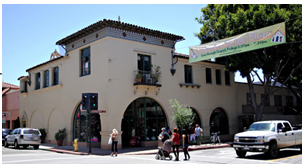
Tenant improvements for the new San Luis Obispo Chamber Of Commerce office at 895 Monterey St Downtown are underway this month.
Early next year, the Chamber will move from its current location at the corner of Chorro and Higuera street. Permits for $157,000 in tenant improvements were issued this month to be carried out by contractor Maino Construction. It is the first move by the group in over 4 decades.
The Chamber’s newsletter says the move to to 895 Monterey St., on the corner of Monterey and Morro streets, will be in the historic Paiarola building, which formerly housed Ann’s Clothing store and Luna Rustica.
The newsletter says the following about the plans.
Triggered by a seismic retrofit scheduled for the Chorro Street location in 2013, the Chamber Board of Directors initiated a process last year to analyze the needs and priorities of the Chamber’s administrative offices and Visitors Center.
“The seismic retrofit prompted us to look at how we could improve visibility for the Visitors Center to benefit the tourism industry and at the same time see whether we could improve the accessibility and efficiency of our administrative offices,” said Russ Levanway, Chamber Board Chair and CEO of TekTegrity. “We are confident that we have found a new location that meets all of the goals set by the Board and will provide the Chamber with all the best of our existing space with some much-needed improvements.”
Levanway said the new space, which will be fully accessible, will provide for greater visibility of the Visitors Center to benefit members and tourists, as well as provide a larger meeting room for Chamber members. “The location in the downtown core maintains the Chamber presence close to the Mission and city and county government offices,’’ Levanway said.
Commissioned in 1932 by Caterina Paiarola, the grandmother of current owner Howard Carroll, the building was built by Maino Construction. It is one of the first reinforced concrete structures in downtown and was built in a Mediterranean-style with expansive arches that border the streets.
“The new location in the Paiarola building represents the Chamber’s ongoing support for the revitalization of our downtown and a commitment to the future vitality of the city’s core,” said Chamber Board member and facilities task force member Pierre Rademaker of Pierre Rademaker Design.
The Chamber Board voted unanimously to make a permanent move following an analysis by a special facilities task force, which looked at several options, including keeping the Visitors Center at its current space and moving the administrative offices out of the downtown core.
“We found a space that seemed to be the perfect fit,” said Clint Pearce, president of Madonna Enterprises and facilities task force member. “The space is the right size and has the features that will help the Chamber fulfill its mission and strategic initiatives. The task force and board were unanimous that the Monterey Street space will be the best long-term home for the Chamber, and we can hardly wait to see it finished.”
“Our current location and landlord have served us well for over four decades,” said Chamber President and CEO Ermina Karim. “Now, given the availability of 895 Monterey, we have the opportunity to serve visitors better, as well as to provide more services to our members. We look forward to creating new memories, build on our brand and, most importantly, enhance service for our members and visitors.”

SLO Jobless Rate Falls Again

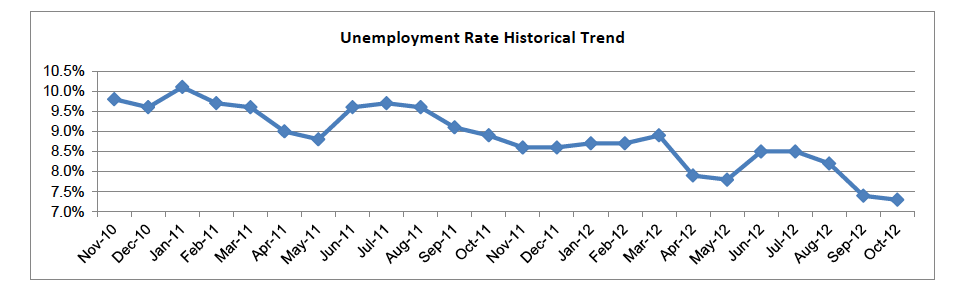
The unemployment rate in the San Luis Obispo County was 7.3 percent in October 2012, down from a revised 7.4 percent in September 2012, and below the year-ago estimate of 8.9 percent. This compares with an unadjusted unemployment rate of 9.8 percent for California and 7.5 percent for the nation during the same period.

A closer look at the numbers show the number of people looking for work has grown with the labor force up by more than 3000 year over year and  2000 in the past month.Year over farm jobs are down 300 while non-farm jobs are up 2300.

Year over year the number of jobs in construction are up 11.5%,up 6% in the hospitality business and up near 19% in state education.

Perspective On Central Coast Farm Labor

By Mark Bolda

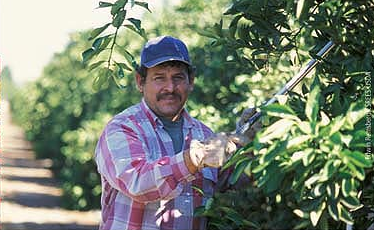
One of the increasing challenges for strawberry and canberry businesses on the Central Coast in California has been the persistant shortage of labor.  Many large operations over this past year reported a shortage of 10 to 15% of workers with some smaller farms reporting even higher percentages.
My prediction is that this shortage will continue to persist, and as a matter of fact may become more pronounced in the years to come.  I base this assertion on two theses, the first being changing demographics and an improving economy in Mexico affecting the dynamics of labor immigration and the second having to do with competition for labor coming from strengthening rental markets and improved conditions for home building in the United States.
Much of the information for the post below comes from the excellent and prescient article written several years ago by Dr. Philip Martin at UC Davis regarding Mexico USA migration.
http://giannini.ucop.edu/media/are-update/files/issues/v8n2.pdf
The Labor Immigration Dynamic from Mexico:
Many of the people involved in the success of the California berry business come from Mexico and without them we will not do well.
However, the changing economic and demographic situation in Mexico should be understood when thinking forward who is going to continue to do all the tough and complex work of planting, growing and picking our crops of strawberries, raspberries and blackberries.
Let us consider the drivers of immigration from Mexico in the past and the future:
According to some academics, one of the major causes of immigration to the United States was the disruption to the rural economy of Mexico by the North American Free Trade Act (NAFTA) put into force January 1, 1994. By some estimates, the economic effects of NAFTA displaced some 1.4 million rural Mexicans, and in the five years following about half of them made their way to the US.  That such a large number of people were displaced at one time from their homeland is tragic, but it did mean that a large number of people not unfamiliar with tough and demanding farm work showed up for work at US agricultural concerns in the years following the implementation of NAFTA.
Now in 2012, to start to understand the changing immigration picture, we should not be unaware that in Mexico, as in many places around the world, the demographics are changing, especially in reference to decline of population growth.  The population growth rate in Mexico has dropped from 1.5% in 2000 to 1.1% in 2012.
To gain meaning from this number in terms of what it would mean for immigration from Mexico, one would want to cast this population growth rate against the current economic growth rate.  Mexico has a vibrant economy with productivity growth rate of above 3%, and it is doing well in adapting to the global economic order of the 2010’s.  Reforms are currently moving through the legislature and more are promised by the incoming administration of Enrique Peña Nieto, including opening the oil sector, simplification of the tax code and labor market reform to further improve the prospects for economic growth. Drawing on all of this, the Central Bank of Mexico estimates GDP growth of 3.5-3.6% for 2013.   The economy of Mexico has been growing and will continue to grow faster than the US (forecast 2013 GDP growth 2%) and this can be to some extent be understood by comparing the performance of each country’s stock market index (Figure 1 below).
In this economic scenario, one would expect labor (read jobs) growth to be in the range of 1- 1.3%.  So population growth of 1.1%, which of course drives labor force growth, has already fallen below the higher end of the rate of employment growth.  An employment growth rate matching or exceeding labor force growth means there is no reason anybody should be lacking for work.  Perhaps there will be mismatches in skill level and available work, but there is no denying an increasing abundance of work will be a factor in reducing emigration, and could even be a cause of some immigration back to Mexico.
Improving Real Estate and Construction Conditions in the US:
We all know that strengthening rents give impetus for investors to come into the market (especially in an environment of extremely low bond yields), creating eventual demand for the construction of additional office, retail and residential space.  Looking to a good proxy for rental markets, real estate investment trusts (REIT’s, corporate entities specializing in real estate), represented by the second chart for the REIT index below, we see that the demand for rental income and subsequently the market valuations of these companies has been rising since the middle of 2009.
Additionally, after a very tough stretch caused by a credit driven over- supply of houses, the fortunes of American home builders have made a turn for the better.  Indeed, the price of an index composed of the shares of publicly owned homebuilders (Figure 3 below) has been moving strongly upwards for the last year. Knowing that the equity markets think forward, we can assert that what happens on Wall Street tends to be a good predictor of what is to happen on Main Street 6 to 12 months from now. Homebuilders are going to be building again in 2013.
What does all this have to do with the labor force working in berries?  A lot as a matter of fact.  Rising rents and the subsequent creation of demand for residential and other construction will pull workers away from agriculture because construction work tends to be higher paying (albeit substantially more cyclical as the last 2003 – 2009 boom and bust has shown).  Simply put, construction going forward will compete for workers.
In consideration of the above, I think it very difficult to see how immigration of laborers from Mexico will return to the levels experienced in the last two decades.  Population growth there is falling, the NAFTA led displacement has run its course, and the economy there is surging forward and generating a lot of jobs.
In addition to the strong economic and employment picture in Mexico, the US housing market is starting to pick up again on the shoulders of a strong rental market and will compete with berry businesses for this already shrinking pool of labor.

New Study to Examine Ecological Tipping Points in Hopes of Preventing Them

October 30, 2012

A healthy kelp forest,<br>photographed near San Clemente<br>Island in California.<br>Credit: Ron H. McPeak/UC Regents*
Click for downloadable image
A healthy kelp forest,
photographed near San Clemente
Island in California.
Credit: Ron H. McPeak/UC Regents*

An urchin barren, pictured,<br>is the result of unchecked population<br>growth among sea urchins,<br>causing destructive and widespread<br>grazing of kelp forests.<br>Credit: Ron H. McPeak/UC Regents*
Click for downloadable image
An urchin barren, pictured,
is the result of unchecked population
growth among sea urchins,
causing destructive and widespread
grazing of kelp forests.
Credit: Ron H. McPeak/UC Regents*

(Santa Barbara, Calif.) –– Predation by otters keeps urchin populations in check, allowing kelp –– a favorite food of urchins –– to flourish. But what if otters were harvested to near extinction for their fur? The resulting overabundance of urchins would decimate the kelp forest, leaving little food or shelter for fish and invertebrates. And so it may go, as declines in these species are likely to affect others.

Such is the potential trickle-down effect on the food chain of even subtle shifts in a single species –– tipping points that can induce wholesale, sometimes irreversible change to entire ecosystems. Examples of these ecological thresholds and unintended consequences are many –– the otter-urchin scenario occurred in Alaska and California –– but solutions are few. Some UC Santa Barbara researchers hope to change that.

A new project of scientists at UCSB’s National Center for Ecological Analysis and Synthesis (NCEAS) and partners aims to synthesize existing research on tipping points in marine ecosystems and conduct case studies to devise a set of early warning indicators and management tools that may help to predict, even prevent, threatened systems from falling off the precipice.

“We know that thresholds in marine ecosystems can lead to rapid changes in their ability to support activities and services that people value, but we seldom have information about how human actions are affecting these things –– and how close we might be to those tipping points,” said Carrie Kappel, associate project scientist and lead principal investigator (PI) on the study.

The NCEAS team of Kappel and co-PIs Ben Halpern and Kimberly Selkoe –– with partners at Stanford’s Center for Ocean Solutions, the Environmental Defense Fund, and the National Oceanographic and Atmospheric Administration (NOAA) –– have been awarded $3.1 million from the Gordon and Betty Moore Foundation for the soon-to-launch study, “Ecosystem Thresholds and Indicators for Marine Spatial Planning.”

“This is an ambitious project that addresses really critical issues in natural resource management and protecting and managing our oceans effectively,” said Halpern, director of UCSB’s Center for Marine Assessment and Planning. “We’re looking at how natural ecosystems respond to changes in human pressure, or to climate change, and what the effects are on the human community. I think people sometimes forget that we are managing these systems not just for the sake of creating bureaucracy and regulations. We have an interest in keeping ecosystems healthy and sustainable not just for nature’s sake, but because we, as humans, fundamentally value and depend upon them.”

Among the core focuses of the four-year project is identifying advance indicators of threshold shifts, which could include water quality, an abundance or lack of certain species, and even rates of disease, according to co-PI Selkoe, a marine ecologist and NCEAS associate scientist. Ascertaining such early warning signals, she said, will improve the monitoring capabilities of ecosystem managers and potentially enable them to prevent threshold shifts –– or at least be better prepared.

“We may or may not be able to really know how fast we’re approaching a threshold shift, but if managers are conscious of these shifts they can be more prepared and cognizant of the possibilities,” Selkoe explained. “There may be a lot of cases of climate change combined with ocean cycle changes that nothing people can do will prevent. There’s a lot beyond our control, which probably means we need to manage more conservatively. The marine resource management world is moving toward these strategies, toward incorporating big picture thinking and comprehensive approaches that will require coordination across sectors –– managers need more tools to operate at that scale.”

While the first phase of the project will be centered on existing data and models, the second phase will involve a more in-the-trenches approach. Deep-dive case studies and engagement with active marine managers and policy makers are intended to “get the folks on the ground involved from the very beginning, so that the tools we develop can be as useful as possible to the people who are actually doing this work,” said Kappel. “We want to give managers tools that help them to maximize the delivery of benefits to people, while protecting the ecosystem and minimizing the risk that it will be tipped into a different state.

“Our coasts and our oceans are becoming increasingly crowded, and more and more people depend upon them,” she added. “Inevitably, there’s this problem of increasing competition for limited ocean resources. We need to be able to proactively plan for how we’re going to use those resources and do it in a way that allows them to be sustainable for the long run. If we are unaware of the potential cliffs you can fall off in the ecosystem dynamics, we run the risk of diminishing benefits to people and of changing ecosystems forever.”

Other researchers on the study include Larry Crowder and Meg Caldwell at Stanford’s Center for Ocean Solutions; Rod Fujita at EDF; and Phil Levin, with NOAA.

The Gordon and Betty Moore Foundation, established in 2000, seeks to advance environmental conservation, patient care, and scientific research. The goal of the Marine Conservation Initiative is to achieve healthy marine ecosystems in North America that support sustainable use. For more information, please visit http://www.moore.org.

*Acquisition and digitization of the Ronald H. McPeak collection was made possible with funding from the National Science Foundation to the Santa Barbara Coastal Long Term Ecological Research project.

Central Coast Building Permits Up In 2012

Topaz Solar project

Industry watch group Construction Monitor report that single family home permits in San Luis Obispo and Santa Barbara counties are up in 2012 with 433 permits issued this year so far vs 316 for the same 10 month period in 2011.The value of those permits are $397 million vs $313 million for the same period in 2011.
The permits for solar panels construction on residents in the two county region show 2012 numbers with 493 projects valued at $89.3 million in 2012 vs  378 for $9.8 million in 2011 as home owners installed more elaborate systems .
On the commercial side the value of all permits  was $623 million vs $821 million in 2011 because $621 million of that was the big Carrizo Plain solar grading permits in SLO County permitted last year.The two projects there will rival the largest solar projects in the world.
The value of all solar panel permits in 2012 on commercial projects reached $235 million in 2012 vs just $12 million in 2011.
The pace of smaller commercial remodeling projects in both counties also picked up in 2012 valued at $112 million vs  $60 million in 2011.
New retail complexes  were  valued at $22 million in 2012 vs $16 million for the same period in 2011.

SLO Unemployment Falls To 7.4%

The EDD reports that the unemployment rate in the San Luis Obispo County was 7.4 percent in September 2012, down from a revised 8.2 percent in August 2012, and below the year-ago estimate of 9.1 percent. This compares with an unadjusted unemployment rate of 9.7 percent for California and 7.6 percent for the nation during the same period.

SLO County’s jobless rate spiked in 2009 with the start of the great recession and is just now has dropped to pre-recession levels. In September 2008 the unemployment rate was 6.1% but by September 2009 that rate had climbed to 9.2%.

Looking closer the number of new jobs climbed from 102,800 in September 2011 to 105,300 in September 2012 with 2900 new non farm jobs but 400 fewer farm jobs. The county now sports 1000 more jobs than year ago in the hospitality sector and 600 more doing construction.

Year over year the number of unemployed in the county dropped from 12,700 to 10,500

Rain & Snow On The Way!

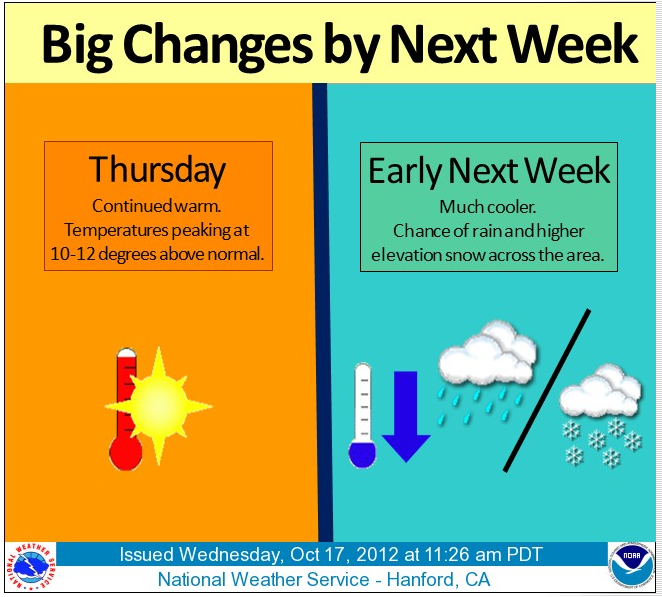
Both Central Coast and Central Valley weather forecasters are predicting a few wet days next week.

Coastal forecaster John Lindsey says (0n 10/18) ”  A strong cold front will move down the California coastline on Monday.
This cold front will pass the Central Coast Tuesday morning with strong to gale force (25- to 38-mph) with higher gust southeasterly
winds and rain. At this time, rainfall amounts should range between
0.75 and 1.00 inches. Rain showers are forecast on Tuesday afternoon
through Wednesday.

Not only will this be the first widespread rain of the season for
California, but it will probably be the first big snow for the
Sierra. Snow levels are forecast to get down to 5,000-feet or
lower across the Sierra by Tuesday and Wednesday with over a foot
or more of snow possible from the storm.

This cold front could be followed by another one late next week
before fair weather returns over the following weekend and through
the end of October.”

According to the National Weather Service,Hanford  – this current heat will give way to moisture.

“THURSDAY IS EXPECTED TO BE THE WARMEST DAY WITH TEMPERATURES 8-13 DEGREES ABOVE NORMAL FOR MID OCTOBER. THE RIDGE WILL BEGIN TO BREAK DOWN FRIDAY AS A TROUGH OF LOW PRESSURE DROPS OUT OF THE GULF OF ALASKA. THIS WILL BRING INCREASING ONSHORE FLOW THROUGH THE WEEKEND WITH TEMPERATURES COOLING TO NEAR NORMAL BY SUNDAY. THIS TROUGH ALSO KICK THE CLOSED LOW OFF THE BAJA COAST EASTWARD AND INTO ARIZONA BY SUNDAY NIGHT.

THE MAIN ENERGY WITH THE TROUGH WILL REMAIN TO OUR NORTH THROUGH
THE WEEKEND. THEN THE LOW WILL DEEPEN FURTHER AS THE CLOSEDLOW
OFF BAJA IS EJECTED EASTWARD. ECMWF/GFS AND ENSEMBLE MODELS
SHOWING INCREASING CERTAINTY ON POSSIBLE PRECIPITATION OVER
CENTRAL CALIFORNIA AS EARLY AS MONDAY AFTERNOON AND CONTINUING
THROUGH TUESDAY AND WEDNESDAY. THERE ARE TIMING AND STRENGTH
DIFFERENCES WITH THIS SYSTEM BETWEEN THE GFS AND ECMWF…SO TIMING OF THE BEST CHANCE OF PRECIPITATION IS UNCERTAIN. BUT BOTH MODELS INDICATE A WETTER AND UNSETTLED PERIOD FOR THE FIRST HALF OF NEXT WEEK.”

SLO Summer Tourism Stays Strong

Hotels in San Luis Obispo County enjoyed increased occupancy,more rooms sold and higher rates in July and August,Smith Travel Research reports.

Separately the City Of San Luis Obispo reported higher TOT,bed tax receipts in July as well.

Regards hotel rooms sold, SLO metro area saw 5.9% more rooms sold than a year earlier,occupancy up 4.8% and that all important RevPAR up 10.9%. The trend follows year to date numbers for all of 2012. SLO metro increases for August are better than our neighbors Monterey and Santa Barbara counties who recorded only slight improvement over Aug 2011.

Occupancy at SLO hotels in August hit 81.1%,up from 77.4% for August of last year, the busiest month of the year for Central Coast visitation.

Regards the City of SLO TOT report, receipts are up 7.7%,The city projects a 4% increase for the fiscal year that started in July.