SLO & State Jobless Rates Fall

SLO County jobless rate

Both San Luis Obispo County and the state of California saw their jobless rates fall in August the EDD reports.
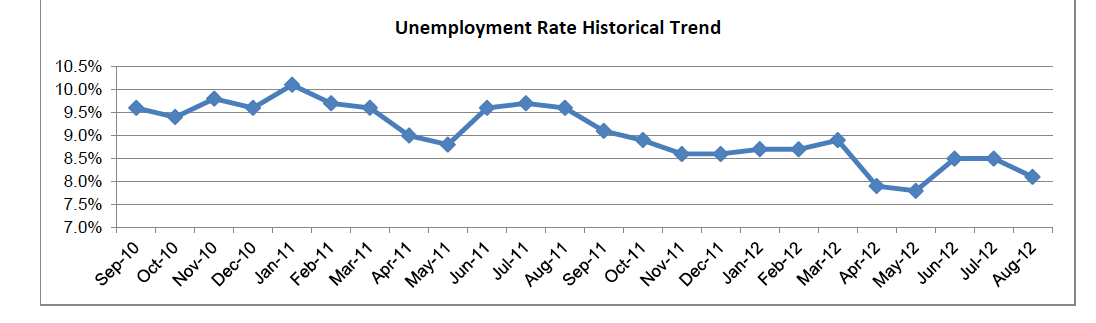
SLO County’s unemployment rate fell to 8.1%,down from 8.5% in July and down from 9.6% in August 2011. The report says SLO County has 2800 more jobs in August than year ago.
In California the unemployment rate decreased to 10.6 percent from.10.7% and 11.9% in August 2011., and nonfarm payroll jobs increased by 12,000 during the month for a total gain of 504,000 jobs since the recovery began in February 2010, according to data released today by the California Employment Development Department (EDD) from two separate surveys.
The year-over-year change (August 2011 to August 2012) shows an increase of 298,700 jobs (up 2.1 percent).

The federal survey of households, done with a smaller sample than the survey of employers, shows a decrease in the number of employed people. It estimates the number of Californians holding jobs in August was 16,404,000, a decrease of 38,000 from July, but up 203,000 from the employment total in August of last year.
The number of people unemployed in California was 1,935,000 – down by 27,000 over the month, and down by 243,000 compared with August of last year.

News Round Up… Seismic Testing / Morro Bay Incubator Plan

Central Coast Seismic Testing Gets State Lands Commission OK

A legal notice as been posted that is a State Lands Commission Record of Decision(ROD) as of 8.20/12. The project has drawn opposition from people concerned the seismic testing will harm sea creatures off the coast.Critics are urging people to contact the California Coastal Commission as well as the California Fish and Game Commission.

The subject of a PG&E EIR this Spring, Lands Commission  says the project consists of a high-energy seismic survey to better characterize various fault zones in the vicinity of the Diablo Canyon Nuclear Power Plant, in Avila Beach, San Luis Obispo County. The Project includes (1) an offshore survey component, consisting of a geophysical vessel towing a series of sound-generating airguns and sound-recording hydrophones, and (2) a nearshore commercial of onshore geophones, strings of seafloor geophones and onshore sound generation. The Project will be conducted between October 15, 2012 and December 31, 2012, including mobilization and demobilization, and between October 15, 2013 and December 31, 2013, if the Project is not completed in the first year. State Lands Commission action is a non-exclusive Geophysical Survey Permit valid from October 15, 2012 through December 31, 2013.

Morro Bay Chamber Incubator Center Plan Still Pending

Morro Bay Chamber wants to move to the soon-to-be vacant city fire station at 695 Harbor St.The city council is considering the chamber proposal to lease the 2400sf building for $1 year for three years with the chamber promising to operate a business incubator center in the building. The incubator would be called the Small Business Resource Center.
According to CEO Craig Schmidt, council at their most recent meeting, heard some push-back from some property owners in town that the city should not subsidize new businesses, But the chamber CEO points out that “these new start-ups are not ready to make a go of it on their own” and that helping them launch will result in more rented space in town and the new jobs more mature businesses would bring.

According to the chamber, the center will offer help to access capital for fledgling businesses,affordable but time-limited rent,counseling,education,marketing and other measures of support.

Schmidt says the chamber has a $58,000 contract to do economic development for the city but longer will do marketing for visitors. That has been assigned to a new tourism bureau who will hold forth at the chamber’s current location at the Visitor Center on the Embarcadero as of January.

Schmidt expects council,who tabled a city staff approval of the plan most recently, will get enough clarification in the next month to make a decision.

The alternative is the transportation building that would not have room to add the incubator program but only space for the chamber and its Economic Development program says Schmidt.

Tracking The Central Coast Economy… Real Estate Market / Sales Tax Revenue / Tourism… All Point Higher

SLO Sales Tax

The  City of San Luis Obispo’s sales tax revenue in the first quarter of 2012 – January through March 2012 – was up by 9.2% compared with the same quarter last year. This follows an 11.7% increase last quarter. This is the eighth consecutive quarter of recovery following 11 quarters of decline but still below the peak in 2006-07.
The city’s sales tax newsletter adds that by area in town- Los Osos Valley Rd was up 1.8%, south Higuera was down 6.6%,Madonna Rd down 4.6% but Downtown was up 12.5%. By category the report says auto sales, fuel and restaurants – up 20%- all were higher. Lumber  and building materials seemed to come to life – up 40%.
The report compares the City of SLO with the county and state. Taxable sales countywide were up 14.25% while the state was up 8.4%.
Nationwide,retailers are reporting strong back to school sales through August despite escalating worries about the slow pace of economic recovery.
SLO Real Estate Market..New Day?
Real estate agent,Collette Kutil of Paterson Realty wrote the following in August in her blog, reflecting a new optimism in the marketplace.
“Last year I worked with a few frustrated sellers, their homes would hang out on the market for a while and receive low ball offers.  Plus, buyers would nitpick the properties apart and ask for a ton of concessions. The agents (myself) would communicate and assure our sellers that we’re doing our best to promote and sell their homes for the best price.   Contrast that with today’s market, sellers are receiving multiples offers with in hours of the property going live on the Multiple Listing Service – MLS.  As an example, today my client toured a home in Arroyo Grande that has been on the market for 2 days.  This home was previously listed last year for 9 months with no sale. Today I called the listing agent and was informed that there are already four offers….hurry…. if I want my offer to be reviewed.  I know this house well, I showed it last year multiple times to clients that didn’t want to pay the asking price of $299K.  Today the property is listed for $40K more and the seller is going to get their price.  I hope my client gets a chance for consideration with our offer, including consideration on the forthcoming multiple counter offer.  Like I said, it’s a new market!!!”

Mortgage Rates Stay Low

Aug. 30, 2012,Freddie Mac released the results of its Primary Mortgage Market Survey® , showing fixed mortgage rates pulling back and following bond yields lower after gradually moving higher over the past month.
30-year fixed-rate mortgage (FRM) averaged 3.59 percent with an average 0.6 point for the week ending August 30, 2012, down from last week when it averaged 3.66 percent. Last year at this time, the 30-year FRM averaged 4.22 percent.

More Labor Day Travelers
Labor Day travel in Southern California is expected to increase by 3.4 percent over last year, with 2.35 million Southland residents projected to take trips over the holiday weekend, according to the Automobile Club of Southern California.

More than 1.85 million Southern Californians are expected to drive to their destinations, an increase of 3.6 percent over the 1.79 million who traveled by car last year. Many will head to the Central Coast where good weather is expected.

The number of Southland travelers by plane is expected to increase by 4.1 percent to 306,000, compared to 294,000 last year. The number of travelers by all other modes – including bus, train, RV and cruise ship – is expected to stay about the same as last year at 190,000.

“Travel interest and bookings have seen improvement compared with 2011,” said Filomena Andre, the Auto Club’s vice president for travel products and services. “Although gas prices are expected to be higher this holiday weekend than during other Labor Day weekends, we anticipate this to have very little impact on holiday travel, because most people have planned their trips and made reservations before the dramatic rise in gas prices. And fuel costs typically represent a fairly small percentage of the overall trip budget.”

Statewide, 3.79 million travelers are expected to get away this holiday weekend – a 3.4 percent increase over last year’s 3.66 million. Of those, 2.99 million will drive, which is a 3.6 percent increase from last year, and 492,000 will fly, which is a 4.1 percent increase. About 306,000 are expected to go by other modes of travel.

LA/U.S.Tourism

In related news, the LA Tourism and Convention Board said last week that July tourism  set a record with 83.9% of hotel rooms occupied in July,a 25 year record.This is the seventh straight month of a rebound from the 2011 downturn.

Also, the U.S. hotel industry experienced positive results in the three key performance metrics during the week of 12-18 August 2012, according to data from Smith Travel.

In year-over-year comparisons, occupancy ended the week with a 3.6-percent increase to 69.6 percent, average daily rate was up 4.4 percent to US$106.58 and revenue per available room ended the week with an increase of 8.1 percent to US$74.21.

Among the Top 25 Markets, St. Louis, Missouri-Illinois, reported the largest occupancy increase, rising 12.5 percent to 66.3 percent. Houston, Texas, followed with an 11.0-percent increase to 64.1 percent. Boston, Massachusetts, fell 2.9 percent in occupancy to 81.8 percent, posting the largest decrease in that metric.
 
Three markets experienced double-digit ADR gains for the week: Oahu Island, Hawaii (+17.8 percent to US$207.82); San Francisco/San Mateo, California (+11.2 percent to US$171.80); and San Diego, California (+10.1 percent to US$145.03).

Santa Maria Farmers & Farmworkers Assist In UC Pesticide-Exposure Research

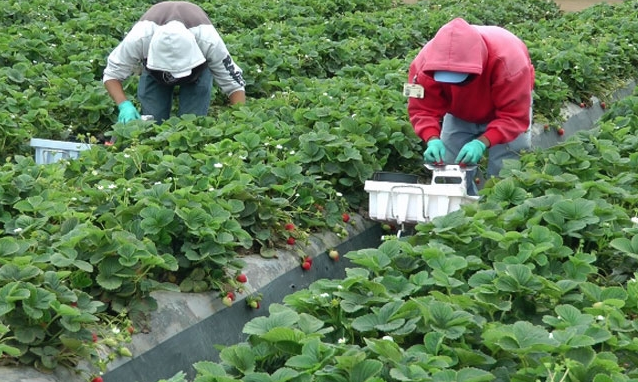
A group of Santa Maria farmworkers has volunteered to participate in a UC study to determine whether they are exposed to hazardous pesticide residues when harvesting strawberries.

The study is led by Robert Krieger, UC Cooperative Extension specialist in the Department of Entomology at UC Riverside. Krieger is an expert in environmental and occupational toxicology.
This summer, Krieger and a team of researchers spent nearly three weeks in Santa Maria with workers at DB Specialty Farms. The workers wear gloves as they pick strawberries. Before each break, their gloves are collected and frozen for later lab analysis.
“We’ve found that pesticides are transferred to the gloves during normal work and we’re measuring the amounts that are transferred in hopes that we can use it to measure total exposure,” Krieger said. “The real question is how much exposure occurs, how much is OK, and how little occurs under normal conditions of use.”
The team is also collecting samples of strawberries harvested by the workers and samples of leaves.
In order to understand uptake and excretion, the workers are asked to collect urine for 24-hour periods after working in sprayed fields. To be certain any sign of pesticides in the urine came from work exposure, the researchers have also collected 24-hour urine samples from spouses or roommates of the field workers to assess dietary or home exposure.
“The levels of exposure are determined by how much is applied, how much remains on the crop and how much is transferred to people. We’ve independently measured those and came up with an assessment of how much a person is exposed to during their normal work,” Krieger said.
The research focuses on two pesticides: the organophosphate malathion and the pyrethroid fenpropathrin. After the pesticides are applied, there is a three-day waiting period before harvest gets under way. In the project, as soon as the workers are back in the field, the monitoring begins.
Studies that Krieger has conducted over the past 18 years show that low, safe levels of pesticide are absorbed and rapidly excreted by harvesters. Breakdown products of the pesticides – parts of the pesticide molecule that are not toxic – can be measured in the urine, but it is not known whether the pesticide broke down on the plant, before the workers were exposed, or if the workers’ metabolism broke down the pesticides.
“Those breakdown products are not toxic, but if they are absorbed, they will appear in the urine and we can’t tell whether a plant made it or a person made it and that complicates our analysis and that’s one of the new areas that we’re investigating in 2012,” Krieger said.
By comparing the gloves, fruit, leaves and urine and using sophisticated metabolic chemistry in the laboratory analyses, the researchers will be able to reconstruct how much exposure there was during the work day.
If the research concludes that analyzing gloves is a useful way to measure worker exposure, gloves could become an important tool for farmers and regulators. Another probable area of impact from the study is in verifying the levels of exposure, which the researchers are finding to be very low.
“These workers have very low levels of pesticide exposure. And in fact, they’re the best-studied workers with respect to pesticide exposure in agriculture,” Krieger said. “That gives us confidence that the exposure is not having a health impact.”
Definitive results from the August study are expected in about six months.
The research program has been sponsored by strawberry growers of the California Strawberry Commission and the Personal Chemical Exposure Program, UC Riverside. The current Santa Maria research is possible by the involvement of DB Specialty Farms and Safari Farms of Santa Maria, and PrimusLabs.
The research was approved by the Institutional Review Board of UC Riverside and the California Environmental Protection Agency. All the participation is voluntary and the farmworkers and their spouses or roommates are compensated for the inconvenience of urine collection. They receive $25 for each 24-hour collection and a $100 bonus for completing all 10 urine collections.
In addition to the extra pay, the study volunteers benefit by helping improve pesticide safety for themselves and their colleagues.
“These workers are doing a service to other workers by allowing us to measure the amount of exposure that occurs during normal work,” Krieger said.

Big SLO County Solar Projects To Energize

The two sprawling utility-scale solar projects in eastern San Luis Obispo county are approaching their second season of construction this fall and both are targeting energizing – hooking the panels up to PGE –  in coming months.

“We’re working on the third of six phases now” says First Solar on-site spokesperson Dawn Legg ”with well over 400 people working.” Ms Legg addressed the county Board of Supervisors this week to give them a progress report on the 550MW Topaz project being built by First Solar but owned by MidAmerican Solar. Legg says the workforce is mostly local and includes plenty of  stories of people glad to be working near home including returning veterans.

“We are on target to energize 48MW by the end of this year” says Legg – noting the complexity of coordinating all the moving parts including construction of a new substation and working with PG&E.

At the second large solar project in the Carrizo Plain – California Valley Solar Ranch –  being built by SunPower and Bechtel and owned by NRG – the 250MW project is a few months ahead of the other on their construction schedule and according to county planner John Mckenzie “energizing is likely in the next few weeks” – some 21 MW that will go out on the grid. About 400 people are working on this project as well.

“People who take a drive out here say when they approach the site – it is pretty impressive. There is no doubt about it – we are building a big power plant “adds Legg that will make sure the light stay on as the state moves to 33% renewables.” The Topaz project has been estimated at $417 million including property and sales tax revenues for the County, wages from direct and indirect employment, induced spending and supply chain revenues.The Sunpower project has been estimated to be valued at $ 315 million in a Cal Poly study.

It will be another two years before both projects are completed.

SLO County & State Jobless Rate Unchanged at 8.5%

San Luis Obispo County saw its jobless rate unchanged in July compared to June but below last July at 9.7%.

The EDD report shows 1330 more jobs in the county year over year but 400 fewer farm jobs than a year ago.

For July 2012 the biggest drop came in the government jobs category. “Those are seasonal jobs that go away every summer when school gets out” says analyst Juan Millan of the EDD.‘These are jobs that will come back in fall.”

Month over month job gains came in construction,transportation and in  the hospitality industry who added 200 jobs in the month.This category is up 600 jobs year over year as tourism has blossomed this summer in SLO.

Statewide,California’s unemployment rate was unchanged at 10.7 percent in July, and nonfarm payroll jobs increased by 25,200 during themonth for a total gain of 507,200 jobs since the recovery began in September2009, according to data released today by the California EmploymentDevelopment Department .

The U.S. unemployment rate increased in July to 8.3 percent.

In July 2011, the state’s unemployment rate was 11.9 percent. The unemployment rate is derived from a federal survey of 5,500 California households. Nonfarm jobs in California totaled 14,358,600 in July, an increase of 25,200 jobs over the month, according to a survey of businesses that is larger and less variable statistically. The survey of 42,000 California businesses measures jobs in the economy. The year-over-year change (July 2011 to July 2012) shows an increase of 365,100 jobs (up 2.6 percent).

EMPLOYMENT AND UNEMPLOYMENT IN CALIFORNIA
The federal survey of households, done with a smaller sample than the survey of
employers, shows a decrease in the number of employed people. It estimates the number of Californians holding jobs in July was 16,444,000, a decrease of 40,000 from June, but up 277,000 from the employment total in July of last year.

The number of people unemployed in California was 1,962,000 – down by 12,000 over the month, and down by 228,000 compared with July of last year.

EDD’s report on payroll employment (wage and salary jobs) in the nonfarm industries of California totaled 14,358,600 in July, a net gain of 25,200 jobs since the June survey.This followed a gain of 45,000 jobs (as revised) in June.

Six categories (financial activities; professional and business services; educational and health services; leisure and hospitality; other services; and government) added jobs over the month, gaining 41,300 jobs. Professional and business services posted the largest increase over the month, adding 15,200 jobs.

San Luis Obispo Median Home Sales Price Rises 19% In July

With record low interest rates a housing recovery appears underway in SLO County.

The median price paid for an existing home in San Luis Obispo County rose 19.4% year over year and up from June of this year as well according to Data Quick. The June 2012 median was $382,50 and rose in July 2012 to $400,000 up from $335,000 in July 2011.

There was also good news on the sales volume – up 9.2% from a year earlier. Sales of new homes in SLO in July was positive as well at 32 compared to just 11 in July 2011 and 15 in June 2012.Condo sales were higher in July at 50 compared to 36 in June and 40 a year earlier.

Five Month Trend

The positive news in SLO County was reflected in statewide figures. The median price paid for a home in California last month was $281,000, up 2.6 percent from $274,000 in June, and up 11.5 percent from $252,000 in July 2011.

Last month’s median was the highest for any month since September 2008, when it was $283,000. July marked the fifth consecutive month in which the state’s median sale price rose year-over-year.

Across California ,home sales rose 13.9 percent from last year at 39,507 homes with the Bay Area up 22%.Sales in Southern California jumped to 20,588 homes, up 13.8 percent from 18,090 homes last year, DataQuick said. This is the seventh straight month that sales climbed year over year.
For the current housing cycle, the median hit a bottom of $221,000 in April 2009, while it peaked at $484,000 in early 2007.

Distressed property sales – the combination of foreclosure resales and “short sales” – made up 41.0 percent of the state’s resale market last month, down from 43.0 percent the month before and down from 51.8 percent a year earlier.
Even in hard hit Fresno County  the median price was up in July 8.5% to $146,500. In Santa Barbara County, the median price rose in July by 4.8% and sales surged 44% from 227 in July 2011 to 327 in July 2012.
Of the existing California homes sold in July, 22.0 percent were properties that had been foreclosed on during the past year. That was down from a revised 24.9 percent in June and down from 34.5 percent a year earlier. Last month’s figure was the lowest for any month since foreclosure resales
Watching interest rates , Freddie mac says 30-year fixed-rate mortgage (FRM) averaged 3.62 percent with an average 0.6 point for the week ending August 16, 2012, up from last week when it averaged 3.59 percent. Last year at this time, the 30-year FRM averaged 4.15 percent.

E. & J. Gallo Winery Announces Intention to Purchase Central Coast Winery and Crush Facility

Company Buying Courtside Cellars to Meet Growing Demand

MODESTO, Calif. E. & J. Gallo Winery (Gallo) announced this week the intention to purchase Courtside Cellars in San Miguel, California. The twelve-year-old winery will support the company’s continued growth in California’s Central Coast. The purchase includes 34 acres of land and a winery capable of crushing 60,000 tons of grapes.

According to Roger Nabedian, Senior Vice President and General Manager of Gallo’s Premium Wine Division, “We’ve been expanding our presence in the Central Coast over the past few years and consider the region to be a key part of our premium wine strategy moving forward. We are excited to have this highly capable winery to support our Bridlewood and Edna Valley Vineyards businesses.”

Earlier this year, Gallo purchased more than 300 acres of vineyards in Monterey County. Last year, the company purchased Edna Valley Vineyards which produces one of the best-selling Chardonnay brands in the U.S. In 2004, Gallo purchased Bridlewood Estate Winery located in the Santa Ynez Valley of Santa Barbara County.

Bob Schiebelhut, of Courtside Cellars, said, “We will be keeping our San Luis Obispo Facility where we will focus our efforts on building our Tolosa Winery brand into one of the finest Pinot Noir and Chardonnay estates, as well as continue to offer custom wine services.”

San Francisco based Demeter Group was the exclusive financial advisor on the deal which is expected to close next week. The purchase price was not disclosed.

About E. & J. Gallo Winery
Established in 1933 in Modesto, California, by Ernest and Julio Gallo, E. & J. Gallo Winery has become the world’s largest winery and the foremost winery in the art of grape growing, winemaking, distribution and marketing of wines. With seven wineries strategically located in California’s wine regions and access to grapes from vineyards in all of the premier grape-growing areas of the state, Gallo produces wines in every category, to suit every taste. Gallo imports wines from eight of the major wine growing countries in the world. Some of the brands in Gallo’s wine portfolio include Gallo Family Vineyards, Barefoot Cellars, Louis M. Martini, MacMurray Ranch, Bridlewood, Mirassou Vineyards, Frei Brothers, DaVinci, Martin Codax, Don Miguel Gascon, Ecco Domani, McWilliam’s Hanwood Estate, and William Hill Estate. Recently, the Winery has expanded its portfolio to include distilled spirits with the introduction of New Amsterdam Gin and Familia Camarena Tequila.

Morro Bay/Los Osos Hotels See More Visitors

Morro Bay hotel

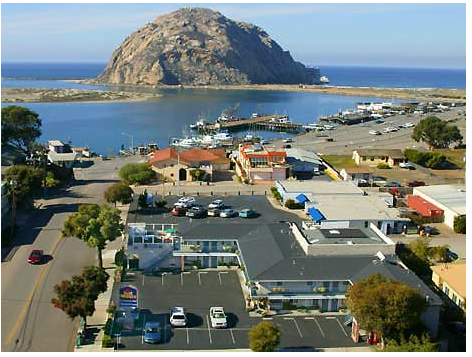
Both Morro Bay and Los Osos appear to be having a busier summer in 2012 than a year ago.

Morro Bay’s Transient Occupancy Tax(TOT) numbers for the fiscal year show nearly a 10% increase in hotel revenues and city bed tax.

Morro Bay has some 920 hotel rooms and they enjoyed improved occupancy in the latest fiscal year that runs June to June. In June of 2011 occupancy stood at 58% and motels did $1.64 million in business. In June 2012 occupancy improved to to 65% and receipts were $1.97 million, the latest number available. July and August are the region’s busiest period.

For the  entire fiscal year, motels in Morro Bay did $17.1 million in 2011-2012 compared to $15.7 million in the 2010-11 fiscal year.

For the city the difference will be an extra $160,000 for the fiscal year. In addition the Morro Bay Tourism Improvement district gets an extra $200,000 vs the year before. Morro Bay’s bed tax is 10% and an extra 3% is given to the improvement district to market the community.

Back Bay

In Los Ososo hotel owner Bill Lee says he increased the number of rooms in Baywood in since last year by converting several out buildings to hotel rooms bringing his total to 21 rooms. Across the street at Baywood Inn there are 18 rooms and the other property in town is Sea Pines Golf Course with 41 rooms – 80 rooms in Los Osos in all.

“Our TOT meetings we have show we are up nicely this year” says Lee, like other areas in SLO County.

Smith Travel says the San luis Obispo/Paso Robles metro area recorded a 8.9% increase in hotel occupancy and a 13.8% increases inRevPAR. Room revenue was up 16.4%.Over a longer term, year to date – hotel occupancy was up 6.9%.

Los Osos/Baywood will see the reopening reopening of Mr Lee’s pizza property called Baywood Pizza this weekend.

Lee does not expect much more development to happen in the community until the sewer project is completed over the next few years. ”That’s called progress” he adds saying that while streets are torn up for a while – the long awaited service will enable stalled development,empty parcels and rundown properties to improve.

The project will build 100 miles of collection pipeline laid over two years. The total budget for the project is $173.4 million.Construction activity for the Los Osos Wastewater Collection System is expected to begin in  August 2012 and continue through 2014. Check this website (http://www.diglososos.com/traffic-update ) regularly to stay informed of current construction activities.
For merchants like Lee the added stimulus of money being spent and workers here should benefit local business.

Sea Level Rise Report an Important Tool For Policy

This month Cal/EPA Secretary Matt Rodriquez released the following statement regarding the release of the National Research Council’s report, Sea-Level Rise for the Coasts of California, Oregon, and Washington: Past, Present, and Future.

“This study provides key findings on how sea level rise will impact the future of California’s environment and economy. The information will help guide California as we continue implementing and developing environmental policies to mitigate and adapt to climate change while, at the same time improving our economy now and in the future,” said Secretary Rodriquez.

The report underscores the importance of California implementing climate laws like AB 32 to reduce greenhouse gases and its effect on the environment. California’s climate laws are addressing both the sources of emissions as well as ways to adapt our infrastructure.
Executive Order S-13-08 directed state agencies to plan for sea-level rise and coastal impacts, and it also requested the National Research Council (NRC) to establish a committee to assess sea-level rise to inform the state efforts.

The Natural Resources Agency’s Department of Water Resources administered the contract with the NRC and Cal/EPA’s State Water Resources Control Board (State Water Board) provided 20 percent of the funding. Both Agencies have been working to craft policies that help mitigate and adapt to California’s changing climate. The State Agencies work through the Climate Action Team coordinating efforts on both fronts.

The study specifically notes that California’s coastline is most sensitive to sea level rise below Cape Mendocino – and rising ocean waters could affect the most populated areas of the California coast.
Projected impacts of sea level rise on California are outlined below and in the report.
 2030: 4cm to 30 cm rise in sea level (1.5 inches to 11.8 inches)
 2050: 15 cm to 60 cm rise in sea level (5.9 inches to 23.6 inches)
 2100: 42 cm to 166 cm rise in sea level (16.5 inches to 65.3543 inches)

“California’s beaches and coastline are vital to our state’s economy. This report reinforces why it’s so critical that we continue to plan to make sure important programs like beach monitoring and coastal protections for sensitive ecosystems and wetlands are fine-tuned to anticipate sea level rising,” said State Water Board Chair Charlie Hoppin.

Sea level rise influences several important State Water Board priorities and will serve as a valuable planning resource to refine critical long-range environmental considerations in program areas ranging from wetlands protections, to beach water quality monitoring, and Bay Delta inflow and outflow concerns.

The report notes that wetlands are important to help protect the coast from sea level rise. The State Water Board is considering a new policy on wetlands designed to protect and enhance California’s wetlands which in turn could serve as an effective deterrent to the impact of sea level rise, particularly in Central and Southern California.
The State Water Board has a two-decade long history of providing loans and grants for the
construction of publicly-owned facilities such as wastewater treatment plants, sewage systems,  and storm water treatment and collection basins (water recycling) through the Clean Water State Revolving Fund (CWSRF).

Because of the long-term planning that goes into this infrastructure (50+ years of service life in some cases), this report will be part of the ongoing planning and siting of future infrastructure by the State Water Board so that any projected impacts of sea level rise do not interfere with the performance and viability of these important projects.

Ongoing Water Board activities related to water pollution, storm water reuse, capture and diversion of pollution carried by storm waters into areas of special biological significance will also have to account for rising sea level. Rising sea levels may pose additional challenges to the state in these efforts.

Beach water quality monitoring is overseen by the State Water Board in coordination with local counties. Sea level rise may impact monitoring locations and constituents. California has the most extensive and comprehensive monitoring and regulatory program for beaches in the nation.

Finally, the Bay Delta Plan — short for the State Water Board’s San Francisco Bay/Sacramento-San Joaquin Delta Estuary Water Quality Control Plan — can determine the amount and timing of water entering and moving through the Delta. Sea level rise is one of the many factors that must be considered by the State Water Board as it updates the plan’s objectives.