Immigration Reform: Central Calif Residents…. Out Of The Shadows?

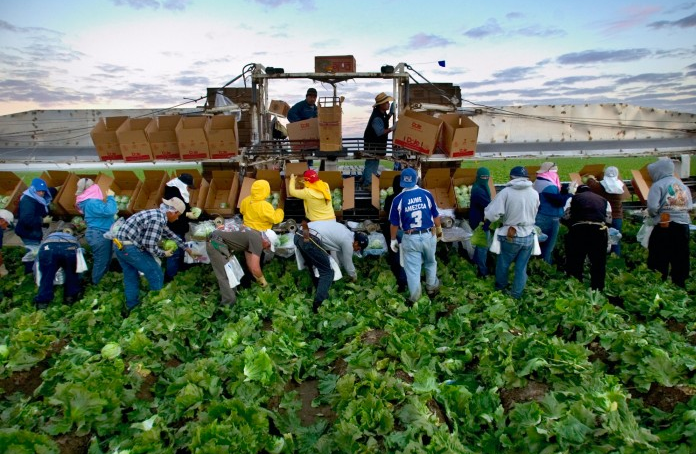
UC Berkeley photo

California has more unauthorized immigrants than any other state, about 2.6 million of the nation’s 11 million; they make up 7 percent of the total California population and 9 percent of the state’s labor force says a July 2011 Public Policy Institute of California study. The report estimates that Tulare County as of 2008 had about 29,000 undocumented people or just under 7% of the population.

Now a bipartisan immigration reform plan gaining support in Congress could change their status this year. Farm leaders like Manual Cunha says leadership in the Senate led by Democrats Chuck Schumer and Dianne Feinstein and the GOP’s Marco Rubio of Florida point “in the most positive direction I’ve seen in years.” Not only is President Obama made a commitment, “The time is now.” he offered in a Nevada speech,but the House GOP leadership including the Valley’s Kevin McCarthy of Bakersfield may be “ready to deal” says Cunha.

Cunha points to leadership by GOP’s rising star Marco Rubio from a farm state who has come to understand the time is right.”I think the country’s taking a much bigger risk by not doing anything,” Rubio observed in the past few days.

This week Tulare County congressman Devin Nunes chimed in. “Our immigration system is broken and needs to be overhauled from top to bottom. We need reform that both secures the border and ends the unacceptable status quo, in which there are millions of people living and working in the shadows. If the Senate bill accomplishes those two goals, it will be a good starting point for discussion.”

The outlines of a plan include a pathway to citizenship for undocumented immigrants, a streamlined legal immigration system, better enforcement and tighter border security.
Cunha predicts a bill will be launched in the Senate and get to the House by April and on to the President’s desk by June.

The stars seem to be aligned between traditional rivals like the California grower community and the UFW as well on the major points of legislation.

“We thank this bipartisan group of Republicans and Democrats for understanding that a roadmap to citizenship is essential to any immigration reform plan. We also endorse the proposal’s commitment to strong labor protections as part of any future flow program and allowing temporary workers who have worked in this country for many years to earn green cards,” said UFW’s Arturo S. Rodriguez recently.

Cunha says immigrants who have been living here for years will be able to gain legal status and not worry they or their families will be suddenly hauled away. Instead, they would be able to  enter the US legally and safely without  being exploited by ‘coyotes’ or put in danger by the drug cartel. For farmers worried again this year about worker shortages “we will finally get a legal workforce and not live in fear of government audits” adds Cunha.

“It’s not just bad for [undocumented workers], it’s bad for the entire economy, because all the businesses that are trying to do the right thing that are hiring people legally…” said Obama in his speech in Nevada this week.
Both Farm Bureau and Western Growers have expressed support for the framework which will also includes a foreign workers (guest worker) plan.

So what changed? Cunha says “it is simple – the election results”  have pushed more Republicans to look at the problem in a new way. In the past a majority of GOP have emphasized what their 2012 party platform said opposing “any form of amnesty” for people who intentionally violate immigration law, saying amnesty “rewards and encourages more law breaking.”

The LA Times reported this week that 4 GOP state legislators have announced support as well including Katcho Achadjian (R-San Luis Obispo).


Pesticides, Water Quality and Alfalfa Production

January 24, 2013

There is no question that managing pests in alfalfa is a challenge. But it’s even more of a challenge considering that we need to consider how our chemical tools impact our environment. Why is this is important?  Two reasons: 1) no grower wants to pollute our natural waterways or wells, 2) ultimately unwanted environmental impacts will cause the loss of these pesticide tools over time.  This became evident last year when the detection of the herbicide Velpar (hexazinone) in wells caused DPR to threaten to pull the registration.  After hearings with members of the California Alfalfa & Forage Association and scientists in Sacramento, ultimately growers were able to keep Velpar, but it should have been a wake-up call about the potential for water impacts of chemicals used in alfalfa.

Pesticide water quality issues continue to be a concern for alfalfa fields that drain into natural waterways. The products used in alfalfa that are most troublesome include the herbicide diuron (Karmex or Direx), Velpar, and the insecticide chlorpyrifos (Lorsban, Lock-On, Cobalt, Stallion). Diuron is used for winter weed control in alfalfa (primarily as a pre-emergence material) while chlorpyrifos is used for weevil control. Velpar is very important for controlling groundsel in alfalfa. All of these  pesticides move with water (irrigation and storm water runoff) after they are applied to fields.

The Water Quality Coalition groups have reported detections of chlorpyrifos and diuron in several of the alfalfa growing areas of the Sacramento and San Joaquin Valleys.

Diuron is relatively persistent in the environment. It has a low tendency to attach to soil particles, has a high aquatic toxicity, and the field dissipation half-life is 90 days. This herbicide is also a groundwater issue in some areas of our state. Chlorpyrifos has a moderate tendency to attach to soil particles, but is very highly toxic to aquatic invertebrates (in parts per trillion) with a half-life of 43 days.

Numerous exceedances have occurred in waterways for both diuron and chlorpyrifos, requiring the implementation of management plans to reduce the concentration of these pesticides to levels that are not toxic to aquatic test species. The development of these management plans, as required by the Regional Water Quality Control Board, are very expensive and time consuming to implement. They require huge amounts of staff time to write reports and additional monitoring requirements.

UCCE is conducting field studies in collaboration with growers and CA DPR and UC Davis to better understand how to minimize offsite movement of these products into surface waters. Current guidelines include the following:

  • If you are managing large alfalfa acreage, consider using multiple pesticide chemistries on different fields to reduce the cumulative effect of any one active ingredient.
  • Study your water systems and look for ways to recirculate water back onto agricultural fields and to prevent drainage water from entering natural waterways.
  • Use alternative products that have less water impacts on those fields where drainage is difficult to prevent – lists by crop and pest are available on the UC IPM guidelines at: http://ipm.ucdavis.edu/PMG/selectnewpest.alfalfa-hay.html
  • Use extreme caution during applications. Eliminate drift and overspray, especially near ditches (supply and drainage).
  • Do not apply to saturated soils where the danger of off-site movement is greater.
  • Do not apply just prior to a runoff event or irrigation.
  • Several approaches such as alternative products on field perimeters have been shown to reduce the off-site movement of the more problematic chemicals.

New Lawsuit Filed Over Fracking In California –

Vineyard Owners On Central Coast Weigh In

click to enlarge

A new lawsuit says state regulators have allowed hydraulic fracturing, or fracking, to expand in California without legally required oversight.
The lawsuit, filed last week in Alameda County Superior Court by the Center for Biological Diversity, seeks to compel regulators to enforce existing state law that protects people and the environment from underground injections carried out by the oil and gas industry.
In a news release, the Center for Biological Diversity said the state has yet to regulate or even monitor the controversial practice of fracking, which involves injecting water and industrial chemicals, mixed with sand, at high pressure into shale formations to release previously inaccessible stores of natural gas or oil. The water-intensive and controversial process has expanded in many areas of the country, raising concerns about impacts on drinking water supplies.
“A looming fracking boom threatens to transform California, creating serious pollution risks to our air, water and climate,” said the center’s Vera Pardee said the release. “Existing rules clearly cover fracking, but state officials don’t regulate or even track this dangerous way of extracting oil and gas. The state needs to stop ignoring the law and start protecting our environment.”
According to the center, more than 600 wells in at least nine California counties were fracked in 2011 alone. Recent advances in fracking techniques are driving a growing interest in the Monterey Shale, a geological formation holding an estimated 15 billion barrels of oil.
California’s existing oil and gas regulations cover all forms of underground injection and clearly apply to fracking, the center said in its release. While fracking was exempted from the federal Safe Drinking Water Act in 2005, no such exemption exists in California law, the center said.
On the central Coast vineyard owners have increasing concern about fracking near their water source. The Wine Spectator has published an article this month suggesting a looming controversy.
Central Coast
“Oilers are intensely exploring the Central Coast. In December, mineral rights leases to 17,000 acres on federal lands near vineyards in southern Monterey County were sold, and another auction is scheduled for May 2013. Vintners are starting to wonder what fracking might mean for them. “We understand that energy is an issue, just as our water is an issue,” said Paula Getzelman, who grows 5 acres of Syrah, Grenache and Mourvèdre with her husband at Tre Gatti Vineyards in the Lockwood Valley of southern Monterey County, less than five miles from a recent federal lease sale. “What we’re saying is, if something spoils our water, we’re all done out here.”
Paul Johnson, president of the Monterey County Vintners and Growers Association, agreed. “Oil companies are buying [mineral rights] up, and if oil companies are buying it, they are obviously planning on doing fracking,” said Johnson, who manages various Central Coast properties under his family’s Johnson Vineyard Com.”
The California Division of Oil, Gas, and Geothermal Resources (DOGGR) released a “discussion draft” of regulations for fracking in December and has said a more formal rulemaking process will begin in 2013. Information on the discussion draft is available here.
According to the Center for Biological Diversity, compliance with California’s existing oil and gas regulations would require disclosure of all fracking chemicals, as well as engineering studies and tests to evaluate the potential for underground migration of fracking fluids. State regulators would also need to ensure that fracking is conducted in a way that prevented, as far as possible, damage to life, health, property, and California’s water and other natural resources.

Contributed by Lisa Lien-Mager – ACWA News

Dairy Exports To China Could Double By 2017

U.S. Dairy Export Council / Updated: 01/22/2013
US & China Resolve Export Issue

Chinese and U.S. regulators approved a dairy certificate ensuring that the flow of U.S. dairy goods into the largest dairy importer in the world continues unabated.
“U.S. dairy exports to China are on pace to clear $400 million in 2012,” says Tom Suber, president, U.S. Dairy Export Council (USDEC). Primarily funded by U.S. dairy farmers through their checkoff investment, USDEC leads industry efforts in resolving overseas dairy regulatory affairs issues and developing export markets. USDEC staff worked closely with Chinese officials and a U.S. inter-agency regulatory team to secure this particular deal.
“With the certificate question settled, we expect U.S. dairy export value to China could more than double by 2017,” he says. “Some or all of those sales could have been lost had it gone unresolved.”
The issue dates back to early 2010 when China revised its dairy certificate as part of sweeping efforts to upgrade domestic food safety.
“Credit goes to China for keeping its market open throughout the certificate negotiation and review process,” says Matt McKnight, senior vice president, market access, regulatory and industry affairs, USDEC. “It is not always the case that a country is so willing to work with a major supplier to find mutually satisfactory ways to get the regulatory assurances it requires. They said, in essence, as long as good faith negotiations were moving forward, the market would stay open. If the United States became nonresponsive or if talks fell apart, China could have closed its doors.”
The process was ongoing and USDEC was involved from the start. Staff visited one-on-one with Chinese food safety and ag authorities to understand the assurances they were seeking and collaborated closely with U.S. regulators to develop and revise sample certificate language.
“Special appreciation is due to USDA [U.S. Department of Agriculture] and the rest of the inter-agency team that worked dedicatedly with China to find a way to address their concerns,” says McKnight.
At the same time, although there never was a market closure, the unresolved certificate issue and threat of closure loomed over U.S.-China dairy trade. That perceived risk made some buyers hesitate, opting to source some or all of their product from U.S. competitors.
USDEC estimates the uncertainty of the certificate situation depressed U.S. dairy ingredient sales by 5-10 percent and cheese sales by as much as 50 percent. The impact was considerably greater in the case of cheese given the foodservice industry’s need for consistent supply and more limited interchangeability of cheeses.

After Wet December – Dry Winter Looms

Tale Of Two Winters & Two Californias

It poured in Northern California in December as rainfall totals were over 200% of normal for the water year starting October 1 and going into the New Year.

Even today – three weeks later – the state DWR says  the Northern California  Water Index stands at 142% of normal for this date with 33 inches of precipitation so far. The agency says in an average water year (ending after April) we can expect around 50 inches in the bucket.

For the 5-station San Joaquin Valley Index – more indicative of our neck of the woods – the index is at 109% of normal for the date having already received about half the 40 inches we can expect by the end of April in a “normal “ year.

But if this football game’s first half has been full of stormy excitement – the second half – January and now likely February seem like a much different team has showed up on the field and they are a quiet and  literally – cold bunch.

“February like January looks on the dry side” says Alan Fox of Fox Weather who predicted the record breaking storms in late November and December characterized by what NOAA called “ atmospheric rivers “ of tropical moisture that funneled into California. Some places along the Feather River  got over 2 inches an hour one of those events.

At that time Fox saw a a wet winter ahead but changes in sea temperatures to the cool side along the equator have changed the ballgame. The El Nino pattern is gone.

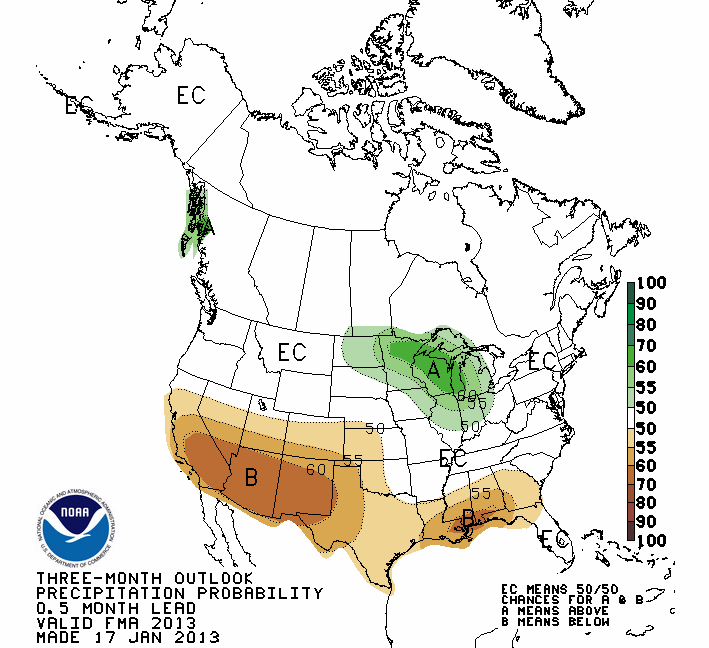
NOAA’s Climate Prediction Center has recently (Jan 17) published this three month map with big brown spot signaling dry weather over central and southern California the rest of this winter.

Not only is this bad news for central California but for drought stricken states in parts of the Midwest who desperately need rain this coming Spring to avoid another bad corn and soybean crop year

Tale Of Two Winters

After flowing freely in December the spigot seemed to be shut on “off” as of January. At the key northern reservoir at Shasta Dam that had seen 31 inches of rain in November and December –  the rain gauge measured just 0.08 inches over the first 21 days of this month.

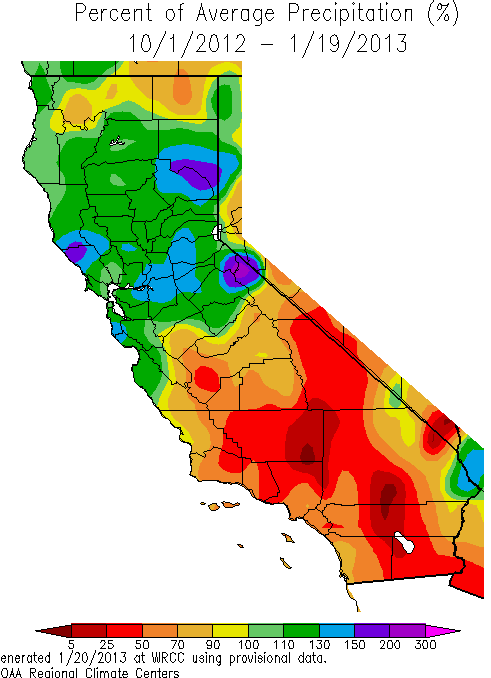
click to enlarge- TWO CALIFORNIAS

If it as a tale of two winters it is also a tale of two Californias so far this water year. This map tells the story showing the percent of average rainfall from Oct 1 through Jan 20 with part of northern California at 200%( purple) and parts of southern California at 25% of average( brown).

More dry cold weather is in the offing Fox says.

Still, forecaster Fox says he is “not giving up on February” and expects a few storms to come into the state over the month coming up.

“January 24,25 ,26 could see a small amount of rain and Feb 5,6 should see a storm that will drop snow in the Sierra “ he says.

Central Coast forecaster John Lindsey says today to expect unsettled weather for this region starting Wednesday and more promising – ”rain showers forecast on Saturday into Sunday.”

But those big rain events of December are long gone.

Tulare County Ag Installing More Solar

A solar farm at Limoneira in Ducor helps run a pump that irrigates the citrus orchard

Strathmore’s Villa Park orange packing house along Hwy 65 is installing a 5 acre solar farm next door that is expected to cover 80% of the power needs for the big Sunkist packing house and cold storage says manager Jammie Logan.The $3.2 million system is going on line at the end of February.

Add Tipton’s Pitigliano Farms to the local ag enterprises taking advantage of solar technology to cut their costs. Mike Pitigliano says a solar farm is being built on their ranch by March that promises to cut  85% of their current electricity costs for some of their ranches. The permit is valued at near $500,000  with the units being put in by Korea-based Hanwha Solar.

Citrus Losses May Be Minimal From Freezing Nights

January 16, 2013
By Cecilia Parsons

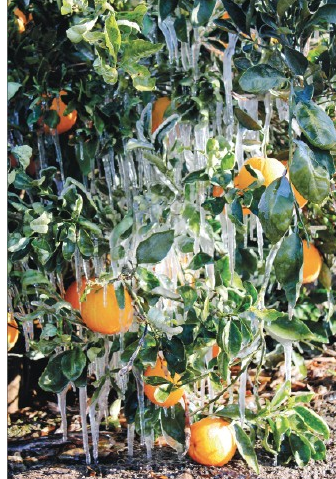
Oranges in Tulare County’s citrus belt are covered with ice. Growers turn on their sprinklers and the ice that forms protects the fruit from internal damage.
Photo/Cecilia Parsons

After five long, freezing nights spent turning on water and wind machines to protect their crops, San Joaquin Valley citrus growers are hoping they have dodged widespread frost damage.
Sunday night recorded the lowest temperatures in the valley citrus belt to date and California Citrus Mutual is reporting the seedless mandarin crop has likely sustained moderate damage due to the low temperatures and their duration. Navel oranges, especially those on edges of groves in the coldest areas, sustained minor damage. Extent of the damage will not be known for several days. Citrus growing areas in Riverside, Ventura and Imperial counties experienced lows in the 30s.
Lows Monday morning were in the lower 20s in many areas, with Ducor recording 22 degrees.
On Monday morning, Joel Nelsen of California Citrus Mutual reported some freeze damage is expected in lemon and mandarin crops, but navel orange damage is not expected to be extensive. The extended cold spell, which began Jan. 10, has been expensive for California citrus growers who have spent $17.5 million on frost protection last week.
Seventy-five percent of the valley’s navel orange harvest remains in the field. Harvest for the Murcott and Tango mandarin varieties harvest begins this month. Only 30 percent of the Valley lemons have been harvested.
“(Sunday) night, the cold began earlier and it stayed cold,” said Nelsen. There was little cloud cover to provide much of an inversion layer that makes wind machines more effective.
Mandarin growers were running their wind machines at least 13 hours in the coldest areas. Navel growers started about 1:30 a.m. Many growers began running water in their groves earlier in the day to warm the ground.
On previous nights, there was enough of an inversion layer that made wind machines more effective in drawing down warmer air aloft. By Saturday night, skies were clear with little cloud cover, extending the duration of low temperatures. Low temperatures in the mid-20s were recorded throughout the citrus belt with lows reaching 25 degrees in a few areas.
Nelsen said duration of cold temperatures is the critical factor. Even though temperatures dropped lower and for longer periods of time during Saturday night, Nelsen said it was not significant enough to cause widespread fruit damage. Fruit on edges of groves farthest from wind machines are expected to incur some damage. Ice crystals forming inside the juice sacs will cause them to burst and the fruit will dry out. The mandarin crop is most likely to see frost damage due to the thinner skin of the seedless fruit, he said.
At this point in the season, navel oranges have reached a higher sugar content and are better able to withstand freezing temperatures for longer periods of time.
Cold temperatures averaging in the low 30s hit citrus production areas in Ventura, Riverside and Imperial counties where fruit has a higher sensitivity to cold due to overall higher temperatures. No damage has been reported where frost protection was provided.
While the freeze event may have shifted grower priorities last week, the Asian citrus psyllid is still a chilling factor in this year’s citrus harvest.
This pest, which can carry the deadly citrus disease Huanglongbing, or citrus greening, was trapped in two San Joaquin Valley sites in October and November—the first time the pest has been found in the state’s prime citrus growing area. The single adults are believed to be hitchhikers into the area and not a signal of an established breeding population of ACP.
Trapping and visual surveys around the two sites have failed to find additional ACP.
In Tulare County, 163 square miles—a five-mile radius around two sites where ACP were trapped late last year—are restricted areas. Citrus nursery stock cannot be moved outside the area unless it was grown inside an insect-proof structure. Citrus harvested inside the restricted areas must either be packed inside the area or be cleaned of stems and leaves before it is moved outside.
On Dec. 31, CDFA announced another option. Growers with citrus inside the two restricted movement areas in Tulare County can opt for chemical treatment prior to harvest to minimize spread of ACP.
This treatment option is much less expensive and favored by growers, said Tulare County Agricultural Commissioner Marilyn Kinoshita. The option had to first be approved by CDFA and updated compliance agreements are required. Growers can choose from a list of approved products, time the application prior to harvest and treat. Kinoshita said they have seven days after treatment to complete harvest. Cost of the treatment option is half of the $10- to $15-per-bin cost of running fruit through a packing line.
Porterville lemon grower John Konda, who grows citrus inside the Terra Bella restricted area, said the chemical treatment is a much better option cost-wise in spite of the extra paperwork required.
Growers outside the restricted areas have not been impacted by the ACP requirements. Leonard Massey of B&Z Nursery said the restricted zones, which are smaller than the normal 20-mile quarantine zones, do not include any large commercial nurseries.
Even with the recent freeze, University of California researcher Beth Grafton-Cardwell said she isn’t convinced the ACP threat is gone in the valley. The pest doesn’t move much in cold weather, but when temperatures warm up, they could still be found, she said.
Citrus growers hoping that the freeze wiped out any ACP lingering in the San Joaquin Valley should know that is not the case, said Shirley Batchman, director of governmental affairs for CCM. On a trip to Florida, Batchman said she visited an ACP research laboratory where she was shown a container with frozen ACP.
“When they began to thaw, they started moving,” Batchman said. “It can’t get cold enough to kill them, so don’t count on that.”
The ACP trapping program in Southern California counties continues to find the pest, Grafton-Cardwell noted. Researchers are also working on a better ACP trap. Grafton-Cardwell said the pest is attracted to color and volatile oils—both found on citrus leaves and the yellow sticky traps currently in use—don’t specifically attract ACP.
(Cecilia Parsons is a reporter in Ducor. She may be contacted at ceciliaparsons8@gmail.com.)

CFB contributed

Tulare County: More Groundwater Basins In The Works

Could Handle Flood Flows & Recharge The Aquifer –

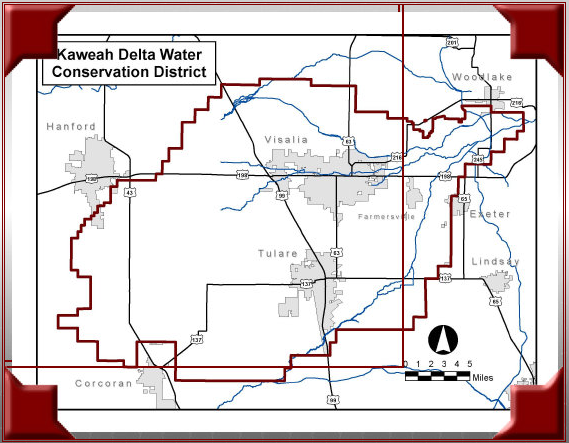
Kaweah Delta Water Conservation District already has some 25 groundwater recharge basins in the greater Kaweah Delta fan and is working hard to design and build 5 more in the near future says district engineer Larry Dotson.

Besides the district, others own recharge basins as well and there around 40 in total covering 5000 acres.

“These basins complement the reason we were founded” says Dotson back in 1925, both “to conserve our water and protect surrounding  land from floods.”

Case in point is work planned for February to construct the 34 acre Curtis Basin near Woodlake being designed by KDWCD to both lay off flood water on about a section of land if need be – as well as recharge the groundwater when surplus water is available,he says. The basin should be ready before Spring,he expects.

The new basin is about 2 miles south of Bravo Lake on district land close to one of those irrigation canals that criss-cross this part of Tulare County.

Another new basin being designed is just south of Kaweah Oaks on the  78 acre Paregien parcel. This basin will enhance storm floodwater control for the City of Farmersville that gets flooded in some wet years. This basin will also feature habitat restoration like they do at next door’s Kaweah Oaks.

Another planned site is just west of Mooney Grove.

Using these basins to recharge water comes only in some years when  contracted districts are able to get Class 2 water from the Friant Kern shipped in and /or when Kaweah flows are heavy.

One of the major importers of water is Tulare Irrigation District(TID)  who when they run water toward their district passes through the Kaweah Delta area between Woodlake and Visalia in earthen canals recharging the aquifer below as the water flows.

TID importation of water comes from both the Kaweah off Terminus Dam and its Bureau of Reclamation allotment delivered through the the Friant Kern. The total water amount varies widely by year. The year 2010 was wet and TID imported 340,000 acre ft adding both Kaweah water and water originating on the upper San Joaquin River, source for the Friant Kern Canal. The following year – in 2011 – less than 30,000 acre ft flowed in and farmers suffered.

But when it does come in the districts will be ready to use that water beneficially adds Dotson, “banking” the water so farms and cities can tap it in another dry year.

The City of Visalia has several partnerships to build basins as well, just upstream from the city limits.

Only this fall the city announced they would get a grant to build a new basin on the east side of town that will help protect the Downtown.

Another partnership under study would exchange TID water with the City of Visalia for highly treated wastewater from the city sewer farm  in coming years. There is a pending Fresno State study of the effect of using such water to grow crops.

All this effort has helped raise the groundwater levels by about 25 ft  in the past 2 years in some parts of TID although they”had to spend around $6.5 million in additional funds in the past two years to help make this happen” says a TID report – constructing new basins and  doing water exchanges.

Kaweah Delta’s own figures show in 2010 the district  experienced a wet year of 135% of normal and between river and canal water importation – using 30 basins they recharged 159,853 acre ft of water. In addition, the water flowing west in the canal percolated another 148,000 acre ft –  all figures estimated. That helped bring the area groundwater level up about 12 ft.

Ag Update/ Beef & Milk

click to enlarge

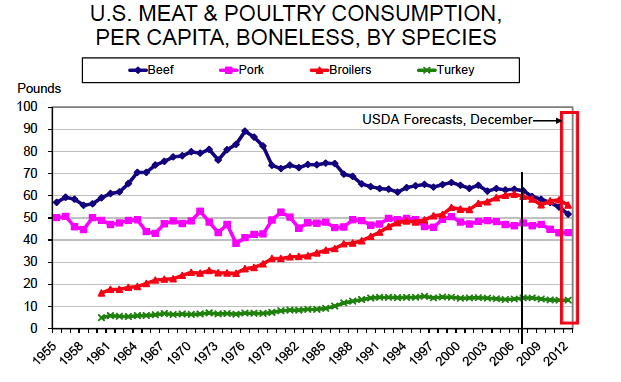
Where’s The Beef? A University of Oklahoma farm advisor is predicting 4.8% drop in beef production this year as consumption continues to drop across the US. In 2011 the consumption drop amounted to 3.8%.
“Beef consumption may drop more sharply in 2014 with a 5% decrease in per capita consumption compared to the lower 2013 level,”Derrell Mr. Peel said. “Furthermore, these decreases in beef production and consumption almost certainly imply higher wholesale and retail beef prices, although other factors will impact the price response to lower supplies.”
USDA figures show per capita beef consumption has fallen 12% from 2007 through 2012.

CDFA Expected To Raise Milk Prices
California dairymen may get at least temporary price relief from the California Department Of Food & Agriculture who are expected to raise the minimum price of milk in the state for six months. Fresno bankruptcy attorney Riley Walter, who testified at a December hearing on the plan, says he had been working with 60 dairy families who had experience extreme financial pressure due to low milk prices. The pressure has been made worse by record high feed prices due to the Midwestern drought. Around 100 dairy operators in the state are expected to be out of business in the past year.
Michael Marsh, CEO of Western United Dairymen, noted that 50 dairy sellouts have occurred in the last eight months within the organization’s membership. Tom Wegner, director of economics and dairy policy at Land O’Lakes, testified that 43 of its dairy farmer members have discontinued milking this year “in large part due to the financial distress.”
The hearing was called by CDFA Secretary Karen Ross to consider whether market conditions support short-term price adjustments to all classes of milk that would last no longer than six months.
Several proposals were offered at the December 21 hearing that would raise the price California dairymen get for their milk of around 0.75 cents to $1 per hundred weight.
After several rejections of pleas dairymen by Karen Ross in 2012 – some relief is expected this time in part because the hearing was called by Ms Ross herself.
California Milk Producers Council general manager Rob Vandenheuvel says he expects to hear the decision by the end of January with new prices set to go February 1. A CDFA posting suggests a decision by January 22.

Opportunity Knocking? Chinese Babies Short On Formula

California milk producers like Visalia-based California Dairies Inc are planning to increase production of baby formula exported to China in coming months. Domestic fluid milk consumption  continues to drop and the industry must look overseas to clear supply. But opportunity knocks as can be seen from news stories like this reported January 3.
Australian supermarkets and pharmacies were running out of popular baby formula Thursday after unprecedented sales reportedly due to Chinese customers trying to secure supplies.
Nutricia, supplier of top-selling formula brand Karicare, said there had been a sudden surge in demand for its products which had seen stocks plummet and left shelves empty.
Major supermarket Coles said it was trying to arrange extra shipments of infant formula. Some pharmacies were rationing sales across brands to a few cans per customer.
Media reports said Chinese residents or tourists in Australia were buying formula in bulk and shipping it back to their native country for family or sometimes sale online.
“Chinese visitors buy as many cans as they can fit into their luggage to take back to China,” one manager of a pharmacy near a major international hotel in central Sydney told the Daily Telegraph newspaper.
Many Chinese people are suspicious of domestically produced milk following a major food safety scandal in 2008 in which six children died and 300,000 others fell ill after drinking milk tainted with the industrial chemical melamine.

Ag Beat – Crops Update

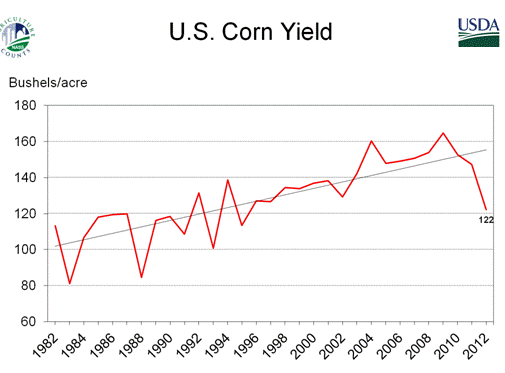
USDA chart show how drought hurt corn yield in US

Corn futures price for March are down to $ 6.90 per bushel from $8.40 per bushel – the record high price due to the drought this past summer. Yield fell dramatically on last years crop say USDA (see chart).

Demand based on price expectations is falling.As one analyst says “ outside speculators and their actions are what is driving the markets today and bringing lower commodity prices right now.
“Yes, those are the traders who want to get out now,”  Darin Newsom, senior analyst for Omaha, Neb.-based DTN.Newsom said. “There is supply and demand (impacts), yes, but it’s mainly commodity investors.”
Looking ahead farmers across the Western world are ready to plant more corn. Mansanto says they are selling more seed in South America.”While farmers across the U.S. corn belt suffered from poor yields last year because of drought, that has driven up prices for corn and soybeans, and along with it seed demand, in the U.S. and South America.” says one news story.
Record  high prices for corn reduced livestock herds,collapsed dairy profits and cut ethanol production in 2012 for the first time since 1996.
Avocado consumption and supply rise :Americans are eating more avocados these days, and the forecast for the coming year shows a good crop to help meet the demand. According to a report by the US Agriculture Department, the annual per-person consumption of avocados is about 4-and-a-half pounds, more than double the amount from just a decade ago. Initial estimates show that last year’s avocado supply from domestic and imported sources set a record at 1.5 billion pounds.
Mandarin crop could break record :California produces two-thirds of the US mandarin crop, and crop estimators forecast a record season for mandarin and tangerine growers. A government crop report says the total US mandarin and tangerine crop could be up nearly 8 percent from the previous year. Analysts attribute the increase to the maturation of a large number of mandarin and tangerine groves that have been planted in recent years and are now producing fruit.

Ag Giant Cargill Reports 2Q Net Income of $409 Million,Compared to $100 Million in 2Q 2011

Minneapolis based Cargill reported Jan. 9 net earnings of $409 million in the fiscal 2013 second quarter ended Nov. 30, compared with $100 million in the same period a year ago.In the first six months, earnings totaled $1.38 billion compared with $336 million in the prior year.The company is the largest privately held corporation in the United States in terms of revenue.[2] If it were a public company, it would rank, as of 2011, number 13 on the Fortune 500, behind AT&T Inc. and ahead of JP Morgan Chase.[3] Some of Cargill’s major businesses are trading, purchasing and distributing grain and other agricultural commodities, such as palm oil; trading in energy, steel and transport; the manufacture of livestock and feed; producing food ingredients such as starch and glucose syrup, vegetable oils and fats for application in processed foods and industrial use.
Cargill has a major meatpacking plant in Fresno and facilities in Fullerton, San Bernardino, Stockton and Los Angeles. A year ago the company was announcing large layoffs. Now its enjoying 4 times earnings.
CFB contributed to this article