
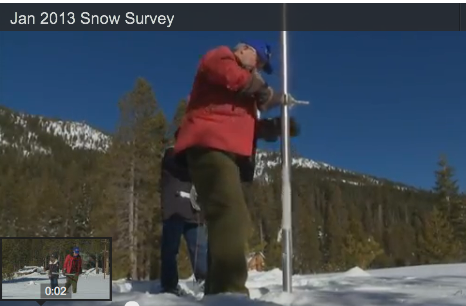
 SACRAMENTO — The first mountain snowpack readings taken Jan. 2 by snow surveyors with the Department of Water Resources (DWR) and other agencies reveal water content “well above average for the date,” DWR officials stated Jan. 2 in a press release.
Manual and electronic readings recorded Jan. 2 show the California’s snowpack water content hovering at about 134% of average for this time of year. That is 49% of the average April 1 measurement, when the snowpack is typically at its peak before the spring melt.
“We are off to a good water supply start for the new year, but we have to remember that we have seen wet conditions suddenly turn dry more than once,” Ted Thomas, a spokesman for DWR said in a statement. “We know from experience that California is a drought-prone state, and that we must always practice conservation.”
Snowpack normally provides about a third of the water for California’s homes, farms and industries as it slowly melts into streams, reservoirs and aquifers in the spring and early summer.
Results of today’s manual readings of snowpack by DWR off Highway 50 near Echo Summit are as follows: Alpha location at 7,600 feet showed 56 inches of snow depth, 16 inches of water content and 122% of long term average; Phillips Station at 6,800 feet showed 48.6 inches of snow depth, 12.1 inches of water content and 101% of long term average; Lyons Creek at 6,700 feet showed 55.7 inches of snow depth, 12.9 inches of water content and 109% of long-term average. Tamarack Flat readings were not available.
Electronic readings indicate that water content in the northern mountains is 133% of normal for the date and 50% of the April 1 seasonal average. Electronic readings for the central Sierra also show 133% of normal for the date and half of the April 1 Average. The Southern Sierra revealed 131% of average for the date and 44% of the April 1 average.
DWR and cooperating agencies conduct snow surveys around the first of each month from January to May. Manual measurements supplement and check the accuracy of real-time readings from sensors throughout the state.
DWR currently estimates it will deliver 40% of the roughly 4 million acre-feet of State Water Project (SWP) water requested for this calendar year by the 29 public agencies that receive water from the project. That delivery estimate is expected to increase as more winter storms develop. The SWP final allocation was 80% in 2011, 50 % in 2010, 40% in 2009, 35% in 2008 and 60% in 2007.
In addition to above average water content in the snowpack, early winter storms have replenished California’s reservoirs. Lake Oroville in Butte County, the SWP’s principal reservoir ,is at 71% of capacity and 113% of average for this date.
Electronic reservoir level readings are available online here.
Electronic snowpack readings are available online here.
Category: Agriculture

Weather Looks Dry & Cold Till End Of January
The spigot that appeared to be stuck on “on” for December but abruptly shut off before New Years now looks like it will stay off with predictions of relatively dry weather over much of California until the last week of January. So says LA forecaster Alan Fox who predicted the very wet storm pattern we got from late November through much of December.
As of January 1 California precipitation in northern California is 182% of average for the date says the state DWR and in the San Joaquin Valley the index stands at 145% of average. Snowpack averages are a little lower with the upper San Joaquin River index at 137% of average for January 1. Farewell Gap on the Kaweah already 48% of April 1 average with 3 months to go.Skiers are celebrating with China Peak saying they have 142 in. of snow on some parts of the mountain.
The drier weather in January could lead to some damaging freezes in Tulare County from around the 11-13 and 15-17 Fox says, a worry for the Valley’s citrus industry.
“Lucky we have received as much rain as we did“to bring on more fog that covers the sky like a blanket on cold nights.Fox says there could be some dry clear nights where the danger of low 20s temperatures could damage trees.
“Sea surface temps in the Pacific have changed since December but this is not unusual to have a dry period after a wetter than normal month.”
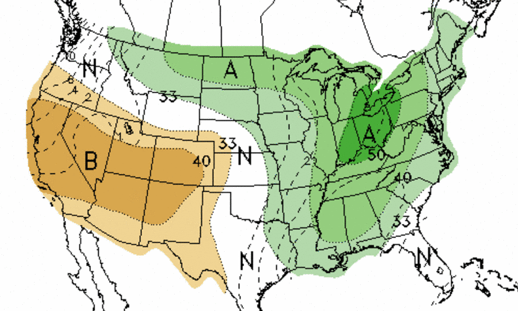
The US Climate Prediction Center is forecasting a dry month as well(see map).
Fox says he does see the storm door re-opening by the last week in January when he expects a return to wet weather. California’s Mediterranean climate gets most of its moisture by April annually,much of it stored in the snowpack.

Strong Winter Storm Blows In Friday
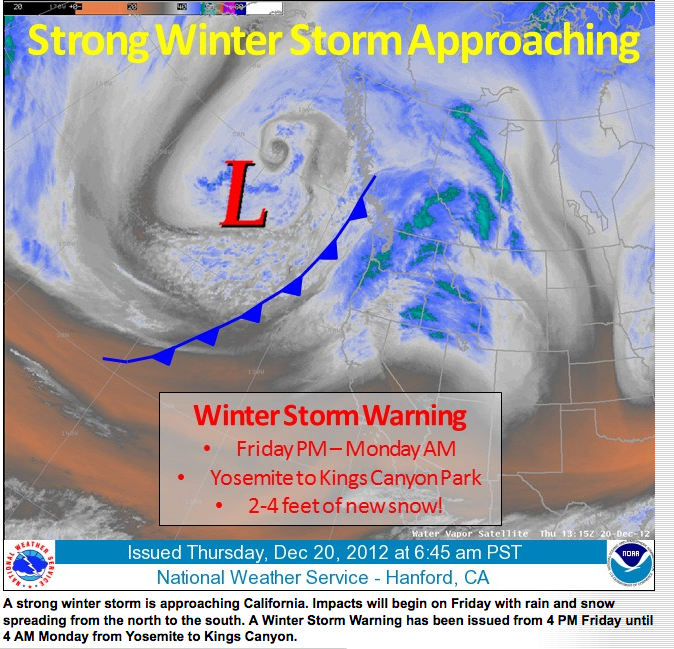
NWS Hanford has released this statement:
MODELS HAVE COME INTO STRONG AGREEMENT REGARDING THE EVOLUTION OF A STRONG WINTER STORM OVER THE UPCOMING WEEKEND. WHILE THERE
CONTINUES TO BE SOME MINOR TIMING DIFFERENCES, IT IS CLEAR THAT
THERE WILL BE A THREAT OF VERY HEAVY SNOW IN THE SOUTHERN SIERRA. IN AGREEMENT WITH NWS SACRAMENTO AND RENO, WE HAVE UPGRADED THE WINTER STORM WATCH TO A WARNING. HAVE ALSO EXTENDED THE WARNING THROUGH SUNDAY NIGHT. WHILE THE FIRST WAVE OF PRECIPITATION WILL HAVE THE POTENTIAL TO BE PLENTY STRONG IN THE SOUTHERN SIERRA…THE SECONDARY TROUGH COMES IN NEGATIVELY TILTED LATE SUNDAY AND LOOKS TO BRING A SHORT BUT INTENSE PERIOD OF PRECIPITATION WITH A SIGNIFICANT ASSOCIATED MOISTURE FETCH.
WINDS WILL BECOME GUSTY ON SATURDAY IN THE VALLEY AND A WIND ADVISORY MAY BE NEEDED…ESPECIALLY ALONG THE I-5 CORRIDOR. WINDS WILL PICK UP IN THE KERN COUNTY MOUNTAINS AND DESERT SUNDAY NIGHT AND INTO MONDAY AS THE TROUGH FINALLY PUSHES THROUGH.
On the Coast, John Lindsey reports rain likely from Friday thru Monday in the SLO area.
Here is his report showing a series of storms lining up:
A vigorous weather system is now crossing into far Northern
California this morning with 50+ mph southerly winds and periods
of heavy rain.
This cold front will decrease in intensity and continue to move
southeastward towards the Central Coast. This cold front will
produce increasing clouds, southerly winds and warmer overnight
low temperatures by Friday morning. Scattered rain showers are
forecast to start on Friday evening as the cold front approaches
San Luis Obispo County. Rain showers will turn to study rain
Friday night into Saturday morning with the frontal passage.
A 1,005 millibar low pressure system will follow the cold front
on Saturday afternoon and produce strong to gale force (24- to 38-
mph) southwesterly winds and rain showers. The southwesterly
winds will decrease and shift out of the west and the rain
showers will end by Saturday night. Heavy Sierra snow will
develop on Friday and continue through Saturday. Snow levels
will begin low tonight and will gradually rise to about 3,000
and 5,000 feet north to south by Saturday.
Another weather system will cross San Luis Obispo County on
Sunday afternoon into early Monday morning with potentially
heavy rain and gusty southerly winds.
Dry weather will return Christmas Day. However, another
low-pressure system may produce increasing southerly winds
and moderate to heavy rain on Wednesday afternoon into next
Thursday morning. At this time, unsettled weather is forecast
to continue into next weekend.

Exports Of Fall Walnut Crop Up 6.6%
This years walnut crop is selling faster than last year at this time with exports up 6.58% and domestic sales up about 0.6% says the California Walnut Commission.
While some parts so the world are taking in fewer California walnuts, the Middle East for example is down 18% and Europe is down a whopping 70% – Asia is up 56% this year to date with China up 102%. In-shell tonnage shipped to China stands at 30 million pounds compared to 22 million lbs this time last year.
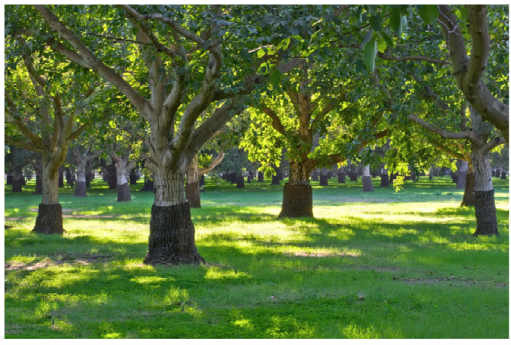
This year’s crop is larger than last year estimated to be 470,000 short tons compared to 461,000 tons – the second largest crop on record. That will be confirmed in February 2013.
Walnuts are now the fourth largest state ag export and big in Central California.Walnuts were a $140 million crop in Tulare County last year.
Helping the state’s 4000 walnut growers sell more overseas is a declining dollar vs the Chinese currency. The yuan is already up about 1.2 percent against the dollar this year following a 4.7 percent advance in 2011. A Bloomberg news survey estimated it will climb another 1.3 percent by the end of 2013, according to the median estimate of 26 analysts.
That adds up to nearly a 7.5% advantage for US products being sold to China by the end of next year vs 2011 with the state’s big 3 nut crops enjoying another good year.
This week US ag secretary Tom Vilsack pointed to the health benefits of eating California nuts. ”Vilsack’s great-aunt in Iowa had a thing for almonds. “She believed that if she consumed seven almonds a day, she would avoid cancer,” the nation’s agriculture secretary said in a phone interview Wednesday. “She lived to be 93.” says a Bee report.
The Bee continues -“I think the best export days are ahead for this industry,” Vilsack said. “There’s just a tremendous opportunity.”
U.S. exports of almonds and other tree nuts will hit a record $7 billion next year, the U.S. Department of Agriculture projected last month. That would double the figure for 2009.
Almost all of those nuts will come from California, where almonds were the top farm export in 2010 at $2.4 billion, according to state figures. Walnuts and pistachios made the top six.”

Citrus Farmers Deal With Psyllid Restrictions
By Cecilia Parsons
Matt Leider, supervisor for Laux Management of Porterville, inspects late-season navel oranges near their shop, which stands outside the five-mile-radius restricted zones created to halt movement of the Asian citrus psyllid. Citrus growers inside the zones are being advised to treat their trees to knock down possible psyllid infestation.
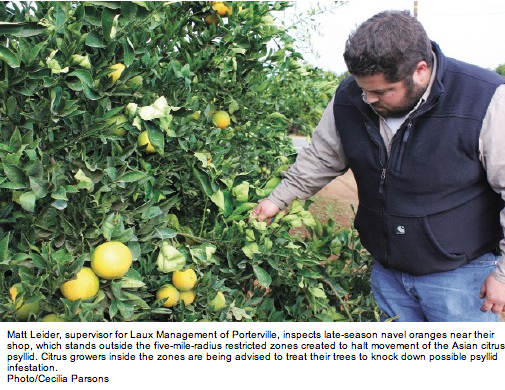 Citrus growers, packers, nursery operators, applicators and grove managers, as well as state and county inspectors, continue to sort out the implications of an Asian citrus psyllid infestation in the heart of the California citrus belt—even as they move into the peak of the billion-dollar Central Valley navel orange harvest.
The two psyllids found in Tulare County citrus groves last month and the one found earlier in Lindsay marked the pest’s first detected foray into the San Joaquin Valley. The psyllid, which can carry the deadly citrus disease huanglongbing, has previously been found in San Diego, Imperial, Los Angeles and Ventura counties.
Huanglongbing, also known as citrus greening, has not been detected in Tulare County, but was found to infect a citrus tree in the Hacienda Heights area of Los Angeles County earlier this year.
A statement from California Citrus Mutual said the circumstances of the psyllid finds in Tulare County dictate a different course of action than taken in Ventura and other Southern California counties where the insects have been trapped. The finds in Tulare County were more isolated, Citrus Mutual said, and intense trapping and surveying since the initial finds have not turned up any additional psyllids.
For those reasons, the California Department of Food and Agriculture has restricted fruit movement only within a five-mile radius of the psyllid finds in the Terra Bella and Strathmore areas. Previously, 20-mile quarantine areas have been implemented.
Growers were still trying to find out exactly where the boundaries for the five-mile restricted zones are located. The interim restrictions on fruit movement will be in place for the next six months, unless more psyllids are found.
Kevin Severns, manager of the Orange Cove-Sanger Citrus Association and CCM vice chairman, said the belief is that the trapped psyllids were hitchhikers and random finds on the exterior of a citrus grove.
Eradication of the psyllid is the goal, not merely control and suppression, said CCM President Joel Nelsen. The significantly smaller eradication zones would better serve that goal, he added.
Citrus growers and packinghouses with trees inside a five-mile radius of the two locations where psyllids were discovered will have the most responsibility in the eradication effort.
Packed fruit is free to move anywhere, but bins of citrus straight from harvest cannot move outside the restricted zones unless all leaves and stems are removed from bins and equipment. The fruit can be moved to packinghouses inside the restricted zones, or the leaf and stem removal can be done in the field.
Grower and grove manager Gary Laux of Laux Management in Porterville said the added costs of precleaning oranges inside the five-mile restriction zones could tip the profit scales for some growers.
If their packinghouse is also inside the same zone, they won’t have the cost. If not, their options are having an in-zone packer clean and re-bin the fruit before trucking to their own packinghouse, or manually or mechanically removing the debris in the field. Either way, they bear the cost of the operation.
Fruit coming from the restricted zones must be accompanied by a compliance agreement with the county, verifying that all cleaning requirements have been met.
“If they have to spend $5 to $10 a bin for cleaning and are only getting $50 to $60 a bin for low-quality fruit, they still have to take out production costs and they could be right on the line,” Laux said.
Nick Arcure, general manager of Magnolia Packing near Porterville, agreed that there would be additional costs to clean fruit and said he doubted there is enough packinghouse capacity inside the restricted zones.
Severns, who also sits on the committee that determines grower assessments to eradicate the psyllid, said it might be possible to substitute inspections and pesticide treatments for the dry-brush cleaning.
Packinghouses inside the restricted areas will also have to double-bag and dispose of field trash from citrus inside the eradication zone at a designated landfill.
Some mandarin growers leave a leaf or two and the stem on the fruit for certain markets, Laux said.
“For some reason, the Canadian market likes those leaves,” he said.
Under the new restrictions, that won’t be allowed.
Citrus nurseries inside the five-mile zone are also affected. Unless their trees grow indoors, their movement is restricted.
In the restricted or eradication zones, citrus growers are being contacted and asked to apply pesticide to their trees. Laux said last week that he had already been contacted by the county about applying a treatment. Unless growers are going to make a routine pest application, the extra one is another expense, he said.
Bob Blakely of California Citrus Mutual said growers are expected to comply with orders to treat and otherwise do their part to contain the psyllid.
Tulare County began last week treating backyard citrus trees within a five-mile radius of the two psyllid finds to control the insect’s spread, but if it appears growers are not treating their own trees, Blakely said, CDFA has the option to back off its control operation.
“Growers need to step up and do their part,” he said.
Currently, farmers pay a 9-cent assessment on each 40-pound carton of fruit they sell, to fund the psyllid eradication effort.
(Cecilia Parsons is a reporter in Ducor. She may be contacted at ceciliaparsons8@gmail.com.)
CFB News

Hanford Farmer Dino Giacomazzi Receives Conservation Award
 Hanford dairy farmer Dino Giacomazzi, a founding member of UC Conservation Agriculture Systems Innovation (CASI), received the prestigious 2012 Leopold Conservation Award for California in acknowledgement of his exemplary land stewardship and management.
The $10,000 Leopold Conservation Award is named in honor of world-renowned conservationist Aldo Leopold. The award, presented annually in eight states, recognizes farming and ranching families who are actively committed to living a land ethic.
Giacomazzi manages the dairy and forage production operations at Giacomazzi Dairy, established in southeastern Hanford in 1939. He lives on the 300-acre dairy property and oversees milking, animal nutrition and feed production.
In the spring of 2005, Giacomazzi initiated a demonstration evaluation of strip-till corn planting in a 28-acre field as part of an Environmental Quality Incentives Program contract he had received from the USDA Natural Resources Conservation Service.
“Dino virtually guaranteed his ultimate success with conservation agriculture by the sheer intensity of this effort and the comprehensive nature of his attention to detail,” said Jeff Mitchell, UC Cooperative Extension specialist in the Department of Plant Science at UC Davis. Mitchell is the chair of CASI.
Though no one realized it at the time, Giacomazzi was beginning to formulate a conservation agriculture systems approach. The systems approach would later become, as he has said, “completely new forage production systems for the entire dairy industry.”
Following this successful trial, Giacomazzi established all of the dairy’s corn acreage using strip-tillage in 2006. However, rather than take a single approach, he set out a comprehensive array of strip-tillage evaluations that included three different strip-till implements, strip-till corn varieties, and twin-row versus single-row planting configurations.
Later that year, he opened his dairy to the public for a Strip-Till Field Day that attracted more than 150 farmers.
“To this day, CASI considers this field day to be the most successful and impacting extension education event that our workgroup has been involved with during the past decade,” Mitchell said.
Over the course of the strip-till evaluations at his dairy, Giacomazzi also shared his expertise with a number of visitors, including representatives of Sen. Dianne Feinstein’s office in Washington, D.C., and the USDA NRCS Regional Agronomist for the Western U.S.
In his quest for the optimal CT forage corn system, Giacomazzi investigated twin-row planting options and is now one of the state’s primary authorities on twin-row production. The idea is to stagger two lines of plants 7.5 inches apart in 30-inch row spacing, giving plants optimal access to resources – nutrients, light, water, etc. From 2007 to 2009, Giacomazzi rigorously tested this hypothesis in a series of comprehensive on-farm studies.
Since the fall of 2008, Giacomazzi has also been collaborating with scientists from the USDA Agricultural Research Service National Soil Tilth Lab in Ames, Iowa, on a major, large-scale quantification of particulate matter emissions under traditional and conservation tillage at his dairy. He worked with Jerry Hatfield, the research director of the Tilth Lab, and a large group from Utah State University. This group quantified dust emissions using LIDAR, laser beam and dispersion modeling technologies and has found significant reductions in particulate emissions in Giacomazzi’s strip-till system relative to his former standard tillage approach.
Last spring, Giacomazzi began using a twin row Monosem planter on his farm that enables GPS precision guidance and application technologies from Trimble Corporation. This instrumentation allows for precision application of seed and nutrients in the same planting pass. He recently showcased his progress on his CT silage production systems by opening his farm to still another public field day that attracted several farmers and media coverage.
“Dino’s contributions to our collective efforts in CASI have been unparalleled,” Mitchell said. “He has made huge contributions to the development of knowledge and to the expansion of conservation agricultural systems in California’s Central San Joaquin Valley

How Candy Canes Grow On California Farms
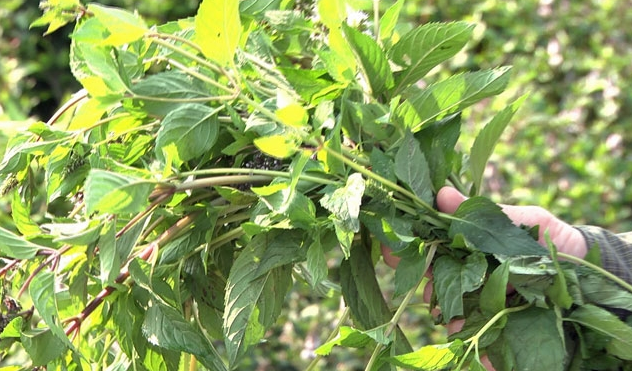
Candy canes have been linked with holiday festivities for more than 100 years. The red and white-striped shepherd’s staffs brighten up the Christmas tree, flavor seasonal lattes, and are found in children’s stockings on Christmas morning.
Many people enjoy the cool and refreshing peppermint flavor without knowing there are ingenious farmers and agricultural researchers working year-round to produce the naturally spicy bite of this holiday icon. Candy canes get their distinctive taste from the oil secreted under the leaves of Mentha × piperita, the bright green herbaceous perennial herb known as peppermint.
Peppermint, a cross between spearmint and wintermint, is America’s most popular mint flavor. Peppermint oil is an important ingredient not just in candy; it is used in toothpaste, mouthwash, gum, pharmaceuticals and beauty products.
The majority of U.S. peppermint is cultivated in the Pacific Northwest, where summer days are warm and long and nights are cool, minimizing the presence of a chemical that imparts a bitter taste in the mint oil. In far northern California – near the University of California’s Intermountain Research and Extension Center in Siskiyou County, plus in Lassen County and in the Fall River Valley of Shasta County – the soil and climate are equally hospitable to mint production.
UC researchers have experimented with mint for more than 50 years, said Rob Wilson, UC Cooperative Extension advisor and director of the Intermountain REC. But it wasn’t until the mid-1990s that interest in commercially producing California peppermint took off. The 2010 peppermint acreage in northeast California was more than 3,500 acres and valued at about $7 million.
“Farmers are excited to have a new cropping choice like mint,” Wilson said, “especially given the fact that we have fewer choices than most areas of California because of our short growing season. Mint has given our farmers a new crop to add to their rotations.”
California peppermint oil producers have stiff competition. A significant quantity of peppermint oil is now produced in China and India. But U.S. growers see the opportunity to set their product apart by applying their agricultural skill to producing exceptionally high quality oil. To do so, the growers rely on research to inform their decisions on irrigation, fertilization and pest control. Extensive work on ideal mint management has been conducted in the Pacific Northwest, but there is a need for additional research to study mint production and economic viability under California conditions.
Peppermint is grown in a fashion similar to other field crops common in the intermountain region and can be harvested with some of the same equipment used for alfalfa and forages, Wilson said. Farmers plant certified verticillium wilt-free rootstock in the fall, and the peppermint stand produces a crop for about five years.
When mint has reached maturity, farmers swath the field like alfalfa and leave the plants to dry a few days before raking them into windrows. Using a forage harvester, the peppermint crop is chopped into small pieces and blown into tubs. At the distillery, steam is forced through the tubs to extract the oil.
“In harvest season, there’s a fragrant aroma of peppermint in the air,” Wilson said. “Even driving by a still along the highway, you immediately notice the smell.”
Peppermint begins bearing a crop the first year after the fall planting, producing 40 to 90 pounds of mint oil per acre. In subsequent years, the crop produces 60 to 120 pounds of oil per acre.
Wilson and Dan Marcum, UCCE advisor in Shasta and Lassen counties, developed a cost study for establishing and producing peppermint oil in the intermountain region. The UC study notes the importance of determining a market channel for the oil before the mint is planted. Annual contracts for the oils are generally negotiated in the winter for the following season at a fixed number of pounds at a set price. It is risky to grow the crop without a prearranged contract because on the spot market growers are competing with imported mint oil, which can be produced in areas where lower wages and limited regulations cut the production cost.
A major risk associated with peppermint farming, the study reported, is producing oil of poor quality, for which there is little or no demand. For example, weeds harvested with the mint lower the quality of oil. Pigweed and other broadleaf weeds contaminate the peppermint oil with a weedy flavor note. Plant stress caused by inadequate water or nitrogen or by insect damage can also reduce oil quality.
IREC has more than five acres of peppermint and a small peppermint still for studying production and evaluating the quality of oil. Wilson, along Intermountain REC superintendent Don Kirby, is using this acreage to compare irrigation, fertilization and harvest management strategies in order to maximize peppermint oil yield and oil quality under local soil and climatic conditions.
The IREC peppermint acreage is also used to study insect management. Among the pests that can reduce peppermint oil quality are spider mites and a recently introduced insect pest, mint root borer. These pests prompt significant pesticide use. Given the highly sensitive watersheds and environment of the intermountain area, wide usage of pesticides is considered problematic. Propargite and chlorpyrifos, the most commonly used pesticides for spider mite and mint root borer control, are under regulatory scrutiny.
In 2010, with funding from a California Department of Food and Agriculture Specialty Crop Block Grant, Larry Godfrey, UC Cooperative Extension specialist in the Department of Entomology at UC Davis, and Kris Tollerup, UC Davis post doctoral researcher, along with Marcum and Wilson, began investigating mint yield and quality response to spider mite infestation, spider mite management methods in mint, and reduced-risk insecticides for mint root borer management. In addition, a study is under way to determine if sex pheromone mating disruption is a plausible tactic against mint root borer, and whether adjusting the timing of the insecticide improve mint root borer control. These research projects will continue in 2013.

Big Boost For California Water Supply After Record Storms / Northern Sierra At 212% of Normal
One storm event doesn’t make a water year….or does it?
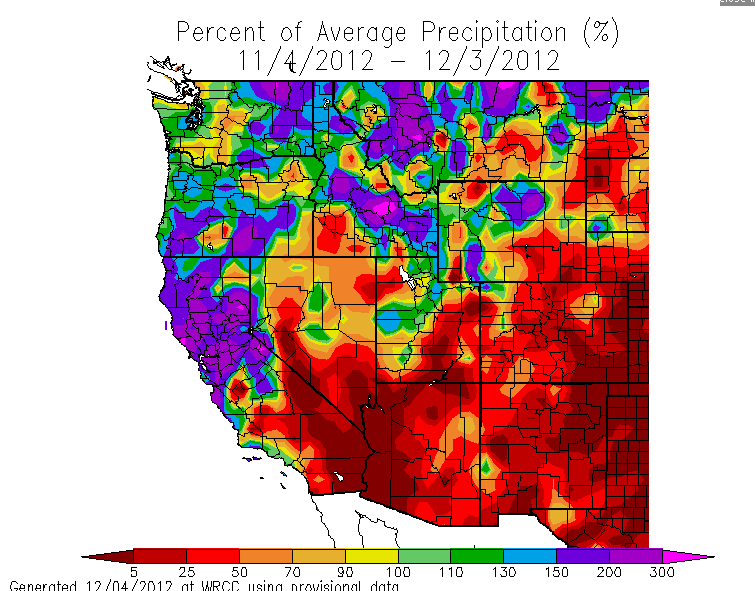
Several California Dept Of Water Resources indexes published this week after a 5 day sequence of storms pounded northern California showed these storms had consequences. A jump in the Northern Sierra Precipitation Index of 8 stations shows rainfall so far this water year is now ahead of the 1982-83 year – the wettest on record.The index which sat at only 5 inches of rain as of late November jumped to 22 inches as of December 3.The index includes Shasta dam that saw 15 inches of rain.
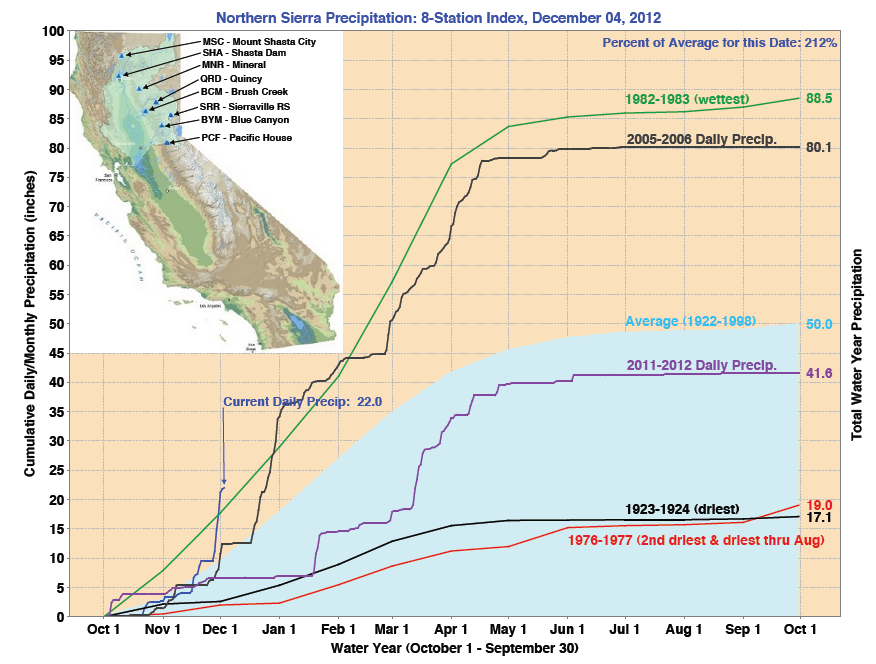
The index is 212% of average for this date for the water year that runs Oct 1 thru Sept 30,2013.
Further south, the 6 station San Joaquin Valley index which includes Huntington Lake on the San Joaquin River, now sits at 150% of normal for this date after a pulse of 6 inches blew into the central Sierra from the 5 day event. This index is also ahead of the 82-83 year.
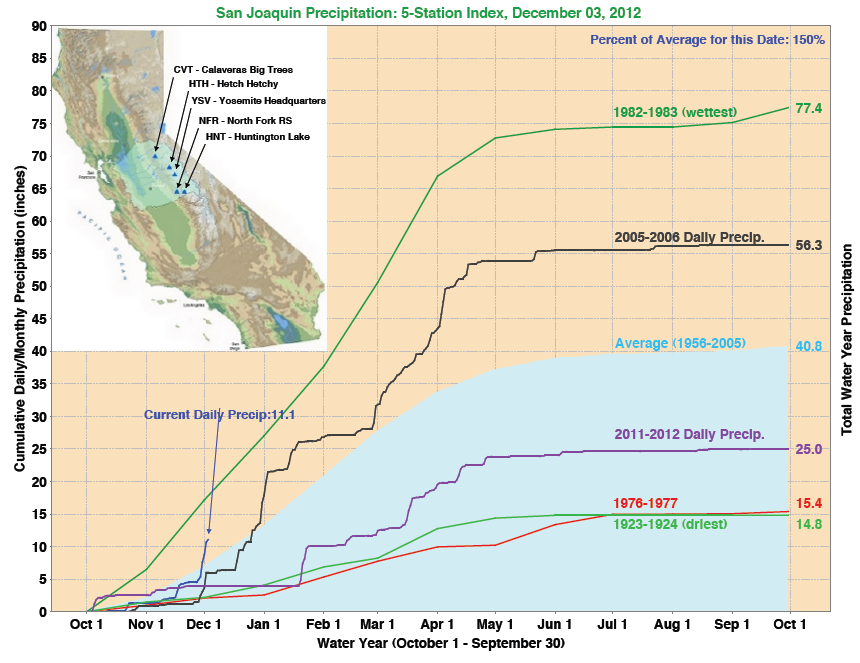
All in all – a nice start for year where expected rainfall was anyone’s guess.
Click to enlarge
The Assoc of California Water Agencies website posted a story this week as follows:
The rains that have pounded parts of California in recent days have boosted water levels in state reservoirs, raising water storage in Oroville Reservoir—the State Water Project’s primary reservoir – by more than 300,000 acre feet, according to a statement released Dec. 3 by the State Water Contractors.
“This weekend’s storms gave a needed boost to California’s water conditions – storage is up in key reservoirs, which will help us get through potential dry spells in 2013,” Terry Erlewine, general manager of the State Water Contractors, said in a statement. “We are by no means out of the woods, but the hope is that we will get enough precipitation throughout the winter to bring State Water Project allocations up to a reasonable amount.”
Last week, the California Department of Water Resources announced that the initial allocation for State Water Project supplies is 30%. Initial allocation estimates are typically conservative and state officials expect the allocation to increase as the winter season progresses. In 2012, State Water Project contractors received 65% of their contracted amount of water.
Water data compiled by DWR and listed here reveal higher than average water storage levels in reservoirs across the state. Reservoirs have shown large increases in storage in recent days due to the series of storms. For instance, Folsom reservoir has increased by more than 100,000 acre feet from Nov. 29 to midnight Dec. 2. It is at 50% of capacity and 104% of its average capacity, according to DWR data available at the California Data Exchange.

Tulare County Citrus Restrictions Scaled Back To Five Miles
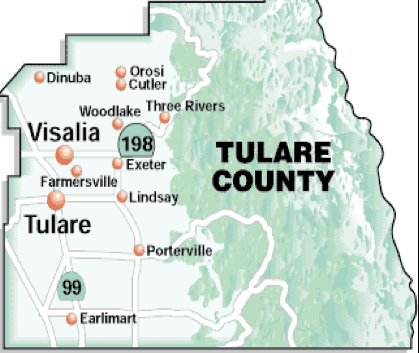
USDA and Tulare County are announcing a scaled back version of a proposed 20 mile quarantine after three recent finds of an Asian Citrus Psyllid in traps in Tulare County’s orange belt production area.
Dept. Ag commissioner Gavin Iacone says the new restrictions will go into effect soon to limit the movement of citrus plant material to a five mile radius of the finds. One zone is near Strathmore ( where there were two finds) that would take in the Lindsay/Strathmore packing houses and the other find – near Terra Bella – would cover packing houses in the Ducor /Terra Bella area.
The finds last month of the feared pest pushed ag authorities to consider a larger 20 mile quarantine that would have covered much of the citrus belt in the county except for the northern area – Woodlake to Dinuba
The restrictions would not hinder the movement of fruit itself but packinghouses and nurseries will have to ensure no plant material, leaves for example, left the zone.
Growers will have to roll their fruit within the zones to remove leaves and nurseries could ship only trees that have been grown under screen. A number of the nurseries in the Exeter area will be spared as well the big Tipton juice plant and the Ventura Coastal plant north of Visalia.
“We consider the plan to be more restrictive than the 20 mile plan” says Iacone,rather than moving plant around within a larger area. No finding of the disease called citrus greening or HLB carried by the pest has been found in the county. The pests have been spreading from Mexico north and now southern California all the way now into Santa Barbara county with a find recently near Santa Maria.But there has bern only one find of the disease in a tree in backyard inLA.
Florida has been particularly hard hit by the citrus pest and citrus greening disease that has cost them an estimated $3.6 billion and the loss of 6600 jobs according to the University Of Florida study. First detected in Florida in 2005 grower costs are as much as 40% higher with the disease that kills the trees within five years

NEW TULARE COUNTY ASIAN CITRUS PSYLLID DETECTION NEAR TERRA BELLA
Tulare, CA. November 27, 2012
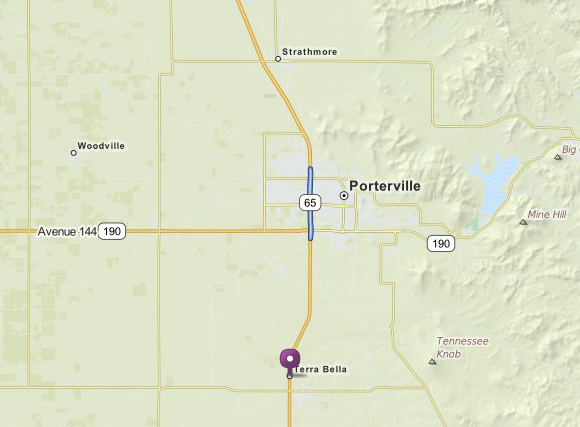
Tulare County Agricultural Commissioner’s office is announcing that an additional Asian citrus psyllid detection has occurred approximately one mile south of the community of Terra Bella. The detection was confirmed last week, bringing the number of psyllids found in Tulare County to three, including two detected previously in the Strathmore area.
The California Department of Food and Agriculture, in cooperation with the agricultural commissioner’s office, is beginning to plan residential treatment programs in the county. More details will be provided at an informational open house scheduled for residents of the Strathmore area on Tuesday, November 27, 2012, at the Grand Avenue United Methodist, Fireside Room, 776 West Grand Avenue, Porterville, CA 93257, from 5:30pm – 7:00pm. An evaluation of quarantine regulations for Tulare County continues and will include the latest detection.
The Asian citrus psyllid is an invasive species of grave concern because it can carry the disease huanglongbing (HLB), also known as citrus greening. All citrus and closely related species are susceptible hosts for both the insect and the disease. There is no cure once a tree becomes infected. The diseased tree will decline in health, producing bitter, misshaped fruit until it dies. To date, HLB has been detected on just one residential property in the Hacienda Heights neighborhood of Los Angeles.
“The Asian citrus psyllid is a dangerous pest of citrus, “said Marilyn Kinoshita, Tulare County Agricultural Commissioner. “We’re working to determine the full extent of this infestation so that we can protect our state’s vital citrus industry as well as our residential citrus trees. We want to emphasize that citrus fruit is safe to eat and the disease is not harmful to human health. The Asian citrus psyllid is another example of the many invasive species that enter our state every year.”
The state of Florida first detected the pest in 1998 and the disease in 2005, and the two have now been detected in all 30 citrus producing counties in the state of Florida. The pest and disease are also present in Louisiana, Georgia, South Carolina and Texas. The states of Hawaii, Mississippi, Arizona, and Alabama have detected the pest but not the disease.
Residents in the area who think they may have seen the pest are urged to call CDFA’s Pest Hotline at 1-800-491-1899. For more information on the Asian citrus psyllid and huanglongbing disease visit: http://www.cdfa.ca.gov/plant/