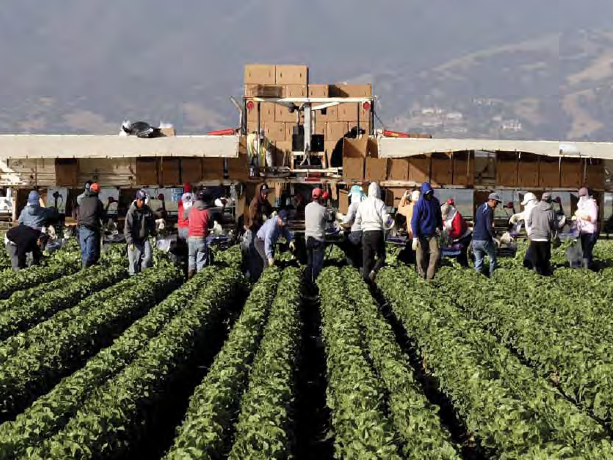
The United Farmworkers Union won an election held July 11 at a Firebaugh vegetable farm the Agricultural Labor Relations Board confirms. In the vote at Gargiulo Inc, the UFW won vs no union by 186 – 40 out of 228 votes.Two ballots were contested.
The victory by the farmworkers union is the second in recent weeks with the vote at a Chular vegetable farm,George Amaral Ranches won by the union 265-65 June 21. The ALRB has yet to certify the results which can take a few weeks.
Lawyers for Amaral claim a union strike by the UFW is a violation of the law after the union demanded a contract after the vote count.
The UFW got it first major contract in the tomatoes a few weeks ago at
Tracy-based Pacific Triple E Farms,one of the largest fresh tomato grower the employes around 800 workers.
Also in recent weeks Salinas Valley grower D’Arrigo Bros. was ordered by a judge to “cease and desist” from assisting or encouraging any decertification campaign against the United Farm Workers union, The union and grower have been at odds over a contract for decades.
The union founded by Cesar Chavez has had a bust summer so farm after years of not much activity.Some believe a change in the state law that make it easier to prove bad faith in farm elections as well as a labor shortage in the fields may be making a difference this year.
“The labor supply is very tight right now,” said Norm Groot, executive director of the Monterey County Farm Bureau. Growers of commodity crops being harvested now are “scrambling to keep crews in place,” he said according to a local newspaper.
2011 Crop & Livestock Report to be presented July 24Tulare County’s 2011 Annual Crop and Livestock Report will be presented to the Board of Supervisors on Tuesday, July 24. Copies of the report will be available during the presentation and posted online.
The Agricultural Commissioner, Marilyn Kinoshita, will present the report and offer brief comments regarding its contents.
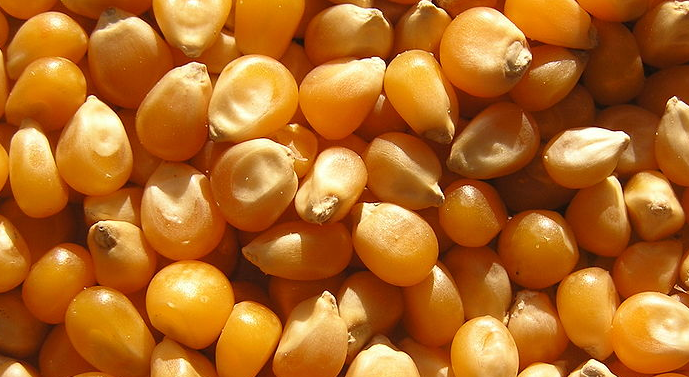
Corn Crop Sizzles: Drought in the cornbelt continues this week and prices are heading to $8 a bushel for July corn and $7.30 for September. That’s’ high enough to hurt both the livestock industry and ethanol makers,some of who are idling plants.Late today USDA reported that just 40% of the corn crop was in good to excellent condition,down from 48% a week ago and 69% this time last year. USDA also said 30% of the corn crop was now in very poor to poor condition compared to 22% just a week ago.
Short Chinese Garlic Crop
The Packer newspaper reports that a” short, lower-quality Chinese garlic crop should open the door for California producers, who report good yields and excellent quality.
The combination of a big, high-quality crop from California and a short crop from China could produce a milestone in the 2012-13 marketing season, said Jim Provost, president of West Grove, Pa.-based I Love Produce.
“I’ve been hoping for a year where California exports garlic to China,” Provost said. “This could be it.”
RUTHSBURG, Maryland — In rural Maryland, an hour-and-a-half drive from Washington, Bill Mason is tilling his fields to plant organic maize and soybeans.
About two-thirds of his 340 hectares are organic, but not all of them. And that bothers some people.
“There are some die-hard organics,” Mason says. “They think every organic farmer should not be planting any conventional.”
As both an organic and conventional farmer, Mason sits right in the middle of a long-running debate over how best to feed the world.
Organic vs. conventional
Demand for organic food – produced without artificial fertilizers or pesticides – is growing worldwide, but some experts doubt a growing world population can be fed if farmers don’t use these chemicals.
An April study in Nature found organic farming is 25 percent less productive on average than conventional farming. But while some say we cannot feed the world with organic agriculture, others say we cannot feed the world without it.
Critics of conventional farming say excessive fertilizer use pollutes waterways, kills fish and contributes to climate change. Customers will pay a premium for food produced without pesticides and fertilizers.
But Mason says his organic crops typically do not produce as much. “We are finding that our corn yields are about three-quarters of the yield of a normal conventional crop.”
Ecological consequences
With those lower yields, feeding the world organically could require clearing more land for farms.
“We’ll have to get more land into cultivation to do it that way,” says Columbia University soil scientist Pedro Sanchez, “with horrible, negative ecological consequences.”
Experts say deforestation to make way for agriculture is already contributing to climate change and a loss of biodiversity.
And farmers will have nine billion mouths to feed by mid-century, which puts agriculture in a difficult position.
“Right now, we can’t feed 9 billion people with the ways we’re farming, whether it’s conventional or organic,” says U.S. Department of Agriculture researcher Michel Cavigelli.
Working both sides
So experts are working on both sides of the equation. Cavigelli is working to improve the productivity of organic farms using natural fertilizers like chicken manure. The trouble, he says, is that often it does not provide enough nutrients.
“We need to improve all systems. And so, what’s the best way to do that, both to feed the world’s population but also to do it in the way where we’re not destroying the planet?”
Many of the African farmers Pedro Sanchez has worked with have used synthetic fertilizers to triple their yields, making a huge difference in their food security.
Blended solution
“But as a scientist, I don’t like that as the solution,” Sanchez says. “And I will not preach it as the solution. I want to integrate that with organically-produced nutrients.”
Organic nutrients, such as fertilizing cover crops, have worked out for Bill Mason and his conventional-farming neighbors are taking notice.
“I think there’s ideas that we’re using that are carrying over to the conventional world,” Mason says.
So the ideal solution to feeding a world of nine billion might not necessarily be a choice between organic or conventional farming, but rather a blend of both.
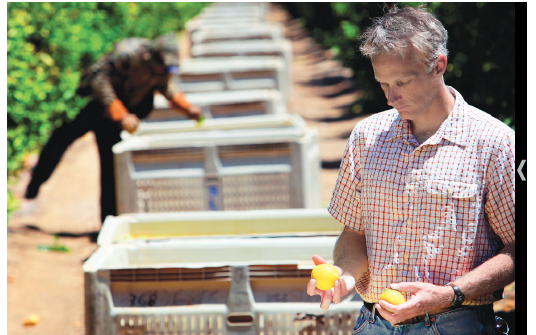
Lemon harvest in Ventura County is about two-thirds complete and growers like Josh Pinkerton, above, say they are happy with the size and quality of fruit, which recovered from weather challenges earlier in the season. Photo/Steve Osman
Facing unusual difficulty in hiring enough harvest help, lemon growers in Ventura County say they are finding ways to get the job done by sharing resources.
“Like everywhere else in California, we are having a labor shortage. We are getting by, but it is taking us a little longer than normal to harvest,” said Gus Gunderson, director of farming for southern operations for Limoneira in Santa Paula.
Ventura County lemon grower Josh Pinkerton said the difficulty in finding enough people for the harvest relates directly to the current situation on the California-Mexico border, where a combination of enforcement by U.S. Customs and Border Protection officers and drug-related violence on the Mexican side of the border has discouraged people from entering the U.S.
“Our labor contractors are juggling everything and that is creating a stumbling block,” he said. “When compared to last summer when my labor contractor may have had 60 to 80 people on his crew, this summer he has about 40.
“We are picking a particular part of the ranch right now, and because of the labor shortage our farm labor contractor had to pull his crew out a few days early to go to another ranch to meet the needs of another farmer. That isn’t an optimal situation for us, but due to the labor shortage that is happening all over Ventura County,” Pinkerton said.
Another Ventura County grower, David Schwabauer, said he faces a similar situation.
“The big challenge has been the very tight labor situation. The picking crews are smaller than they normally would be at this time of year, and it is taking longer to harvest,” he said.
Another area of concern for citrus growers in California is the Asian citrus psyllid and the deadly, bacterial tree disease called huanglongbing, also known as citrus greening disease, that the insect can carry to citrus trees. HLB, which is widespread on the southeastern United States, is responsible for killing 200,000 acres of Florida citrus groves.
The psyllid showed up in a California Department of Food and Agriculture trap in San Diego County in 2008 and has since been found in several Southern California counties. Only one incident of HLB has been detected, in a suburban citrus tree in the Los Angeles suburb of Hacienda Heights, and that tree was removed.
Bob Blakely, director of industry relations for California Citrus Mutual, said HLB is the most serious disease known to citrus because there is no known cure.
“In Florida, they didn’t recognize the danger caused by the psyllid until it was widespread and after about five years the disease started showing up. It was like a domino effect,” he said. “We learned that lesson and benefited from their problems, and when the psyllid showed up in Tijuana and San Diego in 2008 we immediately began a program of treating wherever it was found.
“We haven’t been able to eradicate it in the inner Los Angeles metropolitan area, but we have been able to push it back and keep it from spreading out into the commercial citrus areas. To date, we have no commercial groves that are infested with the Asian citrus psyllid,” he said.
Lemon acreage in Ventura County, which is the state’s leading county for lemon production, is slowly declining. Pinkerton called concern about HLB a driving force behind the shift from lemons to other crops.
“We are seeing quite a bit of lemons being removed throughout Ventura County. Avocado acreage continues to rise, but then we are also seeing people pulling out lemons and going to row crops such as strawberries, celery, raspberries and so on,” he said.
Another citrus crop, tangerines, is gaining in popularity. Ventura County grower Emily Thacher-Ayala, who produces 16 varieties of tangerines for both the wholesale trade and farmers markets, said this year’s fruit had “outstanding flavor,” but that the crop size was down from average.
“This year was a little bit odd with the tangerines because of the freeze in the Central Valley that caused a shortage. We put our prices really high and kept them high, and we sold out early,” she said.
Harvest has wrapped up for mandarins, which are grown primarily in the Central Valley, Blakely said. Clementines, which are harvested from October through Christmas, enjoyed a very good season with excellent quality, ideal size and good flavor, he said, but W. Murcott mandarins did not fare as well.
“Clementines had probably one of their best seasons since that sector has come into existence over the last eight to 10 years. The Murcotts on the other hand were caught by that cold weather in December-January and they struggled,” Blakely said.
Harvest of California’s biggest citrus crop—navel oranges—is just ending. Overall, this year’s crop will be smaller than last year, but about the same amount of fruit was shipped because of better utilization, Blakely said.
California supplies up to 85 percent of the fresh citrus consumed in the United States, and exports, depending on crop size, anywhere from 25 percent to 30 percent. Major export markets include Korea, Southeast Asia, China and Japan.
Navel acreage has remained fairly steady with slight increases in recent years. Acreage of valencia oranges, though, has declined the last 10 years. Valencias compete with other summer tree fruit and with grapes—as well as with navel oranges coming into the United States from Southern Hemisphere countries such as Chile, South Africa and Australia.
“The valencia acreage has been replaced in large part by the mandarins, which have had phenomenal growth over the past 12 to 15 years and have now pretty much surpassed valencias as the No. 2 variety in terms of acreage,” Blakely said.
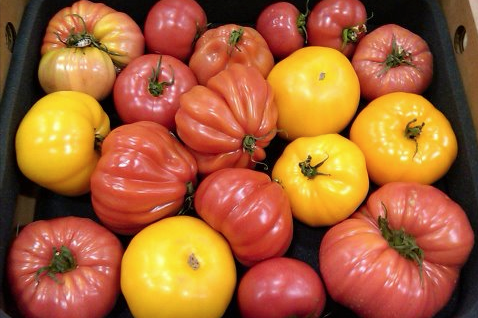
A new discovery could make more tomatoes taste like heirlooms, reports an international research team headed by a University of California, Davis, plant scientist.
The finding, which will be reported in the June 29 issue of the journal Science, has significant implications for the U.S. tomato industry, which annually harvests more than 15 million tons of the fruit for processing and fresh-market sales.
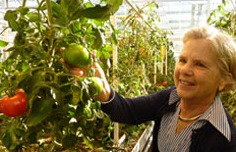
“This information about the gene responsible for the trait in wild and traditional varieties provides a strategy to recapture quality characteristics that had been unknowingly bred out of modern cultivated tomatoes,” said Ann Powell, a biochemist in UC Davis’ Department of Plant Sciences and one of the lead authors of the study
“Now that we know that some of the qualities that people value in heirloom tomatoes can be made available in other types of tomatoes, farmers can have access to more varieties of tomatoes that produce well and also have desirable color and flavor traits,” she said.
For decades, plant breeders in the tomato industry have selected varieties that are uniformly light green before they ripen, in order to produce tomatoes that can be harvested at the same time.
However, this characteristic is accompanied by an unintended reduction in sugars that compromises the flavor of the fresh fruit and its desirability for processing.
Powell’s UC Davis research team began studying the genes influencing tomato fruit development and ripening after spending two summers screening tomato plants for transcription factors that might play a role in both fruit color and quality. Transcription factors are proteins that regulate genes, or turn them on and off. These factors themselves are manufactured or expressed by genes.
The UC Davis researchers were particularly interested in tomatoes they observed in the field that were unusually dark green before they ripened.
Partnering with researchers at Cornell University and in Spain, who were mapping regions of the tomato genome, the scientists discovered two transcription factors, called GLK1 and GLK2, that control the development of chloroplasts. Chloroplasts are the structures in the plant cells that enable plants to photosynthesize, converting the energy of sunlight into sugars and other compounds that influence flavor and color.
The researchers scoured a collection of mutant and wild species of tomatoes at UC Davis established at UC Davis by the late Professor Charles Rick beginning in the 1950s. They discovered that dark green tomatoes that naturally express GLK2 produced ripe fruit with increased levels of sugars or soluble solids, important for processing tomatoes, as well as higher levels of the health-promoting compound lycopene.
“Nature presents numerous important genes and their variants, like uniform ripening, that breeders employ to facilitate the needs of growers, processors and consumers,” said Jim Giovannoni, a USDA plant molecular biologist with the Boyce Thompson Institute at Cornell University. “Understanding the genes responsible for these characteristics facilitates the challenging process of breeding crops that meet the needs of all components of the food-supply chain.”
Cuong Nguyen, a Cornell graduate student in Giovannoni’s laboratory co-authored the paper with Powell. Other members of the research team included: Theresa Hill, KaLai Lam Cheng, Rosa Figueroa-Balderas, Hakan Aktas, Hamid Ashrafi, Ariel Vicente, Javier Lopez-Baltazar, Roger Chetelat, Allen Van Deynze and Alan Bennett, all of UC Davis; Yongsheng Liu and Cornelius Barry of Cornell University and the Boyce Thompson Institute of the USDA; Clara Pons and Antonio Granell, of the Universidad Politécnica de Valencia, Spain; Rafael Fernández-Muñoz of the Universidad de Málaga, Spain.
Funding for the study was provided by The University of California Discovery program, the U.S. Department of Agriculture-Agricultural Research Service, the National Science Foundation, the Viet Nam Education Foundation, the Fundación Genoma España, and the Ministerio de Ciencia y Tecnología and the Instituto Tecnólogico de Costa Rica.
UC Davis is an international leader in agricultural research and is ranked as the most frequently cited university in the world in the area of plant and animal sciences, according to ISI Essential Science Indicators. The university’s Department of Plant Sciences is internationally known for its Plant Breeding Academy, which provides professional training for plant breeders around the world.
Tree Fruit Growers See Improvement
Overcoming challenges from the economy and Mother Nature, California tree fruit growers say their harvest is off to a solid start. Springtime hailstorms destroyed some peaches, plums and nectarines in the Central Valley, but farmers who have fruit to sell say their crops look good and consumer demand has been strong. Tree fruit growers say they’re starting to recover from a tough 2011 and the closure of some fruit packing and shipping facilities in 2009. Strawberry Crop May Set Records
Just about halfway through their harvest, strawberry farmers and marketers say they could be headed toward record production. The harvest avoided severe trouble from springtime rain, which reduced last year’s final crop. California farmers have also increased strawberry acreage about 3 percent. Strawberry harvest will be concentrated along the Central California coast now as the Southern California harvest winds down.
Environmentally Efficient Cows
In 2006, a United Nations report entitled “Livestock’s Long Shadow” claimed that the livestock sector is a major player in climate change, “responsible for 18 percent of greenhouse gas emissions … a higher share than transport.” Appeals for reducing meat consumption to prevent climate change filled the public media, and they continue today (see this recent opinion blog from the New York Times). At Alltech’s recent Symposium, UC Davis Associate Professor and Air Quality Specialist Dr. Frank Mitloehner explained why this greenhouse gas (GHG) statistic is misleading. His examination of the issue is detailed in a 2009 study entitled “Clearing the Air: Livestock’s Contributions to Climate Change,” which was co-authored by Pitesky and Stackhouse. At the Symposium, Mitloehner explained that livestock in developed countries actually make a fairly small contribution to greenhouse gas emissions: in the United States, livestock contribute only about 3 percent of anthropogenic emissions, as compared to 26 percent by transportation and 31 percent by electricity. The 18 percent cited in the UN report is an international statistic, influenced by emissions percentages in developing countries. In these countries, livestock make a greater contribution to total GHG production because the countries have smaller transportation and energy sectors. Percentages of GHG production in developing countries are also influenced by land-use changes related to livestock production, such as deforestation. Many developing countries are converting land to pasture and cropland in an attempt to develop their economies, just as developed countries have already done. According to Mitloehner, GHG emissions due to deforestation and other land-use change patterns inflate the worldwide, livestock-associated GHG production percentage by as much as one-third. Mitloehner emphasized the importance of reducing GHG production by improving efficiency and productivity of livestock in developing countries, rather than decreasing milk and meat consumption. The more productive the animal (for example, the more milk produced per cow), the lower the GHG emissions are for a particular amount of product. Improving productivity can be achieved by improving fertility, health, and genetics of the animal, as well as by increasing digestibility of feed. According to Mitloehner, the efficient nature of livestock production in the U.S. makes it a useful model for developing countries. In the coming years, developing countries should focus on improving digestibility and developed countries should focus on waste management. With the need to feed a world population expected to reach 9 billion by 2050, increased productivity and efficiency, not decreased meat and milk consumption, is the key to reduced GHG production.
Celebrating their 50th anniversary last month in Bakersfield the United Farmworkers Union with barely 27,000 workers under contract- half of what they had- the UFW is not the union powerhouse once feared by California produce growers. But don’t count them out yet.
With some backing from the California government and a perceived worker shortage in the state the UFW is expected to sign the first major contract with large Central Valley tomato growers in coming weeks.
This week the UFW and tomato producer Pacific Triple E of Tracy are signing their first union contract during a ceremony in Stockton covering 800 workers
UFW President Arturo S. Rodriguez will join the union’s negotiating committee and Pacific Triple E Operating Partner Jon Esformes in signing the agreement that comes after decades of battle and litigation.
In a news release Esformes said” When the UFW approached us last fall we found that we held many common ideals which allowed us to quickly establish a line of communication that was honorable, transparent and non-confrontational.”
“Working with the UFW will allow us to continue to enhance the level of mutual respect we have enjoyed for many years”he said.
The contract is said to provide wage increases of 12 to 57.4 % over the life of the agreement for hourly and daily rate employees. Other highlights of the contract include a pension plan, grievance procedure, seniority and job security.
Also expected to be signed soon is a contract with Manteca-based ACE Tomatoes. As with Tripe E, the UFW won an election years ago (1989) at Ace but but never got a union contract because the farm company never came to the table, the union charges.
The UFW has charged growers with bad faith after elections are won dragging their feet for years to stall any contract. Last year they got Governor Brown and the state to agree to new rules that gives them some new clout in talks with farmers.
Senate Bill 126, by Senate President Pro Tem Darrell Steinberg, now gives farmworkers greater protections in organizing disputes with growers, including allowing the state’s Agricultural Labor Relations Board to certify a union when it determines grower misconduct affected an election’s outcome. Brown signed the bill last summer.
Despite the kind words from Triple E’s spokesman the company and UFW have been going at it since 1975 when the union first won an election at the ranch that involves workers from several counties. The matter of the election was litigated by the company all the way to the state supreme court who found in the company’s favor.
The union won again in a state sponsored election in 1989 but it took until 1994 before Triple E and UFW began negotiations.
Now 18 years later, the workers will get that contract with UFW’s president Arturo Rodriguez asserting that it will make them the best paid tomato pickers in the nation.
California produces around 90% of all US tomato production.
On a roll, the UFW is pressing Governor Brown this summer to back overtime pay for farmworkers.
Wine Grapes Down 18:
Monterey County agriculture maintained its economic clout in 2011 with crop production values that exceeded $3.85 billion, Agricultural Commissioner Eric Lauritzen announced this week as he released the annual crop report.
While gross crop values declined slightly from 2010 – about $153 million, or 3.8 percent – agricultural production remained higher than any year prior to 2009. “We expect some fluctuations in production from year to year, based on market, price, weather and other factors,” said Lauritzen. “At the same time, agriculture’s consistent standing as the number one business in Monterey County underscores its importance to our economy.”
The 2011 Monterey County Crop Report calculated total crop values of $3,853,004,200. Leaf lettuce took over the number one spot with a value of $777.4 million (a 7 percent increase), compared to $713.9 million for strawberries (down 5 percent). Other top crops included head lettuce at $454.2 million (down 11 percent), broccoli at $297.3 million (no change), and nursery production at $260.7 million (down 2 percent).
Wine grapes fell 18%, following an even larger decline the previous year. But Rhonda Motil, Executive Director of the Vintners and Growers Association, expects a turnaround in 2012, saying, “The weather was perfect, early cluster counts are up and inventories are down, which indicate a much better year ahead.”
While public attention often focuses on the county’s number one crop, Lauritzen said the top ten crops are worth more than $100 million each and together generate more than $3 billion in production. “These dollars multiply as they spread into the rest of our local economy. An economic analysis released by my office this spring shows that all of our high-value, labor-intensive crops create many jobs in the field and throughout the community,” Lauritzen said.
“The resilience of Monterey County’s agricultural sector is noteworthy,” said Jeff Langholz, who co- authored the economic study. “Even with the recent dip in production value, the overall story for the past decade is one of impressive growth.”

 The United Farmworkers Union won an election held July 11 at a Firebaugh vegetable farm the Agricultural Labor Relations Board confirms. In the vote at Gargiulo Inc, the UFW won vs no union by 186 – 40 out of 228 votes.Two ballots were contested.