Ag Beat updates

-November 10,2019-

Dry milk makes a run

Screen Shot 2019-11-10 at 7.08.13 AMCentral Valley dairymen have something to celebrate as their most abundant commodity, dry milk for export continues to see higher prices on the world market.

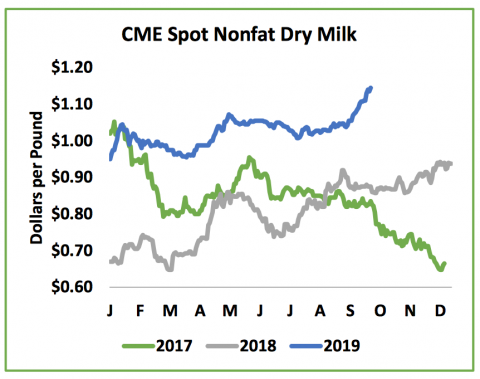
Reports say the CME spot market, NDM advanced 2.25ȼ to $1.205, a five-year high. Combined production of NDM and SMP reached 171.8 million pounds in September, a new high for the month and 6.9% more than September 2018. But demand is more than keeping pace. 

U.S. exports of NDM/SMP advanced to 144 million pounds, up 24.2% year-over-year. That’s the highest volume so far in 2019 and a record high for the month of September.

Santa Maria strawberry volume up

Screen Shot 2019-11-07 at 12.47.34 PMChart shows strawberry production by day in November with the Santa Maria district outproducing both the Oxnard and Salinas regions. Last 2 columns are 2019 and 2018 into order showing California produced less  this year on a year to date basis – but not the Sant Maria district. 

Half the corn crop unharvested as winter blankets Corn Belt

Politico reports  that winter has already arrived in the Corn Belt, and nearly half of the corn crop remains in the field. Farmers are frustrated with sub-par yields, impassable fields, and variable quality./USDA says the cornfield sends at a 4 year low.

Ag beat- lemon growers pucker up / more

-October 28,2019-


Screen Shot 2019-10-28 at 7.11.49 AM

Sour note for lemons

CA lemon prices started the 2018/19 season at multi- 5 year highs and ended at multi-year lows. Early in October, prices for mid-sized lemons were down 18% YOY and down 10% compared to the five-year average according to Rabobank.USDA said U.S. growers produced 704,000 tons of lemons for the fresh market in the 2018/19 season, accounting for 73 percent of the overall domestic lemon crop. The U.S. imported an additional 100 million pounds of lemons in 2018/19 for a total of 322 million pounds, up 45 percent from the previous season. Import volumes were up from most supplying nations, including Argentina (up 400 percent from 2017/18). These higher imports, along with increased domestic productionand lackluster export demand, prompted lower lemon prices, with the average equivalent on-tree price per box falling from $26.03 in 2017/18 to $22.11 in 2018/19

Falling prices for Florida oranges in 2019/2020

The chief economist for the Florida Dept of Citrus expects to see a 25% drop in the price for juice oranges this year.The average price for Valencia oranges, picked from March to June, will plummet to $1.78 per pound solids, a 25% drop from $2.38 last season. Last season’s Valencia price represented a 16% decline from 2017-18. The problem is supply is growing and demand is heading in the other direction.
Growers will be caught between the pincers of a projected 3% increase in orange production this season combined with record high OJ inventories held by Florida juice processors, who will buy 96% of the new crop, Marisa Zansler told the Florida Citrus Commission on Wednesday. That combined with a continued decline in U.S. orange juice sales has radically reduced the demand for this season’s orange crop, pushing down farm prices.

Mexico avocado boom -the good news and bad news

An AP story says small-scale avocado growers armed with AR-15 rifles take turns manning a vigilante checkpoint to guard against thieves and drug cartel extortionists in Michoacan, the heartland of world production of the fruit locals call “green gold.”
The region’s avocado boom, fueled by soaring U.S. consumption, has raised parts of western Mexico out of poverty in just 10 years. But the scent of money has drawn gangs and hyper-violent cartels that have hung bodies from bridges and cowed police forces, and the rising violence is threatening the newfound prosperity. A recent U.S. warning that it could withdraw orchard inspectors sent a shiver through the $2.4 billion-a-year export industry.
Some growers are taking up arms. At the checkpoint in San Juan Parangaricutiro, the vigilantes are calm but attentive. They say their crop is worth fighting for.

“If it wasn’t for avocados, I would have to leave to find work, maybe go to the United States or somewhere else,” said one of guards, Pedro de la Guante, whose small avocado orchard earns him far more than he would get from any other legal — or illegal — crop.

Walnut prices down says USDA but hope for this year

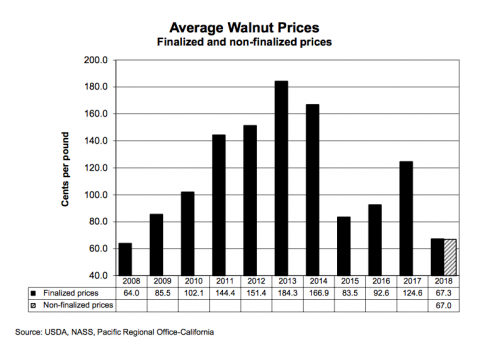
Walnut grower are hoping for a price rebound from last years crop affected by Chinese tariffs.U.S. walnut grower prices were their lowest level since 2009.USDA forecasts walnut production to decline to 1.26 billion pounds (or 630,000 tons), in-shell basis, down 7 percent from last year on lower average per-acre yield, likely supporting 2019/20 walnut grower prices So far the trend is working out.

Screen Shot 2019-10-20 at 8.24.14 PM

USDA eyes lower farm income

A USDA report issued in October says farmers are feeling stress due to lower crop prices.The report says the objectives of this study are to determine how current economic conditions in the farm sector compare with those in past periods of financial stress, to assess potential problems ahead in terms of loan defaults or bankruptcies, and to determine which types of farms are financially vulnerable now and which would be likely to face the biggest challenges in the years ahead if commodity prices decline further.
Sectoral measures of farm finances indicate a deterioration in economic conditions since 2012, yet most measures are near long-run (1970-2017) average levels:
• From 2012 to 2017, the farm sector saw the largest multiyear decline in net cash income in percentage terms since the 1970s. However, farm income fell from a near-record level so that, despite the large drop, in inflation-adjusted income remains close to the long-run average.
• Farm sector debt is again near peak levels of the late 1970s and early 1980s. In 2018, interest expenses were forecast to be 23 percent above the average levels from 2000 to 2017, but remain 8 percent below long-run average levels because of historically low interest rates.
In recent decades, farm assets (especially farmland) have appreciated more rapidly than debt. As a result, the farm sector’s debt-to-asset ratio has fallen since the mid-1980s and reached a historic low in 2012. Since then, the market for land has weakened in some regions and the debt-to-asset ratio has trended upward. The debt-to-asset ratio is now above its 10-year average, though it remains low compared to the 1970-2017 average.

Milk news

-October 6,2019-

California Dairies, Names Brad Anderson CEO

Visalia-based California Dairies, Inc. (CDI), the #1 dairy cooperative in the leading dairy state, today announced the selection of Brad Anderson as its next President and Chief Executive Officer (CEO), effective January 1, 2020. Anderson, who currently serves as the cooperatives Chief Operating Officer (COO), is succeeding Andrei Mikhalevsky, who has served as President and CEO since 2012 and recently announced his retirement from CDI at the end of 2019.

Anderson brings 28 years of experience in the food and beverage industry to this position. Prior to joining CDI, Anderson was Senior Vice President and Chief Sales Officer at Dean Foods and held positions of increasing responsibility at Sara Lee Corporation, Pepsi Bottling Group and Earthgrains Company.

$102 MILLION FOR DAIRY METHANE REDUCTION 

Screen Shot 2019-10-06 at 6.04.47 AMSeptember 18, 2019 – The California Department of Food and Agriculture (CDFA) has awarded nearly $102 million in grant funding to dairy methane reduction projects across the state. These projects, part of the Dairy Digester Research and Development Program (DDRDP) and the Alternative Manure Management Program (AMMP), will reduce greenhouse gas emissions from manure on California dairy farms.

More specifically, 43 DDRDP projects, totaling $67.4 million; 50 AMMP projects, totaling $31.5 million; and three demonstration projects, totaling $3 million, have been funded. The projects will collectively reduce an estimated 789,536 metric tons of greenhouse gases (MTCO2e) per year.

“The awards allow our dairy families to produce clean renewable energy,” said CDFA Secretary Karen Ross. “These efforts promote energy-secure economies, which are long-lasting and important contributions to local rural communities and our planet’s well-being.”

Dairy manure produces methane when it decomposes. Methane is a powerful greenhouse gas (GHG) that traps more than 25 times more heat in the atmosphere as carbon dioxide within a 100-year timeframe, which contributes to global warming. Dairy digesters help capture methane emissions use them to produce electricity or natural gas.

Changing manure management practices so that manure is handled in a dry form (AMMP) also helps to significantly reduce methane emissions.

Nonfat milk prices highest in 5 years

Screen Shot 2019-10-05 at 2.37.30 PM

Nonfat dry milk powder prices are up this fall to the highest level in some 5 years. The commodity is a staple for export and a  large potion the milk processed from Central California dairies.At the CME powder hit $1.13, highest since March 2, 2015.

The rise in powder prices reflects an overall increase in the milk checks for California farmers this year with California’s All Milk price at $18.70, up 10 cents from July and $2.85 above a year ago.

A key factor in the rise is tightened world supply the includes” China’s voracious appetite for imported milk powder that has trimmed global stockpiles” according to one report.

USDA Fruit and Tree Nuts Outlook Sept 27,2019

Screen Shot 2019-10-02 at 7.24.08 AM

 Growers suffer 59% drop in orange prices

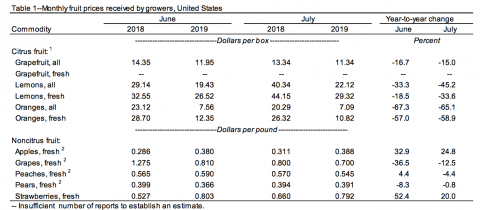
A new report from USDA says fruit grower prices remained weak through the early part of second-half 2019, indicated by the grower price index for fruit and nuts still being below year-ago levels, similar to the first half of the year. At 122.3 (2011=100), the July 2019 index was down from the July 2018 index of 131.4. Rebounding U.S. citrus production in 2018/19 across all major producing States prompted citrus price declines during the season to date, and along with lower prices for fresh grapes, peaches, and pears, drove the July index down (table 1). 

Screen Shot 2019-10-02 at 6.47.37 AM

Some factors behind the grower price movements for selected fresh-market fruit are as follows:

• Seasonally increasing California grape supplies competed with ample supplies of imported grapes from Mexico, lowering July fresh grape prices. Abundant California supplies likely have continued to ease prices through the summer.

• Increased pear supplies in California softened early-season fresh pear prices, but expected reduced supplies in the U.S. Northwest should boost prices this fall.

  • Strong fresh apple grower prices at the end of the 2018/19 season (August-July) bodes favorably to early-2019/20 prices but expectations of a larger crop will likely dampen apple prices this fall when harvest activity peaks.
  • The expected bigger 2019 peach crop is driving down fresh peach prices while lower U.S. strawberry shipment volumes are keeping fresh strawberry prices strong.
  • • Harvest for the 2019/20 California navel crop begins in October. Crop size is forecast to be reduced, likely providing support to fresh orange prices.

 A majority of U.S. fresh-market oranges are grown in California, and increased production in the State contributed to lower grower prices. Overall, the average equivalent on-tree price for a box of fresh oranges dropped from $25.82 in 2017/18 to $15.40 in 2018/19. Despite similar production levels to the previous season, U.S. fresh orange imports in 2018/19 through July were down 17 percent, in volume terms, from the previous season, at the same time fresh orange exports declined 8 percent to date. Exports were down to top foreign markets—South Korea, Canada, Hong Kong, and China. Spain and South Africa continue to gain larger shares of the Korean and Canadian orange markets, the two largest importers of U.S. fresh market oranges.

Early forecast pegs navel orange production in California at 76 million 40- lb cartons, down 7 percent from the previous year, according to the 2019-20 California Navel Orange Objective Measurement Report released September 12 by the NASS Pacific Regional Office. This forecasted decrease in production is due to a reduction in total navel bearing acreage, lower-than-average yields per tree, and smaller fruit size.

U.S. growers produced 704,000 tons of lemons for the fresh market in the 2018/19 season, accounting for 73 percent of the overall domestic lemon crop. The U.S. imported an additional 100 million pounds of lemons in 2018/19 for a total of 322 million pounds, up 45 percent from the previous season. Import volumes were up from most supplying nations, including Argentina (up 400 percent from 2017/18). These higher imports, along with increased domestic production and lackluster export demand, prompted lower lemon prices, with the average equivalent on- tree price per box falling from $26.03 in 2017/18 to $22.11 in 2018/19.

Too many grapes

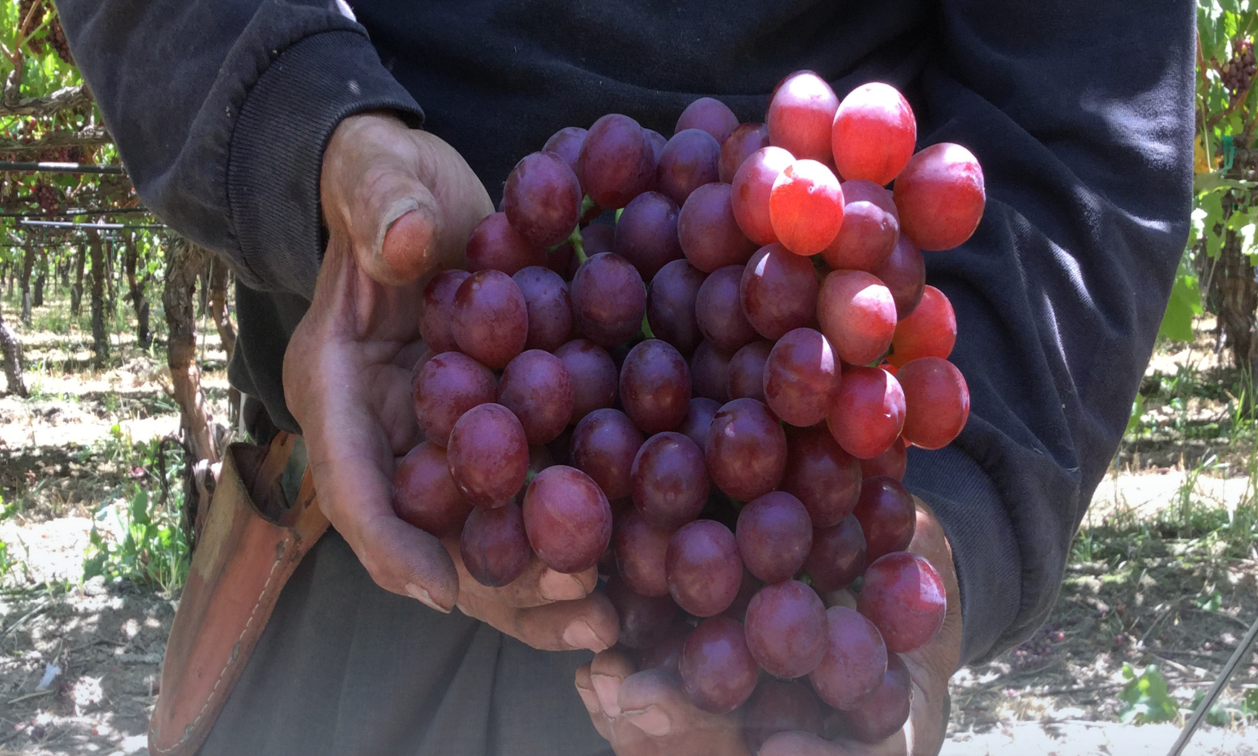
This years grape harvest is clouded by large supplies of imported grapes from Mexico helping  to drive down June and July fresh grape grower prices relative to the same period a year ago. Harvest in California is in full swing and overall expected large table grape supplies will likely help temper 2019/20 fresh grape prices. Exports through July have slowed mostly on reduced volumes to top market Canada and many key Asian markets, including Hong Kong, the Philippines, Japan, Singapore, Indonesia, Malaysia, and China.

Peach outlook

California’s production is forecast up 6 percent to 1.02 billion pounds, reflecting bigger freestone and clingstone peach crops. California’s bigger freestone crop, combined with increased production from most other States, suggests greater availability of U.S. fresh-market peaches, likely easing grower prices this summer. Seasonally declining import supplies in the spring, largely from Chile, helped bolster early-season prices. Meanwhile, although the clingstone crop is up, the Canning Cling Peach Association, the cooperative bargaining association in the canning cling peach industry, reported in July the 2019 base price agreement was ratified with processors at $488 per ton, unchanged from last year.

Nuts outlook mixed

Almond prices trading higher while walnut prices hit a 10 year low.

Another record-setting domestic crop and fairly large beginning stocks together drove down U.S. almond grower prices in 2018/19 (August-July), boosting overall demand for U.S. almonds (table 5). While exports remained almost steady from the 2017/18 high, ending stocks fell to a recent 5-year low, suggesting fairly robust domestic demand. According to the 2019 California Almond Objective Measurement Report, released by NASS on July 3, a 2.20-billion-pound crop (shelled basis) is forecast for the 2019/20 season, down 4 percent from 2018/19 on lower yields. Bearing acreage continued to rise in 2019 but wet weather during bloom hindered pollination and strong winds damaged some trees and knocked off some nuts, reducing nut set per tree. The forecast smaller crop and lower stocks carried over from last season should put upward pressure on 2019/20 grower prices.

Walnut production forecast to decline in 2019/20: Large beginning stocks and near-record domestic production boosted overall supplies in the United States in 2018/19 (September to August), driving U.S. walnut grower prices to their lowest level since 2009 (table 5, reported on shelled basis). Combined with abundant supplies, the low prices are aiding export and domestic demand for U.S. walnuts and reducing ending stocks. The 2019 California Walnut Objective Measurement Report, released by NASS on August 31, forecast walnut production to decline to 1.26 billion pounds (or 630,000 tons), in-shell basis, down 7 percent from last year on lower average per-acre yield, likely supporting 2019/20 walnut grower prices. USDA estimated an averge price of 65cents,down for $1.25 year earlier.

significantly improved grower prices from lows of the past two seasons. Domestic availability and export volume are on track to finish the season at record levels. Thus far, data from the Administrative Committee for Pistachios back strong domestic shipments in the 2018/19 season through July. For the same period, data from the U.S. Census Bureau show significantly higher exports volumes to date, including Hong Kong, China, and Germany, among the top foreign markets for U.S. pistachios. Despite higher overall shipments, a record-setting domestic crop will likely leave 2018/19 ending stocks at above-average levels. If realized, these large carry- over supplies will help alleviate market impacts associated with an anticipated reduced crop in 2019/20 due to the alternate bearing tendency of pistachio trees. Price for 2018/19 crop is  estimated at $2.44 lb, up from $1.69 a year earlier.

Ag beat: Kern Crop Report released / Sniffing for ACPs/Citrus& Walnut Estimates

-September 26,2019-


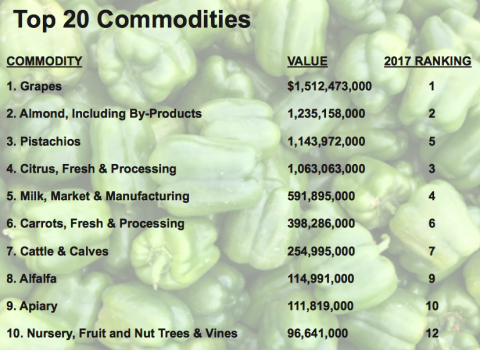
Screen Shot 2019-09-26 at 12.47.24 PMKern County beat its 2017 crop value figure reporting $7.46 billion in 2018, just below the Fresno crop value for 2018. Tulare County has yet to report in the race to claim number one ag producer.

Lat year was a big production year for grapes in Kern County, the state’s number one producer with volume up more than 6% but a valuation that was down by 13.5%. Grape farmers had a tough time making any money in 2018 as there was just too many grapes and not enough markets. Still it was the county’s top crop.

Screen Shot 2019-09-26 at 12.48.46 PM


Detector dogs being trained to sniff ACPs

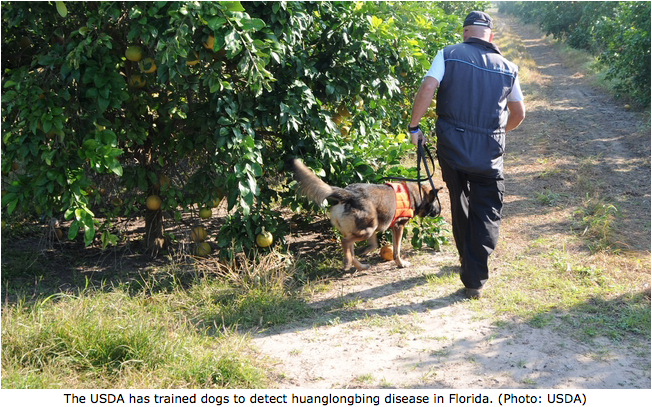
Coastal citrus growers where the citrus disease HLB has been found have hired trained detector dogs from Florida to sniff out the disease early allowing the tree to be removed before the infected tree can allow the spread

UC Lindcove citrus advisor Beth Grafton Cardwell says Valley citrus farmers have not found the disease here, at least yet. But Valley growers could use a dog to detect the presence of the vector for the deadly disease- the Asian Citrus Psyllid.

Screen Shot 2019-09-26 at 12.39.44 PM

“The Florida based trainer says they think they can train dogs to be able to detect the psyllid and expect they may be ready to go into Central Valley groves in six months” she says. 

USDA has invested million of dollars in detector dogs and they have proven to be a credible diagnostic tool for early detection and screening of trees.Now we could detect the critter that brings this plague without the extensive trapping system.

WALNUT PRODUCTION FORECAST DOWN

USDA says the 2019 California walnut production is forecast at 630,000 tons, down 6.8 percent from 2018’s production of 676,000 tons. The forecast is based on 365,000 bearing acres, up 4.3 percent from 2018’s estimated bearing acreage of 350,000.

Survey data indicated an average nut set per tree of 983, down 16.4 percent from 2018’s average of 1,176. Percent of sound kernels in-shell was 98.9 percent statewide.

In 2018 walnut growers took a bath financially with per ton value half of what it was the year before, $1300 per ton vs $2490 in 2017.

Retaliatory tariffs targeting the US  by India and China  are hurting prospects for the coming crop. The Japanese market may be a bright spot. Under a new pact a 10% duty on shelled walnuts to Japan will be eliminated.

Navel Orange Forecast -Down 7%

USDA’s initial 2019-20 Navel orange forecast is 76.0 million cartons, down 7 percent from the previous year. Of the total Navel orange forecast, 73.0 million cartons are estimated to be in the Central Valley. Cara Cara variety Navel orange production in the Central Valley is forecast at 6.0 million cartons. 

Survey data indicated a fruit set per tree of 319, b e l o w the five-year average of 366. The average September 1 diameter was 2.169 inches, below the five-year average of 2.225 inches.But fruit soiree is up formalist year when it was 2.117 inches. 

The Cara Cara orange set was 268 with a diameter of 2.185 inches.

Bearing acres of navel oranges in the state are at a 20 year low at 112,000 acres – down from 2010 who we boasted 135,000 acres.

Warm winters threaten pistachio’s future here

-September 24,2019-

from New York Times

Screen Shot 2019-09-24 at 10.41.43 AMIt was a long, hot summer, like most in the San Joaquin Valley. The pistachio trees planted in orderly rows — and the growers who nurture them — are accustomed to harsh conditions. With their deep roots and tough, gnarly branches, pistachio trees are hardy, tolerant of salty soils and brutal heat waves. Some can live for centuries.

But while sweltering summers are the norm in this part of central California, there’s a new, existential threat to these trees, one that scientists warn could spell the end of the pistachio harvest: warmer winters. Many crops are facing similar threats as agricultural regions across the world experience previously unseen extremes in heat, rain and drought.

Chilly winters are critical to nut and fruit trees, particularly pistachios. To break their slumber and spread their pollen, pistachios need to spend about 850 hours, or five weeks, at temperatures below 45 degrees.

So as the San Joaquin Valley warms and its cooling fogs retreat, growers have found their orchards out of sync: Many male trees are no longer producing pollen when the females need it.

After suffering a billion-dollar loss from a recent warm winter, California pistachio growers don’t need much convincing that their livelihoods are endangered by climate change. Heeding warnings that the industry may not survive past the middle of the century, they are among the world’s earliest adapters. Scientists are wrangling and crossing genes to breed trees that can survive a warmer world, and growers are hedging their bets by planting experimental trees that need fewer chilly days.

Big pistachio crops find growing markets

California Farm Bureau

-September 24,2019-

By Christine Souza

pastedGraphic.png

Jim Maxwell of AgriLand Farming Co. in Chowchilla, says the 2019 California pistachio crop appears to be of great quality and features large kernels. The American Pistachio Growers association estimates the state’s production to be about 800 million pounds, which would be the third-largest crop recorded. 

Photo/Christine Souza

Next year, California pistachio growers and marketers say they expect to produce the state’s first billion-pound crop, and that such larger crops will be needed to supply the nuts to customers around the globe.

“We expect to hit our first 1 billion-pound crop in 2020, and we will continue to see record crops for the next several years as more and more production comes into bearing,” said Richard Matoian, executive director for American Pistachio Growers, a trade organization representing growers, processors and suppliers.

The 2019 harvest, now underway, is expected to be the state’s third-largest, totaling more than 800 million pounds. For the state’s alternate-bearing pistachio trees, 2019 is considered an “off” year, but, Matoian said, “what we’re seeing is, with all the new acres coming into production and the younger orchards bearing more every year, even the off years are producing fairly large-sized crops.”

There are about 350,000 acres of pistachios planted in the state and of that, 284,000 acres are bearing, with more acres expected to come into production during the next several years.

Jim Maxwell, CEO of AgriLand Farming Co., a Chowchilla-based farm management company that specializes in permanent crops, said farmers are harvesting pistachios in several San Joaquin Valley counties including Madera, Fresno, Tulare and Kern.

Maxwell described pistachio quality so far as excellent, and said large kernels have contributed to the weight of this season’s crop.

“We’re operating 55 sets of pistachio harvesters. It is very intense, but exciting; we love it. This is the time of year that we wait for,” he said.

Crews are completing the first shake of pistachio trees and will return in a couple of weeks for the second shake, Maxwell said, noting that the growing season featured a “very forgiving and cool spring.”

“We had significant rains in May, and that cooler weather and extra boost of rainwater really helped the nuts size up at a time when they weren’t under much temperature stress,” Maxwell said. “Pistachios are very drought-tolerant, but if you give them plenty of water and good soils, they will respond and reward you for it.”

Jeff Gibbons, general manager for Setton Pistachio of Terra Bella, the state’s second-largest pistachio processor, said harvest is about two weeks behind a typical schedule.

“The harvest timing worked out really well to get all of the Gold Hills and Lost Hills (varieties) harvested before Kerman started. We started harvest on Aug. 26 and it will probably continue until the middle of October,” Gibbons said, adding that crop quality looks “really nice,” with larger nut size.

Despite challenges caused by the ongoing trade dispute between the U.S. and China, people in the pistachio business say exports into China and Hong Kong—the top export market—have increased, even with retaliatory tariffs.

“The tariffs are real, and they have a real impact, but despite a 55% tariff on raw product and of course that had been going up over the last year, and despite a current 30% tariff on roasted products, we have shipped more into China,” Matoian said.

Shipments to China have increased, he said, due to a 2018 crop disaster in Iran—the largest competitor for U.S. pistachio growers—and strong demand by the Chinese for pistachios, which meant China had to look to the U.S. to fulfill demand. In addition, the Chinese tariff on roasted pistachios initially was 15% during the high shipment months of October through December, Matoian said, and shipments did not slow during that time.

“The tariff on roasted pistachios was still initially at 15% and the majority of the product being shipped into China was shipped in the roasted form,” he said.

But in future crop years, Matoian said, if Iran produces large crops, “there’s the real potential that they could displace us in China, because Chinese buyers are sensitive to price and if they could buy from somewhere else cheaper, they will.”

About 70% of California pistachios are exported. Top export markets include China/Hong Kong, Europe and the Middle East/Africa.

Looking for additional opportunities in expanding markets, Matoian said India has become a focal point due to the country’s growing middle class and disposable income, and the fact that 70% of its population are self-professed vegans.

Judy Hirigoyen, vice president of global marketing for American Pistachio Growers, said the pistachio sector began a new marketing campaign this month, promoting pistachios in India in time for the Diwali holiday.

“We’re in the middle of the first month and we’re getting some really great feedback. Our shipments to India are three times what they were at this time last year, and the feedback is importers underestimated how much to order,” Hirigoyen said.

Maxwell said farmers “want to sell pistachios all over the world, and I think the biggest thing that’s helping us right now is the rising level of affluence in India and China. More and more people in these countries are able to afford them and worldwide, people are becoming much more health conscious. Nuts have been identified as a great source of protein and generally across the board, many people are all about healthy snacking.”

At Setton Pistachio, Gibbons said the firm sells pistachios to more than 50 foreign markets, and distributes to wholesalers and retailers throughout the United States. He said new trends include flavored pistachio kernels, a product that continues to have significant growth.


Oranges: fruit size looks bigger for this season’s crop


-August 27,2019-

Orange growers have not had a lot to cheer about this past year but they can look forward to a more marketable, larger size piece of fruit this fall, or so it seems.

Two who agree with this are California Citrus Mutual’s new president Casey Creamer and past guru Joel Nelsen. “At this stage the fruit size looks larger than last year” says Nelsen. “The general consensus is that it looks better” agrees Creamer. That should help improve prices some. The overall size of the crop looks similar to last year expects Creamer. USDA says last year we saw about 77 million cartons of navels harvested.

orange wiki 2019-08-22 at 2.40.05 PMLast year USDA says the average fruit size was at least a 20-year low measured on September 1 at 2.11 inches -well below the average size in years past. In 2017 the average size was 2.34 inches. If we had smaller size fruit in 2018/19 at least the crop set was good with the average for Central Valley at 426 oranges per tree. That compares to 273 pieces of fruit per tree in 2017.

Look for picking on the 2019/20 crop to start in October.

Even with a more marketable orange, growers face plenty of hurdles again this season as there is no resolution to the Chinese tariffs says Casey and a continued flood of import of overseas citrus targeting our market just as we are in production ourselves and there is plenty of fruit to supply our own market.

Nelsen the offshore fruit penetrating our market just as we are having trouble marketing overseas”just exacerbates the rush to red ink.” We need to talk to USDA” he vows.

Oranges are Tulare County’s number two crop by value with all citrus generating more than $1 billion here.

Apple exports down 27 percent

-August 25,2019-

Screen Shot 2019-08-25 at 2.12.34 PMApple exports for the 2018 crop were down 27 percent from the previous year, said the U.S. Apple Association BB #:145473 today at the organization’s annual Crop and Outlook Marketing Conference.

The value of apple exports fell by 22 percent, from $1.1 billion in 2017 to $854 million for the 2018 crop.

Amid growing trade tensions and escalating tariffs from top export countries, the overall farm gate income for U.S. apple growers fell 16 percent, or $588 million, from 2017 to 2018. The Agriculture Department’s Trade Mitigation Program purchased $83 million of fresh apples according to Agricultural Marketing Service officials.

Ag beat : Big olive crop / more milk-fewer cows / more

-August20,2019-

Big crop of California olives tests market

USDA reports this month that the 2019 California table olive forecast is 81,000 tons, up considerably from last year’s crop of 17,400 tons, according to a survey conducted by the USDA, National Agricultural Statistics Service, Pacific Regional Office. Bearing acreage is estimated at 16,000, which results in a yield of 5.06 tons per acre.
The Manzanillo production forecast is 75,000 tons, Sevillano production forecast is 5,500 tons, and other varieties are expected to total 500 tons.
Ample heat and water availability led to good fruit development. Some growers reported rain during bloom which negatively impacted their olive set.
Marketing remains a concern for California olives, with many growers uncertain how much of their crop will be economical to harvest.

Consolidation in wine sector

Two of the big boys in the California wine sector may merge. This Spring New York-based Constellation Brands announced a $1.7 billion agreement to sell around 30 lower-priced brands and facilities to E. & J. Gallo Winery.Wines the typically sell below $11 is the target in deal that requires regulatory approval.For growers it means less competition for their grapes.

Screen Shot 2019-06-20 at 7.04.40 AM

More milk – fewer cows

In 1950, there were 25 million dairy cows in the United States compared to 9 million dairy cows today producing 60% more milk.Diary supporters says the industry’s environmental footprint is smaller than imagined.

Beef is still ‘what’s for dinner’ and dinner is better

There has been a marked increase in the quality of beef production in this country say cattle & dairy representatives.That includes a 50 percent increase in prime and choice production over the past 15 years,. Some 80 percent of U.S. beef is now Prime and Choice.The industry report that beef has captured an additional 7 percent of market share of meat spending from poultry and pork.

Tyson selling meatless nuggets

Politico reports that meatpacker Tyson Foods will start selling nuggets made from pea protein this summer. The company also plans to launch a burger later this year made from a blend of beef and pea protein, under its new “Raised and Rooted” brand of plant-based meat alternatives.
Food package giant halts nonstick coatings

The company Chemours announced they would stop making some nonstick coatings used in food packaging concerned about their health effects.Three products with PFAS had been applied to paper food packaging to resist oil and grease.

Better times for dairymen

Milk Producers Council this past week reported “Inexpensive feed and $17 milk are incentivizing dairy producers to keep their barns full and to lift milk yields if they can.The CME spot markets stood strong once again this week. Spot Cheddar blocks rallied to a fresh 2019 high of $1.8925 per pound, a price not seen since November 2016.”
 New wrinkle……Lots of prunes

USDA says the 2019 California dried plum (prune) crop is forecast at 110 thousand tons, up 38 percent from the previous 80 thousand tons forecast in 2018. Total 2019 bearing acreage is estimated at 44,000, unchanged from the previous year. The French prune variety accounts for virtually all dried plum acreage grown in California. Despite that good news growers don’t expect the crop to fetch a profit. The export market is tough in part because other countries can sell their prunes for less and the trade war did not help. US exports to Hong Kong and Germany were way down in the first quarter of the 2018-19.

“While the fruit looks good so far, growers are going to have to make some decisions come harvest time about how to field size the crop that they’ve got,” said Franz Niederholzer, Tree Crop Farm Advisor covering Colusa, Yuba and Sutter Counties.  “It’s always been, the market’s not been very good for small to very-small fruit, but this year even medium fruit do not appear to have a lot of value.”

“It appears that if growers have a lot of small, medium sized fruit, they’re not going to get much if anything for that fruit and they’re going to have to pay for it to be harvested and hauled and dried,” said Niederholzer.  “It’s a tough situation for growers this year, especially for growers who didn’t mechanically thin in the spring.”