Trump comment on wheat exports to Japan -“not fake news”
From Politico
They send us … millions of cars, we send them wheat. Wheat. That’s not a good deal,” Trump said. “And they don’t even want our wheat. They do it because they want us to at least feel that we’re OK, you know, they do it to make us feel good.”
The National Association of Wheat Growers on Wednesday rebuked Trump for the slight. “They don’t buy our wheat because ‘they want us to feel okay.’ They buy it because it’s the highest quality wheat in the world. That’s not fake news,” NAWG tweeted.
Big picture: Ag trade with Japan has been a sensitive topic recently as U.S. exporters watch competitors like Canada take over market share since the new 11-nation Trans-Pacific Partnership took effect. Trump, who withdrew from the original TPP shortly after his inauguration, is now seeking a mini-trade deal with Tokyo focused on farm goods and autos. Japan has been the top market for U.S. wheat exports.
Ethanol futures bite
Ethanol futures prices are trading at five-year lows after the EPA granted exemptions to oil refiners from blending requirements. The Energy Information Administration on Wednesday projected that ethanol stockpiles are 4 percent higher than at this point last year.
The low prices are hurting corn growers and ethanol producers.
20% bigger apple crop as trade war hurts
from FreightWaves
Washington state’s 2019 apple harvest officially kicks off September 1 with a crop that is expected to be 20 percent larger than last year, but the increase in volume poses problems for farmers facing shrinking markets due to trade disputes.
“It will be a challenge on the export front,” said Mark Powers, president of the Northwest Horticultural Council, a trade association based in Yakima, Washington.
China slapped a 50 percent tariff on U.S. apples in 2018, reducing state shipments to that country by 20 percent. The levy is likely to be even more damaging in the 2019-2020 season, “when we anticipate a larger crop than last year and need to move more volume overseas,” Powers said.
Washington is by far the country’s top apple producer. Around 58 percent of apples produced in the United States are grown in Washington, followed by New York, which grows 11 percent of the total, and Michigan, where 8 percent of U.S. apples are grown.
This year’s Washington fresh apple crop is estimated at 137.3 million 40-pound boxes, up from around 116 million in 2018.
China said Aug. 5 it would no longer buy U.S. farm commodities, signaling another escalation in a more than year-long trade battle with the U.S.
President Trump’s recent decision to raise tariff rates on $300 billion worth of Chinese imports starting Sept. 1 sparked retaliation by China in the form of a currency devaluation and a pledge by China to stop buying U.S. agricultural commodities.
“China’s announcement that it will not buy any agricultural products from the United States is a body blow to thousands of farmers and ranchers who are already struggling to get by,” said American Farm Bureau Federation President Zippy Duvall in a statement.
Bad weather, falling commodity prices, and high tariffs have dogged U.S. farmers for more than a year, he said in the statement.
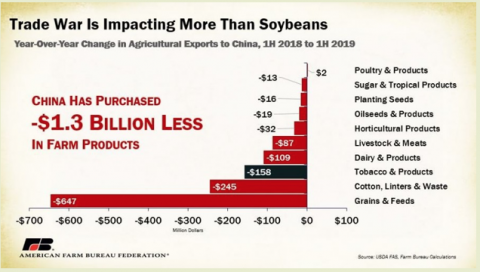
“Farm Bureau economists tell us exports to China were down by $1.3 billion during the first half of the year,” he said. “Now, we stand to lose all of what was a $9.1 billion market in 2018, which was down sharply from the $19.5 billion U.S. farmers exported to China in 2017.”
Duvall said that while farmers appreciate the USDA’s Market Facilitation Program payments to help compensate for trade disruptions, he said time is running out.
“We urge negotiators to redouble their efforts to arrive at an agreement, and quickly,” he said. “Exports ensure farmers will continue to supply safe, healthful and affordable food for families here and around the world.”
Casey Creamer, president of California Citrus Mutual, Exeter, said the Chinese tariffs have hurt the industry.
“It just makes it that much more difficult to move to move product when you’ve got the tariffs in place,” he said. While the Trump administration has put money in place to purchase citrus and other commodities to boost farmer income, the recent statement by China to stop all U.S. commodity purchases will hurt growers even more.
“We will be more impacted then what we’ve been estimating before (and) we are going to need to continue talks with the USDA administration on protecting the citrus industry because we’re an unintended consequence of the (trade war),” he said. “This may still linger for quite some time and one of the biggest fears we have is that these markets are not easy to open up and once they close it’ll be even harder to get back in there,” Creamer said.
Slipping sales
U.S. Department of Agriculture trade statistics show U.S. fresh fruit exports to China from July 2018 through June 2019 were $123 million, down by nearly half from $239 million from June 2017 through July 2018. Fresh vegetable exports to China slid from $1.21 million in 2017-18 to $516,000 in 2018-19.
That’s more bad news for the grape industry where volume shipped to China was down 40% through last November says the California Table Grape Commission.
Trade war, small size fruit and flood of imports added up to doom & gloom in 2018/19
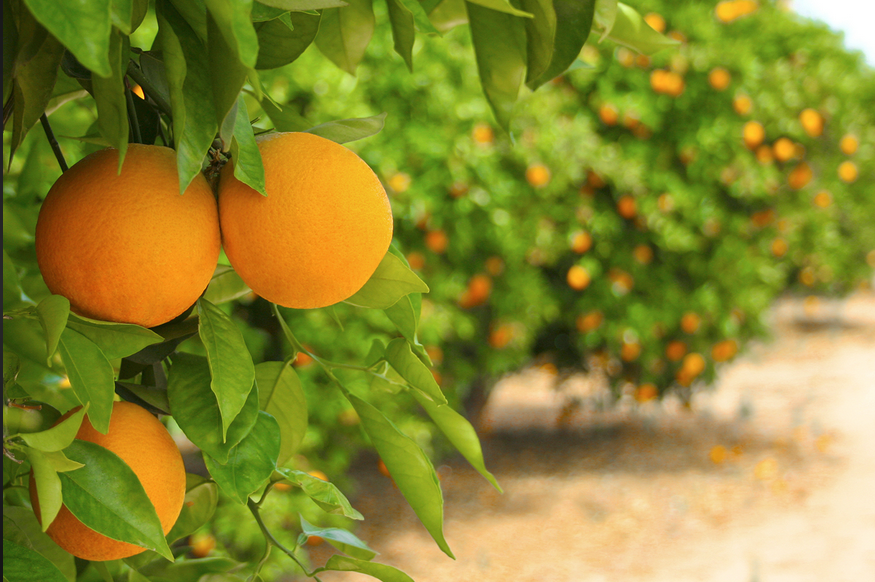
“The 2018-2019 Navel orange season will go down in history as one of the worst seasons outside of a major freeze year. “ says Exeter-based California Citrus Mutual (CCM), clearly mincing few words.
The Valley citrus trade group has just reported what most growers already knew knew – things did not go well during the most recent October through June orange harvest.
CCM says as the season kicked off, the market faced a series of challenges. Unprecedented volumes of imported fruit were present in the marketplace for much later into the season than is typical which remains a significant disruption to the market. Consequently, the normal pent-up demand for fresh California citrus early in the season did not exist. Instead, there was an oversupply situation and a confused customer base.
California’s mature fruit entered a marketplace where there was inconsistent quality, cheap prices, and poor flavor. There was a lack of movement at the store level and therefore reluctance by the retail buyer to purchase additional volumes of citrus. The customer base had a bad taste from poor quality imported fruit which made initial marketing efforts extremely difficult. This was compounded by an inferior product in the mandarin category. Differentiating California product from offshore supplies proved to be more difficult than anticipated.
To make matters worse, the California crop was dominated by small sizes. With consumer preference being for large size fruit, especially during the holiday season, the industry was fighting for shelf-space with a less than desirable size structure.
The domestic market was also impacted by the ongoing trade dispute with China. Generally, there is a push to harvest fruit in November in anticipation of strong demand around the Chinese New Year. That demand normally extends from January through April, but that did not occur this year. Some fruit was exported but was immediately delayed due to increased port inspections in China. For 2018-19 crop year, tariff levels and inspection practices on California citrus created barriers that were difficult to overcome. This forced marketers to place more time and attention to the domestic market.
CCM reports that exports of mostly California oranges were down in the Spring of 2019 about 28% from the same five months in 2018( when the trade dispute started) as tonnage dropped from 114,232 metric tons to 82,764 according to the International Trade Commission.
Additionally, the United States pulled out of the proposed Trans-Pacific Partnership Trade Agreement which would have lowered tariffs on U.S. and California fruit entering Japan. This allowed competing nations to enter the Japanese market at a price lower than California’s. Expanding Japanese export opportunities to compensate for losses in China was therefore not a good option. In fact, just sustaining that export base became a significant challenge. All this was readily visible by late October and it became evident that the first quarter would be difficult.
The California Agricultural Statistics Service (CASS) 2018-2019 Navel Orange Objective Measurement Report released on September 12, 2018 forecast the navel orange crop at 80 million cartons. D-1, or the Central Valley, would harvest 77 million of those cartons. Fruit volume was estimated at 426 per tree, well above the five-year average of 333. The average September 1 diameter was 2.117 inches, also well below the five-year average of 2.269 inches.
Growers will have their fingers crossed that fruit size improves on this fall’s citrus crop as they watch warily the ongoing trade war rhetoric just get hotter. California citrus farmers don’t want to suffer a third year of limited access to the Chinese and Hong Kong marketplace.
But President Trump this week announced another round of higher tariffs on China as of September.
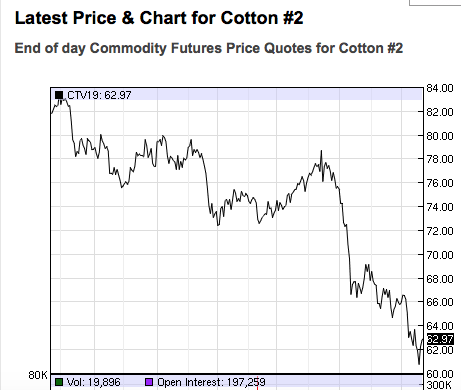
Like some other farm commodes, cotton prices have been hit by reduced demand from China due the two year trade war.Prices have fallen about 30% since the 25% tariff was imposed on US cotton shipments.
Here is the latest price chart from futures market this year.
Meanwhile the California Pink Bollworm report offers the latest snapshot of California cotton plantings this year to be harvested this fall.
The current total mapped acreage across California is 245,250 acres (up from 244,180 acres in 2018).
The breakdown of cotton acreage is 71,880 acres in Fresno County (up from 69,245 acres in 2018), 18,300 acres in Kern County (down from 23,550 acres in 2018), 97,985 acres in Kings County (up from 90,640 acres in 2018), 935 acres in Madera County (down from 950 acres in 2018), 41,620 acres in Merced County (down from 41,760 acres in 2018), and 14,530 acres in Tulare County (down from 17,895 acres in 2018).
2018 report records 14.3% increase in value for all crops
-July 19,2019-
Kings County’s crop value reached $2.35 billion in 2018, up 14.3% from the year before. County ag commissioner Jimmy Hook reported this week that big increases in production in pistachios, tomatoes and chickens although milk remained the top crop. Milk production was flat.
Pistachio acreage grew from 25,375 acres to 32,361 in 2018. The popular nut enjoyed a crop value of $287 million vs $116 million in 2017.
Processing tomatoes crop value jumped to $148 million from $110 million in 2017 – both on higher acreage and improved price.
As for chickens the number of head grew in the county from 9 million in 2017 to over 16 million in 2018 as Pitman Farms expanded their ranch count.
Kings County celebrated its goat industry in this year’s crop report noting that “Used for milking, grazing, and meat, goats really are the little animal that could! Kings County’s goat inventory has exploded since 2003. That year’s crop report totaled the number of goats in the county at 3,100. In 2018, the number had skyrocketed to more than 19,133, an increase of 617% in that 15 year time span.”
With their low overhead costs and spirited personalities, these lovable creatures are finding their way into many livestock herds. Contrary to popular belief, goats are actually quite picky in terms of what they will eat, so your tin cans and other odds and ends are safe from these grazers.
Got (goat) milk? While cows remain the top choice in Kings County for dairy farmers, goats are making headway. Nestled on much smaller parcels, there are currently nine goat dairies in the county contributing more than 2.1 million gallons of goat milk. This milk is used in many products including cheese, candy, yogurt, ice cream, soap and of course, beauty products. The wonder fluid has also been known to have anti-inflammatory, as well as anti-allergic properties.
Although a relative late comer to the United States, the boer goat has made a big impact on the goat industry. Finding its way to the United States from South Africa in 1993, the boer goat has rapidly gained acceptance and is used more prevalently for meat purposes. With its high fertility and fast growth rate, the boer lends itself to lean and healthy cuts of red meat. According to the USDA, goat meat is lower in calories and cholesterol.
California’s 2019 almond production is forecast at 2.20 billion meat pounds, down 12.0 percent from May’s subjective forecast and down 3.5 percent from last year’s crop. The forecast is based on 1.17 million bearing acres. Production for the Nonpareil variety is forecast at 880 million meat pounds, down 1.3 percent from last year’s deliveries. The Nonpareil variety represents 40 percent of California’s total almondproduction.
The 2019 almond crop experienced unusual weather. Significant rainfall during the bloom hindered pollination. Strong winds were reported to have damaged trees and knocked off some nuts. Instances of rain persisted through April and May, prompting concerns about disease pressure and warranting extra fungal applications. Cooler than average temperatures have continued throughout the growing season and the crop development is about a week behind last year.
The average nut set per tree is 4,667, down 17.8 percent from 2018. The Nonpareil average nut set of 4,429 is down 10.1 percent from lastyear’s set of 4,924. The average kernel weight for all varieties sampled was 1.54 grams, unchanged from the 2018 average weight. The Nonpareil average kernel weight was 1.63, down 4.1 percent from last year. A total of 98.7 percent of all nuts sized were sound.
A bipartisan Western water bill unveiled Thursday has the backing of the American Farm Bureau Federation and California Farm Bureau. The bill, introduced by Sens. Dianne Feinstein, (D-Calif.) along with Cory Gardner (R-Colo.) and others would provide more federal funding for water storage and other water infrastructure projects, among other things.
Honeybee decline
A record number of honeybee colonies died last winter. U.S. beekeepers lost nearly 40 percent of their colonies last winter — the greatest reported winter hive loss since a key survey started some 13 years ago says a research group.
Tulare Co jobless rate down
The unemployment rate in the Tulare County was 8.1 percent in May 2019, down from a revised 9.9 percent in April 2019, and below the year-ago estimate of 8.5 percent.
This compares with an unadjusted unemployment rate of 3.5 percent for California and 3.4 percent for the nation during the same period.
Veggies grow on vertical walls indoors
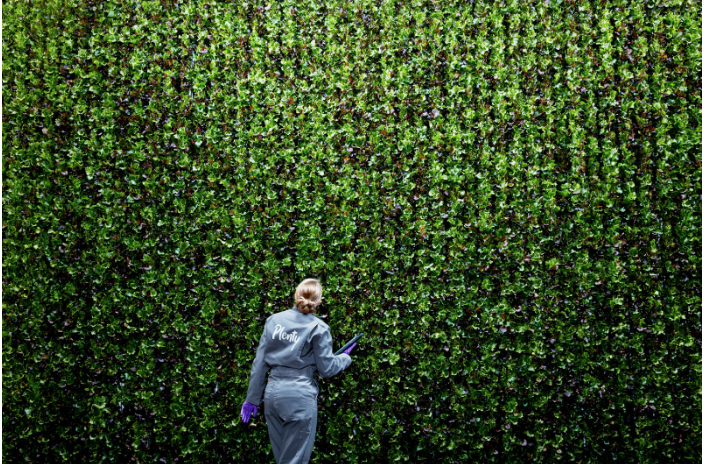
A company named Plenty is growing veggies in large indoor spaces near urban centers, protecting the greens from the weather and dramatically increasing the yield possible from an acre of land.Here is how they describe it.
“Step into one of our urban farms and you’ll see floor-to-ceiling towers nurturing varieties chosen for their taste and nutrient profile. The latest in sensor technology and machine learning allows us to create the optimum growing environments with no need for pesticides or GMOs. And Plenty isn’t just going to bring consumers fresh, local produce all year long; our growing methods are environmentally friendly too.”
Land O Lakes investing in an animal feed operation in China
Land O’Lakes is expanding its global footprint with a new dairy animal feed operation in China. The Minnesota-based ag cooperative’s joint venture with Dutch co-op Royal Agrifirm Group still must be approved by regulators.
Blue Diamond Growers expanding in Salida, Turlock
Blue Diamond Growers is expanding its Salida, California, facility – the largest almond receiving station in the world. The expansion will include a new bulk receiving warehouse that will store an additional 50 million pounds of almond meats and bring the total number of bulk warehouses at the facility to eight. The design of the warehouse features 60-foot ceilings and extends 26 feet into the ground, increasing Blue Diamond’s receiving capacity by 25 percent.The cooperative expects the warehouse to be in operation for the fall 2020 harvest season.
Blue Diamond Growers, a nonprofit grower-owned cooperative and a processor and marketer of almonds, has begun expanding its processing facility in Turlock, California. The company held a groundbreaking ceremony Jan. 29 at the 200,000-s.f. manufacturing plant. The new addition is part of Blue Diamond’s continued plans to expand its value-added product lines and deliver new almond products worldwide.
The new 52,000-s.f. building will be the latest construction of the three-phased project that will eventually yield a total of about 500,000 s.f. of building space over the next nine years. This phase of the project is scheduled to be completed in Spring 2020.
LA Co buys Bolthouse farms
Los Angeles-based private equity company Butterfly has closed on the $510 million acquisition of Bolthouse Farms, Bakersfield, Calif. The purchase from Campbell Soup Co., was announced earlier this year. Bolthouse has “leading market positions in fresh carrots and refrigerated premium beverages,” according to a news release, along with salad dressings. Bolthouse has more than 65,000 of production land, national distribution capabilities and carrot and beverage processing facility. Bolthouse has facilities in Bakersfield, Hodgkins, Ill., Wheatley, Ontario, and Prosser, Wash.
Butterfly partner Jeff Dunn is CEO of Bolthouse as of June 17, according to the release. He was president and CEO there when Campbell Soup bought the company in 2012, later becoming president of Campbell’s fresh division before leaving in 2016 to lead Juicero.
Early in the 20thcentury, dairy operators traded their milking stools for machines to produce enough dairy products to meet growing consumer demand.The technological developments were critical to the formation of California’s enormous dairy industry, the largest in the nation. Today, more than 1.7 million cows produce 39.8 billion pounds of milk in California each year, according to the California Milk Advisory Board.
The march of progress continues. The state’s dairy industry is now beginning to integrate robots and sophisticated computer software into cow barns to maintain the supply of wholesome and inexpensive dairy foods for Americans. UC Cooperative Extension scientists are poised to help them adapt to the new technologies.
On most California dairies, cows are led two or three times each day from the barn to the milking parlor by workers. They clean the cows’ udders to remove bacteria and surface dirt, evaluate whether the cow has mastitis, attach the milking machines, and disinfect the cow’s teats after milking before taking the cows back to their pens.
“Dairy production is automated, but it is still a very labor intensive activity,” said Fernanda Ferreira, UC Cooperative Extension dairy specialist based at the UC Veterinary Medicine Teaching and Research Center in Tulare. “Farmers always tell us that the most challenging thing they are facing is labor – labor availability, training and cost.”
Milking robots – a technology already being used in dairies in the Midwest and Eastern U.S., Europe, South America and Canada – promises greater automation, reduced labor needs and improved animal welfare.
View a short video clip of the milking robot in action.
The machines don’t resemble a stereotypical robot character, but rather are computerized boxes large enough to fit one cow, with a robot arm programmed to reach under the cow and clamp onto the teats. Cows do not need to be led to the milking machine, but rather walk into the box voluntarily when they are ready to be milked.
The machine recognizes each individual cow by a computer tag around her neck or on the ear, and provides personalized milking service. The robots do all the work: clean the teats, attach the milking machines, and disinfect the teats after the milking is done. While milking, the robot collects data on the cow’s output and health.
When it comes to California and all the West, these are very new,” Ferreira said. “We’re talking herds that have 1,800 cows on average. Huge herds. Since each of the robotic units, which serve 60 to 70 cows, costs about $120,000, we’re also talking about a huge investment.”
Two San Joaquin Valley dairies have already installed milking robots, and many others are interested in the new technology. Ferreira and other researchers from the VMTRC in Tulare are collaborating with one of them to study how the machine and the herd’s management can be adapted to better serve large-scale dairy herds like those in California.
“Our idea is to first understand the perspective of the producers who have cows being milked by robots. We want to know what they have learned so far, the challenges they have encountered, their relationship with banks,” Ferreira said. “Relationships with banks are important because most dairies will need to borrow funds to equip their facilities with enough robots for full automation.”
Future research will review issues of milk quality, mastitis management and determine what data farmers will need from the computerized system to improve dairy profitability.
“There are a lot of options available from companies that manufacture the robots. We want to fully understand how they work for our farmers and cows to be able to inform the future of California’s dairy industry,” Ferreira said.
Yolo County farmer Stan Lester checks on his Patterson apricots, still the dominant variety grown in the state. Growers are expected to begin harvesting Pattersons this week. Lester has finished harvest of earlier varieties Castlebrite and Robada.
Photo/Ching Lee
With an estimated crop double the size of last year’s, California apricot growers say some of their fruit will go unsold, as demand for the product continues to shrink and they remove more acreage.
“This year will really tell the tale if we are going to have a commercial apricot industry in the future or not,” said Bill Ferreira, president of Apricot Producers of California.
Ferreira acknowledged that he’s been warning about the disappearance of California apricots for at least 25 years, but he described this year as “critical,” with the loss of another cannery and what he predicts will be “a very large tree removal” at the end of the season.
Fruit processor Seneca Foods closed its Modesto plant last year, but growers didn’t have much of a crop to sell—about 23,000 tons, Ferreira estimated. With a more-robust crop this year, growers who lost their Seneca contracts have been scrambling to find new homes for their fruit, he said, adding that he expects several thousand tons of apricots will go unsold this year.
That is unusual, he noted, as production has become so small. Not only has California acreage dwindled, but growers produced “some very short, erratic crops” the last five years, he said.
Because production has been so inconsistent in recent years—mostly due to lack of chilling and other weather-related issues—Ferreira said demand for apricots has seen “a drastic reduction,” as buyers went away or turned to cheap imports. Foreign competition, especially dried apricots from Turkey, has been a huge problem for years, he noted.
“You’re getting to that point where there’s just not many markets open to us anymore,” he said.
Apricots used to represent more than 90% of what Yolo County farmer Stan Lester grew. Now his main crop is walnuts, with apricots accounting for less than 1% of his production. He and other growers say the labor-intensive nature of apricots—with high pruning, thinning and hand-harvesting costs—has been a major reason for moving away from them. Growing apricots is also very risky, Lester said, as the trees need more chill hours than other stone fruit and often face inclement weather during bloom that could wreck fruit set.
What has allowed him to continue growing apricots is his ability to use them in value-added products, such as at Lester Farms Bakery in Winters for pies and other baked goods. Lester sells some apricots fresh and dries the remainder for year-round use at the bakery.
“It’s definitely a niche crop,” he said.
Most of the state’s production still goes to processing—for canning, freezing, drying, preserves, jams and baby food—although fresh-market use has grown in recent years, as processors lose markets and take less fruit, Ferreira said.
The dominant variety remains the Patterson, harvest of which begins this week. The Patterson goes into processing and the fresh market, with about 75% of state acreage devoted to the variety. Despite its versatility, growers who raised the Patterson for processing likely won’t be able to sell into the fresh market this year, said Dave Santos, a grower and packer in Stanislaus County.
He said not only are fresh-market prices lower this year because of an oversupply, but the market is also saturated with fresh peaches and nectarines. The main reason he said he turned away growers who don’t have a home for their fruit is because processing apricots tend to be too small for fresh-market packing.
What would help, Santos said, is for the U.S. Department of Agriculture, which has promised to buy some surplus fruit, to act more quickly. Ferreira said USDA is set to announce this week how much it will buy.
Even though apricots have been “in the family” for nearly 100 years and he will continue to grow them, Santos said he plans to pull out some trees this year and plant either cherries or more almonds. To reduce employment costs and improve efficiency in his packing shed, he said the company invested in new technology that grades defects in the fruit. In the field, he’s changed how the trees are planted, keeping them small for easier picking.
San Joaquin County grower Bill Koster said he used to sell his fruit to Seneca and said he was fortunate enough to be picked up by other processors—a freezer and a baby-food maker in Oregon. He said the $600 a ton he’s earning for the fruit allows him to make money, if only the processors would take his whole crop, but his excess tonnage will likely not be sold.
“It’s getting to the point where the canneries don’t want it and the dry yards can’t afford it,” Koster said. “It’s going to be a make-or-break year. Are we going to grow or are we going to fold?”
Jeff Simonian of Fresno County-based Simonian Fruit Co., which grows and packs only for the fresh market, said his season typically runs until late May, but it ended early this year because it “wasn’t worth picking” much of his crop, a large percentage of which was damaged by storms last month.
Although he reduced his apricot acreage by half from earlier levels, he’s kept it steady in the last five years. He said he would like to plant more apricots but said there aren’t many “new and exciting varieties” that have caught his eye.
“Because there’s not as much demand for it, breeders are not giving it much attention,” he said.
Stanislaus County grower Daniel Bays, who grows the Patterson variety for canning, freezing, juicing and drying, said he will have more fruit than he has contracts for. He said he had hoped processors would take advantage of the bigger crop this year and buy “a little extra in case we don’t have a crop next year,” but noted they don’t like to hold inventory.
Bays said he intends to remove some older orchards and plant something else, probably almonds, and further shrink his apricot acreage. He said he thinks other growers in a similar situation will do the same.
“As farmers, we look at the risk you take versus the return,” he said. “With the apricot, it’s not pulling that great of a return versus the risk you’ve got to put up with.”
(Ching Lee is an assistant editor of Ag Alert. She may be contacted at clee@cfbf.com.)
SACRAMENTO, Calif. – The Bureau of Reclamation Friday issued updated Central Valley Project South-of-Delta allocations for the 2019 contract year. This update reflects ongoing water supply improvements due to May’s late-season precipitation.
“I am pleased to announce that South-of-Delta agricultural water service contractors’ allocations have been increased to 75% of their contract total because of May’s snow and rain totals,” said Mid-Pacific Regional Director Ernest Conant. South-of-Delta allocations for municipal and industrial contractors have been increased to 100% of their historic use.
Unusual May snow and rainfall set some new records in Central Valley locations and some mountain regions experienced over five inches above normal precipitation. Flood flows from Friant Reservoir and the King’s River have offset supplies from the Delta, prompting this increased allocation.
The CVP Friant Division’s allocation remains unchanged for Class 1 contractors at 100%. However, the period for uncontrolled season deliveries to Class 2 contractors has been extended to June 30. (The first 800,000 acre-feet of available water supply is considered Class 1; Class 2 is considered the next amount of available water supply up to 1.4 million acre-feet).
All other CVP contractors’ allocations were previously increased to 100% of their contract totals in recent months.
The wet conditions this year have allowed Reclamation to meet full allocations for most CVP water users. However, Reclamation has had ongoing challenges in providing higher allocations for South-of-Delta water service contractors in recent decades due to regulatory restrictions.
Even in above average water years, threatened and endangered species’ requirements, storage limitations and lost conveyance capacity from land subsidence pose challenges on Reclamation’s ability to export water South-of-Delta. Reclamation is currently engaged in several processes to improve its ability to meet the water supply needs of the CVP in an environmentally and economically sound manner. These include several efforts directed by the October 2018 Presidential Memorandum on Promoting the Reliable Supply and Delivery of Water in the West, such as the effort to develop new biological opinions for the long-term coordinated operations of the CVP and State Water Project.

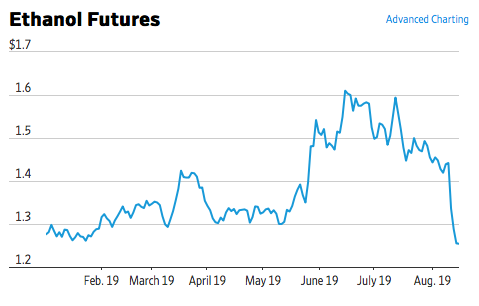 Ethanol futures prices are trading at five-year lows after the EPA granted exemptions to oil refiners from blending requirements. The Energy Information Administration on Wednesday projected that ethanol stockpiles are 4 percent higher than at this point last year.
 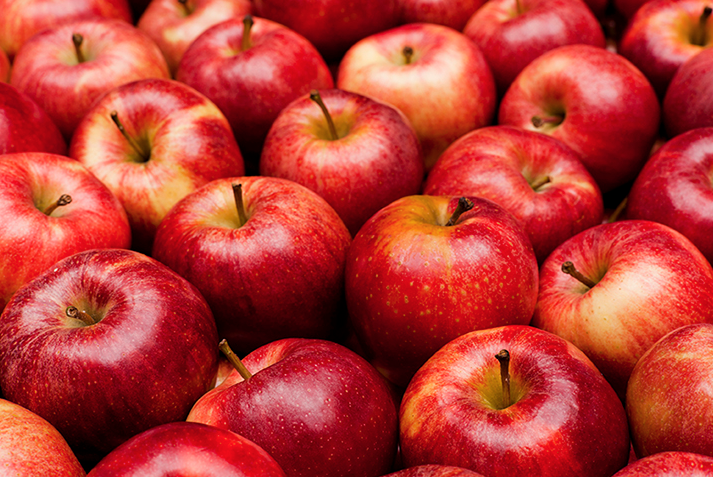 China slapped a 50 percent tariff on U.S. apples in 2018, reducing state shipments to that country by 20 percent. The levy is likely to be even more damaging in the 2019-2020 season, “when we anticipate a larger crop than last year and need to move more volume overseas,” Powers said.