Wet weather hurts California farm production 

-June 11,2019-

Crops take hit from spate of spring storms

By Kevin Hecteman

California Farm Bureau
Screen Shot 2019-06-11 at 12.49.01 PM

Amid the hot weather baking much of California this week, the spate of rain and hail that hit the state last month may have faded from memory—but not for farmers who continue to tally damage from the spring storms.

Farmers, pest control advisers and agricultural commissioners report damage to crops including onions, tomatoes, cherries and cotton, either directly from hail or as a result of diseases brought by wet weather at an inopportune time.

Jeff Rasmussen, an agronomist and pest control adviser in Kern County, said the level and progression of disease onset this year is nearing historic levels.

“You’re seeing the downy mildew taking over in the onions,” especially in organic fields, Rasmussen said. “Now, there’s so many fields of organic here in Kern County that you’re just seeing whole fields go down.”

Catalino “Tito” Martinez, who farms south of Bakersfield and serves as president of the Kern County Farm Bureau, has conventional and organic operations and noted a stark difference in damage levels.

“We are seeing more issues on the organic side due to the limited amount of materials that combat these type of diseases,” Martinez said.

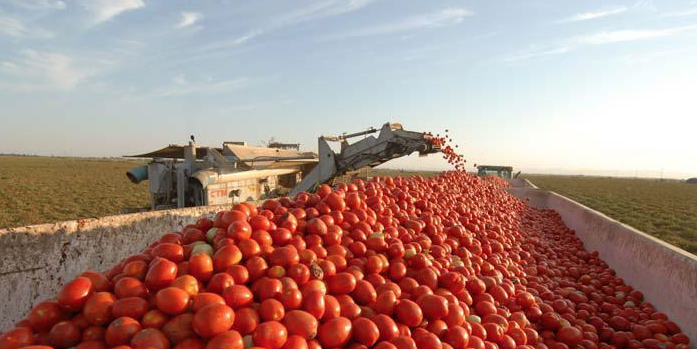
Processing tomatoes have also taken a hit; Mike Montna, president and CEO of the California Tomato Growers Association, estimated 16,000 acres of tomatoes have been affected to some degree.

“A portion of those acres will be abandoned, and I think the rest are really being evaluated as to what the impact will be,” he said. “It’s really too early to tell.”

At least two counties in the San Joaquin Valley may seek a disaster declaration for their cherry crops. Steve Schweizer, deputy agricultural commissioner in Kings County, said cherry damage information is still being processed but he thinks a declaration will be made. His Fresno County counterpart, Fred Rinder, said the county likely will meet the 30 percent threshold for a disaster declaration. In Kern County, cherry damage information is still being gathered and a decision has not yet been made, Agricultural Commissioner Glenn Fankhauser said.

“We really want to make sure that we have as much grower input as we can, so that we can make a good, sound declaration,” Rinder said. “We’re not complete yet.”

Although Fresno County cotton and tomatoes took a hit, Rinder said he doesn’t think disasters will be declared for those crops.

“It was probably bad for the guy that happened to be underneath that particular cloud, but overall for the entire county, I don’t think any other crop’s going to hit that 30 percent,” Rider said. “Mainly, it’s because of the volume. We don’t have a tremendous amount of acres of cherries, but we do have a lot of acres of processed tomatoes. We have 80,000 acres of cotton. And so for 30 percent loss, it’s going to have to take a lot of acres.”

Cotton was already off to a slow start due to the cool spring, said Roger Isom, president and CEO of the California Cotton Growers and Ginners Association in Fresno. The current damage estimate involves 3,000 to 5,000 acres, he said.

“There are some fields that are just basically going to be disked under and forgotten about for this year,” Isom said. “But even if it’s 5,000 acres, you’re talking about, this year, roughly a 260,000-acre crop, so it’s somewhat limited.”

For cotton that escaped storm damage, this week’s warmup represents good news.

“Cotton loves the heat,” Isom said. “We like that it’s warming up now.”

In addition to bacterial-speck issues in tomato plants, other crops are seeing rain-related issues, said Jaspreet Sidhu, a University of California Cooperative Extension vegetable crops advisor in Kern County.

“In watermelons, we have seen a case of measles,” Sidhu said. “It’s due to excessive moisture in the soil.”

With warming temperatures, “the plants will overcome it,” she added. “It’s not going to do any damage to the fruits.”

Sidhu said bell peppers have shown some scalding issues.

“The plants didn’t develop properly due to the weather fluctuations this year, so they have less canopy,” Sidhu said. “Because of the less canopy on the plants, they’re getting more sun.”

The scalds render the peppers unmarketable, she added.

Kern County farmer Martinez said he’d like the state Environmental Protection Agency and Department of Pesticide Regulation to take weather problems and disease outbreaks such as this year’s into account when regulating crop-protection materials.

“With the crops that we grow in this valley and the importance of this valley, we need to make sure that we have the tools in our toolbox to be able to combat these diseases and insects,” Martinez said, noting that the state had moved last month to ban the insecticide chlorpyrifos. “If not, before they ban something, we need to make sure that we have a replacement item and give farmers the tools. We can’t just get rid of something.”

Rasmussen said that, as a PCA, “my job is to manage the pest.”

“I’m not going to control Mother Nature,” Rasmussen said. “She’s going to allow me to manage, and hopefully save the crop and use safe materials that are safe to our environment.”

This, Rasmussen said, represents the challenges of integrated pest management.

“Most years, it’s OK, and you can get by,” he said. “But in years like this, there’s significant losses, and people need to understand that.”

Even with all the side effects, Martinez said he remains thankful for the wet winter.

“We’re blessed to have the rain that we did get, and to have the amount of water that we ended up getting this season,” he said. “Unfortunately, as we are so diverse within the valley, it’s pretty hard not to have issues when you have such a wet season like we did.”

Corn futures climb on Midwest flood problems

-May 21,2019-

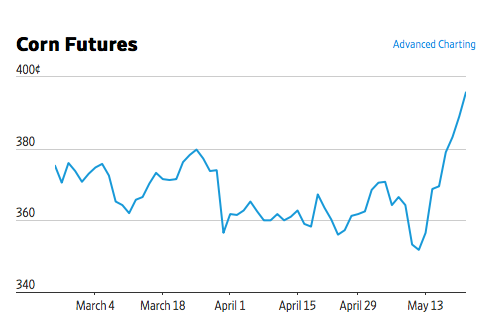
Screen Shot 2019-05-21 at 6.40.51 AMCorn futures climb this week on fear this fall’s harvest will be impacted by Midwest floods reducing the size of the crop. Farmers are not able to get into their fields to plant and the forecast calls for more wet weather. 

One account says Grain futures markets gave “[exploded] higher as of late based off late planting figures,” said Jason Rotman, president of Lido Isle Advisors. The futures and options brokerage executive said fewer crops have been planted than usual, “and wheat and corn are exploding higher.” 

“The market is very short these markets so don’t be surprised to see continued rallies in wheat and corn,” he said, adding that “there is still a big surplus of soybeans.”

Ethanol futures moved higher as well.


 Seafood consumption among U.S. children has declined every year since 2007

 Report from the American Academy of Pediatrics says  most kids don’t eat the recommended 1 or 2 weekly servings of fish.

USDA’s gloomy forecast – lower field crop prices

-May 14,2019-

Here is the May 10 USDA forecast for the season for the supply and price of major US field crops with the trade front still largely unknown. All crops listed here are expected to be down in price.

Screen Shot 2019-05-14 at 10.24.36 AMWHEAT: The initial outlook for 2019/20 U.S. wheat is for larger supplies, higher domestic use, lower exports, and larger stocks. Supplies are increased by 41 million bushels year to year with higher carry-in stocks and larger production.

The projected season-average farm price is $4.70 per bushel, down from last year’s estimated $5.20 on the expectation of greater export competition and lower U.S. corn prices.

CORN: The corn crop is projected at 15.0 billion bushels, up from last year and the second largest on record behind 2016/17 as an increase in area more than offsets a reduction in yield. The yield projection of 176.0 bushels per acre is based on a weather-adjusted trend assuming normal planting progress and summer growing season weather, estimated using the 1988-2018 time period. With beginning stocks down from a year ago, total corn supplies are forecast record high at 17.2 billion bushels.

With total U.S. corn supply rising more than use, 2019/20 U.S. ending stocks are up 390 million bushels from last year and if realized would be the highest since 1987/88. Stocks relative to use at 16.9 percent would be the highest since 2005/06. With larger stocks relative to use, the season-average farm price is projected at $3.30 per bushel, down 20 cents from 2018/19 and the lowest since 2006/07.

SOYBEANS:The 2019/20 outlook for U.S. soybeans is for higher supplies, crush, exports, and slightly lower ending stocks compared to 2018/19. The soybean crop is projected at 4,150 million bushels, down 394 million from last year’s record crop on lower harvested area and trend yields. With sharply higher beginning stocks, soybean supplies are projected at 5,165 million bushels, up 3 percent from 2018/19.Despite limited growth in global soybean import demand, U.S. export share is expected to rise to 35 percent from the 2018/19 record low of 32 percent on higher supplies and competitive prices. U.S. ending stocks for 2019/20 are projected at 970 million bushels, down 25 million from the revised 2018/19 forecast. The 2019/20 U.S. season-average soybean price is projected at $8.10 per bushel, down 45 cents from the 2018/19 forecast

COTTON: Led by higher production, the U.S. cotton forecasts for 2019/20 includes higher exports and ending stocks. Production is forecast at 22.0 million bales, based on 13.8 million planted acres as indicated in the NASS March Prospective Plantings report. While planted area is expected lower in 2019/20, increased precipitation to date in the Southwest suggests abandonment will fall from 2018/19’s above-average level and harvested area will rise. With harvested area up, production is projected 20 percent higher than in 2018/19. Domestic mill use is projected unchanged at 3.1 million bales, while exports are expected to rise 15 percent to 17.0 million. At 6.4 million bales, 2019/20 ending stocks are projected 1.8 million higher than the year before, equivalent to 32 percent of use. This would be the highest U.S. stocks-to-use ratio since 2008/09. The marketing year price received by producers is forecast to average 65 cents per pound, 5 cents lower than in 2018/19.

Ag beat: Almonds / Wages / Chlorpyrifos/ Body Mass

– May11, 2019 –

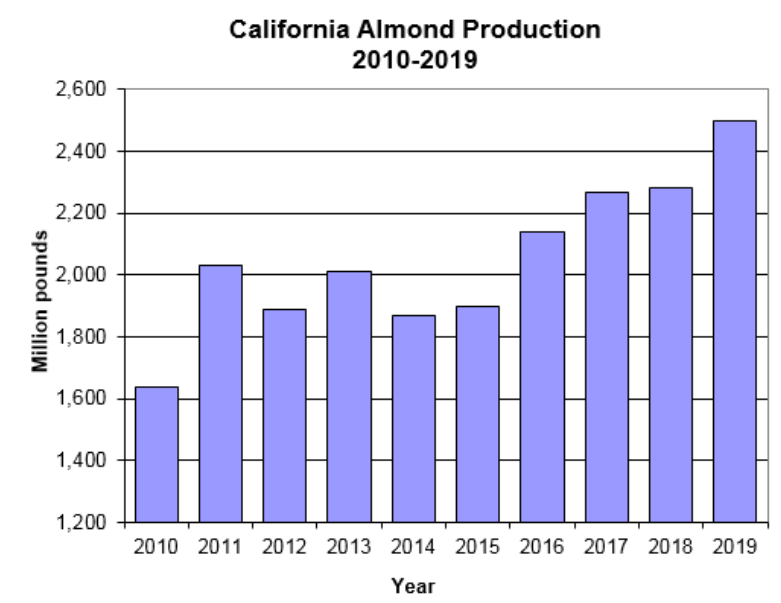
California almond crop expected to grow almost 10%

USDA says the initial subjective forecast for the 2019 California almond production is 2.50 billion pounds. Forecasted production is 9.6 percent above last year’s production of 2.28 billion pounds. Forecasted bearing acreage for 2019 is a record high of 1,170,000. Forecasted yield is 2,140 pounds per acre, 2.4 percent higher than the 2018 yield of 2,090 pounds per acre. The subjective production forecast is based on a telephone survey conducted from April 19 to May 4 from a sample of almond growers.

Screen Shot 2019-05-11 at 6.31.08 AM

The 2019 almond crop experienced unusual weather in the early part of the season. Significant rainfall during the bloom hindered pollination. However, an extended bloom period provided the opportunity to compensate for disruptions and allowed for more overlap between blooming varieties. Instances of rain continued into spring, bringing cooler temperatures that minimized pest and disease pressure, but there were reported occurrences of bacterial blast and jacket rot in some parts of the state. Strong winds in mid-April damaged trees and knocked off some nuts. As temperatures began to rise in the second part of April, orchards dried out enough to allow field work to begin. With the crop developing at a good pace, irrigation and fertilization are in full swing. Growers are optimistic as nuts appear to be sizing well.

86% of farmers raised worker wages last year

In efforts to attract qualified farm labor, California farmers and ranchers have increased their wages due to the chronic employee shortages. In the recent Adapting to Farm Worker Scarcity Survey for 2919 conducted by the California Farm Bureau Federation and UC Davis, data showed there was an increase in farm labor shortage despite more farmers were offering higher pay. The study found that 86 percent of all respondents raised their wages in 2018, with roughly 30 percent starting those increases back in 2014.

CFB

California will ban Chlorpyrifos

Screen Shot 2019-05-11 at 11.52.08 AM
Tulare Co orange growers have been largest users countywide

California will ban the pesticide chlorpyrifos, linked to neurological damage in children.

The California Environmental Protection Agency says that use of the pesticide dropped more than 50 percent from 2 million pounds in 2005 to just over 900,000 pounds in 2016.
“California’s action to cancel the registration of chlorpyrifos is needed to prevent the significant harm this pesticide causes children, farm workers and vulnerable communities,” said CalEPA Secretary Jared Blumenfeld.

The delisting will take effect in two years as the state funds a search for safer alternatives.

The organophosphate pesticide has been used in citrus production including to control the Asian citrus psyllid – the vector of the bacteria that causes citrus greening.

The California Citrus Mutual group criticized the state move.“The citrus industry is fighting feverishly to protect itself from the deadly citrus disease, Huanglongbing,” stated CCM presswint Casey Creamer.  “In order to do so, we must have the necessary tools in the toolbox for an effective Integrated Pest Management program.”

“The once mighty citrus producing state of Florida has lost 70% of its production due to this disease, which is expanding exponentially in residential citrus trees in Southern California at this very moment.  While our commercial growers will remain vigilant, it is vital that our policy makers recognize the seriousness of the threat and ensure sound scientific procedures are followed.”

“California Citrus Mutual will continue to be actively engaged in the regulatory processes around the cancellation decision and will continue to explore all potential remedies to allow the safe and effective use of Chlorpyrifos.”

Chlorpyrifos is used in more than 90 countries. Most household uses of the chemical ended in 2000, but it has remained popular in farming. California already lists chlorpyrifos as a “toxic air contaminant” and has developed permanent restrictions on its use.

DPR figures show that insecticide use on oranges increased in 2016 and has increased 50 percent in the last 5 years.

Chlorpyrifos is a broad-spectrum insecticide used primarily for citricola scale management. However, chlorpyrifos resistance in citricola scale has been documented and imidacloprid is increasingly being used to suppress these resistant populations. Imidacloprid is also used in the required treatment of glassy-winged sharpshooter

DPR futures show that in2016 Tulare County farmers applied 81,000 lbs of the chemical and half of that was on oranges.

Body mass bigger in the countryside

Obesity rises faster in rural areas

from NPR

A new paper in the May 8 journal Nature has shattered the preconceived notions of urban versus rural body types. More than 1,000 researchers representing the Non-Communicable Disease Coalition analyzed 2,009 studies of more than 112 million adults from 200 countries. In the most comprehensive analysis of urban/rural weight gain to date, they assessed changes in body mass index, a measure of body fat based on height and weight, between 1985 and 2017.
A healthy BMI for both male and female adults is 18.5 to 24.9. Overweight is a BMI of 25 to 29.9. And obesity is a BMI of 30 and above. The study found that global averages are creeping up for everyone — but faster for rural residents. The global average BMI for women rose in the past three decades by 2.09 in rural women compared to 1.35 to in urban women; in that same period, it rose by 2.10 in rural men compared to 1.59 in urban men.

Farm commodity watch: citrus from China?/ Holy cow…higher milk prices

– May 6,2019-

California citrus growers face new competition from imports- now from China

Screen Shot 2019-05-06 at 8.23.39 AMCalifornia Citrus Mutual officials were back in Washington last week when they heard unexpected news. USDA would allow imports from one of the worlds largest citrus producers – China.” It caught us by surprise” admits CCM’s Joel Nelsen.

Little US citrus is going into China right now with the high tariff imposed on our produce. In January 2018 U.S. citrus exports to China and Hong Kong were 19,687 metric tons.  For January 2019 the amount exported totaled 10,740 metric tons.

Under the proposed rule, China would be able to ship mandarin oranges, pomelos, sweet oranges, Satsuma mandarin and ponkan if there were no pests or plant disease. USDA says the competition would be limited.

But US farmers have heard that one before.

CCM has complained that increasingly low labor cost countries are targeting the US consumer even offering product just when US production is coming on.

Florida orange growers complain abut Brazil’s flood of imported orange juice produced by workers who get paid very little in areas where pesticide use is far more unregulated than the US industry is.

Similarly California Citrus Mutual has complained to our representatives that South American countries continue to import significantly more product noting “Chile, Mexico, Peru, and South Africa allow for sales at levels below what the California grower needs for a net per acre return that puts a few dollars in the pocket.”

Nelsen told  his membership in a newsletter that there has been  an “explosion of citrus imports from Chile and other producing nations and the cost differential that allows domestic market share for the California industry to be undercut.” Chilean citrus imports are up about 30%.

Overall, more produce eaten by US consumers is imported.More than half of the fresh fruit in the U.S. and almost a third of our vegetables, come from other countries. This past week  the Georgia Fruit and Vegetable Growers Association noted  a study from the University of Georgia that forecast the state would lose nearly $1 billion in annual economic output and over 8,000 jobs unless action is taken “to slow down the increase in low-priced Mexican imports of blueberries and vegetables.” It’s not just farms in the Central Valley of California.

Us farmers farmers face yet another hurdle – their labor supply is drying up up due the Trump administration campaign against immigration.

Chinese poultry next?

The loosening trade in citrus comes as the U.S. is still trying to win access for American rice and beef. China is lobbying the U.S. to allow for fresh poultry exports, a move that has triggered concern among food safety advocates remembering what chine producers did to baby formula tainting it with a plastic by-product.

Screen Shot 2019-05-06 at 8.21.41 AMLess is more as milk prices rise

From Milk Producers Council

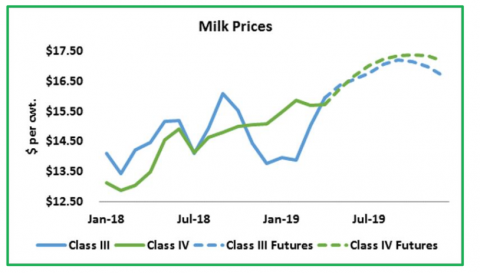
“New highs! For dairy producers, those words are like the first glimpse of an oasis after four years wandering in the desert. And, with some better pricing in upcoming milk checks to wet their whistle, dairy producers can have some confidence that it’s not a mirage. USDA announced the April Class III price at $15.96 per cwt., up 92ȼ from March and up $1.49 from April 2018. At $15.72, the April Class IV price was up, just a penny from March, but it was
$2.24 higher than the paltry level of one year ago.

At long last, lower milk production is translating to higher prices. USDA reinforced this trend with yesterday’s Dairy Products report. The March milk production deficit, coupled with strong demand for cream and other Class II products, left less milk available for driers, butter churns, and even cheese vats.”

Increase in refiner waivers anger corn growers

EPA’s increase in waivers to save refineries millions of dollars in regulatory costs and have become the center of a bitter dispute between the rival oil and corn industries.

The U.S. Renewable Fuel Standard (RFS) is designed to help American farmers by requiring oil refiners to blend certain volumes of biofuels into their fuel each year or purchase credits from those that do. But small refineries with a production capacity of 75,000 barrels per day or less can secure waivers if they prove that compliance would cause them financial harm.
Under President Donald Trump, the EPA has vastly expanded the number of waivers granted to refineries, angering Midwest farmers and their legislative backers who say the policy destroys demand for corn-based ethanol and other biofuels at a time they are already struggling.Corn princess thugs week new down onus $3.50 bushel.

The Renewable Fuels Association says the waivers are costing growers and processors big bucks. “Every gallon produced and sold by the U.S. ethanol industry has been priced lower than would have been the case in the absence of the exemptions.  There were 9.4 billion gallons of ethanol produced between February and August (the latest month for which comprehensive supply/demand data are available).  By multiplying production by the price impact in each month, it can be determined that the industry’s revenues were reduced by $2.3 billion during that time period.”


Cattle ranchers  want country-of-origin labeling in implementing legislation for the new North American trade pact says Politico, The Washington Post reports. Without mandatory labeling for steaks, burgers and other meat products, some ranchers say the trade pact will favor multinational corporations that dominate the meatpacking industry.

Cherry growers hope for a comeback year

from California Farm Bureau

By Ching Lee

A picker harvests cherries at Murray Family Farms in Kern County. Farmer Steve Murray says he started harvest last week with light volumes but expects to ramp up this week.
Photo/Cecilia Parsons

California cherry farmers appear on track to harvest one of their largest crops in recent years, a sharp contrast from a year ago, when a late freeze and other weather-related troubles delivered one of their smallest cherry crops.

Growers and marketers note, however, that harvest is just beginning in the southern part of the San Joaquin Valley with the earliest varieties, including Royal Tioga, Royal Hazel and Royal Lynn, and that major weather events such as rain could still sour their season.

For now, though, people in the cherry business agree this year’s production seems on par with or better than 2017, when they packed nearly 9.6 million 18-pound boxes, the highest in the last 10 years, according to the California Cherry Board. Rivermaid Trading Co., a grower-shipper-packer in Lodi, estimated the 2019 cherry crop at about 10.5 million boxes.

“It’s a record crop,” said Kyle Persky, sales manager for Rivermaid.

The firm reported the increased crop will come mainly during the first half of the season and relates in part to higher acreage and yield in Coral Champagne, an earlier-ripening variety that grows well in the state’s southern and northern growing districts. Rivermaid also reported seeing a “relatively stronger” crop in the Tulare variety.

With a bigger crop, growers see smaller fruit sizes, which they are trying to remedy by thinning their trees and applying the plant hormone gibberellic acid to help maximize fruit size and firmness—qualities that export markets demand, Persky said. Growers will be rewarded in price for bigger fruit, he added, while those who “hung a lot of fruit that’s not going to size” will have a challenge marketing it.

“With the thinning, it should be a good, marketable crop for us,” said Tom Gotelli, who manages Stockton-based OG Packing, which operates farms in the southern and northern districts.

Ralph Casciaro, who markets cherries for King Fresh Produce in Dinuba, said he expects cherry sizes will be “all over the board,” with plenty of 11-row cherries and smaller, though he said he hopes there will be a “fair amount” of nine-and-a-half-row and larger. “Row” refers to the number of cherries that could fit in a row inside a box, with smaller numbers indicating larger-sized cherries.

Kern County grower Steve Murray said he’s done some spot-thinning in his orchards and “gib” applications, but he noted growers in the southern valley tend not to use much gibberellic acid because it delays harvest by several days. Southern-district growers aim to sell their crops early when there are no cherries on the market and prices are high, he said.

“On the very front end, it seems like our prices drop about $7 a day, and if you gib, you lose three days. It might cost you $20 a box,” he said.

Cherry volumes are expected to build in the coming days as farmers begin to pick the Brooks, Coral Champagne and Tulare varieties, with harvest in the southern district peaking in about two weeks, Gotelli said. Packers agree harvest of Bing cherries, still the most widely grown variety, will come later this year, with an estimated 60% of the fruit arriving after Memorial Day, traditionally an important holiday for retailers to promote cherries.

“This year, there really won’t be any Bings on Memorial Day, but we’ll have them for Father’s Day,” Persky said.

Breanna DeVita of King Fresh Produce said she’s not too concerned about having lighter Bing volumes going into Memorial Day, as there will be other red-cherry varieties available.

“There are so many varietals out there,” she said. “We’re going to do our best to plan accordingly to cover everyone—it just may not be Bings.”

Murray said he thinks cherry marketers should do more to promote the different cherry varieties, the way apple varieties are branded and promoted. Farmers, he said, are much more enthusiastic about new cherry varieties, which have different qualities of firmness and sweetness that should be branded.

“I think increased consumption comes through branding,” he said.

Murray started picking “a very small amount of fruit” last week—enough to sell to farmers markets—and will be picking for packinghouses and the export market this week. He said about 75% of his trees “set a nice crop,” with about 20% producing just half a crop. This puts him in a “good position,” he said, though he noted some orchards in his region have not done as well. He described how some growers saw their trees bloom, but then the flowers aborted, resulting in a poor crop. Others set a large crop and are now “fighting smaller sizes.”

“It’s a mixed bag,” he said. “I don’t think we’re going to have a blockbusteScreen Shot 2019-05-01 at 6.31.01 AMr that San Joaquin County is going to have.”

He noted growers are already downgrading their original estimates and forecasts as they drop more fruit on the ground. He said he thinks the crop from the southern district will also have more spurs and doubles—caused by extreme heat the previous summer during flower-bud formation—and that could further lower pack-outs.

“It continues to be a difficult area to grow cherries down here,” he said.

Even though farmers in his region are planting more newer varieties that don’t require as much winter-chilling time to set fruit, Murray noted that Kern County cherry acreage continues to drop, with growers switching to other, more-attractive crops such as almonds, pistachios and table grapes.

Higher temperatures last week also may compress harvest, possibly resulting in some overlap this year between the southern and northern districts, he added.

Persky said he expects a “fairly smooth transition” with not much overlap between the California cherry season, which will probably run through mid-June, and the Pacific Northwest season, which is also running late this year. Gotelli, however, said he thinks the delay in the Northwest crop will result in a “big gap” in the market, though “we just don’t know how big it is right now.”

DeVita said she expects the early market will stay strong for at least another week or two, at which time volumes will get heavier.

“Opening quotes have been strong,” she said. “Business has been steady. Interest has been incredible. We’re looking forward to a good season.”

(Ching Lee is an assistant editor of Ag Alert. She may be contacted at clee@cfbf.com.)

Permission for use is granted, however, credit must be made to the California Farm Bureau Federation when

Ask the farmer… Are you better off?

-April 30,2019-

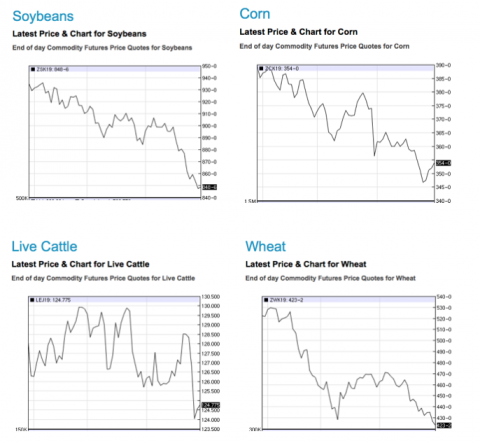
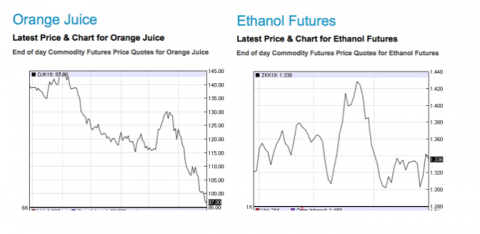
Farmers are facing more severe weather issues, endless trade wars impacting our exports and low prices for many, not all, key  ag commodities. While Wall St celebrates 3.2% GDP in the first quarter, farm GDP is rotting in the fields. Here is a quick glance at the pain threshold thanks to NASDAQ. These are 6 month charts as of April 30. They do not include hogs that are up due to Chinese swine flu and milk prices are finally up after years of red ink. The chart does not show many California key commodities like export dependent walnuts, oranges and wine, suffering from multiple trade disputes.

Farmers generally have beef over US withdrawal from the Trans-Pacific Partnership allowing our competitors to gain an advantage and refusal by President Trump to withdraw tariffs on Canada and Mexico despite an announced trade agreement months ago. Press reports note GOP Senate Finance Chairman Chuck Grassley told reporters that Trump isn’t bending to pressure to lift the duties. “The whole message from everyone in the Senate delegation that went [to the White House recently] was, ‘We’ve got to get rid of the tariffs or nothing is gonna happen,’” Grassley said. The Iowa Republican said he asked Trump directly, “Don’t you think the tariffs ought to come off?” — to which the president replied, “No.” A top Canadian diplomat said Ottawa likely won’t ratify the new North American trade pact this year if the steel and aluminum tariffs aren’t dropped. 

Screen Shot 2019-04-30 at 6.23.57 AMScreen Shot 2019-04-30 at 6.24.14 AM

Almonds vs Milk- day and night

-April 25,2019-

Dean Foods struggles – mirrors dairy industry

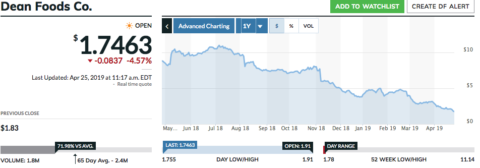
Screen Shot 2019-04-25 at 8.17.32 AMDean Foods Company is struggling with lower sales like much of the US diary industry.Its stock is selling around $1.74 per share this week, down from $11 share last summer.Canadian dairy giant Saputo is said to be interested in buying the company.
Dean Foods is one of the largest processors and distributors of fresh fluid milk and other dairy products. That includes butter and ice cream. Brands include DairyPure, TruMoo, Land O’ Lakes, Country Fresh, Dean’s, and many others. Competition from alternative “milk” offerings is weighing on DeanFoods and rest of the dairy industry including Dairy Farmers of America (DFA). DFA on March 20 that reported a$1.1 billion drop in net sales in 2018. The firm said that the 7.5% decline in sales was primarily due to lower milk prices.

Almond acreage climbs again as tariff impact less than feared

USDA’s National Agricultural Statistics Service (NASS) reports that California’s almond acreage continued to increase in 2018. California’s 2018 almond acreage is estimated at 1,390,000 acres, up 2 percent from the 2017 acreage of 1,360,000. Of the total acreage for 2018, 1,090,000 acres were bearing and 300,000 acres were non-bearing as growers contuse to plant new orchards.

Screen Shot 2019-04-25 at 8.23.26 AMThe value of production is likely to be over $6 billion when all the 2018 numbers are in. That would be double was we saw in 2010 and compares to $5 billion in 2016 and $5.6 billion in 2017.

News reports suggest world prices for almonds and nuts are rising despite the impact of the U.S.-China tariff battle. One report says almonds are selling for $3.25 per pound, up 8% since the September-October period of last year. The U.S. produces 80% of the world’s almonds. California is top producer,
“Last July, No. 1 importer China imposed a 50% retaliatory tariff on American almonds amid the trade conflict with Washington. Yet, while the Almonds Board of California reported a 25% year-on-year decline in shipments bound for mainland China and Hong Kong from August to February, a trading company representative said procurement of American almonds did not decrease as much as anticipated.
Shipments in the U.S. rose 4%, while those to Canada and Mexico climbed 10%. Exports to Southeast Asia were up 13%, and Japan procured 5% more.
Almonds, touted for their health and beauty benefits, are popular worldwide for snacks, sweets and beverages like almond milk”.

California blueberry harvest starts slowly; volumes recover

April 24,2019

From CFB
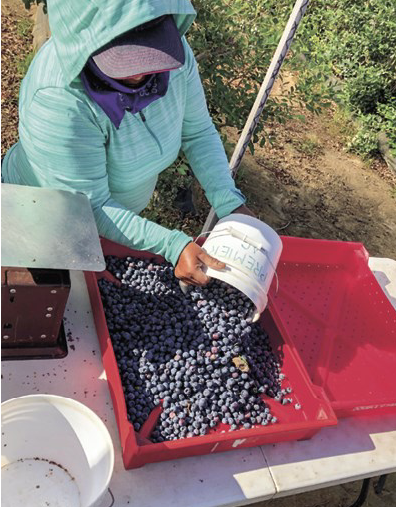
Screen Shot 2019-04-24 at 6.39.09 AMAn employee harvests blueberries for Berry Fresh Produce in Coalinga. The company says it expects heavier volumes of California-grown berries in a couple of weeks.
Photo/courtesy Berry Fresh Produce

Blueberry farmers hoping to capture some of the early-season market when less supply lifts prices are slowed by cooler weather, which has delayed harvest.
Though they expect to market more volume in the coming weeks, with good-quality fruit, growers and marketers say larger crops in other states and offshore have also pressured the market this year.
Harvest is about seven to 10 days behind schedule, said Todd Sanders, executive director of the California Blueberry Commission, but he noted that could change quickly with warmer temperatures arriving this week.
He estimated the crop will be 25% to 30% larger than last year, which saw production drop by 20% to 30% due to frost damage. The bigger crop this year is also related to more acreage in production and more high-density plantings, he noted. California blueberry acreage stood at 8,755 in 2018, an increase of nearly 33 percent from 2017, according to the commission.
Describing the harvested crop so far as “good size, good flavor and good quality,” Sanders added, “it’s looking to be a pretty decent year.”
San Diego County grower Bill Steed, whose crop is about three weeks behind schedule, said cooler temperatures, which allow the berries to ripen at a slower pace, should lend more flavor complexities to the fruit as it sizes. After last year’s late freeze wiped out more than 80% of his crop, he said he expects a “normal, good year” this season.
With plenty of fruit on the market coming from Georgia, Florida and Mexico, Jerry Connery, who markets blueberries for California Giant Berry Farms in Watsonville, said there’s been no supply gap this time of year, which typically boosts market prices. When California hits peak season by mid-May, Georgia blueberries should be waning by then, and that could improve market conditions, he said.
“But I personally doubt it,” he added. “I think it’s a bumper crop. I think it’s an excellent time for retailers to promote. Blueberries will be promotable all summer long.”
Unlike other packers and marketers that sell blueberries year-round with imported fruit, Heidi Devine, purchase manager for Devine Organics, a grower-shipper-packer in Fresno, said the company tries to hit the early-season market, which is the most lucrative. But with “quite a bit of volume” still coming out of Mexico and with California harvest “moving a lot slower than usual,” she said she has not been able to take full advantage of that marketing window this year.
“Having product in April and May is extremely important for us,” Devine said. “We still have some; it’s just been slower. When you see this cool weather, you just imagine how much more successful it could’ve been had it been warmer.”
Historically, market prices for blueberries in March and early April have been “fantastic,” said Gunnar Avinelis, CEO of Agricare, which manages blueberry farms in California from Kern County to Fresno County, and in Oregon. To get in on those early-market prices, growers try to push the maturity of their berries by having some production in hoop houses, he said. He started harvest on his covered berries about two weeks ago. With Mexico staying in the market longer, prices have not been as good as in the past, he said.
“This year, in particular, we’re starting to see the impact of Mexico’s increasing volume in their later varieties,” he added.
Whereas Mexico used to be finished by the time California enters the market, its late-season varieties are now overlapping with the Golden State’s early season, lowering market prices by a sum Avinelis described as “pretty significant.”
Not only is Mexico shipping more volume, he said, but its varieties have gotten better. It’s a trend he said he’s observed in other South American producers as well, noting that Peru and Chile also have become bigger players in recent years. That has led to more steady, year-round supplies in the market and fewer pricing spikes that California growers have enjoyed.
Even though some growers prefer less competition from imports, Avinelis said offshore supplies will come in anyway and he’d rather they be good-quality fruit, which could help increase overall U.S. blueberry consumption.
“The eating experience dictates future buying,” he said. “As a blueberry grower, I want more people to be buying regularly throughout the year, so there’s more customers pulling volume faster in my primary (marketing) windows.”
For this year at least, some of that imported fruit has been “problematic,” and buyers are “looking forward to California and Oregon fruit,” said Peter Hill of Berry Fresh Produce, a grower-distributor in Los Angeles County. The company’s California growing regions include Santa Maria and areas of Fresno County, with imported production from Chile, Argentina, Peru, Uruguay, Mexico and Canada.
Because of bad fruit coming from Chile, Hill noted a lot of it had to be dumped. Though volumes coming from its farms in Santa Maria and Coalinga are so far light, he said he expects heavier volumes in a couple of weeks.
“We’re coming into the California season strong and we’re going to have plenty of supplies,” he added.
To alleviate pressure on the domestic market when there’s a large U.S. crop, Sanders said the commission has been trying to expand California’s export market, specifically in Japan, Canada, Mexico and Southeast Asia. He noted that even though demand for blueberries continues to grow, production has been increasing at a faster rate.
More growers are transitioning to organic, which he described as the sector’s “biggest growth category.” Part of that growth, he said, has been helped by a change in the U.S. national organic standards, which now allow container production and the use of substrates.
Avinelis, whose production is primarily organic, said growers also are farming organically at a larger scale—devoting 200 or more acres rather than 5 to 10. Much of this growth, he added, is driven by price premiums for organic, higher demand and “a number of rough years” in the conventional market.
“And a lot of the retailers are pushing it,” he said. “Their margins remain really strong when they sell organic. It’s rising rapidly and I don’t see that stopping anytime soon.”

Plum loco

Where’s my stone fruit?

-April 22,2019-

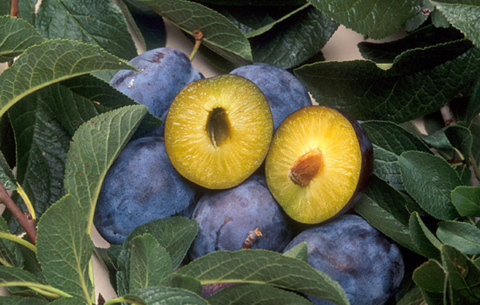
Screen Shot 2019-04-22 at 12.33.45 PMIt’s getting harder to enjoy that big juicy plum from the San Joaquin Valley these days. Acreage of stone fruit in 2017 is down from 2002,2007, and 2012 for most tree fruit varieties. This is according to the latest US Census of Agriculture published every five years.

Case in point are nectarines that in 2002 blanketed over 42,000 acres of farmland but as of 2017 is down to just 17,600 acres, virtually all grown in the San Joaquin Valley. Or those peaches? Today we sport just 24,000 acres, down from 35,000 acres in 2012 and 43,200 in 2002.

Statewide plum acreage is down by more than half in the past 15 years. In 2017 plum acres were 64,702 – down from 82,910 in 2012 ,102,860 acres in 2007, and 141,494 acres in 2002.

California apple orchards have also slid in the past 15 years to 13,637 acres in 2017 – down from 38,268 in 2002. Avocados are down as well although grape acreage has climbed since 2002.

Tulare County plum acres have dropped from over 18,000 acres in 1990 to 8500 acres in 2017. But both peaches and nectarines haven’t declined in the county. Fresno County plum acreage has been hit hard as well ,down by about half.

Import of plums have been trending higher in the past decade with imported dried plums valued at $2.1 million in 2009 but hitting $40 million by 2016. Imports of fresh plums have gone from $36 million in 2009 to $43 million in 2017.

Over all, the number of California farms growing all crops has declined from 84,000in 1987 to about 70,000 in 2017 although the market value of crops sold has climbed from $14 billion in 1987 to over $45 billion in 2017.