Hanford’s Central Valley Meat to acquire Harris Ranch Beef

-April 10,2019-

news release

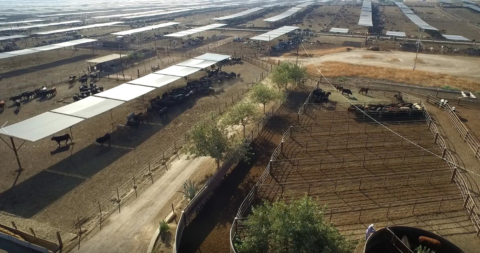
Harris Ranch feedlot off Hwy 99

Hanford and Selma — Harris Farms, Inc. Owner John Harris and Central Valley Meat Company, Inc. President and CEO Brian Coelho announced Tuesday that Central Valley Meat Holding Company will acquire Harris Ranch Beef Holding Company, including its wholly owned subsidiaries, Harris Feeding Company and Harris Ranch Beef Company.
“We have known and respected John Harris and Harris Ranch Beef for decades, and I am pleased to have this once-in-a-lifetime opportunity to continue the business’ family-owned legacy and pursue its tremendous potential for growth here in the Central Valley,” said Coelho. “While Central Valley Meat Company and Harris Ranch Beef will continue to operate independently, I expect both businesses and their respective customers to benefit from the companies’ shared knowledge, extensive resources and expanded product offering.”
Financial terms of the transaction were not disclosed.

Both are Central Valley, California-based, family-owned businesses, and together they will become the 7th largest beef packer and processing company in the U.S.
Under the agreement, Harris Ranch Beef and Central Valley Meat Company will operate independently, with both companies retaining their respective brands.
“The Central Valley has long served as the home of some of the finest beef sold around the world. Today’s announcement cements a future for two family-owned beef operations to continue to thrive,” said Harris. “Brian has a proven track record of growing businesses, and under his leadership Harris Ranch Beef can continue its long and storied legacy.”
“Brian and the Central Valley Meat Company team share our view that employees are our company’s most valuable asset and that customers should be treated as partners, if not as family,” said Dave Wood, chairman of the Harris Ranch Beef operations and a 50-year veteran of the business. “We are pleased to work with Brian and we look forward to each company’s continued success.”
None of Harris Farms’ other entities are impacted by the transaction. Harris Farms’ Hospitality Division, including the Harris Ranch Inn and Restaurant, Farms Division, Horse Division, and River Ranch will remain fully owned by Harris Farms. Wood will remain with Harris Farms as its president.

Snow Survey Boosts Runoff Predictions

Published: Apr 02, 2019

pastedGraphic.png

The Department of Water Resources held its fourth snow survey of the water year on April 2. DWR/2019

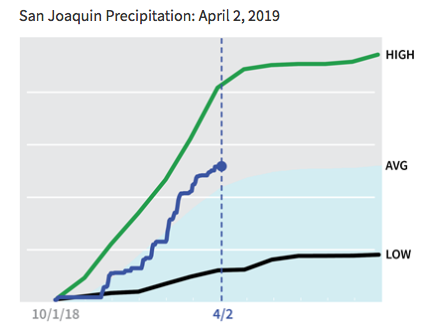
SACRAMENTO, Calif. – The Department of Water Resources (DWR) today conducted the fourth Phillips Station snow survey of 2019. The manual survey recorded 106.5 inches of snow depth and a snow water equivalent (SWE) of 51 inches, which is 200 percent of average for this location.

Statewide, the Sierra Nevada snowpack is 162 percent of average. California has experienced more than 30 atmospheric rivers since the start of the water year, with six in February alone, and statewide snow water equivalent has nearly tripled since February 1. Snow water equivalent is the depth of water that theoretically would result if the entire snowpack melted instantaneously. It is an important tool used by water managers across the state to estimate anticipated spring runoff.

“With full reservoirs and a dense snowpack, this year is practically a California water supply dream,” said DWR Director Karla Nemeth. “However, we know our long-term water supply reliability cannot rely on annual snowpack alone. It will take an all-of-the-above approach to build resiliency for the future.”

Snowpack is an important factor in determining how DWR manages California’s water resources each year to meet demands. On average, the Sierra snowpack supplies about 30 percent of California’s water needs as it melts into streams and reservoirs in the spring and early summer to meet water demands throughout the year. The April results are a key indicator for the rest of the year’s water supply. The snowpack’s water content typically peaks around April 1, after which the sun’s higher position in the sky begins to accelerate snow melt.

While the April 1 snowpack data is good news for water supply, state officials warn there could be flooding risks later this spring.

“With great water supply benefits comes some risk,” said Jon Ericson, DWR Chief of the Division of Flood Management. “Based on snowpack numbers, we have the potential for some minor flooding due to melting snow so we remind folks to always stay vigilant and aware.”

Screen Shot 2019-04-02 at 5.43.53 PMThe state’s largest six reservoirs currently hold between 106 percent (Oroville) and 132 percent (Melones) of their historical averages for this date. Lake Shasta, California’s largest surface reservoir, is 109 percent of its historical average and sits at 89 percent of capacity.

DWR conducts up to five snow surveys each winter – near the first of January, February, March, April and, if necessary, May – at Phillips Station in the Sierra Nevada just off Highway 50 near Sierra-at-Tahoe. The Phillips snow course is one of hundreds that is surveyed manually throughout the winter. Manual measurements augment the electronic readings from about 100 snow pillows in the Sierra Nevada that provide a current snapshot of the water content in the snowpack.

Olive growers face decisions on mechanization

-March 27,2019-

from California Farm Bureau

After years of seeing declining table-olive acreage in the state, growers who remain in the olive business have found themselves at a crossroads: Convert to mechanization or face an uncertain future for their crop.

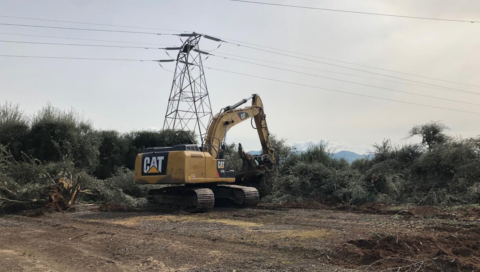
olive trees near Orange Cove meet the CAT

Musco Family Olive Co., one of two major olive processors in the state, is urging them to choose the former. The Tracy-based packer announced last week that it intends to buy this year’s fruit from growers whose contracts were terminated by Walnut Creek-based Bell-Carter Foods, the state’s other olive processor.
CEO Felix Musco said the company plans to offer long-term contracts to growers “who will commit to our modern cultivation program”—that is, remove their existing orchards and plant new acreage that could be mechanically harvested. Most of the state’s table olives are hand-picked.
This new approach requires higher tree density than what exists in typical orchards today and allows growers to harvest 7 to 9 tons per acre, he said. Because the new plantings could be mechanically harvested, “it reduces manpower and lowers labor costs for growers,” he added.
The company would provide financial assistance to growers willing to make the necessary investments, Musco said, noting the company “recently unveiled an incentive program to our existing growers because we believe this approach ensures competitively priced fruit and strong grower returns.”
For now, he said the company would offer one-year contracts to growers cut by Bell-Carter, giving them a home for this year’s crop and “some time for them to understand the opportunities of modern acreage and making the decision to transition.”
With language still being finalized for both contracts, Musco said he could not provide details but noted the company has received “a lot of interest from growers throughout the state,” and that it plans to offer more information the first week of April.
“As we work through the details in the coming weeks, the important takeaway is that we are confident our industry will be successful for generations to come,” he said.
As one of an undisclosed number of growers whose contracts were canceled by Bell-Carter, Joan Vanderhorst, who grows olives in Tulare County, said she is “grateful” to Musco for offering the one-year contracts, but noted it is “a temporary rescue.” She described Musco’s efforts to get growers to replant their orchards in favor of mechanical harvesting as a “stopgap” measure, as it allows Musco to stay competitive by reducing growers’ production costs, thus lowering the price it pays for the fruit.
The bigger issue, she said, is with Bell-Carter, which reportedly sold 20 percent of its share to the Spanish olive company DCoop last year and has been shipping less expensive, foreign olives into the U.S. for processing under a rule that allows the company to avoid paying import tariffs on the raw olives.
Without “checks and balances” to prevent Bell-Carter from bringing in foreign olives, she said, “Musco is not going to be able to stay in business for very long.”
As to whether she’ll replant, Vanderhorst said she’ll use the one year to consider, noting that her 102-year-old trees remain some of the most productive in the state, with yields topping 11 tons per acre.
“You’re talking about a historic grove,” she said. “Part of the reason we still have these trees in the family is kind of nostalgia. But that’s not good business sense.”
Though he hasn’t seen details of Musco’s incentive program, Tulare County grower Rod Burkett, who holds a contract with Musco, said he would be reluctant to replant to olives due to the cost of establishing a new orchard and the alternate-bearing nature of the crop. Even though the new-style plantings that Musco is promoting would save on harvesting costs, Burkett said the cost of pruning to keep the trees shaped is also significant.
“I don’t know if it’s going to be worth it,” he said. “I can’t speak for everybody, but for me, I think I’d rather go a different direction and plant other stuff” such as pistachios, almonds or citrus fruit.
But he acknowledged that with employment costs continuing to rise, mechanical harvesting is “absolutely the way we need to go if we’re going to have a viable olive industry.”
Tim Carter, CEO of Bell-Carter, said his company “carefully looked at” mechanical harvesting, “but we couldn’t see how the economics would work out for the farmers or for us.”
Research on mechanical harvesting for table olives has focused on two main systems: a trunk shaker and “finger” technology in which moving “combs” make contact with the canopy to remove fruit.
Louise Ferguson, a University of California Cooperative Extension pomologist, said mechanical harvesting could be successfully done with manzanillo olives—the predominant variety for canning—if the trees are replanted and trained properly. In some cases, older trees could be converted, but there would be yield losses for two to three years while the trees are being adapted, she noted.
“It won’t be perfect at first, but it’s better than not getting the fruit off the trees at all—or getting it off at a price where the processor can’t economically purchase it,” she said.
Ferguson said the only grower she knows who’s tried mechanical harvesting is Dennis Burreson, Musco’s vice president of field operations whose family grows table olives in Orland.
In a statement, Burreson said his orchards “have generated revenue exceeding any other crop we are involved with, including almonds” and that his family is planting additional olive acreage.
Ferguson commended Musco for making the contract offers and for “trying to force (growers) to do what they need to do.”
“What they’re trying to do is save the industry,” she said of Musco. “I really give Dennis credit for doing it on his own—and for telling people what they need to hear. Now they’re at a crunch point and they have to make a decision.”

Olive farmers get reprieve

-March 21,2109-

Screen Shot 2019-03-21 at 12.38.38 PMOlive growers who found their crops marooned may have another buyer. Tracy-based Musco Olive Company said Tuesday it would offer contracts to farmers whose contracts were canceled by the other main olive processor, Bell-Carter Foods. Bell-Carter said this month it needed to cancel an undisclosed number of grower contracts to remain competitive. Musco says it wants to transition farmers to harvesting ripe olives mechanically.

From CFB

Roundup cancer verdict

From POLITICO

-March 20, 2019-

NPR photo
NPR photo

JURY FINDS ROUNDUP CAUSED CANCER:

 A California man claiming that Roundup caused  his cancer scored a victory Tuesday when a federal jury decided the weedkiller was likely to blame for his non-Hodgkin lymphoma diagnosis. The verdict means the trial will continue into a second phase, in which Monsanto will have to disclose internal documents. The jury will also discuss what liability the company faces.

It’s a major blow for Bayer, which inherited Monsanto’s Roundup product portfolio when it purchased the agrichemical company last year. The company received bad publicity in August when a California jury awarded $289 million in a state case to a former groundskeeper who said he got non-Hodgkin lymphoma after longtime exposure to glyphosate, the active ingredient in Roundup.

In a statement, Bayer said credible science doesn’t support the plaintiffs’ case and that it plans to “vigorously defend” glyphosate-based products used by farmers and consumers.

What’s next: The six-member jury, which has already been in court for about a month, will continue to hear testimony, including those involving company discussions about health studies. The same jury will decide whether Bayer will have to pay damages to Edwin Hardeman, the 70-year-old plaintiff. His attorneys stated they “look forward to presenting this evidence and holding Monsanto accountable for its bad conduct.”

Too late for California walnuts this year

-Growers hurt by tariffs – suffer low price –

Chilean exports take our place

-March 7,2019-

Screen Shot 2019-03-07 at 4.39.58 PMWho is winning the trade war between the US and China? Chile may be the victor for now selling their 2019 walnut crop into China in large volume say local walnut growers.

Visalia walnut farmer Sam Sciacca says” I think its just too late for US walnut farmers to ship into China, even if there is a trade deal announced in coming weeks.”

This has been a tough year for US walnut farmers who are suffering on price, well below break-even point,  getting just 70 cents a pound, half what they got the year before.

Collin Kapigian, Field Representative for Grower Direct Nut Co says”  Chile is our big competition” adding a large carryover of the US crop from the year before has also hurt returns this year.On top of that, the strong US dollar is hurting overseas sales. Kapigian says their growers are receiving about 75 cents per pound.

Sciacca says domestic sales have not made a difference either, despite all the news of health benefits of walnuts recently reported.

Other press reports confirm the extent of the problem. 

Low pricing has caused a recent surge in California walnut shipments says a Fresh Plaza story.

“Supplies of walnuts are becoming limited, especially on premium grade walnuts as lower prices are entering the global pipeline,” says Mark Calder of Primavera Marketing Inc. in Linden, Ca.

“Sales and deliveries have sped up in recent weeks and this is mainly attributed to walnuts selling at virtually half price compared to one year ago. I have never seen such a rapid reduction and it is extremely unfortunate to our growers who collectively delivered outstanding quality this season.”

While California is a strong and preferred supplier of walnuts globally, it’s not the only producing region. “The Chinese have greater production than California. And additional acreage coming into production from Chile has also intruded on some key export markets that we ship to,” says Calder. “Global supplies are increasing and will surely effect how we market California walnuts in the future.”

California Walnut Commission Senior Marketing Director Pamela Graviet has said that tariffs recently applied to many products including walnuts shipped to China, Turkey and India will result in a $300 million loss to the California walnut industry.

California walnuts supply two-thirds of the world’s walnut trade, according to the California Walnut Board.

It not just a trade war with China that is opening the door for California’s ag competitors to take away markets we have nurtured for years.

Chilean walnut exports to the Middle East are up this year.Chile saw Middle East and North Africa exports rise 19% to over $425m in part due to walnuts.

President Trump’s decision to pull out of the Trans Pacific Partnership (TPP), renegotiation of the North American Free Trade Agreement (NAFTA), an ongoing trade battle with China and resulting retaliatory tariffs against the United States are all trade policies that are costing U.S. farmers dearly, according to an updated Purdue University analysis released earlier this month.

The updated study said a U.S. re-entry into TPP would turn a current agriculture trade loss into a gain. In addition, the study says that backing out of NAFTA and failure to implement the USMCA, would lead to an additional $12 billion in annual losses in agriculture export revenues.

After the U.S. pulled out of the TPP, the remaining 11 countries including Australia, Brunei, Canada, Chile, Japan, Malaysia, Mexico, New Zealand, Peru, Singapore and Vietnam, negotiated the Comprehensive and Progressive Agreement for Trans-Pacific Partnership.

Speaking at a Farm Foundation event on Monday in Washington, D.C., Don Buckingham, an attorney with the Canadian Agrifood Policy Institute, said work done between the U.S. and Canada on trade agreements laid the groundwork for a possible re-entry of the U.S. into the TPP.

Most US farmers favor the idea.

Inability to sell products overseas caused the US. trade deficit to balloon in December to a 10-year high of $59.8 billion, well ahead of expectations, despite President Donald Trump’s efforts to reduce the number, the Commerce Department reported Wednesday.

The deficit was the result of a 2.1 percent increase in imports to $264.9 billion while exports fell 1.9 percent to $205.1 billion.

Also slow global growth appears to be reducing demand for U.S. goods,  even as  a stronger dollar is worsening the trade balance.

Ag beat : fat, watermelon juice & freight costs


 Wall Street Journal says avocados and olives are pricier because “Fat Is In Fashion”. The story says fish farmers, butter producers and others are struggling to increase output as consumers eat more good fat.Farmers around the globe are struggling to keep up with an increasing global appetite for fats that are perceived as healthy, leading to long-term disruptions in food prices. Over 75% of the fat in avocados is unsaturated (good fats).

Screen Shot 2019-03-05 at 2.41.33 PMCalifornia Energy Commission is funding technology to replace thermal evaporators that typically are used to process juice concentrates  and freeze dried products in the food industry with a Porifera Forward Osmosis (PFO) Concentrator system at a watermelon food and beverage processing plant in California. Porifera will receive a $2.8 million grant.

Replacement of the thermal evaporators with the PFO Concentrator can provide 40-80 percent energy savings for each facility that utilizes this technology.

The company claims with consumers are turning away from traditional food & beverage concentrates in favor of fresh, naturally processed products, processing with the heat results in   fresher, better tasting juice.

Porifera’s PFO Concentrator system can concentrate food & beverage products by a factor of 5-6 times (on the order of 55-60 Brix) without the application of heat. This means food & beverage products stay fresh. The water removal process removes water weight from the product but preserves taste, nutrients and color. 

Without compromising quality, Porifera can cold concentrate many liquified food & beverage products, including fruit and vegetable purees and dairy.

Trucking costs continue higher in 2019

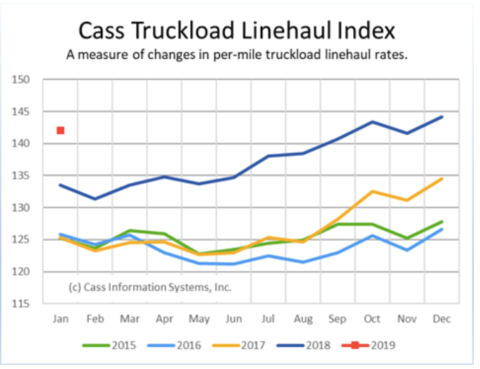
Freight costs including  the shipment of farm goods continue higher in2019 according to the latest Cass Truckload Linehaul Index for January. The year 2018 was the strongest year since deregulation in1980 says the index authors. January’s increase was a 6.4% year over year.

Screen Shot 2019-03-05 at 2.30.19 PM

Latest Snow Survey Finds Water-Rich Snowpack

SNOWPACK DOUBLES

Published:

image
The third snow survey of 2019 is conducted at Phillips Station. DWR/2019

SACRAMENTO, Calif. – Today, the Department of Water Resources (DWR) conducted the third Phillips Station snow survey of 2019. The manual survey recorded 113 inches of snow depth and a snow water equivalent (SWE) of 43.5 inches, which is more than double what was recorded last month at this location. Statewide, the Sierra Nevada snowpack is 153 percent of average for this date, thanks to several atmospheric rivers during February.

Snow water equivalent is the depth of water that theoretically would result if the entire snowpack melted instantaneously. It is an important tool used by water managers across the state to estimate anticipated spring runoff.

The results show a notable improvement since the last Phillips survey on January 31, when measurements at Phillips Station revealed a SWE of 18 inches compared to today’s 43.5 inches. Current conditions stand in stark contrast to this time last year when the snow depth was only 13.5 inches and the SWE was just 1.5 inches.

“This winter’s snowpack gets better each month and it looks like California storms aren’t done giving yet,” said DWR Director Karla Nemeth. “This is shaping up to be an excellent water year.”

On February 14, the National Weather Service officially confirmed that the Northern Hemisphere is experiencing weak El Niño conditions. As a result of these above-average sea surface temperatures, we are likely to experience more precipitation in the next two months.

“Along with the water supply benefits of the heavy rain and snow, there is also increased flood risk,” said John Paasch, DWR Chief of Flood Operations. “We’ve activated the Flood Operations Center, a joint effort between DWR and the National Weather Service, to closely monitor weather, reservoir, river, and flood conditions. Our goal is to share timely and accurate information about changing conditions to help people and communities respond to flood events and stay safe.”

The state’s largest six reservoirs currently hold between 84 percent (Oroville) and 137 percent (Melones) of their historical averages for this date. Lake Shasta, California’s largest surface reservoir, is 112 percent of its historical average.

Farmers expect higher plantings of annual crops

from California Farm Bureau

-February 26,2019-

More rain this winter and an improved water outlook promise California farmers more flexibility in what annual crops to grow, even if sluggish commodity prices limit their crop choices.

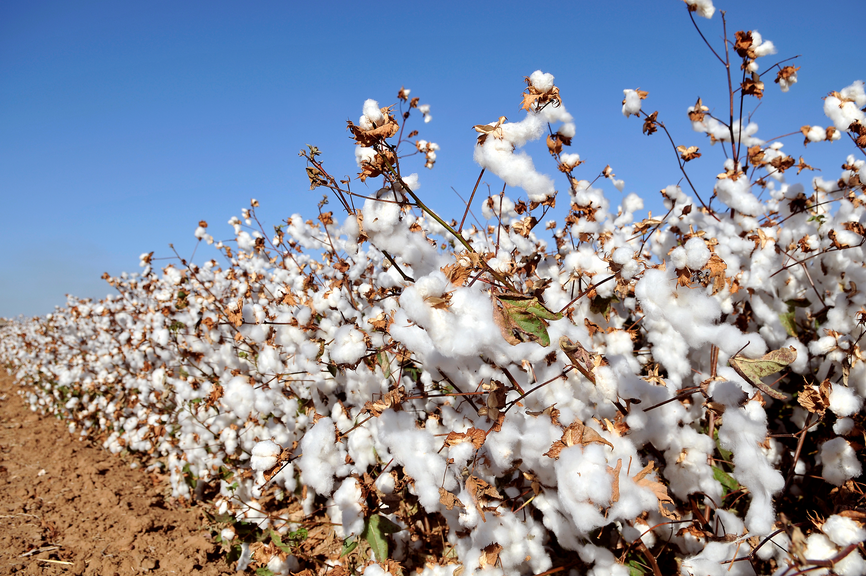
For example, California cotton acreage is expected to increase this year to 287,000, according to a planting-intentions survey by the National Cotton Council. Citing expected water availability, the council reported California farmers intend to plant 230,000 acres of pima cotton and 57,000 acres of upland cotton. That’s up 9.7 percent and 14.4 percent, respectively, from last year.
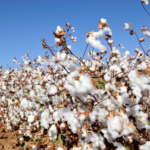
Screen Shot 2019-02-26 at 1.25.46 PM“When you consider tomatoes and other row crops, cotton seems to be a pretty good option right now,” said Roger Isom, president and CEO of the California Cotton Ginners and Growers Association.

Should final water allocations improve for some Central Valley farmers (see story, Page 3), Isom said he thinks total California cotton acreage could rise by as much as 20 percent, provided seeds—especially for newer cotton varieties—are available for those making late planting decisions. He said the long-term decline in acreage has meant lower demand for seeds, with seed companies not saving as much for planting.

At its peak in the late 1970s, California cotton acreage reached more than 1.6 million but dropped to a low of 162,000 acres in 2015 amid California’s multi-year drought.

With more water available this year, Merced County farmer Bill Crivelli said not only will he plant more cotton, but he’ll be able to use all his land, whereas he was forced to fallow hundreds of acres in 2014 and 2015 due to water shortages.

“We can pretty much plant the crops that have the best return and the best prices right now,” he said.

Even though cotton prices have weakened, he said he still considers pima and upland “two of the best things going” compared to crops such as corn and processing tomatoes, adding, “there’s just a lack of alternatives.” He described prices for processing tomatoes as “marginal” and said he’s not sure he will grow any this year; he didn’t last year. If prices improve for feed corn, he said he may still grow some because the crop doesn’t require as much investment as tomatoes.

The improved water outlook will also allow him to double-crop this year on ground now planted to forage hay. He said he hasn’t decided whether to grow melons or squash after the forage, but noted melons are “always a gamble on price.” The longer shelf life of newer melon varieties has slowed demand, he said, and that means there’s less of a need for more melon acreage.

Because Ramon Chavez farms on the west side of Fresno County and relies on surface-water deliveries from the federal Central Valley Project, he described this time of year as “stressful” as he anticipates announcement of final water allocations—all while trying to make cropping decisions ahead of knowing how much water he will ultimately have. He had to make some decisions in the fall, and has already planted lettuce, garlic, parsley and some sweet corn.

“We take a chance on processing tomatoes and sweet corn. If we don’t have enough water, we just fallow sweet corn or tomatoes,” Chavez said, noting he has until May to finish planting both.

Water is not the only factor he’s considering when trying to decide what and how much to plant. With cold winter weather, which has delayed current desert sweet-corn production, the early-season market should be lucrative, he said—but there’s concern that once temperatures warm, corn will flood the market, lowering prices. Having too much crop mature at once also makes harvest difficult, he said.

“Corn takes a lot of labor, so we don’t want to have it pile up, because then we have to work a lot of overtime,” he said.

For Bret Ferguson, who also farms in Fresno County, the high input cost on processing tomatoes, at around $3,500 an acre, versus cotton, at $1,800 to $2,000 an acre, means he’ll reduce half his normal tomato acreage in favor of growing more pima cotton. He said he also used to grow melons and onions, but got out of those due to the poor market.

“Commodity prices have driven our decisions,” Ferguson added.

Isom said cotton is also more attractive to farmers this year due to the “phenomenal” yield and quality of last year’s crop.

“If we could have yields like that, even with somewhat-depressed prices, we could do OK,” he said.

The challenge for farmers this year, though, is the possibility late spring rains could delay planting. Historically, Isom said, farmers have gotten better crops when there’s a dry winter, as it allows them more time to work the ground and plant early. Pima cotton requires a longer growing season and planting it after May 1 is considered risky, he said. If there’s a wet spring, farmers may choose to plant more upland, which has a shorter growing season, is easier to grow and cheaper to gin, he added.

“The money is less (with upland), but if you have higher yield, you can make up some of that,” he said.

As a dryland farmer, Sean McCauley, who farms in Contra Costa, Solano and San Joaquin counties, said he kept things simple this year and planted most of his acreage to winter wheat while reserving some ground for safflower this spring. He took a similar approach last year and had “pretty good luck with wheat.” He used to grow barley and corn also—both for feed—but decided not to this year, based on market prices. With the generous rainfall so far this winter, he said his bet has paid off on wheat, because the crop so far looks good.

“Hopefully, the market will stabilize and prices will rebound,” he said.

In terms of his potato and carrot crops, Kern County farmer John Moore III said increased water availability won’t change the amount of acreage he grows, but it would allow him to plant more cover crops such as wheat or sudangrass, which helps prevent soil erosion and improve soil health. In short water years, he would have to leave that ground fallow.

“I’m trying to get away from growing the same crop back to back,” he said. “When we have water, we’re able to be more creative. With more water comes better soil management and the capacity to do so.”

Cotton & Pork futures suffer Trump slump

-February 14,2019-

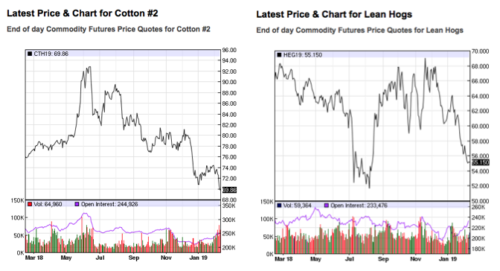
US cotton farmers and pork producers have something in common as they consider 2019.Like with so many other key US crops they are suffering from the ongoing trade war, some call it the Trump Slump with low prices impacting their bottom line.

It’s not just peanuts either, it’s big money.

Screen Shot 2019-02-14 at 12.37.57 PM


Proof of the wilting outlook for cotton is the futures price for March at a year-long low, a chart that looks eerily similar to pork futures (see charts).

Both are suffering not just from the trade war retaliation from China, US producers biggest customer, but from the continuing impact of the tariffs imposed by neighbors Mexico and Canada.These are countries Mr Trump has announced a deal with months ago but without lifting US tariffs on their metal imports, steel and aluminum. So the retaliatory tariffs on our farm goods from Mexico and China remain in place.

The National Pork Producers have asked Trump to to end the stalemate.“Farmers and food companies have been particularly hard hit by the Canadian and Mexican retaliation. Mexico’s 20 percent punitive tariff on U.S. pork, for example, has inflicted severe financial harm on America’s pork producers. According to Iowa State University economist Dermot Hayes, the Mexican tariff is costing producers $12 per animal, meaning industrywide losses of $1.5 billion annually.”

Pork industry reports say it looks like 2019 is “already shaping up to be another difficult year for pork producers to make a profit.”
One report says “It is looking like another challenging year for pork producers to make money in the hog business,” said Chris Hurt, agricultural economics professor at Purdue University.
Hurt said that although it is still early in 2019 it is looking like producers will see a $6 to $8 loss per hundredweight; while it is a loss, it is better than 2018 when the loss was $12 per cwt.”

Cotton market faces uncertainty, increased competition

National Cotton Council economists point to a few key factors that will shape the U.S. cotton industry’s 2019 economic outlook. This past year can be characterized as a year with significant uncertainty and volatility in the global economy and the world cotton market, they say.

The trade group projects 2019 U.S. cotton acreage to be 14.5 million acres, 2.9 percent more than 2018. That would be about 22.7 million bales, with just 3.25 million bales going to the domestic mills .By contrast we export about 15 million bales.So exports are key, particularly for SJV cotton.

“World trade is projected to be higher in the 2018 marketing year, but the trade tensions and increased competition from other major exporting countries has led to a decline in the U.S. trade share. Despite the decline, the U.S. will remain the largest exporter of cotton in 2018.”

Prior to the implementation of tariffs, the United States was in a prime position to capitalize on the increase in Chinese cotton imports. With the imposition of the 25.0 percent tariff, China has turned to other suppliers during the 2018 marketing year, allowing Brazil, Australia, and other countries to gain market share. Vietnam is currently the top export market for the 2018 crop year, followed by China and Mexico.”

Another report says farmers in Brazil have ramped up cotton production as they increase exports to China to replace U.S. shipments, but U.S. cotton acreage is still expected to expand this year as farmers reduce their plantings of soybeans, a commodity hit even harder by China’s tariffs.

Farmer’s patience with Trump is in question some say.“If he wants to be re-elected, he’s got to get that fixed,” Jimmy Webb, who grows cotton, peanuts and corn in southwest Georgia, near Albany, said about Trump’s trade dispute with China. “At first people had a pretty good attitude about it as farmers.”

Proof of the wilting outlook for cotton is the futures price for March at a year-long low, a chart that looks eerily similar to pork futures (see charts).

And it is not just pork, cotton and soybeans facing low prices because of the trade war. West Coast crops including citrus and milk exports also are suffering from rival countries that are selling their products into China this year without those high tariffs.The same is true for US exports of DDG feed and ethanol made from corn.