
-February 14,2019-
US cotton farmers and pork producers have something in common as they consider 2019.Like with so many other key US crops they are suffering from the ongoing trade war, some call it the Trump Slump with low prices impacting their bottom line.
It’s not just peanuts either, it’s big money.
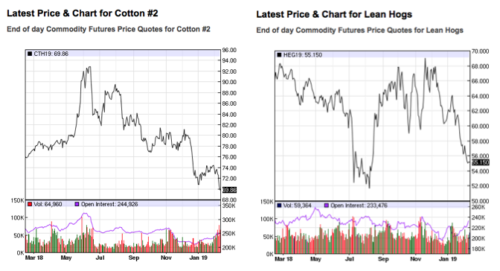
Proof of the wilting outlook for cotton is the futures price for March at a year-long low, a chart that looks eerily similar to pork futures (see charts).
Both are suffering not just from the trade war retaliation from China, US producers biggest customer, but from the continuing impact of the tariffs imposed by neighbors Mexico and Canada.These are countries Mr Trump has announced a deal with months ago but without lifting US tariffs on their metal imports, steel and aluminum. So the retaliatory tariffs on our farm goods from Mexico and China remain in place.
The National Pork Producers have asked Trump to to end the stalemate.“Farmers and food companies have been particularly hard hit by the Canadian and Mexican retaliation. Mexico’s 20 percent punitive tariff on U.S. pork, for example, has inflicted severe financial harm on America’s pork producers. According to Iowa State University economist Dermot Hayes, the Mexican tariff is costing producers $12 per animal, meaning industrywide losses of $1.5 billion annually.”
Pork industry reports say it looks like 2019 is “already shaping up to be another difficult year for pork producers to make a profit.”
One report says “It is looking like another challenging year for pork producers to make money in the hog business,” said Chris Hurt, agricultural economics professor at Purdue University.
Hurt said that although it is still early in 2019 it is looking like producers will see a $6 to $8 loss per hundredweight; while it is a loss, it is better than 2018 when the loss was $12 per cwt.”
Cotton market faces uncertainty, increased competition
National Cotton Council economists point to a few key factors that will shape the U.S. cotton industry’s 2019 economic outlook. This past year can be characterized as a year with significant uncertainty and volatility in the global economy and the world cotton market, they say.
The trade group projects 2019 U.S. cotton acreage to be 14.5 million acres, 2.9 percent more than 2018. That would be about 22.7 million bales, with just 3.25 million bales going to the domestic mills .By contrast we export about 15 million bales.So exports are key, particularly for SJV cotton.
“World trade is projected to be higher in the 2018 marketing year, but the trade tensions and increased competition from other major exporting countries has led to a decline in the U.S. trade share. Despite the decline, the U.S. will remain the largest exporter of cotton in 2018.”
Prior to the implementation of tariffs, the United States was in a prime position to capitalize on the increase in Chinese cotton imports. With the imposition of the 25.0 percent tariff, China has turned to other suppliers during the 2018 marketing year, allowing Brazil, Australia, and other countries to gain market share. Vietnam is currently the top export market for the 2018 crop year, followed by China and Mexico.”
Another report says farmers in Brazil have ramped up cotton production as they increase exports to China to replace U.S. shipments, but U.S. cotton acreage is still expected to expand this year as farmers reduce their plantings of soybeans, a commodity hit even harder by China’s tariffs.
Farmer’s patience with Trump is in question some say.“If he wants to be re-elected, he’s got to get that fixed,” Jimmy Webb, who grows cotton, peanuts and corn in southwest Georgia, near Albany, said about Trump’s trade dispute with China. “At first people had a pretty good attitude about it as farmers.”
Proof of the wilting outlook for cotton is the futures price for March at a year-long low, a chart that looks eerily similar to pork futures (see charts).
And it is not just pork, cotton and soybeans facing low prices because of the trade war. West Coast crops including citrus and milk exports also are suffering from rival countries that are selling their products into China this year without those high tariffs.The same is true for US exports of DDG feed and ethanol made from corn.