
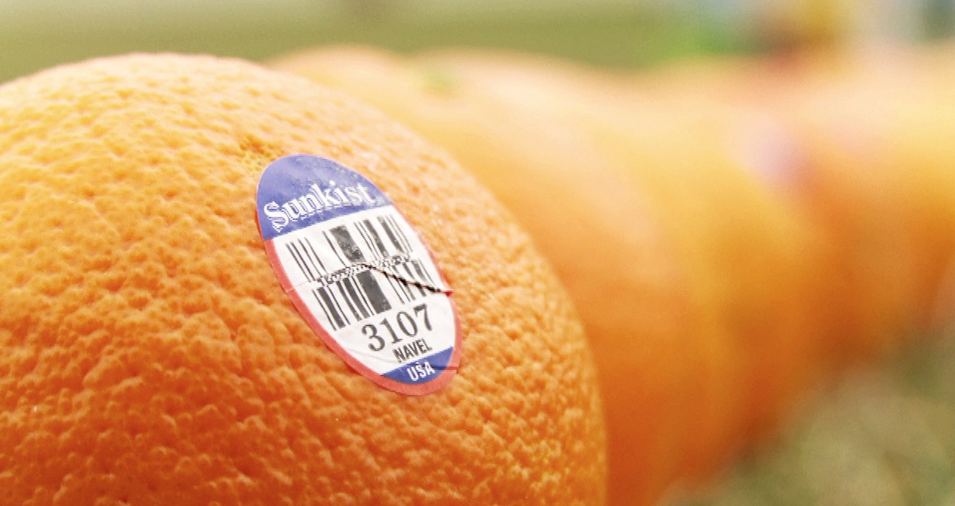
Growers suffer 59% drop in orange prices
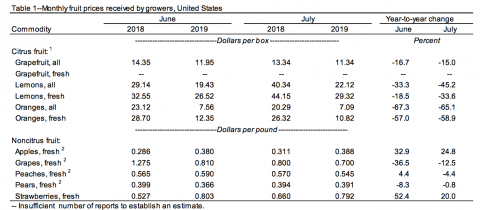
A new report from USDA says fruit grower prices remained weak through the early part of second-half 2019, indicated by the grower price index for fruit and nuts still being below year-ago levels, similar to the first half of the year. At 122.3 (2011=100), the July 2019 index was down from the July 2018 index of 131.4. Rebounding U.S. citrus production in 2018/19 across all major producing States prompted citrus price declines during the season to date, and along with lower prices for fresh grapes, peaches, and pears, drove the July index down (table 1).
Some factors behind the grower price movements for selected fresh-market fruit are as follows:
• Seasonally increasing California grape supplies competed with ample supplies of imported grapes from Mexico, lowering July fresh grape prices. Abundant California supplies likely have continued to ease prices through the summer.
• Increased pear supplies in California softened early-season fresh pear prices, but expected reduced supplies in the U.S. Northwest should boost prices this fall.
- Strong fresh apple grower prices at the end of the 2018/19 season (August-July) bodes favorably to early-2019/20 prices but expectations of a larger crop will likely dampen apple prices this fall when harvest activity peaks.
- The expected bigger 2019 peach crop is driving down fresh peach prices while lower U.S. strawberry shipment volumes are keeping fresh strawberry prices strong.
- • Harvest for the 2019/20 California navel crop begins in October. Crop size is forecast to be reduced, likely providing support to fresh orange prices.
A majority of U.S. fresh-market oranges are grown in California, and increased production in the State contributed to lower grower prices. Overall, the average equivalent on-tree price for a box of fresh oranges dropped from $25.82 in 2017/18 to $15.40 in 2018/19. Despite similar production levels to the previous season, U.S. fresh orange imports in 2018/19 through July were down 17 percent, in volume terms, from the previous season, at the same time fresh orange exports declined 8 percent to date. Exports were down to top foreign markets—South Korea, Canada, Hong Kong, and China. Spain and South Africa continue to gain larger shares of the Korean and Canadian orange markets, the two largest importers of U.S. fresh market oranges.
Early forecast pegs navel orange production in California at 76 million 40- lb cartons, down 7 percent from the previous year, according to the 2019-20 California Navel Orange Objective Measurement Report released September 12 by the NASS Pacific Regional Office. This forecasted decrease in production is due to a reduction in total navel bearing acreage, lower-than-average yields per tree, and smaller fruit size.
U.S. growers produced 704,000 tons of lemons for the fresh market in the 2018/19 season, accounting for 73 percent of the overall domestic lemon crop. The U.S. imported an additional 100 million pounds of lemons in 2018/19 for a total of 322 million pounds, up 45 percent from the previous season. Import volumes were up from most supplying nations, including Argentina (up 400 percent from 2017/18). These higher imports, along with increased domestic production and lackluster export demand, prompted lower lemon prices, with the average equivalent on- tree price per box falling from $26.03 in 2017/18 to $22.11 in 2018/19.
Too many grapes
This years grape harvest is clouded by large supplies of imported grapes from Mexico helping to drive down June and July fresh grape grower prices relative to the same period a year ago. Harvest in California is in full swing and overall expected large table grape supplies will likely help temper 2019/20 fresh grape prices. Exports through July have slowed mostly on reduced volumes to top market Canada and many key Asian markets, including Hong Kong, the Philippines, Japan, Singapore, Indonesia, Malaysia, and China.
Peach outlook
California’s production is forecast up 6 percent to 1.02 billion pounds, reflecting bigger freestone and clingstone peach crops. California’s bigger freestone crop, combined with increased production from most other States, suggests greater availability of U.S. fresh-market peaches, likely easing grower prices this summer. Seasonally declining import supplies in the spring, largely from Chile, helped bolster early-season prices. Meanwhile, although the clingstone crop is up, the Canning Cling Peach Association, the cooperative bargaining association in the canning cling peach industry, reported in July the 2019 base price agreement was ratified with processors at $488 per ton, unchanged from last year.
Nuts outlook mixed
Almond prices trading higher while walnut prices hit a 10 year low.
Another record-setting domestic crop and fairly large beginning stocks together drove down U.S. almond grower prices in 2018/19 (August-July), boosting overall demand for U.S. almonds (table 5). While exports remained almost steady from the 2017/18 high, ending stocks fell to a recent 5-year low, suggesting fairly robust domestic demand. According to the 2019 California Almond Objective Measurement Report, released by NASS on July 3, a 2.20-billion-pound crop (shelled basis) is forecast for the 2019/20 season, down 4 percent from 2018/19 on lower yields. Bearing acreage continued to rise in 2019 but wet weather during bloom hindered pollination and strong winds damaged some trees and knocked off some nuts, reducing nut set per tree. The forecast smaller crop and lower stocks carried over from last season should put upward pressure on 2019/20 grower prices.
Walnut production forecast to decline in 2019/20: Large beginning stocks and near-record domestic production boosted overall supplies in the United States in 2018/19 (September to August), driving U.S. walnut grower prices to their lowest level since 2009 (table 5, reported on shelled basis). Combined with abundant supplies, the low prices are aiding export and domestic demand for U.S. walnuts and reducing ending stocks. The 2019 California Walnut Objective Measurement Report, released by NASS on August 31, forecast walnut production to decline to 1.26 billion pounds (or 630,000 tons), in-shell basis, down 7 percent from last year on lower average per-acre yield, likely supporting 2019/20 walnut grower prices. USDA estimated an averge price of 65cents,down for $1.25 year earlier.
significantly improved grower prices from lows of the past two seasons. Domestic availability and export volume are on track to finish the season at record levels. Thus far, data from the Administrative Committee for Pistachios back strong domestic shipments in the 2018/19 season through July. For the same period, data from the U.S. Census Bureau show significantly higher exports volumes to date, including Hong Kong, China, and Germany, among the top foreign markets for U.S. pistachios. Despite higher overall shipments, a record-setting domestic crop will likely leave 2018/19 ending stocks at above-average levels. If realized, these large carry- over supplies will help alleviate market impacts associated with an anticipated reduced crop in 2019/20 due to the alternate bearing tendency of pistachio trees. Price for 2018/19 crop is estimated at $2.44 lb, up from $1.69 a year earlier.