
-October 28,2019-

Sour note for lemons
CA lemon prices started the 2018/19 season at multi- 5 year highs and ended at multi-year lows. Early in October, prices for mid-sized lemons were down 18% YOY and down 10% compared to the five-year average according to Rabobank.USDA said U.S. growers produced 704,000 tons of lemons for the fresh market in the 2018/19 season, accounting for 73 percent of the overall domestic lemon crop. The U.S. imported an additional 100 million pounds of lemons in 2018/19 for a total of 322 million pounds, up 45 percent from the previous season. Import volumes were up from most supplying nations, including Argentina (up 400 percent from 2017/18). These higher imports, along with increased domestic productionand lackluster export demand, prompted lower lemon prices, with the average equivalent on-tree price per box falling from $26.03 in 2017/18 to $22.11 in 2018/19
Falling prices for Florida oranges in 2019/2020
The chief economist for the Florida Dept of Citrus expects to see a 25% drop in the price for juice oranges this year.The average price for Valencia oranges, picked from March to June, will plummet to $1.78 per pound solids, a 25% drop from $2.38 last season. Last season’s Valencia price represented a 16% decline from 2017-18. The problem is supply is growing and demand is heading in the other direction.
Growers will be caught between the pincers of a projected 3% increase in orange production this season combined with record high OJ inventories held by Florida juice processors, who will buy 96% of the new crop, Marisa Zansler told the Florida Citrus Commission on Wednesday. That combined with a continued decline in U.S. orange juice sales has radically reduced the demand for this season’s orange crop, pushing down farm prices.
Mexico avocado boom -the good news and bad news
An AP story says small-scale avocado growers armed with AR-15 rifles take turns manning a vigilante checkpoint to guard against thieves and drug cartel extortionists in Michoacan, the heartland of world production of the fruit locals call “green gold.”
The region’s avocado boom, fueled by soaring U.S. consumption, has raised parts of western Mexico out of poverty in just 10 years. But the scent of money has drawn gangs and hyper-violent cartels that have hung bodies from bridges and cowed police forces, and the rising violence is threatening the newfound prosperity. A recent U.S. warning that it could withdraw orchard inspectors sent a shiver through the $2.4 billion-a-year export industry.
Some growers are taking up arms. At the checkpoint in San Juan Parangaricutiro, the vigilantes are calm but attentive. They say their crop is worth fighting for.
“If it wasn’t for avocados, I would have to leave to find work, maybe go to the United States or somewhere else,” said one of guards, Pedro de la Guante, whose small avocado orchard earns him far more than he would get from any other legal — or illegal — crop.
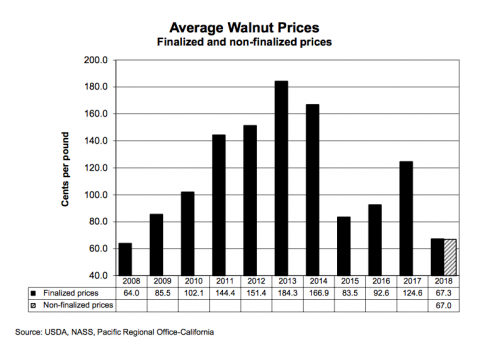
Walnut prices down says USDA but hope for this year
Walnut grower are hoping for a price rebound from last years crop affected by Chinese tariffs.U.S. walnut grower prices were their lowest level since 2009.USDA forecasts walnut production to decline to 1.26 billion pounds (or 630,000 tons), in-shell basis, down 7 percent from last year on lower average per-acre yield, likely supporting 2019/20 walnut grower prices So far the trend is working out.
USDA eyes lower farm income
A USDA report issued in October says farmers are feeling stress due to lower crop prices.The report says the objectives of this study are to determine how current economic conditions in the farm sector compare with those in past periods of financial stress, to assess potential problems ahead in terms of loan defaults or bankruptcies, and to determine which types of farms are financially vulnerable now and which would be likely to face the biggest challenges in the years ahead if commodity prices decline further.
Sectoral measures of farm finances indicate a deterioration in economic conditions since 2012, yet most measures are near long-run (1970-2017) average levels:
• From 2012 to 2017, the farm sector saw the largest multiyear decline in net cash income in percentage terms since the 1970s. However, farm income fell from a near-record level so that, despite the large drop, in inflation-adjusted income remains close to the long-run average.
• Farm sector debt is again near peak levels of the late 1970s and early 1980s. In 2018, interest expenses were forecast to be 23 percent above the average levels from 2000 to 2017, but remain 8 percent below long-run average levels because of historically low interest rates.
In recent decades, farm assets (especially farmland) have appreciated more rapidly than debt. As a result, the farm sector’s debt-to-asset ratio has fallen since the mid-1980s and reached a historic low in 2012. Since then, the market for land has weakened in some regions and the debt-to-asset ratio has trended upward. The debt-to-asset ratio is now above its 10-year average, though it remains low compared to the 1970-2017 average.