Jolly good price for milk products for Xmas

-December 16,2021-
 
dry milk powder, mostly for export is enjoying high price

Kings County retains its ranking as the nation’s third most productive dairy county supplying 2.27% of federal order milk from California with 375 million pounds in the month of May 2021. Kings is behind Merced and number one Tulare, who pumped out 5.8% of the state’s milk at 973 million pounds.

 
Kings dairy operators are getting better prices for their product  this holiday season, good news for the county’s number-one crop
 
Market reports say retail dairy sales are strong ahead of the holiday. During the week ending November 21, retail natural cheese sales rose roughly 15% versus the same period in 2019, while butter purchases increased 5% on a two-year basis.
 
Slow growth in U.S. milk production and strong demand have lifted the futures sharply higher in the past few weeks
 
Western United Dairymen says the Class III average for 2022 surged to $19.55 per hundredweight, while Class IV reached $20.20 per hundredweight. If prices remain at these levels, next year will be the second highest on record, behind 2014.
 
The bulk of our milk goes to Class IV. $20 milk compares to the 2020 average of 18.60 per cwt and $16.30 in 2019, according to the Kings crop report.
 
USDA says per capita dairy consumption has been up since 1975 when the average American consumed just 539 pounds of dairy foods per year. Last year, the average American consumed 655 pounds of dairy in milk, cheese, yogurt, ice cream, butter, and other dairy foods. The 2020 figure represents an increase of 3 pounds per person over the previous year.
 
As to the hot topic of inflation and its impact on consumers, the average price of a gallon of milk in California this year is around $3.79 per gallon says USDA .The average price in 2020 was $3.76.So milk is not the reason inflation is hurting. Look elsewhere like  gasoline – up 50% in the past year. Instead dairies are selling more overseas trying to keep up with rising feed and labor costs here.
 
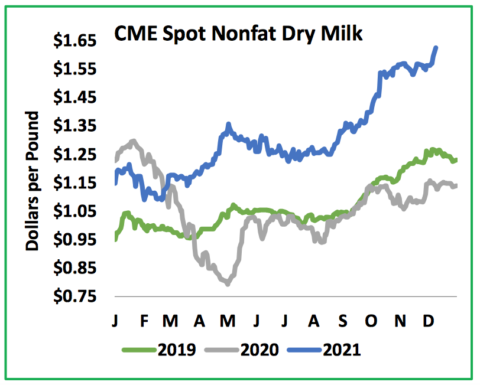
Caption: Nonfat dry milk, mostly exported,is selling for $1.65/lb compared to around $1 in recent years.(courtesy CME)
 
Caption California milk company reminds us – Santa likes milk and cookies (photo Clover Milk)
 
Storms bring hope to California cities and farms
 
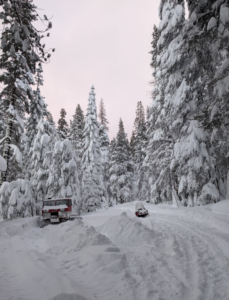
This week’s “atmospheric river” storm brought heavy rain and  snow to the Sierra offering hope those empty reservoirs would be filling up this water year. And there is more on the way as the NWS says the storm door is open through the end of the year.
Heavy snow is forecast through Christmas at Huntington Lake says a forecast report. Heavy snow is expected December 14,15,16,21,22,23,24,25 and December 26. That’s good news for both skiers and farmers who depend on the runoff from the San Joaquin River needed to fill the Friant Kern Canal this spring.The same goes for the upper Kings watershed that feeds Pine Flat Dam with similar, but more moderate precip expected over the same days.
 
What’s in the bucket already?
 
Berkeley Snow Lab at Donner Pass

On Wednesday the San Joaquin precip Index stands at 128% of average, tracking the second wettest year of 2016/17.Tulare Basin Index reads 75% of average, even though Giant Forest got 4 inches of precip with the Tuesday storm this week. Up north, things are better with the Northern California Index reading 165% of average for the date. Shasta Dam saw 4.25 inches  of rain between Tuesday and Wednesday. The dam has recorded 20 inches so far this water year compared to just 25 inches all last year!

 
In the upper Kings watershed Big Meadow now has 36 inches of snow depth today compared to just 10 inches this time a year ago.
NWSHanford says  “Current ensemble solution for the extended period shows another possible tap of atmospheric river moisture “is on its way.
Observers say this all amounts to a real comeback story after one of the driest Novembers on record, following one of the wettest Octobers and now a big December in the Sierra.


Navel and Mandarin Forecast Drops

December 16, 2021, Exeter, Calif. 

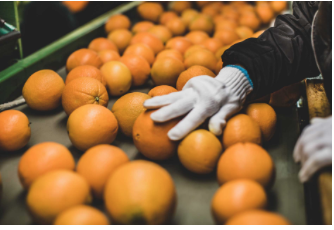
Screen Shot 2021-12-17 at 6.27.09 AMThe California Citrus Mutual Marketing Committee (Committee) estimates that the total Navel orange crop for the 2021-22 season will be down 20% from the previous season’s final utilized, or sold, production. The Committee also estimates that the Mandarin crop will be down as much as 45% from the 2020-2021 season.

According to the California Department of Food and Agriculture’s 2021-22 California Navel Orange Objective Measurement Report, released on September 10, 2021, the initial forecast for the navel orange crop was 70.0 million cartons, down 14% from the previous year’s total utilized production. Additionally, an estimated 4% of last season’s crop was not utilized, meaning it was not picked or sold.

Now several weeks into 2021-22 season, the Committee anticipates, based on current picking estimates, will be 20% below the prior season’s total utilized production and approximately 24% below the total crop size.

The drop in production is attributed to the previous season’s heavy crop and extended season. Due to the larger sized crop and other market conditions, fruit remained on the tree far longer than is typical, which negatively affected the current year’s crop size.

The Committee also estimates that the 2021-22 mandarin crop will be down 45% from the previous season’s exceptionally large crop.

Wonderful loses court case looking to stop local nut farm

-November 7,2021-
Screen Shot 2021-11-05 at 6.37.25 AMA Tulare County judge ruled October 28 against The Wonderful Company in a dispute with a rival pistachio farmer.
 
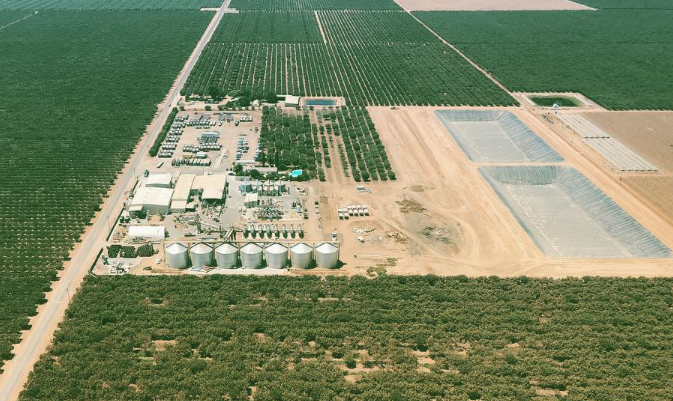
LA-based Wonderful challenged the Tulare County building permits issued to ARO Pistachios of Terra Bella and its owner Touchstone Pistachios. ARO received permits to add dryers and silos to their operations. The Wonderful suit was filed last July.
 
Tulare County Superior Court Judge Bret Hillman ruled Wonderful did not have standing to challenge ARO who has a similar operation to Wonderful in the area but, the judge reasoned, Wonderful does not suffer any direct impact that would allow such a challenge.
 
The judge wrote in his ruling:
 
Wonderful is, instead, a commercial resident of a general geographic area zoned for farming operations where it has substantial farming operations, like its competitor, Touchstone. At the hearing, counsel for Wonderful clarified that their client has a citrus orchard about two miles from Touchstone’s facility.
Wonderful’s counsel admitted at the hearing that there was no evidence submitted of impacts to employees living or working nearby in the record. Touchstone’s counsel noted that this was a tenuous connection and argued that Wonderful could file countless similar claims if acting in the public interest but chose to file only one against a direct competitor in the Pistachio business. Wonderful’ s interests are not akin to individual residence owners challenging development of a condominium complex in the immediate vicinity of their neighborhood.
 
Also unlike the residents in other cases, Wonderful was not party to proceedings relating to the initial land use decision facilitating the challenged land use approval. 
 
The judge concluded there is insufficient evidence in the record supporting that its property interests or employees’ health will suffer harm as a result of issuance of the Building Permits.
 
The judge said that Wonderful’s interest in this litigation is as a direct economic competitor with direct commercial and competitive interests adverse to Touchstone’s farming operations, not a party motivated by concerns relating to public rights and enforcement of public duty.
 
Wonderful Co is owned by billionaire Stewart Resnick who also owns almond, citrus and pomegranate farms in the Valley – the largest player in all of these crops. Resnick has been tangling with Touchstone owners the Assemi Brothers of Fresno who are in the middle of a court battle in Fresno County. The Assemi Bros claim Resnick uses litigation to burden and destroy competitors.  Both are big players in the pistachio industry. Assemi Bros are building a large processing plant in western Fresno County, a project successfully challenged by Resnick causing the Assemi Bros to start over on the permitting of the facility and delaying their plans.
 
The Assemi Bros recently purchased the ARO farm in Tulare County and filed plans to expand its operations, setting up this latest dispute. 
 
County planner Mike Washam says despite this year -long court case in Tulare County, Aro/Touchstone added the improvements that were based on the disputed permits.
captions : ARO Pistachios of Terra Bella

Here’s the buzz on Bee Sweet’s new project

-September 30,2021-
 
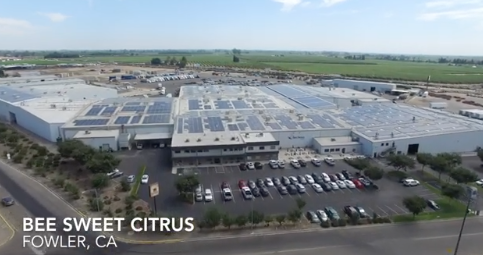
BEE SWEET CAMPUSFowler-based Bee Sweet Company is underway on construction of a large new 225,000sf mandarin(tangerine) orange processing plant at their expansive Highway 99 citrus packing campus. The City of Fowler has approved a plan to build the new facility on South Ave.
 
Vice president of the company Ben Ladd says the state of the art plant will enable the citrus packer  to more efficiently handle farmer’s mandarin citrus crop beginning in 22/23. Ladd says for example,  the company expects to eliminate the need for a night shift to keep up with increasing volumes of the tangy flavored fruit varieties that ripen one after another over the winter and spring months. The volume of the kid-favorite citrus being grown in the Central Valley continues to climb each year.
 
Biggest crop ever
 
“Last year was the biggest crop ever” states Ladd  
 
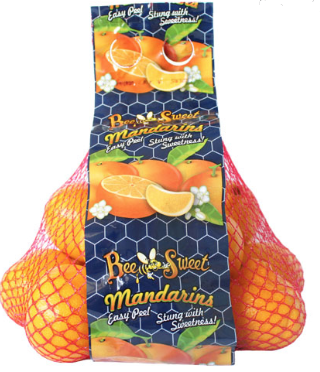
Unlike their significant competitors in the mandarin marketplace  Bee Sweet tangerines are not marketed with any of those cute brand names other grower/packers use to sell these smaller size, typically seedless, easy-peel fruit.
 
All citrus variety sales have enjoyed a big boost during the pandemic with their high Vitamin C content the best sales pitch of all.
 
Screen Shot 2021-09-26 at 6.21.17 PM“We just market under our Bee Sweet brand” explains Ladd, proud they pack notes not just mandarins but 15 different varieties of citrus shipping to retail customers like Walmart.Like their competitors, Bee Sweet has adopted those handy 3 lb netting bags that  grocery shoppers are now used to.
 
Bee Sweet Citrus was founded in 1987 as an independent packer and shipper of California oranges.Since  then the company handles a growing  number of citrus varieties. Now year-round  with some S American fruit filling in ,Bee Sweet ships throughout the United States, Canada, Europe, Australia, New Zealand and several Pacific Rim countries including Japan.
 
The new Bee Sweet facility will feature cold storage- high tech washing, sorting and packing lines as well as a large shipping and dock area next to Highway 99. Solar panels already cover the huge  multi-building citrus packing complex south of Fresno.
 
Bee Sweet is in a competitive business with other major players in this arena including Fowler Packing, across the freeway, who market their mandarins under the Peelz name.There is also Kern County-based Sun Pacific who markets under the Cuties brand of clementine variety mandarins.-  fruit  that first imported from Spain in the 1980s.
 
Then there is Wonderful Citrus who market Halos out of their 500,000sf facility in Delano. Not to be left behind, Sunkist has several varieties grown by their member growers and  packed in the familiar bags  under the Gold Nugget and Delite label.
 
Steady growth
 
A decade ago mandarin acreage in the Valley was 30,000 acres- up from 23,000 acres in 2007. It now totals about 67,000 acres  compared to 46,000 acres in 2013. Most of that is grown in Tulare Kern and Fresno counties.
 
While mandarin production was up 25% this past year, USDA says navel orange production fell 7%. Indeed, while mandarin acres have more than doubled in the past ten years, navel orange acres in California shrunk from 130,000 acre to 116,000 acres today.
 
In 2020/21 there were 40 million boxes of navels packed compared to the newer guys on the block – mandarin varieties at  28 million boxes.
 
Last year was a good one for prices to the grower or most California citrus and all agree there is plenty of room for both that iconic Washington Navel orange and those tangy little mandarins.

Around Kings County -Sept 15

-September 18,2021-

Solar updates

Screen Shot 2021-09-18 at 5.12.57 AM
No power from slave labor after all

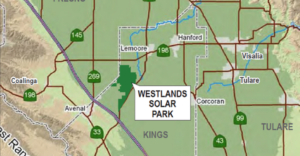
A critic of three Westlands Solar Park projects in Kings County ended up withdrawing an appeal from the BOS recently that had claimed Westlands would not certify they would not use solar panels from China that used slave labor. It turns out that the developer of the solar projects – CIM group – says they are indeed, in compliance.

“With regard to solar panels, supply chain traceability protocol is now part of the law. Any product coming into the U.S. regardless of where it’s coming from, has to demonstrate with supply chain documentation and certification that the product is not coming from any of the jurisdictions associated with forced labor” says a note to this reporter. Looks like there will be no lawsuit over this after all.

Farms supply solar to self driving car start-up

Tulare & Reedley farms are supplying solar power to a Bay Area self-driving car company. Cruise self-driving cars is developing a ride-hailing service in San Francisco, where its cars are being tested on the city’s streets — both with and without drivers. When the company’s cars are charged in San Francisco, they get the same electricity from the same grid as everyone else. But Cruise is paying undisclosed sums to local farmers Sundale Vineyards near Tulare and Moonlight Co near Reedley in exchange for renewable energy credits that correspond to the same amount of power Cruise uses from the grid.

Battery power making a difference

More Kings County solar farms are adding battery storage to their existing and new solar projects joining others statewide supplying renewable power when the sun does not shine.

Last year, the state energy regulator – CAISO had around 550 MW of storage on its system; today, that number has grown to a little over 1,500 MW, and is expected to top 3,000 MW by the end of the year according to the California Energy Commission.

Opposition scuttles state canal bill

Opposition from the Sierra Club and others to a bill carried by state Senator Melissa Hurtado (D–Sanger) forced the postponement of Senate Bill 559 – The State Water Resiliency Act of 2021 – after the Assembly gutted its funding and amended it to include additional hurdles.

The bill would have provided $785 million to repair canals, roads and bridges damaged by subsidence including at least $100 million for the Friant Kern. The funds would have gone towards repairing sections of the Friant-Kern, the Delta-Mendota Canal, the San Luis Canal and the California Aqueduct, all important water conveyances to Central valley ag interests and a number of communities.

The canals have already secured some federal funding for their subsidence repair. In addition the Friant Kern Canal has secured $125 million from the Eastern Tule GSA farmers to help repair a 30 like stretch near Porterville where the land has sunk about 12 feet. Despite the shelving of the state monies, work on the canal repair is scheduled to begin this December using federal and local monies.

Opposing any state public funding for the waterways, Sierra Club has argued that “those entities who receive water from these canals should share the cost of repair; not state taxpayers.” They say “this bill would authorize the use of state funds in the restoration of a federal canal project, subsidizing profits of a single industry and violating the beneficiary pays principle that requires those who benefit from a project pay for the maintenance and operation of the project.”

But as mentioned,in the case of the Friant Kern, one farmer group has agreed to pay $125 million and another group $50 million in capital funding along with their maintenance payments to the Bureau of Reclamation.

Besides that argument Hurtado responds he public has a role in that climate change has amped up the western drought . “Repairing critical water infrastructure is part of the solution to adapting to climate change” she says.

A dry canal will lead to collapse of the Valley economy to make matters worse and everyone has a stake in not letting that happen. It is not just farmers but farmworkers and their families who depend on that water.

“Water supply reliability is central to the production of food in California, and vital to the rural communities and statewide economy that is supported by the agriculture industry,” argues California Citrus Mutual President and CEO Casey Creamer.

Attachments area

Groundbreaking for new Valley CDI milk processing facility.

-September 15,2021-

Screen Shot 2021-09-15 at 7.22.27 AMCalifornia Dairies, Inc.(CDI) the leading milk marketing and processing cooperative in the state will be holding a groundbreaking ceremony for their new state-of-the-art ultra-high temperature and extended shelf-life milk processing facility south of Shafter in Kern County. This new operation will be called Valley Natural Beverages.The plant will be operational in 2023.

The groundbreaking will be Wednesday, September 29, 2021, starting at 10:30 a.m.

With an eye on exports, Visalia-based CDI will be building its first new processing plant in years, focusing on a trend that the pandemic has accelerated- milk products that require less refrigeration and last longer on the shelf.

It’s real milk, but its special pasteurization and packaging process makes it last longer.

Extended shelf life milk can enjoy a shelf life of up to 180 days. A combination of high temperature and an Ultra Clean filling environment allows us to package products with this extended shelf life so you can enjoy products longer.

The demand for shelf-stable and extended-shelf-life (ESL) products continues to grow. According to Transparency Market Research, the worldwide aseptic packaging market is expected to have a compound annual growth rate of 10.2% during the period of 2017-2024.

One analysis says poor cold chain set up in developing countries is a key factor expected to drive ultra-high temperature milk market revenue growth during the forecast period. Many developing countries continue to face a severe lack in cold chain infrastructure and logistics necessary to safely distribute food products to consumers. Extended shelf life of UHT milk and less requirement of refrigeration are boosting demand in developing countries. This allows for a level of dependability and portability not seen with fresh milk supply. The shelf life of milk is extended to over four months with UHT and aseptic technology, which is otherwise around 21 days for traditional milk pasteurization. Moreover, these products are ideal for storage in warehouses, safety in long distance distribution, as well as for retail outlets that lack refrigeration. Small scale restaurants and food outlet chains in many parts of Asia and Africa are increasingly utilizing UHT milk due to lack of proper refrigeration system, and the trend has been gaining traction in the recent past.

California Dairies Inc is the number 10 largest milk processor in the country, tied with Land o Lakes- with 2020 sales in excess of $4 billion according to Dairy Foods Magazine

Around Kings County -drought impacts

-September 9,2021-

Supervisors reject appeal of solar projects 

 
This week, Kings County Supervisors rejected an appeal of a Planning Commission approval of three large solar projects proposed by Westlands Solar Park.  The appeal, by Roger McNitt, President of Southern Realty Co. argues that no one will buy the electricity produced by the project if they use polysilicon made by forced (aka slave) labor in the Xinjiang Province in China. He says the Commission erred and abused its discretion by not insisting on mitigation by use of the Traceability Protocol, Buyer Disclosure Guides, and Environmental Commitments of the Solar Energy Industries Association or some other type of mitigation.
 
McNitt says he may take the county to court over the issue. Southern Realty Co. leases its oil and gas mineral rights. They own rights in several counties. His argument is that Community Aggregators -energy providers in coastal cities- may not want to buy the solar power because it uses the Chinese solar panels. A few years ago,McNitt complained about another Kings solar project fearing a plane may crash into the panels near NAS Lemoore.
 
Drought cuts tomato harvest
 
USDA announced this week that contracted production for California processing tomatoes is forecast at 11.1 million tons, averaging 48.9 tons per acre. The forecast is 1.9% below last year’s contracted production, and 4.3% below the May forecast. The projected harvested acreage of tomatoes grown under contract is 227,000 acres -0.4% lower than in 2020.
 
The report adds “Drought concerns impacted planting decisions for the 2021 processing tomato crop and acreage has decreased significantly from early season intentions. Extreme high temperatures in May and throughout the summer lowered expected yields and slowed down operations at the canneries. Crop quality is reported to be average or slightly above average.”

 With no water – Westside farm removes almonds 

 
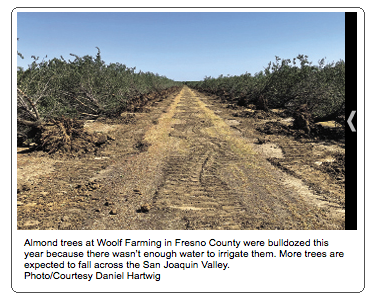
Screen Shot 2021-09-01 at 8.00.51 AMDaniel Hartwig, President of Fresno County Farm Bureau writes in Ag Alert this week – Due to water shortages and high-water costs, Woolf Farming, the company I work for in Fresno County, had to pull 383 acres of 15-year-old, prime, production almond trees. There simply was not enough water in the system to irrigate them. It was emotionally gutting to watch these trees bulldozed out of the ground, with this year’s crop already set.
 
To add insult to injury, we’re still paying over $100 an acre for water we are not receiving. That’s because infrastructure for the water still must be paid for, water or no water. Additionally, just to try to patch the year together, we need to buy some water on the open or spot market. That water is running between $1,200-$2,000 an acre-foot right now. The bulk of that water will not be delivered until this fall, after the growing season is over.
 
As a result, there’s a lot of food not being grown in the San Joaquin Valley’s west side this year, and 2022 is looking to be more painful. California is the nation’s plate, growing over two-thirds of America’s fruits and one-third of its vegetables, a lot of those from my backyard.
Woolf Farming was started back in 1974 by Jack and Bernice Woolf shortly after the completion of the Central Valley Project, which delivers federal water. Fresno County’s west side was known for growing grains, cotton and melons —primarily on groundwater—until the CVP was completed. This lifeline of surface water allowed our farm to greatly diversify our produce crops with processing tomatoes, almonds, pistachios, garlic and more. The CVP deliveries also allowed for reduced use of our groundwater, eliminating the undesirable effects now outlined in the Sustainable Groundwater Management Act.
 
Historically, our water allocations—and flows—were significantly more predictable. Even in a short water year such as this, there was still a basic allocation. But politics and regulations have reduced agricultural water supplies. Now, after the recent emergency water curtailments from the Sacramento-San Joaquin Delta watershed due to drought and failure to plan for the future, additional trees throughout the valley appear primed to be pulled as soon as harvest wraps up.
 
As a result of the curtailments, many other farmers and ranchers throughout the state are now enduring the pain we in the San Joaquin Valley have experienced throughout the past decade. The action will affect thousands of acres and over 6,000 farms. I am not the only one who has had to make agonizing decisions such as removing a valuable, productive orchard that result from these water cutbacks.
 
 
Lemoore expected to OK large pot farm
 
The City of Lemoore is expected to approve the region’s largest outdoor pot farm in the industrial area of Lemoore.The 137 acre project is proposed by an Irvine developer, People’s Properties  LLC. It will require a series of city approvals and annexation into the city limits.
 
Olam Tomatoes is located immediately to the west and Golf Avenue Park is located to the northeast of the project site.
 
An environmental study says  only mechanical harvesting will be used, with approximately five staff onsite. Once operational it would be staffed with two to four people daily. Water for the project will be provided by the City of Lemoore and use approximately two acre-feet. Ten parking spaces would be provided onsite. The entire site will be surrounded with an eight-foot chain-link fence topped with three strands of barbed wire for security. Lighting will be located on the fence.
 
Smoky skies delay raisin drying
 
Manuel Cunha, who represents many of the area’s raisin farmers, says the smoky skies are extending the raisin drying process.”There is not enough sun” to do the job this summer,he complains. The drying process could take three weeks longer than usual- extending further into October and rain possibilities.
 
 
Nisei Farmers gather support for farm labor bill
 
Manuel Cunha, League President Nisei Farmers is making the rounds at Central Valley cities to gather support for the Farm Workforce Modernization Act of 2021 before the House of Representatives.However, the legislation in its current form does not include people that work in packing houses and processing plants. 
 
“They should not have to resign to benefit from the opportunity to earn citizenship when their contributions are essential to the agricultural industry.Dreamers must not be forgotten in this push to legalize the agricultural workforce.”
 
So far, he has the support of 24 cities and counting including Avenal, Corcoran and Lemoore with plans to visit the City Council in Visalia.
 
Prop 12 will raise price of pork says UC report
 
Are you going to run short on bacon in the future? The California Department of Food & Agriculture refused this past week  to postpone implementation of Prop 12 in January even though a UC story shows consumers here can expect higher pork prices.
 
Beginning Jan. 1, the measure will require farms to add space for certain farm animals, including breeding pigs, or mother sows. The North American Meat Institute called for a moratorium on enforcement to allow those subject to the law time to comply. But CDFA says the voter passed initiative can’t be changed.
 
The UC study says California consumers will pay 8% more for pork and will consume 6% less of that pork .Kings County has one major hog farm near Corcoran.
 
More than 63% of California voters supported Proposition 12 to set housing space requirements for covered animals, including egg-laying hens, breeding pigs, and calves raised for veal. Prop 12 applies to all farms that produce these covered livestock in California and to farms in other states with covered livestock connected to products ultimately sold in California. Some Prop 12 requirements were implemented on January 1, 2020, with the full set of requirements for breed- ing pigs and egg-laying hens to be implemented on January 1, 2022.
 
The UC study says “The cost of $5 per weanling pig implies a $5 increase per retail weight of 160.8 pounds of pork per pig, or about $0.03 per pound of carcass meat available for retail sales.”

Ag roundup

-August 25,2021-

20% smaller navel crop predicted

Stronger lemon prices this year 

Screen Shot 2021-08-25 at 6.43.05 AMCitrus Mutual is predicting a smaller navel orange crop based on fruit sizing on the trees some 6 weeks before fall picking starts. That should benefit pricing, they say.

“The CCM Marketing Committee recently met and discussed crop size for the 21-22 season. Overall, statewide early projections are twenty percent down from the 20-21 season” says spokesperson Alexis Silveira for Exeter-based California Citrus Mutual.

Central Valley navel orange production often varies by year  influenced largely by the success and size of fruit set on the trees. In the past 20 years Central Valley production may range from 67 million cartons up to 92 million. Bearing acres has declined from about 135,000 12 years ago to about 111,000 today.

The 21-22 season, if it follows the estimate, would be at the low end of the 20 year numbers.

Alexis Silveira says “Drought and heat play a role, but the major factors are the cyclical nature of the crop and the long season we had this year.”

Meanwhile prices for the existing lemon crop are staying strong, ahead of the 5-year average and last year’s numbers. Exports continue to suffer port congestion issues.


CALIFORNIA TABLE OLIVE FORECAST FOR 2021


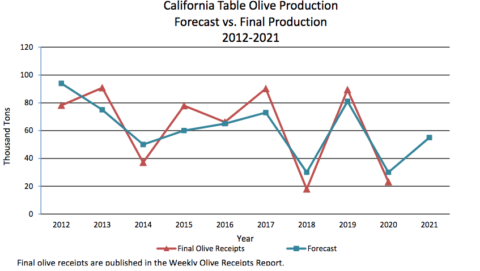
Screen Shot 2021-08-25 at 6.45.17 AMThe 2021 California table olive forecast is 55,000 tons, up considerably from last year’s crop of 23,200 tons, according to a survey conducted by the USDA.The crop is alternate bearing indication this is an on year.But the crop size is small for an on year. In 2019 the state produced over 82,000 tons

Bearing acreage this year is estimated at 12,800, which results in a yield of 4.30 tons per acre.

The Manzanillo production forecast is 53,800 tons, Sevillano production forecast is 1,100 tons, and other varieties are expected to total 100 tons.

Manzanillo yields were reported to be higher and more consistent than the Sevillano variety yields. Sizes were reported to be smaller than normal due to high heat and lack of water availability.

Labor costs and marketing remains an issue for California olives growers.

Milk’s rise and fall

2014 vs 2020 – Milk production & price down

But Kings Co milk valuation in 2020 beats 2019

Screen Shot 2021-08-25 at 5.52.21 AMThe year 2014 was the biggest year for milk production in Kings County with a combination of the best price ever too-$22 per cwt.

Since then, the number of milk cows in the county shrunk from 190,000 in 2011,187,000 in 2014 to 170,00 in the 2020 Crop Report -just published.

In 2014, production reached 44 billion pounds vs 37.3 billion pounds in 2020 – up from 36.7 billion pounds in 2019.

In 2020 the price of milk was $18.60 per cwt compared to $16.18 in 2019 says the crop report.

While milk production in 2020 remained well below 2014 levels, dairymen saw better returns in 2020 vs 2019 with the value of the crop rising from $597 million to $694 million.Operators are getting more milk per cow in recent years. After several unprofitable years – 2020 wasn’t to too bad say farmers.

Tulare County again number one?

Tulare County’s 2020 Crop Report is not yet released.But you can bet the value will be up in the nation’s number one dairy county plugging in the increase in the 2020 price per hundredweight., likely similar to the Kings County’s number.

Tulare County milk value and production will each be higher than 2019.Citrus value will be up in 2020( the county is also the top citrus producer) as well as will a number of Tulare’s  other top crops. The upshot is the the 2020Tulare County crop report may rank number one again in the nation, at least good for bragging rights.

Extreme hot weather blankets area 

Irrigated ag land grows despite water woes

-July 29,2021-
Screen Shot 2021-07-18 at 5.48.45 AMHanford has seen 13 days of 100 degrees or above during the first half of July, including a run of extreme temps from 105 to 112 degrees,  a record for many of those days. This compares to just 5 days at 100 or more during the first half of July 2020 and only 4 in the same period in July 2019.

Meteorologist Cindy Bean of NWS Hanford says it is part of a giant high pressure system that has stubbornly blanketed much of the West Coast and even up into Canada.”It’s very unusual” she says. ”The good news is that it has weakened a bit and temperatures this week are more typical” at 102 to 104, Bean adds.

The heat just keeps coming – at night too, with lows during those 2 weeks in the 70s for 6 nights and in the 60s. In July 2020, there were no lows in the 70s and a few in the 50s. In July 2019, we saw 5 nights in the 50s.

That heat blanket is also helping to fuel 70 wildfires in the Western US this week.

The extreme heat is forcing farmers to irrigate their trees more often even as they watch their irrigation canals suck up more of the little surface water being brought in.

Kaweah River flows to trickle

Kaweah River flows are at a 20-year low, says SCE who is struggling to make electricity at their hydroelectric plant on the river. The river flow at Pumpkin Hollow is below 20cfs with water temps a toasty 90 degrees. By way of comparison, river flows on the Kaweah were as high as 1800cfs in July 2019, a good water year.

Today, Kaweah Lake stands at a more than a decade-old low for this time of the year with around 35,000 acre-ft left in the lake. The  dam holds 186,000af.

Irrigation districts below the dam are managing what is left, bringing in small amounts to their farm customers but the flows into dry channels are causing channel loss that is “off the charts” says Mark Larsen of Kaweah Delta Conservation District.

The upshot is the famer who buys a set amount of water to be delivered to their farm, ends up with a fraction of what they ordered. If there is some good news it is that the parched aquifer is getting the water. Larsen says the “drought is being magnified 100 times”over the scale of complications all over the state that are impacting other regions.Various state and federal government agencies are struggling to balance irrigation, fish and urban interests due to the drought that has hit the usually wet north part of the state too.

We’re not alone. Lake Mead, on the mighty Colorado, has never been this empty.

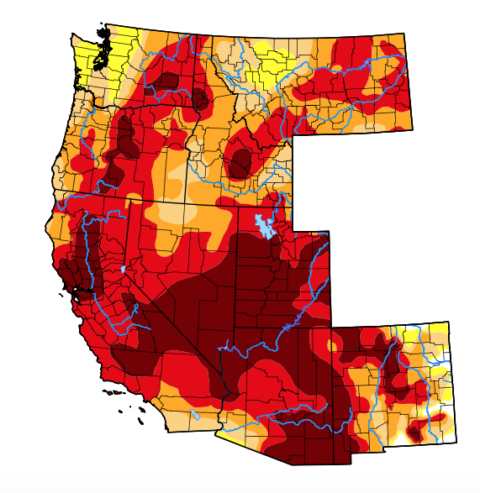
NOAA says more than 94% of the West is in drought, the largest area on record. More than 60% of the region is in ‘extreme’ or ‘exceptional’ drought  the two most severe categories — expanding by 35,000 square miles, or roughly the size of the state of Indiana.The latest Drought Monitor map for July 15 shows many parts of the state in”exceptional drought” – in dark red.

When Tulare Irrigation District(TID) tried to run 1500af dam water to the TID boundary 14 miles away this summer, they lost an estimated  80% of that to seepage.Normally channel losses are 30% anyway. 

Besides channel seepage, water bodies are losing more water into thin air as evaporation rates are higher than usual in this heat.

TID will get no Kaweah River nor any Friant-Kern Canal water this year. The upshot, says GM Aaron Fakuda,”It will be business as usual” for TID farmers who will rely on pumping from the groundwater. The district hopes to sink wet-year surpluses when those years come.

The much larger Pine Flat Dam on the Kings has some 243,000af in a dam that holds 1 million acre-feet – much larger than Lake Kaweah, but only a quarter full.

Pine Flat Reservoir is 41 percent of average this year with runoff at 24 percent of average. Farmers below the dam are at least getting a few weeks of surface water.

Friant Water news 

What’s happening on the Friant Kern Canal? Spokesman Johnny Amaral says staff is still acting under the guidance they have a 20% allocation from the Bureau and some districts are now taking their water out of the canal.

Still Friant has posted that they expect some water from the Friant dam may have to be sent to the Exchange Contractors this year -down the river.

Amaral says the Friant Canal subsidence fix is making progress with the new construction contract set to be awarded in a matter of weeks. Actual construction is expected to start this fall and wind up in 2024. Now we know the state along with the feds will kick in money for the fix that includes a parallel canal.

The canal has literally sunk due to over pumping of the aquifer along over 30 miles near Porterville.The same thing has happened up and down the Central Valley where canals run.

On Monday, July 12, Governor Gavin Newsom signed a bill that provides $100 million in initial budget funding toward restoring the capacity of the Friant-Kern Canal and the other major canals named in Senate Bill (SB) 559.

The Friant-Kern Canal Middle Reach Capacity Correction Project’s estimated cost is more than $500 million, and the cost to restore the canal’s full design capacity is estimated as $924 million. The Friant-Kern Canal’s middle reach has lost 60% of its capacity to convey water, resulting in as much as 300,000 acre-feet of water going undelivered by the canal in some years

Meanwhile the brutal heat and lack of water is not being made any better by the fact that permanent plantings in the Tulare Lake Basin continue to climb 4 or more percent each year. Unlike some crops that can be idled in a water crisis, trees and vines need to be irrigated or they will turn into fire wood.

More trees planted despite water woes

USDA reports there were at least 8.6 million almond trees sold by California nurseries from June 1, 2019 to May 31, 2020.Not just replacement  trees either – About 55% of the total trees sold (36,000 acres) were for new almond orchard acres.

In Tulare County the annual crop reports tell the story. Trees and vine acreage in 2013 covered 361,000 acres in the county .By 2019 that figure jumped to 484,408 acres – climbing about 70,00 acres in one year. Farmers planted more almonds, pistachios  and tangerines that continue to mature and year by year -more are harvested.  In 1982 Tulare County had under 1000 acres of pistachios.Today, that number is over 71,000 acres.

In Kings County both permanent plantings and field crop land have increased since 2000. Permanent plantings went from 30,000 acres in 2000 to just under 100,000 acres in 2019. Field crop acres climbed from 641,000 in 2000 to 681,000 acres in 2019.

The latest crop report for now is for 2019, but other surveys clearly show the planting of nut trees continues. Almonds statewide in 2020 covered 1.25 million acres -up 6% from 2019. Likewise for pistachios, with bearing acres in 2020 up 9%. It will rise again in 2021.

To make up for the drought, farmers say that they have reduced the amount of water needed to grow each almond by 33 percent between the 1990s and 2010s and stand committed to another 20 percent by 2025.Likewise for dairy farmer who says they have reduced water use by 88% in the past fifty years. Local diaries use their wastewater to grow field corn needed to feed the animals.

But not only surface water is dwindling , the main go-to source- groundwater is being found at lower depths year after year.The magnitude of the overdraft in KDWCD districts including portions of Kings County ranges from 60,900 to 75,100 acre-feet per year.

Heat cuts production

The heat is also shriveling many crop yields this summer from cherries, to lemons, processing tomatoes to milk production. Almond production this year will be off 10%, largely due to the drought.

USDA said July 12,”The 2021 almond crop started off with very dry weather in February, providing excellent bloom conditions and plenty of opportunity for pollination. A lack of rainfall continued through the spring and brought about concern for water availability. Due to low water allocations and record high temperatures in June, the crop did not develop as well as expected. Some growers have decided to save their trees by stripping nuts before harvest.”

With the whole state suffering from a shortfall, one can expect more finger pointing at the farm sector’s water use vs other sectors.

In the Kaweah Delta WCD they deliver about 918,5000 acre feet annually as of 2012. And ag takes 93% of that. Out of 340,00 acres in the district, just 40,000 acres are urban. Hard to blame housing for gobbling up too much water.

Some economists point to water marketing, allowing farmers who have access to low-cost water to sell that water to other farmers willing to pay more. Screen Shot 2021-07-18 at 5.48.45 AM