WHAT DOES COTTON ACREAGE LOOK LIKE FOR CALIFORNIA IN 2022?

from California Cotton Growers

April 1,2022

With cotton prices where they are today, it comes as no surprise to see an increase in cotton acreage for 2022.  Unfortunately, another year of drought will severely limit the amount of acreage that gets planted this year.  As of today, California cotton growers are only increasing their plantings this year by approximately 10% despite record cotton prices.  Cotton growers planted approximately 120,000 total acres in 2021 and are looking to plant 132,000 acres in 2022.

According to the preliminary planting intentions survey conducted by the California Cotton Ginners and Growers Association this month, the Association is currently estimating approximately only 107,000 acres of pima, 1,600 acres of Hazera and about 24,000 acres of upland statewide for the 2022 cotton season plus or minus 10%.  This survey is based on surveys from all of the gins in California and things could change when planting is actually completed and final field surveys are completed by CDFA.  If it plays out, it will represent a 26% increase in pima acreage and a 31% decrease in upland acreage in California as compared to 2021.  Again, this is preliminary, but reflects what all gins are reporting.

Navel orange industry having good year-prices $2 a box more than last year and far above recent average

-April 3,2022-

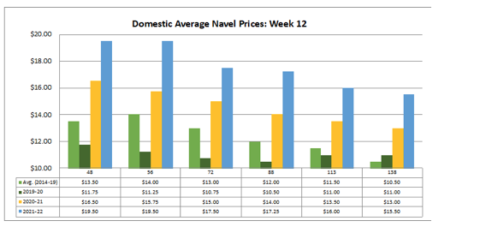
Screen Shot 2022-04-02 at 12.15.28 PMCitrus Mutual, based in Exeter, reports that as of March 31 that the navel crop is approximately 70% harvested. Shippers report under-picking estimates and most expect to finish picking in June, if not before.

Utilization continues to be over 80%, on average, with a fancy/choice ratio of 75/25. Sizes are peaking on 72, 88, and 56.

The industry average price across all grades and sizes is holding steady at just under $18. The average FOB for each size is $2 (or more) higher than last season. Movement is excellent and shippers are optimistic that prices will come up in these final months of the season.

Even more impressive, the popular 48 size orange is fetching an average of $19.50 this season compared to $16.50 in 02/21 and just $11.75 in 19/20.(see chart).
Attachments area

VALENCIA ORANGE PRODUCTION FORECAST AT 17.2 MILLION CARTONS

-March 10.2022-

King of juice oranges, the Valencia crop is ripening on Valley trees this spring – but the 2022 crop looks to be down from recent years.

Screen Shot 2021-03-18 at 5.43.03 AMUSDA says the March 2021-22 Valencia orange forecast is 17.2 million cartons .The season had experienced scattered precipitation in some areas but mainly warm and dry conditions in January and February.
Survey data indicated an average fruit set per tree of 541, a 0.7% decrease from the previous year and slightly above the five-year average. The average March 1 diameter was 2.459 inches, down 3.6% from the previous year and slightly below the five-year average of 2.539.
A look at the ten year history shows a decade ago there were 41,000 bearing acres of Valencia oranges in California. Today it’s down to 26,000 acres. This year the forecasted crop at 17.2 mili is down from 29 million cartons in 2011 and lower than last year when we produced 19 million cartons.

 
CALIFORNIA EXPORTS EFFECTIVELY SLIPPED IN LATEST NUMBERS

Inflation reversed what appeared to be a modest January increase in California’s merchandise export trade, according to Beacon Economics’ analysis of U.S. trade statistics released this morning by the U.S. Census Bureau.
Foreign shipments by California businesses totaled $13.707 billion for the month, a nominal 4.5% increase over the $13.115 billion recorded in January 2021. The state’s exports of manufactured goods in the year’s first month rose 2.1% to $8.650 billion from $8.468 billion one year earlier. Exports of non-manufactured goods (chiefly agricultural products and raw materials) jumped by 17.2% to $1.691 billion from $1.443 billion. Re-exports, meanwhile, were up by 5.1% to $3.367 billion from $3.203 billion.
Overall, California accounted for 9.3% of the nation’s merchandise export trade in January.
“Unfortunately, these ‘gains’ are an illusion,” said Jock O’Connell, Beacon Economics’ International Trade Advisor. “Heightened rates of inflation and shifts in commodity prices and exchange rates in recent months sharply degraded the apparent increases.” O’Connell added that, while the U.S. Census Bureau is today reporting a nominal 15.6% year-over-year bump in overall U.S. merchandise exports in January, the Bureau also calculates that the real, inflation-adjusted gain over this period was a mere 1.3%.
Those numbers are consistent with the 6.5% drop in outbound loaded containers from California’s major seaports in January as well as a meager 1.9% increase in export tonnage at Los Angeles International Airport.

Milk consumption down again in California

-March 5,2022-

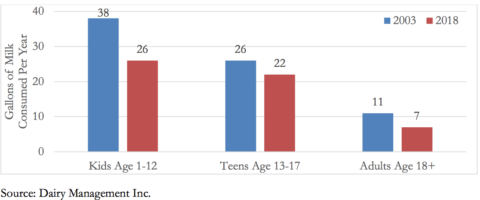
Californians continue to drink less milk, says a recent USDA report.Tulare County dairymen and suppliers in the nation’s top milk county, are paying attention.

Screen Shot 2022-03-04 at 12.29.08 PMFluid milk sales in California posted another year- over-year decline in 2021. Disposition of fluid milk products—deliveries of packaged Class I products to retail, institutional, or wholesale outlets—in Federal Order 51 declined by 4.6 percent on a daily average basis from 2020.

Reduced fat milk suffered the largest decline from 2020, decreasing 8 percent on a daily average basis. Other major conventional milk categories declined as well, including whole milk (5.1 percent), low fat milk (3.2 percent), and skim milk (6.5 percent). Additionally, organic milk products including regular and flavored organic milks—dipped 1.9 percent from 2020 on a daily average basis. Although organic milk sales declined from 2020 to 2021, they sit well above 2019 levels by 15.7 percent.

Beginning in 2010, total fluid milk sales started declining, and if current trends persist, fluid milk utilization in California will decrease by an estimated 23% between 2020 and 2030.

A California Dairy Quota Research paper in 2019 writes that “per capita fluid milk sales have been in decline for decades, and in recent years, the decay has accelerated. In the 1980s, average per capita fluid milk consumption decreased by 1.8 lbs per year. In the 1990s, consumption fell by an average of 2.2 lbs per year and in the 2000s, decreased by 1.90 lbs per year. In the 2010s, per capita consumption decreased at an accelerated pace and is falling by an average of 3.7 lbs per year.

“While there are many factors that are contributing to the decline in fluid milk consumption, including shifting household demographics, longer working hours, and consumer trends away from breakfast cereals, the most important factor was the increased competition from other beverages.”

Plant based competition

Tom Barcellos, a 35 year dairy operator in Tulare County, says the industry has been fighting “ the plant-based commentary” for years with limited success. Whatever its made of they sill cll it milk” eh shrugs.. Even with less fluid milk sales, dairymen in California are enjoying “a great mix price “ right now even though all the input costs are up as well. Barecellos ships milk to Land O Lakes inTulare and the coop—“recently sent co-op profits to the producers” and is doing well.


Screen Shot 2022-03-04 at 9.23.52 AM

If there is bad news in the milk aisles, the butter and cheese grocery shelves are working overtime. The report says “While fluid milk sales are declining, we forecast consumption of other dairy products in California will continue to trend upward with total consumption of cheese increasing by 29% between 2020 and 2030, butter by 15%, and yogurt by 5%.

Dairy operators are getting more money per lb this year in all categories of milk products including fluid milk called Class 1 fetching nearly $22 per hundredweight compared to an average of $17.24 in 2021.Much more milk is shipped as powder mostly for exports also enjoying a near record high price.In 2020 nonfat dry milk was going for $1 and today is $1.85.

If the demand for a glass of milk is declining, local cheese companies – one French-owned and the other Canadian, are investing in major expansion of their production plants in Tulare..Meanwhile there are only small boutique fluid milk processors using local fluid milk.

Sandridge Partners pulls application for feedlot but retains beef plant project near Lemoore

-March 5,2022-

Screen Shot 2022-03-02 at 3.13.58 PMBowing to negative reaction from residents and city officials from Lemoore, Sandridge Partners told the City at a special meeting last week they would withdraw their plan to have a feedlot next to their proposed beef harvesting plant. The plant would be located near Hwy 41 and 198, outside the city limits.

The county is processing the application for a 826-acre cattle feedlot and slaughterhouse. Instead of allowing up to 12,600 cow feedlot, the plant holding pen would limit the number of head to a few days supply- 125 to 250 animals. Residents speaking at the meeting, said they were worried about flies, smells and water pumping on the so near the community. A letter from the city to the county argued the project with the feedlot would have a “very negative impact” on the livelihoods of city residents and the operations and investments of the city’s businesses.

City Manager Nathan Olson said nearby business, several marijuana growers said they had “no problem” with the project if the feedlot was left off.

In addition Olson said the company promises not to do any rendering to the plant.

After discussion, council decided to keep their opposition letter to the entire project since it would be up to the county to revise and recirculate any modified project for comments if the feedlot is removed.

But Olson herself, who is a big economic development advocate, argued in a press story “I really don’t see any downside to the beef harvesting plant, and if we could ever get that, it would be a great one to annex,” said Olson. He suggested that the facility could generate two to three million dollars in retail every month or
$24 million in retail sales. The facility would feature a retail store selling fresh meat conveniently located on the main Valley to the Coast highway.

Olson stated that the facility might net the city $300,000 to $500,000 per year. “If we could get it into the city, that’s good money.” This assumes annexation.

Spokesman for Sandridge Partners, Jim Wilson said Sandridge has various feedlots around the area where animals could be housed but would require just in time truck deliveries to keep the harvesting plant stocked.

Wilson says there is a time element in all this because the company is applying for new USDA grants and loans to help small meat processors expand. The application has a late March deadline.

Looking to simulated competition in the beef packing business the Biden administration is offering up to $1 billion in various funding opportunities to help affect beef prices

“Capitalism without competition isn’t capitalism, it’s exploitation,” Biden said. “That’s what we’re seeing in meat and poultry.” Four large meat packing companies control 85% of the beef market. The top four processing firms control 54% of the market in poultry. And in pork, the top four processing firms control about 70% of the market according to reports

In the Valley, consolidation last year created what has been described as the 7th largest meat packer in the nation when Hanford- based Central Valley Meat acquired Harris Ranch Beef. Indeed, the sprawling Harris Ranch feedlot lot has been suggested as what Lemoore does not want nearby. The feedlot along Hwy 5 spans 800 acres with up to 100,000 cattle.

Sandridge’s proposed feedlot was to cover 215 acres designed for a maximum of 12,600 cattle, lots smaller.

The Sandridge beef harvesting plant includes approximately 72,000 square feet of building space consisting of livestock loading areas, a kill floor, coolers, cold storage, dry storage, a cut room, offices, and employee space.

Ag- Biz Briefs; Friant / milk prices/ rail traffic

-February 27,2022-
$3.59 -Average rate per mile for refrigerated transport on the trucking spot market in January, up 12 cents from December and 98 cents from January 2021, according to DAT Solutions.-WSJ

The U.S. Postal Service rejected Biden administration calls to purchase more electric vans and instead finalized the purchase of 148,000 gasoline-powered delivery trucks. (Washington Post)
Imports of fresh cultivated blueberries totaled more than $1.22 billion for 2021, up 24% from the previous year. By month, U.S. fresh blueberry imports are heaviest in November (19%) and December (13%) in terms of the percentage of the U.S. annual import total value, but blueberry imports that arrive every month of the year are relatively heavy in the January through April period. Those four months account for a combined 38% of the annual import value, according to the USDA.- The Packer
Milk prices soar: The dairy markets soared to historic heights early in the week. Butter and Cheddar reached all-time highs at the Global Dairy Trade auction on Tuesday, while both skim milk powder and whole milk powder prices climbed to fresh seven-year highs. The GDT Index advanced 4.2%, its third straight increase above 4%. The milk powder markets got off to a strong start in Chicago as well. For the first time since 2014, CME spot nonfat dry milk (NDM) traded at $1.90 per pound. – Milk Producers Council-Feb 18


Screen Shot 2022-02-27 at 7.00.09 AMFriant water supply: The Bureau of Reclamation just announced the initial Central Valley Project water allocation for 2022, which includes a 15% allocation (120,000 acre feet) for Friant Division Class 1 contractors. Friant Division Class 2 contractors did not receive an allocation.
FWA argues that “ based on the current snowpack and reservoir conditions in and above Millerton Lake, there is ample justification for an allocation higher than 15%.  Even if the remainder of the year is extremely dry, FWA estimates that approximately 240,000 acre-feet of additional unallocated water supply exists in the upper San Joaquin watershed. This estimate is in addition to the 254,000 acre-feet already allocated to the San Joaquin River Restoration Program.”

Friant says an allocation of at least 40% makes sense based on storage in the SJ watershed that stands at 46% capacity.For the Water Year precip is at 78% of average for the 5 station San Joaquin River watershed.

“Not allocating water that is clearly available will only exacerbate an unnecessary rush to pump groundwater, causing additional overdraft.”

The February 15th update to the unimpaired inflow forecast for Shasta indicates a water year unimpaired flow of
3.8 MAF at the 50% exceedance level and 3.1 MAF at the 90% exceedance level . To avoid a Shasta Critical year designation, the cumulative unimpaired water year inflow to Shasta needs to be at least 4.0 MAF this year.

US shale oil companies are not stepping up production

Sorry, cash-strapped consumers: If you thought OPEC was stingy about oil output, large U.S. shale producers aren’t here to help, either.

EOG Resources and Occidental Petroleum , both of which held investor calls on Friday, capped major shale producers’ results for this earnings season. Both companies are among the top five producers in the Permian basin, the most productive oil field in the U.S.- WSJ

The big public US shale firms are still resolutely focused on making money for shareholders rather than chasing output growth. Six of the top 10 shale producers accounting for nearly a third of output are publicly owned and assert that they will not be tempted by high prices. “Diamondback’s team and board believe that we have no reason to put growth before returns,” chief executive Travis Stice says. “Long term, we are still in that 0pc to 5pc,” Pioneer Resources chief executive Scott Sheffield says. “We are not going to change, as I said, at $100/bl oil, $150/bl oil, we are not going to change our growth rate. We think it is important to return cash back to the shareholders.”- Argus Media


Rail traffic on the mend

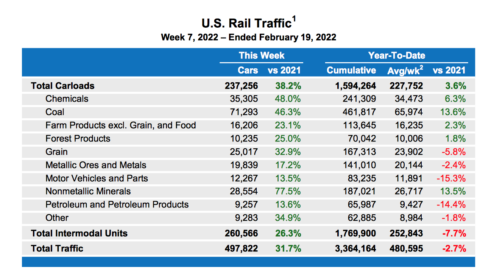
Here is the latest snapshot of rail traffic across the US  showing improvement this last  week vs the year to date numbers that are weaker.

Screen Shot 2022-02-27 at 7.43.34 AM

Tomato growers get 24% bump in price & 10% more contracted tonnage in 2022 / Friant update

-January 28.2022-

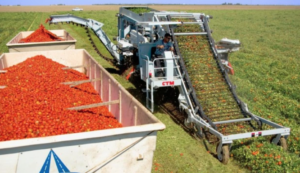
Screen Shot 2022-01-26 at 11.42.36 AMLooks like that bottle of ketchup will cost a little more. Join the club for other commodities from Kings County. Cotton growers, dairymen ,oil producers and now tomato growers will see higher returns in 2022. In most cases, the rise has been spurred by good demand but reduced supply. The California Tomato Growers Association has agreed to $105.00 per ton with all processors for 2022.The trade group considers $105.00 to be fair and reasonable Base Price for the industry, growers and processors alike, they say. This represents a 24.3% increase from 2021. The association board felt it was important to set a price prior to the first of the year in order to allow the members to make the best decisions for their operations in light of the reduced water supplies for 2022. Growers got about $79 a ton for the past few years.Both acreage and tonnage in California dropped in 2021.
Now, both are likely to go up, says USDA.
As of January, California’s tomato processors reported they have, or will have, contracts for 12.2 million tons in 2022, which is an increase of 10% compared to 11.1 million contracted tons forecast in August 2021. Processors estimate that the contracted production for 2022 will come from 245,000 acres, generating an average yield of 49.8 tons per acre. The contracted planted acreage forecast is 7% higher than the 2021 acreage of 229,000 reported under contract in August.


Friant launches construction of 10 mile canal

Screen Shot 2022-01-26 at 8.33.42 AM
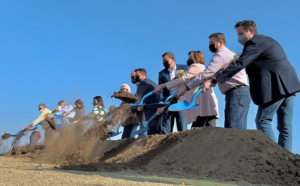
The long-awaited repair of the Friant-Kern Canal is underway with a groundbreaking ceremony near Terra Bella held in the past few days. Job one is to build a new canal some 10-miles long that will replace that portion of the 150 mile canal hardest hit by subsidence in southern Tulare County. Altogether, the plan will repair 33 miles of the key artery by January 2024.State and federal funds supplied most of the money for the $ 500 million project but the Eastern Tule Groundwater Sustainability Agency will provide $125 million for damage caused by the over pumping of groundwater. Since its construction in 1951 more than 50 percent of its original conveyance capacity in the middle reach has been lost due to land subsidence. Friant contractors are providing $50 million.


USDA: Retaliatory tariffs cost farmers $27 billion

-January 15,2022-
Screen Shot 2022-01-15 at 7.37.17 AMIn 2018, the United States imposed Section 232 tariffs on steel and aluminum imports from major trading partners and separately Section 301 tari s on a broad range imports from China. In response, Canada, China, the European Union (EU), India, Mexico, and Turkey imposed retaliatory tari s on many U.S. exports, including a wide range of agricultural and food products. Individual product lines experienced tari increases ranging from 2 to 140 percent. Retaliatory tariffs increased the price of U.S. agricultural exports in these markets relative to alternatives that were either domestically produced or imported from other international sources. Despite opportunities for U.S. producers to sell their products to non-retaliating trade partners, the overall
effect was a reduction in U.S. agricultural exports. Given that agricultural production for certain commodities is concentrated in certain States, retaliatory tariffs a effected the United States differently. As of October 2021, many retaliatory tarif s were still in effect with
the following exceptions—Canada and Mexico’s tari s were removed in May 2019,
China announced tariff exemptions for some products after the U.S.-China Phase One Economic and Trade Agreement (Phase One Agreement) was signed on January 15, 2020, and in October 2021 the United States and EU reached arrangements to address global steel and aluminum excess capacity which include replacement of Section 232 tariff s with a tariff-rate quota and lifting of the EU’s retaliatory tariffs.
What Did the Study Find?
Retaliatory tariffs led to a significant cant reduction in U.S. agricultural exports to retaliating partners. Nationally, direct U.S. agricultural export losses due to retaliatory tari s totaled more than $27 billion during 2018 through the end of 2019. Across retaliatory partners, China accounted for approximately 95 percent of the losses ($25.7 billion), followed by the EU ($0.6 billion), and Mexico ($0.5 billion), with Canada, Turkey, and India having smaller shares. We estimated annualized losses for selected commodities from retaliatory tari s were $13.2 billion from mid-2018 to the end of 2019

Sandridge Partners plans new beef processing plant

-January 2,2022-
 
Screen Shot 2021-12-27 at 7.08.45 AMDeveloper,farmer and water trader John Vidovich plans to build a beef feedlot and processing plant near Lemoore according to a preliminary application filed with the county.The 789 acre project would be located along Highway 41 just south of 198.Located on property owned by Vidovich, the land is zone for ag.
 
According to their application, Sandridge Cattle wants to develop land in Kings County to construct and operate a cattle feedlot and beef harvesting plant on 250 acres of the larger parcel.
 
The proposed feedlot will grow cattle in” a healthy, well‐managed, cattle friendly environment and cattle will be fed natural grain/hay and receive no hormones. The beef harvesting plant will produce high quality and dry aged beef for bulk sale to consumers. The beef harvesting plant will make use of humane slaughter techniques using kosher and halal methods.”
 
The feedlot portion encompasses approximately 215 acres of the site and includes approximately 120 acres of corrals, a 300,000 sf beef loading and processing center, a horse barn, 275,000 sf manure lagoon, 50,000 sf manure basin, 336,800 sf silage pad, 60,000 sf silage lagoon run‐off, 6,500 sf commodity barn, and 5,000 sf equipment shop. At capacity, the cattle feedlot will be designed for a maximum of 12,600 cattle.
 
70 employees- small volume
 
The feedlot would be operated 7 days a week from 7am to 4 pm would require 7 full‐time employees to manage and run the daily feedlot operations. During operations, the feedlot would receive approximately 30 feed deliveries and 4 cattle deliveries per week.
 
There would be a small walk-in customer retail store on site.
 
The beef harvesting plant includes approximately 72,000 sf of building space consisting of livestock loading areas, a kill floor, coolers, cold storage, dry storage, a cut room, offices, employee facilities and 1,900 sf of retail space. This facility will be used to slaughter, butcher, process, and distribute bulk beef products using kosher and halal slaughter techniques. At capacity, the beef harvesting plant would harvest a maximum of 120 cattle per day.
 
The plant would be operated Monday‐Friday from 6am to 11pm and would require 60 full‐time employees to run the daily beef harvesting plant operations at maximum capacity.
 
By contrast, the Sandridge beef operation would be small compared to Central Valley Meat’s large and expanding operation on the outskirts of Hanford. With Sandridge cattle harvesting  just 120 cattle a day, Central Valley Meat plans to do a two-phase expansion of its beef processing plant that already processes about 1,500 head of cattle a day. According to the application  approved in the past year, the company plans to increase the capacity three-fold to 4,500 head a day.

Touchstone Pistachios remain stalled in Fresno County but move forward in Tulare County

-January 2,2022-
 
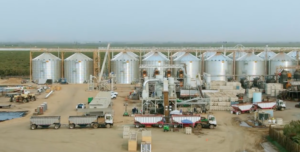
Screen Shot 2021-12-28 at 8.15.33 AMThe Valley’s” pistachio wars” pitting industry leader Wonderful Pistachios vs local company Touchstone continue now for about 4-years running. Fresno’s Touchstone Pistachios remains stalled on their 2018 plan to build a large 49-silo processing plant near Hwy 33 after a series of CEQA  environmental challenges by rival Wonderful. The plant was expected to be operating by now but instead Touchstone, stalled in Fresno County, is counting on a site in Tulare County to process the growing volume of pistachio nuts being grown in the Valley.
 
Touchstone got some good news in Tulare County when a county  judge ruled in November against  Wonderful in their effort to halt new construction at rival Touchstone’s plant in Terra Bella.
 
Touchstone  alleges that like in the Fresno County case, Wonderful is suing by using environmental laws to stifle competition. Wonderful appeared to be carrying on their commercial  dispute with Touchstone who used to do business with Wonderful but is now on their own.
 
The judge pointed out that Wonderful didn’t challenge the building or operation of the Terra Bella plant when it was originally built in 1996 by ARO Pistachios. Instead, the company waited until the plant was purchased by Touchstone.
 
The Tulare County plant, when originally built, had just 4 storage silos. Today, owned by Touchstone, it sports 20 silos and now as of January  2022 the company has filed a plan to add another 16 for a total 36 silos.The “Minor Modification” application to the county says “There will be no expansion of the project site.  The intent of the applicant is to increase efficiency for the existing use.”
 
Processors need to add processing capacity and silos in the Valley as growers continue to plant 30,000 acres of new trees annually, says Bob Klein of the Administrative Committee for Pistachios. This year’s crop tops one billion pounds.
 
caption
Touchstone Pistachios Tulare County plant looking to expand