
-September 9,2021-
Supervisors reject appeal of solar projects
This week, Kings County Supervisors rejected an appeal of a Planning Commission approval of three large solar projects proposed by Westlands Solar Park. The appeal, by Roger McNitt, President of Southern Realty Co. argues that no one will buy the electricity produced by the project if they use polysilicon made by forced (aka slave) labor in the Xinjiang Province in China. He says the Commission erred and abused its discretion by not insisting on mitigation by use of the Traceability Protocol, Buyer Disclosure Guides, and Environmental Commitments of the Solar Energy Industries Association or some other type of mitigation.
McNitt says he may take the county to court over the issue. Southern Realty Co. leases its oil and gas mineral rights. They own rights in several counties. His argument is that Community Aggregators -energy providers in coastal cities- may not want to buy the solar power because it uses the Chinese solar panels. A few years ago,McNitt complained about another Kings solar project fearing a plane may crash into the panels near NAS Lemoore.
Drought cuts tomato harvest
USDA announced this week that contracted production for California processing tomatoes is forecast at 11.1 million tons, averaging 48.9 tons per acre. The forecast is 1.9% below last year’s contracted production, and 4.3% below the May forecast. The projected harvested acreage of tomatoes grown under contract is 227,000 acres -0.4% lower than in 2020.
The report adds “Drought concerns impacted planting decisions for the 2021 processing tomato crop and acreage has decreased significantly from early season intentions. Extreme high temperatures in May and throughout the summer lowered expected yields and slowed down operations at the canneries. Crop quality is reported to be average or slightly above average.”
With no water – Westside farm removes almonds
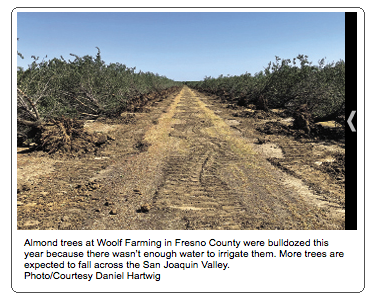 Daniel Hartwig, President of Fresno County Farm Bureau writes in Ag Alert this week – Due to water shortages and high-water costs, Woolf Farming, the company I work for in Fresno County, had to pull 383 acres of 15-year-old, prime, production almond trees. There simply was not enough water in the system to irrigate them. It was emotionally gutting to watch these trees bulldozed out of the ground, with this year’s crop already set.
To add insult to injury, we’re still paying over $100 an acre for water we are not receiving. That’s because infrastructure for the water still must be paid for, water or no water. Additionally, just to try to patch the year together, we need to buy some water on the open or spot market. That water is running between $1,200-$2,000 an acre-foot right now. The bulk of that water will not be delivered until this fall, after the growing season is over.
As a result, there’s a lot of food not being grown in the San Joaquin Valley’s west side this year, and 2022 is looking to be more painful. California is the nation’s plate, growing over two-thirds of America’s fruits and one-third of its vegetables, a lot of those from my backyard.
Woolf Farming was started back in 1974 by Jack and Bernice Woolf shortly after the completion of the Central Valley Project, which delivers federal water. Fresno County’s west side was known for growing grains, cotton and melons —primarily on groundwater—until the CVP was completed. This lifeline of surface water allowed our farm to greatly diversify our produce crops with processing tomatoes, almonds, pistachios, garlic and more. The CVP deliveries also allowed for reduced use of our groundwater, eliminating the undesirable effects now outlined in the Sustainable Groundwater Management Act.
Historically, our water allocations—and flows—were significantly more predictable. Even in a short water year such as this, there was still a basic allocation. But politics and regulations have reduced agricultural water supplies. Now, after the recent emergency water curtailments from the Sacramento-San Joaquin Delta watershed due to drought and failure to plan for the future, additional trees throughout the valley appear primed to be pulled as soon as harvest wraps up.
As a result of the curtailments, many other farmers and ranchers throughout the state are now enduring the pain we in the San Joaquin Valley have experienced throughout the past decade. The action will affect thousands of acres and over 6,000 farms. I am not the only one who has had to make agonizing decisions such as removing a valuable, productive orchard that result from these water cutbacks.
Lemoore expected to OK large pot farm
The City of Lemoore is expected to approve the region’s largest outdoor pot farm in the industrial area of Lemoore.The 137 acre project is proposed by an Irvine developer, People’s Properties LLC. It will require a series of city approvals and annexation into the city limits.
Olam Tomatoes is located immediately to the west and Golf Avenue Park is located to the northeast of the project site.
An environmental study says only mechanical harvesting will be used, with approximately five staff onsite. Once operational it would be staffed with two to four people daily. Water for the project will be provided by the City of Lemoore and use approximately two acre-feet. Ten parking spaces would be provided onsite. The entire site will be surrounded with an eight-foot chain-link fence topped with three strands of barbed wire for security. Lighting will be located on the fence.
Smoky skies delay raisin drying
Manuel Cunha, who represents many of the area’s raisin farmers, says the smoky skies are extending the raisin drying process.”There is not enough sun” to do the job this summer,he complains. The drying process could take three weeks longer than usual- extending further into October and rain possibilities.
Nisei Farmers gather support for farm labor bill
Manuel Cunha, League President Nisei Farmers is making the rounds at Central Valley cities to gather support for the Farm Workforce Modernization Act of 2021 before the House of Representatives.However, the legislation in its current form does not include people that work in packing houses and processing plants.
“They should not have to resign to benefit from the opportunity to earn citizenship when their contributions are essential to the agricultural industry.Dreamers must not be forgotten in this push to legalize the agricultural workforce.”
So far, he has the support of 24 cities and counting including Avenal, Corcoran and Lemoore with plans to visit the City Council in Visalia.
Prop 12 will raise price of pork says UC report
Are you going to run short on bacon in the future? The California Department of Food & Agriculture refused this past week to postpone implementation of Prop 12 in January even though a UC story shows consumers here can expect higher pork prices.
Beginning Jan. 1, the measure will require farms to add space for certain farm animals, including breeding pigs, or mother sows. The North American Meat Institute called for a moratorium on enforcement to allow those subject to the law time to comply. But CDFA says the voter passed initiative can’t be changed.
The UC study says California consumers will pay 8% more for pork and will consume 6% less of that pork .Kings County has one major hog farm near Corcoran.
More than 63% of California voters supported Proposition 12 to set housing space requirements for covered animals, including egg-laying hens, breeding pigs, and calves raised for veal. Prop 12 applies to all farms that produce these covered livestock in California and to farms in other states with covered livestock connected to products ultimately sold in California. Some Prop 12 requirements were implemented on January 1, 2020, with the full set of requirements for breed- ing pigs and egg-laying hens to be implemented on January 1, 2022.
The UC study says “The cost of $5 per weanling pig implies a $5 increase per retail weight of 160.8 pounds of pork per pig, or about $0.03 per pound of carcass meat available for retail sales.”