High Speed Anxiety vs Reality:This Rail Has A Head Of Steam

A key state Senate vote last week made it clear – California High Speed Rail will likely be built starting next spring coming through the  Central Valley whether farmers and GOP politicians oppose it or not.

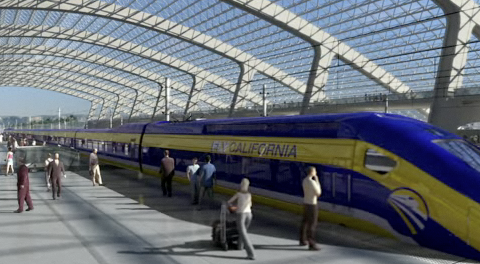
After the Assembly gave their OK Thursday by a large margin, the Senate barely passed the modified SB 1029 “rail modernization” bill by a dramatic one vote majority Friday. The legislation, backed by Governor Jerry Brown, but opposed by all Republicans, authorizes spending $1.9 billion of voter-approved Prop 1A bonds and $3.3 billion in federal grants to begin construction of the proposed Central Valley high-speed rail line. The line will eventually connect the state with a new 220mph electrified passenger train system.

After the nail biter of a vote, Brown said “In 2008, California voters decided to create jobs and modernize our state’s rail transportation system with a major investment in high-speed rail and key local projects in Northern and Southern California. The Legislature took bold action today that gets Californians back to work and puts California out in front once again.”

Winning by one vote was deja vu all over again for Brown whose father won a key legislative battle by one vote to build an equally controversial public works program – the now hugely popular State Water Project.

The revised CHSR rail plan lowers the total cost from an anticipated $100 billion to $68 billion and in an effort to get support in the state legislature from major population centers offered to do $800 million in rail connections in the larger metro areas simultaneously as the first Central Valley segment is built.

“Our new plan makes major investments in regional and local rail systems throughout the state,” said CHSRA chair Dan Richard in a statement. “In the BART system, MUNI, Caltrain, Transbay Terminal, the ACE train in the Central Valley, Metrolink in Los Angeles, the Los Angeles to San Diego Amtrak service…all of these things will benefit from the investment program that high-speed rail is leading.”

Farmer Opposition

But farmer critics of the plan refuse to give up their battle to junk the train while others in the Central Valley are busy this week figuring out how to plan to connect to the new transportation system that will have stations in Fresno,Bakersfield and likely Hanford/Tulare County.Pending now, just where in the Central Valley will CHSRA decide to place a 1500 job heavy maintenance station and will Hanford /Tulare County get a station?

Just before the July 6 vote, the California Farm Bureau voted to oppose the project due to loss of farmland and impacts on rural communities in places like Kings County where opposition has been  particularly strong.

“The high-speed rail system would change the landscape for generations across some of the most productive agricultural counties in the United States,” California Farm Bureau President Paul Wenger said. “We understand the need for transportation projects, but we should not needlessly sacrifice food production, family farmers and workers who depend on agricultural jobs.”
Wenger noted that the bond measure authorizing construction of the high-speed rail system stressed the goal to build the system along existing transportation corridors where practical. Instead, the proposed route for high-speed rail cuts through farms and ranches, requires numerous road closures and bisects canals and other water delivery systems.
“A rural road or a canal may look insignificant to a planner studying a map, but those roads and canals support farms, ranches and rural communities,” Wenger said. “The High-Speed Rail Authority has seen farmland as the path of least resistance. But farmers and ranchers are resisting. The authority needs to address the impacts that high-speed rail will force on rural communities.”
Two county Farm Bureaus—in Madera and Merced counties—are plaintiffs in a lawsuit challenging the environmental review of the Merced-to-Fresno route for the rail project. The Kings County Farm Bureau has joined county officials in expressing concerns about the impact on farmland along the proposed Fresno-to-Bakersfield route.
“In the past, California Farm Bureau has said we support the concept of high-speed rail as long as it conserves irreplaceable farmland, avoids premature conversion of farmland for urban sprawl, and complies with established environmental law. As of now, the proposed system does not meet any of those goals and we can’t support it until it does,” Wenger said.
Legal Battle Already Underway
Translation – get ready for a hard fought legal battle now that the funding has been authorized. Indeed it is already well underway.
As of last month three complaints have been filed in the Sacramento Superior Court that challenge the Merced to Fresno route section over inadequate environmental review. This would be the first leg of the bullet train’s construction. Plaintiffs include the City of Chowchilla and County of Madera. A ruling on the merits of the petitions is expected in early 2013, before the expected start of construction in the spring of 2013 say legal experts.

“We are going to protect our property,” said Frank Oliveira, a farmer and leader of the Central Valley group Citizens For California High-Speed Rail Accountability. “Somebody is coming into our area, and they are going to seize our property and say we don’t have a choice in the matter.” Oliveira told a reporter.
Both sides in this ideological battle are determined to fight this out. The law allows the taking of farmland to run a road or rail line and allows other negative impacts,noise ,dust etc, as long as those impacts are mitigated, reduced to the degree possible and compensated for.
The upshot is the California Environmental Quality Act(CEQA) under which the  plaintiffs are and will be suing the CHSRA over does not pave the way to kill the project but simply delay it until whatever court recognized shortcomings of the plan are fixed.
Already, a court found last month a Kings County suit did not pass muster but offered a chance for them to amend the suit.
Rubio’s Role
On the other side of the coin Senator Michael Rubio (D- Shafter) who represents Kings County and who arguably cast the deciding vote last week has sought to mollify critics of the project. He released this statement.
“Earlier today, I voted in favor of funding the initial phase of the high speed rail project because it provides the Central Valley with critical transportation dollars and includes provisions that protect agriculture.
I laid out early on a set of two requirements that I expected the project to meet before I would consider supporting high speed rail funding. The project needed to:
1.) Exhibit greater accountability. The Governor replaced the CEO and Chairman of the Authority and language was adopted to increase reporting and accountability.
2.) Appoint an Agriculture Czar. The Authority will develop an agriculture industry committee—headed by an individual from the Central Valley—that includes California Department of Food and Agriculture Secretary Karen Ross.
The construction of the Central Valley segment will create about 100,000 year-long jobs in the Valley. Unemployment rates in Fresno, Kern, Kings and Tulare Counties are unacceptable and high speed rail guarantees jobs for the Central Valley.”
Rubio’s decision may not be a popular one in Kings County although the district includes friendlier landscape in Kern County as well.Rubio does not have run again until 2014.
What Route?
After the vote the debate over elements of the big project continues this week.The LA Times reported Monday that The French railway recommended that the state build the rail line along the Interstate 5 corridor and partner with it or another foreign firm to hold down costs in 2010.But the CHSRA rejected the idea.
One commenter offered”The whole point of HSR is to be a viable, practical alternative to air travel. If I’m traveling from L.A. to San Francisco, I want the quickest route and no detours to places like Fresno.”
Still, Valley supporters of the planned rail route through Fresno on the Valley’s east side want their millions of constituents to enjoy access and the benefits of a rail stop and not simply be a bystander to fast train service between LA and SF. As of now, the train on this route would take your from SF to LA in 2 hrs 40 minutes.
The CHSRA has also rejected the idea of running the train down Hwy 99,popular among farm critics and some cities on the eastside like Visalia and Hanford but they have rejected that route as too costly with strong opposition from Union Pacific Railroad.
Ready to build along the currently proposed route, CHSRA chair Dan Richard remains a true believer on a project he insists will attract private investment and help clean the air.
“Not only will California be the first state in the nation to build a high-speed rail system to connect our urban centers, we will also modernize and improve rail systems at the local and regional level. This plan will improve mobility for commuters and travelers alike, reduce emissions, and put thousands of people to work while enhancing our economic competitiveness,” said  CHSRA chair Richard .

NOAA Sees El Nino More Likely

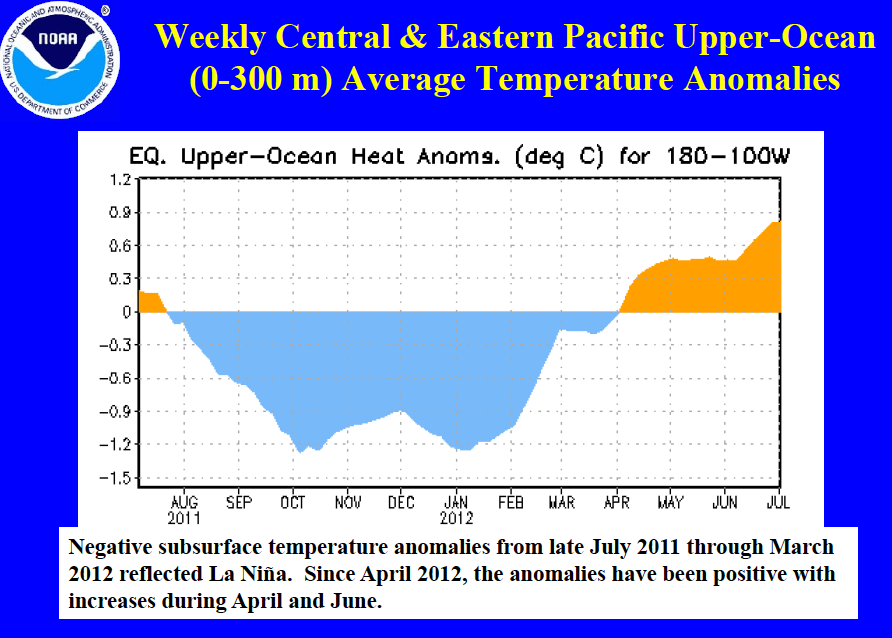
In their July 9 weekly posting, NOAA’s Climate PredictionCenter says”  chances increase for El Nino beginning July-September”  in their latest update. The oceanic heat content anomalies (average temperatures in the upper 300 meters of the ocean) increased during June,” says the report.

The diagnosis shows a heating up waters near the equator that is strengthening as summer goes on leading to more scientific models forecasting a stronger El Nino pattern developing and now virtually none forecasting a return of a La Nina pattern that we have been in.

El Nino, the periodic warming of central and eastern tropical Pacific waters, occurs on average every two to five years and typically lasts about 12 months.

A stronger and earlier El Nino could lead to a wetter winter this coming season in California that would ease concerns over another drought year.

Visalia Biz Briefs… Hospital Gobbles Up Taco Bell

In-Shape Fitness Moving To Sequoia Mall. In Shape Fitness with three locations in Visalia will relocate its Caldwell near Demaree location to the former 24Hr Fitness space behind the Sequoia Mall. A spokesperson in the Caldwell Ave location office confirmed the move planned for late 2012. The gym would gain substantial space in the larger 20,000sf building that has been vacant for years.

Kaweah Delta Remodeling Mineral King Hospital Wing. Kaweah Delta hospital CEO Lindsay Mann says the district is remodeling all 6 floors of the 1969 built Mineral King wing top to bottom with interiors comparable to the new Acequia wing.”We are going floor by floor with two floors completed already and a third underway.” The complete retrofit costs about $300,000 per floor, he says.
Hospital Gobbles Up Taco Bell. Kaweah Delta has completed the purchase of the former Taco Bell property on Acequia,in the path of future expansion of the hospital. “Near term (3 years), we plan to lease it out to one of several bidders who want to use it for food services” says Mann with both national and local vendors interested. Mann also confirmed continued discussion with the property owner at Checkers Hamburgers but no sale yet. “If we buy it, Checkers would stay for some time.”
Retail On Hwy 99? The hottest debate in town will continue later this month with a new meeting of the General Plan Update Committee(GPUC) set up to advise the city on the update for the General Plan.Two big issues loom. Should the city designate more new retail commercial land including a shopping center on Highway 99?  On July 26,the committee will get a first look at a Sacramento consultants’ report on demand for retail space.  A divided Visalia City Council, who earlier this year tabled the plan,will by not take up the contentious issue until late August, if then. The second issue is new population projections that appear to show much less demographic growth in our future,less than the GPUC committee has assumed. At issue – how much new housing and new subdivision land do we need?

Mid-Year Construction Strong In SLO County

A glance at construction activity in San Luis Obispo county through mid-year show an improved picture compared to last year.

Through mid-year 2012 some 111 single family permits were issued in SLO County compared to 108 over the same period a year ago. What pops out at you however, is the valuation of all residential permits – $55.4 million in mid 2011 compared to $142.7 million during the same period this year.

What’s the change?

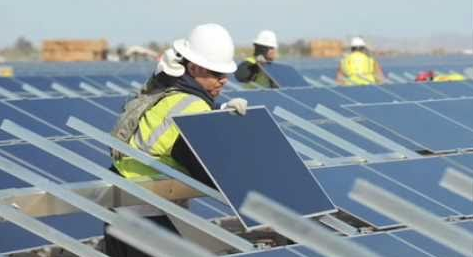
By far the big change is a surge in alternative energy( think solar) permits for residential units valued at $83.2 million so far this year compared to to just $3.6 million for the same period in 2011.Residential remodels are up in 2012 as well from $9.6 million to $12 million.

Commercial Busy

How about on the commercial front? Much bigger numbers here with all commercial permits valued at $115 million so far this year compared to $23.7 million during the first half of 2011.A large chunk of that comes form the big solar projects in the Carrizo Plain valued at $65 million so far this year compared to $163,000 in 2011 in the commercial alternative energy category.

However, there is also a big jump in oil exploration related industrial activity this year mostly at one address in Price Canyon near Pismo where they are literally sinking millions of dollars.The value of ag projects (think wineries) in the county also jumped so far this year form $6.3 million to $11 million. Retail permits jumped  from $3.2 million to $7.4 million while the construction category of offices increased to $8.7 million from only $280,000 in the first half of 2011.

Clearly, commercial building activity is back in SLO this year. All data from Construction Monitor.

SLO Biz News

Tourism remained strong in the City of San Luis Obispo in April with hotel bed tax (TOT) revenues for April 2012 up by 5.5% from the same month last year and up by 7.9% year to date. About 100 new hotel rooms have just come online or are under construction.

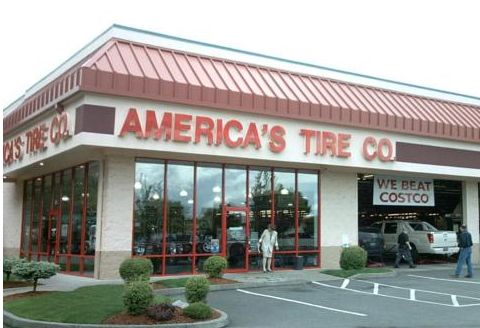
SLO will get an America’s Tire store off Los Osos Valley Rd on Calle Joaquin,the freeway frontage road near the reborn Mercedes Benz dealership. The independent tire company has locations across much of California and plans a new store in Paso Robles too.The tire  retailer promises to”beat Costco” on prices. The business activity near the freeway interchange includes the new Hampton Inn hotel open now for about a month with the car dealer and new tire store helping city tax revenues but also helping to clog traffic at the interchange

Downtown, the Morro St/Higuera area is getting new life with construction of the 17 room Granada Hotel to open this December in the 1920s era Granada building with new retailers joining current tenants this fall.

California Bullet Train Vote In State Senate

A critical vote in the California Senate set for this week (likely Thursday) will be a make-or-break moment for the ambitious plan to build high speed rail in the state starting late this year.
The federal government has demanded the state legislature approve or deny issuance of $2.7 billion in state voter approved bonds to match $3.3 billion in federal monies to begin the construction of the 130 mile stretch through the Central Valley.
Critics have called this segment the “train to nowhere” because this Madera to Bakersfield section would not immediately connect high speed rail to the state’s big metro areas although Amtrak would fill the gap for a while. Farmers in the Central Valley have led the charge to kill the project and have already sued over the plan they say will hurt their production.
Both Madera and Merced Farm Bureaus have sued in Sacramento court. Backed by the ag industry,Kings County has also sued to stop the project as well. Greg Gatzka, Kings County’s community development director has estimated that the train would cut across more than 7,000 acres of farm fields, resulting in an $8.2 million annual loss in production value.
But led by Governor Jerry Brown the bullet train has enough support in the state Assembly but is on the edge in the Senate where 21 votes are needed to move forward. All GOP member oppose the project requiring most Democrats to support it. Speculation has the measure short by a few votes.
“Suck it in,” Brown told an audience gathered last month for the 75th anniversary of the Golden Gate Bridge. Referring to the revised high speed rail plan he emphasized “We got to build, we got to do it right.”

The revised rail plan lowers the total cost from an anticipated $100 billion to $68 billion and in an effort to get support from major population centers offers to do $800 million in rail connections in the larger metro areas simultaneously as the first Central Valley segment is built.

“Our new plan makes major investments in regional and local rail systems throughout the state,” said CHSRA chair Dan Richard in a statement. “In the BART system, MUNI, Caltrain, Transbay Terminal, the ACE train in the Central Valley, Metrolink in Los Angeles, the Los Angeles to San Diego Amtrak service…all of these things will benefit from the investment program that high-speed rail is leading.”

“We’re talking about more than $10 Billion of investments not only in high-speed rail, but also in regional and local rail systems,” continued Richard.

Supporters says the electrified project would help clean the air and must be viewed vs simply building more freeways and airports to move people in the state in coming decades.

Critics call the project wasteful and say the state cannot afford it right now adding the money would be better used for education.

Brown remains the prime mover here walking in the footsteps of his father, the former governor, who built the state water project mired in controversy and doubt at the time – winning approval in the legislature by one vote in 1959. It remains the largest state financed project ever built and today serves about 25 million people.

If the vote in the Senate fails, the Obama administration has said it will reallocate the $3.3 billion to other states who want the money.

Senate Committee Votes To Move Water Bond

Legislation that would move the $11.14 billion water bond to the November 2014 ballot passed in the Senate Natural Resources and Water Committee today on a bipartisan 6-0 vote.
AB 1422 by Assembly Member Henry Perea (D-Fresno) would move the bond measure from this November’s ballot to the 2014 ballot without making any changes to the content of the bond. The measure is supported by a broad coalition including ACWA and its member agencies, conservation groups, business, labor and agriculture.

“this is not the year for the water bond to be on the ballot”
Cindy Tuck, Association of California Water Agencies deputy executive director, government relations, led testimony in support of the bill.
“From ACWA’s perspective, we were hoping that this would be the year for the bond to pass, but for multiple reasons, including the economy, this is not the year for the water bond to be on the ballot,” Tuck said. “This bill simply delays it to the November 2014 ballot, which is the right course.”
The committee approved the bill after rejecting a motion by Sen. Lois Wolk (D-Davis) to repeal the bond measure entirely.
AB 1422 is expected to go the Senate floor for a vote this week. If passed there, it would return to the Assembly for concurrence.
The Legislature originally approved legislation placing the bond measure on the November 2010 ballot as part of the comprehensive water package enacted in 2009. Lawmakers voted in August 2010 to move the bond to the November 2012 ballot, citing the state’s economic woes and the need to focus on budget issues this year.

Submitted by Lisa Lien-Mager,ACWA  report

Tractor Dealer Takes Tulare Dodge Showroom

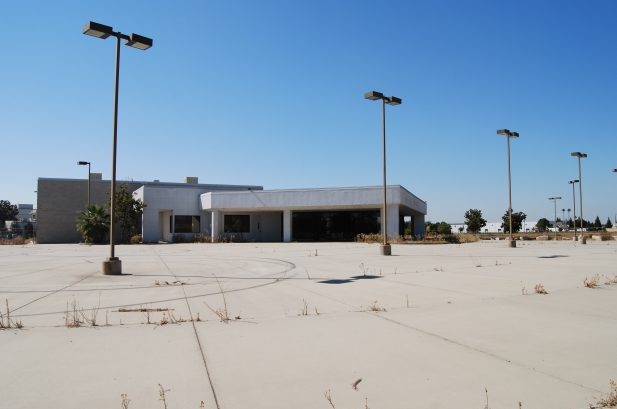
vacant car dealership along Hwy 99

The vacant Dodge dealership on Blackstone in Tulare has a new tenant- tractor dealer Krone North America.

“Today is our first day” says local parts manager Mike Moore. Moore explains Tulare will be the south Valley headquarters for Krone with a second store in Turlock to cover the north Valley.”We will take over sales of our farm equipment from Pioneer” who will longer sell the product at their Valley locations. This will be a company store.

Krone has leased the 15,000sf  commercial building on 5.6 acres at 1950 S. Blackstone which enjoys freeway 99 frontage.The Dodge dealer closed here in 2010 and the former  property owner let it go to the bank.But it was recently purchased for a reported $1.25 million in March and now leased.

Lampe Dodge Chrysler Jeep of Tulare decided to  acquire the Surroz Dodge Chrysler Jeep dealership in Visalia and moved operations from Tulare to Visalia in 2010.

The German farm equipment manufacturer  first opened their offices in the United States in 1973.  They were very successful in selling their large machinery because it was well suited for the large farms of the Mid-West. Over the years, Krone North America has grown to be the largest single export market for Krone machinery and has grown to over 350 dealerships.  There are now offices in Memphis, TN and Reno, NV and warehouses in Memphis, Reno, Ontario, and Quebec.

The Krone company makes a full line of harvesters, choppers and hay making equipment.

June Was Cooler For Much Of California


Scorching Temps Fuel Drought in Midwest

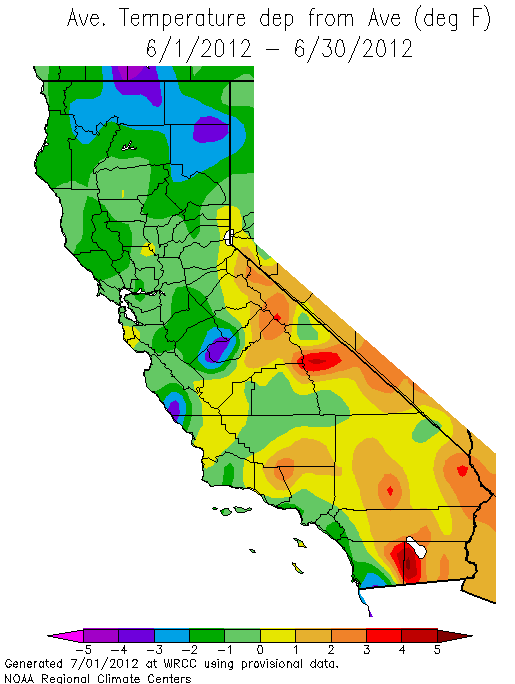
Much of central and northern California experienced slightly cooler than normal temperatures in June according of to Climate Tracker(see map). The map indicates a bit cooler June in SLO County and Tulare County with slightly higher than average temps in parts of southern California but not the South Coast.

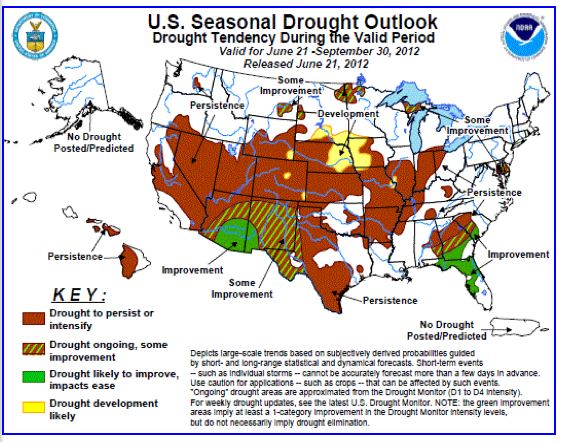
June was much tougher in the Midwest and in Colorado experiencing days of record high temperatures and growing drought conditions affecting the Midwest grain growing region and current corn crop(see map).In the Midwest with both triple digit temps and conditions that are hot and dry there are fears of a falling corn crop harvest.Of course Colorado and elsewhere in the West are seeing terrible wildfires.


NWS Hanford says both Bakersfield and Fresno experienced just above a normal June for high temps and slightly cooler low temps.On June 17th Fresno recorded 109 degrees besting the record of 107 set in 1917.

NWS calls for about average temps this week the Central Valley but not breaking 100.But Coast weather forecaster John Lindsey says  current cooler weather could change. Watch for high pressure to build in the West next week,affecting the state and offering a taste of what the rest of the US is suffering.

Blending Organic & Conventional Farming

RUTHSBURG, Maryland — In rural Maryland, an hour-and-a-half drive from Washington, Bill Mason is tilling his fields to plant organic maize and soybeans.

About two-thirds of his 340 hectares are organic, but not all of them. And that bothers some people.

“There are some die-hard organics,” Mason says. “They think every organic farmer should not be planting any conventional.”

As both an organic and conventional farmer, Mason sits right in the middle of a long-running debate over how best to feed the world.

Organic vs. conventional

Demand for organic food – produced without artificial fertilizers or pesticides – is growing worldwide, but some experts doubt a growing world population can be fed if farmers don’t use these chemicals.

An April study in Nature found organic farming is 25 percent less productive on average than conventional farming.  But while some say we cannot feed the world with organic agriculture, others say we cannot feed the world without it.

Critics of conventional farming say excessive fertilizer use pollutes waterways, kills fish and contributes to climate change. Customers will pay a premium for food produced without pesticides and fertilizers.

But Mason says his organic crops typically do not produce as much. “We are finding that our corn yields are about three-quarters of the yield of a normal conventional crop.”

Ecological consequences

With those lower yields, feeding the world organically could require clearing more land for farms.

“We’ll have to get more land into cultivation to do it that way,” says Columbia University soil scientist Pedro Sanchez, “with horrible, negative ecological consequences.”

Experts say deforestation to make way for agriculture is already contributing to climate change and a loss of biodiversity.

And farmers will have nine billion mouths to feed by mid-century, which puts agriculture in a difficult position.

“Right now, we can’t feed 9 billion people with the ways we’re farming, whether it’s conventional or organic,” says U.S. Department of Agriculture researcher Michel Cavigelli.

Working both sides

So experts are working on both sides of the equation. Cavigelli is working to improve the productivity of organic farms using natural fertilizers like chicken manure. The trouble, he says, is that often it does not provide enough nutrients.

“We need to improve all systems. And so, what’s the best way to do that, both to feed the world’s population but also to do it in the way where we’re not destroying the planet?”

Many of the African farmers Pedro Sanchez has worked with have used synthetic fertilizers to triple their yields, making a huge difference in their food security.

Blended solution

“But as a scientist, I don’t like that as the solution,” Sanchez says. “And I will not preach it as the solution. I want to integrate that with organically-produced nutrients.”

Organic nutrients, such as fertilizing cover crops, have worked out for Bill Mason and his conventional-farming neighbors are taking notice.

“I think there’s ideas that we’re using that are carrying over to the conventional world,” Mason says.

So the ideal solution to feeding a world of nine billion might not necessarily be a choice between organic or conventional farming, but rather a blend of both.